Monday, July 7, 2025

A Book of the Seasons: Savory-leaved aster (Aster Linariifolius/Diplopappus)


South of the lighthouse
the savory-leaved aster
on a steep hillside.
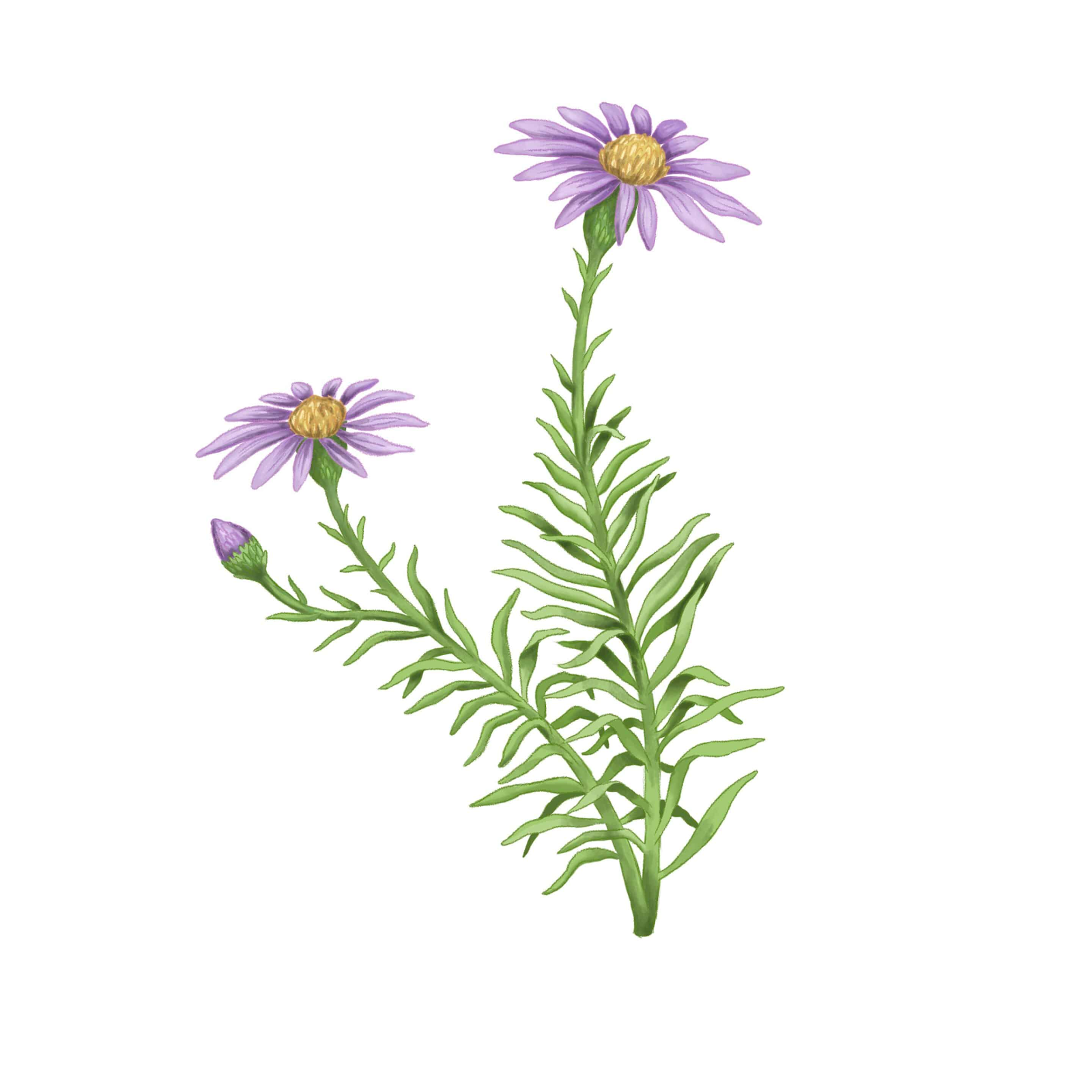
That common rigid
narrow-leaved faint-purplish
aster in dry woods.

July 7.  Just south of the lighthouse near the bank on a steep hillside, the savory-leaved aster (Diplopappus linariifolius) and mouse-ear (Gnaphalium plantaginifolium) form a dense sward, being short and thick; the aster not yet out. July 7, 1855

July 26. Diplopappus linariifolius. Aster dumosus. July 26, 1854

July 28Aster linariifolius.  July 28, 1853

July 29. That common rigid narrow-leaved faint-purplish aster in dry woods by shrub oak path, Aster linariifolius of Bigelow, but it is not savory leaved. I do not find it in Gray. July 29, 1852

August 3. Savory-leaved aster.  August 3, 1858 

August 4. The yellow Bethlehem-star still, and the yellow gerardia, and a bluish "savory-leaved aster."  August 4, 1851 

August 16. Diplopappus linariifolius, apparently several days. August 16, 1856 

August 22The savory-leaved aster (Diplopappus linariifolius) out; how long?  August 22, 1859

August 30. As I went along from the Minott house to the Bidens Brook, I was quite bewildered by the beauty and variety of the asters, now in their prime there – A. lævis (large and handsome with various leaves), patens, linariifolius, etc. Why so many asters and goldenrods now? The sun has shone on the earth, and the goldenrod is his fruit. The stars, too, have shone on it, and the asters are their fruit. August 30, 1853

September 1. D. linariifolius, hardly noticed. September 1, 1856

September 2. Diplopappus linariifolius, quite common . . . D. linariifolius, pale bluish-purple (Some, outdoors, have a lilac or violet tint.) . . . The D. linariifolius is interesting, with its commonly single flower, with very broad rays turned backward, or handsomer still when it has fifteen or twenty heads crowded together. September 2, 1853

September 7. At Brattleboro, Vt . . .The Solidago Canadensis, and the smooth three-ribbed one, and nemoralis, etc., the helianthus (apparently decapetalus), and Aster or Diplopappus linariifolius, Vitis cordifolius (?) (now beginning to be ripe) are quite common along the bank. September 7, 1856

September 10. Diplopappus linariifolius and Aster undulatus apparently now in prime. September 10, 1854

September 18.  – By boat to Conantum, barberrying. Diplopappus linariifolius in prime. September 18, 1856

September 24. D. linariifolius, in prime, abundant.  September 24, 1856

September 29. Diplopappus linariifolius, Aster undulatus, and a few small ones September 29,1853 

September 30. We then took the path to Clematis Brook on the north of Mt. Misery, where we found a few of the Diplopappus linariifolius (savory-leaved aster) and one or two small white (bushy ?) asters, also A. undulatus September 30, 1852

October 8. D. linariifolius, apparently nearly done  October 8, 1856

October 10.  Pulling up some Diplopappus linariifolius, now done, I find many bright-purple shoots, a half to three quarters of an inch long, freshly put forth underground and ready to turn upward and form new plants in the spring. October 10, 1858 

October 12. With man all is uncertainty. He does not confidently look forward to another spring. But examine the root of the  savory-leaved aster, and you will find the new shoots, fair purple shoots, which are to curve upward and bear the next year’s flowers, already grown half an inch or more in earth. Nature is confident. October 12, 1858

October 16.  Many Diplopappus linariifolius are gone to seed, and yellowish globes. Such are the stages in the year's decline. The flowers are at the mercy of the frosts.   October 16, 1859

October 20. Many plants which in the summer show a few red or scarlet leaves at length are all yellow only . . . Diplopappus linariifolius in shade yellow, in sun purple last of October  October 20, 1858

October 22.  I see the small narrow leaves of the Aster dumosus and also the yet finer ones of the Diplopappus linariifolius in wood-paths, turned a clear light-yellow.  October 22, 1858

October 23. One Diplopappus linariifolius in bloom, its leaves all yellow or red. This and A. undulatus the asters seen to-day.  October 23, 1853

October 25. Aster longifolius in low ground (a few). This and the Diplopappus linariifolius, and, above all,  A. undulatus, the only flowers of the kind seen this week. (Afterwards A. puniceus, Tradescanti, and one lævis!)  October 25, 1853

November 7The Diplopappus linariifolius, which was yellow in the shade, in open and sunny places is purple.  November 7, 1858

December 26.  After snow, rain, and hail yesterday and last night, we have this morning quite a glaze, there being at last an inch or two of crusted snow on the ground, the most we have had . . .Weeds in the fields and the wood-paths are the most interesting. Here are asters, savory-leaved, whose flat imbricated calyxes, three quarters of an inch over, are surmounted and inclosed in a perfectly transparent icebutton, like a glass knob, through which you see the reflections of the brown calyx. December 26, 1855 
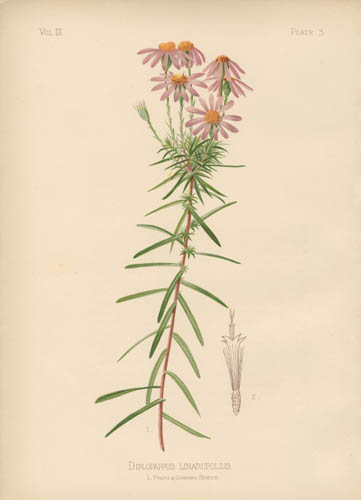
Aster linariifolius and  Diplopappus linariifolius — Savory-leaved aster, Flax-leaved stiff-aster , Stiff-leafed Aster, Sandpaper Aster or Sandpaper Starwort (now classified as  Lonactis linariifolia

See also

 A Book of the Seasons, by Henry Thoreau
"A book, each page written in its own season,
out-of-doors, in its own locality."
~edited, assembled and rewritten by zphx ©  2009-2025

https://tinyurl.com/hdt-savoryaster


Friday, July 4, 2025

A Book of the Seasons: July Days


A year is made up of 
a certain series and number 
of sensations and thoughts 
which have their language in nature.

Henry Thoreau, June 6, 1857


A late breeze rises
wood thrush and tanager sing
sparkling the river.  

Fine silvery light
reflecting from the blades of
miles of waving grass.

Wintergreen blossom,
pretty little chandelier,
adorns forest floor.

Waves of light and shade
over the breadth of the land
sweeping the landscape.

Shadows of pine stems
fall across the small wood path
red with pine-needles.

June grasses are past.
Now the grass turns to hay as
flowers turn to fruits.

Lilies surprise me.
Now the flowering season
has reached its height.

The moon reflected
from the rippled surface like
a stream of dollars.

Busy hummingbird
unmindful of the shower,
struck by a big drop.

Aboriginal
bream over its sandy nest
poised on waving fin.

Waving in the wind
this grass gives a purple sheen
over the meadow.

The upland plover
hovers on quivering wing –
 alights by steep dive.
July 12, 1855

Hayers rest at noon
and resume after sunset.
The Haymaker’s moon.

A fine misty rain
lies on reddish tops of grass
like morning cobwebs.

Thoughts driven inward –
clouds and trees reflected in 
the still, smooth water.


Dark-blue winding stripe,
green meadow, dark-green forest,
blue dark and white sky.

Flying shore to shore,
yellowish devil's-needles
cross their Atlantic.


I first hear the locust sing 
so dry and piercing
by the side of the pine woods 
in the heat of the day.  
July 18, 1851

With midsummer heats
asters and goldenrods come –
children of the sun.

The more smothering
furnace-like heats are begun –
and the locust days.

We see the first star 
and know not if we might have
seen it earlier.

Sun warm on my back
I turn round and shade my face -
a beautiful life.

Our fairest days born
in a fog, the season of
morning fogs arrived.

Along the river
the memory of roses -
late rose now in prime.

In low Flint's Pond Path 
goldenrod makes a thicket 
higher than my head. 

Fog rises highest
over the river and ponds
which are thus revealed.
July 25, 1852

Sun's disk round and red
seen well above horizon
through thick atmosphere.

The voice of the loon 
in the middle of the night
far over the lake.

Goldenrod, asters
grasshoppers now abundant -
cooler breezy air.

Kindred red color
of skies in the evening and
fruits in the harvest.

Grand sound of the rain
on the leaves of the forest
distant, approaching.

Thoughts of autumn and
the memory of past years
occupy my mind.
July 31, 1856


<<<<< Last Month                                                                                           Next Month  >>>>>                                                                                                                                                                                


A Book of the Seasons, by Henry Thoreau, July Days

 A Book of the Seasons, by Henry Thoreau
"A book, each page written in its own season,
out-of-doors, in its own locality."
~edited, assembled and rewritten by zphx ©  2009-2025

Saturday, June 28, 2025

A Book of the Seasons: Dogsbane and Indian hemp


 For the first time I perceive this spring
that the year is a circle.  
I would make a chart of our life,
know why just this circle of creatures completes the world.
Henry Thoreau, April 18, 1852

It would be pleasant to write
the history of one hillside for one year --
Blackberries, roses, and dogsbane
now in bloom here.

 Some years ago I sought for Indian hemp (Apocynum cannabinum) . . . 
though I did not believe that it grew here;
 and in a day or two my eyes fell on it, aye, 
in three different places, and different varieties of it. 

 I find the dog's-bane (Apocynum androsoemifolium) bark
 not the nearly so strong as that of the A. cannabinum. 

January 19. Gather some dry water milkweed stems to compare with the materials of the bird’s nest of the 18th . . .I strip off some bark about one sixteenth of an inch wide and six inches long and, separating ten or twelve fibres from the epidermis, roll it in my fingers, making a thread about the ordinary size. This I can not break by direct pulling, and no man could. I doubt if a thread of flax or hemp of the same size could be made so strong. What an admirable material for the Indian’s fish-line. January 19,   1856

February 9. At Cambridge to-day. Dr. Harris thinks the Indians had no real hemp but their apocynum, and, he thinks, a kind of nettle, and an asclepias, etc. February 9, 1853

April 24. See a dog’s-bane with two pods open and partially curved backward on each side, but a third not yet open. This soon opens and scatters its down and seeds in my chamber. The outside is a dull reddish or mahogany-color, but the inside is a singularly polished very pale brown. The inner bark of this makes a strong twine like that of the milkweed, but there is not so much of it.  April 24, 1856

June 15Dogsbane is just ready to open. June 15, 1852

June 21.  It would be pleasant to write the history of one hillside for one year. First and last you have the colors of the rainbow and more, and the various fragrances, which it has not. Blackberries, roses, and dogsbane also are now in bloom here. June 21, 1852

June 27. The dogsbane is one of the more interesting little flowers. June 27, 1853

July 2.[DunstableWalked to and along the river and bathed in it. There were harebells, well out, and much Apocynum cannabinum, well out, apparently like ours, prevailing along the steep sandy and stony shore. A marked peculiarity in this species is that the upper branches rise above the flowers. Also get the A. androsoemifolium, quite downy beneath. July 2, 1858

July 3.  Dogsbane and Jersey tea are among the prevailing flowers now. July 3, 1853 

July 11Apocynum cannabinum, with its small white flowers and narrow sepals half as long as whole corolla, apparently two or three days. July 11, 1857

August 1. [The East Branch] I saw at the end of this carry small Apocynum cannabinum on the rocks on the rocks, also more of the spurred gentian. August 1, 1857

August 4. Cannabis sativaAugust 4, 1854

August 5. At the Assabet stone bridge, apparently freshly in flower, — though it may have been out nearly as long as the androscemifolium, — apparently the Apocynum cannabinum var. hypericifolium (?). The tallest is four feet high. The flowers very small (hardly more than an eighth of an inch in diameter), the segments of the corolla not revolute but nearly erect. There are twenty to thirty flowers at end of a branch. The divisions of the calyx are longer than in the common, long ovate. Yet it differs from Gray's hypericifolium in having flowers rose-streaked within like the common, the cymes not shorter than the leaves, and the tube of the corolla rather longer than the divisions of the calyx. The leaves are hardly more downy or heart-shaped below than the common. Hypericifolium is a separate species in Pursh and some others. And the branches are less ascending than the common, making an angle of about 62° with the stem (the four lower), while three of the lower of a common one make an angle of 44°. August 5, 1856

August 7.  Hemp, perhaps a week. August 7, 1856

August 9Again I am surprised to see the Apocynum cannabinum close to the rock at the Island, several plants, apparently not more than ten days out; say July 25th, including the ones I saw before. The flowers of this are white, with divisions of the corolla erect or nearly so, corolla not one eighth of an inch wide, calyx-segments lanceolate, pointed, as long as the tube of the corolla. I now notice that all the branches are about equally upright, and hence the upper ones are much more upright than the upper ones of the A. andro-soemifolium. The plant is inclined to be taller and narrower than that, perhaps because it grows by water. The leaves are more oblong or lanceolate and pointed, the downiness and petioles about the same with that of the common; in this case, none heart-shaped. The one found the 5th was between this and the common, a rose-streaked one, in fact colored like the common; this, a white one with still longer calyx-segments and no heart-shaped leaves. This is rather smooth. Say, then, for that of the 5th and this, they are varieties of the A. cannabinum. August 9, 1858

August 11This side of Hubbard's Meadow Bridge . . . Cannabis sativa, apparently out. August 11, 1852

August 11Also the small rough sunflower (now abundant) and the common apocynum (also in bloom as well as going and gone to seed) are very common. August 11, 1858

August 13.  I stripped off a shred of Indian hemp bark and could not break it. It is as strong as anything of the kind I know. August 13, 1856

August 16Hemp (Cannabis sativa), said by Gray to have been introduced; not named by Bigelow. Is it not a native? August 16, 1851

August 16I find the dog's-bane (Apocynum androsoemifolium) bark not the nearly so strong as that of the A. cannabinum. August 16, 1856

August 16[Minott] used to love to hear the goldfinches sing on the hemp which grew near his gate. August 16, 1858 

August 21The prevailing conspicuous flowers at present are:
  •  The early goldenrods,
  •  tansy,
  •  the life-everlastings,
  •  flea bane (though not for its flower) . . .
  •  prunella, and dog’s-bane (getting stale), etc., etc. 
August 21, 1851

August 21. The leaves of the dogsbane are turning yellow.  August 21, 1852

August 28.  Hemp still in blossom.  August 28, 1852

September 2. Some years ago I sought for Indian hemp (Apocynum cannabinum) hereabouts in vain, and concluded that it did not grow here. A month or two ago I read again, as many times before, that its blossoms were very small, scarcely a third as large as those of the common species, and for some unaccountable reason this distinction kept recurring to me, and I regarded the size of the flowers I saw, though I did not believe that it grew here; and in a day or two my eyes fell on it, aye, in three different places, and different varieties of it. September 2, 1856

September 4Indian hemp out of bloom.  September 4, 1856

September 26.. Dogsbane leaves a clear yellow. September 26, 1852


A Book of the Seasons, by Henry Thoreau
"A book, each page written in its own season,
out-of-doors, in its own locality.”
~edited, assembled and rewritten by zphx © 2009-2025

***:

notes:


All parts of the Apocynum cannabinum plant are poisonous and can cause cardiac arrest if ingested.  
Apocynum means "poisonous to dogs". The cannabinum in the scientific name and the common names Hemp Dogbane and Indian Hemp refer to its similarity to cannabis as a fiber plant.  ~ Wikipedia

Apocynum cannabinum — hemp dogbane ~ GoBotany (petals white, green-white, or yellow, not recurving at the tips, the entire flower 3-6 mm long and upright)

Apocynum androsaemifolium
— spreading dogbane ~ GoBotany (petals pink or white with pink stripes, recurving at the tips, the entire flower 6-10 mm long and nodding))

Popular Posts Last 30 Days.

The week ahead in Henry’s journal

The week ahead in Henry’s journal
A journal, a book that shall contain a record of all your joy.
"A stone fruit. Each one yields me a thought." ~ H. D. Thoreau, March 28, 1859


I sit on this rock
wrestling with the melody
that possesses me.