9 A. M. —To Flint’s Pond via Walden, by railroad and the crust.
I hear the hens cackle as not before for many months. Are they not now beginning to lay?
The catkins of the willow by the causeway and of the aspens appear to have pushed out a little further than a month ago. I see the down of half a dozen on that willow by the causeway; on the aspens pretty generally.
As I go through the cut it is still, warm, and more or less sunny, springlike (about 40° + ), and the sand and reddish subsoil is bare for about a rod in width on the railroad.
I hear several times the fine-drawn phe-be note of the chickadee, which I heard only once during the winter. Singular that I should hear this on the first spring day.
I see a pitch pine seed with its wing, far out on Walden.
Going down the hill to Goose Pond, I slump now and then. Those dense, dry beds of leaves are gathered especially about the leafy tops of young oaks, which are bent over and held down by the snow. They lie up particularly light and crisp.
The birch stubs stand around Goose Pond, killed by the water a year or two ago, five or six feet high and thickly, as if they were an irregular stake fence a rod out.
Going up the hill again, I slump in up to my middle.
At Flint’s I find half a dozen fishing. The pond cracks a very little while I am there, say at half past ten. I think I never saw the ice so thick. It measures just two feet thick in shallow water, twenty rods from shore.
It is remarkable that though I have not been able to find any open place in the river almost all winter, except under the further stone bridge and at Loring’s Brook, — this winter so remarkable for ice and snow— Coombs should (as he says) have killed two sheldrakes at the falls by the factory, a place which I had forgotten, some four or six weeks ago. Singular that this hardy bird should have found this small opening, which I had forgotten, while the ice everywhere else was from one to two feet thick, and the snow sixteen inches on a level.
If there is a crack amid the rocks of some waterfall, this bright diver is sure to know it. Ask the sheldrake whether the rivers are completely sealed up.
H. D. Thoreau, Journal, March 1, 1856
To Flint’s Pond via Walden, by railroad and the crust. See note to February 28, 1856, The month of the crusted snow ("I go on the crust which we have had since the 13th . . . across the fields and brooks.") Compare March 1, 2026:
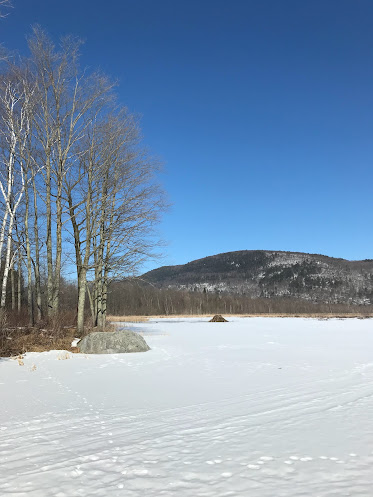
March 1, 2019
The catkins of the willow by the causeway and of the aspens appear to have pushed out a little further than a month ago. I see the down of half a dozen on that willow by the causeway; on the aspens pretty generally.
As I go through the cut it is still, warm, and more or less sunny, springlike (about 40° + ), and the sand and reddish subsoil is bare for about a rod in width on the railroad.
I hear several times the fine-drawn phe-be note of the chickadee, which I heard only once during the winter. Singular that I should hear this on the first spring day.
I see a pitch pine seed with its wing, far out on Walden.
Going down the hill to Goose Pond, I slump now and then. Those dense, dry beds of leaves are gathered especially about the leafy tops of young oaks, which are bent over and held down by the snow. They lie up particularly light and crisp.
The birch stubs stand around Goose Pond, killed by the water a year or two ago, five or six feet high and thickly, as if they were an irregular stake fence a rod out.
Going up the hill again, I slump in up to my middle.
At Flint’s I find half a dozen fishing. The pond cracks a very little while I am there, say at half past ten. I think I never saw the ice so thick. It measures just two feet thick in shallow water, twenty rods from shore.
It is remarkable that though I have not been able to find any open place in the river almost all winter, except under the further stone bridge and at Loring’s Brook, — this winter so remarkable for ice and snow— Coombs should (as he says) have killed two sheldrakes at the falls by the factory, a place which I had forgotten, some four or six weeks ago. Singular that this hardy bird should have found this small opening, which I had forgotten, while the ice everywhere else was from one to two feet thick, and the snow sixteen inches on a level.
If there is a crack amid the rocks of some waterfall, this bright diver is sure to know it. Ask the sheldrake whether the rivers are completely sealed up.
H. D. Thoreau, Journal, March 1, 1856
Now on the backtrack
deep in yesterday’s postholes –
no crust this winter.
~ Zphx,
I hear the hens cackle as not before for many months. Are they not now beginning to lay? See January 26, 1858 ("The hens cackle and scratch, all this winter. Eggs must be plenty.")
Ask the sheldrake whether the rivers are completely sealed up. See February 28, 1856 (" Coombs s . . says that he killed a sheldrake a month or six weeks ago in a small open place beneath the falls at the factory. This shows what hardy birds they are ."); February 12, 1856 ("Forty three days of uninterrupted cold weather.”); February 27, 1856 ("The river has been frozen solidly for seven weeks"); March 20, 1856 ("The river has just begun to open at Hubbard’s Bend. It has been closed there since January 7th, i. e. ten weeks and a half."); See also A Book of the Seasons, by Henry Thoreau, Ice-Out and A Book of the Seasons, by Henry Thoreau, The Sheldrake (Merganser, Goosander)
I see a pitch pine seed with its wing, far out on Walden. See February 1, 1856 ("I see a pitch pine seed, blown thirty rods from J. Hosmer’s little grove.") and A Book of the Seasons, by Henry Thoreau, the Pitch Pine.
The catkins of the willow by the causeway. See A Book of Seasons, by Henry Thoreau. Willows on the Causeway and A Book of the Seasons, by Henry Thoreau, Signs of the Spring: Alder and Willow Catkins Expanding
I hear several times the fine-drawn phe-be note of the chickadee . . . Singular that I should hear this on the first spring day. See March 1, 1854 ("Here is our first spring morning according to the almanac . . . I hear the phoebe or spring note of the chickadee, and the scream of the jay is perfectly repeated by the echo from a neighboring wood.") See also A Book of the Seasons, by Henry Thoreau, Signs of the Spring, the spring note of the chickadee and A Book of the Seasons, by Henry Thoreau, the Chickadee in Winter
The catkins of the willow by the causeway. See A Book of Seasons, by Henry Thoreau. Willows on the Causeway and A Book of the Seasons, by Henry Thoreau, Signs of the Spring: Alder and Willow Catkins Expanding
Ask the sheldrake whether the rivers are completely sealed up. See February 28, 1856 (" Coombs s . . says that he killed a sheldrake a month or six weeks ago in a small open place beneath the falls at the factory. This shows what hardy birds they are ."); February 12, 1856 ("Forty three days of uninterrupted cold weather.”); February 27, 1856 ("The river has been frozen solidly for seven weeks"); March 20, 1856 ("The river has just begun to open at Hubbard’s Bend. It has been closed there since January 7th, i. e. ten weeks and a half."); See also A Book of the Seasons, by Henry Thoreau, Ice-Out and A Book of the Seasons, by Henry Thoreau, The Sheldrake (Merganser, Goosander)
March 1. See A Book of the Seasons, by Henry Thoreau, March 1
Several phe-be
notes of the chickadee – this
on the first spring day.
A Book of the Seasons, by Henry Thoreau, The phe-be note of the chickadee
A Book of the Seasons, by Henry Thoreau
"A book, each page written in its own season,
out-of-doors, in its own locality."
~edited, assembled and rewritten by zphx © 2009-2026
https://tinyurl.com/hdt-560301


No comments:
Post a Comment