Chelidonium.
Rubus triflorus abundantly out at the Saw Mill Brook; how long?
A robin’s nest without mud, on a young white oak in woods, with three eggs.
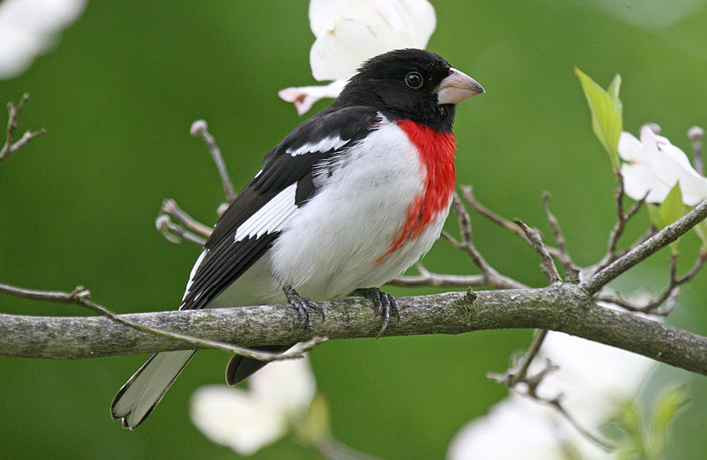
Saw two splendid rose-breasted grosbeaks with females in the young wood in Emerson’s lot. What strong colored fellows, black, white, and fiery rose-red breasts! Strong-natured, too, with their stout bills. A clear, sweet singer, like a tanager but hoarse somewhat, and not shy.
The redstarts are inquisitive and hop near.
 |
| Solomon’s seal May 21, 2016 |
At the trough near Turnpike, near Hosmer’s Spring, the (perhaps) Stellaria borealis of the 15th. I am still in doubt whether it is a stellaria or cerastium. This is quite smooth, four to five inches high, spreading and forking, with a single flower each fork, on a long peduncle; square-stemmed, oblong—lanceolate leaves, slightly ciliate and connate: ten stamens, five long, five short. Aspect of a smooth cerastium, but this has four to seven styles, oftenest perhaps five, all apetalous, except one petal shorter than the calyx; leaves one-nerved, sepals three-nerved! The bare and small plants are reddish stemmed. Can it be Stellaria longipes?
The buck-bean in Everett’s Pool abundantly out, say four or five days. It is earlier than at B. Stow’s.
Myosotis laxa by Turnpike, near Hosmer Spring, may have been out several days; two or three at least.
H. D. Thoreau, Journal, May 21, 1856
Rubus triflorus abundantly out at the Saw Mill Brook; how long? See May 18, 1857 ("The Rubus triflorus is well out there on the hummocks."); May 28, 1855 (" Rubus triflorus at Miles Swamp will apparently open to-morrow."); June 30, 1854 ("Rubus triflorus berries, some time, — the earliest fruit of a rubus. The berries are very scarce, light red, semitransparent, showing the seed") See also A Book of the Seasons, by Henry Thoreau, the Raspberry
A robin’s nest without mud, on a young white oak in woods, with three eggs. See May 21, 1852 ("Also a robin's nest and eggs in the crotch of a maple.");See also May 6. 1855 (''A robin’s nest with two eggs, betrayed by peeping."); May 13, 1853 ("A robin's nest, with young, on the causeway"); May 19, 1854 ("The robin's nest and eggs are the earliest I see.") and A Book of the Seasons, by Henry Thoreau, Robins in Spring
Two splendid rose-breasted grosbeaks. See May 18, 1856 ("A large bird on a tree top, a sort of flaxen olive. Made me think of a female rose-breasted grosbeak"); May 24, 185 5("Hear a rose-breasted grosbeak. At first think it a tanager, but soon I perceive its more clear and instrumental . . . Black all above except white on wing, with a triangular red mark on breast but, as I saw, all white beneath this. Female quite different, yellowish olivaceous above"); May 25, 1854 ("The rose-breasted grosbeak, a handsome bird with a loud and very rich song, in character between that of a robin and a red-eye. It sings steadily like a robin. Rose breast, white beneath, black head and above, white on shoulder and wings ") See also A Book of the Seasons, by Henry Thoreau, the Rose-breasted Grosbeak
The redstarts are inquisitive and hop near. See May 10, 1853 ("Is it the redstart? I now see one of these. The first I have distinguished . . . As I sit, it inquisitively hops nearer and nearer."); May 26, 1855 ("I lay on my back again in Conant's thick wood. Saw a redstart over my head there; black with a sort of brick red on sides [of] breast, spot on wing and under root of tail. Note heard once next day, at Kalmia Swamp, somewhat like aveet aveet aveet aveet.") See also A Book of the Seasons, by Henry Thoreau, The American Redstart
The Polygonatum pubescens there, in shade, almost out; perhaps elsewhere already . See May 12, 1855 ("One flower of the Polygonatum pubescent open there [under Lee’s Cliff]; probably may shed pollen to-morrow.”); May 20, 1858 ("The Polygonatum pubescens, not quite."); May 22, 1856 ("Polygonatum pubescens at rock."); May 25, 1852 ("Polygonatum pubescens ready to bloom."); See also A Book of the Seasons, by Henry Thoreau, Solomon's Seal
The (perhaps) Stellaria borealis of the 15th. I am still in doubt whether it is a stellaria or cerastium. See May 15, 1856 ("I find what may be the Stellaria borealis [boreal starwort/stitchwort](if it is not the longifolia [long-leaved stitchwort], but it is not in cymes like that; only a single flower to each axil, now at least);); May 23, 1856 ("The stellaria at Heywood Spring must be the same with that near the E. Hosmer Spring, though the former has commonly fewer styles and rather slenderer leaves. It appears to be the S. borealis, though the leaves are narrowly lanceolate; has three to seven styles; a few petals (cleft almost to the bottom) or none; pods, some larger than the calyx and apparently ten-ribbed; petals, now about the length of the sepals."); June 8, 1856 ("Stellaria longrfolia opposite Barbarea Shore not yet out. It is obviously different from what I call S. borealis."); See also June 6, 1854 ("The Stellaria longifolia has been out, apparently, a day or two."); May 19, 1858 ("Stellaria borealis well out, apparently several days."); June 6, 1859 ("Stellaria longifolia, at Well Meadow Head, how long?"); May 29, 1860 ("Saw, in a shaded swamp beyond, the Stellaria borealis, still out, — large, broadish leaves.")
The buck-bean in Everett’s Pool abundantly out. See May 11, 1853 ("The buck-bean is budded, but hard to find now."); May 17, 1853 ("The buck-bean is out, apparently to-day, the singularly fuzzy- looking blossom. How inconspicuous its leaves now!"); May 19, 1858 ("Looking with my glass into the Gourgas pond-hole, I see three or four buck-bean blossoms."); May 24, 1855 ("Buck-bean just fairly begun, though probably first the 18th; a handsome flower.")
Myosotis laxa . . . may have been out several days See June 12, 1852 ("The mouse-ear forget me-not (Myosotis laxa) . . .is one of the most interesting minute flowers. It is the more beautiful for being small and unpretending, for even flowers must be modest..") See also See also A Book of the Seasons, by Henry Thoreau, the Mouse-ear forget-me-not
May 21. See A Book of the Seasons, by Henry Thoreau, May 21
Strong colored fellows
black, white, and fiery red -
rose-breasted grosbeaks.
A Book of the Seasons, by Henry Thoreau, Two splendid rose-breasted grosbeaks
A Book of the Seasons, by Henry Thoreau
"A book, each page written in its own season,out-of-doors, in its own locality.”
~edited, assembled and rewritten by zphx © 2009-2026
https://tinyurl.com/hdt-560521


No comments:
Post a Comment