Showing posts with label june 4. Show all posts

Friday, June 4, 2021

Few men do not love better to give advice than to give assistance.


June 4. 


To-day, June 4th, I have been tending a burning in the woods. 

Ray was there. It is a pleasant fact that you will know no man long, however low in the social scale, however poor, miserable, intemperate, and worthless he may appear to be, a mere burden to society, but you will find at last that there is something which he understands and can do better than any other. I was pleased to hear that one man had sent Ray as the one who had had the most experience in setting fires of any man in Lincoln.

***

There are few men who do not love better to give advice than to give assistance.

***

The fire stopped within a few inches of a partridge's nest to-day, June 4th, whom we took off in our hands and found thirteen creamy-colored eggs.

H. D. Thoreau, Journal, June 4, 1850

Thursday, June 4, 2020

These evergreen wilderness names.


Saturday.

The date of the introduction of the Rhododendron maximum into Concord is worth preserving, May 16th, ’53. They were small plants, one to four feet high, some with large flower-buds, twenty-five cents apiece; and I noticed next day one or more in every front yard on each side of the street, and the inhabitants out watering them. Said to be the most splendid native flower in Massachusetts; in a swamp in Medfield. I hear to-day that one in town has blossomed.

George Minott says he saw many lightning-bugs a warm evening the forepart of this week, after the rains. Probably it was the 29th.

P. M. – To Hubbard’s Close Swamp.

The vetch just out by Turnpike, — dark violet purple.

Horse-radish fully out (some time).

The great ferns are already two or three feet high in Hubbard’s shady swamp.

The clintonia is abundant there along by the foot of the hill, and in its prime. Look there for its berries. Commonly four leaves there, with an obtuse point, — the lady’s-slipper leaf not so rich, dark green and smooth, having several channels.

June 4, 2020

The bullfrog now begins to be heard at night regularly; has taken the place of the hylodes.

Looked over the oldest town records at the clerk’s office this evening, the old book containing grants of land. Am surprised to find such names as “Walden Pond” and “Fair Haven” as early as 1653, and apparently 1652; also, under the first date at least, “Second Division,” the rivers as North and South Rivers (no Assabet at that date), “Swamp bridge,” apparently on back road, “Goose Pond,” “Mr. Flints Pond,” “Nutt Meadow,” “Willow Swamp,” “Spruce Swamp,” etc., etc. “Dongy,” “Dung Hole,” or what-not, appears to be between Walden and Fair Haven.

Is Rocky Hill Mr. Emerson’s or the Cliffs? Where are South Brook, Frog Ponds, etc., etc., etc.? 

It is pleasing to read these evergreen wilderness names, i. e. of particular swamps and woods, then applied to now perchance cleared fields and meadows said to be redeemed. The Second Division appears to have been a very large tract between the two rivers.

H. D. Thoreau, Journal, June 4, 1853

Hubbard's shady swamp. Thoreau’s first reference to this swamp (Clintonia Swamp, Clintonia Maple Swamp, E. Hubbard’s Clintonia Swamp, E. Hubbard’s Swamp, Hubbard’s Close Swamp) – a large swamp just to the northeast of Hubbard Close. ~ Ray Angelo, Thoreau's Place Names, Clintonia Swamp

The clintonia is abundant there along by the foot of the hill, and in its prime. See June 2, 1853 ("Clintonia borealis, a day or two. This is perhaps the most interesting and neatest of what I may call the liliaceous (?) plants we have. Its beauty at present consists chiefly in its commonly three very handsome, rich, clear dark-green leaves . . . arching over from a centre at the ground, sometimes very symmetrically disposed in a triangular fashion; and from their midst rises the scape [ a ] foot high, with one or more umbels of“green bell - shaped flowers,” yellowish-green, nodding or bent downward"); June 10, 1855 ("Clintonia, apparently four or five days (not out at Hubbard’s Close the 4th).")

The bullfrog now begins to be heard at night regularly; has taken the place of the hylodes.
See May 10, 1858 ("At length, near Ball's Hill, I hear the first regular bullfrog's trump. . . . This sound, heard low and far off over meadows when the warmer hours have come, grandly inaugurates the summer. "); June 13, 1851 ("The different frogs mark the seasons pretty well,- the peeping hyla, the dreaming frog, and the bullfrog."); June 15, 1860 ("The bullfrogs now commonly trump at night, and the mosquitoes are now really troublesome. For some time I have not heard toads by day, and the hylodes appear to have done. . . . A new season begun");See also June 16, 1860 ("It appears to me that these phenomena occur simultaneously, say June 12th . . .")

Tuesday, June 4, 2019

Alternate leaf dogwood.

June 4. 

P. M. — To Flint's Pond. 

Cornus alternifolia well out, apparently three or four days. 

Yellow-eyed grass, how long? 


Canada Bluegrass

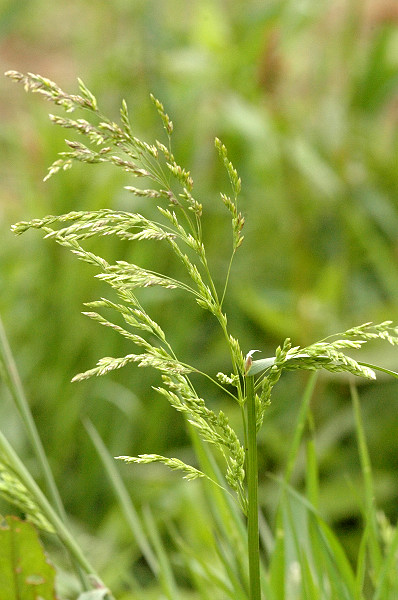
Poa compressa not quite out.

H. D. Thoreau, Journal, June 4, 1859

Cornus alternifolia well out. See June 10, 1856 ("Cornus alternifolia a day or two, up railroad; maybe longer elsewhere.")

Poa compressa .  The Canada bluegrass or flattened meadow-grass, is a perennial flattened meadow grass, similar to common meadow-grass,  native to Europe  found nearly worldwide as an introduced species. ~ Wikipedia . Specimen in Thoreau herbarium collected on June 14, 1859 at the railroad  causeway. Two other specimens collected at Britton’s Shanty and Great Road on June 2 and 4, 1859, which are in neighboring Lincoln, Massachusetts . The only Journal reference with a specific Concord locale is on June 23, 1860, the railroad at Walden Pond, likely the same locale as his June 14, 1859 collection. ~ Vascular Flora of Concord, Massachusetts. See June 23, 1860 ("Poa compressa may fairly begin on the railroad at Walden").

Monday, June 4, 2018

The railroad runs very straight for long distances here through a primitive forest.

June 4 

Friday. 

At 6 A. M. we began to descend. 

Near the upper edge of the wood, I heard, as I had done in ascending, a very peculiar lively and interesting strain from some bird, which note was new to me. At the same time I caught sight of a bird with a very conspicuous deep-orange throat and otherwise dark, with some streaks along the head. This may have been the Blackburnian warbler, if it was not too large for that, and may have been the singer. 

We descended or continued along the base of the mountain southward, taking the road to the State Line Station and Winchendon, through the west part of Rindge. 

It is remarkable how, as you are leaving a mountain and looking back at it from time to time, it gradually gathers up its slopes and spurs to itself into a regular whole, and makes a new and total impression. The lofty beaked promontory which, when you were on the summit, appeared so far off and almost equal to it, seen now against the latter, scarcely deepens the tinge of bluish, misty gray on its side. 

The mountain has several spurs or ridges, bare and rocky, running from it, with a considerable depression between the central peak and them; i.e., they attain their greatest height half a mile or more from the central apex. There is such a spur, for instance, running off southward about a mile. When we looked back from four or five miles distant on the south, this, which had appeared like an independent summit, was almost totally lost to our view against the general misty gray of the side of the principal summit.

We should not have suspected its existence if we had not just come from it, and though the mountain ranges northeasterly and southwesterly, or not far from north and south, and is much the longest in that direction, it now presented a pretty regular pyramidal outline with a broad base, as if it were broadest east and west. 

That is, when you are on the mountain, the different peaks and ridges appear more independent; indeed, there is a bewildering variety of ridge and valley and peak, but when you have with drawn a few miles, you are surprised at the more or less pyramidal outline of the mountain and that the lower spurs and peaks are all subordinated to the central and principal one. 

The summit appears to rise and the surrounding peaks to subside, though some new prominences appear. Even at this short distance the mountain has lost most of its rough and jagged outline, considerable ravines are smoothed over, and large boulders which you must go a long way round make no impression on the eye, being swallowed up in the air. 

We had at first thought of returning to the railroad at Fitzwilliam, passing over Gap Mountain, which is in Troy and Fitzwilliam quite near Monadnock, but concluded to go to Winchendon, passing through the western part of Rindge to the State Line Station, the latter part of the road being roundabout. We crossed the line between Jaffrey and Rindge three or four miles from the mountain. 

Got a very good view of the mountain from a high hill over which the road ran in the western part of Rindge. 

But the most interesting part of this walk was the three miles along the railroad between State Line and Winchendon Station. It was the best timbered region we saw, though its trees are rapidly falling. The railroad runs very straight for long distances here through a primitive forest. 

To my surprise I heard the tea-lea of the myrtle-bird here, as in Maine, and suppose that it breeds in this primitive wood. There was no house near the railroad but at one point, and then a quarter of a mile off. The red elder was in full bloom and filled the air with its fragrance. 

I saw some of the handsomest white pines here that I ever saw, – even in Maine, — close by the railroad. One by which I stood was at least three and a half feet in diameter at two feet from the ground, and, like several others about it, rose perfectly straight without any kind of limb to the height of sixty feet at least. 

What struck me most in these trees, as I was passing by, was not merely their great size, for they appeared less than they were, but their perfect perpendicularity, roundness, and apparent smoothness, tapering very little, like artificial columns of a new style. Their trunks were so very round that for that reason they appeared smoother than they were, marked with interrupted bands of light-colored lichens. 

Their regular beauty made such an impression that I was forced to turn aside and contemplate them. They were so round and perpendicular that my eyes slid off, and they made such an impression of finish and even polish as if they had had an enamelled surface. Indeed they were less rough than I might have expected. 

Beneath them grew the Trillium pictum and clintonia, both in bloom. 

For last expedition to Monadnock, vide September, 1852. 

I find the Cornus florida out in my pitcher when I get home June 4th, though it was not out on Island May 31st, and it is well out on Island when I look June 6th. I will say, therefore, that it opened June 3d.

H. D. Thoreau, Journal, June 4, 1858

It is remarkable how, as you are leaving a mountain and looking back at it from time to time, it gradually gathers up its slopes and spurs to itself into a regular whole, and makes a new and total impression.  See May 23, 1841 ("When I have travelled a few miles I do not recognize the profile of the hills of my native village.")

Leaving a mountain
looking back makes a new and
total impression.

Sunday, June 4, 2017

It is time now to bring our philosophy out of doors.

June 4. 

P. M. — To Bare Hill. 

The early potentilla is now erect in the June grass. 

Salix tristis is going to seed, showing some cotton; also some S. rostrate. 

I am surprised to see some kind of fish dart away in Collier's veronica ditch, for it about dries up and has no outlet. 

I observed yesterday, the first time this year, the lint on the smooth surface of the Assabet at the Hemlocks, giving the water a stagnant look. It is an agreeable phenomenon to me, as connected with the season and suggesting warm weather. I suppose it to be the down from the new leaves which so rapidly become smooth. There may be a little pitch pine pollen with it now. The current is hardly enough to make a clear streak in it here and there. The stagnant-looking surface, where the water slowly circles round in that great eddy, has the appearance of having been dusted over. This lint now covers my clothes as I go through the sprout- lands, but it gets off remarkably before long. Each under side of a leaf you strike leaves the mark of its lint on your clothes, but it is clean dirt and soon wears off. 

One thing that chiefly distinguishes this season from three weeks ago is that fine serene undertone or earth-song as we go by sunny banks and hillsides, the creak of crickets, which affects our thoughts so favorably, imparting its own serenity. It is time now to bring our philosophy out of doors. Our thoughts pillow themselves unconsciously in the troughs of this serene, rippling sea of sound. Now first we begin to be peripatetics. No longer our ears come in contact with the bold echoing earth, but everywhere recline on the spring cushion of a cricket's chirp. These rills that ripple from every hillside become at length a universal sea of sound, nourishing our ears when we are most unconscious. 

In that first apple tree at Wyman's an apparent hairy woodpecker's nest (from the size of the bird), about ten feet from ground. The bird darts away with a shrill, loud chirping of alarm, incessantly repeated, long before I get there, and keeps it up as long as I stay in the neighborhood. The young keep up an in cessant fine, breathing peep which can be heard across the road and is much increased when they hear you approach the hole, they evidently expecting the old bird. 

I perceive no offensive odor. I saw the bird fly out of this hole, May 1st, and probably the eggs were laid about that time. Vide it next year. 

In the high pasture behind Jacob Baker's, soon after coming out of the wood, I scare up a bay-wing. She runs several rods close to the ground through the thin grass, and then lurks behind tussocks, etc. The nest has four eggs, dull pinkish-white with brown spots; nest low in ground, of stubble lined with white horse hair. 

Carya glabra [Carya glabra – pignut hickory], apparently a day at least. 

Oldenlandia on Bare Hill, along above wall opposite the oak, a rod or more off and westerly. Apparently several days at least, but it appears not to do well. It has a dry, tufted look, somewhat like young savory- leaved aster, on the bare rocky hill and in the clear spaces between the huckleberry bushes. Reminds me of a heath. Does not blossom so full as once I saw it. 

Arethusa. 

Crimson fungus (?) on black birch leaves, as if bespattered with blood.

H. D. Thoreau, Journal, June 4, 1857

The early potentilla is now erect in the June grass. See June 4, 1855 (“There are now many potentillas ascendant.”)

Each under side of a leaf you strike leaves the mark of its lint on your clothes, but it is clean dirt and soon wears off. See June 4, 1855 (“Lint comes off on to clothes from the tender leaves, but it is clean dirt and all gone when you get home. . .”); June 4, 1854 (“ The surface of the still water nowadays looking like dust at a little distance. Is it the down of the leaves blown off? . . .”)

That fine serene undertone or earth-song . . . imparting its own serenity. See June 4, 1854 (“These warm and dry days, which put spring far behind, the sound of the cricket at noon has a new value and significance, so serene and cool . . ..”) ;May 12, 1857 (“The spirit of its earth-song, of its serene and true philosophy, was breathed into me, and I saw the world as through a glass, as it lies eternally”);; May 22, 1854 (“The song suggests lateness, but only as we come to a knowledge of eternity after some acquaintance with time. . . . . Only in their saner moments do men hear the crickets. . . .A quire has begun which pauses not for any news, for it knows only the eternal.”); June 1, 1856 (“Was soothed and cheered by I knew not what at first, but soon detected the now more general creak of crickets”); June 13, 1851 ("I listen to the ancient, familiar, immortal, dear cricket sound under all others, and as these cease I become aware of the general earth-song.”)  June 17, 1852 (“The earth-song of the cricket! Before Christianity was, it is. Health! health! health! is the burden of its song. ”); July 14, 1851 (“It is a sound from within, not without.You cannot dispose of it by listening to it. In proportion as I am stilled I hear it. It reminds me that I am a denizen of the earth.”);

The [peep of the young] is much increased when they hear you approach the hole, they evidently expecting the old bird. I perceive no offensive odor. See June 10, 1856 ("They utter their squeaking hiss whenever I cover the hole with my hand, apparently taking it for the approach of the mother. A strong, rank fetid smell issues from the hole.?”)  

A bay-wing . . .  The nest has four eggs, dull pinkish-white with brown spots. . . .See May 18, 1855 ("At Clamshell a bay-wing sparrow’s nest, four eggs (young half hatched) -- some black-spotted, others not.”); May 27, 1856 ("Fringilla melodia’s nest in midst of swamp, with four eggs . . . with very dark blotches"); May 31, 1856 (“A ground-bird’s nest (melodia or graminea.), with six of those oblong narrow gray eggs speckled with much brown at end. . . .The bird would steal out through the grass when I came within a rod, and then, after running a rod or two, take to wing.”)

Oldenlandia on Bare Hill . . . See July 8, 1857 ("Edith Emerson shows me Oldenlandia purpurea var. longifolia, which she saw very abundantly in bloom on the Blue Hills . . .”)

Saturday, June 4, 2016

A Book of the Seasons: June 4. (leafy season; thin shade, the clear brightness of June, white clouds and blue sky, bird nests, dandelion seed, bullfrogs and crickets)


The year is but a succession of days,
and I see that I could assign some office to each day
which, summed up, would be the history of the year.
Henry Thoreau, August 24, 1852


Now is the time to
observe the leaves so perfect
in color and form. 

In the washing breeze
the undersides of leaves flash
new light on the year.

The dandelions
now gone to seed – downy spheres
seen amid the grass.

Black oak leaflets on 
the downy undersides now
show a crimson edge. 

Thin shade so open
that we see the shadow of
each fluttering leaf. 

June 4, 2021


These warm and dry days, which put spring far behind, the sound of the cricket at noon has a new value and significance, so serene and cool. It is the iced-cream of song. It is modulated shade.June 4, 1854

I notice to-day that most maple, birch, willow, alder, and elm leaves are fully expanded, but most oaks and hickories, ash trees, etc., are not quite. You may say that now, the leafy season has fairly commenced. June 4, 1860

The surface of the still water nowadays looking like dust at a little distance. Is it the down of the leaves blown off? June 4, 1854

Lint comes off on to clothes from the tender leaves, but it is clean dirt and all gone when you get home. June 4, 1855

Each under side of a leaf you strike leaves the mark of its lint on your clothes, but it is clean dirt and soon wears off. June 4, 1857

Great white-bosomed clouds, darker beneath, float through the cleared sky and are seen against the deliciously blue sky, such a sky as we have not had before. June 4, 1855

June 4, 2020

Now I observe the shadows of massive clouds still floating here and there in the peculiarly blue sky; which dark shadows on field and wood are the more remarkable by contrast with the light yellow-green foliage now, and when they rest on evergreens they are doubly dark, like dark rings about the eyes of June. June 4, 1855

In the washing breeze the lighter undersides [of leaves] begin to show, and a new light is flashed upon the year, lighting up and enlivening the landscape. June 4, 1854

Most trees now hold out many little twigs with two or three fully expanded leaves on it, between us and the sun, making already a grateful but thin shade, like a coarse sieve, so open that we see the fluttering of each leaf in its shadow. June 4,1860

Now is the time to observe the leaves
, so fair in color and so perfect in form. June 4, 1854

Now various forms of oak leaves in sprout-lands, wet-glossy, as if newly painted green and varnished, attract me. June 4, 1854

The crimson velvety leafets of the black oak, showing also a crimson edge on the downy undersides, are beautiful as a flower. June 4, 1855

I stand over a sprig of choke-cherry, with fair and perfect glossy green obovate and serrate leaves, in the woods this p.m., as if it were a rare flower. June 4, 1854

In a week or more the twigs will have so extended themselves, and the number of fully expanded leaves be so increased, that the trees will look heavy and dark with foliage and the shadow be dark and opaque, - a gelid shade. Hazy, and mountains concealed. June 4,1860

The clear brightness of June was well represented yesterday by the buttercups (Ranunculus bulbosus) along the roadside. June 4,1860

The golden alexanders is called Zizia aurea. June 4, 1852

The cistus is out. June 4, 1852

Lupines in prime. June 4, 1852

The Canada snapdragon, that little blue flower that lasts so long, grows with the lupines under Fair Haven. June 4, 1852

The early chickweed with the star-shaped flower is common in fields now. June 4, 1852

The Linnaea borealis has grown an inch. June 4, 1855

Wintergreen has grown two inches. June 4, 1855

Cornus alternifolia well out, apparently three or four days. June 4, 1859

The birds sing at dawn. What sounds to be awakened by! If only our sleep, our dreams, are such as to harmonize with the song, the warbling of the birds, ushering in the day! They appear comparatively silent an hour or two later. June 4, 1852

In the woods I hear the tanager and chewink and red-eye. It is fairly summer, and mosquitoes begin to sting in earnest. June 4, 1855

The catbird sings less now, while its mate is sitting, or maybe taking care of her young, and probably this is the case with robins and birds generally. June 4,1860

Thus it is after the first important rain at this season. The song of birds is more lively and seems to have a new character; a new season has commenced. June 4, 1855

I hear that the nest of that marsh hawk which we saw on the 29th (q. v.) has since been found with five eggs in it. So that bird (male), whose mate was killed on the 16th of May, has since got a new mate and five eggs laid. June 4,1860

Found, on a hummock in the open swamp, in the midst of bushes, at the foot of a pitch pine, a nest about ten inches over, made of dry sedge and moss. I think it must have been a duck’s nest. June 4, 1856

In the high pasture behind Jacob Baker's, soon after coming out of the wood, I scare up a bay-wing. She runs several rods close to the ground through the thin grass, and then lurks behind tussocks, etc. The nest has four eggs, dull pinkish-white with brown spots; nest low in ground, of stubble lined with white horse hair. June 4, 1857

In that first apple tree at Wyman's an apparent hairy woodpecker's nest (from the size of the bird), about ten feet from ground. The bird darts away with a shrill, loud chirping of alarm, incessantly repeated, long before I get there, and keeps it up as long as I stay in the neighborhood. The young keep up an in cessant fine, breathing peep which can be heard across the road and is much increased when they hear you approach the hole, they evidently expecting the old bird. June 4, 1857

I now notice froth on the pitch and white pines. June 4, 1854

The clintonia is abundant there along by the foot of the hill, and in its prime. Look there for its berries. Commonly four leaves there, with an obtuse point, — the lady’s-slipper leaf not so rich, dark green and smooth, having several channels. June 4, 1853

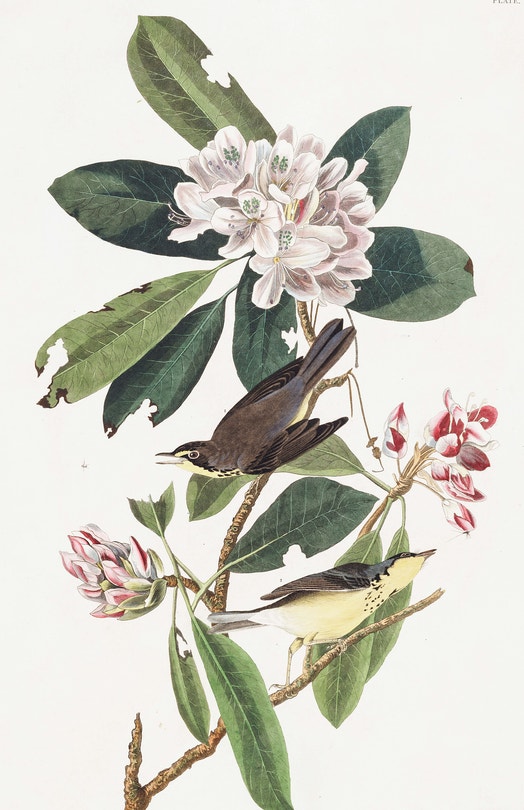
In the clintonia swamp I hear a smart, brisk, loud and clear whistling warble, quite novel and remarkable, something like te chit a wit, te chit a wit, tchit a wit, tche tche. . . . I think it must be the Canada warbler June 4, 1855

See a warbler much like the black and white creeper  . . . It did not occur to me that it was the same till I could not find any other like this in the book.  June 4, 1855

Redstarts still very common in the Trillium Woods, , , Note tche, tche, tche vit, etc. I see some dark on the breast. June 4, 1855

Now there is a . . . departure of the warblers, on the expansion of the leaves and advent of yet warmer weather. The black-poll warblers (Sylvia striata) appear to have left, and some other warblers, if not generally, with this first clear and bright and warm, peculiarly June weather, immediately after the May rain. June 4, 1860

The Lycopodium dendroideum now shows fresh green tips like the hemlock. June 4, 1855

The great ferns are already two or three feet high in Hubbard’s shady swamp. June 4, 1853

Greenish puffs on panicled andromedas. June 4, 1855

Salix tristis is going to seed, showing some cotton; also some S. rostrate. June 4, 1857

The dandelions are now almost all gone to seed, and children may now see if "your mother wants you." June 4, 1852

I see the dandelions now generally gone to seed amid the grass —their downy spheres. June 4, 1855

The early potentilla is now erect in the June grass. June 4, 1857

There are now many potentillas ascendant. June 4, 1855

White clover out probably some days, also red as long. June 4, 1855

Poa compressa not quite out. June 4, 1859

Yellow-eyed grass, how long? June 4, 1859

The vetch just out by Turnpike, — dark violet purple. June 4, 1853

The bullfrog now begins to be heard at night regularly; has taken the place of the hylodes. June 4, 1853

One thing that chiefly distinguishes this season from three weeks ago is . . .the creak of crickets, which affects our thoughts so favorably, imparting its own serenity. It is time now to bring our philosophy out of doors. June 4, 1857

*****

A Book of the Seasons,  by Henry Thoreau, Leaf-Out

A Book of the Seasons,  by Henry Thoreau. Summer


I think it must be the Canada Warbler? See May 28, 1860 ("Sylvia pardalina. It is a bright yellow beneath, with a broad black stripe along each side of the throat, becoming longish black marks crescent-wise on the fore part of the breast, leaving a distinct clear bright-yellow throat, and all the rest beneath bright-yellow; a distinct bright-yellow ring around eye; a dark bluish brown apparently all above; yellowish legs. Not shy; on the birches.")

The leafy season has fairly commenced.  See  May 27, 1853 ("A new season has commenced - summer - leafy June.”);  June 1, 1853 ("Summer begins now about a week past, with the expanded leaves, the shade and warm weather.")

Thin shade, like a coarse sieve, so open that we see the fluttering of each leaf in its shadow. See May 17, 1860 ("Standing in the meadow near the early aspen at the island, I hear the first fluttering of leaves, - a peculiar sound, at first unaccountable to me”); May 24, 1860 (“I notice the first shadows of hickories, - not dense and dark shade, but open-latticed, a network of sun and shadow on the north sides of the trees.”); May 29, 1857 ("For the first time this year I noticed the little shades produced by the foliage which had expanded in the rain."); June 2 ,1860 ("Not yet heavy masses of verdure, but a light openwork, the leaves being few and small yet, as regularly open as a sieve."); June 11, 1856 ("I observe and appreciate the shade, as it were the shadow of each particular leaf on the ground.")

And in the washing breeze the lighter under sides begin to show, and a new light is flashed upon the year, lighting up and enlivening the landscape. See June 11, 1860 (“I now first begin to notice the silvery under sides of the red maple and swamp white oak leaves, turned up by the wind”); June 14, 1852 (""There are various new reflections now of the light, viz. from the under sides of leaves (fresh and white) turned up by the wind.)

The surface of the still water nowadays looking like dust at a little distance. See May 27, 1859 "Now first I notice a linty dust on the surface of the dark river at the Hemlocks, evidently from the new and downy leaves. These expressions of the face of Nature are as constant and sure to recur as those of the eyes of maidens, from year to year, — sure to be repeated as long as time lasts. It is a new and peculiar season when this phenomenon is observed.")

The bullfrog now begins to be heard at night regularly; has taken the place of the hylodes. See May 10, 1858 ("At length, near Ball's Hill, I hear the first regular bullfrog's trump. . . . This sound, heard low and far off over meadows when the warmer hours have come, grandly inaugurates the summer.");  June 13, 1851 ("The different frogs mark the seasons pretty well,- the peeping hyla, the dreaming frog, and the bullfrog . . .The bullfrog belongs to summer.")

June 4, 2020

If you make the least correct 
observation of nature this year,
 you will have occasion to repeat it
 with illustrations the next, 
and the season and life itself is prolonged.


June 3   < <<<<<. June 4    >>>>>  June 5


A Book of the Seasons, by Henry Thoreau, June 4
A Book of the Seasons,  by Henry Thoreau
"A book, each page written in its own season,
out-of-doors, in its own locality.”
~edited, assembled and rewritten by zphx © 2009-2022



Near Loring pond four houses and families now gone.

June 4

Surveying for J. Hosmer. Very warm.

While running a line on the west edge of Loring’s Pond, south of the brook, found, on a hummock in the open swamp, in the midst of bushes, at the foot of a pitch pine, a nest about ten inches over, made of dry sedge and moss. 

I think it must have been a duck’s nest. This pond and its islets, half flooded and inaccessible, afford excellent places. 

Anthony Wright says that he used to get slippery elm bark from a place southwest of Wetherbee’s Mill, about ten rods south of the brook. 

He says there was once a house at head of hollow next beyond Clamshell. 

He pointed out the site of “Perch” Hosmer’s house in the small field south of road this side of Cozzens’s; all smooth now. Dr. Heywood worked over him a fortnight, while the perch was dissolving in his throat. He got little compassion generally, and the nickname “Perch” into the bargain. Think of going to sleep for fourteen nights with a perch, his fins set and his scales (!), dissolving in your throat! ! What dreams! What waking thoughts! 

Also showed where one Shaw, whom he could just remember, used to live, in the low field north of Dennis’s barn, and also another family in another house by him.

English hawthorn from Poplar Hill blossoms in house.

H. D. Thoreau, Journal, June 4, 1856

[A duck's nest] found, on a hummock in the open swamp, in the midst of bushes, at the foot of a pitch pine. See June 23, 1857 ("Found a black duck's nest Sunday before the last, i. e. the 14th, with perhaps a dozen eggs in it, a mere hollow on the top of a tussock, four or five feet within a clump of bushes forming an islet . . . in Hubbard's great meadow.") See also A Book of the Seasons,  by Henry Thoreau, the American Black Duck

Anthony Wright says that he used to get slippery elm bark from a place southwest of Wetherbee’s Mill. See June 6, 1853 ("A slippery elm (Ulmus fulva) on Lee's Cliff, – red elm . . . It has large, rough leaves and straggling branches – a rather small, much-spreading tree, with an appearance between the common elm and iron-wood."); July 17, 1857 (" To Lee's Cliff. The young leaves of the slippery elm are a yellowish green and large, and the branches recurved or drooping."); April 6, 1851 ("On examining the buds of the elm at Helianthus Bank, I find it is not the slippery elm, and therefore I know but one.")

“Perch” Hosmer. See November 18, 1851("Deacon Brown told me to-day of a tall, raw-boned fellow by the name of Hosmer who used to help draw the seine behind the Jones house, who once, when he had hauled it without getting a single shad, held up a little perch in sport above his face, to show what he had got. At that moment the perch wiggled and dropped right down his throat head foremost, and nearly suffocated him; and it was only after considerable time, during which the man suffered much, that he was extracted or forced down. He was in a worse predicament than a fish hawk would have been.”)

English hawthorn from Poplar Hill blossoms in house. See June 2, 1856 ("English hawthorn will open apparently in two days.")

A duck's nest found on
a hummock in the swamp, made
of dry sedge and moss.


A Book of the Seasons,  by Henry Thoreau
"A book, each page written in its own season,
out-of-doors, in its own locality."
 ~edited, assembled and rewritten by zphx ©  2009-2026

https://tinyurl.com/hdt-560604

Thursday, June 4, 2015

A new season has commenced.

June 4.

P. M. ——To Hubbard’s Close. 

Clears up in forenoon. White clover out probably some days, also red as long. 

It has just cleared off after this first rain of consequence for a long time, and now I observe the shadows of massive clouds still floating here and there in the peculiarly blue sky; which dark shadows on field and wood are the more remarkable by contrast with the light yellow-green foliage now, and when they rest on evergreens they are doubly dark, like dark rings about the eyes of June. 

June 4, 2020

Great white-bosomed clouds, darker beneath, float through the cleared sky and are seen against the deliciously blue sky, such a sky as we have not had before. 

Thus it is after the first important rain at this season. The song of birds is more lively and seems to have a new character; a new season has commenced. 

In the woods I hear the tanager and chewink and red-eye. It is fairly summer, and mosquitoes begin to sting in earnest. 


I see the dandelions now generally gone to seed amid the grass —their downy spheres.

There are now many potentillas ascendant, and the Erigeron bellidifolius is sixteen inches high and quite handsome, by the railroad this side of turn-off.

Redstarts still very common in the Trillium Woods (yesterday on Assabet also). Note tche, tche, tche vit, etc. I see some dark on the breast. 

The Lycopodium dendroideum now shows fresh green tips like the hemlock. Greenish puffs on panicled andromedas. 

Lint comes off on to clothes from the tender leaves, but it is clean dirt and all gone when you get home; and now the crimson velvety leafets of the black oak, showing also a crimson edge on the downy under sides, are beautiful as a flower, and the more salmon white oak. 

The Linnaea borealis has grown an inch. But are not the flowers winter-killed? I see dead and blackened flower-buds. Perhaps it should have opened before. 

Wintergreen has grown two inches. 

See a warbler much like the black and white creeper, but perched warbler-like on trees; streaked slate, white, and black, with a large white and black mark on wing, crown divided by a white line and then chestnut (?) or slate or dark, and then white above and below eye, breast and throat streaked downward with dark, rest beneath white. Can it be the common black and white creeper? Its note hardly reminds me of that. It is somewhat like pse pse pse pse, psa psa, weese weese weese, or longer. It did not occur to me that it was the same till I could not find any other like this in the book. 


Canada Warbler
(Sylvia pardalina /
Cardellina canadensis)
In the clintonia swamp I hear a smart, brisk, loud and clear whistling warble, quite novel and remarkable, something like te chit a wit, te chit a wit, tchit a wit, tche tche. It is all bright yellow or ochreous orange (?) below except vent, and a dark or black crescent on breast, with a white line about eye. Above it appears a nearly uniform dark blue slate, legs light, bill dark (?), tail long and forked. I think it must be the Canada warbler, seen in ’37, though that seems short for this.
 
It is quite different from the warbler of May 30. 


The recent high winds have turned the edges of young leaves by beating and killing them. 

H. D. Thoreau, Journal, June 4, 1855

The shadows of massive clouds still floating here and there in the peculiarly blue sky. See May 30, 1852 (A day for shadows, even of moving clouds, over fields in which the grass is beginning to wave."); June 3, 1858 ("The shadows of clouds flitting over the landscape are a never-failing source of amusement . . . to see one man’s farm in the shadow of a cloud, — which perhaps he thought covered all the Northern States, — while his neighbor’s farm was in sunshine."); June 9, 1856 ("There are some large cumuli with glowing downy cheeks floating about"); June 11, 1856 ("Great cumuli are slowly drifting in the intensely blue sky, with glowing white borders”). June 24, 1852 ("The drifting white downy clouds are objects of a large, diffusive interest. . . among the most glorious objects in nature. ");  July 1, 1854 ("The clouds are separate glowing masses or blocks floating in the sky, not threatening rain. I see from this hill their great shadows pass slowly here and there over the top of the green forest. ")

In the woods I hear the tanager and chewink and red-eye. See July 10, 1854 ("The singing birds at present are . . . Red-eye, tanager, wood thrush, chewink, veery, oven-bird, — all even at midday.")

I see the dandelions now generally gone to seed amid the grass —their downy spheres.
See June 4, 1852 (“The dandelions are now almost all gone to seed, and children may now see if "your mother wants you."”); 
 May 9, 1858 ("A dandelion perfectly gone to seed, a complete globe, a system in itself.") See also A Book of the Seasons,  by Henry Thoreau, The Dandelion in Spring

Redstarts still very common . . . Note tche, tche, tche vit, etc. See.May 26, 1855 ("Saw a redstart . . . black with a sort of brick red on sides [of] breast, spot on wing  and under root of tail. Note heard once next day, at Kalmia Swamp, somewhat like aveet aveet aveet aveet.");   June 6, 1855  ("On the Island I hear still the redstart—tsip tsip tsip tsip, tsit-i-yet, or sometimes tsip tsip tsip tsip, tse vet . . . It repeats this at regular intervals for a long time") See also  A Book of the Seasons, by Henry Thoreau,  The American Redstart

The Linnaea borealis has grown an inch. See 
   June 1, 1855 ("I find the Linnaea borealis growing near the end of the ridge in this lot toward the meadow, near a large white pine stump recently cut."); See also  A Book of the Seasons, by Henry Thoreau, Linnaea borealis (Twinflower)

Can it be the common black and white creeper? Its note hardly reminds me of that. It is somewhat like pse pse pse pse, psa psa, weese weese weese, or longer.  See April 28, 1856 (" I hear to-day frequently the seezer seezer seezer of the black and white creeper, or what I have referred to that”); May 11, 1856 ("The black and white creeper also is descending the oaks, etc., and uttering from time to time his seeser seeser seeser.”);  May 12, 1855 ("A very neat and active bird, exploring the limbs on all sides and looking three or four ways almost at once for insects. Now and then it raises its head a little, opens its bill, and, without closing it, utters its faint seeser seeser seeser.") See alsoA Book of the Seasons,   by Henry Thoreau, The Black and White Creeper

I think it must be the Canada Warbler? See May 23, 1860 ("I get sight for a moment of a large warbler on a young oak, – only the under side, which is a clear bright lemon-yellow, all beneath, with a sort of crescent of black spots on the breast. Is it not the Sylvia pardalina?"); May 28, 1860 ("Sylvia pardalina. It is a bright yellow beneath, with a broad black stripe along each side of the throat, becoming longish black marks crescent-wise on the fore part of the breast, leaving a distinct clear bright-yellow throat, and all the rest beneath bright-yellow; a distinct bright-yellow ring around eye; a dark bluish brown apparently all above; yellowish legs. Not shy; on the birches.")
 See also A Book of the Seasons, by Henry Thoreau, The Canada Warbler

The warbler of May 30. See May 30, 1855 ("A familiar warbler not recognized for some years")

The recent high winds. See May 30, 1855  ("A strong west wind "); June 1, 1855 ("A very windy day, the third, drowning the notes of birds."); June 2, 1855 ("Still windier than before.")

June 4.  See A Book of the Seasons, by Henry Thoreau, June 4

The dandelions
        now gone to seed – downy spheres
seen amid the grass.
A Book of the Seasons, by Henry Thoreau
"A book, each page written in its own season,
out-of-doors, in its own locality.”
~edited, assembled and rewritten by zphx © 2009-2025

Popular Posts Last 30 Days.

The week ahead in Henry’s journal

The week ahead in Henry’s journal
A journal, a book that shall contain a record of all your joy.
"A stone fruit. Each one yields me a thought." ~ H. D. Thoreau, March 28, 1859


I sit on this rock
wrestling with the melody
that possesses me.