Showing posts with label april 6. Show all posts

Wednesday, April 6, 2022

A Book of the Seasons: April 6 (April snow, honey-bees, first flowers, wind, high water, low water)


The year is but a succession of days,
and I see that I could assign some office to each day
which, summed up, would be the history of the year.
Henry Thoreau, August 24, 1852

 April 6.

White maples resound 
with the hum of honey-bees 
like a summer dream. 


April 6, 2012

Last night a snow-storm, and this morning we find the ground covered again six or eight inches deep -- and drifted pretty badly beside. 
The conductor in the car, which have been detained more than an hour, says it is a dry snow up-country. Here it is very damp. April 6, 1852

Last night a snow-storm
now six or eight inches deep --
and drifted badly.
April 6, 1852

April 6, 2023

All along under the south side of this hill on the edge of the meadow, the air resounds with the hum of honey-bees, attracted by the flower of the skunk cabbage.. . .I watched many when they entered and came out, and they all had little yellow pellets of pollen at their thighs. As the skunk-cabbage comes out before the willow, it is probable that the former is the first flower they visit. It is the more surprising, as the flower is for the most part invisible within the spathe. . . .One cowslip, though it shows the yellow, is not fairly out, but will be by to-morrow. How they improve their time! Not a moment of sunshine lost. One thing I may depend on: there has been no idling with the flowers. They advance as steadily as a clock. Nature loses not a moment, takes no vacation. April 6, 1853

Flowers advance as
steadily as a clock. Nature
loses no moment.
April 6, 1853

April 6, 2024

A still warmer day than yesterday — a warm, moist rain-smelling west wind. Up Assabet. I am surprised to find so much of the white maples already out . . . They resound with the hum of honey-bees, heard a dozen rods off, and you see thousands of them about the flowers against the sky . . . This susurrus carries me forward some months toward summer -- to those still warm summer noons when . . .the fishes retreat from the shallows into the cooler depths, and the cows stand up to their bellies in the river. The reminiscence comes over me like a summer's dream. April 6, 1854 

A still warmer day 
than yesterday — a warm, moist 
rain-smelling west wind. 
April 6, 1854


It clears up at 8 P. M. warm and pleasant, leaving flitting clouds and a little wind, and I go up the Assabet in my boat . . . The April waters, smooth and commonly high, before many flowers (none yet) or any leafing, while the landscape is still russet and frogs are just awakening, is peculiar. It began yesterday. A very few white maple stamens stand out already loosely enough to blow in the wind, and some alder catkins look almost ready to shed pollen. On the hillsides I smell the dried leaves and hear a few flies buzzing over them. The banks of the river are alive with song sparrows and tree sparrows. They now sing in advance of vegetation. . . they have come to enliven the bare twigs before the buds show any signs of starting. April 6, 1855

A few white maple
stamens stand out loose enough
to blow in the wind.
April 6, 1855


April 6, 2026

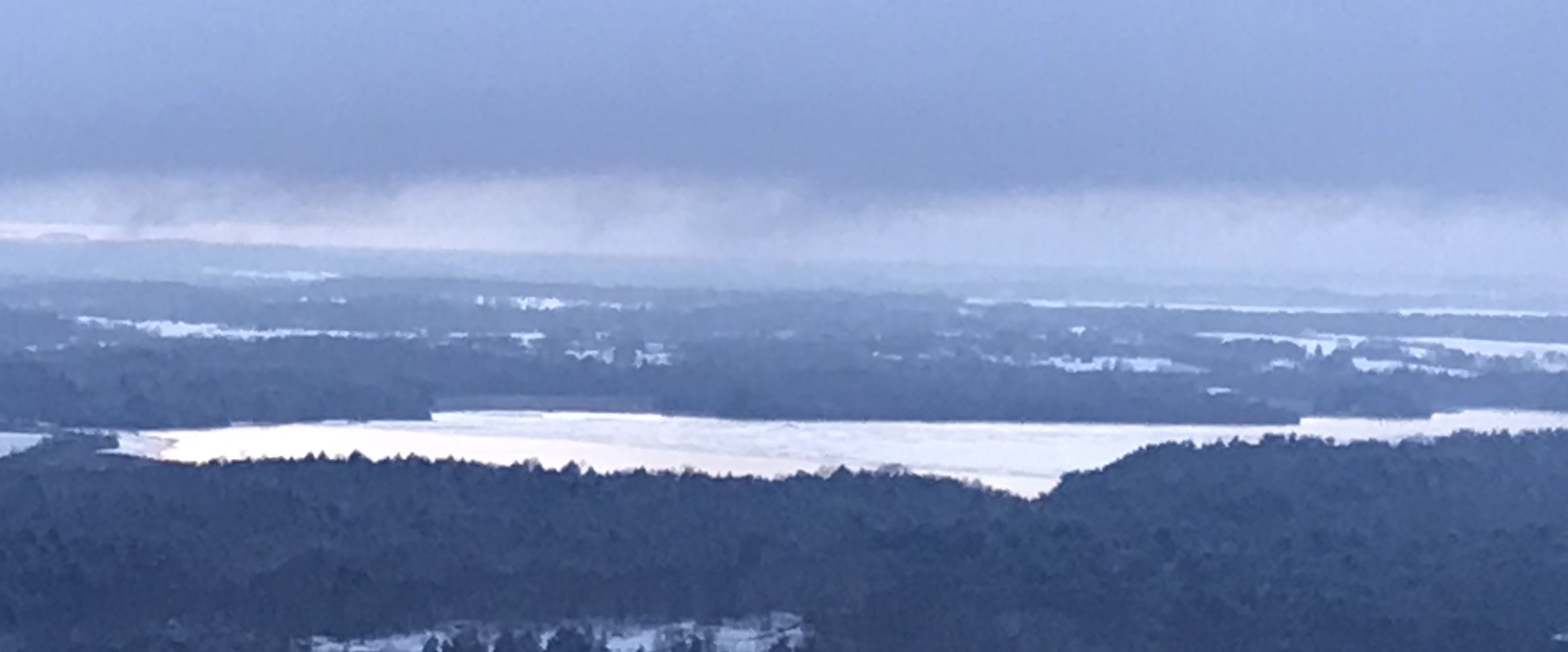
Just beyond Wood’s Bridge, I hear the pewee. With what confidence after the lapse of many months, I come out to this waterside, some warm and pleasant spring morning, and, listening, hear, from farther or nearer, through the still concave of the air, the note of the first pewee! If there is one within half a mile, it will be here, and I shall be sure to hear its simple notes from those trees, borne over the water. It is remarkable how large a mansion of the air you can explore with your ears in the still morning by the waterside . . . It is a still and warm, overcast afternoon, and I am come to look for ducks on the smooth reflecting water which has suddenly surrounded the village, — water half covered with ice or icy snow On the 2d it was a winter landscape, —a narrow river covered thick with ice for the most part, and only snow on the meadows. In three or four days the scene is changed to these vernal lakes, and the ground more than half bare. The reflecting water alternating with unrefiecting ice . . . I am not sure whether it was a white-headed eagle or a fish hawk. . . It rose and wheeled, flapping several times, till it got under way; then, with its rear to me, presenting the least surface, it moved off steadily in its orbit over the woods northwest, with the slightest possible undulation of its wings, — a noble planetary motion, like Saturn with its ring seen edgewise. . .Through my glass I saw the outlines of this sphere against the sky, trembling with life and power as it skimmed the topmost twigs of the wood toward some more solitary oak amid the meadows.  April 6, 1856

Over the water
the note of the first pewee --
this still concave air.
April 6, 1856


P. M. — To New Bedford Library. Mr. Ingraham, the librarian, says that he once saw frog-spawn in New Bedford the 4th of March. 
Take out Emmons’s Report on the insects injurious to vegetation in New York. 


See a plate of the Colias Philodice, or common sulphur-yellow butterfly, male and female of different tinge. April 6, 1857
April 6, 2018

It begins to grow cold about noon, after a week or more of generally warm and pleasant weather. They with whom I talk do not remember when the river was so low at this season. The top of the bathing-rock, above the island in the Main Branch, was more than a foot out of water on the 3d, and the river has been falling since . . . At Lee's Cliff I find no saxifrage in bloom above the rock, on account of the ground having been so exposed the past exceedingly mild winter, and no Ranunculus fascicularis anywhere there, but on a few small warm shelves under the rocks the saxifrage makes already a pretty white edging along the edge of the grass sod [?] on the rocks; has got up three or four inches, and may have been out four or five days. I also notice one columbine, which may bloom in a week if it is pleasant weather . . . I hear hylas in full blast 2.30 P. M. It is remarkable how much herbaceous and shrubby plants, some which are decidedly evergreen, have suffered the past very mild but open winter on account of the ground being bare. Accordingly the saxifrage and crowfoot are so backward, notwithstanding the warmth of the last ten days. Perhaps they want more moisture, too. The asplenium ferns of both species are very generally perfectly withered and shrivelled, and in exposed places on hills the checkerberry has not proved an evergreen, but is completely withered and a dead-leaf color. I do not remember when it has suffered so much. Such plants require to be covered with snow to protect them . . . The very earliest aspens, such as grow in warm exposures on the south sides of hills or woods, have begun to be effete. Others are not yet out . . . It rapidly grows cold and blustering.  April 6, 1858

It grows cold about
noon after a week or more
of pleasant weather.
April 6 1858

April 6, 2019

Another remarkably windy day; cold northwest wind and a little snow spitting from time to time, yet so little that even the traveller might not perceive it. For nineteen days, from the 19th of March to the 6th of April, both inclusive, we have had remarkably windy weather. For ten days of the nineteen the wind has been remarkably strong and violent, so that each of those days the wind was the subject of general remark. The first one of these ten days was the warmest, the wind being southwest, but the others, especially of late, were very cold, the wind being northwest, and for the most part icy cold. There have also been five days that would be called windy and only four which were moderate. The last seven, including to-day, have all been windy, five of them remarkably so; wind from northwest . . . A fish hawk sails down the river, from time to time almost stationary one hundred feet above the water, notwithstanding the very strong wind. April 6, 1859

A fish hawk sails down
the river one hundred feet 
above the water
April 6, 1859

I am struck by the fact that at this season all vegetable growth is confined to the warm days; during the cold ones it is stationary, or even killed. Vegetation thus comes forward rather by fits and starts than by a steady progress. Some flowers would blossom tomorrow if it were as warm as to-day, but cold weather intervening may detain them a week or more. The spring thus advances and recedes repeatedly, — its pendulum oscillates, — while it is carried steadily forward. Animal life is to its extent subject to a similar law. It is in warm and calm days that most birds arrive and reptiles and insects and men come forth.  April 6, 1860

Vegetation comes
not by a steady progress
but by fits and starts.
April 6, 1860

April 6, 2021

Am surprised to find the river fallen some nine inches notwithstanding the melted snow.  April 6, 1861
April 6, 2020
*****
A Book of the Seasons, by Henry Thoreau The Osprey (Fish Hawk)
A Book of the Seasons,  by Henry Thoreau, the Snipe.

*****
If you make the least correct 
observation of nature this year,
 you will have occasion to repeat it
 with illustrations the next, 
and the season and life itself is prolonged.

April 6, 2024


A Book of the Seasons, by Henry Thoreau
"A book, each page written in its own season,
out-of-doors, in its own locality.”
~edited, assembled and rewritten by zphx © 2009-2024

Flowers advance as steadily as a clock. Nature loses not a moment, takes no vacation.


April 6.


6 A. M. – To Cliffs.

April 6, 2021

The robin is the singer at present, such is its power and universality, being found both in garden and wood. Morning and evening it does not fail, perched on some elm or the like, and in rainy days it is one long morning or evening.

The song sparrow is still more universal but not so powerful.

The lark, too, is equally constant, morning and evening, but confined to certain localities, as is the blackbird to some extent.

The bluebird, with feebler but not less sweet warbling, helps fill the air, and the pheobe does her part.

The tree sparrow, F. hyemalis, and fox-colored sparrows make the meadow-sides or gardens where they are flitting vocal, the first with its canary-like twittering, the second with its lively ringing trills or jingle. The third is a very sweet and more powerful singer, which would be memorable if we heard him long enough.

The woodpecker's tapping, though not musical, suggests pleasant associations in the cool morning,-is inspiriting, enlivening.

I hear no hylas nor croakers in the morning. Is it too cool for them?

The gray branches of the oaks, which have lost still more of their leaves, seen against the pines when the sun is rising and falling on them, how rich and interesting! 

From Cliffs see on the still water under the hill, at the outlet of the pond, two ducks sailing, partly white.

Hear the faint, swelling, far-off beat of a partridge.

Saw probably female red-wings (?), grayish or dark ashy-brown, on an oak in the woods, with a male (?) whose red shoulder did not appear.

How many walks along the brooks I take in the spring! What shall I call them? Lesser riparial excursions? Prairial? rivular?

When I came out there was not a speck of mist in the sky, but the morning without a cloud is not the fairest.

Now, 8.30 A. M., it rains. Such is April.

A male willow, apparently same with that at H.'s Bridge, or No. 2, near end of second track on west. Another male by ring-post on east side, long cylindrical catkins, now dark with scales, which are generally more rounded than usual and reddish at base and not lanceolate, turning backwards in blossom and exposing their sides or breasts to the sun, from which side burst forth fifty or seventy-five long white stamens like rays, tipped with yellow anthers which at first were reddish above, spears to be embraced by invisible Arnold Winkelrieds; — reddish twigs and clear gray beneath.

These last colors, especially, distinguish it from Nos. 1 and 2. Also a female, four or five rods north of last, just coming into bloom, with very narrow tapering catkins, lengthening already, some to an inch and a half, ovaries conspicuously stalked; very downy twigs, more reddish and rough than last below.

If we consider the eagle as a large hawk, how he falls in our estimation! 

Our new citizen Sam Wheeler has a brave new weathercock all gilt on his new barn. This morning at sunrise it reflected the sun so brightly that I thought it was a house on fire in Acton, though I saw no smoke, but that might well be omitted.

The flower-buds of the red maple have very red inner scales, now being more and more exposed, which color the tree-tops a great distance off.


P. M.-To Second Division Brook.

Near Clamshell Hill, I scare up in succession four pairs of good-sized brown or grayish-brown ducks. They go off with a loud squeaking quack. Each pair is by itself. One pair on shore some rods from the water.  Is not the object of the quacking to give notice of danger to the rest who cannot see it? 


All along under the south side of this hill on the edge of the meadow, the air resounds with the hum of honey-bees, attracted by the flower of the skunk cabbage. I first heard the fine, peculiarly sharp hum of the honey-bee before I thought of them. Some hummed hollowly within the spathes, perchance to give notice to their fellows that plant was occupied, for they repeatedly looked in, and backed out on finding another.

It was surprising to see them, directed by their instincts to these localities, while the earth has still but a wintry aspect so far as vegetation is concerned, buzz around some obscure spathe close to the ground, well knowing what they were about, then alight and enter. As the cabbages were very numerous for thirty or forty rods, there must have been some hundreds of bees there at once, at least.

I watched many when they entered and came out, and they all had little yellow pellets of pollen at their thighs.

As the skunk-cabbage comes out before the willow, it is probable that the former is the first flower they visit. It is the more surprising, as the flower is for the most part invisible within the spathe.

Some of these spathes are now quite large and twisted up like cows ' horns, not curved over as usual. Commonly they make a pretty little crypt or shrine for the flower, like the overlapping door of a tent.

It must be bee-bread (?), then, they are after. Lucky that this flower does not flavor their honey.

I have noticed for a month or more the bare ground sprinkled here and there with several kinds of fungi, now conspicuous, — the starred kind, puffballs, etc. 

Now it is fair, and the sun shines, though it shines and rains with short intervals to-day.

I do not see so much greenness in the grass as I expected, though a considerable change. No doubt the rain exaggerates a little by showing all the greenness there is ! The thistle is now ready to wear the rain-drops.

I see, in J. P. Brown's field, by Nut Meadow Brook, where a hen has been devoured by a hawk probably. The feathers whiten the ground. They cannot carry a large fowl very far from the farmyard, and when driven off are frequently baited and caught in a trap by the remainder of their quarry.

The gooseberry has not yet started.

I cannot describe the lark's song.

I used these syllables in the morning to remember it by, -- heetar-su-e-00.

The willow in Miles's Swamp which resembles No. 2 not fairly in blossom yet.

Heard unusual notes from, I think, a chickadee in the swamp, elicited, probably, by the love season, -- che che vet, accent on last syllable, and vissa viss a viss, the last sharp and fine.

Yet the bird looked more slender than the common titmouse, with a longer tail, which jerked a little, but it seemed to be the same bird that sang phebe and he-phebe so sweetly. The woods rang with this.

Nuttall says it is the young that phebe in winter.

I noticed some aspens (tremuliformis) of good size there, which have no flowers! 

The first lightning I remember this year was in the rain last evening, quite bright; and the thunder followed very long after. A thunder-shower in Boston yesterday.

One cowslip, though it shows the yellow, is not fairly out, but will be by to-morrow. How they improve their time ! Not a moment of sunshine lost.

One thing I may depend on : there has been no idling with the flowers. They advance as steadily as a clock. Nature loses not a moment, takes no vacation.

These plants, now protected by the water, just peeping forth. I should not be surprised to find that they drew in their heads in a frosty night.

Returning by Harrington's, saw a pigeon woodpecker flash away, showing the rich golden under side of its glancing wings and the large whitish spot on its back, and presently I heard its familiar long-repeated loud note, almost familiar as that of a barn-door fowl, which it somewhat resembles.

The robins, too, now toward sunset, perched on the old apple trees in Tarbell's orchard, twirl forth their evening lays unweariedly.

Is that a willow, the low bush from the fireplace ravine which from the lichen oak, fifty or sixty rods distant, shows so red in the westering sun light? More red, I find, by far than close at hand.

To-night for the first time I hear the hylas in full blast.

Is that pretty little reddish-leaved star-shaped plant by the edge of water a different species of hypericum from the perforatum?

H. D. Thoreau, Journal, April 6, 1853

The robin is the singer at present, such is its power and universality, . . .The song sparrow is still more universal but not so powerful . . .and the pheobe does her part. See April 6, 1856 ("the note of the first pewee! If there is one within half a mile, it will be here, and I shall be sure to hear its simple notes from those trees, borne over the water") see also April 1, 1854 (" The robin now begins to sing sweet powerfully"); April 2, 1852 ("The air is full of the notes of birds, - song sparrows, red-wings, robins (singing a strain), bluebirds, - and I hear also a lark, - as if all the earth had burst forth into song."); April 9, 1855 ("At sunset after the rain, the robins and song sparrows fill the air along the river with their song.") and A Book of the Seasons, by Henry Thoreau, the Song Sparrow (Fringilla melodia); A Book of the Seasons, by Henry Thoreau, Robins in Spring
 
The air resounds with the hum of honey-bees, attracted by the flower of the skunk cabbage. See April 6, 1854 ("I am surprised to find so much of the white maples already out. The light-colored stamens show to some rods. They resound with the hum of honey-bees, ")See also   March 18, 1860 ("The first sunny and warmer day in March the honeybee leaves its home. . .There is but one flower in bloom in the town, and this insect knows where to find it. . . . it knows a spot a mile off under a warm bank-side where the skunk-cabbage is in bloom. No doubt this flower, too, has learned to expect its winged visitor knocking at its door in the spring. ");  April 7, 1855  ("At six this morn to Clamshell. The skunk-cabbage open yesterday, — the earliest flower this season") See also A Book of the Seasons, by Henry Thoreau , the Skunk CabbageA Book of the Seasons, by Henry Thoreau, the Earliest Flower

To-night for the first time I hear the hylas in full blast. See April 6, 1858 ("I hear hylas in full blast 2.30 P. M.") See also  March 26, 1857 ("The notes of the croaking frog and the hylodes are not only contemporary with, but analogous to, the blossoms of the skunk-cabbage and white maple."); March 31, 1855 ("I go listening for the croak of the first frog, or peep of a hylodes."); March 31, 1857 ("The shrill peeping of the hylodes locates itself nowhere in particular.");  April 1, 1860 ("I hear the first hylodes by chance, but no doubt they have been heard some time"); April 2, 1852 ("I hear a solitary hyla for the first time."). April 5, 1854("Hark! while I write down this field note, the shrill peep of the hylodes is borne to me from afar through the woods") and  A Book of the Seasons, by Henry Thoreau, The first frogs to begin calling

Flowers advance as steadily as a clock.
 See April 6, 1860 ("Vegetation thus comes forward rather by fits and starts than by a steady progress. . . .The spring thus advances and recedes repeatedly, — its pendulum oscillates, — while it is carried steadily forward.") See also A Book of the Seasons, by Henry Thoreau, Nature

April 6. See A Book of the Seasons, by Henry Thoreau, April 6

Flowers advance as
steadily as a clock. Nature
loses no moment.

A Book of the Seasons, by Henry Thoreau
"A book, each page written in its own season,
out-of-doors, in its own locality.”
~edited, assembled and rewritten by zphx © 2009-2024

April Snow.


April 6. 


April 6, 2012

Last night a snow-storm, and this morning we find the ground covered again six or eight inches deep -- and drifted pretty badly beside. 

The conductor in the car, which have been detained more than an hour, says it is a dry snow up-country. Here it is very damp.

April 6, 2016


H. D. Thoreau, Journal, April 6, 1852

This morning we find the ground covered again six or eight inches deep -- and drifted. See  April 2, 1857 ("In the night it was very cold, with snow, which is now several inches deep."); April 13, 1852 ( "A driving snow - storm in the night and still raging; five or six inches deep on a level at 7 A. M. . . .Snowed all day, till the ground was covered eight inches deep."); April 15, 1854 ("Snow and snowing; four inches deep.”) See also note to April 2, 1861 ("A drifting snow-storm, perhaps a foot deep on an average.”)

April 6. See A Book of the Seasons, by Henry Thoreau, April 6

Last night a snow-storm
now six or eight inches deep --
and drifted badly.

A Book of the Seasons, by Henry Thoreau
"A book, each page written in its own season,
out-of-doors, in its own locality.”
~edited, assembled and rewritten by zphx © 2009-2024

Tuesday, April 6, 2021

The river fallen some nine inches notwithstanding the melted snow.


April 6.

April 6, 2021

Am surprised to find the river fallen some nine inches notwithstanding the melted snow.

But I read in Blodget that the equivalent in water is about one tenth. Say one ninth in this case, and you have one and one third inches, and this falling on an unfrozen surface, the river at the same time falling from a height, shows why it was no more retarded (far from being absolutely raised).

There is now scarcely a button-ball to be seen on Moore's tree, where there were many a month ago. The balls have not fallen entire, but been decomposed and the seed dispersed gradually, leaving long, stringy stems and their cores dangling still.  It is the storms of February and March that disperse them.

The (are they cinnamon?) sparrows are the finest singers I have heard yet, especially in Monroe's garden, where I see no tree sparrows. Similar but more prolonged and remarkable and loud.


H. D. Thoreau, Journal, April 6, 1861

Am surprised to find the river fallen some nine inches notwithstanding the melted snow. See April 6, 1858 ("They with whom I talk do not remember when the river was so low at this season.");April 7, 1858 ("The ground about the outmost willow at my boat's place is high and dry. . . . There is no water anywhere on these meadows now — except the one or two permanent pools — which I cannot walk through in my boots. ") Compare  April 8, 1856 ("River had risen so since yesterday I could not get under the bridge, but was obliged to find a round stick and roll my boat over the road.”) and  April 12, 1856 ("The river . . . was at its height when the snow generally was quite melted here, i. e. yesterday.")

But I read in Blodget that the equivalent in water is about one tenth. See L Blodgett, Climatology of the United States 320 (1857) ("one-tenth of the recorded depth of snow has been taken as its equivalent in water. This rule is sufficiently near to accuracy for any general purpose,")

There is now scarcely a button-ball to be seen on Moore's tree, where there were many a month ago. See February 28. 1861 ("The buttonwood seed has apparently scarcely begun to fall yet — only two balls under one tree, but they loose and broken. [Almost entirely fallen March 7th, leaving the dangling stems and bare receptacles.]") Note, per Wikipedia ("The Buttonball Tree is an exceptionally large American sycamore (Platanus occidentalis) located in Sunderland, Massachusetts. The nickname "buttonball" has been used for all like trees")

Monday, April 6, 2020

The spring thus advances and recedes repeatedly, — its pendulum oscillates, — while it is carried steadily forward.


April 6

Rainy, more or less, — April weather. 

I am struck by the fact that at this season all vegetable growth is confined to the warm days; during the cold ones it is stationary, or even killed. Vegetation thus comes forward rather by fits and starts than by a steady progress. 

April 6, 2020

Some flowers would blossom tomorrow if it were as warm as to-day, but cold weather intervening may detain them a week or more. The spring thus advances and recedes repeatedly, — its pendulum oscillates, — while it is carried steadily forward. 

Animal life is to its extent subject to a similar law. It is in warm and calm days that most birds arrive and reptiles and insects and men come forth. 

A toad has been seen dead on the sidewalk, flattened.

H. D.Thoreau, Journal, April 6, 1860

Vegetation thus comes forward rather by fits and starts than by a steady progress . . .The spring thus advances and recedes repeatedlySee April 6, 1853 ("One thing I may depend on : there has been no idling with the flowers. They advance as steadily as a clock. Nature loses not a moment, takes no vacation.");  See also  April 28, 1852 ("This year, at least, one flower hardly precedes another, but as soon as the storms are over and pleasant weather comes, all blossom at once, having been retarded so long.");  September 13, 1852 ("How earnestly and rapidly each creature, each flower, is fulfilling its part while its day lasts! Nature never lost a day, nor a moment. . . . The plant waits a whole year, and then blossoms the instant it is ready and the earth is ready for it, without the conception of delay.); April 24 1854 ("The summer approaches by almost insensibly increasing lieferungs of heat"); March 23, 1856 ("How many springs I have had this same experience! I am encouraged, for I recognize this steady persistency and recovery of Nature as a quality of myself."); September 17, 1857 (“How perfectly each plant has its turn! – as if the seasons revolved for it alone.!” ); March 8, 1860 ("In some respects our spring, in its beginning, fluctuates a whole month, so far as it respects ice and snow, walking, sleighing, etc., etc.; for some years winter may be said to end about the first of March, and other years it may extend into April."); November 8, 1860 ("Consider how persevering Nature is, and how much time she has to work in, though she works slowly.") 

A toad has been seen dead on the sidewalk, flattened. See April 5, 1857 ("This, then, is apparently the way with the toads. They very early hop out from under walls on to sidewalks in the warmer nights, long before they are heard to ring, and are often frozen and then crushed there."); April 2, 1857("On the sidewalk in Cambridge I see a toad, which apparently hopped out from under a fence last evening, frozen quite hard in a sitting posture."

April 6. See A Book of the Seasons, by Henry Thoreau, April 6

April 6, 2024

Vegetation comes
not by a steady progress
but by fits and starts.

A Book of the Seasons, by Henry Thoreau
"A book, each page written in its own season,
out-of-doors, in its own locality.”
~edited, assembled and rewritten by zphx © 2009-2024

https://tinyurl.com/HDT-600406

Saturday, April 6, 2019

A fish hawk sails down the river.

April 6

April 6,2012

April 6, 2019

Another remarkably windy day; cold northwest wind and a little snow spitting from time to time, yet so little that even the traveller might not perceive it. 

For nineteen days, from the 19th of March to the 6th of April, both inclusive, we have had remarkably windy weather. For ten days of the nineteen the wind has been remarkably strong and violent, so that each of those days the wind was the subject of general remark. The first one of these ten days was the warmest, the wind being southwest, but the others, especially of late, were very cold, the wind being northwest, and for the most part icy cold. There have also been five days that would be called windy and only four which were moderate. The last seven, including to-day, have all been windy, five of them remarkably so; wind from northwest.

The sparrows love to flit along any thick hedge, like that of Mrs. Gourgas's. Tree sparrows, F. hyemalis, and fox-colored sparrows in company. 

A fish hawk sails down the river, from time to time almost stationary one hundred feet above the water, notwithstanding the very strong wind. 

I see where moles have rooted in a meadow and cast up those little piles of the black earth.

H. D. Thoreau, Journal, April 6, 1859

For nineteen days, from the 19th of March to the 6th of April, both inclusive, we have had remarkably windy weather. See March 21, 1859 ("From the evening of March 18th to this, the evening of the 21st, we have had uninterrupted strong wind, — till the evening of the 19th very strong south west wind, then and since northwest, — three days of strong wind.”);  April 4, 1852 (" I feel the northwest air cooled by the snow on my cheek.”); April 15, 1854 ("Snow and snowing; four inches deep.”); April 12, 1855 ("the mountains are again thickly clad with snow, and, the wind being northwest, this coldness is accounted for.”); April 15, 1860 ("Strong northwest wind and cold.. . .We are continually expecting warmer weather than we have”)

Tree sparrows, F. hyemalis, and fox-colored sparrows in company.
 See March 23, 1853 (“The birds which are merely migrating or tarrying here for a season are especially gregarious now, — the redpoll, Fringilla hyemalis, fox-colored sparrow, etc.”); April 8, 1855 ("Also song sparrows and tree sparrows and F. hyemalis are heard in the yard. The fox-colored sparrow is also there”); April 17, 1855 ("A sudden warm day, like yesterday and this, takes off some birds and adds others. It is a crisis in their career. The fox-colored sparrows seem to be gone, and I suspect that most of the tree sparrows and F. hyemalis, at least, went yesterday.”). See also A Book of the Seasons, by Henry Thoreau, The Tree Sparrow;  A Book of the Seasons, by Henry Thoreau, the Fox-colored Sparrow;  A Book of the Seasons, by Henry Thoreau, the Dark-eyed Junco.

A fish hawk sails down the river. See April 7, 1859 ("The fish hawk which you see soaring and sailing so leisurely about over the land . . . may have a fish in his talons all the while and only be waiting till you are gone for an opportunity to eat it on his accustomed perch");  April 14, 1852 ("The streams break up ; the ice goes to the sea. Then sails the fish hawk overhead, looking for his prey.”); April 25, 1858 (“He sails along some eighty feet above the water’s edge, looking for fish, and alights again quite near. ”)  See also A Book of Seasons, by Henry Thoreau The Osprey (Fish Hawk)

Popular Posts Last 30 Days.

The week ahead in Henry’s journal

The week ahead in Henry’s journal
A journal, a book that shall contain a record of all your joy.
"A stone fruit. Each one yields me a thought." ~ H. D. Thoreau, March 28, 1859


I sit on this rock
wrestling with the melody
that possesses me.