Showing posts with label march 1. Show all posts

Tuesday, March 1, 2022

A Book of the Seasons: March 1 (the spring note of the chickadee, the warmth of the sun, the glory of everything)


The year is but a succession of days,
and I see that I could assign some office to each day
which, summed up, would be the history of the year.
Henry Thoreau, August 24, 1852


On this first spring day 
 hear the fine-drawn phe-be note 
of the chickadee.


March 1, 2019

This morning the air is still, and, though clear enough, a yellowish light is widely diffused throughout the east, now just after sunrise. The sunlight looks and feels warm, and a fine vapor fills the lower atmosphere. March 1, 1854

Here is our first spring morning according to the almanac. . . .I hear the phoebe or spring note of the chickadee, and the scream of the jay is perfectly repeated by the echo from a neighboring wood.
March 1, 1854

I hear several times the fine-drawn phe-be note of the chickadee, which I heard only once during the winter. Singular that I should hear this on the first spring day. March 1, 1856

Blue jays have blown the trumpet of winter as usual, but they, as all birds, are most lively in springlike days. The chickadees have been the prevailing bird. March 1, 1854

We go listening for bluebirds, but only hear crows and chickadees. March 1, 1855

Ask the sheldrake whether the rivers are completely sealed up. March 1, 1856

It is remarkable that though I have not been able to find any open place in the river almost all winter . . . — this winter so remarkable for ice and snow— . . .that this hardy bird should have found this small opening, which I had forgotten, while the ice everywhere else was from one to two feet thick, and the snow sixteen inches on a level. If there is a crack amid the rocks of some waterfall, this bright diver is sure to know it. March 1, 1856

It was wonderfully warm and pleasant up to the 10th of February, and since then the greatest degree of cold I have heard of was -4°. March 1, 1858

The ground has been partially covered or whitened only since the 20th. It has been an excellent winter for walking in the swamps, or walking anywhere. March 1, 1858

We have just had a winter with absolutely no sleighing, which I do not find that any one distinctly remembers the like of. March 1, 1858

The last day for skating. It is a very pleasant and warm day, the finest yet, with considerable coolness in the air however, — winter still. The air is beautifully clear, and I trace at a distance the roofs and outlines of farmhouses amid the woods. March 1, 1855

For some days past the surface of the earth, covered with water, or with ice where the snow is washed off, has shone in the sun as it does only at the approach of spring, methinks. March 1, 1854

The dusty banks of snow by the railroad reflect a wonderfully dazzling white due to the higher sun. March 1, 1855

The spring sun shining on the sloping icy shores makes numerous dazzling ice-blinks, still brighter and prolonged with rectilinear sides in the reflection. March 1, 1855

I see a pitch pine seed with its wing, far out on Walden. March 1, 1856

The catkins of the willow by the causeway and of the aspens appear to have pushed out a little further than a month ago. I see the down of half a dozen on that willow by the causeway; on the aspens pretty generally. March 1, 1856

To-day is a still, dripping spring rain, but more fell in the night. It makes the walking worse for the time, but if it does not freeze again, will greatly help to settle the ways. March 1, 1860

I have thoughts, as I walk, on some subject that is running in my head, but all their pertinence seems gone before I can get home to set them down. The most valuable thoughts which I entertain are anything but what I thought. Nature abhors a vacuum, and if I can only walk with sufficient carelessness I am sure to be filled. March 1, 1860

I do well to walk in the forenoon, the fresh and inspiring half of this bright day. March 1, 1855


A Book of the Seasons, by Henry Thoreau, March 

*****

If you make the least correct 
observation of nature this year,
 you will have occasion to repeat it
 with illustrations the next, 
and the season and life itself is prolonged.

February 29   <<<<<  March 1  >>>>>  March 2

A Book of the Seasons,  by Henry Thoreau,   March 1
A Book of the Seasons,  by Henry Thoreau
 "A book, each page written in its own season,
out-of-doors, in its own locality."
 ~edited, assembled and rewritten by zphx ©  2009-2024

*****

Seems so long ago
when I came up here alone
only yesterday.
March 1, 2019


Monday, March 1, 2021

No man writes on lichens without having something to say.


March 1.

March 1, 2019


Linnæus, speaking of the necessity of precise and adequate terms in any science, after naming some which he invented for botany, says, “Termini praeservarunt Anatomiam, Mathesin, Chemiam, ab idiotis; Medicinam autem eorum defectus conculcavit.” (Terms (well defined) have preserved anatomy, mathematics, and chemistry from idiots; but the want of them has ruined medicine.)

But I should say that men generally were not enough interested in the first-mentioned sciences to meddle with and degrade them.

There is no interested motive to induce them to listen to the quack in mathematics, as they have to attend to the quack in medicine; yet chemistry has been converted into alchemy, and astronomy into astrology.

However, I can see that there is a certain advantage in these hard and precise terms, such as the lichenist uses, for instance. No one masters them so as to use them in writing on the subject without being far better informed than the rabble about it.

New books are not written on chemistry or cryptogamia of as little worth comparatively as are written on the spiritual phenomena of the day.

No man writes on lichens, using the terms of the science intelligibly, without having something to say, but every one thinks himself competent to write on the relation of the soul to the body, as if that were a phænogamous subject.

After having read various books on various subjects for some months, I take up a report on Farms by a committee of Middlesex Husbandmen, and read of the number of acres of bog that some farmer has redeemed, and the number of rods of stone wall that he has built, and the number of tons of hay he now cuts, or of bushels of corn or potatoes he raises there, and I feel as if I had got my foot down on to the solid and sunny earth, the basis of all philosophy, and poetry, and religion even.

I have faith that the man who re deemed some acres of land the past summer redeemed also some parts of his character. I shall not expect to find him ever in the almshouse or the prison. He is, in fact, so far on his way to heaven.

When he took the farm there was not a grafted tree on it, and now he realizes something handsome from the sale of fruit. These, in the absence of other facts, are evidence of a certain moral worth.

 H. D. Thoreau, Journal, March 1, 1852

There is a certain advantage in these hard and precise terms, such as the lichenist uses. See August 20, 1851 ("Botany is worth studying if only for the precision of its terms, — to learn the value of words and of system."); January 15, 1853 ("I have long known this dust, but, as I did not know the name of it, i. e . what others called it, I therefore could not conveniently speak of it, and it has suggested less to me and I have made less use of it. I now first feel as if I had got hold of it.")); March 23, 1853 ("One studies books of science merely to learn the language of naturalists , — to be able to communicate with them."); August 29, 1858 ( "With the knowledge of the name comes a distincter recognition and knowledge of 'the thing."); Compare March 5, 1858 ("Our scientific names convey a very partial information only; they suggest certain thoughts only. It does not occur to me that there are other names for most of these objects, given by a people who stood between me and them, who had better senses than our race."); February 12, 1860 ("Whatever aid is to be derived from the use of a scientific term, we can never begin to see anything as it is so long as we remember the scientific term which always our ignorance has imposed on it. Natural objects and phenomena are in this sense forever wild and unnamed by us. "). 

 [On Feb 3 Thoreau had checked out Linnaeus' Philosophia botanica by Carl von Linnaeus from Harvard Library (Companion to Thoreau’s Correspondence, 290).] 


No man writes on lichens without having something to say. See February 7, 1859 ("I expect that the lichenist will have the keenest relish for Nature in her every-day mood and dress.. . . To study lichens is to get a taste of earth and health, to go gnawing the rails and rocks. This product of the bark is the essence of all times. The lichenist extracts nutriment from the very crust of the earth. A taste for this study is an evidence of titanic health, a sane earthiness. It makes not so much blood as soil of life. It fits a man to deal with the barrenest and rockiest experience. . . . — so the lichenist loves the tripe of the rock, — that which eats and digests the rocks. He eats the eater. “Eat-all” may be his name. A lichenist fats where others starve. His provender never fails."),


March 1.  See A Book of the Seasons,  by Henry Thoreau,   March 1


A Book of the Seasons,  by Henry Thoreau,

A Book of the Seasons
,  by Henry Thoreau
 "A book, each page written in its own season,
out-of-doors, in its own locality."
 ~edited, assembled and rewritten by zphx ©  2009-2025

Sunday, March 1, 2020

Thoughts as I walk running in my head

March 1

Rain all day. This will apparently take the frost out very much and still further settle the ways. 

March 1, 2019

It was already yesterday pretty good bare-ground walking on the north side the street. Yesterday was a dark, louring, moist day and still. The afternoon before, the wind was east, and I think that a storm (snow or rain) always succeeds. 

To-day is a still, dripping spring rain, but more fell in the night. It makes the walking worse for the time, but if it does not freeze again, will greatly help to settle the ways. 

I have thoughts, as I walk, on some subject that is running in my head, but all their pertinence seems gone before I can get home to set them down. The most valuable thoughts which I entertain are anything but what I thought. Nature abhors a vacuum, and if I can only walk with sufficient carelessness I am sure to be filled.

H. D. Thoreau, Journal, March 1, 1860

Rain all day. This will apparently take the frost out very much and still further settle the ways. See March 5, 1860("Ways fairly settled generally. "); March 15, 1860 ("Though it is pretty dry and settled travelling on open roads, it is very muddy still in some roads through woods, as the Marlborough road or Second Division road. ");  March 19, 1860 ("The road and paths are perfectly dry and settled in the village, except a very little frost still coming out on the south side the street");; See also February 18, 1857 (" The frost out of the ground and the ways settled in many places."); March 17, 1853 ("The ways are mostly settled, frozen dry."); March 21, 1858 ("This first spring rain . . .helps take the remaining frost out and settles the ways. “)

The afternoon before, the wind was east, and I think that a storm (snow or rain) always succeeds. See March 30, 1852 (“To-day, as frequently for some time past, we have a raw east wind, which is rare in winter.”); September 15, 1858 (“There is a southeast wind, with clouds, and I suspect a storm brewing. It is very rare that the wind blows from this quarter.”); September, 16, 1858 ("A southeast storm. . . . The trees are unprepared to resist a wind from this quarter. ") see also March 24, 1860 ("During the year the wind [at Cambridge] was southwest 130 days, northwest 87, northeast 59, south 33, west 29, east 14, southeast 10, north 3 days.”); May 2, 1860 (“Since (perhaps) the middle of April we have had much easterly (northeast chiefly) wind, and yet no rain, though this wind rarely fails to bring rain in March.”)

I have thoughts, as I walk, on some subject that is running in my head, but all their pertinence seems gone before I can get home to set them down. Compare August 21, 1851 ("A man may walk abroad and no more see the sky than if he walked under a shed.");  February 12, 1860 ("Surrounded by our thoughts or imaginary objects, living in our ideas, not one in a million ever sees the objects which are actually around him."); Walking (“I am alarmed when it happens that I have walked a mile into the woods bodily, without getting there in spirit . . . But sometimes it happens that I cannot easily shake off the village. The thought of some work will run in my head and I am not where my body is. I am out of my senses. In my walks I would fain return to my senses. What business have I in the woods, if I am thinking of something out of the woods?” ) with June 14, 1853 (“This seems the true hour to be abroad sauntering far from home. Your thoughts being already turned toward home, your walk in one sense ended, you are in that favorable frame of mind described by De Quincey, open to great impressions, and you see those rare sights with the unconscious side of the eye, which you could not see by a direct gaze before. Then the dews begin to descend in your mind, and its atmosphere is strained of all impurities; and home is farther away than ever. Here is home; the beauty of the world impresses you. There is a coolness in your mind as in a well. Life is too grand for supper.")

March 1.  See A Book of the Seasons,  by Henry Thoreau,   March 1

I have thoughts as I
walk on some subject that is 
running in my head.

A Book of the Seasons,  by Henry Thoreau, Thoughts as I walk running in my head.

A Book of the Seasons
,  by Henry Thoreau
 "A book, each page written in its own season,
out-of-doors, in its own locality."
 ~edited, assembled and rewritten by zphx ©  2009-2025


Thursday, March 1, 2018

An open Winter

March 1
March 1, 2014

The divergent open capsules (?) of the rhodora, yellowish-brown, are quite interesting when the sun falls on them.

We have just had a winter with absolutely no sleighing, which I do not find that any one distinctly remembers the like of. It may have been as warm before, but with more snow. 

It was wonderfully warm and pleasant up to the 10th of February, and since then the greatest degree of cold I have heard of was —4°. 

The ground has been partially covered or whitened only since the 20th. It has been an excellent winter for walking in the swamps, or walking anywhere, and for lumbering operations in Maine, there being not too much snow, and yet the swamps, etc., frozen there.

H. D.Thoreau, Journal, March 1, 1858

We have just had a winter with absolutely no sleighing. See January 23, 1858 ("The wonderfully mild and pleasant weather continues. The ground has been bare since the 11th. . . .I have not been able to walk up the North Branch this winter, nor along the channel of the South Branch at any time") See also  note to January 23, 1857 ("I may safely say that -5° has been the highest temperature to-day by our thermometer."); and compare March 9, 1856 ("sixteen inches of snow on a level in open fields, hard and dry, ice in Flint’s Pond two feet thick, and the aspect of the earth is that of the middle of January in a severe winter."); February 24, 1856 (" there was as much snow as this in ’35, when [Dr. Jarvis] . . . drove in his sleigh from November 23d to March 30th excepting one day.”) See also February 11, 1852 (“Perhaps the best evidence of an amelioration of the climate - at least that the snows are less deep than formerly - is the snow-shoes which still lie about in so many garrets, now useless. No man ever uses them now, yet the old men used them in their youth.”)

It has been an excellent winter for walking in the swamps.
See January 29, 1858 ("I go through the northerly part of Beck Stow's."); January 30, 1858 ("To Gowing's Swamp. I thought it would be a good time to rake in the mud of that central pool, and see what animal or vegetable life might be there, now that it is frozen."); February 4, 1858 ("To C. Miles Swamp. Discover the Ledum latifolium, quite abundant over a space about six rods in diameter just east of the small pond-hole"); February 19, 1854 ("I incline to walk now in swamps and on the river and ponds, where I cannot walk in summer.")

March 1.  See A Book of the Seasons,  by Henry Thoreau,   March 1


A Book of the Seasons,  by Henry Thoreau,

A Book of the Seasons
,  by Henry Thoreau
 "A book, each page written in its own season,
out-of-doors, in its own locality."
 ~edited, assembled and rewritten by zphx ©  2009-2025

Tuesday, March 1, 2016

A Book of the Seasons March 1.


Last day for skating
pleasant and warm — winter still— 
the finest day yet.
March 1, 1855

The scream of the jay
perfectly repeated— the
echo from a wood. 

On the first spring day 
we first hear the pheobe note 
of the chickadee.

The spring sun shining
on the sloping icy shores
makes dazzling ice-blinks.

I have thoughts as I
walk on some subject that is 
running in my head.
March 1, 1860

March 1, 2019


A Book of the Seasons, by Henry Thoreau
"A book, each page written in its own season,
out-of-doors, in its own locality.”
~edited, assembled and rewritten by zphx © 2009-2016

The fine-drawn phe-be note of the chickadee, this on the first spring day.

March 1

9 A. M. —To Flint’s Pond via Walden, by railroad and the crust. 

I hear the hens cackle as not before for many months. Are they not now beginning to lay?

March 1, 2019

The catkins of the willow by the causeway and of the aspens appear to have pushed out a little further than a month ago. I see the down of half a dozen on that willow by the causeway; on the aspens pretty generally. 

As I go through the cut it is still, warm, and more or less sunny, springlike (about 40° + ), and the sand and reddish subsoil is bare for about a rod in width on the railroad. 

I hear several times the fine-drawn phe-be note of the chickadee, which I heard only once during the winter. Singular that I should hear this on the first spring day. 

I see a pitch pine seed with its wing, far out on Walden. 

Going down the hill to Goose Pond, I slump now and then. Those dense, dry beds of leaves are gathered especially about the leafy tops of young oaks, which are bent over and held down by the snow. They lie up particularly light and crisp. 

The birch stubs stand around Goose Pond, killed by the water a year or two ago, five or six feet high and thickly, as if they were an irregular stake fence a rod out. 

Going up the hill again, I slump in up to my middle.

At Flint’s I find half a dozen fishing. The pond cracks a very little while I am there, say at half past ten. I think I never saw the ice so thick. It measures just two feet thick in shallow water, twenty rods from shore. 

It is remarkable that though I have not been able to find any open place in the river almost all winter, except under the further stone bridge and at Loring’s Brook, — this winter so remarkable for ice and snow— Coombs should (as he says) have killed two sheldrakes at the falls by the factory, a place which I had forgotten, some four or six weeks ago. Singular that this hardy bird should have found this small opening, which I had forgotten, while the ice everywhere else was from one to two feet thick, and the snow sixteen inches on a level. 

If there is a crack amid the rocks of some waterfall, this bright diver is sure to know it. Ask the sheldrake whether the rivers are completely sealed up.

H. D. Thoreau, Journal, March 1, 1856

To Flint’s Pond via Walden, by railroad and the crust. See note to February 28, 1856, The month of the crusted snow ("I go on the crust which we have had since the 13th . . . across the fields and brooks.") Compare March 1, 2026:

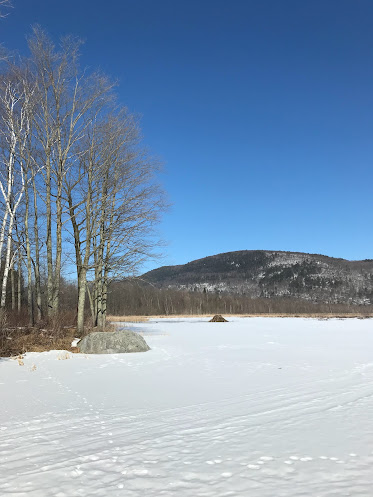
Now on the backtrack 

deep in yesterday’s postholes –

no crust this winter. 

~ Zphx, 


I hear the hens cackle as not before for many months. Are they not now beginning to lay? See January 26, 1858 ("The hens cackle and scratch, all this winter. Eggs must be plenty.")

I see a pitch pine seed with its wing, far out on Walden.  See February 1, 1856 ("I see a pitch pine seed, blown thirty rods from J. Hosmer’s little grove.") and A Book of the Seasons,  by Henry Thoreau, the Pitch Pine.

The catkins of the willow by the causeway. See  A Book of Seasons,  by Henry Thoreau. Willows on the Causeway and  A Book of the Seasons,  by Henry Thoreau, Signs of the Spring: Alder and Willow Catkins Expanding

I hear several times the fine-drawn phe-be note of the chickadee . . . Singular that I should hear this on the first spring day. See March 1, 1854 ("Here is our first spring morning according to the almanac  . . . I hear the phoebe or spring note of the chickadee, and the scream of the jay is perfectly repeated by the echo from a neighboring wood.") See also 
A Book of the Seasons,  by Henry Thoreau, Signs of the Spring, the spring note of the chickadee and  A Book of the Seasons,  by Henry Thoreau, the Chickadee in Winter

Ask the sheldrake whether the rivers are completely sealed up.  
See February 28, 1856 (" Coombs s . . says that he killed a sheldrake a month or six weeks ago in a small open place beneath the falls at the factory. This shows what hardy birds they are ."); February 12, 1856 ("Forty three days of uninterrupted cold weather.”); February 27, 1856 ("The river has been frozen solidly for seven weeks");  March 20, 1856 ("The river has just begun to open at Hubbard’s Bend. It has been closed there since January 7th, i. e. ten weeks and a half."); See also A Book of the Seasons, by Henry Thoreau, Ice-Out  and A Book of the Seasons, by Henry Thoreau, The Sheldrake (Merganser, Goosander)

March 1.  See A Book of the Seasons,  by Henry Thoreau, March 1

Several phe-be 
notes of the chickadee – this 
on the first spring day. 

A Book of the Seasons,  by Henry Thoreau
 "A book, each page written in its own season,
out-of-doors, in its own locality."
 ~edited, assembled and rewritten by zphx ©  2009-2026

https://tinyurl.com/hdt-560301


Sunday, March 1, 2015

A fresh and inspiring dazzling bright day.

March 1


The last day for skating. It is a very pleasant and warm day, the finest yet, with considerable coolness in the air however, — winter still. 


March 1, 2025


The air is beautifully clear, and I trace at a distance the roofs and outlines of farmhouses amid the woods. 

We go listening for bluebirds, but only hear crows and chickadees. 

A fine seething air over the fair russet fields. 

The dusty banks of snow by the railroad reflect a wonderfully dazzling white due to the higher sun.

I am surprised to find the North River more frozen than the South, and we can cross it in many places. The spring sun shining on the sloping icy shores makes numerous dazzling ice-blinks, still brighter and prolonged with rectilinear sides in the reflection. 

I did well to walk in the forenoon, the fresh and inspiring half of this bright day.

H. D. Thoreau, Journal, March 1, 1855


The last day for skating. See February 3, 1855 ("This will deserve to be called the winter of skating."); See also A Book of the Seasons, by Henry Thoreau, The Winter of Skating

It is a very pleasant and warm day, the finest yet.  See March 2, 1855 ("Another still, warm, beautiful day like yesterday. "); March 15, 1860 ("On the whole the finest day yet . . . Here is the first fair, and at the same time calm and warm, day") See also A Book of the Seasons, by Henry Thoreau, The world can never be more beautiful than now.

I am surprised to find the North River more frozen than the South. See March 1, 1856 ("Ask the sheldrake whether the rivers are completely sealed up.") and A Book of the Seasons,  by Henry Thoreau, Ice-out

The spring sun shining on the sloping icy shores. See March 1, 1854 ("For some days past the surface of the earth, covered with water, or with ice where the snow is washed off, has shone in the sun as it does only at the approach of spring.")

We go listening for bluebirds, but only hear crows and chickadees.  
A fine seething air over the fair russet fields. See February 22, 1855 ("Remarkably warm and pleasant weather, perfect spring. I even listen for the first bluebird. I see a seething in the air over clean russet fields. "); March 1, 1854 ("I hear the phoebe or spring note of the chickadee, and the scream of the jay is perfectly repeated by the echo from a neighboring wood "); March 1, 1856 ("I hear several times the fine-drawn phe-be note of the chickadee. . .Singular that I should hear this on the first spring day."). See also A Book of the Seasons,  by Henry Thoreau, Signs of the Spring:   

March 1.  See A Book of the Seasons,  by Henry Thoreau,   March 1

I did well to waik
the fresh and inspiring half
of this bright day.


We go listening 
for bluebirds, but only hear 
crows and chickadees. 


A Book of the Seasons
,  by Henry Thoreau
 "A book, each page written in its own season,
out-of-doors, in its own locality."
 ~edited, assembled and rewritten by zphx ©  2009-2025

https://tinyurl.com/hdt-550301

***


March 1. 10 A. M. — To Derby's Bridge and return by Sam Barrett's, to see ice cakes and meadow crust.

The last day for skating.

It is a very pleasant and warm day, the finest yet, with considerable coolness in the air, however, — winter still.

The air is beautifully clear, and through [ it ] I love to trace at a distance the roofs and outlines of sober - colored farmhouses amid the woods.

We go listening for bluebirds, but only hear crows and chickadees.

A fine seething air over the fair russet fields.

The dusty banks of snow by the railroad reflect a wonderfully dazzling white from their pure crannies, being melted into an uneven, sharp, wavy surface.

This more dazzling white must be due to the higher sun.

I see some thick cakes of ice where an ice - car has broken up : I detect a large bubble four inches in diameter about a foot be neath the upper surface and six inches from the lower.

In confirmation of my theory, the grain of the ice, as indicated by the linear bubbles within it, was converging beneath this bubble, as the rays of light under a burning glass, and what was the under surface at that time was melted in a concave manner to within one and a half inches of the bubble, as appeared by the curvature in the horizontal grain of the more recently formed ice beneath.

I omit to draw the other horizontal grain.

The situation of this bubble also suggests that ice perhaps increases more above than below the plane of its first freezing in the course of a winter, by the addition of surface water and snow ice.

Examined again the ice and meadow - crust deposited just south of Derby's Bridge.

The river is almost down to summer level there now, being only three to four feet deep at that bridge.

It has fallen about eight feet since February 17. The ice is piled up there three or four feet deep, and no water beneath, and most of the cakes, which are about one foot thick, have a crust of meadow of equal thickness (i. e. from six inches to a foot) attached beneath.

I saw in one place three cakes of ice each with a crust of meadow frozen to it beneath, lying one directly upon another and all upon the original ice there, alternately ice and meadow, and the middle crust of meadow measured twenty eight by twenty - two feet.

In this case the earth was about six inches thick only for the most part, three to four feet high in all above original ice.

This lay on a gentle ridge or swell between the main Derby Bridge and the little one beyond, and it suggested that that swell might have been thus formed or increased.

As we went down the bank through A. Hosmer's land we saw great cakes, and even fields of ice, lying up high and dry where you would not suspect otherwise that water had been.

Some have much of the withered pickerel - weed, stem and leaves, in it, causing it to melt and break up soon in the sun.

I saw one cake of ice, six inches thick and more than six feet in diameter, with a cake of meadow of exactly equal dimensions attached to its underside, exactly and evenly balanced on the top of a wall in a pasture forty rods from the river, and where you would not have thought the water ever came.

We saw three white maples about nine inches in diameter which had been torn up, roots and sod together, and in some cases carried a long distance.

One quite sound, of equal size, had been bent flat and broken by the ice striking it some six or seven feet from the ground.

Saw some very large pieces of meadow lifted up or carried off at mouth of G. M. Barrett's Bay.

One measured seventy - four by twenty - seven feet.

Topped with ice almost always, and the old ice still beneath.

In some cases the black, peaty soil thus floated was more than one and a half feet thick, and some of this last was carried a quarter of a mile without trace of ice to buoy it, but probably it was first lifted by ice.

Saw one piece more than a rod long and two feet thick of black, peaty soil brought from I know not where.

The edge of these meadow - crusts is singularly abrupt, as if cut with a turf - knife.

Of course a great surface is now covered with ice on each side of the river, under which there is no water, and we go constantly getting in with impunity.

The spring sun shining on the sloping icy shores makes numerous dazzling ice - blinks, still brighter, and prolonged with rectilinear sides, in the reflection.

I am surprised to find the North River more frozen than the South, and we can cross it in many places.

I think the meadow is lifted in this wise: First, you have a considerable freshet in midwinter, succeeded by severe cold before the water ' has run off much.

Then, as the water goes down, the ice for a certain width on each side the river meadows rests on the ground, which freezes to it.

Then comes another freshet, which rises a little higher than the former.

This gently lifts up the river ice, and that meadow ice on each side of it which still has water under it, without breaking them, but overflows the ice which is frozen to the bot tom.

Then, after some days of thaw and wind, the latter ice is broken up and rises in cakes, larger or smaller with or without the meadow - crust beneath it, and is floated off before the wind and current till it grounds somewhere, or melts and so sinks, frequently three cakes one upon another, on some swell in the meadow or the edge of the upland.

The ice is thus with us a wonderful agent in changing the aspect of the surface of the river - valley.

I think that there has been more meadow than usual moved this year, because we had so great a freshet in midwinter succeeded by severe cold, and that by another still greater freshet before the cold weather was past.

Saw a butcher-bird, as usual on top of a tree, and distinguished from a jay by black wings and tail and streak side of head.

I did well to walk in the forenoon, the fresh and inspiring half of this bright day, for now, at mid afternoon, its brightness is dulled, and a fine stratus is spread over the sky.

Is not “the starry puff (Lycoperdon stellatum)” of the “Journal of a Naturalist,” which “remains driving about the pastures, little altered until spring," my five fingered fungus ?

The same tells of goldfinches (Fringilla carduelis) (Bewick calls it the " thistle - finch ”) "scattering all over the turf the down of the thistle, as they pick out the seed for their food.” It is singular that in this particular it should resemble our goldfinch, a different bird.


Saturday, March 1, 2014

Our first spring morning


March 1. 

Here is our first spring morning according to the almanac. It is remarkable that the spring of the almanac and of nature should correspond so closely.  The morning of the 26th was good winter, but there came a plentiful rain in the afternoon, and yesterday and to-day are quite springlike.


This morning the air is still, and, though clear enough, a yellowish light is widely diffused throughout the east, now just after sunrise. The sunlight looks and feels warm, and a fine vapor fills the lower atmosphere. I hear the phoebe or spring note of the chickadee, and the scream of the jay is perfectly repeated by the echo from a neighboring wood. 

For some days past the surface of the earth, covered with water, or with ice where the snow is washed off, has shone in the sun as it does only at the approach of spring, methinks. 

And are not the frosts in the morning more like the early frosts in the fall, — common white frosts?

As for the birds of the past winter: 


  • I have seen but three hawks, — one early in the winter and two lately; have heard the hooting owl pretty often late in the afternoon. 
  • Crows have not been numerous, but their cawing was heard chiefly in pleasanter mornings.
  • Blue jays have blown the trumpet of winter as usual, but they, as all birds, are most lively in springlike days. 
  • The chickadees have been the prevailing bird.
  • The partridge common enough. 
  • One ditcher tells me that he saw two robins in Moore's Swamp a month ago. 
  • I have not seen a quail, though a few have been killed in the thaws. 
  • Four or five downy woodpeckers. 
  • The white-breasted nuthatch four or five times. 
  • Tree sparrows one or more at a time, oftener than any bird that comes to us from the north. 
  • Two pigeon wood peckers, I think, lately. 
  • One dead shrike, and perhaps one or two live ones. 
  • Have heard of two white owls, — one about Thanksgiving time and one in midwinter. 
  • One short-eared owl in December. 
  • Several flocks of snow buntings for a week in the severest storm, and in December, last part. 
  • One grebe in Walden just before it froze completely.
  • And two brown creepers once in middle of February.
  • Channing says he saw a little olivaceous-green bird lately. 
  • I have not seen an F. linaria, nor a pine grosbeak, nor an F. hyemalis this winter, though the first was the prevailing bird last winter.

In correcting my manuscripts, which I do with sufficient phlegm, I find that I invariably turn out much that is good along with the bad, which it is then impossible for me to distinguish — so much for keeping bad company; but after the lapse of time, having purified the main body and thus created a distinct standard for comparison, I can review the rejected sentences and easily detect those which deserve to be readmitted.

H. D. Thoreau, Journal, March 1, 1854

Here is our first spring morning according to the almanac. See March 1, 1856 ("I hear several times the fine-drawn phe-be note of the chickadee. . .Singular that I should hear this on the first spring day.") See also  A Book of the Seasons,  by Henry Thoreau, the Chickadee in Winter

For some days past the surface of the earth, covered with water, or with ice where the snow is washed off, has shone in the sun as it does only at the approach of spring. See March 1, 1855 ("This more dazzling white must be due to the higher sun.")

As for the birds of the past winter.
See A Book of the Seasons,  by Henry Thoreau, Winter Birds

Blue jays have blown the trumpet of winter as usual, but they, as all birds, are most lively in springlike days..  February 12, 1854 ("You hear the lisping tinkle of chickadees from time to time and the unrelenting steel-cold scream of a jay, unmelted, that never flows into a song, a sort of wintry trumpet, screaming cold; hard, tense, frozen music, like the winter sky itself; in the blue livery of winter's band. It is like a flourish of trumpets to the winter sky") See also A Book of the Seasons, by Henry Thoreau. The Blue Jay

March 1.  See A Book of the Seasons,  by Henry Thoreau,   March 1


A Book of the Seasons,  by Henry Thoreau,

A Book of the Seasons
,  by Henry Thoreau
 "A book, each page written in its own season,
out-of-doors, in its own locality."
 ~edited, assembled and rewritten by zphx ©  2009-2025

Popular Posts Last 30 Days.

The week ahead in Henry’s journal

The week ahead in Henry’s journal
A journal, a book that shall contain a record of all your joy.
"A stone fruit. Each one yields me a thought." ~ H. D. Thoreau, March 28, 1859


I sit on this rock
wrestling with the melody
that possesses me.