Sunday, December 1, 2019

A little green hemisphere of moss.


December 1

It is quite mild and pleasant to-day. 

December 1, 2025

I saw a little green hemisphere of moss which looked as if it covered a stone, but, thrusting my cane into it, I found it was nothing but moss, about fifteen inches in diameter and eight or nine inches high. 

When I broke it up, it appeared as if the annual growth was marked by successive layers half an inch deep each. The lower ones were quite rotten, but the present year's quite green, the intermediate white. I counted fifteen or eighteen. 

It was quite solid, and I saw that it continued solid as it grew by branching occasionally, just enough to fill the newly gained space, and the tender extremities of each plant, crowded close together, made the firm and compact surface of the bed. There was a darker line separating the growths, where I thought the surface had been exposed to the winter. 

It was quite saturated with water, though firm and solid.

H. D. Thoreau, Journal, December 1, 1850

It is quite mild and pleasant to-day.  See December 2, 1850 ("If there is a little more warmth than usual at this season, then the beautiful air which belongs to winter is perceived and appreciated.") See also  November 29, 1852 ("November 29, 30, and December 1 have been the mildest and pleasantest days since November came in.”); December 2, 1859 ("Nov. 30, Dec. 1 and 2 were remarkably warm and springlike days, — a moist warmth.”)

I saw a little green hemisphere of moss. See February 7, 1858 ("Little mounds or tufts of yellowish or golden moss in the young woods look like sunlight on the ground."); February 8, 1857  ("It is exciting to walk over the moist, bare pastures, though slumping four or five inches, and see the green mosses again."); April 25, 1857 ("The dense, green, rounded beds of mosses in springs and old water-troughs are very handsome now, — intensely cold green cushions.") See also A Book of the Seasons, by Henry Thoreau, Signs of the Spring: Mosses Bright Green

December 1. See A Book of the Seasons,  by Henry Thoreau, December 1

Hemisphere of moss 
looks as if covers a stone – 
yet nothing but moss.

A Book of the Seasons,  by Henry Thoreau
 "A book, each page written in its own season, 
out-of-doors, in its own locality."
 ~edited, assembled and rewritten by zphx ©  2009-2025

https://tinyurl.com/hdt-501201

Saturday, November 30, 2019

My eye rested with pleasure on the white pines.


A cold afternoon
windy with some snow not yet
melted on the ground.

My eye wanders as
I sit on an oak stump by
an old cellar-hole.

Where is my home now?
Faint as an old cellar hole,
 is where we have lived.

Methinks that in my 
mood I am asking Nature 
to give me a sign.

Transient gladness.
I do not know what it is –
something that I see:

A recognition
from white pines now reflecting
a silvery light.

And by the old site
I sit on the stump of an
oak which once grew here.

November 30, 2016

Sunday. 

A rather cold and windy afternoon, with some snow not yet melted on the ground. 

Under the south side of the hill between Brown's and Tarbell's, in a warm nook, disturbed three large gray squirrels and some partridges, who had all sought out this bare and warm place. While the squirrels hid themselves in the tree-tops, I sat on an oak stump by an old cellar-hole and mused. 

This squirrel is always an unexpectedly large animal to see frisking about. 

My eye wanders across the valley to the pine woods which fringe the opposite side, and in their aspect my eye finds something which addresses itself to my nature. 

Methinks that in my mood I was asking Nature to give me a sign. 

I do not know exactly what it was that attracted my eye. I experienced a transient gladness, at any rate, at something which I saw. 

I am sure that my eye rested with pleasure on the white pines, now reflecting a silvery light, the infinite stories of their boughs, tier above tier, a sort of basaltic structure, a crumbling precipice of pine horizontally stratified. Each pine is like a great green feather stuck in the ground. A myriad white pine boughs extend themselves horizontally, one above and behind another, each bearing its burden of silvery sunlight, with darker seams between them, as if it were a great crumbling piny precipice thus stratified. 

On this my eyes pastured, while the squirrels were up the trees behind me. That, at any rate, it was that I got by my afternoon walk, a certain recognition from the pine, some congratulation. 

Where is my home? It is indistinct as an old cellar-hole, now a faint indentation merely in a farmer's field, which he has plowed into and rounded off its edges years ago, and I sit by the old site on the stump of an oak which once grew there. 

Such is the nature where we have lived. 

Thick birch groves stand here and there, dark brown (?) now with white lines more or less distinct. 

The Lygodium palmatum is quite abundant on that side of the swamp, twining round the goldenrods, etc., etc.

H. D. Thoreau, Journal, November 30, 1851

My eye rested with pleasure on the white pines, now reflecting a silvery light. See November 11, 1851 ("There is a cold, silvery light on the white pines as I go through J.P. Brown's field near Jenny Dugan’s.”); December 21. 1851(“Sunlight on pine-needles is the phenomenon of a winter day.”); February 4, 1852 ("Now the white pine are a misty blue; anon a lively, silvery light plays on them, and they seem to erect themselves unusually. . . The sun loves to nestle in the boughs of the pine and pass rays through them."); February 5, 1852 ("The boughs, feathery boughs, of the white pines, tier above tier, reflect a silvery light against the darkness of the grove, as if both the silvery-lighted and greenish bough and the shadowy intervals of the shade behind belong to one tree.”); December 8, 1855 ("Yet it is cheering to walk there while the sun is reflected from far through the aisles with a silvery light from the needles of the pine.”); December 3, 1856 (“Tthe pine forest's edge seen against the winter horizon. . . .The silvery needles of the pine straining the light.”).

The Lygodium palmatum twining round the goldenrods. [CLIMBING FERN, or Hartford Fern (Lygodium palmatum) . A species of fern found, rarely, from Massachusetts to Kentucky and southward, remarkable for climbing or twining around weeds and shrubs ~ Wikisource.] See October 2, 1859 (“The climbing fern is perfectly fresh, — and apparently therefore an evergreen, — the more easily found amid the withered cinnamon and flowering ferns.”); May 1, 1859 ("The climbing fern is persistent, i. e. retains its greenness still, though now partly brown and withered.")

November 30. A Book of the Seasons,   by Henry Thoreau, November 30

An old cellar hole.
I sit on the stump of an
oak which once grew here.


A Book of the Seasons
,  by Henry Thoreau, 
"A book, each page written in its own season,
out-of-doors, in its own locality.”
~edited, assembled and rewritten by zphx © 2009-2025


https://tinyurl.com/HDT511130

Friday, November 29, 2019

A BOOK OF THE SEASONS: NOVEMBER

Crows fly southwest in 
a very long straggling flock.
We see neither end.

November twilight 
clear white light seen through the woods --
the leaves being gone. 
November 2, 1853


Cool northerly wind
a ripple on the river -- 
rustling of oak leaves.

The jays with their scream
at home in the scenery.
A raw gusty day. 

It is worth the while 
to walk in swamps now, to bathe 
your eyes with greenness. 

Remarkable how
little we attend to what
passes before us.

All this is distinct
to an observant eye yet
unnoticed by most.

The notes of small birds
like a nail on an anvil
in now leafless woods.

Nature perseveres.
Though she works slowly she has 
much time to work in.

There is a season
when pine leaves are yellow and
then they are fallen. 

Grand natural features 
waving woods and huge boulders 
are not on the map. 

Smooth shallow water 
in the shelter of the wood 
awaiting the ice. 

A narrow white cloud 
resting on every mountain 
on the horizon.
November 12, 1852

Little birds peck at
white birch catkins and fly off 
with a jingling sound. 

October light fades 
into the clear white leafless 
November twilight. 

I see a lichen 
on a rock in a meadow, 
a perfect circle. 

The jay on alert, 
mimicking each woodland note. 
What happened? Who's dead? 

The manifold ways
that light at this season is 
reflected to us. 

Rejoice at sundown,
at the hooting of an owl,
this world where owls live.

These nuts not gathered. 
One who used to get them has 
committed suicide. 
November 19, 1858 

We see a partridge 
on the ground under an oak, 
looking like a snag. 

November 21, 2016


We are made to love 
the pond and meadow as wind
to ripple water. 

November's bare bleak 
inaccessible beauty 
seen through a clear air. 

The new-fallen snow 
seen lying just as it fell 
on the twigs and leaves. 

This sugaring of 
snow reveals a cow-path in 
the distant landscape. 

The unexpected
exhilarating yellow 
light of November.

Faint creak of a limb 
heard in this oak wood is the
note of a nuthatch. 
I detect it much
nearer than I suspected,
its mate not far off.

The bare, barren earth 
cheerless without ice and snow. 
But how bright the stars. 

Twilight makes so large
a part of the afternoon
these November days.

Snow buntings rise from 
the midst of a stubble-field
unexpectedly. 
November 29, 1859

Sparkling windows and
vanes of the village now seen
against the mountains.


A Book of the Seasons, by Henry Thoreau
"A book, each page written in its own season,
out-of-doors, in its own locality.”
~edited, assembled and rewritten by zphx © 2009-2020

The mildest and pleasantest days since November came in..

November 29, 30, and December 1. 

The snow which fell the 23d whitened the ground but a day or two. 

These have been the mildest and pleasantest days since November came in. November 29th, walked in p. m. to old stone bridge and down bank of river by Sam Barrett's house.

When I stood on the caving swallow banks by the bridge about 4 o'clock, the sun sank below some clouds, or they rose above it, and it shone out with that bright, calm, memorable light which I have else where described, lighting up the pitch pines and everything. 

The patches of winter rye, at this season so green by contrast, are an interesting feature in the landscape.

When I got out of the wood, going toward Barrett's, the softness of the sunlight on the russet landscape, the smooth russet grassy fields and meadows, was very soothing, the sun now getting low in a November day. 

The stems and twigs of the maples, etc., looking down the river, were beautifully distinct. You see distinctly the form of the various clumps of maples and birches. 

Geese in river swam as fast as I walked. 

Many broken but apparently rather recent turtles' eggs on the bank.

H. D. Thoreau, Journal, November 29, 1852

November 29, 30, and December 1. have been the mildest and pleasantest days since November came in. See December 2, 1859 ("Nov. 30, Dec. 1 and 2 were remarkably warm and springlike days, — a moist warmth.”)


About 4 o'clock, the sun sank below some clouds, or they rose above it, and it shone out with that bright, calm, memorable light which I have else where described. See November 29, 1853 ("I begin to see, under the clouds in the west horizon, a clear crescent of yellowish sky, and suddenly a glorious yellow sunlight falls on all the eastern landscape . . . I think that we have some such sunsets as this, and peculiar to the season, every year. I should call it the russet afterglow of the year.") See also November 9, 1858 (“ We had a true November sunset after a dark, cloudy afternoon. The sun reached a clear stratum just before setting, beneath the dark cloud, though ready to enter another on the horizon’s edge, and a cold, yellow sunlight suddenly illumined the withered grass of the fields around, near and far, eastward. Such a phenomenon as, when it occurs later, I call the afterglow of the year."); November 10, 1858 (" dark-blue or slate-colored clouds in the west, and the sun going down in them. All the light of November may be called an afterglow."); November 22, 1851 ("The light of the setting sun, just emerged from a cloud and suddenly falling on and lighting up the needles of the white pine. . . .After a cold gray day this cheering light almost warms us by its resemblance to fire."); November 23, 1851 ("Another such a sunset to - night as the last."); November 25, 1851 ("That kind of sunset which I witnessed on Saturday and Sunday is perhaps peculiar to the late autumn. The sun is unseen behind a hill. Only this bright white light like a fire falls on the trembling needles of the pine.")
");

Thursday, November 28, 2019

The pecuniary value of the book.

November 28

Monday. 

Saw boys skating in Cambridgeport, — the first ice to bear. 

Settled with J. Munroe & Co., and on a new account placed twelve of my books with him on sale. I have paid him directly out of pocket since the book was published two hundred and ninety dollars and taken his receipt for it. This does not include postage on proof-sheets, etc., etc. I have received from other quarters about fifteen dollars. This has been the pecuniary value of the book. 

Saw at the Natural History rooms the skeleton of a moose with horns. The length of the spinal processes (?) over the shoulder was very great. The hind legs were longer than the front, and the horns rose about two feet above the shoulders and spread between four and five, I judged. 

Dr. Harris described to me his finding a species of cicindela at the White Mountains this fall (the same he had found there one specimen of some time ago), supposed to be very rare, found at St. Peter's River and at Lake Superior; but he proves it to be common near the White Mountains.

H. D. Thoreau, Journal, November 28, 1853

Boys skating in Cambridgeport, — the first ice to bear See December 6, 1854 ("I see thick ice and boys skating all the way to Providence, but know not when it froze, I have been so busy writing my lecture."); December 14. 1851 ("The boys have been skating for a week, but I have had no time to skate for surveying. I have hardly realized that there was ice, though I have walked over it about this business."); December 15, 1855 ("The boys have skated a little within two or three days, but it has not been thick enough to bear a man yet.")

I have paid him directly out of pocket since the book was published two hundred and ninety dollars. See November 20, 1853 (“I was obliged to manufacture a thousand dollars' worth of pencils and slowly dispose of and finally sacrifice them, in order to pay an assumed debt of a hundred dollars.”); September 14, 1855 ("It costs so much to publish, would it not be better for the author to put his manuscripts in a safe?”)

The horns rose about two feet above the shoulders and spread between four and five, I judged. See July 23, 1857 ("[Mr. Leonard, of Bangor, a sportsman,] said that the horns of a moose would spread four feet, some times six; would weigh thirty or forty pounds")

Wednesday, November 27, 2019

I am pretty sure to scare up partridges in a wood-lot of this size


November 27.

P. M. — To Colburn Farm wood-lot north of C. Hill.

 
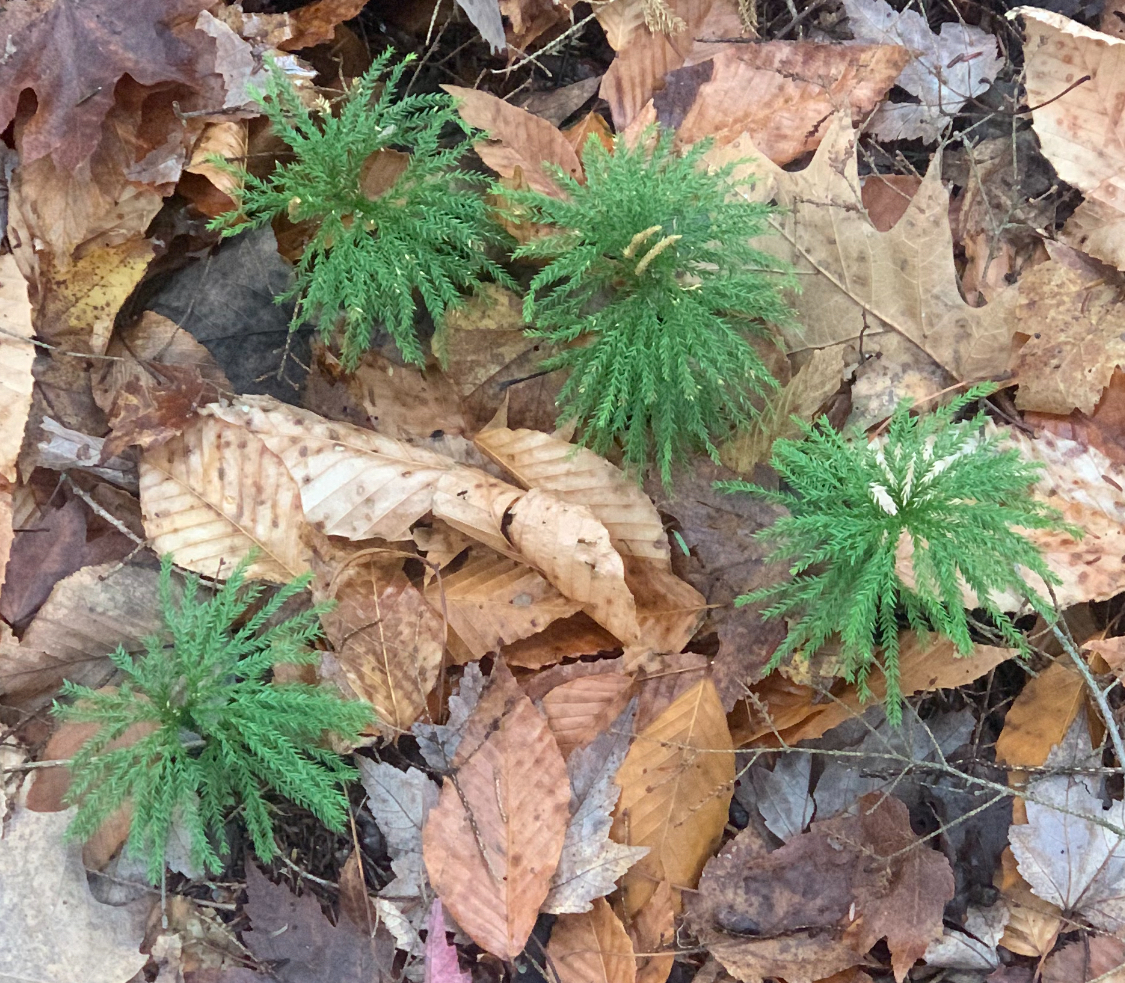
Lychopodium, November 27, 2024

I traverse this wood-lot back and forth by the lines cut by those who have lotted it off. Thus I scare up the partridges in it. A dozen long lines four rods apart are cut through it. Walking through these, I am pretty sure to scare up what partridges there are in it, and there are few wood-lots of this size which have not some in them at present. 


Come upon a large ant-hill in the midst of the wood, but no ants on it. It has made an open and bare spot in the woods, ten or twelve feet in diameter. Its mound is partly grassed over, as usual, and trees have been prevented from springing up by the labors of the ants beneath. As this wood is about thirty years old, it may prove that the ant-hill is of the same age! 

On the 22d the ground was white with snow for a few hours only. Yet, though you saw no more of it generally the latter part of that day, I still see some of it in cold, wet, shaded places, as amid andromeda and cranberry vines. 

November 27, 2024

This wood-lot, especially at the northwest base of the hill, is extensively carpeted with the Lycopodium complanatum and also much dendroideum and Chimaphila umbellata. 

The former, methinks, abounds especially in shady and rather moist, and I think old, or rather diseased, and cold(?), woods. It covers the earth densely, even under the thickest white pine groves, and equally grows under birches. It surprises you as if the trees stood in green grass where you commonly see only withered leaves. 

The Greeks and Romans made much of honey be cause they had no sugar; olive oil also was very important. Our poets(?) still sing of honey, though we have sugar, and oil, though we do not produce and scarcely use it. 

The principal flight of geese is said to have been a few days before the 24th. I have seen none.

H D. Thoreau, Journal, November 27, 1859


This wood-lot, especially at the northwest base of the hill, is extensively carpeted with the Lycopodium complanatum and also much dendroideum. See November 27, 1853 (" I observe the Lycopodium lucidulum still of .a fresh, shining green. ");October 16, 1859 ("All the Lycopodium complanatum I see to-day has shed its pollen.");November 11, 1859 ("The flat variety of Lycopodium dendroideum shed pollen on the 25th of October."); November 15, 1858 ("The Lycopodium dendroideum var. obscurum appears to be just in bloom in the swamp about the Hemlocks (the regular one (not variety) is apparently earlier)");  November 16, 1858 ("the lycopodium dendroideum, complanatum, and lucidulum, and the terminal shield fern are also very interesting."); November 17, 1858 ("Lycopodium dendroideum . . .was apparently in its prime yesterday); November 17, 1858 ("It would seem that these lycopodiums, at least, which have their habitat on the forest floor and but lately attracted my attention there (since the withered leaves fell around them and revealed them by the contrast of their color and they emerged from obscurity), —it would seem that they at the same time attained to their prime, their flowering season. ");  December 7, 1853 ("I In the latter part of November and now, before the snow, I am attracted by the numerous small evergreens on the forest floor, now most conspicuous, especially the very beautiful Lycopodium dendroideum, somewhat cylindrical, and also, in this grove, the variety obscurum of various forms, . . .like looking down on evergreen trees. And the L. lucidulum of the swamps, forming broad, thick patches of a clear liquid green,. . . not to mention the spreading openwork umbrellas of the L. complanatum, or flat club-moss, all with spikes still. Also the liquid wet glossy leaves of the Chimaphila (winter or snow-loving) umbellata, with its dry fruit.") See also A Book of the Seasons, by Henry Thoreau, The Lycopodiums

Chimaphila umbellata. [what HDT calls pipsissewa, or “wintergreen.”]   See November 16, 1858 (“Methinks the wintergreen, pipsissewa, is our handsomest evergreen, so liquid glossy green and dispersed almost all over the woods.”); November 19, 1850 ("Now that the grass is withered and the leaves are withered or fallen, it begins to appear what is evergreen the partridge-berry and checkerberry, and winter-green leaves even, are more conspicuous.”)  See also  November 27, 1853 (Checkerberries and partridge-berries are both numerous and obvious now")

The principal flight of geese is said to have been a few days before the 24th.  See November 20, 1853 ("Methinks the geese are wont to go south just before a storm, and, in the spring, to go north just after one, say at the end of a long April storm.”); November 24, 1855 ("Geese went over on the 13th and 14th, on the 17th the first snow fell, and the 19th it began to be cold and blustering.”); November 25, 1852 ("At Walden. — I hear at sundown . . . a flock of wild geese going south."); November 30, 1857 ("The air is full of geese. I saw five flocks within an hour, about 10 A. M., containing from thirty to fifty each, and afterward two more flocks, making in all from two hundred and fifty to three hundred at least”)


November 27. See A Book of the Seasons,  by Henry Thoreau,  November 27

I am sure to scare
up partridges at present
a wood-lot this size


A Book of the Seasons,  by Henry Thoreau,  
A Book of the Seasons,  by Henry Thoreau
 "A book, each page written in its own season, 
out-of-doors, in its own locality."
 ~edited, assembled and rewritten by zphx ©  2009-2025

Monday, November 25, 2019

A flock of wild geese going south..


November 25. 

At Walden. — I hear at sundown what I mistake for the squawking of a hen, — for they are firing at chickens hereabouts, — but it proved to be a flock of wild geese going south. 

This proves how much the voices of all fowls are alike.

H. D. Thoreau, Journal, November 25, 1852

 I hear at sundown what  proved to be a flock of wild geese going south. See November 20, 1853 ("Methinks the geese are wont to go south just before a storm, and, in the spring, to go north just after one, say at the end of a long April storm.”); November 22, 1853 (“Geese went over yesterday, and to-day also.”); November 23, 1853 ("At 5 P. M. I saw, flying southwest high overhead, a flock of geese, and heard the faint honking of one or two. They were in the usual harrow form, twelve in the shorter line and twenty four in the longer, the latter abutting on the former at the fourth bird from the front. I judged hastily that the interval between the geese was about double their alar extent, and, as the last is, according to Wilson, five feet and two inches, the former may safely be called eight feet. . . . . This is the sixth flock I have seen or heard of since the morning of the 17th , i . e . within a week ."); November 24, 1855 ("Geese went over on the 13th and 14th, on the 17th the first snow fell, and the 19th it began to be cold and blustering.”); November 30, 1857 ("The air is full of geese. I saw five flocks within an hour, about 10 A. M., containing from thirty to fifty each, and afterward two more flocks, making in all from two hundred and fifty to three hundred at least”) See also A Book of Seasons, by Henry Thoreau, Geese in Autumn

Popular Posts Last 30 Days.

The week ahead in Henry’s journal

The week ahead in Henry’s journal
A journal, a book that shall contain a record of all your joy.
"A stone fruit. Each one yields me a thought." ~ H. D. Thoreau, March 28, 1859


I sit on this rock
wrestling with the melody
that possesses me.