New and collected mind-prints. by Zphx. Following H.D.Thoreau 170 years ago today. Seasons are in me. My moods periodical -- no two days alike.
Tuesday, September 23, 2025
A Book of the Seasons: Blue-stemmed goldenrod (solidago caesia)
Saturday, September 23, 2023
Over the highest hill behind Bangor.
Friday. Walked down the riverside this forenoon to the hill where they were using a steamshovel at the new railroad cut, and thence to a hill three quarters of a mile further.
Saw Aster undulatus, Solidago nemoralis, fragrant everlasting, silvery cinquefoil, small white birch, Lobelia inflata, both kinds of primrose, low cudweed, lactuca, Polygonum cilinode (apparently out of bloom), yellow oxalis.
I returned across the fields behind the town, and over the highest hill behind Bangor, and up the Kenduskieg, from which I saw the Ebeeme Mountains in the northwest and hills we had come by.
The arbor-vitæ is the prevailing shrub.
H. D. Thoreau, Journal, September 23, 1853
Friday. Walked down the riverside. See September 21, 1853 ("Reached Bangor at dark."); September 22, 1853 ("Behind one house, an Indian had nearly finished one canoe and was just beginning another, outdoors")
Thursday, September 23, 2021
I scare up large flocks of sparrows in the garden.
September 23
Notwithstanding the fog, the fences this morning are covered with so thick a frost that you can write your name anywhere with your nail.
The partridge and the rabbit, — they still are sure to thrive like true natives of the soil, whatever revolutions occur. If the forest is cut off, many bushes spring up which afford them concealment, and they become more numerous than ever.
The sumach are among the reddest leaves at present.
The telegraph harp sounds strongly to-day, in the midst of the rain. I put my ear to the trees and I hear it working terribly within, and anon it swells into a clear tone, which seems to concentrate in the core of the tree, for all the sound seems to proceed from the wood. It is if you had entered some world - famous cathedral, resounding to some vast organ.
The fibres of all things have their tension, and are strained like the strings of a lyre. I feel the very ground tremble under my feet as I stand near the post. This wire vibrates with great power, as if it would strain and rend the wood.
What an awful and fateful music it must be to the worms in the wood! No better vermifuge were needed. No danger that worms will attack this wood; such vibrating music would thrill them to death.
I scare up large flocks of sparrows in the garden.
The partridge and the rabbit, — they still are sure to thrive like true natives of the soil, whatever revolutions occur. See February 14, 1856 ("In all the little valleys in the woods and sprout-lands, and on the southeast sides of hills, the oak leaves which have blown over the crust are gathered in dry and warm-looking beds. . . No doubt they are of service to conceal and warm the rabbit and partridge and other beasts and birds."); March 17, 1860 ("The rabbit and partridge can eat wood; therefore they abound and can stay here all the year."); November 18, 1851 (".Here hawks also circle by day, and chickadees are heard, and rabbits and partridges abound. . . .You must be conversant with things for a long time to know much about them,. . . as the partridge and the rabbit are acquainted with the thickets and at length have acquired the color of the places they frequent."); Walden (" All day the sun has shone on the surface of some savage swamp, where the single spruce stands hung with usnea lichens, and small hawks circulate above, and the chickadee lisps amid the evergreens, and the partridge and rabbit skulk beneath”); December 1, 1856 ("Well named shrub oak. Low, robust, hardy, indigenous. Well known to the striped squirrel and the partridge and rabbit"); December 11, 1854 ("A gray rabbit scuds away over the crust in the swamp on the edge of the Great Meadows beyond Peter’s. A partridge goes off, and, coming up, I see where she struck the snow first with her wing,"); December 11, 1858 ("Already, in hollows in the woods and on the sheltered sides of hills, the fallen leaves are collected in small heaps on the snow-crust, simulating bare ground and helping to conceal the rabbit and partridge, etc"); December 31, 1855 ("I see many partridge-tracks in the light snow, where they have sunk deep amid the shrub oaks; also gray rabbit and deer mice tracks");
Wednesday, September 23, 2020
A farmer in his field.
September 23
P. M. — Round by Clematis Brook.
The forget-me-not still.
I observe the rounded tops of the dogwood bushes, scarlet in the distance, on the edge of the meadow (Hubbard's), more full and bright than any flower.
The maples are mostly darker, the very few boughs that are turned, and the tupelo, which is reddening.
The ash is just beginning to turn.
The scarlet dogwood is the striking bush to-day.
I find huckleberries on Conantum still sound and blackening the bushes.
How much longer a mile appears between two blue mountain peaks thirty or more miles off in the horizon than one would expect!
Some acorns and hickory nuts on the ground, but they have not begun to shell.
Is it the nut of the Carya amara, with raised seams, but not bitter, that I perceive?
I suppose that is the Carya tomentosa, or mockernut hickory, with large rounded nuts on Lee's land.
The bitternuts (?), rubbed together, smell like varnish.
The sarothra in bloom.
The wind from the north has turned the white lily pads wrong side up, so that they look red, and their stems are slanted up-stream.
Almost all the yellow ones have disappeared.
The woodbine high on trees in the shade a delicate pink.
I gathered some haws very good to eat to-day. I think they must be the senelles of the Canadians.
Hamamelis Virginiana out, before its leaves fall.
A woodchuck out.
The waxwork not opened.
The "feathery tails" of the clematis fruit conspicuous and interesting now.
Yellow lily out (again?) in the pond-holes.
Passing a corn-field the other day, close by a hat and coat on a stake, I recognized the owner of the farm. Any of his acquaintances would. He was only a trifle more weather-[beaten] than when I saw him last. His back being toward me, I missed nothing, and I thought to myself if I were a crow I should not fear the balance of him, at any rate.
In northern latitudes, where other edible fruits are scarce, they make an account of haws and bunch-berries.
The barberry bushes in Clematis Hollow are very beautiful now, with their wreaths of red or scarlet fruit drooping over a rock.
H. D. Thoreau, Journal, September 23, 1852
A blue-stemmed goldenrod, its stem and leaves red. See September 23, 1860 ("I see everywhere in the shady yew wood those pretty round-eyed fungus-spots on the upper leaves of the blue-stemmed goldenrod, contrasting with the few bright-yellow flowers above them, -- yellowish-white rings (with a slate-colored centre), surrounded by green and then dark."); See also November 10, 1858 ("In the path below the Cliff, I see some blue-stemmed goldenrod turned yellow as well as purple.") and A Book of the Seasons, by Henry Thoreau, Blue-stemmed Goldenrod (solidago caesia)
Monday, September 23, 2019
Pretty copious rain in the night.
11 A. M. — River risen about fourteen inches above lowest this year (or thirteen and three quarters above my mark by boat).
What an army of non-producers society produces, —, ladies generally (old and young) and gentlemen of leisure, so called! Many think themselves well employed as charitable dispensers of wealth which somebody else earned, and these who produce nothing, being of the most luxurious habits, are precisely they who want the most, and complain loudest when they do not get what they want.
H. D. Thoreau, Journal, September 23, 1859
Sunday, September 23, 2018
Cape Ann and the comet
![]() |
| September 23, 2018 |
We kept along the road to Rockport, some two miles or more, to a “thundering big ledge” by the road, as a man called it; then turned off toward the south shore, at a house with two very large and old pear trees before it. Part of the house was built by a Witham, one of the first settlers, and the place or neighborhood used to be called “the Farms.” Saw the F. hyemalis flitting along the walls, and it was cool enough for them on this cape.
In a marsh by the shore, where was a very broad curving sandy beach, the shore of a cove, found the Ranunculus Cymbalaria, still in bloom, but mostly in fruit. Glaux maritima (?), nearly prostrate, with oblong leaves. Triglochin palustris in fruit. An eleocharis, apparently marine, with lenticular fruit and a wrinkled mitre-shaped beak. Spergularia rubra, etc., samphire, etc.
The narrow road — where we followed it — wound about big boulders, past small, often bevel-roofed cottages where sometimes was a small flag flying for a vane. The number and variety of bevelled roofs on the Cape is surprising. Some are so nearly flat that they reminded me of the low brows of monkeys.
We had already seen a sort of bare rocky ridge, a bare boulder-covered back of the Cape, running northeasterly from Gloucester toward Rockport and for some three miles quite bare, the eastern extremity of the Cape being wooded. That would be a good place to walk.
In this marsh, saw what I thought the solitary tattler, quite tame.
Having reached the shore, we sat under the lee of the rocks on the beach, opposite Salt Island. A man was carting seaweed along the shore between us and the water, the leather-apron kind, which trailed from his cart like the tails of oxen, and, when it came between us and the sun, was of a warm purple-brown glow.
Half a mile further, beyond a rocky head, we came to another curving sandy beach, with a marsh between it and the Cape on the north. Saw there, in the soft sand, with beach-grass, apparently Juncus Balticus (?), very like but not so stout (!) as Juncus effusus.
Met a gunner from Lynn on the beach, who had several pigeons which he had killed in the woods by the shore. Said that they had been blown off the mainland. Second, also a kingfisher. Third, what he called the “ox eye,” about size of peetweet but with a short bill and a blackish-brown crescent on breast, and wing above like peetweet’s, but no broad white mark below. Could it be Charadrius semipalmatus? Fourth, what he called a sandpiper, very white with a long bill. Was this Tringa arenaria? Fifth, what I took to be a solitary tattler, but possibly it was the pectoral sandpiper, which I have seen since.
On the edge of the beach you see small dunes, with white or fawn-colored sandy sides, crowned with now yellowish smilax and with bayberry bushes. Just before reaching Loblolly Cove, near Thatcher’s Island, sat on a beach composed entirely of small paving-stones lying very loose and deep.
We boiled our tea for dinner on the mainland opposite Straitsmouth Island, just this side the middle of Rockport, under the lee of a boulder, using, as usual, dead bay berry bushes for fuel. This was, indeed, all we could get. They make a very quick fire, and I noticed that their smoke covered our dippers with a kind of japan which did not crock or come off nearly so much as ordinary soot.
We could see the Salvages very plainly, apparently ex tending north and south, the Main Rock some fifteen or twenty rods long and east-northeast of Straitsmouth Island, apparently one and a half or two miles distant, with half-sunken ledges north and south of it, over which the sea was breaking in white foam. The ledges all together half a mile long.
We could see from our dining-place Agamenticus, some forty miles distant in the north. Its two sides loomed so that about a third of the whole was lifted up, while a small elevation close to it on the east, which afterward was seen to be a part of it, was wholly lifted up.
Rockport well deserves its name, — several little rocky harbors protected by a breakwater, the houses at Rockport Village backing directly on the beach.
At Folly Cove, a wild rocky point running north, covered with beach—grass. See now a mountain on the east of Agamenticus. Isles of Shoals too low to be seen. Probably land at Boar’s Head, seen on the west of Agamenticus, and then the coast all the way from New Hampshire to Cape Ann plainly, Newburyport included and Plum Island. Hog Island looks like a high hill on the mainland.
It is evident that a discoverer, having got as far west as Agamenticus, off the coast of Maine, would in clear weather discern the coast trending southerly beyond him as far round as Cape Ann, and if he did not wish to be embayed would stand across to Cape Ann, where the Salvages would be the outmost point.
At Annisquam we found ourselves in the midst of boulders scattered over bare hills and fields, such as we had seen on the ridge northerly in the morning, i. e., they abound chiefly in the central and northwesterly part of the Cape. This was the most peculiar scenery of the Cape.
We struck inland southerly, just before sundown, and boiled our tea with bayberry bushes by a swamp on the hills, in the midst of these great boulders, about half way to Gloucester, having carried our water a quarter of a mile, from a swamp, spilling a part in threading swamps and getting over rough places.
Two oxen feeding in the swamp came up to reconnoitre our fire. We could see no house, but hills strewn with boulders, as if they had rained down, on every side, we sitting under a shelving one. When the moon rose, what had appeared like immense boulders half a mile off in the horizon now looked by contrast no larger than nutshells or buri-nut against the moon’s disk, and she was the biggest boulder of all.
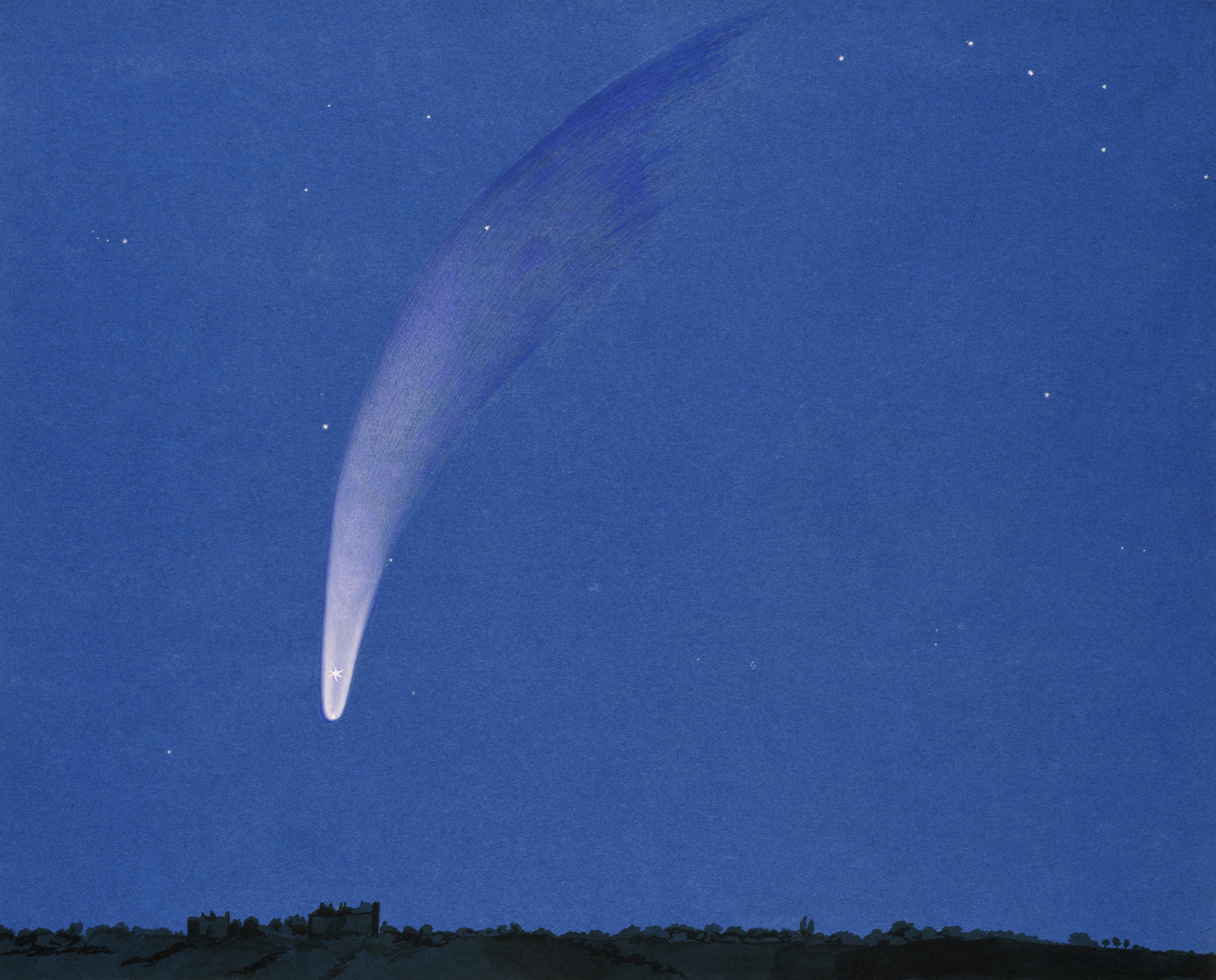
When we had put out our bayberry fire, we heard a squawk, and, looking up, saw five geese fly low in the twilight over our heads. We then set out to find our way to Gloucester over the hills, and saw the comet very bright in the northwest.
![]() |
| Donati’s Comet 1858 |
After going astray a little in the moonlight, we fell into a road which at length conducted us to the town.
As we bought our lodging and breakfast, a pound of good ship-bread, which cost seven cents, and six herring, which cost three cents, with sugar and tea, supplied us amply the rest of the two days. The selection of suitable spots to get our dinner or supper led us into interesting scenery, and it was amusing to watch the boiling of our water for tea. There is a scarcity of fresh water on the Cape, so that you must carry your water a good way in a dipper.
H. D. Thoreau, Journal, September 23, 1858
Saturday, September 23, 2017
By Flint’s Pond road in the woods.
| September 23, 2017 Solidago, aster & vanessa |
Varieties of nabalus grow along the Walden road in the woods; also, still more abundant, by the Flint's Pond road in the woods. I observe in these places only the N. alba and Fraseri; but these are not well distinguished; they seem to be often alike in the color of the pappus. Some are very tall and slender, and the largest I saw was an N. Fraseri! One N. alba had a panicle three feet long!
The Ripley beeches have been cut. I can’t find them. There is one large one, apparently on Baker's land, about two feet in diameter near the ground, but fruit hollow.
I see yellow pine-sap, in the woods just east of where the beeches used to stand, just done, but the red variety is very common and quite fresh generally there.
H. D. Thoreau, Journal, September 23, 1857
Varieties of nabalus grow along the Walden road in the woods; also, still more abundant, by the Flint's Pond road in the woods. See September 13, 1857 (“Nabalus Fraseri, top of Cliffs, — a new plant, . . ."The nabalus family generally, apparently now in prime.”);September 15, 1851 ("Prenanthes alba; this Gray calls Nabalus albus, white lettuce or rattlesnake-root. Also I seem (?) to have found Nabalus Fraseri, or lion's-foot.”);September 17, 1857 (“I go to Fair Haven Hill, looking at the varieties of nabalus, which have a singular prominence now in all woods and roadsides.”)
I see yellow pine-sap . . . just done, but the red variety is very common . See September 23, 1860 (“Red pine-sap by north side of Yew Path some ten rods east of yew, not long done. The root of the freshest has a decided checkerberry scent, and for a long time — a week after — in my chamber, the bruised plant has a very pleasant earthy sweetness. ”). See also June 29, 1853 (“American pine-sap, just pushing up, — false beech- drops. Gray says from June to August. It is cream-colored or yellowish under the pines in Hubbard's Wood Path. Some near the fence east of the Close. A plant related to the tobacco-pipe.”); July 29,1853 (“American pine-sap, just pushing up, — false beech-drops. Gray says from June to August. It is cream-colored or yellowish under the pines in Hubbard's Wood Path. Some near the fence east of the Close. A plant related to the tobacco-pipe. Remarkable this doubleness in nature, — not only that nature should be composed of just these individuals, but that there should be so rarely or never an individual without its kindred, — its cousin. It is allied to something else. There is not only the tobacco-pipe, but pine-sap.”); August 14, 1856 (“Hypopitys, just beyond the last large (two-stemmed) chestnut at Saw Mill Brook, about done. Apparently a fungus like plant. It erects itself in seed.”); August 23, 1858 (“See an abundance of pine-sap on the right of Pine-sap Path.”); October 6, 1857 (“I see a great quantity of hypopitys, now all sere, along the path in the woods beyond. Call it Pine-Sap Path. It seems to have been a favorable season for it”); October 14, 1858 ("On the top of Ball’s Hill, nearly half-way its length, the red pine-sap, quite fresh, apparently not long in bloom, the flower recurved. As last year, I suspect that this variety is later than the yellowish one, of which I have seen none for a long time."); November 25, 1857 ("Methinks there has been more pine-sap than usual the past summer. I never saw a quarter part so much. It stands there withered in dense brown masses, six or eight inches high, partly covered with dead leaves.") and note to September 9, 1857 (“C. brings me a small red hypopitys. It has a faint sweet, earthy, perhaps checkerberry, scent”) and A Book of the Seasons, by Henry Thoreau, Pine-sap and Indian-pipe
Wednesday, September 23, 2015
A screech owl in moonlight/confusing fall warblers
Small sparrows, with yellow on one side above eye in front and white belly, erectile (?) crown divided by a light line.
Those weeds, etc., on the bared meadow come up spontaneously.
8 P. M. — I hear from my chamber a screech owl about Monroe’s house this bright moonlight night, — a loud, piercing scream, much like the whinny of a colt perchance, a rapid trill, then subdued or smothered a note or two.
A little wren-like (or female goldfinch) bird on a willow at Hubbard’s Causeway, eating a miller: with bright-yellow rump when wings open, and white on tail. Could it have been a yellow-rump warbler?
H. D. Thoreau, Journal, September 23, 1855
I hear from my chamber a screech owl — a loud, piercing scream, much like the whinny of a colt. See June 2, 1860 ("I soon hear its mournful scream. . . not loud now but, though within twenty or thirty rods, sounding a mile off.”); June 25, 1860 ("At evening up the Assabet hear four or five screech owls on different sides of the river, uttering those peculiar low screwing or working, ventriloquial sounds.”); August 14, 1854 (“I hear the tremulous squealing scream of a screech owl in the Holden Woods.”); October 9, 1851 ("Heard two screech owls in the night")
A Book of the Seasons: September 23 (the crisis of first frosts, look for redness, huckleberries, blue-stemmed goldenrod, pine-sap)
The sumach are among the reddest leaves at present. September 23, 1851
The maples are mostly darker, the very few boughs that are turned, and the tupelo, which is reddening. September 23, 1852
The ash is just beginning to turn. September 23, 1852
The scarlet dogwood is the striking bush to-day. September 23, 1852
A blue-stemmed goldenrod, its stem and leaves red. September 23, 1852

of the white lily pads
exposed by the wind.
June 29, 1852
If you make the least correctobservation of nature this year,you will have occasion to repeat itwith illustrations the next,and the season and life itself is prolonged.September 22 <<<<<<<< September 23 >>>>>>> September 24A Book of the Seasons, by Henry Thoreau, September 23A Book of the Seasons, by Henry Thoreau"A book, each page written in its own season,out-of-doors, in its own locality.”~edited, assembled and rewritten by zphx © 2009-2022
tinyurl.com/HDT23September
Popular Posts Last 30 Days.
-
I would make a chart of our life, know why just this circle of creatures completes the world. Henry Thoreau, April 18, 1852 It is but a s...
-
July 14 P. M. — To Muhlenbergii Brook. Anthony Wright found a lark's nest with fresh eggs on the 12th in E. Hubbard's meadow by...
-
July 18 P. M. — To Wheeler meadow to look at willows. Again scare up a woodcock, apparently seated or sheltered in shadow of ferns in the m...
-
July 12 P. M. — Down Turnpike to Red Lily Meadow. Hear the plaintive note of young bluebirds, a reviving and gleaming of their blue...