Showing posts with label january 13. Show all posts

Thursday, January 13, 2022

A Book of the Seasons: January 13 (hoar frost, mist, vapor, clouds, ice, thaw, snow, music)

The year is but a succession of days,
and I see that I could assign some office to each day
which, summed up, would be the history of the year.


A drifting snow-storm
last night and to-day--the first
sleighing this winter.
January 13, 1853

The landscape is now
patches of bare ground and snow
running water, sun.

The cold spell over.
Here this morning is hoar frost--
a crystallized fog.

January 13, 2020


A drifting snow-storm last night and to-day, the first of consequence; and the first sleighing this winter. January 13, 1853

Sunrise. —A heavy lodging snow, almost rain, has been falling—how long? —coming from the eastward. The weather comparatively warm, but windy. It will probably turn to rain. Say four or five inches deep. It sticks to the sides of the houses.. . . January 13, 1856

It turns to rain before noon, four or five inches of very moist snow or sleet having fallen. January 13, 1856

Warm and wet, with rain-threatening clouds drifting from southwest. Muddy, wet, and slippery. January 13, 1855

Still warm and thawing, springlike; no freezing in the night, though high winds. January 13, 1854

The landscape is now patches of bare ground and snow; much running water with the sun reflected from it. January 13, 1854

Now, though clear and bright, all is moist and dissolving. January 13, 1854

Walden is covered with puddles, in which you see a dim reflection of the trees and hills on the grayish or light-colored snow-ice.January 13, 1854

The cold spell is over, and here this morning is a fog or mist. January 13, 1859

On the north side of every twig and other surface a very remarkable sort of hoar frost, the crystallized fog, which is still increasing. January 13, 1859

This is already full an inch deep on many trees, and gets to be much more, perhaps an inch and a half even, on some in the course of the day. It is quite rare here, at least on this scale. January 13, 1859

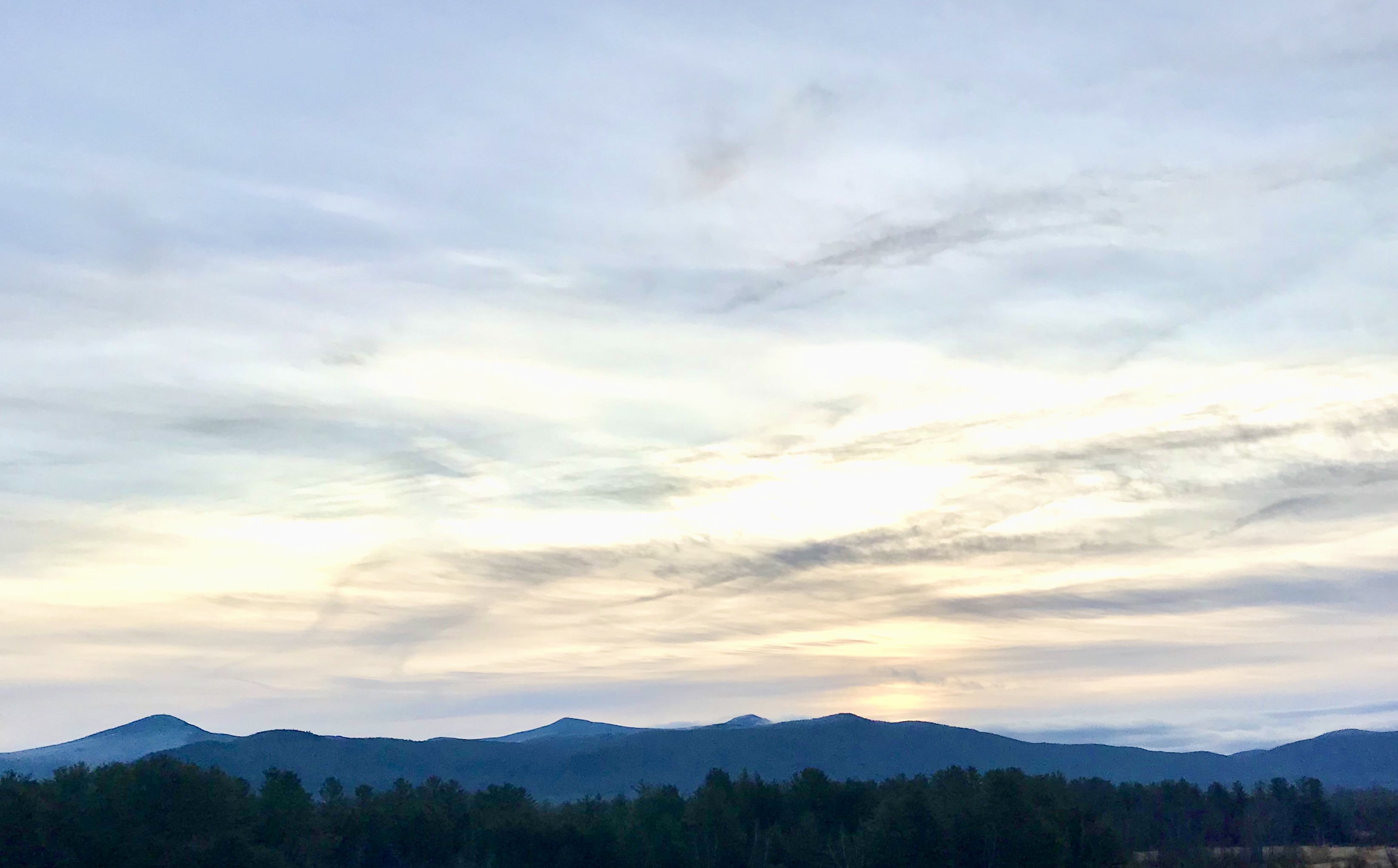
I can see about a quarter of a mile through the mist, and when, later, it is somewhat thinner, the woods, the pine woods, at a distance are a dark-blue color. January 13, 1859

I go to the river this morning and walk up it to see the trees and bushes along it. January 13, 1859

You must stand on the north side and look south at the trees, etc., when they appear, except the large limbs and trunk, wholly of snow or frostwork, mere ghosts of trees, seen softly against the mist for a background. January 13, 1859

It is mist on mist. The outline and character of each tree is more distinctly exhibited. January 13, 1859

The mist lasts all this day, though it is far from warm (+ 11° at 8 A. M.), and till noon of the 14th, when it becomes rain, and all this time there is exceedingly little if any wind. January 13, 1859

I see vapor rising from and curling along the open brook and also rising from the end of a plank in the sun, which is wet with melted snow, though the thermometer was 16° only when I left the house. 
January 13, 1860

The snow more than a foot deep over all the land. Few if any leave the beaten paths. January 13, 1852

The river is now completely concealed by snow. January 13, 1857

I come this way partly because it is the best walking here, the snow not so deep. January 13, 1857

In a very few places, for half a dozen feet the snow is blown off, revealing the dark transparent ice, in which I see numerous great white cleavages, which show its generous thickness, a foot at least. January 13, 1857

They cross each other at various angles and are frequently curved vertically, reflecting rainbow tints from within. January 13, 1857

The snow is drifted and much deeper about the button-bushes, January 13, 1857

The surface of the snow, now that the sun has shone on it so long, is not so light and downy, almost impalpable, as it was yesterday. 
January 13, 1860

I can see sparkles on it, but they are finer than at first and therefore less dazzling. January 13, 1860

The thin ice of the Mill Brook sides at the Turnpike bridge is sprinkled over with large crystals which look like asbestos or a coarse grain. January 13, 1860

This is no doubt the vapor of last evening crystallized. January 13, 1860

I see in low grounds numerous heads of bidens, with their seeds still. January 13, 1860

I see no tracks but of mice, and apparently of foxes, which have visited every muskrat-house and then turned short away. January 13, 1857


The only wildlife I notice is a crow on a distant oak. January 13, 1857

One man at the post-office said that a crow would drive a fox. He had seen three crows pursue a fox that was crossing the Great Meadows, and he fairly ran from [them] and took refuge in the woods. January 13, 1860

I see under some sizable white pines in E. Hubbard's wood, where red squirrels have run about much since this snow. . . The scales of the white pine cones are scattered about here and there. January 13, 1860

Picked up a pitch pine cone which had evidently been cut off by a squirrel. The successive grooves made by his teeth while probably he bent it down were quite distinct. The woody stem was a quarter of an inch thick, and I counted eight strokes of his chisel. January 13, 1855

Am surprised to see, returning, how much it has drifted in the Corner road . . .driving the traveller into the neighboring field, having some taken down the fence. January 13, 1857

Here I am on the Cliffs at half past three or four o'clock. January 13, 1852

Clear sky and bright sun. January 13, 1852

A few clouds are floating overhead, downy and dark. January 13, 1852

I see a long, light-textured cloud stretching from north to south, stretching over half the heavens; and underneath it, in the west, flitting mother-o'-pearl clouds, which change their loose-textured form and melt rapidly away, even while I write. January 13, 1852

Before I can complete this sentence, I look up and they are gone, like the steam from the engine in the winter air. January 13, 1852

Even a considerable cloud is dissolved and dispersed in a minute or two, and nothing is left but the pure ether. January 13, 1852

Then another comes by magic, is born out of the pure blue empyrean, and now this too has disappeared, and no one knows whither it is gone. January 13, 1852

I hear one thrumming a guitar below stairs. It reminds me of moments that I have lived. January 13, 1857

What a comment on our life is the least strain of music! It lifts me up above all the dust and mire of the universe. January 13, 1857

We hear the kindred vibrations, music! and we put out our dormant feelers unto the limits of the universe. January 13, 1857

When I hear music I fear no danger, I am invulnerable, I see no foe. I am related to the earliest times and to the latest. January 13, 1857

You are compelled to look at the sky for the earth is invisible. 
January 13, 1852

January 13, 2014
. . 
*****
*****

March 1, 1858 ("We have just had a winter with absolutely no sleighing.")
March 3, 1855 (“A few rods from the broad pitch pine beyond, I find a cone which was probably dropped by a squirrel in the fall, for I see the marks of its teeth where it was cut off; and it has probably been buried by the snow till now, for it has apparently just opened, and I shake its seeds out. . . . Most fallen pitch pine cones show the marks of squirrels’ teeth, showing they were cut off.”)
June 24, 1852 (“What could a man learn by watching the clouds?”)
August 3, 1852 (" At the east window. — A temperate noon. I hear a cricket creak in the shade; also the sound of a distant piano. . . .A thrumming of piano-strings beyond the gardens and through the elms. At length the melody steals into my being. . . .I am attuned to the universe, I am fitted to hear, my being moves in a sphere of melody, my fancy and imagination are excited to an inconceivable degree.”)
August 9, 1860 ("All at once a small cloud begins to form half a mile from the summit and rapidly grows in a mysterious manner till it drapes and conceals the summit above us for a few moments, then passes off and disappears northeastward just as it had come.”)
October 6 1857 ("Going through Ebby Hubbard's woods, I see thousands of white pine cones on the ground, fresh light brown, which lately opened and shed their seeds and lie curled up on the ground.")
November 23, 1852 (“You must go forth very early to see a hoar frost, which is rare here”);
November 29, 1856 ("This is the first snow.”)
December 3, 1854 ("The first snow of consequence fell in the evening, very damp (wind northeast); five or six inches deep in morning.”)
December 4, 1859 ("Awake to winter, and snow two or three inches deep, the first of any consequence.")
December 14, 1859 ("Snow-storms might be classified . . . this is a fine, dry snow, drifting nearly horizontally from the north, so that it is quite blinding to face")
December 14, 1859 ( "Snow-storms might be classified. .. . there is sleet, which is half snow, half rain.")
December 16 1853 (“These days, when the earth is still bare and the weather is so warm as to create much vapor by day, are the best for these frost works.”)
December 22, 1860 ("This evening and night, the second important snow, there having been sleighing since the 4th, and now")
December 26, 1853 ("The first snow of any consequence thus far. It is about three inches deep.”)
December 26, 1857 ("Snows all day, — first snow of any consequence, three or four inches in all.")
December 31, 1853("I hear very distinctly from the railroad causeway the whistle of the locomotive on the Lowell road. . . . It, as it were, takes me out of my body and gives me the freedom of all bodies and all nature. . . . The contact of sound with a human ear whose hearing is pure and unimpaired is coincident with an ecstasy. ") 
January 2, 1860 ("The past December has been remarkable for steady cold, or coldness, and sleighing.")
January 8, 1856 (“All of the pitch pine cones that I see, but one, are open.”)
January 8, 1860 ("The sloshy edges of the puddles are the frames of so many wave-shaped mirrors in which the leather-colored oak leaves, and the dark-green pines and their stems, on the hillside, are reflected.")
January 12, 1860 ("Such is the glitter or sparkle on the surface of a snow freshly fallen when the sun comes out and you walk from it, the points of light constantly changing.")

January 14, 1853 ("Snow freshly fallen is one thing, to-morrow it will be another.")
January 15, 1857 ("What is there in music that it should so stir our deeps?”)
January 21, 1855 ("The snow is turning to rain through a fine hail. Pines and oaks seen at a distance — say two miles off — are considerably blended and make one harmonious impression. The former, if you attend, are seen to be of a blue or misty black," )
January 22, 1856 (“At Walden, near my old residence, I find that since I was here on the 11th, apparently within a day or two, some gray or red squirrel or squirrels have been feeding on the pitch pine cones extensively. The snow under one young pine is covered quite thick with the scales they have dropped while feeding overhead.”)
January 26, 1856 ("We have had good sleighing ever since the 26th of December and no thaw.")
February 6, 1852 ("Mistiness makes the woods look denser, darker, and more imposing.")
February 7, 1857 (“The water on the ice is for the most part several inches deep, and trees reflected in it appear as when seen through a mist or smoke, apparently owing to the color of the ice.”)
February 7, 1856 ("During the rain the air is thick, the distant woods bluish, and the single trees on the hill, under the dull mist-covered sky, remarkably distinct and black.")
February 7, 1859 ("Evidently the distant woods are more blue in a warm and moist or misty day in winter.")
February 8, 1856 ("At this hour the crust sparkles with a myriad brilliant points or mirrors, one to every six inches, at least.")
February 9, 1860 ("A hoar frost on the ground this morning — for the open fields are mostly bare — was quite a novel sight. I had noticed some vapor in the air late last evening")
February 12, 1855 (“All trees covered this morning with a hoar frost, very handsome looking toward the sun, —the ghosts of trees.”)
February 15, 1859 ("We walk through almost invisible puddles on the river and meadows, in which we see the trees, etc., reflected.")

January 13, 2018

If you make the least correct 
observation of nature this year,
 you will have occasion to repeat it
 with illustrations the next, 
and the season and life itself is prolonged.


January 12 <<<<<<<<   January 13 >>>>>>>>  January 14

A Book of the Seasons,  by Henry Thoreau, January 13
A Book of the Seasons,  by Henry Thoreau
 "A book, each page written in its own season, 
out-of-doors, in its own locality."
 ~edited, assembled and rewritten by zphx ©  2009-2023

 tinyurl.com/HDT13Jan


Wednesday, January 13, 2021

The first sleighing this winter.


January 13. 

A drifting snow-storm last night and to-day, the first of consequence; and the first sleighing this winter.

H. D. Thoreau, Journal, January 13, 1853

A drifting snow-storm, the first of consequence. See December 26, 1853 ("The first snow of any consequence thus far. It is about three inches deep.”) and note to November 29, 1856 ("This is the first snow.”) See also December 14, 1859 ("Snow-storms might be classified . . . this is a fine, dry snow, drifting nearly horizontally from the north, so that it is quite blinding to face")

The first sleighing this winter. See January 26, 1856 ("We have had good sleighing ever since the 26th of December and no thaw."); March 1, 1858 ("We have just had a winter with absolutely no sleighing."); January 2, 1860 ("The past December has been remarkable for steady cold, or coldness, and sleighing."); December 22, 1860 ("This evening and night, the second important snow, there having been sleighing since the 4th, and now")


A Book of the Seasons,  by Henry Thoreau
"A book, each page written in its own season,
out-of-doors, in its own locality.”
~edited, assembled and rewritten by zphx © 2009-2022

Monday, January 13, 2020

The thin ice of the Mill Brook sides at the Turnpike bridge is sprinkled over with large crystals.


January 13

January 13, 2020

Tuttle was saying to-day that he did remember a certain man's living with him once, from something that occurred. It was this: The man was about starting for Boston market for Tuttle, and Mrs. Tuttle had been telling him what to get for her. The man inquired if that was all, and Mrs. Tuttle said no, she wanted some nutmegs. "How many," he asked. Tuttle, coming along just then, said, "Get a bushel." 

When the man came home he said that he had had a good deal of trouble about the nutmegs. He could not find so many as were wanted, and, besides, they told him that they did not sell them by the bushel. But he said that he would take a bushel by the weight. Finally he made out to get a peck of them, which he brought home. It chanced that nutmegs were very high just then, so Tuttle, after selecting a few for his own use, brought the remainder up to town and succeeded in disposing of them at the stores for just what he gave for them. 

One man at the post-office said that a crow would drive a fox. He had seen three crows pursue a fox that was crossing the Great Meadows, and he fairly ran from [them] and took refuge in the woods. 

Farmer says that he remembers his father's saying that as he stood in a field once, he saw a hawk soaring above and eying something on the ground. Looking round, he saw a weasel there eying the hawk. Just then the hawk stooped, and the weasel at the same instant sprang upon him, and up went the hawk with the weasel; but by and by the hawk began to come down as fast as he went up, rolling over and over, till he struck the ground. His father, going up, raised him up, when out hopped the weasel from under his wing and ran off none the worse for his fall. 

The surface of the snow, now that the sun has shone on it so long, is not so light and downy, almost impalpable, as it was yesterday, but is somewhat flattened down and looks even as if [it] had had a skim-coat of some whitewash. I can see sparkles on it, but they are finer than at first and therefore less dazzling. 

The thin ice of the Mill Brook sides at the Turnpike bridge is sprinkled over with large crystals which look like asbestos or a coarse grain. This is no doubt the vapor of last evening crystallized. I see vapor rising from and curling along the open brook and also rising from the end of a plank in the sun, which is wet with melted snow, though the thermometer was 16° only when I left the house. 

I see in low grounds numerous heads of bidens, with their seeds still. 

I see under some sizable white pines in E. Hubbard's wood, where red squirrels have run about much since this snow. They have run chiefly, perhaps, under the surface of the snow, so that it is very much under mined by their paths under these trees, and every now and then they have come to the surface, or the surface has fallen into their gallery. They seem to burrow under the snow about as readily as a meadow mouse. There are also paths raying out on every side from the base of the trees. And you see many holes through the snow into the ground where they now are, and other holes where they have probed for cones and nuts. The scales of the white pine cones are scattered about here and there. They seek a dry place to open them, — a fallen limb that rises above the snow, or often a lower dead stub projecting from the trunk of the tree.

H. D. Thoreau, Journal, January 13, 1860

The scales of the white pine cones are scattered about here and there. See October 6 1857 ("Going through Ebby Hubbard's woods, I see thousands of white pine cones on the ground, fresh light brown, which lately opened and shed their seeds and lie curled up on the ground.")


A Book of the Seasons,  by Henry Thoreau
"A book, each page written in its own season,
out-of-doors, in its own locality.”
~edited, assembled and rewritten by zphx © 2009-2022

Sunday, January 13, 2019

Hoar frost, crystallized fog, on the north side of every twig.


January 13. 


January 13, 2019

The cold spell is over, and here this morning is a fog or mist; the wind, if there is any, I think, northerly; and there is built out horizontally on the north side of every twig and other surface a very remarkable sort of hoar frost, the crystallized fog, which is still increasing. 

Mr. Edwin Morton was telling me night before last of a similar phenomenon witnessed in central New York, the fog of highlands or mountains crystallizing in this way and forming a white fringe or frost on the trees even to an inch and a half. 

This is already full an inch deep on many trees, and gets to be much more, perhaps an inch and a half even, on some in the course of the day. It is quite rare here, at least on  this scale. 

The mist lasts all this day, though it is far from warm (+ 11° at 8 A. M.), and till noon of the 14th, when it becomes rain, and all this time there is exceedingly little if any wind. 

I go to the river this morning and walk up it to see the trees and bushes along it. 

As the frostwork (which is not thin and transparent like ice, but white and snow-like, or between the distinctly leaf with veins and a mere aggregation of snow, though you easily distinguish the distinct leaves) is built out northward from each surface, spreading at an angle of about forty-five degrees, i. e. some twenty-odd each side of the north, you must stand on the north side and look south at the trees, etc., when they appear, except the large limbs and trunk, wholly of snow or frostwork, mere ghosts of trees, seen softly against the mist for a background. 

It is mist on mist. 

The outline and character of each tree is more distinctly exhibited, being exaggerated, and you notice any peculiarity in the disposition of the twigs. 

  • Some elm twigs, thus enlarged into snowy fingers, are strikingly regular and handsome.
  • In the case of most evergreens, it amounts to a very rich sugaring, being so firmly attached. 
  • The weeping willow seems to weep with more remarkable and regular curve than ever, and stands still and white with thickened twigs, as if carved in white marble or alabaster. 
  • Those trees, like alders, which have not grown much the past year — which have short and angular twigs—are the richest in effect. The end of each alder twig is recurved where the drooping catkin is concealed. On one side you see the dark-brown fruit, but on the north that too is concealed. 

I can see about a quarter of a mile through the mist, and when, later, it is somewhat thinner, the woods, the pine woods, at a distance are a dark-blue color.

H. D. Thoreau, Journal, January 13, 1859

A very remarkable sort of hoar frost, the crystallized fog, which is still increasing, an inch deep on many trees, and gets to be much more, perhaps an inch and a half even, on some in the course of the day. It is quite rare here, at least on this scale. See November 23, 1852 (“You must go forth very early to see a hoar frost, which is rare here”); December 16 1853 (“These days, when the earth is still bare and the weather is so warm as to create much vapor by day, are the best for these frost works.”); February 9, 1860 ("A hoar frost on the ground this morning — for the open fields are mostly bare — was quite a novel sight. I had noticed some vapor in the air late last evening"); February 12, 1855 (“All trees covered this morning with a hoar frost, very handsome looking toward the sun, —the ghosts of trees.”)

Through the mist the woods, the pine woods, at a distance are a dark-blue color.
 See January 21, 1855 ("The snow is turning to rain through a fine hail.Pines and oaks seen at a distance — say two miles off — are considerably blended and make one harmonious impression. The former, if you attend, are seen to be of a blue or misty black," ); February 7, 1856 ("During the rain the air is thick, the distant woods bluish, and the single trees on the hill, under the dull mist-covered sky, remarkably distinct and black."); February 7, 1859 ("Evidently the distant woods are more blue in a warm and moist or misty day in winter."); see also note to February 6, 1852 ("mistiness makes the woods look denser, darker, and more imposing."


A Book of the Seasons,  by Henry Thoreau
"A book, each page written in its own season,
out-of-doors, in its own locality.”
~edited, assembled and rewritten by zphx © 2009-2022

Saturday, January 13, 2018

Go to Lynn to lecture, via Cambridge.


January 13.
January 13, 2018

Wednesday. Go to Lynn to lecture, via Cambridge. 

4.30 P.M. — At Jonathan Buffum's, Lynn. Lecture in John B. Alley's parlor. 

Mr. J. Buffum describes to me ancient wolf-traps, made probably by the early settlers in Lynn, perhaps after an Indian model; one some two miles from the shore near Saugus, another more northerly; holes say seven feet deep, about as long, and some three feet wide, stoned up very smoothly, and perhaps converging a little, so that the wolf could not get out.

Tradition says that a wolf and a squaw were one morning found in the same hole, staring at each other.

H. D. Thoreau, Journal, January 13, 1858

Lecture at Lynn. Thoreau likely presented “An Excursion to the Maine Woods”.  See Thoreau's Lectures after Walden. 289-92

January 13, 2018


A Book of the Seasons,  by Henry Thoreau
"A book, each page written in its own season,
out-of-doors, in its own locality.”
~edited, assembled and rewritten by zphx © 2009-2022

Friday, January 13, 2017

A thrumming guitar reminds me of moments that I have lived.

January 13.

I hear one thrumming a guitar below stairs. It reminds me of moments that I have lived. 

What a comment on our life is the least strain of music! It lifts me up above all the dust and mire of the universe. I soar or hover with clean skirts over the field of my life. It is ever life within life, in concentric spheres. 

The field wherein I toil or rust at any time is at the same time the field for such different kinds of life! The farmer's boy or hired man has an instinct which tells him as much indistinctly, and hence his dreams and his restlessness; hence, even, it is that he wants money to realize his dreams with. The identical field where I am leading my humdrum life, let but a strain of music be heard there, is seen to be the field of some unrecorded crusade or tournament the thought of which excites in us an ecstasy of joy. 

The way in which I am affected by this faint thrumming advertises me that there is still some health and immortality in the springs of me. What an elixir is this sound! I, who but lately came and went and lived under a dish cover, live now under the heavens. It releases me; it bursts my bonds. 

Almost all, perhaps all, our life is, speaking comparatively, a stereotyped despair; i. e., we never at any time realize the full grandeur of our destiny. We forever and ever and habitually underrate our fate. 

Talk of infidels! Why, all of the race of man, except in the rarest moments when they are lifted above themselves by an ecstasy, are infidels. With the very best disposition, what does my belief amount to? This poor, timid, unenlightened, thick-skinned creature, what can it believe? I am, of course, hopelessly ignorant and unbelieving until some divinity stirs within me. 

Ninety-nine one-hundredths of our lives we are mere hedgers and ditchers, but from time to time we meet with reminders of our destiny. 

We hear the kindred vibrations, music! and we put out our dormant feelers unto the limits of the universe. We attain to a wisdom that passeth understanding. 

The stable continents undulate. The hard and fixed becomes fluid. "Unless above himself he can Erect himself, how poor a thing is man!" When I hear music I fear no danger, I am invulnerable, I see no foe. I am related to the earliest times and to the latest. 

There are infinite degrees of life, from that which is next to sleep and death, to that which is forever awake and immortal. We must not confound man with man. We cannot conceive of a greater difference than between the life of one man and that of another. I am constrained to believe that the mass of men are never so lifted above themselves that their destiny is seen to be transcendently beautiful and grand.

 P. M. — On the river to Bittern Rock. 

The river is now completely concealed by snow. I come this way partly because it is the best walking here, the snow not so deep. 

The only wild life I notice is a crow on a distant oak. 

The snow is drifted and much deeper about the button-bushes, etc. It is surprising what an effect a thin barrier of bushes has on it, causing it to lodge there until often a very large drift is formed more or less abrupt on the south. 

Wool-grass still rises above the snow along the sides. In a very few places, for half a dozen feet the snow is blown off, revealing the dark transparent ice, in which I see numerous great white cleavages, which show its generous thickness, a foot at least. They cross each other at various angles and are frequently curved vertically, reflecting rainbow tints from within. Small triangles only a foot or two over are seen to be completely cracked around at the point of convulsion, yet it is as firm there as anywhere. 

I am proud of the strength of my floor, and love to jump and stamp there and bear my whole weight on it. As transparent as glass, yet you might found a house on it. Then there are little feathery flake-like twisted cleavages, which extend not more than an inch into it. 

I see no tracks but of mice, and apparently of foxes, which have visited every muskrat-house and then turned short away. 

Am surprised to see, returning, how much it has drifted in the Corner road. It has overflowed from the northern fields and lodged behind the north wall, forming drifts as high as the wall, which extend from one third to two thirds across the road for two long reaches, driving the traveller into the neighboring field, having some taken down the fence. 

It must be pleasant to ride along in the narrow path against the untouched and spotless edge of the drift, which curves over sharp like the visor of a cap. Sometimes this edge is bent down till it is almost vertical, yet a foot or two wide and only a few inches thick.

H. D. Thoreau, Journal, January 13, 1857


We hear the kindred vibrations, music! and we put out our dormant feelers unto the limits of the universe. . . .I fear no danger, I am invulnerable, I see no foe. I am related to the earliest times and to the latest.  See  December 31, 1853("I hear very distinctly from the railroad causeway the whistle of the locomotive on the Lowell road. . . . It, as it were, takes me out of my body and gives me the freedom of all bodies and all nature. . . . The contact of sound with a human ear whose hearing is pure and unimpaired is coincident with an ecstasy. ") August 3, 1852 (" At the east window. — A temperate noon. I hear a cricket creak in the shade; also the sound of a distant piano. The music reminds me of imagined heroic ages; it suggests such ideas of human life and the field which the earth affords as the few noblest passages of poetry. Those few interrupted strains which reach me through the trees suggest the same thoughts and aspirations that all melody, by whatever sense appreciated, has ever done. I am affected. What coloring variously fair and intense our life admits of! How a thought will mould and paint it! Impressed by some vague vision, as it were, elevated into a more glorious sphere of life, we no longer know this, we can deny its existence. We say we are enchanted, perhaps. But what I am impressed by is the fact that this enchantment is no delusion. So far as truth is concerned, it is a fact such as what we call our actual existence, but it is a far higher and more glorious fact. It is evidence of such a sphere, of such possibilities. It is its truth and reality that affect me. A thrumming of piano-strings beyond the gardens and through the elms. At length the melody steals into my being. I know not when it began to occupy me. By some fortunate coincidence of thought or circumstance I am attuned to the universe, I am fitted to hear, my being moves in a sphere of melody, my fancy and imagination are excited to an inconceivable degree.”) See also note to January 15, 1857 ("What is there in music that it should so stir our deeps?”)


A Book of the Seasons,  by Henry Thoreau
"A book, each page written in its own season,
out-of-doors, in its own locality.”
~edited, assembled and rewritten by zphx © 2009-2022

Wednesday, January 13, 2016

A Book of the Seasons: January 13.


A drifting snow-storm
last night and to-day, the first
sleighing this winter.
January 13, 1853

The landscape is now
patches of bare ground and snow
running water, sun.

Still warm and thawing.
The landscape is now patches
of bare ground and snow. 
January 13, 1854

The cold spell over,
here this morning is hoar frost-- 
a crystallized fog.
January 13, 1859


I see the pine woods
at a distance through the mist --
a dark-blue color.
January 13, 1859

January 13, 2018

January 13.  See A Book of the Seasons,  by Henry Thoreau  January 13

A Book of the Seasons,  by Henry Thoreau 
"A book, each page written in its own season,
out-of-doors, in its own locality.”
~edited, assembled and rewritten by zphx © 2009-2022


A

In Nature nothing is wasted.


January 13

Sunrise. —A heavy lodging snow, almost rain, has been falling—how long? —coming from the eastward. 

The weather comparatively warm, but windy. It will probably turn to rain. Say four or five inches deep. It sticks to the sides of the houses. 

Take to pieces a pensile nest which I found the 11th on the south shore of Walden on an oak sapling (red or black), about fifteen feet from the ground. 

Though small, it measures three inches by three in the extreme, and was hung between two horizontal twigs or in a fork forming about a right angle, the third side being regularly rounded without any very stiff material. The twigs extended two or three inches beyond the nest. The bulk of it is composed of fine shreds or fibres, pretty long (say three to six inches), of apparently inner oak (?) bark, judging from some scraps of the epidermis adhering. It looks at first sight like sedge or grass. 

The bottom, which I accidentally broke off and disturbed the arrangement of, was composed of this about the same size and form, rough with little leaf-stalks or feet (probably hemlock), and also strips and curls of paper birch epidermis, and some hornet or other wasp nest used like the last. I mention the most abundant material first. Probably the needles and twigs were used on account of their curved form and elasticity, to give shape to the bottom. 

The sides, which were not so thick, were composed of bark shreds, paper birch, and hornet-nest (the two latter chiefly outside, probably to bind and conceal and keep out the wind), agglutinated together. But most pains was taken with the thin edge and for three quarters of an inch down, where, beside the bark-fibres, birch paper, and hornets’ nest, some silky reddish-brown and also white fibre was used to bind all with, almost spun into threads and passed over the twigs and agglutinated to them, or over the bark edge. 

The shreds of birch paper were smaller there, and the hornets’ nest looked as if it had been reduced to a pulp by the bird and spread very thinly here and there over all, mixed with the brown silk. This last looked like cow’s hair, but as I found a piece of a small brown cocoon, though a little paler, I suspect it was from that. The white may have been from a cocoon, or else vegetable silk. 

Probably a vireo’s nest, maybe red-eye’s. 

In Nature nothing is wasted. Every decayed leaf and twig and fibre is only the better fitted to serve in some other department, and all at last are gathered in her compost-heap. What a wonderful genius it is that leads the vireo to select the tough fibres of the inner bark, instead of the more brittle grasses, for its basket, the elastic pine-needles and the twigs, curved as they dried to give it form, and, as I suppose, the silk of cocoons, etc., etc., to bind it together with! 

I suspect that extensive use is made of these abandoned cocoons by the birds, and they, if anybody, know where to find them. 

There were at least seven materials used in constructing this nest, and the bird visited as many distinct localities many times, always with the purpose or design to find some particular one of these materials, as much as if it had said to itself, “Now I will go and get some old hornets’ nest from one of those that I saw last fall down in the maple swamp—perhaps thrust my bill into them—or some silk from those cocoons I saw this morning.” 

It turns to rain before noon, four or five inches of very moist snow or sleet having fallen.

H. D. Thoreau, Journal, January 13, 1856

It turns to rain before noon, four or five inches of very moist snow or sleet having fallen. See December 14, 1859 ( "Snow-storms might be classified. .. . there is sleet, which is half snow, half rain.")y


A Book of the Seasons,  by Henry Thoreau
"A book, each page written in its own season,
out-of-doors, in its own locality.”
~edited, assembled and rewritten by zphx © 2009-2022

Tuesday, January 13, 2015

Muddy, wet, and slippery.


January 13.

Warm and wet, with rain-threatening clouds drifting from southwest. Muddy, wet, and slippery. 

Surprised to see oak balls on a red oak. 

Picked up a pitch pine cone which had evidently been cut off by a squirrel. The successive grooves made by his teeth while probably he bent it down were quite distinct. The woody stem was a quarter of an inch thick, and I counted eight strokes of his chisel.

H. D. Thoreau, Journal, January 13, 1855

A pitch pine cone cut off by a squirrel.
See January 8, 1856 (“All of the pitch pine cones that I see, but one, are open.”); January 22, 1856 (“At Walden, near my old residence, I find that since I was here on the 11th, apparently within a day or two, some gray or red squirrel or squirrels have been feeding on the pitch pine cones extensively. The snow under one young pine is covered quite thick with the scales they have dropped while feeding overhead.”); March 3, 1855 (“A few rods from the broad pitch pine beyond, I find a cone which was probably dropped by a squirrel in the fall, for I see the marks of its teeth where it was cut off; and it has probably been buried by the snow till now, for it has apparently just opened, and I shake its seeds out. . . . Most fallen pitch pine cones show the marks of squirrels’ teeth, showing they were cut off.”)

January 13.  See A Book of the Seasons,  by Henry Thoreau  January 13

A Book of the Seasons,  by Henry Thoreau 
"A book, each page written in its own season,
out-of-doors, in its own locality.”
~edited, assembled and rewritten by zphx © 2009-2022


Popular Posts Last 30 Days.

The week ahead in Henry’s journal

The week ahead in Henry’s journal
A journal, a book that shall contain a record of all your joy.
"A stone fruit. Each one yields me a thought." ~ H. D. Thoreau, March 28, 1859


I sit on this rock
wrestling with the melody
that possesses me.