Showing posts with label Bedford. Show all posts

Monday, September 13, 2021

The Bedford sunrise bell.


September 13 

Railroad causeway, before sunrise.

Here is a morning after a warm, clear, moonlight night almost entirely without dew or fog.

It has been a little breezy through the night, it is true; but why so great a difference between this and other mornings of late? I can walk in any direction in the fields without wetting my feet.

I see the same rays in the dun, buff, or fawn-colored sky now, just twenty minutes before sunrise, though they do not extend quite so far as at sundown the other night. Why these rays? What is it divides the light of the sun? Is it thus divided by distant inequalities in the surface of the earth, behind which the other parts are concealed, and since the morning atmosphere is clearer they do not reach so far?

Some small island clouds are the first to look red.

The cross-leaved polygala emits its fragrance as if at will. 

You are quite sure you smelled it and are ravished with its sweet fragrance, but now it has no smell. You must not hold it too near, but hold it on all sides and at all distances, and there will perchance be wafted to you sooner or later a very sweet and penetrating fragrance. What it is like you cannot surely tell, for you do not enjoy it long enough nor in volume enough to compare it. It is very likely that you will not discover any fragrance while you are rudely smelling at it; you can only remember that you once perceived it.

Both this and the caducous polygala are now somewhat faded.

Now the sun is risen. The sky is almost perfectly clear this morning; not a cloud in the horizon.

The morning is not pensive like the evening, but joyous and youthful, and its blush is soon gone. It is unfallen day.

The Bedford sunrise bell rings sweetly and musically at this hour, when there is no bustle in the village to drown it. Bedford deserves a vote of thanks from Concord for it. It is a great good at these still and sacred hours, when towns can hear each other. It would be nought at noon.

H. D. Thoreau, Journal, September 13, 1851


The cross-leaved polygala emits its fragrance as if at will.
  See August 27, 1851 ("Polygala cruciata, cross-leaved polygala, has a very sweet but intermittent fragrance, as of checkerberry and mayflowers combined.");); July 13, 1852 ("The Polygala sanguinea and P. cruciata in Blister's meadow, both numerous and well out. The last has a fugacious (?) spicy scent, in which, methinks, I detect the scent of nutmegs. Afterward I find that it is the lower part of the stem and root which is most highly scented, like checkerberry, and not fugacious"); see also August 13, 1856 ("The root of the Polygala verticillata also has the checkerberry odor.") See also A Book of the Seasons, by Henry Thoreau,The Polygala

The morning is not pensive like the evening, but joyous and youthful, and its blush is soon gone. See July 3, 1840 (We will have a dawn, and noon, and serene sunset in ourselves.); July 18, 1851 ("It is a test question affecting the youth of a person , — Have you knowledge of the morning? Do you sympathize with that season of nature? Are you abroad early, brushing the dews aside ? If the sun rises on you slumbering, if you do not hear the morning cock-crow, if you do not witness the blushes of Aurora, if you are not acquainted with Venus as the morning star, what relation have you to wisdom and purity? "); December 29, 1851 ("What a fine and measureless joy the gods grant us by letting us know nothing about the day that is to dawn! . . . This day, yesterday, was as incredible as any other miracle."); March 17, 1852 (“There is a moment in the dawn,. . . when we see things more truly than at any other time.”); June 13, 1852 ("All things in this world must be seen with the morning dew on them, must be seen with youthful, early-opened, hopeful eyes"); June 17, 1852 ("Perhaps these mornings are the most memorable in the year, — after a sultry night and before a sultry day, — when, especially, the morning is the most glorious season of the day, when its coolness is most refreshing and you enjoy the glory of the summer gilded or silvered with dews, without the torrid summer's sun or the obscuring haze."); August 31, 1852 ("Morning is full of promise and vigor. Evening is pensive."); January 26, 1853 (“ I look back . . . not into the night, but to a dawn for which no man ever rose early enough.”); March 31, 1852("How can one help being an early riser and walker in that season when the birds begin to twitter and sing in the morning? March 22, 1853 ("As soon as these spring mornings arrive in which the birds sing, I am sure to be an early riser.. . .expecting the dawn in so serene and joyful and expectant a mood."); January 8, 1854 ("The morning hope is soon lost in what becomes the routine of the day, and we do not recover ourselves again until we land on the pensive shores of evening, shores which skirt the great western continent of the night."); Walden (“To him whose elastic and vigorous thought keeps pace with the sun, the day is a perpetual morning. It matters not what the clocks say . . . Morning is when I am awake and there is a dawn in me.”); Walden (“ Only that day dawns to which we are awake.”); Walden ("We must learn to reawaken and keep ourselves awake, by an infinite expectation of the dawn.”); February 25, 1859 ("Measure your health by your sympathy with morning and spring. If there is no response in you to the awakening of nature, — if the prospect of an early morning walk does not banish sleep, if the warble of the first bluebird does not thrill you,— know that the morning and spring of your life are past.")

The Bedford sunrise bell rings sweetly and musically at this hour.
 See January 2, 1842 ("The ringing of the church bell is a much more melodious sound than any that is heard within the church."); August 8, 1851 (“I hear the nine o'clock bell ringing in Bedford. Pleasantly sounds the voice of one village to another. ”); January 2, 1853 ("The bells are particularly sweet this morning."); January 21, 1853 ("In this stillness and at this distance, I hear the nine-o'clock bell in Bedford five miles off, which I might never hear in the village, but here its music surmounts the village din and has something very sweet and noble and inspiring in it, associated, in fact, with the hooting of owls."); ; April 15, 1855 ("The sound of church bells . . ., sounds very sweet to us on the water this still day").  See also  March 3, 1841 ("Nature always possesses a certain sonorousness , as in the hum of insects, the booming of ice, the crowing of cocks in the morning, and the barking of dogs in the night, which indicates her sound state. God's voice is but a clear bell sound. I drink in a wonderful health, a cordial, in sound. The effect of the slightest tinkling in the horizon measures my own soundness. I thank God for sound; it always mounts, and makes me mount. I think I will not trouble myself for any wealth, when I can be so cheaply enriched.")

Tuesday, October 6, 2020

The reach of the river between Bedford and Carlisle, seen from a distance


October  6.

Monday. 12 m. — To Bedford line to set a stone by river on Bedford line. 


Carlisle Reach


The reach of the river between Bedford and Carlisle, seen from a distance in the road to-day, as formerly, has a singularly ethereal, celestial, or elysian look. It is of a light sky-blue, alternating with smoother white streaks, where the surface reflects the light differently, like a milk-pan full of the milk of Valhalla partially skimmed, more gloriously and heavenly fair and pure than the sky itself.

It is something more celestial than the sky above it. I never saw any water look so celestial. I have often noticed it. I believe I have seen this reach from the hill in the middle of Lincoln.

We have names for the rivers of hell, but none for the rivers of heaven, unless the Milky Way be one.

It is such a smooth and shining blue, like a panoply of sky-blue plates.

Our dark and muddy river has such a tint in this case as I might expect Walden or White Pond to exhibit, if they could be seen under similar circumstances, but Walden seen from Fair Haven is, if I remember, of a deep blue color tinged with green.

Cerulean?

Such water as that river reach appears to me of quite incalculable value, and the man who would blot that out of his prospect for a sum of money does not otherwise than to sell heaven.

George Thatcher, having searched an hour in vain this morning to find a frog, caught a pickerel with a mullein leaf.

The white ash near our house, which the other day was purple or mulberry-color, is now much more red. 


7.30 P. M. – To Fair Haven Pond by boat, the moon four-fifths full, not a cloud in the sky; paddling all the way.

The water perfectly still, and the air almost, the former gleaming like oil in the moonlight, with the moon's disk reflected in it.

When we started, saw some fishermen kindling their fire for spearing by the riverside.

It was a lurid, reddish blaze, contrasting with the white light of the moon, with dense volumes of black smoke from the burning pitch pine roots rolling upward in the form of an inverted pyramid.The blaze reflected in the water, almost as distinct as the substance. It looked like tarring a ship on the shore of the Styx or Cocytus. For it is still and dark, notwithstanding the moon, and no sound but the crackling of the fire.

The fishermen can be seen only near at hand, though their fire is visible far away; and then they appear as dusky, fuliginous figures, half enveloped in smoke, seen only by their enlightened sides. Like devils they look, clad in old coats to defend themselves from the fogs, one standing up forward holding the spear ready to dart, while the smoke and flames are blown in his face, the other paddling the boat slowly and silently along close to the shore with almost imperceptible motion.

The river appears indefinitely wide; there is a mist rising from the water, which increases the indefiniteness. A high bank or moonlit hill rises at a distance over the meadow on the bank, with its sandy gullies and clamshells exposed where the Indians feasted.

The shore line, though close, is removed by the eye to the side of the hill. It is at high-water mark. It is continued till it meets the hill.

Now the fisherman's fire, left behind, acquires some thick rays in the distance and becomes a star. As surely as sunlight falling through an irregular chink makes a round figure on the opposite wall, so the blaze at a distance appears a star.

Such is the effect of the atmosphere.

The bright sheen of the moon is constantly travelling with us, and is seen at the same angle in front on the surface of the pads; and the reflection of its disk in the rippled water by our boat-side appears like bright gold pieces falling on the river's counter. This coin is incessantly poured forth as from some unseen horn of plenty at our side.

(I hear a lark singing this morn (October 7th ), and yesterday saw them in the meadows. Both larks and blackbirds are heard again now occasionally, seemingly after a short absence, as if come to bid farewell.)

I do not know but the weirdness of the gleaming oily surface is enhanced by the thin fog.

A few water-bugs are seen glancing in our course.

I shout like a farmer to his oxen, — a short barking shout, — and instantly the woods on the eastern shore take it up, and the western hills a little up the stream; and so it appears to rebound from one side the river valley to the other, till at length I hear a farmer call to his team far up as Fair Haven Bay, whither we are bound.

We pass through reaches where there is no fog, perhaps where a little air is stirring.

Our clothes are almost wet through with the mist, as if we sat in water.

Some portions of the river are much warmer than others.

In one instance it was warmer in the midst of the fog than in a clear reach.

In the middle of the pond we tried the echo again. First the hill to the right took it up; then further up the stream on the left; and then after a long pause, when we had almost given it up, — and the longer expected, the more in one sense unexpected and surprising it was, — we heard a farmer shout to his team in a distant valley, far up on the opposite side of the stream, much louder than the previous echo; and even after this we heard one shout faintly in some neighboring town.
The third echo seemed more loud and distinct than the second.

But why, I asked, do the echoes always travel up the stream?

I turned about and shouted again, and then I found that they all appeared equally to travel down the stream, or perchance I heard only those that did so.

As we rowed to Fair Haven's eastern shore, a moonlit hill covered with shrub oaks, we could form no opinion of our progress toward it, — not seeing the water line where it met the hill, – until we saw the weeds and sandy shore and the tall bulrushes rising above the shallow water ( like ) the masts of large vessels in a haven. The moon was so high that the angle of excidence did not permit of our seeing her reflection in the pond.

As we paddled down the stream with our backs to the moon, we saw the reflection of every wood and hill on both sides distinctly. These answering reflections-shadow to substance-impress the voyager with a sense of harmony and symmetry, as when you fold a blotted paper and produce a regular figure, - a dualism which nature loves.

What you commonly see is but half.

Where the shore is very low the actual and reflected trees appear to stand foot to foot, and it is but a line that separates them, and the water and the sky almost flow into one another, and the shore seems to float.

As we paddle up or down, we see the cabins of muskrats faintly rising from amid the weeds, and the strong odor of musk is borne to us from particular parts of the shore.

Also the odor of a skunk is wafted from over the meadows or fields.

The fog appears in some places gathered into a little pyramid or squad by itself, on the surface of the water.

Home at ten.

H. D. Thoreau, Journal, October 6, 1851 


To Bedford line to set a stone by river on Bedford line.
See September 18, 1851 ("Perambulated Bedford line.") See also April 3, 1858 ("we paddle along all day, down to the Bedford line.")

The reach of the river between Bedford and Carlisle, seen from a distance in the road to-day, as formerly, has a singularly ethereal, celestial, or elysian look. See  April 1, 1852 ("Now I see the river - reach , far in the north . The more distant river is ever the most ethereal ,");April 10, 1852 ("This meadow is about two miles long at one view from Carlisle Bridge southward, appearing to wash the base of Pine hill, and it is about as much longer northward and from a third to a half a mile wide."):August 24, 1858 ("I look down a straight reach of water to the hill by Carlisle Bridge, —and this I can do at any season, — the longest reach we have. It is worth the while to come here for this prospect, — to see a part of earth so far away over the water")

The water and sky 
flow into one another –
 the shore seems to float.


The sheen of the moon 
constantly travels with us –
bright gold at out side.

tinyurl.com/HDT511006

Wednesday, September 16, 2020

Select men.


Met the selectmen of Sudbury, ____and ____. I trust that towns will remember that they are supposed to be fairly represented by their select men.

From the specimen which Acton sent, I should judge that the inhabitants of that town were made up of a mixture of quiet, respectable, and even gentlemanly farmer people, well to do in the world, with a rather boisterous, coarse, and a little self-willed class; 


that the inhabitants of Sudbury are farmers almost exclusively, exceedingly rough and countrified and more illiterate than usual, very tenacious of their rights and dignities and difficult to deal with; 

that the inhabitants of Lincoln yield sooner than usual to the influence of the rising generation, and are a mixture of rather simple but clever with a well-informed and trustworthy people; 

that the inhabitants of Bedford are mechanics, who aspire to keep up with the age, with some of the polish of society, mingled with substantial and rather intelligent farmers.

____of Sudbury thinks the river would be still lower now if it were not for the water in the reservoir pond in Hopkinton running into it.


H. D. Thoreau, Journal, September 16, 1851


Tuesday, March 17, 2020

Getting ice out of Loring's Pond.

March 17. 

Channing says he saw blackbirds yesterday; F. C. Brown, that they were getting ice out of Loring's Pond yesterday.

P. M . – Rode to Lexington with Brown. 

Saw, on the corner of a wall by a house about three quarters of a mile from the monument on the Bedford road, a stone apparently worn by water into the form of a rude bird-like idol, which I thought, as I rode by, to be the work of the Indians. It was probably discovered and used by them. 

It was as near as nature might come by accident to an eagle, with a very regular pedestal such as busts have, on which it stood  — in all about two and a half feet high. Whitewashed as well as the wall. Found not near water. It is one of those stones which Schoolcraft describes as found among the Chippeways. 

The ways are mostly settled, frozen dry.

H. D. Thoreau, Journal, March 17, 1853


Channing says he saw blackbirds yesterday. See March 11, 1852 ("I believe that I saw blackbirds yesterday."); March 17, 1858 ("Now I hear, when passing the south side of the hill, or first when threading the maple swamp far west of it, the tchuck tchuck of a blackbird, and after, a distinct conqueree. So it is a red-wing? Thus these four species of birds have all come in one day, no doubt to almost all parts of the town.") See also note to March 17, 1860 ("How handsome a flock of red-wings,").

It is one of those stones which Schoolcraft describes as found among the Chippeways. 
Henry Rowe Schoolcraft (March 28, 1793 – December 10, 1864) was an American ethnologist noted for his early studies of Native American cultures, as well as for his 1832 expedition to the source of the  Mississippi River. He is also noted for his major six-volume study of Native Americans published in the 1850s. ~Wikipedia

The ways are mostly settled, frozen dry. See March 15, 1860 ("Though it is pretty dry and settled travelling on open roads, it is very muddy still in some roads through woods"); March 19, 1860 ("The road and paths are perfectly dry and settled in the village, except a very little frost still coming out on the south side the street.");  March 21, 1858 ("This first spring rain . . .helps take the remaining frost out and settles the ways.")

Friday, January 31, 2020

The ice has many curious marks on it.


January 31

2 p. m. — To Bedford Level. 


Thermometer 45. Fair but all overcast. Sun's place quite visible. Wind southwest.

Went to what we called Two-Boulder Hill, behind the house where I was born. There the wind suddenly changed round 90° to northwest, and it became quite cold (had fallen to 24° at 5.30). 

Called a field on the east slope Crockery Field, there were so many bits in it. 

Saw a pitch pine on a rock about four feet high, but two limbs flat on the ground. This spread much and had more than a hundred cones of different ages on it. Such are always the most fertile. 

Can look a great way northeast along the Bedford Swamp. 

Saw a large hawk, probably hen-hawk. 

The ice that has been rotting and thawing from time to time on the meadows — the water run out from below — has many curious marks on it. There are many ingrained waving lines more or less parallel. Often they make circular figures, or oval, and are concentric, as if they marked the edge of a great bubble or the like. 

I notice the ice on a ditched brook so far worn by the current as to be mackerelled in color, white and dark, all along the middle, making a figure two or three rods long which reminds me forcibly of the flat skin of a boa-constrictor, — marked just like it.

H. D. Thoreau, Journal, January 31, 1860


The house where I was born.
See About Thoreau Farm (“[I was] born July 12, 1817 in the Minott House, on the Virginia Road," Concord); and note to December 27. 1855 ("the various houses (and towns) in which I have lived")

A pitch pine on a rock about four feet high had more than a hundred cones of different ages on it
. See  April 29, 1857 ("See old cones within two feet of the ground on the trunk, — sometimes a circle of them around it, — which must have been formed on the young tree some fifteen years ago.");  pitch pine cones two years old still closed on felled trees, two to six together recurved, in the last case closely crowded and surrounding the twig in a ring, forming very rich-looking clusters eight to ten inches from the extremity, and, within two or three inches of the extremity, maybe one or two small ones of the last year. Low down on twigs around the trunks of old trees, and sometimes on the trunk itself, you see old gray cones which have only opened or blossomed at the apex, covered with lichens; which have lost their spines. February 18, 1855 ("I see pitch pine cones two years old still closed on felled trees, two to six together recurved, in the last case closely crowded and surrounding the twig in a ring, forming very rich-looking clusters eight to ten inches from the extremity, and, within two or three inches of the extremity, maybe one or two small ones of the last year. Low down on twigs around the trunks of old trees, and sometimes on the trunk itself, you see old gray cones which have only opened or blossomed at the apex, covered with lichens; which have lost their spines."); see also T. Evans, Forest Trees of Vemont ("Cones often remain on the trees 10-12 years.") and  A Book of the Seasons, The Pitch Pine in Winter

The ice that has been rotting and thawing has many curious marks on it. See January 26, 1859 ("The ice, having fairly begun to decompose, is very handsomely marked  . . .  with a sort of graphic character, or bird-tracks, very agreeable and varied.")

I notice the ice so far worn by the current as to be mackerelled in color, white and dark, all along the middle. See March 3, 1857 ("Flakes of thin ice from two or three inches to a foot in diameter, scattered like a mackerel sky over the pastures"); January 25, 1860 ("When the river begins to break up, it becomes clouded like a mackerel sky, but in this case the blue portions are where the current, clearing away the ice beneath, begins to show dark."); February 12, 1860 ("Above me is a cloudless blue sky; beneath, the sky-blue, sky-reflecting ice with patches of snow scattered over it like mackerel clouds");
JANUAR 28, 2018

A mackerel sky
of pine boughs sunny above
and shaded beneath.

Wednesday, September 18, 2019

Perambulated Bedford line.

September 18

Perambulated Bedford line.

H. D. Thoreau, Journal, September 18, 1851

See October 6, 1851 ("To Bedford line to set a stone by river on Bedford line."); January 21, 1853 ("I hear the nine- o'clock bell in Bedford five miles off,"); October 8, 1853 ("surveying on the new Bedford road to-day,");  April 3, 1858 ("we paddle along all day, down to the Bedford line."); May 15, 1858("Measured two apple trees by the road from the middle of Bedford"); See also September 17, 1851 ("Perambulated the Lincoln line.")

Tuesday, May 15, 2018

The shad-bush in bloom.

May 15

7.30 A. M. – Ride to the Shawsheen in the northeast of Bedford. 

Meadow saxifrage well out, many of them, at the tan-yard meadow. 

The Equisetum limosum will apparently (?) open there in two or three days.

Thalictrum dioicum abundant, apparently in prime; how long? It is a very interesting, graceful, and delicate plant, especially the sterile, with its pretty, commonly purple, petal-like sepals, and its conspicuous long yellow anthers in little bare clusters (?), trembling over the meadow. Yet a frail and rather inobvious plant. It grows on moist, commonly rocky slopes next to meadows at the base of hills, or by rocks in rather swampy woods. 

The meadows are now full of sedges in bloom, which shed clouds of pollen and cover my shoes with it. 

The cassia has not come up yet. 

High blueberries well out. 

Hear the evergreen-forest note. 

Also, in rather low ground in Bedford, a note much like the summer yellowbird's, or between that and the redstart, and see the bird quite near, but hopping quite low on the bushes. It looked like the yellowbird with a bluish ash top of head. What was it? [Probably parti-colored warbler.]

The shad-bush in bloom is now conspicuous, its white flags on all sides. Is it not the most massy and conspicuous of any wild plant now in bloom? I see where the farmer mending his fence has just cut one to make part of the fence, and it is stretched out horizontally, a mass of white bloom. 

Measured two apple trees by the road from the middle of Bedford and Fitch’s mill. One, which divided at the ground, was thirteen and a half feet in circumference there, around the double trunk; but another, in a field on the opposite side of the road, was the most remarkable tree for size. 

This tree was exceedingly low for the size of its trunk, and the top rather small. At three feet from the ground it measured ten and a quarter feet in circumference, and immediately above this sent off a branch as big as a large apple tree. It was hollow, and on one side part of the trunk had fallen out. These trees mark the residence of an old settler evidently.

H. D. Thoreau, Journal  May 15, 1858

It looked like the yellowbird with a bluish ash top of head. See May 15, 1856 ("See also, for a moment, in dry woods, a warbler with blue-slate head and apparently all yellow beneath for a minute, nothing else conspicuous; note slightly like tseep, tseep, tseep, tseep, tsit sitter ra-re-ra")  ; May 16, 1858 ("See again the warbler of yesterday. . . . Its note, with little variation, is like twit twit, twit twit, twitter twitter twe. It must be the parti-colored warbler"); and note to May 13, 1856 ("The tweezer-bird or Sylvia Americana . . .the parti-colored warbler, and was that switter switter switter switter swit also by it?.”)

Hear the evergreen-forest note. See May 11, 1854 ("Hear the evergreen-forest note"); May 6, 1855 ("The er er twe, ter ter twe, evergreen-forest note.");  June 1, 1854 ("Hear my evergreen-forest note, . . . I get a glimpse of its black throat and, I think, yellow head "); May 30, 1855 ("In the thick of the wood between railroad and Turnpike, hear the evergreen forest note, and see probably the bird,-- black throat, greenish-yellow or yellowish-green head and back, light-slate (?) wings with two white bars. Is it not the black-throated green warbler?”).

The shad-bush in bloom is now conspicuous. See May 9, 1852 ("The first shad-bush, Juneberry, or service-berry (Amclanchier canadensis), in blossom.") and note to May 13, 1852 ("The shad-blossom days in the woods.")

Tuesday, April 3, 2018

The Day of the Snoring Frogs, or the Awakening of the Meadows.

April 3. 

Going down-town this morning, I am surprised by the rich strain of the purple finch from the elms. Three or four have arrived and lodged against the elms of our street, which runs east and west across their course, and they are now mingling their loud and rich strains with that of the tree sparrows, robins, bluebirds, etc. 

The hearing of this note implies some improvement in the acoustics of the air. It reminds me of that genial state of the air when the elms are in bloom. 

They sit still over the street and make a business of warbling. They advertise me surely of some additional warmth and serenity. How their note rings over the roofs of the village! You wonder that even the sleepers are not awakened by it to inquire who is there, and yet probably not another than myself in all the town observes their coming, and not half a dozen ever distinguished them in their lives. And yet the very mob of the town know the hard names of Germanians or Swiss families which once sang here or elsewhere. 

About 9 A. M., C. and I paddle down the river. 

It is a remarkably warm and pleasant day. The shore is alive with tree sparrows sweetly warbling, also black birds, etc. The crow blackbirds which I saw last night are hoarsely clucking from time to time. 

Approaching the island, we hear the air full of the hum of bees, which at first we refer to the near trees. It comes from the white maples across the North Branch, fifteen rods off. We hear it from time to time, as we paddle along all day, down to the Bedford line. There is no pause to the hum of the bees all this warm day. It is a very simple but pleasing and soothing sound, this susurrus, thus early in the spring. 

When off the mouth of the Mill Brook, we hear the stertorous tut tut tut of frogs from the meadow, with an occasional faint bullfrog-like er er er intermingled. I land there to reconnoitre. 

The river is remarkably low, quite down to summer level, and there is but very little water anywhere on the meadows. I see some shallow lagoons (west of the brook), whence the sound comes. 

There, too, are countless painted turtles out, around on the banks and hummocks left by the ice. Their black and muddy backs shine afar in the sun, and though now fifteen to twenty rods off, I see through my glass that they are already alarmed, have their necks stretched out and are beginning to slip into the  water, where many heads are seen. 

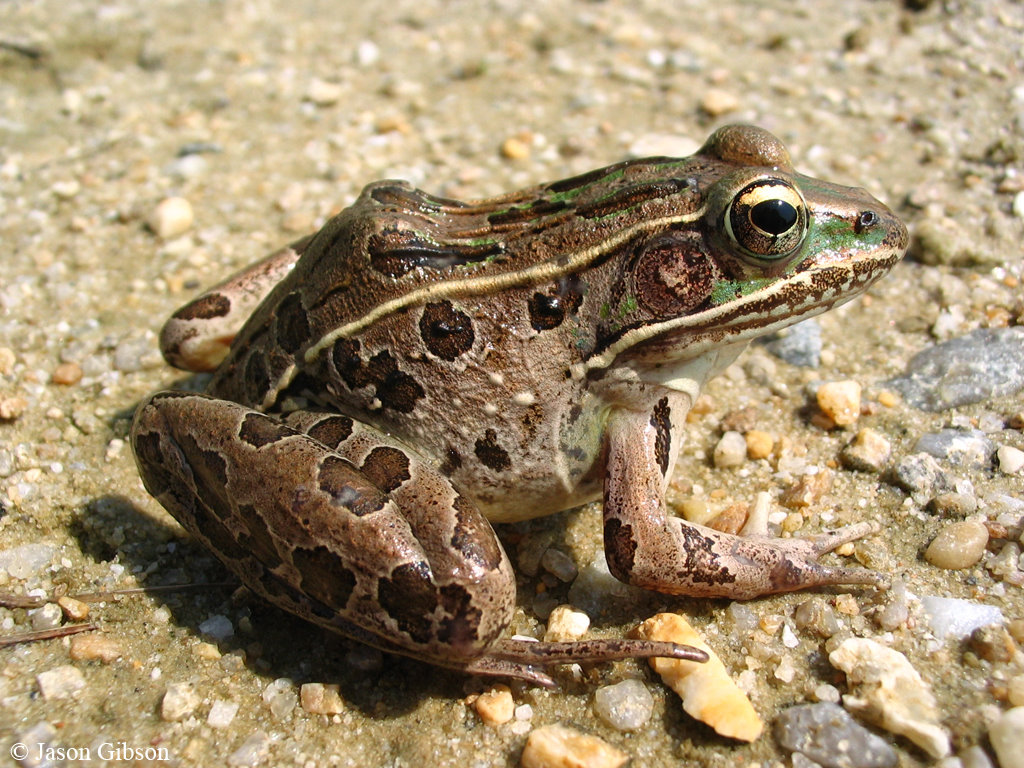
Resolved to identify this frog, one or two of whose heads I could already see above the surface with my glass, I picked my way to the nearest pool. Close where I landed, an R. halecina lay out on some sedge. In went all the turtles immediately, and soon after the frogs sank to the bottom, and their note was heard only from more distant pools. 

I stood perfectly still, and ere long they began to reappear one by one, and spread themselves out on the surface. They were the R. halecina. I could see very plainly the two very prominent yellow lines along the sides of the head and the large dark ocellated marks, even under water, on the thighs, etc. Gradually they begin to recover their voices, but it is hard to say at first which one of the dozen within twenty feet is speaking. They begin to swim and hop along the surface toward each other. Their note is a hard dry tut tut tut tut, not at all ringing like the toad’s, and produced with very little swelling or motion of the throat, but as much trembling of the whole body; and from time to time one makes that faint somewhat bullfrog-like er er er. Both these sounds, then, are made by one frog, and what I have formerly thought an early bullfrog note was this. 

This, I think, is the first frog sound I have heard from the river meadows or anywhere, except the croaking leaf-pool frogs and the hylodes. They are evidently breeding now like toads, and probably are about the water as exclusively as the toads will soon be. 

This sound we continue to hear all day long, especially from the broad meadows in Bedford. Close at hand a single one does not sound loud, yet it is surprising how far a hundred or thousand croaking ( ? ) at once can be heard. It comes borne on the breeze from north over the Bedford meadows a quarter of a mile off, filling the air. It is like the rattling of a wagon along some highway, or more like a distant train on a railroad, or else of many rills emptying in, or more yet like the sound of a factory, and it comes with an echo which makes it seem yet more distant and universal. At this distance it is a soft and almost purring sound, yet with the above-named bullfrog-like variation in it. 

Sometimes the meadow will be almost still; then they will begin in earnest, and plainly excite one an other into a general snoring or eructation over a quarter of a mile of meadow. It is unusually early to hear them so numerously, and by day, but the water, being so very low and shallow on the meadows, is unusually warm this pleasant day. This might be called the Day of the Snoring Frogs, or the Awakening of the Meadows. 

Probably the frost is out of the meadows very early this year. It is a remarkable spring for reptile life. 

It remains now to detect the note of the palustris, wood frog, and fontinalis. I am not sure but I heard one kind of bullfrog’s note along the river once or twice. I saw several middle-sized frogs with green noses and dark bodies, small, bullfrog-like (? ?), sitting along the shore. 

At what perhaps is called the Holt just below N. Barrett’s, many grackles and red-wings together flit along the willows by our side, or a little ahead, keeping up a great chattering, while countless painted turtles are as steadily rustling and dropping into the water from the willows, etc., just ahead. 

We land at Ball's Hill and eat our dinners. It is so warm we would fain bathe. We seek some shade and cannot easily find it. You wonder that all birds and insects are not out at once in such a heat. We find it delicious to take off our shoes and stockings and wade far through the shallows on the meadow to the Bedford shore, to let our legs drink air. 

How pretty the white fibrous roots of the eriocaulon, floating in tufts on the meadow, like beaded chains! 

In the hazy atmosphere yesterday we could hardly see Garfield's old unpainted farmhouse. It was only betrayed by its elms. This would be the right color for painters to imitate. When the sun went into a cloud we detected the outlines of the windows only. 

When returning, we discovered, on the south side of the river, just at the old crossing-place from the Great Meadows, north of the ludwigia pool, a curious kind of spawn. It was white, each ovum about as big as a robin-shot or larger, with mostly a very minute white core, no black core, and these were agglutinated together in the form of zigzag hollow cylinders, two or three inches in diameter and one or two feet long, looking like a lady's ruff or other muslin work, on the bottom or on roots and twigs of willow and button-bush, where the water was two or three feet deep. The greater part lay on the bottom, looking like a film, these cylinders being somewhat coiled about there. When you took it up, the two sides fell together, and it was flat in your hand like the leg of a stocking. In one place there were a dozen very large red-bellied and brown-backed leeches in it, evidently battening on it. This must be frog or fish spawn. 

If frog-spawn, I think it must be that of the Rana halecina [No. Vide April 5th. Is it not fish-spawn?], the only ones fairly awake along the river; but how are leeches propagated? There was a great abundance of it, many bushels, for at least a dozen rods along the shore, and it must afford food to many creatures. The consistency of a jelly we eat. We saw one perch there. Some on the ruts was quite up to the surface, but most lower. When you had taken up a handful and broken it, on dropping it into the water it recovered its form for the most part. I noticed that the fine willow root-fibres and weeds, potamogeton, etc., there were thickly covered with a whitish film or fuzz, an eighth to a quarter of an inch deep, or long, apparently connected with this spawn, which made them look like plants covered with frost in a winter morning, though it was a duller white; but out of water you did not perceive anything. Probably this was the milt. 

When I have been out thus the whole day and spend the whole afternoon returning, it seems to me pitiful and ineffectual to be out as usual only in the afternoon, – as if you had come late to a feast, after your betters had done. The afternoon seems coarse and reversed, or at best a long twilight, after the fresh and bright forenoon. 

The gregariousness of men is their most contemptible and discouraging aspect. See how they follow each other like sheep, not knowing why. Day & Martin's   blacking was preferred by the last generation, and also is by this. They have not so good a reason for preferring this or that religion as in this case even. Apparently in ancient times several parties were nearly equally matched. They appointed a committee and made a compromise, agreeing to vote or believe so and so, and they still helplessly abide by that. Men are the inveterate foes of all improvement. Generally speaking, they think more of their hen-houses than of any desirable heaven. If you aspire to anything better than politics, expect no cooperation from men. They will not further anything good. You must prevail of your own force, as a plant springs and grows by its own vitality. 

Hear the Rana halecina in the evening also, from my window.


Rana halecina

I could see very plainly the two very prominent yellow lines along the sides of the head
and the large dark ocellated marks, even under water, on the thighs, etc.

H. D. Thoreau, Journal, April 3, 1858

We hear the air full of the hum of bees, which . . .comes from the white maples across the North Branch, fifteen rods off. . .It is a very simple but pleasing and soothing sound, this susurrus, thus early in the spring. See April 6, 1854 ("I am surprised to find so much of the white maples already out. . . . They resound with the hum of honey-bees, heard a dozen rods off, and you see thousands of them about the flowers against the sky. . . .This susurrus carries me forward some months toward summer --"); April 6, 1853 ("Notice a white maple with almost all the staminate flowers above or on the top, most of the stamens now withered, before the red maple has blossomed. Another maple, all or nearly all female. The staminiferous flowers look light yellowish, the female dark crimson”); April 6,1855 ("A very few white maple stamens stand out already loosely enough to blow in the wind.") White maple stamens stand out already loosely enough to blow in the wind.");  April 7, 1861 (" The white maple at the bridge not quite out.”); April 8, 1855 (I find some anthers effete and dark, and others still mealy with pollen. There are many in this condition. The crimson female stigmas also peeping forth. It evidently began to shed pollen yesterday.”); April 9, 1852 ("The maple by the bridge in bloom”);


This might be called the Day of the Snoring Frogs, or the Awakening of the Meadows. See April 5, 1855 ("Hear from one half-flooded meadow that low, general, hard, stuttering tut tut tut of frogs,—the awakening of the meadow.”);   April 5, 1858 ("The woods resound with the one [R. sylvatica], and the meadows day and night with the other [R. halecina], so that it amounts to a general awakening of the pools and meadows. "); April 5, 1860 (" a very faint distant ring of toads.");  April 9, 1853 (“The whole meadow resounds, probably from one end of the river to the other, this evening, with this faint, stertorous breathing. It is the waking up of the meadows."); 

Rana halecina (Lithobates pipiens) – Northern Leopard Frog. See  April 8, 1852 ("To-day I hear the croak of frogs in small pond-holes in the woods"); August 22, 1854 ("There are now hopping all over this meadow small Rana palustris, and also some more beautifully spotted halecina or shad frogs.");April 13, 1855 ("The small croaking frogs are now generally heard in all those stagnant ponds or pools in woods floored with leaves, which are mainly dried up in the summer.");  April 15, 1855 ("That general tut tut tut tut, or snoring, of frogs on the shallow meadow heard first slightly the 5th. There is a very faint er er er now and then mixed with it."); April 13, 1856 ("As I go by the Andromeda Ponds, I hear the tut tut of a few croaking frogs. . ."); June 17, 1856 ("Went to Rev. Horace James’s reptiles (Orthodox). . . . He distinguished the Rana halecina in the alcohol by more squarish (?) spots.");  March 31,1857 ("The dry croaking and tut tut of the frogs"); April 4, 1857 ("Caught a croaking frog in some smooth water in the railroad gutter. Above it was a uniform (perhaps olive?) brown, without green, and a yellowish line along the edge of the lower jaws.. . .What frog can it be?"); September 6, 1857 ("I observe to-day, away at the south end of our dry garden, a moist and handsome Rana halecina. It is the only frog that I ever see in such localities. He is quite a traveller."); April 1, 1858 ("A Rana halecina on the bank"); April 2, 1858 ("I catch a large Rana halecina, which puffs itself up “); April 5, 1858 (“I go to the meadow at the mouth of the Mill Brook to find the spawn of the R. halecina. They are croaking and coupling there by thousands")

We could hardly see Garfield's old unpainted farmhouse. See August 26, 1858 ("A weather-painted house and barn, with an orchard by its side, in midst of a sandy field surrounded by green woods, with a small blue lake on one side. A sympathy between the color of the weather-painted house and that of the lake and sky. . . .The weather-painted house. This is the New England color.")


April 3. See A Book of the Seasons, by Henry Thoreau, April 3

A Book of the Seasons, by Henry Thoreau
"A book, each page written in its own season,
out-of-doors, in its own locality.”
~edited, assembled and rewritten by zphx © 2009-2022


Sunday, January 21, 2018

I wish to hear the silence of the night.


January 21.


January 21, 2018

A fine, still, warm moonlight evening. We have had one or two already. Moon not yet full.

To the woods by the Deep Cut at 9 o'clock.

The blueness of the sky at night — the color it wears by day — is an everlasting surprise to me, suggesting the constant presence and prevalence of light in the firmament, that we see through the veil of night to the constant blue, as by day. The night is not black when the air is clear, but blue still. The great ocean of light and ether is unaffected by our partial night. Night is not universal. At midnight I see into the universal day. Walking at that hour, unless it is cloudy, still the blue sky o'erarches me.

I am somewhat oppressed and saddened by the sameness and apparent poverty of the heavens, — that these irregular and few geometrical figures which the constellations make are no other than those seen by the Chaldean shepherds. The same simplicity and unchangeableness which commonly impresses me by wealth sometimes affects me as barrenness. I pine for a new world in the heavens as well as on the earth, and though it is some consolation to hear of the wilderness of stars and systems invisible to the naked eye, yet the sky does not make that impression of variety and wildness that even the forest does, as it ought. It makes an impression, rather, of simplicity and unchangeableness, as of eternal laws; this being the same constellation which the shepherds saw, and obedient still to the same law. 

It does not affect me as that unhandselled wilderness which the forest is. I seem to see it pierced with visual rays from a thousand observatories.

It is more the domain of science than of poetry. But it is the stars as not known to science that I would know, the stars which the lonely traveller knows. The Chaldean shepherds saw not the same stars which I see, and if I am elevated in the least toward the heavens, I do not accept their classification of them. I am not to be distracted by the names which they have imposed. The sun which I know is not Apollo, nor is the evening star Venus. The heavens should be as new, at least, as the world is new.

This classification of the stars is old and musty; it is as if a mildew had taken place in the heavens, as if the stars so closely packed had heated and moulded there. If they appear fixed, it is because that hitherto men have been thus necessitated to see them. I see not merely old but new testaments in the skies. Do not I stand as near the stars as the Chaldean shepherds? The heavens commonly look as dry and meagre as our astronomies are, — mere troops, as the latter are catalogues, of stars. The Milky Way yields no milk. A few good anecdotes is our science, with a few imposing statements respecting distance and size, and little or nothing about the stars as they concern man; teaching how he may survey a country or sail a ship, and not how he may steer his life.

Astrology contained the germ of a higher truth than this. It may happen that the stars are more significant and truly celestial to the teamster than to the astronomer. Nobody sees the stars now. They study astronomy at the district school, and learn that the sun is ninety-five millions distant, and the like, — a statement which never made any impression on me, because I never walked it, and which I cannot be said to believe.

But the sun shines nevertheless. Though observatories are multiplied, the heavens receive very little attention. The naked eye may easily see farther than the armed. It depends on who looks through it. No superior telescope to this has been invented. In those big ones the recoil is equal to the force of the discharge. The poet's eye in a fine frenzy rolling ranges from earth to heaven, but this the astronomer's does not often do. It does not see far beyond the dome of the observatory. Compared with the visible phenomena of the heavens, the anecdotes of science affect me as trivial and petty.

Man's eye is the true star-finder, the comet-seeker. As I sat looking out the window the other evening just after dark, I saw the lamp of a freight-train, and, near by, just over the train, a bright star, which looked exactly like the former, as if it belonged to a different part of the same train. It was difficult to realize that the one was a feeble oil lamp, the other a world. 


As I walk the railroad causeway I am, as the last two months, disturbed by the sound of my steps on the frozen ground. I wish to hear the silence of the night, for the silence is something positive and to be heard. I cannot walk with my ears covered. I must stand still and listen with open ears, far from the noises of the village, that the night may make its impression on me. A fertile and eloquent silence. Sometimes the silence is merely negative, an arid and barren waste in which I shudder, where no ambrosia grows. I must hear the whispering of a myriad voices.

Silence alone is worthy to be heard. Silence is of various depth and fertility, like soil. Now it is a mere Sahara, where men perish of hunger and thirst, now a fertile bottom, or prairie, of the West. As I leave the village, drawing nearer to the woods, I listen from time to time to hear the hounds of Silence baying the Moon, — to know if they are on the track of any game. If there 's no Diana in the night, what is it worth? I hark the goddess Diana.

The silence rings; it is musical and thrills me. A night in which the silence was audible. I hear the unspeakable. I easily read the moral of my dreams. 


Yesterday I was influenced with the rottenness of human relations. They appeared full of death and decay, and offended the nostrils. In the night I dreamed of delving amid the graves of the dead, and soiled my fingers with their rank mould. It was sanitarily, morally, and physically true.

If night is the mere negation of day, I hear nothing but my own steps in it. Death is with me, and life far away. If the elements are not human, if the winds do not sing or sigh, as the stars twinkle, my life runs shallow. I measure the depth of my own being. I walk with vast alliances. I am the allied powers, the holy alliance, absorbing the European potentates.

I do not get much from the blue sky, these twinkling stars, and bright snow-fields reflecting an almost rosaceous light. But when I enter the woods I am fed by the variety, — the forms of the trees above against the blue, with the stars seen through the pines like the lamps hung on them in an illumination, the somewhat in distinct and misty fineness of the pine-tops, and the finely divided spray of the oaks, etc., and the shadows of all these on the snow.

The first shadow I came to I thought was a black place where the woodchoppers had had a fire. These myriad shadows checker the white ground and enhance the brightness of the enlightened portions. See the shadows of these young oaks which have lost half their leaves, more beautiful than themselves, like the shadow of a chandelier, and motionless as if they were fallen leaves on the snow, — but shake the tree, and all is in motion.

In this stillness and at this distance, I hear the nine-o'clock bell in Bedford five miles off, which I might never hear in the village, but here its music surmounts the village din and has something very sweet and noble and inspiring in it, associated, in fact, with the hooting of owls.

Returning, I thought I heard the creaking of a wagon just starting from Hubbard's door, and rarely musical it sounded. It was the telegraph harp. It began to sound but at one spot only. It is very fitful, and only sounds when it is in the mood. You may go by twenty times, both when the wind is high and when it is low and let it blow which way it will, and yet hear no strain from it, but another time, at a particular spot, you may hear a strain rising and swelling on the string, which may at last ripen to something glorious. The wire will perhaps labor long with it before it attains to melody. Even the creaking of a wagon in a frosty night has music in it which allies it to the highest and purest strain of the muse.

I think it was January 20th that I saw that which I think an otter track in path under the Cliffs, — a deep trail in the snow, six or seven inches wide and two or three deep in the middle, as if a log had been drawn along, similar to a muskrat's only much larger, and the legs evidently short and the steps short, sinking three or four inches deeper still, as if it had waddled along. It finally turned into my old tracks and went toward the river and Fair Haven Pond. One was killed there last spring.

Minott says his mother told him she had seen a deer come down the hill behind her house, where I. Moore's now is, and cross the road and the meadow in front; thinks it may have been eighty years ago.

Otter are very rare here now. I have not heard of any killed here abouts for twenty or thirty years till, within two years, two or three of them. In Sudbury and at Fair Haven Pond. Israel Rice tells of one shot within the year in a ditch near White Pond; probably the same [as made the track of January 20.]

H. D Thoreau, Journal, January 21, 1853

Moon not yet full.To the woods by the Deep Cut at 9 o'clock
. See July 16, 1850 ("Many men walk by day; few walk by night.); July 12, 1851 ("The moon is full, and I walk alone.")

The blueness of the sky at night — the color it wears by day — is an everlasting surprise to me. See September 9, 1851 (" Even by night the sky is blue and not black, for we see through the veil of night into the distant atmosphere of day");  February 3, 1852 ("Is not the sky unusually blue to-night? dark blue? Is it not always bluer when the ground is covered with snow in the winter than in summer?"); February 4, 1852 ("Coming home through the village by this full moonlight, . . . the sky is the most glorious blue I ever beheld, even a light blue on some sides, as if I actually saw into day."); February 5, 1852 ("The sky last night was a deeper, more cerulean blue than the far lighter and whiter sky of to-day."); May 11, 1853 ("The sky is blue by night as well as by day, because it knows no night.")

As I sat looking out the window the other evening just after dark, I saw the lamp of a freight-train, and, near by, just over the train, a bright star, which looked exactly like the former, as if it belonged to a different part of the same train. Compare Wordsworth, according to DeQuincey (""Just now … . . .t the very instant when I raised my head from the ground . . .at the very instant when the organs of attention were all at once relaxing from their tension, the bright star hanging in the air above those outlines of massy blackness, fell suddenly upon my eye, and penetrated my capacity of apprehension with a pathos and a sense of the Infinite, that would not have arrested me 
under other circumstances.")

I hear the nine- o'clock bell in Bedford five miles off. See August 8, 1851 (“I hear the nine o'clock bell ringing in Bedford. ”)

She had seen a deer eighty years ago.
See March 23, 1856 ("I consider that the nobler animals have been exterminated here, — the cougar, panther, lynx, wolverene, wolf, bear, moose, deer, the beaver, the turkey, etc., etc., — I cannot but feel as if I lived in a tamed, and, as it were, emasculated country.”)

I think it was January 20th that I saw that which I think an otter track in path under the Cliffs.
See note to March 6, 1856 ("On the rock this side the Leaning Hemlocks, is the track of an otter. He has left some scentless jelly-like substance").

Otter are very rare here now. See December 10, 1840. (" I discover a strange track in the snow, and learn that some migrating otter has made across from the river to the wood, by my yard and the smith's shop, in the silence of the night . . . though his tracks are now crosswise to mine, our courses are not divergent, but we shall meet at last."); March 14, 1853 ("The blacksmith of Sudbury has two otter skins taken in that town."); December 31, 1853 ("Saw probably an otter's track, very broad and deep, as if a log had been drawn along. . . .This animal probably I should never see the least trace of, were it not for the snow, the great revealer."); January 30, 1854 ("How retired an otter manages to live! He grows to be four feet long without any mortal getting a glimpse of him,"); February 20, 1855 (among the quadrupeds of Concord, the otter is "very rare."); April 6, 1855 ("it reminds me of an otter, which however I have never seen."); ; March 31, 1857 ("The existence of the otter, our largest wild animal, is not betrayed to any of our senses (or at least not to more than one in a thousand)!");and the Natural History of Massachusetts (1842) ("The bear, wolf, lynx, wildcat, deer, beaver, and marten have disappeared ; the otter is rarely if ever seen here at present; and the mink is less common than formerly.")

http://tinyurl.com/hdt530121

Thursday, January 15, 2015

Skating to Bedford.

January 15

January 15, 2014

P. M. - Skated to Bedford

It has just been snowing, and this lies in shallow drifts or waves on the Great Meadows, alternate snow and ice. 

Skate into a crack, and slide on my side twenty-five feet. 

The river-channel dark and rough with fragments of old ice, — polygons of various forms, — cemented together, not strong.

H. D. Thoreau, Journal, January 15, 1855

Shallow drifts or waves on the Great Meadows, alternate snow and ice. See January 26, 1860
("Pretty good skating on the Great Meadows, slightly raised and smoothed by the thaw . . . Skating, crusted snow, slosh, etc., are wont to take you by surprise.")

Skated to Bedford. See January 14, 1855 ("Skate to Baker Farm with a rapidity which astonished myself, before the wind . . . in a quarter of an hour I was three and a half miles from home without having made any particular exertion."); January 31, 1855 ("At 10 A. M., skated up the river to explore further than I had been."); February 3, 1855 ("This will deserve to be called the winter of skating.") See also A Book of the Seasons, by Henry Thoreau, The Winter of Skating and January 21, 1853 ("In this stillness and at this distance, I hear the nine-o'clock bell in Bedford five miles off, which I might never hear in the village"); April 3, 1858 ("We paddle along all day, down to the Bedford line.")

January 15. See A Book of the Seasons, by Henry Thoreau, January 15

A Book of the Seasons, by Henry Thoreau
"A book, each page written in its own season,
out-of-doors, in its own locality.”
~edited, assembled and rewritten by zphx © 2009-2025

https://tinyurl.com/hdt-550115

Wednesday, March 12, 2014

It is a beautiful spring morning.


March 12. 

This is the blackbird morning. Their sprayey notes and conqueree ring with the song sparrows' jingle all along the river. Thus gradually they acquire confidence to sing. It is a beautiful spring morning.

I hear my first robin peep distinctly at a distance. No singing yet. 

I hear from an apple tree a faint cricket like chirp, and a sparrow darts away, flying far, dashing from side to side. 

See a large mouse on the snow near the edge of the wood. 

I hear a jay loudly screaming phe-phay phe-phay, — a loud, shrill chickadee's phebe

Now I see and hear the lark sitting with head erect, neck outstretched, in the middle of a pasture, and I hear another far off singing. Sing when they first come.

All these birds do their warbling especially in the still, sunny hour after sunrise, as rivers twinkle at their sources. Now is the time to be abroad and hear them, as you detect the slightest ripple in smooth water. As with tinkling sounds the sources of streams burst their icy fetters, so the rills of music begin to flow and swell the general quire of spring. 

Memorable is the warm light of the spring sun on russet fields in the morning.

A new feature is being added to the landscape, and that is expanses and reaches of blue water. This great expanse of deep-blue water, deeper than the sky, why does it not blue my soul as of yore? It is hard to soften me now. The time was when this great blue scene would have tinged my spirit more.

I look across the meadows to Bedford, and see that peculiar scenery of March, in which I have taken so many rambles, the earth just bare and beginning to be dry, the snow lying on the north sides of hills, the gray deciduous trees and the green pines soughing in the March wind — they look now as if deserted by a companion, the snow. When you walk over bare lichen-clad hills, just beginning to be dry, and look afar over the blue water on the meadows, you are beginning to break up your winter quarters and plan adventures for the new year.

The scenery is like, yet unlike, November; you have the same barren russet, but now, instead of a dry, hard, cold wind, a peculiarly soft, moist air, or else a raw wind. Now is the reign of water.  Toward night the water becomes smooth and beautiful. Men are eager to launch their boats and paddle over the meadows.

H. D. Thoreau, Journal, March 12, 1854

This is the blackbird morning. Their sprayey notes and conqueree ring with the song sparrows' jingle all along the river. See March 14, 1852 ("I see a flock of blackbirds and hear their conqueree."); March 18, 1857 ("And now from far southward coming on through the air, the chattering of blackbirds, —probably red-wings, for I hear an imperfect conqueree.") and A Book of the Seasons, by Henry Thoreau, The Red-wing in Early Spring

I hear my first robin peep distinctly at a distance. No singing yet. See March 7, 1859 ("The first note which I heard from the robins, far under the hill, was sveet sveet, suggesting a certain haste and alarm, and then a rich, hollow, somewhat plaintive peep or peep-eep-eep, as when in distress with young just flown. When you first see them alighted, they have a haggard, an anxious and hurried, look."); March 8, 1855 ("I hear the hasty, shuffling, as if frightened, note of a robin from a dense birch wood."); April 2, 1856 ("Robins are peeping and flitting about. Am surprised to hear one sing regularly their morning strain.”); Compare April 16, 1856 ("The robins sing with a will now.”); see also A Book of the Seasons, by Henry Thoreau, Signs of the Spring, the anxious peep of the early robin

A large mouse on the snow near the edge of the wood.
[Probably the common mouse (mus musculus)] See A Book of the Seasons, by Henry Thoreau, The Wild Mouse

Now I see and hear the lark. . . Sing when they first come. All these birds do their warbling especially in the still, sunny hour after sunrise.
See March 13, 1859 ("Going down railroad, listening intentionally, I hear, far through the notes of song sparrows (which are very numerous), the song of one or two larks..") Compare March 13, 1853 ("Excepting a few bluebirds and larks, no spring birds have come, apparently. The woods are still."); See also A Book of the Seasons, by Henry Thoreau, the Lark in Early Spring

Memorable is the warm light of the spring sun on russet fields in the morning. See March 12, 1859 ("This russet grass with its weeds, being saturated with moisture, was in this light the richest brown, methought, that I ever saw. ") See also A Book of the Seasons, by Henry Thoreau, the Colors of March-- Brown Season

A new feature is being added to the landscape, and that is expanses and reaches of blue water. See  February 27, 1860 ("The sudden apparition of this dark-blue water on the surface of the earth is exciting. I must now walk where I can see the most water, as to the most living part of nature. This is
the blood of the earth and we see its blue arteries pulsing with new life."); March 5, 1854 ("It is a clear morning with some wind beginning to rise, and for the first time I see the water looking blue on the meadows."); March 11, 1854 ("From the hill the river and meadow is about equally water and ice, — rich blue water and islands or continents of white ice") See also A Book of the Seasons, by Henry Thoreau, Signs of the Spring: Bright Blue Water

Men are eager to launch their boats and paddle over the meadows. See March 12, 1855 ("Thus the river is no sooner fairly open than they [ducks] are back again, — before I have got my boat launched, and long before the river has worn through Fair Haven Pond.") See also March 3, 1860 ("I should have launched my boat ere this if it had been ready."); March 8, 1855 ("This morning I got my boat out of the cellar and turned it up in the yard to let the seams open before I calk it. The blue river, now almost completely open, admonishes me to be swift.")   

Memorable light 
of the spring sun on russet 
fields in the morning.

A Book of the Seasons,  by Henry Thoreau
 "A book, each page written in its own season,
out-of-doors, in its own locality."
 ~edited, assembled and rewritten by zphx ©  2009-2024
tinyurl.com/hdt-540312

Popular Posts Last 30 Days.

The week ahead in Henry’s journal

The week ahead in Henry’s journal
A journal, a book that shall contain a record of all your joy.
"A stone fruit. Each one yields me a thought." ~ H. D. Thoreau, March 28, 1859


I sit on this rock
wrestling with the melody
that possesses me.