Showing posts with label Sudbury. Show all posts

Monday, March 8, 2021

A spring sheen on the snow – signs of the morrow


March 8

10 A. M. Rode to Saxonville with F. Brown to look at a small place for sale, via Wayland. Return by Sudbury. On wheels in snow.


A spring sheen on the snow. The melting snow, running and sparkling down-hill in the ruts, was quite springlike. The snow pure white, but full of water and dissolving through the heat of the sun.

Saw a mink run across the road in Sudbury, a large black weasel, to appearance, worming its supple way over the snow. Where it ran, its tracks were thus: 

the intervals between the fore and hind feet sixteen or eighteen inches by two and a half. 

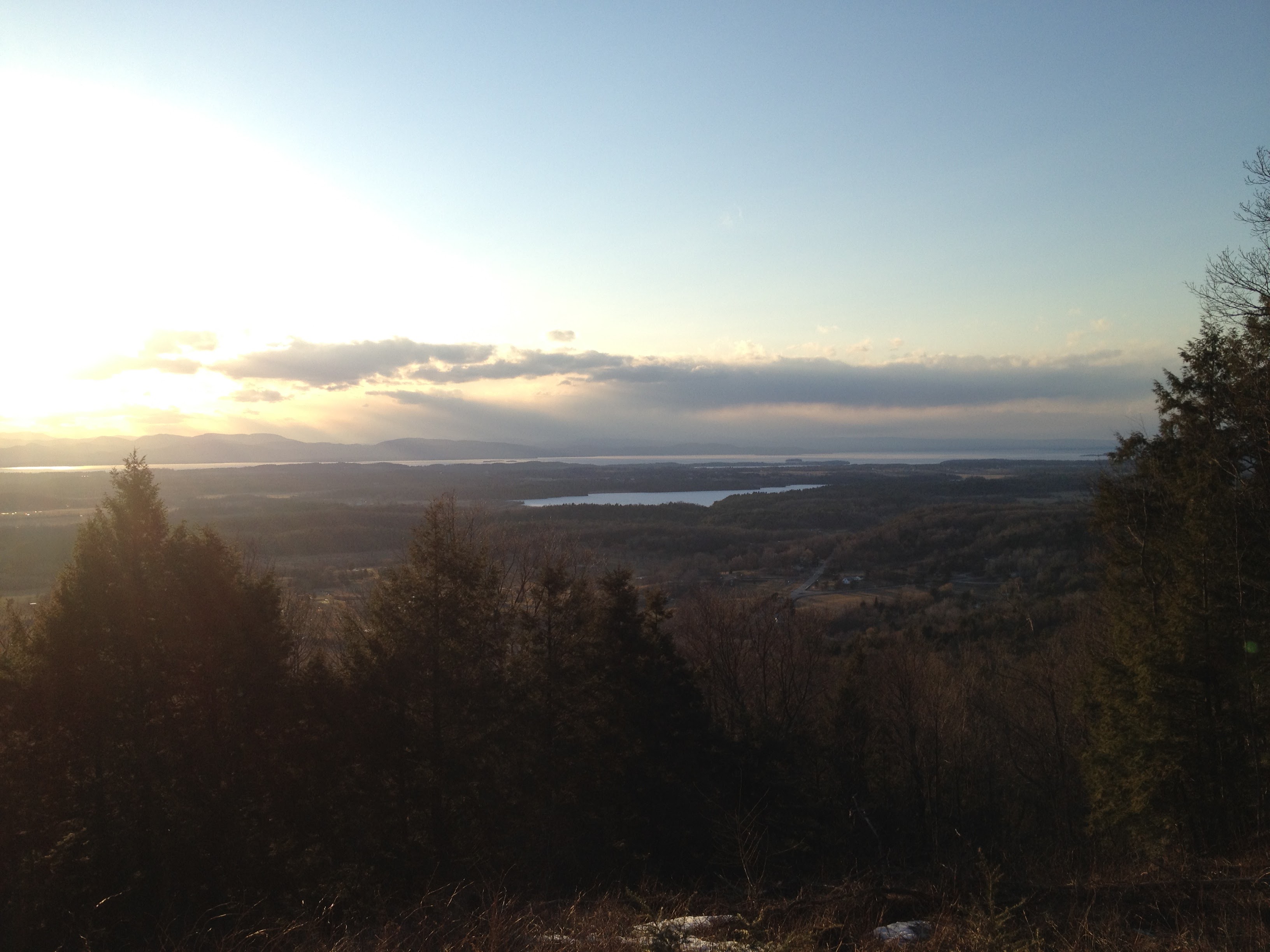
The distant view of the open flooded Sudbury meadows, all dark blue, surrounded by a landscape of white snow, gave an impulse to the dormant sap in my veins. Dark-blue and angry waves, contrasting with the white but melting winter landscape. Ponds, of course, do not yet afford this water prospect; only the flooded meadows.

There is no ice over or near the stream, and the flood has covered or broken up much of the ice on the meadows. The aspect of these waters at sunset, when the air is still, begins to be unspeakably soothing and promising. Waters are at length, and begin to reflect, and, instead of looking into the sky, I look into the placid reflecting water for the signs and promise of the morrow.

These meadows are the most of ocean that I have fairly learned.

Now, when the sap of the trees is probably beginning to flow, the sap of the earth, the river, overflows and bursts its icy fetters. This is the sap of which I make my sugar after the frosty nights, boiling it down and crystallizing it.

I must be on the lookout now for the gulls and the ducks.

That dark-blue meadowy revelation.

It is as when the sap of the maple bursts forth early and runs down the trunk to the snow.

Saw two or three hawks sailing.

Saw the remains of four cows and a horse that were burned in a barn a month ago. Where the paunch was, a large bag of coarse hay and stalks was seen in the midst of an indistinct circumference of ribs.

Saw some very large willow buds expanded (their silk) to thrice the length of their scales, indistinctly carved or waved with darker lines around them. They look more like, are more of, spring than anything I have seen.

Heard the phebe, or spring note of the chickadee, now, before any spring bird has arrived.

I know of no more pleasing employment than to ride about the country with a companion very early in the spring, looking at farms with a view to purchasing if not paying for them.

Heard the first flies buzz in the sun on the south side of the house.


H. D. Thoreau, Journal, March 8, 1853

The heat of the sun. See March 8, 1860 (" Nowadays we separate the warmth of the sun from the cold of the wind and observe that the cold does not pervade all places. "); see also February 23, 1856 ("t is inspiriting to feel the increased heat of the sun reflected from the snow. "); March 4, 1852 (" The sun has got a new power in his rays after all, cold as the weather is. He could not have warmed me so much a month ago.") See also A Book of the Seasons,  by Henry Thoreau,  Signs of the Spring: the new warmth of the sun 

The melting snow, running and sparkling down-hill in the ruts, was quite springlike. See February 16, 1856 ("The melting snow shines in the ruts."); February 21, 1860 ("When you see the sparkling stream from melting snow in the ruts, know that then is to be seen this braid of the spring"); March 9, 1859 (" The earth shines, its icy armor reflecting the sun, and the rills of melting snow in the ruts shine, too.") See also A Book of the Seasons,  by Henry Thoreau,  Signs of the Spring: Braided ripples of melting snow

Saw a mink run across the road in Sudbury, a large black weasel, to appearance, worming its supple way over the snow.  See 
 December 2, 1852 ("Above the bridge . . . we see a mink, slender, black, very like a weasel in form");  November 9, 1853 ("We saw a mink swimming in the agitated water close to the shore, east side, above Nut Meadow Brook. It showed the whole top of the back and part of the tail, unlike the muskrat, and did not dive. Stopped a moment when we headed toward it, and held up its head at the end of its long neck toward us, reminding me of pictures of the otter, then turned and swam and ran the other way; dark-brown."); March 26, 1855 ("At the Hubbard Bath, a mink comes teetering along the ice by the side of the river. I am between him and the sun, and he does not notice me. He runs daintily, lifting his feet with a jerk as if his toes were sore. They seem to go a-hunting at night along the edge of the river r; perhaps I notice them more at this season, when the shallow water freezes at night and there is no vegetation along the shore to conceal them."); November 13, 1855 (“Going over Swamp Bridge Brook at 3 P. M., I saw in the pond by the roadside, a few rods before me, the sun shining bright, a mink swimming . . . It was a rich brown fur . . . not black as it sometimes appears, especially on ice.”); April 28, 1857 (“It crossed to my side about twenty-five feet off, apparently not observing me, and disappeared in the woods. It was perfectly black, for aught I could see (not brown), some eighteen or twenty inches or more in length from tip to tip, and I first thought of a large black weasel, then of a large black squirrel, then wondered if it could be a pine marten. I now try to think it a mink”); April 15, 1858 ("Having stood quite still on the edge of the ditch close to the north edge of the maple swamp some time, and heard a slight rustling near me from time to time, I looked round and saw a mink under the bushes within a few feet. It was pure reddish-brown above, with a blackish and somewhat bushy tail, a blunt nose, and somewhat innocent-looking head. It crept along toward me and around me, within two feet, in a semicircle, snuffing the air, and pausing to look at me several times.");  April 29, 1860 ("I now actually see one small-looking rusty or brown black mink scramble along the muddy shore and enter a hole in the bank.") See also March 13, 1859 ("Garfield . . . asked if I had seen any mink. I said that I commonly saw two or three in a year. He said that he had not seen one alive for eight or ten years. [but] catch thirty or forty dollars' worth every winter.")

Now, when the sap of the trees is probably beginning to flow, the sap of the earth, the river, overflows and bursts its icy fetters . . . That dark-blue meadowy revelation. See  February 12, 1860 ("That dark-eyed water . . .  is it not the first sign of spring?"; )February 27, 1852 (" If rivers come out of their icy prison thus bright and immortal, shall not I too resume my spring life with joy and hope ?") See also A Book of the Seasons,  by Henry Thoreau,  Signs of the Spring: Red Maple Sap Flows and  A Book of the Seasons,  by Henry Thoreau, Signs of the Spring: Bright Blue Water

Saw two or three hawks sailing. See March 8, 1857 ("Get a glimpse of a hawk, the first of the season.") See also March 6, 1858 (" I see the first hen-hawk, or hawk of any kind, methinks, since the beginning of winter, Its scream, even, is inspiring as the voice of a spring bird.") and A Book of the Seasons,  by Henry Thoreau,  Signs of the Spring: the Hawks of March

 Saw some very large willow buds expanded . . . look more like, are more of, spring than anything I have seen. See  March 7, 1855 ("Methinks the buds of the early willows, the willows of the railroad bank, show more of the silvery down than ten days ago.");  March 8, 1860 ("Willow catkins expanding and peeping out a little further every warm day from the very beginning of winter.");  March 10, 1853 ("Methinks the first obvious evidence of spring is the pushing out of the swamp willow catkins.") See also A Book of the Seasons,  by Henry Thoreau, Signs of the Spring: Alder and Willow Catkins Expanding

Heard the phebe, or spring note of the chickadee, now, before any spring bird has arrived. See Walden ("On the 13th of March, after I had heard the bluebird, song-sparrow, and red-wing, the ice was still nearly a foot thick. "); February 24, 1857 ("A chickadee with its winter lisp flits over, and I think it is time to hear its phebe note, and that instant it pipes it forth. "); March 1, 1854 ("I hear the phoebe or spring note of the chickadee"); March 1, 1856 ("I hear several times the fine-drawn phe-be note of the chickadee, which I heard only once during the winter. Singular that I should hear this on the first spring day."); March 10, 1852 ("Hear the phoebe note of the chickadee to-day for the first time.."): March 22, 1855 ("My first distinct spring note (phe-be) of the chickadee.”) See also A Book of the Seasons, by Henry Thoreau,  Signs of the Spring: The Spring Note of the Chickadee

Heard the first flies buzz in the sun on the south side of the house. 
See March 4, 1855 (" It is very warm in the sun. . . The rustle of the dry leaves . . . reminds me of fires in the woods . . . I see a fly on the rock."); See also A Book of the Seasons,  by Henry Thoreau, Signs of the Spring: Buzzing flies

The distant view of
now dark blue open meadows –
sign of the morrow.


A Book of the Seasons,  by Henry Thoreau
 "A book, each page written in its own season, 
out-of-doors, in its own locality."
 ~edited, assembled and rewritten by zphx ©  2009-2026

https://tinyurl.com/hdt-530308

Saturday, February 13, 2021

Nature is a great imitator and loves to repeat herself.


February 13

Skated to Sudbury. A beautiful, summer-like day.

The meadows were frozen just enough to bear.

Examined now the fleets of ice-flakes close at hand. They are a very singular and interesting phenomenon, which I do not remember to have seen.

I should say that when the water was frozen about as thick as paste board, a violent gust had here and there broken it up, and while the wind and waves held it up on its edge, the increasing cold froze it in firmly. So it seemed, for the flakes were for the most part turned one way; i. e. standing on one side, you saw only their edges, on another the northeast or southwest their sides.

They were for the most part of a triangular form, like a shoulder-of - mutton sail, slightly scalloped, like shells. They looked like a fleet of a thousand mackerel fishers under a press of sail careering before a smacking breeze. Sometimes the sun and wind had reduced them to the thinness of writing-paper, and they fluttered and rustled and tinkled merrily.

I skated through them and strewed their wrecks around.

They appear to have been elevated expressly to reflect the sun like mirrors, to adorn the river and attract the eye of the skater. Who will say that their principal end is not answered when they excite the admiration of the skater? Every half-mile or mile, as you skate up the river, you see these crystal fleets.

Nature is a great imitator and loves to repeat herself.

She wastes her wonders on the town. It impresses me as one superiority in her art, if art it may be called, that she does not require that man appreciate her, takes no steps to attract his attention.

The trouble is in getting on and off the ice; when you are once on you can go well enough. It melts round the edges.

Again I saw to-day, half a mile off in Sudbury, a sandy spot on the top of a hill, where I prophesied that I should find traces of the Indians. When within a dozen rods, I distinguished the foundation of a lodge, and merely passing over it, I saw many fragments of the arrowhead stone. I have frequently distinguished these localities half a mile, gone forward, and picked up arrowheads.

Saw in a warm, muddy brook in Sudbury, quite open and exposed, the skunk-cabbage spathes above water. The tops of the spathes were frost- bitten, but the fruit sound. There was one partly expanded.

The first flower of the season; for it is a flower. I doubt if there is [a] month without its flower. Examined by the botany all its parts, the first flower I have seen. The Ictodes fætidus.

Also mosses, mingled red and green. The red will pass for the blossom.

As for antiquities, one of our old deserted country roads, marked only by the parallel fences and cellar - hole 
with its bricks where the last inhabitant died, the victim of intemperance, fifty years ago, with its bare and exhausted fields stretching around, suggests to me an antiquity greater and more remote from the America of the newspapers than the tombs of Etruria. I insert the rise and fall of Rome in the interval. This is the decline and fall of the Roman Empire.

It is important to observe not only the subject of our pure and unalloyed joys, but also the secret of any dissatisfaction one may feel.

In society, in the best institutions of men, I remark a certain precocity. When we should be growing children, we are already little men. Infants as we are, we make haste to be weaned from our great mother's breast, and cultivate our parts by intercourse with one another.

I have not much faith in the method of restoring impoverished soils which relies on manuring mainly and does not add some virgin soil or muck.

Many a poor, sore-eyed student that I have heard of would grow faster, both intellectually and physically, if, instead of sitting up so very late to study, he honestly slumbered a fool's allowance.

I would not have every man cultivated, any more than I would have every acre of earth cultivated. Some must be preparing a mould by the annual decay of the forests which they sustain.

Saw half a dozen cows let out and standing about in a retired meadow as in a cow-yard.


H. D. Thoreau, Journal, February 13, 1851

Skated to Sudbury. See January 31, 1855 ("Skated up the river to explore further than I had been . . .  up as far as the boundary between Wayland and Sudbury just above Pelham’s Pond, about twelve miles,")

Examined now the fleets of ice-flakes close at hand . . .They looked like a fleet of a thousand mackerel fishers under a press of sail careering before a smacking breeze. See February 12, 1851 ("I saw to-day something new to me. . . thin cakes of ice forced up on their edges and reflecting the sun like so many mirrors, whole fleets of shining sails, giving a very lively appearance to the river, — where for a dozen rods the flakes of ice stood on their edges, like a fleet beating up-stream against the sun, a fleet of ice-boats")

Nature is a great imitator and loves to repeat herself. Compare October 14, 1857 ("I doubt if you can ever get Nature to repeat herself exactly") See also A Book of the Seasons,  by Henry Thoreau, Nature

I saw to-day, half a mile off in Sudbury, a sandy spot on the top of a hill, where I prophesied that I should find traces of the Indians. See August 22, 1860 ("I never find a remarkable Indian relic but I have first divined its existence, and planned the discovery of it. Frequently I have told myself distinctly what it was to be before I found it.”); see also note to February 4, 1858 (" It is a remarkable fact that, in the case of the most interesting plants which I have discovered in this vicinity, I have anticipated finding them perhaps a year before the discovery.") 

The first flower of the season. See February 18, 1851 ("See the skunk-cabbage in flower.”); April 2, 1856 ("This year, at least, the cabbage is the first flower; and perhaps it is always earlier than I have thought, if you seek it in a favorable place."); and note to March 21, 1858 ("The skunk-cabbage at Clamshell is well out, shedding pollen. It is evident that the date of its flowering is very fluctuating,") See also A Book of the Seasons, by Henry Thoreau, the Skunk Cabbage and A Book of the Seasons, by Henry Thoreau, the Earliest Flower

Mosses, mingled red and green See February 18, 1852 ("The mosses on the rocks look green where the snow has melted. This must be one of the spring signs, when spring comes.");  February 27, 1852 ("The mosses now are in fruit - or have sent up their filaments with calyptrae."); March 10, 1859 ("Fine red-stemmed mosses have begun to push and bud on Clamshell bank")

Mosses now in fruit
are warmly red in the sun
when seen from one side.
April 25, 1857

Wednesday, September 16, 2020

Select men.


Met the selectmen of Sudbury, ____and ____. I trust that towns will remember that they are supposed to be fairly represented by their select men.

From the specimen which Acton sent, I should judge that the inhabitants of that town were made up of a mixture of quiet, respectable, and even gentlemanly farmer people, well to do in the world, with a rather boisterous, coarse, and a little self-willed class; 


that the inhabitants of Sudbury are farmers almost exclusively, exceedingly rough and countrified and more illiterate than usual, very tenacious of their rights and dignities and difficult to deal with; 

that the inhabitants of Lincoln yield sooner than usual to the influence of the rising generation, and are a mixture of rather simple but clever with a well-informed and trustworthy people; 

that the inhabitants of Bedford are mechanics, who aspire to keep up with the age, with some of the polish of society, mingled with substantial and rather intelligent farmers.

____of Sudbury thinks the river would be still lower now if it were not for the water in the reservoir pond in Hopkinton running into it.


H. D. Thoreau, Journal, September 16, 1851


Wednesday, June 3, 2020

The landscape is a vast amphitheatre rising to its rim in the horizon.


June 3.

I visited this afternoon (June 3d) Goodman's Hill in Sudbury, going through Lincoln over Sherman's Bridge and Round Hill, and returning through the Corner. It probably affords the best view of Concord River meadows of any hill. The horizon is very extensive as it is, and if the top were cleared so that you could get the western view, it would be one of the most extensive seen from any hill in the county. 


The most imposing horizons are those which are seen from tops of hills rising out of a river valley. The prospect even from a low hill has something majestic in it in such a case. The landscape is a vast amphitheatre rising to its rim in the horizon. 

There is a good view of Lincoln lying high up in among the hills. You see that it is the highest town hereabouts, and hence its fruit. 

The river at this time looks as large as the Hudson. I think that a river-valley town is much the handsomest and largest-featured, — like Concord and Lancaster, for instance, natural centres. 

Upon the hills of Bolton, again, the height of land between the Concord and Nashua, I have seen how the peach flourishes. 

Nobscot, too, is quite imposing as seen from the west side of Goodman's Hill. On the western side of a continuation of this hill is Wadsworth’s battle field.

Returning, I saw in Sudbury twenty-five nests of the new (cliff?) swallow under the eaves of a barn.


The republican or cliff swallow.
Their nests, built side by side, looked somewhat like large hornets' nests.
 They seemed particularly social and loquacious neighbors, though their voices are rather squeaking. Their nests, built side by side, looked somewhat like large hornets' nests, enough so to prove a sort of connection. Their activity, sociability, and chattiness make them fit pensioners and neighbors of man — summer companions — for the barn-yard.

H. D. Thoreau, Journal, June 3, 1850


 The landscape is a vast amphitheatre rising to its rim in the horizon. 
See September 12, 1851 ("It is worth the while to see the mountains in the horizon once a day"); June 25, 1852 ("The earth appears like a vast saucer sloping upward to its sharp mountain rim."); July 27, 1852 ("How beautiful hills and vales, the whole surface of the earth a succession of these great cups, falling away from dry or rocky edges to gelid green meadows and water in the midst, where night already is setting in!"); August 2, 1852 ("In many moods it is cheering to look across hence to that blue rim of the earth, and be reminded of the invisible towns and communities, for the most part also unremembered, which lie in the further and deeper hollows between me and those hills."); August 5, 1852 (" From Smith's Hill beyond, there is as good a view of the mountains as from any place in our neighbor hood, because you look across the broad valley in which Concord lies first of all.");  March 18, 1858 ("When I get two thirds up the hill, I look round and am for the hundredth time surprised by the landscape of the river valley and the horizon with its distant blue scalloped rim.");March 28, 1858 ("From this hilltop I overlook,. . . this seemingly concave circle of earth, in the midst of which I was born and dwell, which in the northwest and southeast has a more distant blue rim to it,.") See also note to September 27, 1852 ("From Smith's Hill I looked toward the mountain line.")


Twenty-five nests of the new (cliff?) swallow under the eaves of a barn. See April 30, 1856 ("I was surprised by the great number of swallows—white-bellied and barn swallows and perhaps republican — flying round and round, or skimming very low over the meadow. . .There were a thousand or more of swallows, and I think that they had recently arrived together on their migration."); May 4, 1856 (“Among others, I see republican swallows flying over river at Island”); May 11, 1856 ("There are many swallows circling low over the river behind Monroe’s, — bank swallows, barn, republican, chimney, and white-bellied. These are all circling together a foot or two over the water, passing within ten or twelve feet of me in my boat."); May 20, 1858 (“Hundreds of swallows are now skimming close over the river. . .. There are bank, barn, cliff, and chimney swallows, all mingled together.”); May 20, 1858 (“The cliff swallow, then, is here.”); May 21, 1855 (“Is that plump blue-backed, rufous rumped swallow the cliff swallow, flying with barn swallows, etc., over the river?"); May 29, 1859 “The republican swallow at Hosmer's barn just begun to lay.”

Saturday, March 14, 2020

Repairing my boat.

March 14.

 P. M. – Repairing my boat. 

High winds, growing colder and colder, ground stiffening again. My ears have not been colder the past winter.

Lowell Fay tells me that he overtook with a boat and killed last July a woodchuck which was crossing the river at Hollowell Place . 

He also says that the blacksmith of Sudbury has two otter skins taken in that town. 

March is rightly famous for its winds.

H. D. Thoreau, Journal, March 14, 1853

Repairing my boat. See ; February 24, 1857 ("Get my boat out the cellar."); February 26, 1857 ("Paint the bottom of my boat"); March 3, 1860 ("I should have launched my boat ere this if it had been ready. ");March 8, 1855 ("This morning I got my boat out of the cellar and turned it up in the yard to let the seams open before I calk it."); March 9, 1855 ("Painted the bottom of my boat."); March 15, 1854 ("Paint my boat."); March 16, 1859 ("Launch my boat and sail to Ball's Hill"); March 16, 1860 ("As soon as I can get it painted and dried, I launch my boat and make my first voyage for the year up or down the stream, on that element from which I have been debarred for three months and a half.")

The blacksmith of Sudbury has two otter skins taken in that town. See note to January 21, 1853 ("Otter are very rare here now. I have not heard of any killed here abouts for twenty or thirty years till, within two years, two or three of them.")

Sunday, March 18, 2018

Each new year is a surprise to us.

 
March 18

 7 A.M. – By river. 

Almost every bush has its song sparrow this morning, and their tinkling strains are heard on all sides. You see them just hopping under the bush or into some other covert, as you go by, turning with a jerk this way and that, or they flit away just above the ground, which they resemble. It is the prettiest strain I have heard yet. 

Melvin is already out in his boat for all day, with his white hound in the prow, bound up the river for musquash, etc., but the river is hardly high enough to drive them out. 

March 18, 2018

P. M. – To Fair Haven Hill via Hubbard’s Bath. 

How much more habitable a few birds make the fields! At the end of winter, when the fields are bare and there is nothing to relieve the monotony of the withered vegetation, our life seems reduced to its lowest terms. But let a bluebird come and warble over them, and what a change! 
  • The note of the first bluebird in the air answers to the purling rill of melted snow beneath. It is eminently soft and soothing, and, as surely as the thermometer, indicates a higher temperature. It is the accent of the south wind, its vernacular. It is modulated by the south wind. 
  • The song sparrow is more sprightly, mingling its notes with the rustling of the brash along the watersides, but it is at the same time more terrene than the bluebird. 
  • The first woodpecker comes screaming into the empty house and throws open doors and windows wide, calling out each of them to let the neighbors know of its return. But heard further off it is very suggestive of ineffable associations which cannot be distinctly recalled, – of long-drawn summer hours, – and thus it, also, has the effect of music. I was not aware that the capacity to hear the woodpecker had slumbered within me so long.
  • When the blackbird gets to a conqueree he seems to be dreaming of the sprays that are to be and on which he is to perch. 
  • The robin does not come singing, but utters a somewhat anxious or inquisitive peep at first. The song sparrow is immediately most at home of any that I have named. 

I see this afternoon as many as a dozen bluebirds on the warm side of a wood. 

At Hubbard's shore, where a strong but warm westerly wind is blowing, the shore is lined for half a rod in width with pulverized ice, or “brash,” driven against it. 

At Potter's sand-hill (Bear Garden), I see, on the southeast side of the blue-curls, very distinct and regular arcs of circles (about a third of a circle), scored deep in the sand by the tops of these weeds, which have been blown about by the wind, and these marks show very surely and plainly how the wind has been blowing and with what force and flakiness. 

The rather warm but strong wind now roars in the wood — as in the maple swamp — with a novel sound. I doubt if the same is ever heard in the winter. It apparently comes at this season, not only to dry the earth but to wake up the trees, as it were, as one would awake a sleeping man with a smart shake. Perchance they need to be thus wrung and twisted, and their sap flows the sooner for it. 

Perfectly dry sand even is something attractive now, and I am tempted to tread on and to touch it, as a curiosity. Skunks’ tracks are everywhere now, on the sand, and the little snow that is left. 

The river is still closed with ice at Cardinal Shore, so Melvin must have stopped here at least; but there is a crescent of “brash ” there, which the waves blown up-stream have made, half a dozen rods wide. It is even blown a rod on to the solid ice. The noise made by this brash undulating and grating upon itself, at a little distance, is very much like the rustling of a winrow of leaves disturbed by the winds. A little farther off it is not to be distinguished from the roar of the wind in the woods. 

Each new year is a surprise to us. We find that we had virtually forgotten the note of each bird, and when we hear it again it is remembered like a dream, reminding us of a previous state of existence. How happens it that the associations it awakens are always pleasing, never saddening; reminiscences of our sanest hours? The voice of nature is always encouraging. 

The blackbird — probably grackle this time —wings his way direct above the swamp northward, with a regular tchuck, carrier haste, calling the summer months along, like a hen her chickens. 

When I get two thirds up the hill, I look round and am for the hundredth time surprised by the landscape of the river valley and the horizon with its distant blue scalloped rim. 

It is a spring landscape, and as impossible a fortnight ago as the song of birds. It is a deeper and warmer blue than in winter, methinks. The snow is off the mountains, which seem even to have come again like the birds. 

The undulating river is a bright-blue channel between sharp-edged shores of ice retained by the willows. The wind blows strong but warm from west by north, so that I have to hold my paper tight when I write this, making the copses creak and roar; but the sharp tinkle of a song sparrow is heard through it all. 

But ah! the needles of the pine, how they shine, as I look down over the Holden wood and westward! Every third tree is lit with the most subdued but clear ethereal light, as if it were the most delicate frostwork in a winter morning, reflecting no heat, but only light. And as they rock and wave in the strong wind, even a mile off, the light courses up and down there as over a field of grain; i. e., they are alternately light and dark, like looms above the forest, when the shuttle is thrown between the light woof and the dark web, weaving a light article, – spring goods for Nature to wear. 

At sight of this my spirit is like a lit tree. It runs or flashes over their parallel boughs as when you play with the teeth of a comb. The pine tops wave like squirrels' tails flashing in the air. Not only osiers but pine-needles, methinks, shine in the spring, and arrowheads and railroad rails, etc., etc. Anacreon noticed the same. 

Is it not the higher sun, and cleansed air, and greater animation of nature? There is a warmer red to the leaves of the shrub oak, and to the tail of the hawk circling over them. 

I sit on the Cliff, and look toward Sudbury. I see its meeting-houses and its common, and its fields lie but little beyond my ordinary walk, but I never played on its common nor read the epitaphs in its graveyard, and many strangers to me dwell there. How distant in all important senses may be the town which yet is within sight! We see beyond our ordinary walks and thoughts. With a glass I might perchance read the time on its clock. How circumscribed are our walks, after all! With the utmost industry we cannot expect to know well an area more than six miles square, and yet we pretend to be travellers, to be acquainted with Siberia and Africa! 

Going by the epigaea on Fair Haven Hill, I thought I would follow down the shallow gully through the woods from it, that I might find more or something else. There was an abundance of checkerberry, as if it were a peculiar locality for shrubby evergreens. At first the checkerberry was green, but low down the hill it suddenly became dark-red, like a different plant, as if it had been more subject to frost there, it being more frosty lower down. Where it was most turned, that part of the leaf which was protected by another overlapping it was still pure bright-green, making a pretty contrast when you lifted it. 

Eight or ten rods off I noticed an evergreen shrub with the aspect or habit of growth of the juniper, but, as it was in the woods, I already suspected it to be what it proved, the American yew, already strongly budded to bloom. This is a capital discovery. 

I have thus found the ledum and the taxus this winter and a new locality of the epigaea.

H. D. Thoreau, Journal, March 18, 1858

The note of the first bluebird in the air answers to the purling rill of melted snow beneath . . . It is modulated by the south wind. See March 9, 1852 ("I hear and see bluebirds, come with the warm wind."); March 17, 1858 ("Hear the first bluebird. A remarkably warm and pleasant day with a south or southwest wind . . .  The air is full of bluebirds. I hear them far and near on all sides of the hill, warbling in the tree-tops, though I do not distinctly see them . . . four species of birds have all come in one day, no doubt to almost all parts of the town. ") See also A Book of the Seasons, by Henry Thoreau, Signs of the Spring: Listening for the Bluebird

The rather warm but strong wind now roars in the wood to wake up the trees,  and their sap flows the sooner for it. See March 9, 1852 (“These March winds, which make the woods roar and fill the world with life and bustle, appear to wake up the trees out of their winter sleep and excite the sap to flow.”)

When I get two thirds up the hill, I look round and am for the hundredth time surprised by the landscape of the river valley and the horizon with its distant blue scalloped rim. See May 17, 1853 ("I was surprised, on turning round, to behold the serene and everlasting beauty of the world.”); May 22, 1854 ("How many times I have been surprised  thus, on turning about on this very spot, at the fairness of the earth!”) ; October 7, 1857 ("When I turn round half-way up Fair Haven Hill, by the orchard wall, and look northwest, I am surprised for the thousandth time at the beauty of the landscape.”). See also note to June 3, 1850 ("The landscape is a vast amphitheatre rising to its rim in the horizon.")

The robin does not come singing, but utters a somewhat anxious or inquisitive peep at first. See March 18, 1853 ("He does not sing as yet . . . the robin and blackbird only peep and chuck at first."); March 18, 1859 ("Three days ago, the 15th, we had steady rain with a southerly wind. . . and the peep of the robin was heard through the drizzle and the rain.") See also  February 27, 1857 (" Before I opened the window this cold morning, I heard the peep of a robin, that sound so often heard in cheerless or else rainy weather, so often heard first borne on the cutting March wind or through sleet or rain, as if its coming were premature. "); March 8, 1855 ("I hear the hasty, shuffling, as if frightened, note of a robin from a dense birch wood . . . This sound reminds me of rainy, misty April days in past years."); March 12, 1854 ("I hear my first robin peep distinctly at a distance. No singing yet."); March 17, 1858 ("I hear a faint note far in the wood which reminds me of the robin. Again I hear it; it is he, — an occasional peep.") and A Book of the Seasons, by Henry Thoreau, Signs of the Spring, the anxious peep of the early robin

Each new year is a surprise to us. See December 29, 1851 (" What a fine and measureless joy the gods grant us thus, letting us know nothing about the day that is to dawn! This day, yesterday, was as incredible as any other miracle.")

The sharp tinkle of a song sparrow is heard through it all
. See March 18, 1857 ("I now again hear the song sparrow’s tinkle along the riverside, probably to be heard for a day or two.”)March 18, 1852 ("I hear the song sparrow's simple strain, most genuine herald of the spring.”)

I have thus found the ledum this winter. See February 4, 1858 (“As usual with the finding of new plants, I had a presentiment that I should find the ledum in Concord.”)

Going by the epigaea on Fair Haven Hill, I thought I would follow down the shallow gully through the woods from it, that I might find more or something else. See September 8, 1858 ("It is good policy to be stirring about your affairs, for the reward of activity and energy is that if you do not accomplish the object you had professed to yourself, you do accomplish something else. So, in my botanizing or natural history walks, it commonly turns out that, going for one thing, I get another thing.")

A new locality of the epigaea. See February 7, 1858 (“I am surprised to find the epigaea on this hill, at the northwest corner of C. Hubbard’s (?) lot.”)

March 18. See A Book of the Seasons,  by Henry Thoreau, March 18

The snow is off the
mountains, which seem to have come
again like the birds,

their blue scalloped rim
a deeper and warmer blue
than winter, methinks.

A spring landscape as
impossible a fortnight
ago as birdsong.

The note of each bird
remembered like a dream when
we hear it again.

How happens it that
each new year is always
a pleasing surprise?


A Book of the Seasons,  by Henry Thoreau 
"A book, each page written in its own season,
out-of-doors, in its own locality.”
~edited, assembled and rewritten by zphx © 2009-2025

https://tinyurl.com/hdt-580318


Saturday, March 11, 2017

Woodchuck mittens

March 11

I see and talk with Rice, sawing off the ends of clapboards which he has planed, to make them square, for an addition to his house. He has got a fire in his shop, and plays at house-building there. His life is poetic. He does the work himself. 

He combines several qualities and talents rarely combined. Though he owns houses in the city, whose repair he attends to, finds tenants for them, and collects the rent, he also has his Sudbury farm and bean-fiolds. Though he lived in a city, he would still be natural and related to primitive nature around him. 

Though he owned all Beacon Street, you might find that his mittens were made of the skin of a woodchuck that had ravaged his bean-field, which he had cured. I noticed a woodchuck’s skin tacked up to the inside of his shop. He said it had fatted on his beans, and William had killed and expected to get another to make a pair of mittens of, one not being quite large enough. It was excellent for mittens. You could hardly wear it out. 

Spoke of the cuckoo, which was afraid of the birds, was easily beaten; would dive right into the middle of a poplar, then come out on to some bare twig and look round for a nest to rob of young or eggs. 

Had noticed a pigeon woodpecker go repeatedly in a straight line from his nest in an apple tree to a distant brook-side in a meadow, dive down there, and in a few minutes return.

H. D. Thoreau, Journal, March 11, 1857

Thursday, August 25, 2016

What is the use, in Nature's economy, of these occasional floods in August?

August 25. 

 P. M. — To Hill by boat. Silvery cinquefoil now begins to show itself commonly again. Perhaps it is owing to the rain, spring like, which we have in August. 

I paddle directly across the meadow, the river is so high, and land east of the elm on the third or fourth row of potatoes. The water makes more show on the meadows than yesterday, though hardly so high, be cause the grass is more flatted down. 

I easily make my way amid the thin spires. Almost every stem which rises above the surface has a grasshopper or caterpillar upon it. Some have seven or eight grasshoppers, clinging to their masts, one close and directly above an other, like shipwrecked sailors, now the third or fourth day exposed. Whither shall they jump? It is a quarter of a mile to shore, and countless sharks lie in wait for them. They are so thick that they are like a crop which the grass bears; some stems are bent down by their weight. 

This flood affects other inhabitants of these fields than men; not only the owners of the grass, but its inhabitants much more. It drives them to their upper stories, — to take refuge in the rigging. Many that have taken an imprudent leap are seen struggling in the water. How much life is drowned out that inhabits about the roots of the meadow-grass! How many a family, perchance, of short-tailed meadow mice has had to scamper or swim! 

The river-meadow cranberries are covered deep. I can count them as they lie in dense beds a foot under water, so distinct and white, or just beginning to have a red cheek. They will probably be spoiled, and this  crop will fail. 

Potatoes, too, in the low land on which water has stood so long, will rot. 

The farmers commonly say that the spring floods, being of cold water, do not injure the grass like later ones when the water is warm, but I suspect it is not so much owing to the warmth of the water as to the age and condition of the grass and whatever else is exposed to them. They say that if you let the water rise and stand some time over the roots of trees in warm weather it will kill them. 

This, then, may be the value of these occasional freshets in August: they steam and kill the shrubs and trees which had crept into the river meadows, and so keep them open perpetually, which, perchance, the spring floods alone might not do. 

It is commonly supposed that our river meadows were much drier than now originally, or when the town was settled. They were probably drier before the dam was built at Billerica, but if they were much or at all drier than now originally, I ask what prevented their being converted into maple swamps? Maples, alders, birches, etc., are creeping into them quite fast on many sides at present. If they had been so dry as is supposed they would not have been open meadows. It seems to be true that high water in midsummer, when perchance the trees and shrubs are in a more tender state, kills them. 

It "steams" them, as it does the grass; and maybe the river thus asserts its rights, and possibly it would still to great extent, though the meadows should be considerably raised. Yet, I ask, why do maples, alders, etc., at present border the stream, though they do not spring up to any extent in the open meadow? Is it because the immediate bank is commonly more firm as well as higher (their seeds also are more liable to be caught there), and where it is low they are protected by willows and button-bushes, which can bear the flood? Not even willows and button-bushes prevail in the Great Meadows, — though many of the former, at least, spring up there, — except on the most elevated parts or hummocks.

The reason for this cannot be solely in the fact that the water stands over them there a part of the year, be cause they are still more exposed to the water in many places on the shore of the river where yet they thrive. Is it then owing to the soft character of the ground in the meadow and the ice tearing up the meadow so extensively? On the immediate bank of the river that kind of sod and soil is not commonly formed which the ice lifts up. Why is the black willow so strictly confined to the bank of the river? 

What is the use, in Nature's economy, of these occasional floods in August? Is it not partly to preserve the meadows open? 

Mr. Rice says that the brook just beyond his brother Israel's in Sudbury rises and runs out before the river, and then you will see the river running up the brook as fast as the brook ran down before. 

Apparently half the pads are now afloat, notwithstanding the depth of the water, but they are almost all white lily pads, the others being eaten and decayed. They have apparently lengthened their stems some what. They generally lie with more or less coil, prepared for a rise of the water, and perhaps the length of that coil shows pretty accurately to how great a rise they are ordinarily subject at this season. 

I was suggesting yesterday, as I have often before, that the town should provide a stone monument to be placed in the river, so as to be surrounded by water at its lowest stage, and a dozen feet high, so as to rise above it at its highest stage; on this feet and inches to be permanently marked; and it be made some one's duty to record each high or low stage of the water. Now, when we have a remarkable freshet, we cannot tell surely whether it is higher than the one thirty or sixty years ago or not. It would be not merely interesting, but often practically valuable, to know this. 

Reuben Rice was telling me to-night that the great freshet of two or three years ago came, according to his brother Israel, within two inches of one that occurred about forty years ago. I asked how he knew. He said that the former one took place early (February?), and the surface froze so that boys skated on it, and the ice marked a particular apple tree, girdled it, so that it is seen to this day. 

But we wish to speak more confidently than this allows. It is important when building a causeway, or a bridge, or a house even, in some situations, to know exactly how high the river has ever risen. It would need to be a very large stone or pile of stones, which the ice could not move or break. Perhaps one corner of a bridge abutment would do. 

Rice killed a woodchuck to-day that was shearing off his beans. He was very fat. 

I cross the meadows in the face of a thunder-storm rising very dark in the north. There are several boats out, but their crews soon retreat homeward before the approaching storm. It comes on rapidly, with vivid lightning striking the northern earth and heavy thunder following. 

Just before, and in the shadow of, the cloud, I see, advancing majestically with wide circles over the meadowy flood, a fish hawk and, apparently, a black eagle (maybe a young white-head). The first, with slender curved wings and silvery breast, four or five hundred feet high, watching the water while he circles slowly southwesterly. What a vision that could detect a fish at that distance! The latter, with broad black wings and broad tail, hovers only about one hundred feet high; evidently a different species, and what else but an eagle? 

They soon disappear southwest, cutting off a bend. The thunder-shower passed off to the southeast.

H. D. Thoreau, Journal, August 25, 1856

Silvery cinquefoil now begins to show itself commonly again. See September 1, 1853 ("Methinks the silvery cinquefoil is of late much more abundant") See also A Book of the Seasons,  by Henry Thoreau, Cinquefoil in Autumn

Why is the black willow so strictly confined to the bank of the river? See August 7, 1858 ("The most luxuriant groves of black willow are on the inside curves, —but rarely ever against a firm bank or hillside, the positive male shore. “); August 15, 1858 (“I notice the black willows . . . to see where they grow, distinguishing ten places. In seven instances they are on the concave or female side distinctly.”); August 19, 1858 (“I noticed the localities of black willows as far up as the mouth of the river in Fair Haven Pond, but not so carefully as elsewhere, and from the last observations I infer that the willow grows especially and almost exclusively in places where the drift is most likely to lodge, as on capes and points and concave sides of the river, though I noticed a few exceptions to my rule.”) See also A Book of the Seasons, by Henry Thoreau, the Propogation of the Willow.

I cross the meadows –
the face of a thunder-storm 
rising in the north.

Saturday, August 22, 2015

Barn swallows in the nest still.

August 22.
I hear of some young barn swallows in the nest still in R. Rice’s barn, Sudbury.

H. D. Thoreau, Journal, August 22, 1855

Sunday, April 5, 2015

It is a sober, moist day, with a circle round the sun.


April 5

Fast-Day. 9 A. M. —To Sudbury line by boat. 

A still and rather warm morning, with a very thick haze concealing the sun and threatening to turn to rain. 


April 5, 2015

It is a smooth, April-morning water, and many sportsmen are out in their boats. I see a pleasure-boat, on the smooth surface away by the Rock, resting lightly as a feather in the air. 

Scare up a snipe close to the water’s edge, and soon after a hen-hawk from the Clamshell oaks. The last looks larger on his perch than flying. 

The snipe too, then, like crows, robins, blackbirds, and hens, is found near the waterside, where is the first spring (e.g. alders and white maples, etc., etc), and there too especially are heard the song and tree sparrows and pewees, and even the hen-hawk at this season haunts there for his prey. 

Inland, the groves are almost completely silent as yet. The concert of song and tree sparrows at willow-row is now very full, and their different notes are completely mingled. 

See a single white-bellied swallow dashing over the river. He, too, is attracted here by the early insects that begin to be seen over the water.  See this forenoon a great many of those little fuzzy gnats in the air.

It being Fast-Day, we on the water hear the loud and musical sound of bells ringing for church in the surrounding towns. 

It is a sober, moist day, with a circle round the sun, which I can only see in the reflection in the water.

The river appears to have risen still last night, owing to the rain of the 1st, and many spring cranberries are washed together at last, and now many new seeds, apparently of sedges, are loosened and washed up. 

Now that for the most part it is melted quite to its edge, and there is no ice there, the water has a warmer, April look close under my eye. Now is the first time this year to get spring cranberries. 

In many places now the river wreck is chiefly composed of Juncus militaris. Was it so in fall? 

There is a strong muskrat scent from many a shore. See a muskrat floating, which may have been drowned when the river was so high in midwinter, —for this is the second I have seen, —with the rabbit. 

I saw yesterday a yellow-spot and see to-day a painted tortoise, already out on the bank on a tuft of grass. 

The muskrat-hunter sits patiently with cocked gun, waiting for a muskrat to put out his head amid the button-bushes. He gets half a dozen in such a cruise.

Bush our boat with hemlock to get near some ducks, but another boat above, also bushed, scares them.

Hear from one half-flooded meadow that low, general, hard, stuttering tut tut tut of frogs,—the awakening of the meadow. 

Hear the cry of the peacock again. 

By 4 P. M. it begins to rain gently or mizzle. 

H. D. Thoreau, Journal, April 5, 1855

Fast Day. ~  A traditional day of fasting and prayer in New England celebrated on the third Monday in April, was replaced in Massachusetts by Patriots' Day, commemorating the Battles of Lexington and Concord.

A still and rather warm morning, with a very thick haze concealing the sun and threatening to turn to rain. See April 14, 1855 ("An overcast and moist day, but truly April—no sun all day—like such as began methinks on Fast Day, or the 5th. You cannot foretell how it will turn out.")

Scare up a snipe close to the water’s edge. See April 2, 1859 (" As I go down the street just after sunset, I hear many snipe to-night. This sound is annually heard by the villagers, but always at this hour, i. e. in the twilight, — a hovering sound high in the air, — and they do not know what to refer it to.");  April 10, 1854 ("There are many snipes now feeding in the meadows, which you come close upon, and then they go off with hoarse cr-r-r-ack cr-r-r-ack. They dive down suddenly from a considerable height sometimes when they alight"); See also A Book of the Seasonsby Henry Thoreau: the Snipe

Juncus militaris.  ~ Bayonet rush. Inhabits shallow water of lakes and slow-moving rivers.  Its fruit is a capsule, with at least three seeds in it.

We on the water hear the loud and musical sound of bells ringing for church in the surrounding towns. See 
April 15, 1855 ("The sound of church bells, at various distances, in Concord and the neighboring towns, sounds very sweet to us on the water this still day. It is the song of the villages heard with the song of the birds."); see also May 3, 1852 ("There is a grand, rich, musical echo trembling on the air long after the clock has ceased to strike. . . like a flower of sound. ") ; Walden ("Sometimes, on Sundays, I heard the bells, the Lincoln, Acton, Bedford, or Concord bell, when the wind was favorable, a faint, sweet, and, as it were, natural melody, worth importing into the wilderness. At a sufficient distance over the woods this sound acquires a certain vibratory hum") and A Book of the Seasons by Henry Thoreau, Bells and Whistles

The muskrat-hunter . . . gets half a dozen in such a cruise. See April 7, 1853 ("It is Fast-Day, and many gunners are about the shore, which makes them shy. I never cross the meadow at this season without seeing ducks")

 That low, general, hard, stuttering tut tut tut of frogs,—the awakening of the meadow.. See April 5, 1854 ("the shrill peep of the hylodes borne to me from afar through the woods");  April 5, 1855 ("Hear from one half-flooded meadow that low, general, hard, stuttering tut tut tut of frogs,—the awakening of the meadow.”); April 5, 1857 ("I hear the croaking frogs at 9.30 P. M.");; April 5, 1858 ("The woods resound with the one [R. sylvatica], and the meadows day and night with the other [R. halecina], so that it amounts to a general awakening of the pools and meadows. "); April 5, 1860 (" a very faint distant ring of toads."). See also April 3, 1858 ("This might be called the Day of the Snoring Frogs, or the Awakening of the Meadows."); April 9, 1853 (“The whole meadow resounds, probably from one end of the river to the other, this evening, with this faint, stertorous breathing. It is the waking up of the meadows.")

April 5. See A Book of the Seasons, by Henry Thoreau, April 5

Circle round the sun
seen only in reflection –
a sober moist day.


A Book of the Seasons
, by Henry Thoreau
"A book, each page written in its own season,
out-of-doors, in its own locality.”
~edited, assembled and rewritten by zphx © 2009-2025

https://tinyurl.com/hdt-550405

Popular Posts Last 30 Days.

The week ahead in Henry’s journal

The week ahead in Henry’s journal
A journal, a book that shall contain a record of all your joy.
"A stone fruit. Each one yields me a thought." ~ H. D. Thoreau, March 28, 1859


I sit on this rock
wrestling with the melody
that possesses me.