Showing posts with label Lupine Knoll. Show all posts

Thursday, May 28, 2020

The carnival of the year commencing.


May 28.

A rose in a garden.

5 P. M. – To Lupine Hill by boat.

The carnival of the year commencing — a warm, moist, hazy air, the water already smooth and uncommonly high, the river overflowing, and yellow lilies all drowned, their stems not long enough to reach the surface.

I see the boat-club, or three or four in pink shirts, rowing at a distance.

Beech-drops out apparently some days, the old bridge landing at Nawshawtuct; also just out green-briar.

Already the ringing croak of a toad begins to be heard here and there along the river, and the troonk of a bullfrog from time to time.

What is peculiar now, beginning yesterday, after rains, is the sudden heat, and the more general sound of insects by day, and the loud ringing croak of common toads and tree-toads at evening and in the night.

Our river has so little current that when the wind has gone down, as at present, it is dark and perfectly smooth, and at present dusty as a stagnant pool in every part of it; far from there being any murmur, there is no ripple nor eddy for the most part.

Hubbard has plowed up the low-lying field at the bathing place and planted it with potatoes; and now we find that the field we resort to was equally used by the Indians, for their arrowheads are now exposed by the plow.

The sidesaddle-flower conspicuous, but no pollen yet.

The bulbous arethusa out a day or two — probably yesterday. Though in a measure prepared for it, still its beauty surprised me; it is by far the highest and richest color yet. Its intense color in the midst of the green meadow made it look twice as large as reality; it looks very foreign in the midst of our plants - its richly speckled, curled, and bearded lip.

Devil’s needles begin to fly; saw one the 14th.

Thesium just beams now at six o’clock, and the lupines do not look so well for it; their lilac tints show best looking at them towards the sun, for they are transparent. Last night in the dark they were all a pale, whitish color like the moon by day — a mere dull luminousness, as if they reflected light absorbed by day.

Seen from this point now, the pitch pines on Bear Garden Hill, the fresh green foliage of the deciduous trees now so prevails, the pitch pines, which lately looked green, are of a dark brownish or mulberry color by contrast, and the white pines almost as dark, but bluer. In this haziness no doubt they are a little darker than usual.

The grass on pretty high ground is wet with dew an hour before sunset. Whiteweed now, and cotton-grass. 
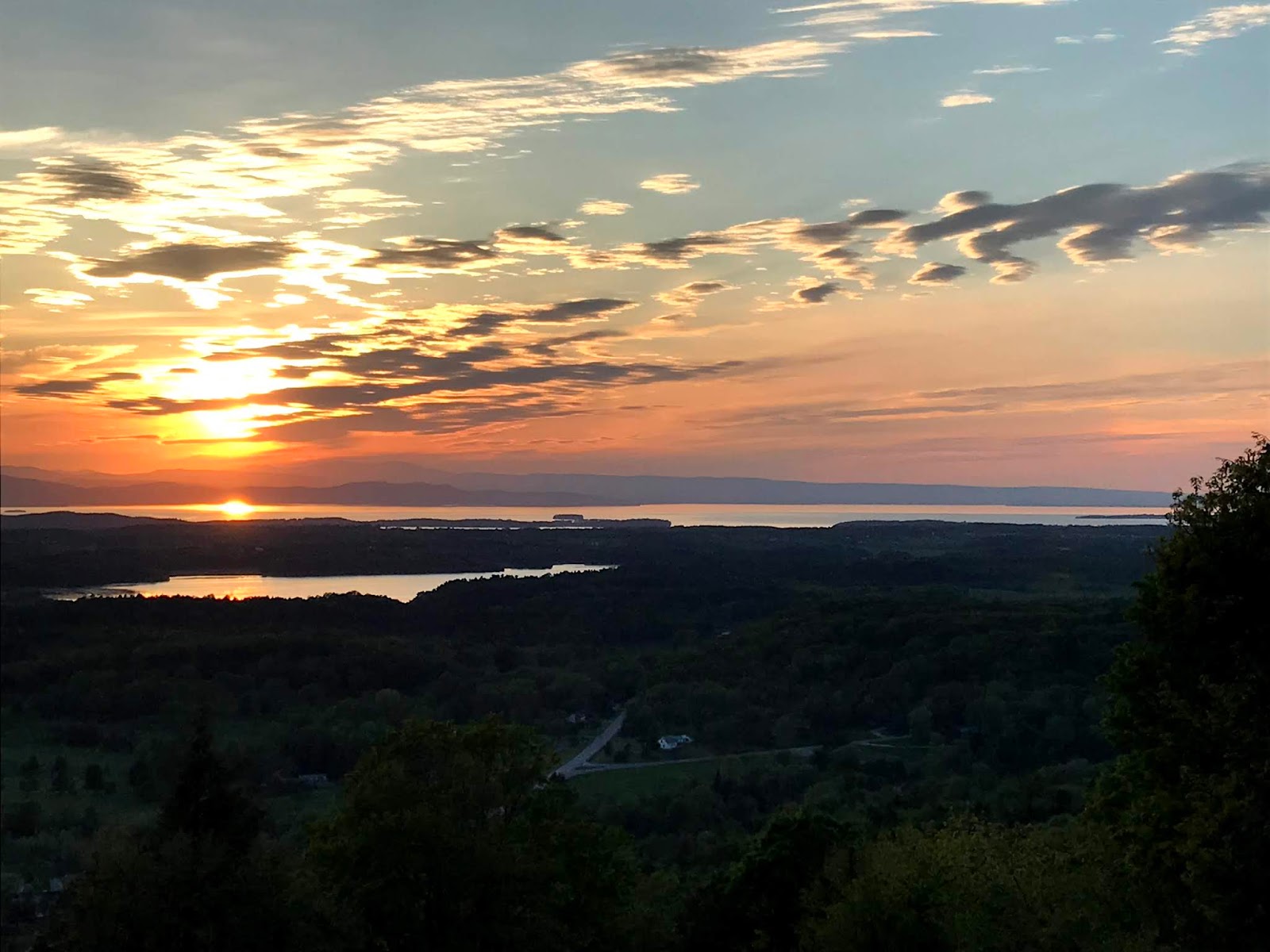


May 27, 2019

For three quarters of an hour the sun is a great round red ball in the west, reflected in the water; at first a scarlet, but as it descends growing more purple and crimson and larger, with a blue bar of a cloud across it; still reflected in the water, two suns, one above the other, below the hilly bank; as if it were a round hole in the cope of heaven, through which we looked into a crimson atmosphere. If such scenes were painted faithfully they would be pronounced unnatural. 

May 28, 2017

It is remarkable at how little distance a hillside covered with lupines looks blue, while a house or board painted blue is seen so great a distance.

A sprig of wilted fir now grown an inch emits that rich fragrance somewhat like strawberries and pineapples, yet peculiar.

Mayhew, in his “London Labour and London Poor,” treating of the costermongers, or those who get their living in the streets of London, speaks of “the muscular irritability begotten by continued wande ing,” making one “unable to rest for any time in one place.”

Mentions the instance of a girl who had been accustomed to sell sprats in the streets, who having been taken into a gentleman ‘ s house out of charity, the pressure of shoes was intolerable to her.” “ ut no sooner did she hear from her friends, that sprats were again in the market, than as if there were some magical influence in the fish, she at once requested to be freed from the confinement, and permitted to return to her old calling.”

I am perhaps equally accustomed to a roaming field-life, experience a good deal of that muscular irritability, and have a good many friends who let me know when sprats are in the market.

H. D. Thoreau, Journal, May 28, 1853


Our river has so little current. See July 30, 1859 ("It is a mere string of lakes which have not made up their minds to be rivers. As near as possible to a standstill."); April 16, 1852 ("A succession of bays it is, a chain of lakes, . . .There is just stream enough for a flow of thought; that is all. Many a foreigner who has come to this town has worked for years on its banks without discovering which way the river runs. ")

The bulbous arethusa out a day or two — probably yesterday. Though in a measure prepared for it, still its beauty surprised me; it is by far the highest and richest color yet. See May 30, 1854 ("I am surprised to find arethusas abundantly out in Hubbard's Close, maybe two or three days ... This high-colored plant shoots up suddenly, all flower, in meadows where it is wet walking. A superb flower.”) and note to May 29, 1856 ("Two Arethusa bulbosa at Hubbard’s Close apparently a day or two")

The sidesaddle-flower conspicuous, but no pollen yet. See May 30, 1852 ("The sidesaddle-flowers . . . are just beginning to blossom. The last are quite showy flowers when the wind turns them so as to show their under sides.");  June 10, 1854 ("Sidesaddle generally out; petals hang down, apparently a day or two. It is a conspicuous flower."); and note to June 12, 1856 ("Sidesaddle flower numerously out now")

It is remarkable at how little distance a hillside covered with lupines looks blue, See June 5, 1852 ("The transparency of the flower makes its color changeable. It paints a whole hillside with its blue,. . .No other flowers exhibit so much blue. That is the value of the lupine. The earth is blued with them.")


May 28. SeeA Book of the Seasons,, by Henry Thoreau, May 28

Two suns in the west
reflected in water, one
above the other.

A Book of the Seasons,  by Henry Thoreau
"A book, each page written in its own season,
out-of-doors, in its own locality."
 ~edited, assembled and rewritten by zphx ©  2009-2021

Wednesday, July 24, 2019

Near the ditch beyond Dennis's Lupine Hill


July 24. 

P. M. — To Ledum Swamp. 

The hairy huckleberry still lingers in bloom, — a few of them. 

The white orchis will hardly open for a week.

Mulgedium, how long? 

Near the ditch beyond Dennis's Lupine Hill, a vaccinium near to Pennsylvanicum, perhaps a variety of it, with ripe fruit, little or no bloom, broader-leaved than that, and not shining beneath but somewhat glaucous.

H. D. Thoreau, Journal, July 24, 1859

The hairy huckleberry still lingers in bloom, — a few of them.The white orchis will hardly open for a week See July 15, 1859 ("The white orchis not yet, apparently, for a week or more. Hairy huckleberry still in bloom, but chiefly done."); August 8, 1858 ("I find at Ledum Swamp, near the pool, the white fringed orchis, quite abundant but past prime, only a few, yet quite fresh. It seems to belong to this sphagnous swamp and is some fifteen to twenty inches high, quite conspicuous, its white spike, amid the prevailing green. The leaves are narrow, half folded, and almost insignificant. It loves, then, these cold bogs.")

Mulgedium, how long? See August 12, 1856 ("The mulgedium in that swamp is very abundant and a very stately plant, so erect and soldier-like, in large companies, rising above all else, with its very regular long, sharp, elliptic head and bluish-white flowers.")

A vaccinium near to Pennsylvanicum, perhaps a variety of it, with ripe fruit, little or no bloom.See  July 15, 1859 ("Ledum Swamp . . .Gather a few Vaccinium Pennsylvanicum.")  See also July 3, 1852 ("When the woods on some hillside are cut off, the Vaccinium Pennsylvanicum springs up, or grows more luxuriantly, being exposed to light and air, and by the second year its stems are weighed to the ground with clusters of blueberries covered with bloom, and much larger than they commonly grow, also with a livelier taste than usual, as if remembering some primitive mountain-side given up to them anciently.");July 11, 1857(“Vaccinium Pennsylvanicum ripe. Their dark blue with a bloom is a color that surprises me. ”); July 13, 1852 ("There are evidently several kinds of . . . blueberries not described by botanists: of the very early blueberries at least two varieties, one glossy black with dark-green leaves, the other a rich light blue with bloom and yellowish-green leaves"); July 13, 1854 (“The V. Pennsylvanicum is soft and rather thin and tasteless, mountain and spring like, with its fine light-blue bloom, very handsome, simple and ambrosial.”); July 13, 1857 ("Vaccinium Pennsylvanicum berries pretty thick [in that sprout-land beyond the red huckleberry], and one lass is picking them with a dipper tied to her girdle.");July 21, 1856 ("Low blackberries thick enough to pick in some places, three or four days. Thimble-berries about the 12th, and V. Pennsylvanicum much longer."). July 29, 1858 ("To Pine Hill, looking for the Vaccinium Pennsylvanicum berries. I find plenty of bushes, but these bear very sparingly. They appear to bear but one or two years before they are overgrown."); August 4, 1856 (“still fresh, the great very light blue (i. e. with a very thick blue bloom) Vaccinium Pennsylvanicum in heavy clusters, that early ambrosial fruit, delicate-flavored, thin-skinned, and cool, — Olympian fruit”

Saturday, August 25, 2018

Botanizing the grasses and sedges

August 25. 

It has been cool and especially windy from the northwest since the 19th, inclusive, but is stiller now.

The note of a warbling vireo sounds very rare. 

P. M. — To Lupine Hill and beyond. 

I see a mouse on the dry hillside this side of Clamshell. 

It is evidently the short-tailed meadow mouse, or Arvicola hirsuta. Generally above, it is very dark brown, almost blackish, being browner forward. It is also dark beneath. Tail but little more than one inch long. Its legs must be very short, for I can hardly glimpse them. Its nose is not sharp. It endeavors to escape down the hill to the meadow, and at first glides along in a sort of path (?), methinks. It glides close to the ground under the stubble and tries to conceal itself. 

I gather from Nut Meadow Brook, not far below the road, a potamogeton (perhaps P. Clayton heterophylus of Gray), which Russell said was the one by road at Jenny Dugan’s). It is still out. Has handsome broad, grassy immersed leaves and somewhat elliptic floating ones. 

I distinguish these plants this afternoon: 


  • Cyperus filiculmis (mariscoides, or tuberous cyperus of Bigelow) in arid, sandy pastures, with globular green heads and slender, commonly slanting culms, five to twelve inches long. It is perhaps getting stale. 
  • The prevalent grass in John Hosmer’s meadow I take to be cut-grass? [no] Long since done, and the leaves now commonly purplish, reflecting that color in the sun from a distance. 
  • The Paspalum setaceum (ciliatifolium), my saw-grass, which I have seen for some time, commonly cut off by the mowers, apparently in prime or past. 
  • Eragrostis pectinacea (Poa hirsuta), hair spear-grass, perhaps not quite so bright as heretofore. Money-Diggers’ Hollow has the most of it. Say a week in prime. 
  • Fimbrystilis capillaris (Scirpus capillaris), that little scirpus turning yellowish in sandy soil, as our garden and Lupine Hill sand. Some time in prime. 
  • Cyperus strigosus under Clamshell Hill, that yellowish fuzzy headed plant, five to twelve inches high, now apparently in prime. Also in Mrs. Hoar’s garden. 
  • Also Cyperus phymatodes, very much like last, in Mrs. Hoar’s garden, which has little tubers at a distance from the base; apparently in prime. 
  • Cyperus dentatus (?), with flat spikelets, under Solidago rigida Bank, apparently in prime; also Pout’s Nest, with round fascicles of leaves amid spikes. 
  • Juncus scirpoides (?)[Is it not paradoxes? Vide Aug. 30] (polycephalus, many-headed of Bigelow), at Alder Ditch and in Great Meadows, etc., perhaps some time. 
  • Andropogon furcatus, forked beard grass, Solidago rigida Bank, a slender grass three to seven feet high on dry soil, apparently in prime with digitate purple spikes, all over hillside behind Caesar’s. 
  • Setaria glauca, glaucous panic grass, bottle grass, sometimes called fox-tail, tawny yellow, going to seed, Mrs. Hoar’s garden. 
  • Setaria viridis, green bottle grass, in garden, some going to seed, but later than the last. These two I have called millet grass. 
  • Aristida dichotomy  poverty grass, slender, curving, purplish, in tufts on sterile soil, looking White fuzzy as it goes to seed; apparently in prime.


H. D. Thoreau, Journal, August 25, 1858

The note of a warbling vireo sounds very rare. See August 9, 1856 (“The notes of the wood pewee and warbling vireo are more prominent of late, and of the goldfinch twittering over.”)

Monday, October 9, 2017

It has come to this, – that the lover of art is one, and the lover of nature another.

October 9. 

P. M. – To Dugan Desert and Ministerial Swamp.

The elms are now at the height of their change. As I look down our street, which is lined with them, now clothed in their very rich brownish-yellow dress, they remind me of yellowing sheaves of grain, as if the harvest had come to the village itself, and we might expect to find some maturity and flavor in the thoughts of the villagers at last. 

Under those light-rustling yellow piles, just ready to fall on the heads of the walker, how can any crudity or greenness of thought or act prevail? The street is a great harvest-home. It would be worth the while to set out these trees, if only for their autumnal value. 

Think of these great yellow canopies or parasols held over our heads and houses by the mile together, making the village all one and compact, an ulmarium. And then how gently and unobserved they drop their burdens and let in the sun when it is wanted, their leaves not heard when they fall on our roofs and in our streets.

I see the traveller driving into the village under its canopy of elm-tops, with his crop, as into a great granary or barn-yard. I am tempted to go thither as to a husking of thoughts, now dry and ripe and ready to be separated from their integuments, but I foresee that it will be chiefly husks and little thought, blasted pig-corn, fit only for cob-meal. 

Is there, then, indeed, no thought under this ample husk of conversation and manners? There is the sermon husk, the lecture husk, and the book husk, and are they all only good to make mats of and tread under foot? 

Looking from railroad bridge, birches are perhaps at the height of their change now; hickories are about the color of elms or a little browner; balm-of-Gileads, about as birches; many ash trees are a mere finely divided dull-reddish color; swamp white oaks are green, yellow, and brown, much less ripe than elms, not much yellowed yet. 

Under the pines by the Clamshell, that fine purple grass is now withered and faded to a very light brown which reflects the autumnal light. Patches of rabbit's clover amid the blackberry vines are now quite hoary if not silvery. I thought it a mass of Aster Tradescanti at first, but they are not so common. Many plants, like them, remind you by their color of the frosts. 

Sprout-lands, with their oaks, chestnuts, etc., etc., are now at their height of color. 

From Lupine Hill, not only the maples, etc., have acquired brighter tints at this season, but the pines, by contrast, appear to have acquired a new and more liquid green, and to some extent this is true, — where their old leaves have chiefly fallen, which is not yet generally the case, however. 

I see now that, near the river and low on the meadows, the maple stands with paled fires, burned out, thin-leaved, a salmon or faint cherry tint, ready to surrender to the first smart frost. 

It has come to this, – that the lover of art is one, and the lover of nature another, though true art is but the expression of our love of nature. It is monstrous when one cares but little about trees but much about Corinthian columns, and yet this is exceedingly common. 

Scarlet oaks have fairly begun to blaze, — especially their lower limbs, – in low places which have from green through dull crimson to dull scarlet. 

Going along the mill road, the common shrub oaks make a dull-red or salmon impression in the mass at a little distance, from which brighter scarlet oaks stand out. 

On F. Wheeler's clearing, over the swamp, many shrub oak leaves fallen, laying bare the acorns, which are browned. Many leaves already thickly strew the dry, sandy ground. 

In the swamp, some twenty-foot maples are already bare, and some white pines are as yellow as birches. The spruces appear unchanged, even close at hand, though many leaves have fallen and are falling. The Viburnum nudum in the swamp is a clear handsome crimson. The young cherry yellow, with a faint cherry tinge. The mulberry is browned and falling, though it is but slightly tinged with yellow. 

I see an Irishman digging mud at Harrington's mud-hole. He digs it out rapidly, — a hole four feet wide by eight long, — leaving a water-tight partition, eighteen or twenty inches wide, on two sides next the water. At three feet it is clear white sand, whiter than common sand-hills. Why? Why is there no stain of vegetation in it? It requires some skill to save much of the partition at last. This man first pares off the top nearly to the level of the water, then, standing on it, digs it away as the water rushes in, - though it fills it before he has got a foot, — and he thus saves about half its depth. No doubt his work is the more amusing for requiring this exercise of thought. 

Saw a jay stealing corn from a stack in a field.

H. D. Thoreau, Journal, October 9, 1857

Is there, then, indeed, no thought under this ample husk of conversation and manners? See August 7, 1854 ("How can we expect a harvest of thought who have not had a seed-time of character?”); January 30, 1854 ("It is for man the seasons and all their fruits exist. The winter was made to concentrate and harden and mature the kernel of his brain, to give tone and firmness and consistency to his thought. Then is the great harvest of the year, the harvest of thought. Now we burn with a purer flame like the stars…")

Wednesday, July 12, 2017

I drink at every cooler spring in my walk these afternoons / the earliest bobolinks of the season.

July 12.

P. M. — To Equiseium hyemale.

Those little minnows, a third or half inch long or more, which I catch when bathing, hovering over open sandy spaces, as here at Clamshell, appear to be little shiners. When left dry on my hand, they can toss themselves three or four inches with a spring of their tails, and so often get into the water again. Small as they are, it is rather difficult to catch them, they dodge your hands so fast.

I drink at every cooler spring in my walk these afternoons and love to eye the bottom there, with its pebbly caddis-cases, or its white worms, or perchance a luxurious frog cooling himself next my nose. 


Sometimes the farmer, foreseeing haying, has been prudent enough to sink a tub in one, which secures a clear deep space. 

It would be worth the while, methinks, to make a map of the town with all the good springs on it, indicating whether they were cool, perennial, copious, pleasantly located, etc. The farmer is wont to celebrate the virtues of some one on his own farm above all others. Some cool rills in the meadows should be remembered also, for some such in deep, cold, grassy meadows are as cold as springs. I have sometimes drank warm or foul water, not knowing such cold streams were at hand. By many a spring I know where to look for the dipper or glass which some mower has left.

When a spring has been allowed to fill up, to be muddied by cattle, or, being exposed to the sun by cutting down the trees and bushes, to dry up, it affects me sadly, like an institution going to decay. Sometimes I see, on one side the tub, — the tub overhung with various wild plants and flowers, its edge almost completely concealed even from the searching eye, — the white sand freshly cast up where the spring is bubbling in. 

Often I sit patiently by the spring I have cleaned out and deepened with my hands, and see the foul water rapidly dissipated like a curling vapor and giving place to the cool and clear. 

Sometimes I can look a yard or more into a crevice under a rock, toward the sources of a spring in a hillside, and see it come cool and copious with incessant murmuring down to the light. There are few more refreshing sights in hot weather. 

I find many strawberries deep in the grass of the meadow near this Hosmer Spring; then proceed on my way with reddened and fragrant fingers, till it gets washed off at new springs. 

It is always pleasant to go over the bare brow of Lupine Hill and see the river and meadows thence. 

It is exceedingly sultry this afternoon, and few men are abroad. The cows stand up to their bellies in the river, lashing their sides with their tails from time to time. 

A strong and wholesome fragrance now from the vegetation as I go by overgrown paths through the swamp west of Nut Meadow. 

Equisetum hyemale has been out a good while; is mostly effete, but some open yet. Some have several flower-spikes on the sides near the top, but most one at top, of the last year's plant. This year's shoots a foot high, more or less. 

All the Pyrola secunda I can find is out of bloom. 

The Chimaphila umbellata flower-buds make a very pretty umbel, of half a dozen small purple balls surmounted by a green calyx. They contrast prettily with the glossy green leaves. 

A song sparrow's nest in a small clump of alder, two feet from ground! Three or four eggs. 

I hear the occasional link note from the earliest bobolinks of the season, — a day or two.

H. D. Thoreau, Journal, July 12, 1857

Those little minnows, a third or half inch long or more, which I catch when bathing at Clamshell.   See June 27, 1853 ("Saw a little pickerel with a minnow in his mouth. It was a beautiful little silver-colored minnow, two inches long, with a broad stripe down the middle."); June 28, 1855 ("Shoals of minnows a half-inch long."); July 16, 1856 ("I See many young shiners (?) (they have the longitudinal bar), one to two and a half inches long"); July 17, 1856 ("Bathed at Clamshell. See great schools of minnows, apparently shiners, hovering in the clear shallow next the shore . . . a broad, distinct black band along sides (which methinks marks the shiner) and note to May 3, 1860 ("little fishes one and a half to two inches long, with a very distinct black line along the sides, which I should have called brook minnows")  See also A Book of the Seasons, by Henry Thoreau, The Luxury of Bathing

I drink at every cooler spring . . . and love to eye the bottom there, with its pebbly caddis-cases . . . See July 17, 1856 "Stooping to drink at the Hosmer Spring, I saw a hundred caddis-cases, of light-colored pebbles, at the bottom, and a dozen or twenty crawled half-way up the side of the tub, apparently on their way out to become perfect insects.")

Some cool rills in the meadows should be remembered also, for some such in deep, cold, grassy meadows are as cold as springs. See August 19, 1852 ("Here [at the Corner Spring] is a little brook of very cold spring-water, rising a few rods distant, sometimes running underground, meandering exceedingly, with a gray sandy and pebbly bottom, flowing through this dense swampy thicket.. . . The water has the coldness it acquired in the bowels of the earth."); October 10, 1860("In August, '55, I levelled for the artificial pond at Sleepy Hollow. They dug gradually for three or four years and completed the pond last year, '59. It is now about a dozen rods long by five or six wide and two or three deep, and is supplied by copious springs in the meadow.")

The Chimaphila umbellata flower-buds make a very pretty umbel, of half a dozen small purple balls surmounted by a green calyx. They contrast prettily with the glossy green leaves. See February 16, 1854 ("It must be the leaves of the Chimaphila umbellate, spotted wintergreen, which Channing left here day before yesterday.Snows again this morning."); February 16, 1855 (“I see where probably rabbits have nibbled of the leaves of the Wintergreen.”); May 21, 1860 ("Wintergreen had started the 18th at least");  July 3, 1852 ("The Chimaphila umbellata, wintergreen, must have been in blossom some time. The back side of its petals, "cream colored tinged with purple," which is turned toward the beholder, while the face is toward the earth, is the handsomest. It is a very pretty little chandelier of a flower, fit to adorn the forest floor.”); July 8, 1857 ("Chimaphila umbellata, apparently a day or two."); July 17, 1857 ("An abundance of chimaphila in bloom. It is a beautiful flower, with its naked umbel of crystalline purplish-white flowers, their disks at an angle with the horizon. On its lower side a ring of purple (or crimson) scales at the base of its concave petals, around the large, green, sticky ovary."); July 24, 1856 ("Chimaphila maculata, three flowers, apparently but few days, while the umbellata is quite done.");  November 16, 1858 (“Methinks the wintergreen, pipsissewa, is our handsomest evergreen, so liquid glossy green and dispersed almost all over the woods.”); December 7, 1853 ("The liquid wet glossy leaves of the Chimaphila (winter or snow-loving) umbellata, with its dry fruit.")

Often I sit patiently by the spring I have cleaned out . . . See July 11, 1857("Am surprised to find the water of Corner Spring spoiled for the present, however much I clear it out, by the numbers of dead and dying frogs in it (Rana palustris). ")

I hear the occasional link note from the earliest bobolinks of the season . . . See July 11, 1856 ('Hear now the link of bobolinks, and see quite a flock of red-wing blackbirds and young. "); July 15, 1854 ("I hear the link link of the bobolink,. . . . Many birds begin to fly in small flocks like grown-up broods."); July 19, 1855 ("Young bobolinks; one of the first autumnalish notes.") July 15, 1856 ("Bobolinks are heard — their link, link — above and amid the tall rue which now whitens the meadows.") See also A Book of the Seasons,  by Henry Thoreau, the Bobolink


July 12. See A Book of the Seasons,  by Henry Thoreau, July 12

A Book of the Seasons,  by Henry Thoreau
"A book, each page written in its own season,
out-of-doors, in its own locality.”
~edited, assembled and rewritten by zphx © 2009-2021

Sunday, April 24, 2016

The epigaea shows a good deal of the pink.


April 24

A rain-threatening April day. Sprinkles a little in the forenoon. 

P. M. — To mayflower. 

The yellow willow peels fairly, probably for several days. Its buds are bursting and showing a little green, at end of railroad bridge. 

On Money-Diggers’ Shore, much large yellow lily root washed up; that white root with white fibres and yellowish leaf—buds. I doubt if I have seen any pontederia this year. 

I find, on the southeast side of Lupine Hill, nearly four rods from the water and a dozen feet above its level, a young Emys picta, one and five eighths inches long and one and a half wide. I think it must have been hatched year before last. It was headed up-hill. Its rear above was already covered with some kind of green moss (?) or the like, which probably had adhered or grown to it in its winter quarters. 

The epigaea on the upper edge of the bank shows a good deal of the pink, and may open in two or three days if it is pleasant. 


April 23, 2024

Trailing arbutus (epigaea) April 24, 2020


Equisetum arvense, by path beyond second brook, probably yesterday. As usual, am struck with the forwardness of the dark patch of slender rush at the cowslip place. 

Returning, in the low wood just this side the first Second Division Brook, near the meadow, see a brown bird flit, and behold my hermit thrush, with one companion, flitting silently through the birches. I saw the fox-color on his tail-coverts, as well as the brown streaks on the breast. Both kept up a constant jerking of the tail as they sat on their perches. 

This season of rain and superabundant moisture makes attractive many an unsightly hollow and recess. I see some roadside lakes, where the grass and clover had already sprung, owing to previous rain or melted snow, now filled with perfectly transparent April rain water, through which I see to their emerald bottoms, -- paved with emerald.

In the pasture beyond Nut Meadow Brook Crossing, the unsightly holes where rocks have been dug and blasted out are now converted into perfect jewels. They are filled with water of crystalline transparency, paved with the same emerald, with a few hardhacks and meadow-sweets standing in them, and jagged points of rock, and a few skaters gliding over them.

Even these furnish goblets and vases of perfect purity to hold the dews and rains, and what more agreeable bottom can we look to than this which the earliest moisture and sun had tinged green? We do not object to see dry leaves and withered grass at the bottom of the goblet when we drink, if these manifestly do not affect the purity of the water. What wells can be more charming? 

If I see an early grasshopper drowning in one, it looks like a fate to be envied. Here is no dark unexplored bottom, with its imagined monsters and mud, but perfect sincerity, setting off all that it reveals. Through this medium we admire even the decaying leaves and sticks at the bottom. 

The brook had risen so, owing to Miles’s running his mill, that I could not get over where I did going.* 

April wells, call them, vases clean as if enameled.

There is a slight sea-turn. I saw it like a smoke beyond Concord from Brown’s high land, and felt the Cool fresh east wind. Is it not common thus early?

The old caterpillar-nests which now lie on the ground under wild cherry trees, and which the birds may use, are a quite light-colored cottony web, close and thick matted, together with the dried excrement of caterpillars, etc., on the inside. 

See a dog’s-bane with two pods open and partially curved backward on each side, but a third not yet open. This soon opens and scatters its down and seeds in my chamber. The outside is a dull reddish or mahogany-color, but the inside is a singularly polished very pale brown. The inner bark of this makes a strong twine like that of the milkweed, but there is not so much of it. 

What is that now ancient and decayed fungus by the first mayflowers, —trumpet-shaped with a very broad mouth, the chief inner part green, the outer dark brown?   

The earliest gooseberry leaf has spread a third of an inch or more.

Goodwin shot, about 6 P. M., and brought to me a cinereous coot (Fulica Americana) which was flying over the willows at Willow Bay, where the water now runs up. It measures fourteen inches to end of tail; eighteen and one half to end of legs. Tail projects a half inch beyond closed wings. Alar extent twenty-six inches. (These dimensions are somewhat stretched.) Above it is a bluish slate, passing into olive behind the wings, the primaries more brownish. Beneath, ash color or pale slate. Head and neck, uniform deep black. Legs, clear green in front, passing into lead-color behind and on the lobes. Edging of wings, white; also the tips of the secondaries for one fourth of an inch, and a small space under the tail. Wings beneath, very light,  almost silvery, slate. Vent, for a small space, black. Bill, bluish-white, with a chestnut bar near tip, and corresponding chestnut spot on each side of lower mandible and a somewhat diamond-shaped chestnut spot at base in front. No noticeable yellow on bill. Irides, reddish. No noticeable whitish spot beneath eyes; only bare lid. Legs and feet are very neat; talons very slender, curving, and sharp, the middle ones 1/2 inch+ long. Lobes chiefly on the inner side of the toes. Legs bare half an inch above the joint. From its fresh and tender look I judge it to be a last year’s bird. It is quite lousy. 

According to Nuttall, they range from 55° north latitude to Florida and Jamaica and west to Oregon (?) and Mexico. Probably breed in every part of North America, —even in Fresh Pond, he would imply, — but their nests, eggs, and breeding-habits are yet unknown. Nocturnal, hiding by day. In Florida in the winter. Come to Fresh Pond in September. A pair there in April, and seen with young birds in June. When alarmed utter a “hoarse kruk.” Called “flusterers” in Carolina, according to Lawson, because they fly trailing their legs or pattering with them over the water. Food: vegetables, also small shellfish, insects, gravel, etc. Leave the Northern States in November.

H. D. Thoreau, Journal, April 24, 1856

*Warren Miles at his new mill tells me eels can’t get above his mill now, in the spring.


A young Emys picta, one and five eighths inches long. See April 21, 1855 ("Saw a painted turtle not two inches in diameter. This must be more than one year old”). See also A Book of the Seasons, by Henry Thoreau, the Painted Turtle (Emys picta)

The inner bark of [the dog's-bane] makes a strong twine like that of the milkweed. See August 16, 1856 ("I find the dog's-bane (Apocynum androsoemifolium) bark not the nearly so strong as that of the A. cannabinum”).; August 5, 1856 (“At the Assabet stone bridge, apparently freshly in flower, — though it may have been out nearly as long as the androscemifolium, — apparently the Apocynum var. hypericifolium (?)”) ;  September 2, 1856 ("Some years ago I sought for Indian hemp (Apocynum cannabinum) hereabouts in vain, and concluded that it did not grow here. A month or two ago I read again, as many times before, that its blossoms were very small, scarcely a third as large as those of the common species, and for some unaccountable reason this distinction kept recurring to me, and I regarded the size of the flowers I saw, though I did not believe that it grew here; and in a day or two my eyes fell on it, aye, in three different places, and different varieties of it.")

The earliest gooseberry leaf has spread a third of an inch or more. See April 13, 1856 ("Th
e early gooseberry leaf-buds in garden have burst, -- now like small green frilled horns); April 23, 1855 ("The currant and second gooseberry are bursting into leaf.”) See also A Book of the Seasons,  by Henry Thoreau, Spring Leaf-Out

The epigaea on the upper edge of the bank shows a good deal of the pink.
 See April 4, 1859 ("The epigaea looks as if it would open in two or three days at least, — showing much color. The flower-buds are protected by the withered leaves, oak leaves, which partly cover them, so that you must look pretty sharp to detect the first flower."); See also A Book of the Seasons, by Henry Thoreau,  Epigaea (mayflower or trailing arbutus)

Equisetum arvense, by path beyond second brook, probably yesterday. S
ee April 24, 1855 ("The Equisetum arvense on the causeway sheds its green pollen .”)

Behold my hermit thrush, with one companion, flitting silently through the birches . . . Both kept up a constant jerking of the tail as they sat on their perches.   This may be HDT’s first certain, correct identification of the hermit, which is the first thrush to arrive in April. He has mistaken it for the wood thrush and the "golden-crowned” thrrush and  has been brushing up on his thrushes. See  May 7, 1852 (" A wood [sic] thrush which. . .betrayed himself by moving, like a large sparrow with ruffled feathers, and quirking his tail like a pewee,  on a low branch.”);  May 22, 1852 ("On my way to Plymouth, looked at Audubon in the State-House. The female (and male?) wood thrush spotted the whole length of belly; the hermit thrush not so.”); April 18, 1854 ("Was surprised to see a wagtail thrush, the golden-crowned, at the Assabet Spring,”); April 27, 1854 ("What a shy fellow my hermit thrush! ");May 4, 1855 ("Several larger thrushes on low limbs and on ground, with a dark eye (not the white around it of the wood thrush) and, I think, the nankeen spot on the secondaries. A hermit thrush?); April 21, 1855 ("At Cliffs, I hear at a distance a wood [sic] thrush. It affects us as a part of our unfallen selves..”); September 29, 1855 ("At Natural History Library saw Dr. Cabot, who says that he has heard either the hermit, or else the olivaceous, thrush sing,—very like a wood thrush, but softer. Is sure that the hermit thrush sometimes breeds hereabouts.”). See also June 12, 1857 ("At Natural History Rooms.. . . The wood thrush's is a slender egg, a little longer than a catbird's and uniform greenish-blue. . . . The egg of the hermit thrush [which variety?] is about as big as that of Wilson's thrush, but darker green.”); October 22, 1857 (“I see what I call a hermit thrush on the bushes by the shore of Flint’s Pond . . .”) Also see A Book of the Seasons, by Henry Thoreau, Early Spring: The Arrival of the Hermit Thrush

See a brown bird flit
and behold my hermit thrush
with one companion.

A Book of the Seasons, by Henry Thoreau
"A book, each page written in its own season,
out-of-doors, in its own locality.”
~edited, assembled and rewritten by zphx © 2009-2026

https://tinyurl.com/hdt-560424

Wednesday, April 29, 2015

This dark, damp, cold day.

April 29, 2015
April 29.

This morning it snows, but the ground is not yet whitened. This will probably take the cold out of the air. 

Many chip-birds are feeding in the yard, and one bay-wing. The latter incessantly scratches like a hen, all the while looking about for foes. The bay on its wings is not obvious except when it opens them. The white circle about the eye is visible afar. Now it makes a business of pluming itself, doubling prettily upon itself, now touching the root of its tail, now thrusting its head under its wing, now between its wing and back above, and now between its legs and its belly; and now it drops flat on its breast and belly and spreads and shakes its wings, now stands up and repeatedly shakes its wings. It is either cleaning itself of dirt acquired in scratching and feeding, — for its feet are black with mud, — or it is oiling its feathers thus. It is rather better concealed by its color than the chip bird with its chestnut crown and light breast. The chip-bird scratches but slightly and rarely; it finds what it wants on the surface, keeps its head down more steadily, not looking about. I see the bay-wing eat some worms. 

For two or three days the Salix alba, with its catkins (not yet open) and its young leaves, or bracts (?), has made quite a show, before any other tree, —a pyramid of tender yellowish green in the russet landscape. 

The water now rapidly going down on the meadows, a bright-green grass is springing up. 

P. M. — By boat to Lupine Hill. 

It did not whiten the ground. Raw, overcast, and threatening rain. 

A few of the cones within reach on F. Monroe’s larches shed pollen; say, then, yesterday. The crimson female flowers are now handsome but small.

That lake grass — or perhaps I should call it purple grass — is now apparently in perfection on the water. Long and slender blades (about an eighth of an inch wide and six to twelve inches long, the part exposed) lie close side by side straight and parallel on the surface, with a dimple at the point where they emerge. Some are a very rich purple, with apparently a bloom, and very suggestive of placidity. It is a true bloom, at any rate,—the first blush of the spring caught on these little standards elevated to the light. By the water they are left perfectly smooth and flat and straight, as well as parallel, and thus, by their mass, make the greater impression on the eye. It has a strong marshy, somewhat fishy, almost seaweed-like scent when plucked. Seen through a glass the surface is finely grooved. 

The scrolls of the interrupted fern are already four or five inches high. 

I see a woodchuck on the side of Lupine Hill, eight or ten rods off. He runs to within three feet of his hole; then stops, with his head up. His whole body makes an angle of forty-five degrees as I look sideways at it. I see his shining black eyes and black snout and his little erect ears. 

He is of a light brown forward at this distance (hoary above, yellowish or sorrel beneath), gradually darkening backward to the end of the tail, which is dark-brown. The general aspect is grizzly, the ends of most of the hairs being white. The yellowish brown, or rather sorrel, of his throat and breast very like the sand of his burrow, over which it is slanted. No glaring distinctions to catch the eye and betray him. 

As I advance, he crawls a foot nearer his hole, as if to make sure his retreat while he satisfies his curiosity. Tired of holding up his head, he lowers it at last, yet waits my further advance. 

The snout of the little sternothaerus is the most like a little black stick seen above the water of any of the smaller tortoises. I was almost perfectly deceived by it close at hand; but it moved. 

Choke-cherry begins to leaf. Dandelions out yesterday, at least. Some young alders begin to leaf. Viola ovata will open to-morrow. 

Mountain-ash began to leaf, say yesterday. Makes a show with leaves alone before any tree. 

Paddling slowly along, I see five or six snipes within four or five rods, feeding on the meadow just laid bare, or in the shallow and grassy water. This dark, damp, cold day they do not mind me. View them with my glass. How the ends of their wings curve upward! They do not thrust their bills clear down commonly, but wade and nibble at something amid the grass, apparently on the surface of the water. Sometimes it seems to be the grass itself, sometimes on the surface of the bare meadow. They are not now thrusting their bills deep in the mud. They have dark-ash or slate-colored breasts. 

At length they take a little alarm and rise with a sort of rippling whistle or peep, a little like a robin’s peep, but faint and soft, and then alight within a dozen rods. I hear often at night a very different harsh squeak from them, and another squeak much like the nighthawk’s, and also the booming.

H. D. Thoreau, Journal, April 29, 1855

One bay-wing . . .The white circle about the eye is visible afar. See  April 13, 1855 ("See a sparrow without marks on throat or breast, running peculiarly in the dry grass in the open field beyond, and hear its song, and then see its white feathers in tail; the bay-wing"); April 23, 1854 ("The bay-wing has a light ring at some distance around the eye.")  See also A Book of the Seasons,  by Henry Thoreau, the Bay-Wing Sparrow (Fringilla graminea)

 The scrolls of the interrupted fern are already four or five inches high. See  April 29, 1859 ("Interrupted fern scrolls there, four to five inches high."); April 30, 1858 ("I noticed one of the large scroll ferns, with its rusty wool, up eight inches on the 28th"); See also A Book of the Seasons,  by Henry Thoreau: The Interrupted Fern (Osmunda claytoniana)

I see a woodchuck on the side of Lupine Hill. 
See April 2, 1858 (“At Hubbard’s Grove I see a woodchuck. He waddles to his hole and then puts out his gray nose within thirty feet to reconnoitre”); April 12, 1855 (“For a week past I have frequently seen the tracks of woodchucks in the sand.”);  April 17, 1855 ("See a woodchuck. His deep reddish-brown rear, somewhat grizzled about, looked like a ripe fruit mellowed by winter."); April 30, 1855 (“The woodchuck has. . . exactly that peculiar rank scent which I perceive in a menagerie.”);  May 30, 1859 ("When I entered the interior meadow of Gowing's Swamp I heard a slight snort, and found that I had suddenly come upon a woodchuck . . . Its colors were gray, reddish brown, and blackish, the gray-tipped wind hairs giving it a grizzly look above, and when it stood up its distinct rust-color beneath was seen, while the top of its head was dark-brown, becoming black at snout, as also its paws and its little rounded ears.")

The snout of the little sternothaerus is the most like a little black stick seen above the water, See September 11, 1854 ("Measured to-day the little Sternothærus odoratus which came out the ground in the garden September 9th. . .  It does not so much impress me as an infantile beginning of life as an epitome of all the past of turtledom and of the earth. I think of it as the result of all the turtles that have been.") See also A Book of the Seasons, by Henry Thoreau,  the Musk Turtle (Sternothaerus odoratus)

Dandelions out yesterday, at least. See April 29, 1859 ("First observe the dandelion well out in R. W. E.'s yard. "); April 29, 1857 ("At Tarbell's watering-place, see a dandelion, its conspicuous bright-yellow disk in the midst of a green space on the moist bank. It seems a sudden and decided progress in the season")  See also A Book of the Seasons,  by Henry Thoreau, The Dandelion in Spring and A Book of the Seasons,  by Henry Thoreau,  the Earliest Flower

And also the booming. See April 9, 1855 ("Some twenty minutes after sundown I hear the first booming of a snipe.") and note to April 9, 1858 ("This “booming” of the snipe is our regular village serenade.”); See also 
A Book of the Seasons,  by Henry Thoreau: the Snipe

April 29.  See A Book of the Seasons,  by Henry Thoreau, April 29

This morning it snows
but does whiten the ground  –
a dark damp cold day.

A Book of the Seasons, by Henry Thoreau
"A book, each page written in its own season,
out-of-doors, in its own locality.”
~edited, assembled and rewritten by zphx © 2009-2025

https://tinyurl.com/hdt-550429


Tuesday, July 22, 2014

Morning fog and melting heat.

July 22

The hottest night, — the last. It was almost impossible to pursue any work out-of- doors yesterday. There were but few men to be seen out. You were prompted often, if working in the sun, to step into the shade to avoid a sunstroke. 

Fogs almost every morning now. Now clouds have begun to hang about all day, which do not promise rain, as it were the morning fogs elevated but little above the earth and floating through the air all day.

P. M. -- To Assabet Bath. 

There is a cool wind from the east, which makes it cool walking that way while it is melting hot walking westward. 


Zizania, a day, with a handsome light-green panicle a foot or more long , a long slender stem, and corn-like leaves frequently more than an inch wide. 

Gerardia flava, apparently two or three days, Lupine Hillside up railroad, near fence.

Solidago odora, a day or two, Lupine Hillside, and what I will call S. puberula, to-morrow. S. altissima on railroad, a day or two.

H. D. Thoreau, Journal, July 22, 1854


The hottest night, — the last . . . There is a cool wind from the east, which makes it cool walking that way while it is melting hot walking westward.
See July 22, 1852 ("A strong west wind, saving us from intolerable heat, accompanied by a blue haze, making the mountains invisible. We have more of the furnace-like heat to-day, after all."); July 22, 1855 (''Dog day weather begins.") See also
A Book of the Seasons
, by Henry Thoreau, Locust, Dogdayish Days

There were but few men to be seen out. See July 22, 1853 (" I enjoy walking in the fields less at this season than at any other; there are so many men in the fields haying now.")

Fogs almost every morning now. See July 22, 1851 ("The season of morning fogs has arrived.”); See also July 18, 1852 ("Now the fogs have begun, in midsummer and mid-haying time "); July 19, 1853 ("This morning a fog and cool.")

Lupine Hillside.  See July 12, 1857 ("It is always pleasant to go over the bare brow of Lupine Hill and see the river and meadows thence.")

Gerardia flava, apparently two or three days. See July 28, 1853 ("The Gerardia flava in the hickory grove behind Lee's Cliff."); July 28, 1856 (Gerardia flava, apparently several days.) [Gerardia flava now know as Aureolaria flava (smooth false foxglove)]

Solidago. See July 17, 1853 ("Rank weeds begin to block up low wood-paths, — goldenrods, asters, etc."); July 18, 1854 ("Methinks the asters and goldenrods begin, like the early ripening leaves, with midsummer heats."); July 19, 1851 ("Beyond the bridge there is a goldenrod partially blossomed."); July 24, 1856 ("In the low Flint's Pond Path, beyond Britton's, the tall rough goldenrod makes a thicket higher than my head."); July 28, 1852 ("Solidago altissima (?) beyond the Corner Bridge, out some days at least . . . Goldenrod and asters have fairly begun."); August 14, 1856 ("Solidago odora abundantly out.")

July 22. See A Book of the Seasons, by Henry Thoreau, July 22

Fogs every morning. 
Clouds now hang about all day
but it does not rain.

A Book of the Seasons, by Henry Thoreau,  Melting Heat
A Book of the Seasons, by Henry Thoreau
"A book, each page written in its own season,
out-of-doors, in its own locality."
~edited, assembled and rewritten by zphx © 2009-2024

https://tinyurl.com/hdt-540722

[At dusk we hike to the view without headlamps on, arriving to a spectacular light show of constant lightning flashes and bolts to the northwest — so far  away we only occasionally  hear the thunder.  we water the dogs and  linger as long as we dare. Loki watches the light show.   My water bottle has dropped somewhere on the trail so we walk back the same route. Little Acorn is on an elastic leach strapped to my waist, her first outing since her surgery 10 day ago. A short hike.  It has been a 90 degree day and two fans so loud  in the family room we do not hear when the deluge hits home a little later.  ~ zphx 20160722]

Popular Posts Last 30 Days.

The week ahead in Henry’s journal

The week ahead in Henry’s journal
A journal, a book that shall contain a record of all your joy.
"A stone fruit. Each one yields me a thought." ~ H. D. Thoreau, March 28, 1859


I sit on this rock
wrestling with the melody
that possesses me.