September 24.
What that singular spiny plant, otherwise like chenopodium, which I found on a wharf in Salem?
Saw at the East India Marine Hall a bay lynx killed in Danvers July 21st (I think in 1827); another killed in Lynnfield in March, 1832. These skins were, now at any rate, quite light dirty-whitish or white wolfish color, with small pale-brown spots. The animals much larger than I expected.
Saw a large fossil turtle, some twenty inches in diameter, with the plates distinct, in a slate colored stone from western New York; also a sword in its scabbard, found in the road near Concord April 19, 1775, and supposed to have belonged to a British officer.
Cape Ann, from Beverly round to Squam, is bristling with little capes, projecting from the main one and similar to it.
H. D. Thoreau, Journal, September 24, 1858
Saw at the East India Marine Hall a bay lynx killed in Danvers. See September 13, 1860 ("Five [lynx] I have heard of (and seen three) killed within some fifteen or eighteen miles of Concord within thirty years past."); September 29, 1856 ("Dr. Reynolds told me the other day of a Canada lynx (?) killed in Andover,. . . thought to be one of a pair, the other being killed or seen in Derry.") and note to February 15, 1858 (' Saw, at a menagerie, a Canada lynx, said to have been taken at the White Mountains.")
Showing posts with label Salem. Show all posts
Showing posts with label Salem. Show all posts
Monday, September 24, 2018


Saturday, September 22, 2018
From Salem to Cape Ann on foot.
A clear cold day, wind northwest.
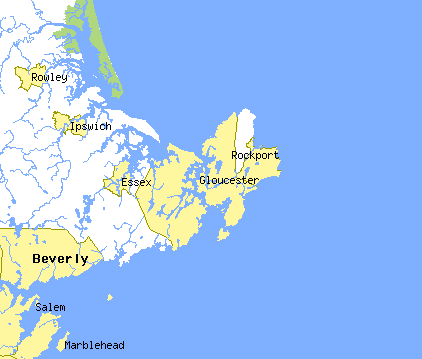 |
| Cape Ann |
Soon struck off to the shore in Beverly. See the discolor thistle on a sandy beach, and Phaseolus diversifolius (three-lobed bean vine), with pretty terete long pods, some ripe, but a few flowers still. Aster linifolius, perhaps still in prime, — though it has a flexuous stem, — in a marsh, and lyme-grass, apparently like ours, along edge of marsh.
Dined on the edge of a high rocky clifl', quite perpendicular, on the west side of entrance of Manchester Harbor.
One mile southeast of the village of Manchester, struck the beach of “musical sand,” just this side of a large, high, rocky point called Eagle Head. This is a curving sandy beach, maybe a third of a mile long by some twelVe rods wide. (We also found it on a similar but shorter beach on the east side of Eagle Head.)
We first perceived the sound when we scratched with our umbrella or finger swiftly and forcibly through the sand; also still louder when we struck forcibly with our heels “scuffing” along. The wet or damp sand yielded no peculiar sound, nor did that which lay loose and deep next the bank, but only the more compact and dry.
The sound was not at all musical, nor was it loud. Fishermen might walk over it all their lives, as indeed they have done, without noticing it. R., who had not heard it, was about right when he said it was like that made by rubbing on wet glass with your fingers. I thought it as much like the sound made in waxing a table as anything. It was a squeaking sound, as of one particle rubbing on another. I should say it was merely the result of the friction of peculiarly formed and constituted particles.
The surf was high and made a great noise, yet I could hear the sound made by my companion’s heels two or three rods distant, and if it had been still, probably could have heard it five or six rods.
We kept thence along the rocky shore to Kettle Cove, where, however, I did not find any rocks like Lewis’s.
Somewhere thereabouts Scirpus maritimus, with its great spikes now withered. In the marsh at Kettle Cove, Gerardia maritima, apparently in prime, four or five inches high; Euphorbia polygonifolia, six inches in diameter. Spartina glabra in the salt water of the cove.
The shore, thus far, from Beverly Bridge had been a succession of bold rocky points half a mile apart, with sometimes curving sandy beaches between, or else rocks.
We now kept the road to Gloucester, leaving the shore a mile or more to the right, wishing to see the magnolia swamp. This was perhaps about a mile and a half beyond Kettle Cove. After passing over a sort of height of land in the woods, we took a path to the left, which within a few rods became a corduroy road in the swamp. Within three or four rods on the west side of this, and perhaps ten or fifteen from the highroad, was the magnolia.
It was two to seven or eight feet high, but distinguished by its large and still fresh green leaves, which had not begun to fall. I saw last year's shoots which had died down several feet, and probably this will be the fate of most which has grown this year.
The swamp was an ordinary one, not so wet but we got about very well. The bushes of this swamp were not generally more than six feet high. There was another locality the other side of the road.
Cooked our supper in a salt marsh some two miles this side of Gloucester, in view of the town. We had cooked our tea for dinner with dead bayberry bushes; now we used the chips and bark which the tide had deposited in little parcels on the marsh, having carried water in our dippers from a brook, a quarter of a mile.
There was a large patch of samphire turned a bright crimson, very conspicuous, near by on the flat marsh, the more conspicuous because large and in the midst of the liquid green of the marsh.
We sat on some stones which we obtained flat in the marsh till starlight.
I had seen in this day’s walk an abundance of Aster cordifolius (but no A. undulatus); also saw A. corymbosus, which is a handsome white wood aster; and, very common, what I called A. longifolius, with shorter thick, clasping leaves and growing in drier ground than ours, methinks; also, all along the road, the up-country hard, small, mulberry-shaped high blackberry, and many still holding on. This may be due to the cool air of the Cape. They were quite sweet and good. Vide a specimen.
The foliage had but just fairly begun to change. Put up in Gloucester.
H. D. Thoreau, Journal, September 22, 1858
 |
| September 22, 2018 |
Friday, September 21, 2018
Botanizing Marblehead and Salem
September 21.
Go to Cape Ann.
A very warm day. A. M.—Go with Russell to the rooms of the Essex Institute, — if that is the name.
See some Indian pottery from the Cayuga Reservation, fragments, very pale brick-color three eighths of an inch thick, with a rude ornament (apparently made with the end of a stick) of this form and size: - the lines re presenting slight hollows in a row around it. Saw a stone, apparently slate, shaped like small “sinkers,” but six inches by three and a half with a small handle, found near here. Was it a sinker or pestle?
(On the 24th, at the East India Marine Hall, saw a circular stone mortar about six inches in diameter, and a stone exactly like the above in it, described as pestle and mortar found in making Salem Turnpike. Were they together? Also, at the last place, what was called the blade of an Indian knife found on Governor Endicott’s farm, broken, three or four inches long, of a light colored kind of slate, quite thin, with a back. It might have been for skinning.)
At the Essex Institute (?),—if that ’s the name, — the eggs of the Rallus Virginianus, labelled by Brewer, but much smaller than those I have seen, and nearly white, with dull-brown spots! Can mine be the egg of the R. crepitons, though larger than mine?
Their eggs of the Sterna hirundo look like mine which I have so called; also do those of the black-headed gull, which do not perceive in Peabody.
Looked over the asters. goldenrods, and willows in their herbarium, collected and named by Oakes, Lapham, Russell, and Cassi —— something. Oakes’s Salix sericea, also Marshall’s, and what O. calls grisea of Willdenow, is the same I so call,, by the white maple at Assabet. What O. calls S. phyllicifolia from White Mountains, having only sterile catkins, ——his specimen, ——is apparently the one I have from there together with the repent.
P. M. — Walked with Russell to Marblehead above railroad.
Saw, in Salem, Solidago Canadensis, considerably past prime; our three-ribbed one done; Spartina cynosuroides; (was that the S. juncea, seven feet high, with a broad leaf, which I mistook for the above? Very common on edge of marshes); apparently Scirpus pungens, two to four feet high; Polygonum aviculare, appearently peculiar; swamp thistle, still abundant; Trifolium procumbens, still abundant; Aster Nova-Anglia, dark violet or lilac-purple, in prime or a little past, three quarters of a mile down railroad; also by shore in Manchester, the 22d; Ruppia maritima, in a ditch.
In Marblehead, Aster cordifolius, abundant, railroad; Woodsia Ivensis. R. pointed out Juncus bufonius (? ?) (but did not know it); it was tenuis-like and probably that. Juncus Green (?) (tenuis-like), dense-flowered, on high sea-bank, sea side of Marblehead. Herb robert, near shore, done. Datura Stramonium var. Tatula, done there, but out at Rockport; got seeds. Also various lichens. Got Parmelia parietina, elegans, and rubina on the rocks. Saw, but did not get, P. murorum. Cetraria Islandica.
R. said that that I saw at the White Mountains was bitter. Endocarpon miniatum (which we have) on rocks. Peltigera polydactyla. Umbilicaria Muhlenbergii, rocks by sea. That common crustaceous lichen on rdcks, —black fruit prettily scattered on a white ground, —— which reminds me of maps, is Lecidea atroalba.
R. thought that my small umbilicaria on Monadnock and Lafayette was Uerosa or hyperborea. He knew a Carex lupulina because the beaks were recurved.
Called Marblehead coast greenstone generally with dykes in sienite. Saw artichokes out in several places, at some time. Have a sort of Spouting Horn by shore. Returned by some very deep hollows in Salem (like the Truro ones) called the Dungeons ! ! as our Dunge Hole.
R. gave me from his garden corns of the true [?] squirrel-corn corydalis, which I plant, and what Tracy gave him for Utricularia intermedia from —-—, not in flower, though he says that T. has examined the flowers. It looks like mine.
What I have called the clustered blackberry he has raised from the seed he got here, and this second year (or third) it has run as long as the common, but, perhaps because in rich soil and the shade, no flowers or fruit.
Saw no Aster Tradescanti in this walk, but an abundance of A. multiflorus in its prime, in Salem and Marblehead.
H. D. Thoreau, Journal , September 21, 1858
 |
| September 21, 2019 |
A very warm day. A. M.—Go with Russell to the rooms of the Essex Institute, — if that is the name.
See some Indian pottery from the Cayuga Reservation, fragments, very pale brick-color three eighths of an inch thick, with a rude ornament (apparently made with the end of a stick) of this form and size: - the lines re presenting slight hollows in a row around it. Saw a stone, apparently slate, shaped like small “sinkers,” but six inches by three and a half with a small handle, found near here. Was it a sinker or pestle?
(On the 24th, at the East India Marine Hall, saw a circular stone mortar about six inches in diameter, and a stone exactly like the above in it, described as pestle and mortar found in making Salem Turnpike. Were they together? Also, at the last place, what was called the blade of an Indian knife found on Governor Endicott’s farm, broken, three or four inches long, of a light colored kind of slate, quite thin, with a back. It might have been for skinning.)
At the Essex Institute (?),—if that ’s the name, — the eggs of the Rallus Virginianus, labelled by Brewer, but much smaller than those I have seen, and nearly white, with dull-brown spots! Can mine be the egg of the R. crepitons, though larger than mine?
Their eggs of the Sterna hirundo look like mine which I have so called; also do those of the black-headed gull, which do not perceive in Peabody.
Looked over the asters. goldenrods, and willows in their herbarium, collected and named by Oakes, Lapham, Russell, and Cassi —— something. Oakes’s Salix sericea, also Marshall’s, and what O. calls grisea of Willdenow, is the same I so call,, by the white maple at Assabet. What O. calls S. phyllicifolia from White Mountains, having only sterile catkins, ——his specimen, ——is apparently the one I have from there together with the repent.
P. M. — Walked with Russell to Marblehead above railroad.
Saw, in Salem, Solidago Canadensis, considerably past prime; our three-ribbed one done; Spartina cynosuroides; (was that the S. juncea, seven feet high, with a broad leaf, which I mistook for the above? Very common on edge of marshes); apparently Scirpus pungens, two to four feet high; Polygonum aviculare, appearently peculiar; swamp thistle, still abundant; Trifolium procumbens, still abundant; Aster Nova-Anglia, dark violet or lilac-purple, in prime or a little past, three quarters of a mile down railroad; also by shore in Manchester, the 22d; Ruppia maritima, in a ditch.
In Marblehead, Aster cordifolius, abundant, railroad; Woodsia Ivensis. R. pointed out Juncus bufonius (? ?) (but did not know it); it was tenuis-like and probably that. Juncus Green (?) (tenuis-like), dense-flowered, on high sea-bank, sea side of Marblehead. Herb robert, near shore, done. Datura Stramonium var. Tatula, done there, but out at Rockport; got seeds. Also various lichens. Got Parmelia parietina, elegans, and rubina on the rocks. Saw, but did not get, P. murorum. Cetraria Islandica.
R. said that that I saw at the White Mountains was bitter. Endocarpon miniatum (which we have) on rocks. Peltigera polydactyla. Umbilicaria Muhlenbergii, rocks by sea. That common crustaceous lichen on rdcks, —black fruit prettily scattered on a white ground, —— which reminds me of maps, is Lecidea atroalba.
R. thought that my small umbilicaria on Monadnock and Lafayette was Uerosa or hyperborea. He knew a Carex lupulina because the beaks were recurved.
Called Marblehead coast greenstone generally with dykes in sienite. Saw artichokes out in several places, at some time. Have a sort of Spouting Horn by shore. Returned by some very deep hollows in Salem (like the Truro ones) called the Dungeons ! ! as our Dunge Hole.
R. gave me from his garden corns of the true [?] squirrel-corn corydalis, which I plant, and what Tracy gave him for Utricularia intermedia from —-—, not in flower, though he says that T. has examined the flowers. It looks like mine.
What I have called the clustered blackberry he has raised from the seed he got here, and this second year (or third) it has run as long as the common, but, perhaps because in rich soil and the shade, no flowers or fruit.
Saw no Aster Tradescanti in this walk, but an abundance of A. multiflorus in its prime, in Salem and Marblehead.
H. D. Thoreau, Journal , September 21, 1858
Subscribe to:
Posts (Atom)
Popular Posts Last 30 Days.
-
If you make the least correct observation of nature . . . the season and life itself is prolonged. Henry Thoreau, April 7, 1853 Marc...
-
For the first time I perceive this spring that the year is a circle. I would make a chart of our life, know why just this circle of creat...
-
"Bellows Falls from Table Rock; From a Lithograph made in 1855” (source: danaxtell ) September 10 10.30 A. M. — Took the cars to...
-
This bright moonlight night an owl heard from my chamber — a loud, piercing scream. HDT ~ September 23, 1855 October 28 As I paddle under th...


The week ahead in Henry’s journal

A journal, a book that shall contain a record of all your joy.