Showing posts with label utriculata. Show all posts

Saturday, August 11, 2018

I smell the fragrant everlasting concealed in the higher grass and weeds, some distance off.

August 11

P. M. — To Beck Stow’s. 

I see of late a good many young sparrows (and old) of different species flitting about. That blackberry-field of Gowing’s in the Great Fields, this side of his swamp, is a famous place for them. I see a dozen or more, old and young, perched on the wall. As I walk along, they fly up from the grass and alight on the wall, where they sit on the alert with outstretched necks. 

Nearest and unalarmed sit the huckleberry-birds; next, quite on the alert, the bay-wings, with which and further off the yellow-browed sparrows, of whom one at least has a clear yellowish breast; add to which that I heard there abouts the seringo note. If made by this particular bird, I should infer it was Fringilla passerina. I still hear there at intervals the bay-wing, huckleberry-bird, and seringo. 

Now is our rainy season. It has rained half the days for ten days past. Instead of dog-day clouds and mists, we have a rainy season. You must walk armed with an umbrella. It is wettest in the woods, where the air has had no chance to dry the bushes at all. 

The Myriophyllum ambiguum, apparently variety natans, is now apparently in its prime. Some buds have gone to seed; others are not yet open. It is floating all over the surface of the pool, by the road, at the swamp, — long utricularia-like masses without the bladders. The emersed part, of linear or pectinate leaves, rises only about half an inch; the rest, eighteen inches more or less in length, consists of an abundance of capillary pinnate leaves, covered with slime or conserve (?) as a web. Evidently the same plant, next the shore and creeping over the mud, only two or three inches long, is without the capillary leaves, having roots instead, and apparently is the variety limosum (?), I suspect erroneously so called. 

Heard a fine, sprightly, richly warbled strain from a bird perched on the top of a bean-pole. It was at the same time novel yet familiar to me. I soon recognized it for the strain of the purple finch, which I have not heard lately. But though it appeared as large, it seemed a different-colored bird. With my glass, four rods off, I saw it to be a goldfinch. It kept repeating this warble of the purple finch for several minutes. A very surprising note to be heard now, when birds generally are so silent. Have not heard the purple finch of late. 

I conclude that the goldfinch is a very fine and powerful singer, and the most successful and remarkable mocking-bird that we have. In the spring I heard it imitate the thrasher exactly, before that bird had arrived, and now it imitates the purple finch as perfectly, after the latter bird has ceased to sing! It is a surprising vocalist. It did not cease singing till I disturbed it by my nearer approach, and then it went off with its usual mew, succeeded by its watery twitter in its ricochet flight. Have they not been more common all summer than formerly?

I go along plum path behind Adolphus Clark’s. This is a peculiar locality for plants. The Desmodium Canadense is now apparently in its prime there and very common, with its rather rich spikes of purple flowers, — the most (?) conspicuous of the desmodiums. It might be called Desmodium Path. 

Also the small rough sunflower (now abundant) and the common apocynum (also in bloom as well as going and gone to seed) are very common. 

I smell the fragrant everlasting concealed in the higher grass and weeds there, some distance off. It reminds me of the lateness of the season. 

Saw the elodea (not long) and a dangle-berry ripe (not long) at Beck Stow’s. 

See a small variety of helianthus growing with the divaricatus, on the north side of Peter’s path, two rods east of bars southeast of his house. It is an imperfect flower, but apparently answers best to the H. tracheliifolius. There is evidently a great variety in respect to form, petiole, venation, roughness, thickness, and color of the leaves of helianthuses. 

Saw yesterday the Utricularia vulgaris, apparently in its prime, yellowing those little pools in Lincoln at the town bound by Walden. Their stems and leaves seem to half fill them. Some pools, like that at bath-place by pond in R. W. E.’s wood, will have for all vegetation only the floating immersed stems and leaves, light brown, of this plant, without a flower, perhaps on account of shade. 

The great bullfrogs, of various colors from dark brown to greenish yellow, lie out on the surface of these slimy pools or in the shallow water by the shore, motionless and philosophic. Toss a chip to one, and he will instantly leap and seize and drop it as quick. Motionless and indifferent as they appear, they are ready to leap upon their prey at any instant.

H. D. Thoreau, Journal, August 11, 1858

Nearest sit the huckleberry-birds; next the bay-wings, with which and further off the yellow-browed sparrows, of whom one at least has a clear yellowish breast I infer was Fringilla passerina. See August 8, 1858 (“I see at Clamshell Hill a yellow-browed sparrow sitting quite near on a haycock, pluming itself.”); and note to July 26, 1858 (“ A broad egg, white with large reddish and purplish brown spots chiefly about large end. . .  Could not see the bird; only saw bay-wings and huckleberry-birds. I suspect it may be the Fringilla passerina? He says the bird had a clear yellowish-white breast!”); June 28, 1858 (“According to Audubon’s and Wilson’s plates, the Fringilla passerina has for the most part clear yellowish-white breast.... Audubon says that the eggs . . .of the yellow-winged sparrow are “of a dingy white, sprinkled with brown spots.”); May 28, 1856 (“A seringo or yellow-browed (?) sparrow’s nest . . .Egg, bluish-white ground, thickly blotched with brown, yet most like a small ground bird’s egg, rather broad at one end, pretty fresh.”)

The seringo note. See April 22, 1856 ("The seringo also sits on a post, with a very distinct yellow line over the eye,and the rhythm of its strain is ker chick | ker che | ker-char—r-r-r-r chick, the last two bars being the part chiefly heard."). See June 26, 1856 (" According to Audubon’s and Wilson’s plates, ... the Savannah sparrow no conspicuous yellow on shoulder, a yellow brow, and white crown line. Rode to Sconticut Neck or Point in Fairhaven, five or six miles, and saw, apparently, the F. Savanna near their nests (my seringo note), restlessly flitting about me from rock to rock within a rod. Distinctly yellow-browed and spotted breast, not like plate of passerina. Audubon says that the eggs of the Savannah sparrow “are of a pale bluish color, softly mottled with purplish brown,””)May 28, 1856 ("A seringo or yellow-browed (?) sparrow’s nest . . . Egg, bluish-white ground, thickly blotched with brown . . ..”); October 22, 1855 ("I sit on a bank at the brook crossing, beyond the grove, to watch a flock of seringos, perhaps Savannah sparrows, which, with some F. hyemalis and other sparrows, are actively flitting about amid the alders and dogwood. "); July 16, 1854 ("Is it the yellow-winged or Savannah sparrow with yellow alternating with dark streaks on throat, as well as yellow over eye, reddish flesh-colored legs, and two light bars on wings?“). See also Guide to Thoreau’s Birds "(Thoreau frequently called the Savannah Sparrow Passerculus sandwichensis the seringo or seringo-bird, but he also applied the name to other small birds.)”


Heard a fine, sprightly, richly warbled strain from a bird perched on the top of a bean-pole.I conclude that the goldfinch is a very fine and powerful singer, and the most successful and remarkable mocking-bird that we have. See April 19, 1858 ("This was the most varied and sprightly performer of any bird I have heard this year, and it is strange that I never heard the strain before. It may be this note which is taken for the thrasher’s before the latter comes.") See also June 25, 1853 ("I think it must be the purple finch . . . which I see and hear singing so sweetly and variedly in the gardens . .. on a bean-pole or fence-picket. It has a little of the martin warble and of the canary bird.")

I smell the fragrant everlasting concealed in the higher grass and weeds. See August 10, 1856 ("Fragrant everlasting, maybe some days.”);  August 13, 1856 (“Is there not now a prevalence of aromatic herbs in prime?. . . Does not the season require this tonic?“); August 29, 1856 ("Fragrant everlasting in prime and very abundant, whitening Carter's pasture.”); September 19, 1852 ("The small-flowering Bidens cernua (?) and the fall dandelion and the fragrant everlasting abound. "); September 26, 1852 ("The small cottony leaves of the fragrant everlasting in the fields for some time, protected, as it were, by a little web of cotton against frost and snow, — a little dense web of cotton spun over it, — entangled in it, — as if to restrain it from rising higher."); February 25, 1857 (“The fragrant everlasting has retained its fragrance all winter. ”)


The small rough sunflower (now abundant) and see a small variety of helianthus growing with the divaricatus, on the north side of Peter’s path. See August 1, 1852 ("The small rough sunflower (Helianthus divaricatus) tells of August heats”); August 11, 1856 ("A new sunflower at Wheeler's Bank, . . ., which I will call the tall rough sunflower; opened say August 1st”); August 12, 1856 (“Am surprised to see still a third species or variety of helianthus (which may have opened near August 1st)”); August 29, 1856 (The Helianthus decapetalus, apparently a variety, with eight petals, about three feet high, leaves petioled, but not wing-petioled, and broader-leaved than that of August 12th“)

It reminds me of the lateness of the season. See July 26, 1853 ("This the afternoon of the year. How apt we are to be reminded of lateness, even before the year is half spent!”); July 30 1852 (After midsummer we have a belated feeling . . .") ; August 18, 1853 ("What means this sense of lateness that so comes over one now”)

August 11 See A Book of the Seasons, by Henry Thoreau, August 11


A Book of the Seasons,  by Henry Thoreau
"A book, each page written in its own season,
out-of-doors, in its own locality.”
~edited, assembled and rewritten by zphx © 2009-2021

Thursday, June 7, 2018

A new season has arrived: heat, fireflies; mosquitoes; trumping bullfrogs

June 7

P. M. — To Walden. 

Warm weather has suddenly come, beginning yesterday. To-day it is yet warmer, 87° at 3 P. M., compelling me to put on a thin coat, and I see that a new season has arrived.

June 7, 2018
 (Avesong)

June shadows are moving over waving grass-fields, the crickets chirp uninterruptedly, and I perceive the agreeable acid scent of high blueberry bushes in bloom. The trees having leaved out, you notice their rounded tops, suggesting shade. 

The nighthawk sparks and booms over arid hillsides and sprout-lands. 

It is evidence enough against crows and hawks and owls, proving their propensity to rob birds’ nests of eggs and young, that smaller birds pursue them so often. You do not need the testimony of so many farmers' boys when you can see and hear the small birds daily crying “Thief and murder” after these spoilers. 

What does it signify, the kingbird, black bird, swallow, etc., etc., pursuing a crow? They say plainly enough, “I know you of old, you villain; you want to devour my eggs or young. I have often caught you at it, and I’ll publish you now.” And probably the crow pursuing the fish hawk and eagle proves that the latter sometimes devour their young. 

The Salix tristis is now generally going or gone to seed.

Oxalis violacea in garden.

I see toads copulating and toad-spawn freshly laid in the Wyman meadow at Walden. 

Utricularia vulgaris out there. 

The water colored or dusted with the pollen of the pitch pine. 

As I was wading in this Wyman meadow, looking for bullfrog-spawn, I saw a hole at the bottom, where it was six or eight inches deep, by the side of a mass of mud and weeds which rose just to the surface three or four feet from the shore. It was about five inches in diameter, with some sand at the mouth, just like a musquash's hole. As I stood there within two feet, a pout put her head out, as if to see who was there, and directly came forth and disappeared under the target-weed; but as I stood perfectly still, waiting for the water which I had disturbed to settle about the hole, she circled round and round several times be tween me and the hole, cautiously, stealthily approaching the entrance but as often withdrawing, and at last mustered courage to enter it.

I then noticed another similar hole in the same mass, two or three feet from this. I thrust my arm into the first, running it in and downward about fifteen inches. It was a little more than a foot long and enlarged somewhat at the end, the bottom, also, being about a foot beneath the surface, — for it slanted downward, – but I felt nothing within; I only felt a pretty regular and rounded apartment with firm walls of weedy or fibrous mud. 

I then thrust my arm into the other hole, which was longer and deeper, but at first discovered nothing; but, trying again, I found that I had not reached the end, for it turned a little and descended more than I supposed. Here I felt a similar apartment or enlargement, some six inches in diameter horizontally but not quite so high nor nearly so wide at its throat.

 Here, to my surprise, I felt something soft, like a gelatinous mass of spawn, but, feeling a little further, felt the horns of a pout. I deliberately took hold of her by the head and lifted her out of the hole and the water, having run my arm in two thirds its length. She offered not the slightest resistance from first to last, even when I held her out of water before my face, and only darted away suddenly when I dropped her in the water. 

The entrance to her apartment was so narrow that she could hardly have escaped if I had tried to prevent her. Putting in my arm again, I felt, under where she had been, a flattish mass of ova, several inches in diameter, resting on the mud, and took out some. Feeling again in the first hole, I found as much more there. Though I had been stepping round and over the second nest for several minutes, I had not scared the pout.

 The ova of the first nest already contained white wiggling young. I saw no motion in the others. The ova in each case were dull-yellowish and the size of small buckshot. These nests did not communicate with each other and had no other outlet.

 Pouts, then, make their nests in shallow mud-holes or bays, in masses of weedy mud, or probably in the muddy bank; and the old pout hovers over the spawn or keeps guard at the entrance. Where do the Walden pouts breed when they have not access to this meadow?

 The first pout, whose eggs were most developed, was the largest and had some slight wounds on the back. The other may have been the male in the act of fertilizing the ova.

 I sit in my boat in the twilight by the edge of the river. Toads are now in full blast along the river. Some sit quite out at the edge of the pads, and hold up their heads so high when they ring, and make such a large bubble, that they look as if they would tumble over backward.

 Bullfrogs now are in full blast. I do not hear other frogs; their notes are probably drowned. I perceive that this generally is the rhythm of the bullfrog; er|er-r er-r-r| (growing fuller and fuller and more tremendous) and then doubling, er, er er, err er, er, er er, er, er and finally er, er, er, er er, er, er, er. Or I might write it oorar oorar oorar oorar-hah oorar-hah hah oorar hah hah hah.

Some of these great males are yellow or quite yellowish over the whole back. Are not the females oftenest white-throated?

 What lungs, what health, what terrenity (if not serenity) it suggests! 

At length I hear the faint stertoration of a Rana palustris (if not halecina).

Seeing a large head, with its prominent eyes, projecting above the middle of the river, I found it was a bullfrog coming across. It swam under water a  rod or two, and then came up to see where it was, or its way. It is thus they cross when sounds or sights attract them to more desirable shores. Probably they prefer the night for such excursions, for fear of large pickerel, etc.

 I thought its throat was not yellow nor baggy. Was it not the female attracted by the note of the male?

 Fireflies pretty numerous over the river, though we have had no thunder-showers of late.

 Mosquitoes quite troublesome here.

 The ledum is a very good plant to bloom in a pitcher, lasting a week or more.

H. D. Thoreau, Journal, June 7, 1858


87° at 3 P. M and i see that a new season has arrived.
. . .Fireflies pretty numerous over the river, though we have had no thunder-showers of late. Mosquitoes quite troublesome here. See  June 7, 1854   ([M]osquitoes are very troublesome in the woods . . .This muggy evening I see fireflies, the first I have seen"); See also June 16, 1860 ("It appears to me that these phenomena occur simultaneously, say June 12th, viz.: -
• Heat about. 85° at 2 P.M.
• Hylodes cease to peep.
• Purring frogs (Rana palustris) cease.
• Lightning-bugs first seen.
• Bullfrogs trump generally.
• Mosquitoes begin to be really troublesome.
• Afternoon thunder-showers almost regular.
• Sleep with open window.
• Turtles fairly and generally begun to lay.")
See also A Book of the Seasons,  by Henry Thoreau, Fireflies, winged sparks of fire!

The nighthawk sparks and booms over arid hillsides and sprout-lands. See June 7, 1853 ("Visit my nighthawk on her nest. . . . The sight of this creature sitting on its eggs impresses me with the venerableness of the globe.");  See also  May 25, 1852 ("First nighthawks squeak and boom")  and also A Book of Seasons,  by Henry Thoreau,, the Nighthawk

Oxalis violacea in garden. See June 7, 2057 ("Pratt has got the . . . Oxalis violacea, which he says began about last Sunday, or May 31st, larger and handsomer than the yellow, though it blossoms but sparingly.")

June 7. See A Book of the Seasons,  by Henry Thoreau, June 7


 June shadows moving
 over waving grass-fields, 
new season arrived.
 
I sit in my boat
in the twilight by the
edge of the river.

At length I hear the 
faint stertoration of a 
Rana palustris


A Book of the Seasons, by Henry Thoreau
"A book, each page written in its own season,
out-of-doors, in its own locality.”
~edited, assembled and rewritten by zphx © 2009-2026

https://tinyurl.com/hdt-580607

Friday, September 1, 2017

The question of the two varieties of Polygonum amphibium.

September 1.

Tuesday. P. M. — To Fair Haven Pond by boat. 

Landing at Bittern Cliff, I see that fine purple grass; how long? 

At Baker's shore, I at length distinguished fairly the Sagittaria simplex, which I have known so long, the small one with simple leaves. But this year there are very few of them, being nearly drowned out by the high water. 

On the west side of Fair Haven Pond, an abundance of the Utricularia purpurea and of the whorled, etc., whose finely dissected leaves are a rich sight in the water. Again I observe that the heart-leaf, as it decays, preserves fresh and green for some time within, or in its centre, a finely dissected green leaf, suggesting that it has passed through this stage in its development. Immersed leaves often present this form, but  seems that even emersed ones remember it. 

High blackberries are still in their prime on Lee's Cliff, but huckleberries soft and wormy, many of them. 

I have finally settled for myself the question of the two varieties of Polygonum amphibium. I think there are not even two varieties. As formerly, I observe again to-day a Polygonum amphibium extending from the shore six feet into the water. In the water, of course, the stem is prostrate, rank, and has something serpent-like in its aspect. From the shore end rise erect flowering branches whose leaves are more or less roughish and prickly on the midrib beneath. On the water end the leaves are long-petioled, heart-shaped, and perfectly smooth. Vide a specimen pressed. I have seen this same plant growing erect in the driest soil, by the roadside, and it ranges from this quite into the water.

H. D. Thoreau, Journal, September 1, 1857

Landing at Bittern Cliff, I see that fine purple grass. . . See May 1, 1856 ("How pleasing that early purple grass in smooth water! "); April 29, 1855 ("That lake grass — or perhaps I should call it purple grass — is now apparently in perfection on the water.” . . . )


On the west side of Fair Haven Pond, an abundance of the Utricularia purpurea . . .See August 3, 1856 ("The purple utricularia abundant . . ."); August 5, 1854 ("I see very few whorled or common utricularias, but the purple ones are exceedingly abundant on both sides the river, apparently from one end to the other. The broad pad field on the southwest side of Fair Haven is distinctly purpled with them. Their color is peculiarly high for a water plant.”)


Friday evening. It is perfectly clear.  The sunset sky is orange . I  wear parka and gloves. We sit.  The sunset turns to  starlight  The big dipper holds water this time of year.  Arcturus in the southwest
Now under headlamp we hike to the double chair.. The moon seen in the clearing  will be full in a week. An owl nearby hoots for 10 or 15 minutes eventually calling in a companion who arrives with that raucous clown-like sound. Down the mountain trail and home by 10 o’clock:

On  top of the mountain  
listening to the barred owl 
only a few feet away.
zphx 20170901

Tuesday, August 29, 2017

To Owl-Nest Swamp and Indian Rock

August 29


Spotted coral-root
Mt. Pritchard August 2018
(Avesong)
"Nearby, north, is a rocky ridge, on the east slope of which the Corallorhiza multiflora is very abundant. Call that Corallorhiza Rocks.”
August 29, 1857

Saturday. P. M. —To Owl-Nest Swamp with C.

Gerardia tenuifolia, a new plant to Concord, apparently in prime, at entrance to Owl-Nest Path and generally in that neighborhood. Also on Conantum height above orchard, two or three days later. This species grows on dry ground, or higher than the purpurea, and is more delicate. 

Got some ferns in the swamp and a small utricularia not in bloom, apparently different from that of Pleasant Meadow (vide August 18). 

The proserpinaca leaves are very interesting in the water, so finely cut. Polygonum arifolium in bloom how long? We waded amid the proserpinaca south of the wall and stood on a small bed of sphagnum, three or four feet in diameter, which rose above the surface. 

Some kind of water rat had its nest or retreat in this wet sphagnum, and being disturbed, swam off to the shore from under us. He was perhaps half as large again as a mole, or nearly, and somewhat grayish. 

The large and broad leafed sium which grows here is, judging from its seed, the same with the common. 

I find the calla going to seed, but still the seed is green. 

That large, coarse, flag-like reed is apparently Carex comosa; now gone to seed, though only one is found with seed still on it, under water. 

The Indian Rock, further west, is upright, or over hanging two feet, and a dozen feet high. Against this the Indians camped.

It has many very large specimens of the Umbilicaria Dillenii, some six or eight inches in diameter, dripping with moisture to-day, like leather aprons hanging to the side of the rock, olive-green (this moist day), curled under on the edges and showing the upper side; but when dry they curl upward and show the crocky under sides. 

Nearby, north, is a rocky ridge, on the east slope of which the Corallorhiza multiflora is very abundant. Call that Corallorhiza Rocks.

H. D. Thoreau, Journal, August 29, 1857

Owl-Nest Swamp. See June 24, 1857 ("Went to Farmer's Swamp to look for the owl's nest Farmer had found. “)  Owl-Nest Swamp and Calla Swamp are the same, located south of Bateman’s Pond .

I find the calla going to seed. . . June 24, 1857 ("Found [in Owl-Nest Swamp] the Calla palustris, out of bloom") and note to July 2, 1857 ("Having found this in one place, I now find it in another. ")

Corallorhiza multiflora [spotted coral root]... See note to August 13, 1857

Tuesday, July 18, 2017

Old Sam Nutting used to pinch off the first leaves of his melon

July 18

Minott says that old Sam Nutting used to pinch off the first leaves of his melon vines as soon as they had three or four leaves, because they only attracted the bugs, and he was quite successful. 

George Bradford says he finds in Salem striped maple and Sambucus pubens. He (and Tuckerman?) found the Utricularia resupinata once in Plymouth, and it seems to correspond with mine at Well Meadow.

H. D. Thoreau, Journal, July 18, 1857

The Utricularia resupinata ...in Plymouth ... seems to correspond with mine at Well Meadow. See July 18, 1856 ("You see almost everywhere on the muddy river bottom . . . the Utricularia vulgaris, with its black or green bladders, and the two lesser utricularias in many places."): July 18, 1853 ("Three utricularias and perhaps the horned also common now. ")


George Bradford says he finds in Salem striped maple and Sambucus pubens. See June 16, 1856 (To Found in the Purgatory [in Sutton] the panicled elder(Sambucus pubens), partly gone to ribbed seed, but some in flower, new to me;... moose-wood or striped maple..."); September 5, 1856 ("About one mile from West Fitchburg depot, westward, I saw the panicled elderberries on the railroad but just beginning to redden, though it is said to ripen long before this.")


July 18. See A Book of Seasons, by Henry Thoreau, July 18

A Book of Seasons, by Henry Thoreau
"A book, each page written in its own season,
out-of-doors, in its own locality."
 ~edited, assembled and rewritten by zphx © 2009-2021

Wednesday, August 3, 2016

Our river is so sluggish and smooth that sometimes I can trace a boat that has passed half an hour before, by the bubbles on its surface.

August 3

Sunday. P. M. — To Lee's Cliff by river. 

Landing at flat shore. The sium and sarothra apparently now in prime. The central umbel of the sium going or gone to seed. The whorled utricularia is open all day. The Hypericum ellipticum is apparently out of bloom, there at least. 

At length from July 30th inclusive the cloud-like wreaths of mist of these dog-days lift somewhat, and the sun shines out more or less, a short time, at 3 p. m. 

The sun coming out when I am off Clamshell, the abundant small dragon-flies of different colors, bright-blue and lighter, looped along the floating vallisneria, make a very lively and gay appearance. I fancy these bright loops adorn or set forth the river like triumphal arches for my procession, stretching from side to side. 

The floating vallisneria is very thick at the shallow bends. I see many of its narrow, erect, spoon-shaped tops. 


Cornus alternifolia 

Cornus alternifolia berries ripe, as I go from Holden Swamp shore to Miles Swamp. They are in open cymes, dull-blue, somewhat depressed globular, tipped with the persistent styles, yet already, as usual, mostly fallen. But handsomer far are the pretty (bare) red peduncles and pedicels, like fairy fingers spread. They make a show at a distance of a dozen rods even. Some thing light and open about this tree, but a sort of witch's tree nevertheless. 

The purple utricularia abundant, but I did not chance to notice it July 25th. 

At Bittern Cliff again lucky enough to find Polygonum tenue, apparently out but a short time, say one week at most. Have marked the spot by a stone from the wall; further north than formerly. 

Selaginella rupestris (?) shows yellow fruit now at Bittern Cliff. 

Gerardia quercifolia, three to four feet high, out there, apparently two or three days. Yet none of the leaves I have are twice pinnatifid. 

Penny royal there, apparently some days.

Diplopappus cornifolius, some time. Desmodium acuminatum a long time out and also gone to seed. Lespedeza hirta, Blackberry Steep, how long? 

High blackberries beginning; a few ripe. 

Parietaria a foot high, some time, under the slippery elm. 

What is that tall (four feet), long-bearded grass, now nearly ripe, under this end of Lee's Cliff

I see blackened haycocks on the meadows. Think what the farmer gets with his hay, — what his river-meadow hay consists of, — how much of fern and osier and sweet-gale and Polygonum hydropiperoides and rhexia (I trust the cattle love the scent of it as well as I) and lysimachia, etc., etc., and rue, and sium and cicuta. 

In a meadow now being mown I see that the ferns and small osiers are as thick as the grass. If modern farmers do not collect elm and other leaves for their cattle, they do thus mow and cure the willows, etc., etc., to a considerable extent, so that they come to large bushes or trees only on the edge of the meadow. 

Two small ducks (probably wood ducks) flying south. Already grown, and at least looking south! ! It reminds me of the swift revolution of the seasons.

Our river is so sluggish and smooth that sometimes I can trace a boat that has passed half an hour before, by the bubbles on its surface, which have not burst. I have known thus which stream another party had gone up long before. A swift stream soon blots out such traces. 

Cirsium lanceolatum at Lee's Cliff, apparently some days. Its leaves are long-pointed and a much darker green than those of the pasture thistle. On the under sides of its leaves I noticed very large ants attending peculiar large dark-colored aphides, for their milch cows. 

The prevailing willow off Holden Swamp is sericea- like, but the leaf is narrow, more shining above, and merely glaucous beneath, longer-petioled, the serratures not so much bent toward the point. The twigs not nearly so brittle at the base, but bringing away strings of bark. Stipules probably fallen or inconspicuous. Can it be S. petiolaris? and is it the same with that above Hemlocks, north side? Or is it S. lucida? Vide in press. 

Edge of grain-field next Bittern Cliff Wood, common spurge; and, with it, apparently the same, half ascendant and covered or spotted with a minute fungus.

H. D. Thoreau, Journal, August 3, 1856

Cornus alternifolia berries ripe . . . See August 1, 1852 ("The berries of what I have called the alternate-leaved cornel are now ripe, a very dark blue - blue-black - and round, but dropping off prematurely, leaving handsome red cymes, which adorn the trees from a distance.")

Willows, etc., etc.. . . come to large bushes or trees only on the edge of the meadow. See July 29, 1853 ("[A plant] grows where it escapes the mower, . . . we do not know where they would prefer to grow if unmolested by man, but rather where they best escape his vandalism. How large a proportion of flowers, for instance, are referred to and found by hedges, walls, and fences.")

Our river is so sluggish and smooth that sometimes I can trace a boat that has passed half an hour before. . . See April 16, 1852 ("[Concord River is a] succession of bays . . . a chain of lakes . . . There is just stream enough for a flow of thought; that is all . . . Many a foreigner who has come to this town has worked for years on its banks without discovering which way the river runs.") See also 
A Book of the Seasons, by Henry Thoreau, The pulse of the River (Aaugust 2, 1856)

August 3. See A Book of the Seasons, by Henry Thoreau,  August 3

Bubbles trace a boat
that passed half an hour before –
our sluggish river.

A Book of the Seasons, by Henry Thoreau
"A book, each page written in its own season,
out-of-doors, in its own locality."
~edited, assembled and rewritten by zphx ©  2009-2026

https://tinyurl.com/hdt-560803
 

Monday, July 25, 2016

A cock crows at noon.

July 25

Friday. A. M. — Up river to see hypericums out. 

Lycopus Virginicus, with its runners, perhaps some days, in Hosmer Flat Meadow. 

Whorled utricularia very abundantly out, apparently in its prime. 

Lysimachia ciliata some days. 

The Hieracium Canadense grows by the road fence in Potter's hydrocotyle field, some seven or eight inches high, in dense tufts! 

The haymakers getting in the hay from Hubbard's meadow tell me the cock says we are going to have a long spell of dry weather or else very wet.  
"Well, there 's some difference between them," I answer; "how do you know it? " 
"I just heard a cock crow at noon, and that 's a sure sign it will either be very dry or very wet." 

The Hypericum perforatum, corymbosum, and ellipticum are not open this forenoon, but the angulosum, Canadense, mutilum, and Sarothra are partly curled up (their petals) even by 9 a.m.; perhaps because it is very warm, for day before yesterday, methinks, I saw the mutilum and Sarothra open later. 

The street is now strewn with bark under the buttonwood at the brick house. Has not the hot weather taken the bark off? 

The air begins to be thick and almost smoky.

H. D. Thoreau, Journal, July 25, 1856


The Hypericum perforatum, corymbosum, and ellipticum are not open this forenoon, but the angulosum, Canadense, mutilum, and Sarothra are partly curled up (their petals) even by 9 a.m
. See July 26, 1856 ("Arranged the hypericums in bottles this morning and watched their opening.")  See also A Book of the Seasons,  by Henry Thoreau, St. Johns-wort (Hypericum)Compare August 21, 1851 (" I have now found all the hawkweeds. Singular these genera of plants, plants manifestly related yet distinct. They suggest a history to nature, a natural history in a new sense.”)

Monday, July 18, 2016

Sheltered in shadow of ferns in the meadow on the cool mud in the hot afternoon.

July 18

P. M. — To Wheeler meadow to look at willows. 

Again scare up a woodcock, apparently seated or sheltered in shadow of ferns in the meadow on the cool mud in the hot afternoon. 

July 18

Rosa Carolina, some time, at edge of Wheeler meadow near Island Neck. 

You see almost everywhere on the muddy river bottom, rising toward the surface, first, the coarse multifid leaves of the Ranunculus Purshii, now much the worse for the wear; second, perhaps, in coarseness, the ceratophyllum, standing upright; third, perhaps, the Bidens Beckii, with its leafets at top; then the Utricularia vulgaris, with its black or green bladders, and the two lesser utricularias in many places.

H. D. Thoreau, Journal, July 18, 1856

Again scare up a woodcock. See July 3, 1856 ("I scare up one or two woodcocks in different places by the shore, where they are feeding, and in a meadow. They go off with a whistling flight. Can see where their bills have probed the mud. "); July 13, 1852 ("Each day now I scare up woodcocks by shady springs and swamps."); July 27, 1852 ("Woodcocks have been common by the streams and springs in woods for some weeks."); See also A Book of the Seasons, by Henry Thoreau, The American Woodcock

Rosa Carolina, some time. See July 8, 1854 ("The Rosa nitida I think has [been] some time done; the lucida generally now ceasing, and the Carolina (?) just begun."); .July 18, 1853  ("The late, or river, rose spots the copses over the water, — a great ornament to the river's brink now"); July 23, 1860  ("The late rose is now in prime along the river, a pale rose-color but very delicate, keeping up the memory of roses."); See also A Book of the Seasons,  by Henry Thoreau, The Wild Rose

The coarse multifid leaves of the Ranunculus Purshii . . . ceratophyllum, standing upright . . . the Bidens Beckii, . . . the Utricularia vulgaris, with its black or green bladders, and the two lesser utricularias in many places. See  July 18, 1853 ("Three utricularias and perhaps the horned also common now. ") See also July 4, 1853 ("The weeds are now so thick in the river — potamogetons, heart - leaf, Ranunculus Purshii, eel - grass, etc., etc. — as almost to conceal the stream and seriously to obstruct the passage of my boat."); July 14, 1856 ("Ceratophyllum [hornwort] with a dense whorl of twelve little oval red-dotted apparent flower-buds (?) in an axil. "); July 25, 1856 ("Whorled utricularia very abundantly out, apparently in its prime. ); July 27, 1856 ("Ceratophyllum is now apparently in bloom commonly, with its crimson-dotted involucre."); July 31, 1859 ("What a variety of weeds by the riverside now, in the water of the stagnant portions! Not only lilies of three kinds, but heart-leaf, Utricularia vulgaris and purpurea, all (at least except two yellow lilies) in prime. Sium in bloom, too, and Bidens Beckii just begun, and Ranunculus Purshii still.") and  A Book of the Seasons,, by Henry Thoreau, The Bidens Beckii
 
July 18. See A Book of the Seasons, by Henry Thoreau, July 18

In shadow of ferns 
on the cool mud, a woodcock
this hot afternoon.

A Book of the Seasons, by Henry Thoreau
"A book, each page written in its own season,
out-of-doors, in its own locality."
 ~edited, assembled and rewritten by zphx © 2009-2026

https://tinyurl.com/hdt-560718

Sunday, June 12, 2016

A small pewee nest on apple in Miles’s meadow.

June 12

P. M. — To Conantum on foot. 

Sophia has sent me, in a letter from Worcester, part of an orchis in bloom, apparently Platanthera Hookeri (?), or smaller round-leafed orchis, from the Hermitage Wood, so called, northeast of the town; but the two leaves are elliptical.

Utricularia vulgaris was abundantly out yesterday in Everett’s Pool; how long? 

Sidesaddle flower numerously out now. 

Apparently a small pewee nest on apple in Miles’s meadow. Bird on, and not to be frightened off, though I throw sticks and climb the tree to near her.

H. D. Thoreau, Journal, June 12, 1856

Sidesaddle flower numerously out now:  Sarracenia purpurea, also known as the purple pitcher plant or northern pitcher plant, the only pitcher plant native to New England.  See  June 12, 1852 ("The petals of the sidesaddle-flower, fully expanded, hang down. How complex it is, what with flowers and leaves! It is a wholesome and interesting plant to me, the leaf especially."); June 12, 1853 ('The sidesaddle-flowers are partly turned up now and make a great show, with their broad red petals flapping like saddle ears (?)" See also A Book of the Seasons, by Henry Thoreau, The Purple Pitcher Plant

Apparently a small pewee nest on apple. See  June 9, 1855 ("The nest probably of the small pewee — looking from the ground like a yellowbird’s, showing reddish wool of ferns —against a white birch, on a small twig, eighteen feet from ground. Four little eggs, all pale cream-color before blowing, white after - fresh.”); June 21, 1855 (" On an apple at R.W.E.’s a small pewee’s nest, on a horizontal branch, seven feet high, almost wholly of hair, cotton without, not incurved at edge; four eggs, pale cream-color.”)

The “Small Pewee” is listed as Muscicapa acadia in Report on the Fishes, Reptiles and Birds of Massachusetts 295 (1839), also in Thompson, Natural History of Vermont, part I, 76 (1842). Probably what Thoreau calls the "small pewee” is what we now know as the Least Flycatcher (Empidonax minimus). It nests in open woods, aspen groves orchards and shade trees. Its sound, che bek, seems closer to Thoreau’s chevet, tche-vet. And it arrives in Massachusetts the last week in April and in Vermont the first week of May. See A Book of the Seasons,by Henry Thoreau, the "Small Pewee”

small pewee nest 
on apple in Mile's meadow – 
bird on, not frightened.

Saturday, June 13, 2009

Early Strawberries


June 14

P. M. — To Flint's Pond. 

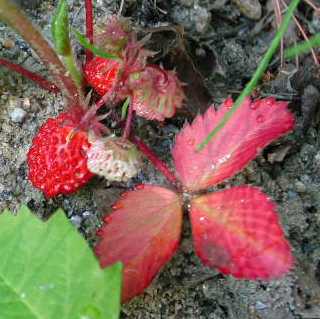
Early strawberries begin to be common. The lower leaves of the plant are red, concealing the fruit. 

Violets, especially of dry land, are scarce now. 

Eleocharis palustris abundant in Stow's meadow, by railroad. 

See a rose-bug. 

A pout's nest (at Pout's Nest) with a straight entrance some twenty inches long and a simple round nest at end. The young just hatched, all head, light-colored, under a mass of weedy hummock which is all under water. 

The common utricularia out. 

Hear the phebe note of a chickadee.

Cow-wheat, how long ? 

A rose-breasted grosbeak betrays itself by that peculiar squeak, on the Britton path. It is evident that many breed in the low woods by Flint's Pond. 

Catbird's nest with four eggs in a swamp-pink, three and a half feet up. 

The rose-breasted grosbeak is common now in the Flint's Pond woods. It is not at all shy, and our richest singer, perhaps, after the wood thrush. The rhythm is very like that of the tanager, but the strain is perfectly clear and sweet. 

One sits on the bare dead twig of a chestnut, high over the road, at Gourgas Wood, and over my head, and sings clear and loud at regular intervals, — the strain about ten or fifteen seconds long, rising and swelling to the end, with various modulations.

Another, singing in emulation, regularly answers it, alternating with it, from a distance, at least a quarter of a mile off. It sings thus long at a time, and I leave it singing there, regardless of me.

H.D. Thoreau, Journal, June 14, 1859

Early strawberries begin to be common
The lower leaves of the plant are red, concealing the fruit. See June 2, 1859 ("Strawberries reddening on some hills"}; June 10, 1856 ("Ripe strawberries . . . hard at first to detect amid the red radical leaves.”)

A rose-breasted grosbeak. It is evident that many breed in the low woods by Flint's Pond
See June 2, 1859 ("Found within three rods of Flint's Pond a rose-breasted grosbeak's nest.") See also A Book of Seasons,  by Henry Thoreau, , the Rose-breasted Grosbeak

A pout's nest (at Pout's Nest).The young just hatched. See April 25, 1859 ("Young Stewart tells me that he saw last year a pout's nest at Walden in the pond-hole by the big pond. The spawn lay on the mud quite open and uncovered, and the old fish was tending it. A few days after, he saw that it was hatched and little pouts were swimming about.") "Pout’s Nest": HDT's name for Wyman's Meadow near Walden. See note to July 26, 1860 (I see a bream swimming about in that smaller pool by Walden in Hubbard's Wood. . . So they may be well off in the Wyman meadow or Pout's Nest."); see also June 7, 1858 ("Pouts, then, make their nests in shallow mud-holes or bays, in masses of weedy mud, or probably in the muddy bank; and the old pout hovers over the spawn or keeps guard at the entrance.Where do the Walden pouts breed when they have not access to this meadow?")

Popular Posts Last 30 Days.

The week ahead in Henry’s journal

The week ahead in Henry’s journal
A journal, a book that shall contain a record of all your joy.
"A stone fruit. Each one yields me a thought." ~ H. D. Thoreau, March 28, 1859


I sit on this rock
wrestling with the melody
that possesses me.