Showing posts with label Clark. Show all posts

Sunday, March 25, 2018

A poet away from home.

March 25. 

P. M. – To bank of Great Meadows by Peter’s. 

Cold northwest wind as yesterday and day before. Large skaters (Hydrometra) on a ditch. 

Going across A. Clark's field behind Garfield’s, I see many fox-colored sparrows flitting past in a straggling manner into the birch and pitch pine woods on the left, and hear a sweet warble there from time to time. They are busily scratching like hens amid the dry leaves of that wood (not swampy), from time to time the rearmost moving forward, one or two at a time, while a few are perched here and there on the lower branches of a birch or other tree; and I hear a very clear and sweet whistling strain, commonly half finished, from one every two or three minutes. It is too irregular to be readily caught, but methinks begins like ar tohe tohe tchear, te tche tchear, etc., etc., but is more clear than these words would indicate. The whole flock is moving along pretty steadily. 

There are so many sportsmen out that the ducks have no rest on the Great Meadows, which are not half covered with water. They sit uneasy on the water, looking about, without feeding, and I see one man endeavor to approach a flock crouchingly through the meadow for half a mile, with india-rubber boots on, where the water is often a foot deep. This has been going on, on these meadows, ever since the town was settled, and will go on as long as ducks settle here. 

You might frequently say of a poet away from home that he was as mute as a bird of passage, uttering a mere chip from time to time, but follow him to his true habitat, and you shall not know him, he will sing so melodiously.

H. D. Thoreau, Journal, March 25, 1858

Large skaters (Hydrometra) on a ditch. See March 22, 1853 ("At Nut Meadow Brook, water-bugs and skaters are now plenty."); March 22, 1860 ("The phenomena of an average March . . . Many insects and worms come forth and are active , -and the perla insects still about ice and water , — as tipula , grubs , and fuzzy caterpillars , minute hoppers on grass at springs ; gnats , large and small , dance in air ; the common and the green fly buzz outdoors ; the gyrinus , large and small , on brooks , etc. , and skaters") See also A Book of the Seasons, by Henry Thoreau, the Water-bug (Gyrinus) and Skaters (Hydrometridae)

I hear a very clear and sweet whistling strain. See March 28, 1854 ("The fox-colored sparrow sings sweetly also.”)

The whole flock is moving along pretty steadily. See April 9, 1856 (“A flock of them - rapidly advancing, flying before one another, through the swamp.”) See also A Book of the Seasons,  by Henry Thoreau, the Fox-colored Sparrow.

Cold northwest wind as yesterday and day before . . .There are so many sportsmen out that the ducks have no rest.  See March 25, 1854 ("Too cold and windy almost for ducks. They are in the smoother open water (free from ice) under the lee of hills.") Compare  March 25, 1860 ("See no ducks on Fair Haven Pond .") and see . March 28, 1858 ("There is not a duck nor a gull to be seen on it. I can hardly believe that it was so alive with them yesterday. Apparently they improve this warm and pleasant day, with little or no wind, to continue their journey northward.. . . No doubt there are some left, and many more will soon come with the April rains. It is a wildlife that is associated with stormy and blustering weather"); .March 29, 1858 ("I infer that waterfowl travel in pleasant weather") See also   A Book of the Seasons, by Henry Thoreau, the American Black Duck

Friday, October 20, 2017

Clark, Brown, Melvin, and the robins in Easterbrooks Country.

October 20  
October 20, 2017
P. M. – To the Easterbrooks Country. 

I go along the riverside and by Dakin the pumpmaker's. 

There is a very strong northwest wind, Novemberish and cool, raising waves on the river and admonishing to prepare for winter. 

I see two Chenopodium album with stems as bright purple and fair as the poke has been, and the calyx lobes enveloping the seeds the same color. 

Apples are gathered; only the ladders here and there, left leaning against the trees. 

I had gone but little way on the old Carlisle road when I saw Brooks Clark, who is now about eighty and bent like a bow, hastening along the road, barefooted, as usual, with an axe in his hand; was in haste perhaps on account of the cold wind on his bare feet. It is he who took the Centinel so long. When he got up to me, I saw that besides the axe in one hand, he had his shoes in the other, filled with knurly apples and a dead robin. He stopped and talked with me a few moments; said that we had had a noble autumn and might now expect some cold weather. I asked if he had found the robin dead. No, he said, he found it with its wing broken and killed it. He also added that he had found some apples in the woods, and as he had n’t anything to carry them in, he put 'em in his shoes. They were queer-looking trays to carry fruit in. How many he got in along toward the toes, I don’t know. I noticed, too, that his pockets were stuffed with them. His old tattered frock coat was hanging in strips about the skirts, as were his pantaloons about his naked feet. He appeared to have been out on a scout this gusty afternoon, to see what he could find, as the youngest boy might. It pleased me to see this cheery old man, with such a feeble hold on life, bent almost double, thus enjoying the evening of his days. Far be it from me to call it avarice or penury, this childlike delight in finding something in the woods or fields and carrying it home in the October evening, as a trophy to be added to his winter's store. Oh, no; he was happy to be Nature's pensioner still, and bird- . like to pick up his living. Better his robin than your turkey, his shoes full of apples than your barrels full; they will be sweeter and suggest a better tale. He can afford to tell how he got them, and we to listen. There is an old wife, too, at home, to share them and hear how they were obtained. Like an old squirrel shuf ling to his hole with a nut. Far less pleasing to me the loaded wain, more suggestive of avarice and of spiritual penury. 

This old man's cheeriness was worth a thousand of the church's sacraments and memento mori's. It was better than a prayerful mood. It proves to me old age as tolerable, as happy, as infancy. I was glad of an occasion to suspect that this afternoon he had not been at “work” but living somewhat after my own fashion (though he did not explain the axe), — had been out to see what nature had for him, and now was hasten ing home to a burrow he knew, where he could warm his old feet. If he had been a young man, he would probably have thrown away his apples and put on his shoes when he saw me coming, for shame. But old age is manlier; it has learned to live, makes fewer apologies, like infancy. This seems a very manly man. I have known him within a few years building stone wall by himself, barefooted. 

I keep along the old Carlisle road. The leaves having mostly fallen, the country now seems deserted, and you feel further from home and more lonely. 

I see where squirrels, apparently, have gnawed the apples left in the road. 

The barberry bushes are now alive with, I should say, thousands of robins feeding on them. They must make a principal part of their food now. 

I see the yellowish election-cake fungi. Those large chocolate-colored ones have been burst some days (at least). 

Warren Brown, who owns the Easterbrooks place, the west side the road, is picking barberries. Allows that the soil thereabouts is excellent for fruit, but it is so rocky that he has not patience to plow it. That is the reason this tract is not cultivated. The yellow birches are generally bare. The sassafras in Sted Buttrick's pasture near to E. Hubbard's Wood, nearly so; leaves all withered. Much or most of the fever-bush still green, though somewhat wrinkled." 

There was Melvin, too, a-barberrying and nutting. He had got two baskets, one in each hand, and his game-bag, which hung from his neck, all full of nuts and barberries, and his mouth full of tobacco. Trust him to find where the nuts and berries grow. He is hunting all the year and he marks the bushes and the trees which are fullest, and when the time comes, for once leaves his gun, though not his dog, at home, and takes his baskets to the spot. It is pleasanter to me to meet him with his gun or with his baskets than to meet some portly caterer for a family, basket on arm, at the stalls of Quincy Market. Better Melvin's pignuts than the others' shagbarks. It is to be ob served that the best things are generally most abused, and so are not so much enjoyed as the worst. Shag barks are eaten by epicures with diseased appetites; pignuts by the country boys who gather them. So wood. 

Melvin says he has caught partridges in his hands. If there’s only one hole, knows they’ve not gone out. Sometimes shoots them through the snow. 

What a wild and rich domain that Easterbrooks Country! 

Not a cultivated, hardly a cultivatable field in it, and yet it delights all natural persons, and feeds more still. Such great rocky and moist tracts, which daunt the farmer, are reckoned as unimproved land, and therefore worth but little; but think of the miles of huckleberries, and of barberries, and of wild apples, so fair, both in flower and fruit, resorted to by men and beasts; Clark, Brown, Melvin, and the robins, these, at least, were attracted thither this afternoon. 

There are barberry bushes or clumps there, behind which I could actually pick two bushels of berries with out being seen by you on the other side. And they are not a quarter picked at last, by all creatures to gether. I walk for two or three miles, and still the clumps of barberries, great sheaves with their wreaths of scarlet fruit, show themselves before me and on every side, seeming to issue from between the pines or other trees, as if it were they that were promenading there, not I. 

That very dense and handsome maple and pine grove opposite the pond-hole on this old Carlisle road is Ebby Hubbard's. [Sted Buttrick's, according to Melvin.] Melvin says there are those alive who remember mowing there. Hubbard loves to come with his axe in the fall or winter and trim up his woods. 

Melvin tells me that Skinner says he thinks he heard a wildcat scream in E. Hubbard's Wood, by the Close. It is worth the while to have a Skinner in the town; else we should not know that we had wildcats. They had better look out, or he will skin them, for that seems to have been the trade of his ancestors. How long Nature has manoeuvred to bring our Skinner within ear-shot of that wildcat's scream! Saved Ebby's wood to be the scene of it! Ebby, the wood-saver. 

Melvin says that Sted sold the principal log of one of those pasture oaks to Garty for ten dollars and got several cords besides. What a mean bribe to take the life of so noble a tree! 

Wesson is so gouty that he rarely comes out-of-doors, and is a spectacle in the street; but he loves to tell his old stories still! How, when he was stealing along to get a shot at his ducks, and was just upon them a red squirrel sounded the alarm, chickaree chickaree chickaree, and off they went; but he turned his gun upon the squirrel to avenge himself. 

It would seem as if men generally could better appreciate honesty of the John Beatton stamp, which gives you your due to a mill, than the generosity which habitually throws in the half-cent.

H. D. Thoreau, Journal, October 20, 1857

Apples are gathered; only the ladders here and there, left leaning against the trees. See October 5, 1857 (“I see in most orchards the apples in heaps under the trees, and ladders slanted against their twiggy masses.”)

Yellowish election-cake fungi. See note to October 20, 1856 (“I notice, as elsewhere of late, a great many brownish-yellow (and some pink) election-cake fungi, eaten by crickets; about three inches in diameter. Some of those spread chocolate-colored ones have many grubs in them, though dry and dusty.")


What a wild and rich domain that Easterbrooks Country! See June 10, 1853 ("What shall this great wild tract over which we strolled be called?. . . It contains what I call the Boulder Field, the Yellow Birch Swamp, the Black Birch Hill, the Laurel Pasture, the Hog-Pasture, the White Pine Grove, the Easterbrooks Place, the Old Lime-Kiln, the Lime Quarries, Spruce Swamp, the Ermine Weasel Woods; also the Oak Meadows, the Cedar Swamp, the Kibbe Place, and the old place northwest of Brooks Clark‘s.Ponkawtasset bounds it on the south. There are a few frog-ponds and an old mill-pond within it, and Bateman‘s Pond on its edge. What shall the whole be called? . . .Shall we call it the Easterbrooks Country?")

Apples all gathered.
Only ladders here and there
lean against the trees.

Wednesday, September 20, 2017

Our first fall rain makes a dividing line between the summer and fall.

September 20

Sunday. Another mizzling day. 

P. M. — To beach plums behind A. Clarke’s. 

We walked in some trodden path on account of the wet grass and leaves, but the fine grass overhanging paths, weighed down with dewy rain, wet our feet nevertheless. We cannot afford to omit seeing the beaded grass and wetting our feet. 

This is our first fall rain, and makes a dividing line between the summer and fall. 

Yet there has been no drought the past summer. Vegetation is unusually fresh. Methinks the grass in some shorn meadows is even greener than in the spring. You are soon wet through by the underwood if you enter the woods, — ferns, aralia, huckleberries, etc. 

Went through the lower side of the wood west of Peter’s. 

The early decaying and variegated spotted leaves of the Aralia nudicaulis, which spread out flat and of uniform height some eighteen (?) inches above the forest floor, are very noticeable and interesting in our woods in early autumn, now and for some time. For more than a month it has been changing. 

The outlines of trees are more conspicuous and interesting such a day as this, being seen distinctly against the near misty background, – distinct and dark. 

The branches of the alternate cornel are spreading and flat, somewhat cyme-like, as its fruit. 

Beach plums are now perfectly ripe and unexpectedly good, as good as an average cultivated plum. I get a handful, dark purple with a bloom, as big as a good-sized grape and but little more oblong, about three quarters of an inch broad and a very little longer. 

I got a handkerchief full of elder-berries, though I am rather late about it, for the birds appear to have greatly thinned the cymes. 

A great many small red maples in Beck Stow's Swamp are turned quite crimson, when all the trees around are still perfectly green. It looks like a gala day there. 

A pitch pine and birch wood is rapidly springing up between the Beck Stow Wood and the soft white pine grove. It is now just high and thick enough to be noticed as a young wood-lot, if not mowed down.

H. D. Thoreau, Journal, September 20, 1857

First fall rain. See September 20, 1853 (It rained very hard while we were aboard the steamer."); September 20, 1854 ("Windy rain-storm last night");   September 20, 1856 ("Rain in afternoon. Rain again in the night, hard."); September 20, 1860 ("Rainy in forenoon."); September 25, 1860 ("Hard, gusty rain (with thunder and lightning) in afternoon.")

The outlines of trees are more conspicuous and interesting such a day as this, being seen distinctly against the near misty background, – distinct and dark. See December 16, 1855 ("The mist makes the near trees dark and noticeable, like pictures, and makes the houses more interesting, revealing but one at a time."); August 4, 1854 ("Rain and mist contract our horizon and we notice near and small objects"); February 6, 1852 (A mistiness makes the woods look denser, darker and more primitive.); November 29, 1850 ("The trees and shrubs look larger than usual when seen through the mist...As you advance, the trees gradually come out of the mist and take form before your eyes.")  See also November 7, 1855 ("I find it good to be out this still, dark, mizzling afternoon . . .The world and my life are simplified. ")

September 20. See A Book of the Seasons, by Henry Thoreau. September 20

Our first fall rain makes 
a dividing line between 
the summer and fall. 

The outlines of trees
 distinct and dark against the 
near misty background.
A Book of the Seasons, by Henry Thoreau
"A book, each page written in its own season,
out-of-doors, in its own locality.”
~edited, assembled and rewritten by zphx © 2009-2024


https://tinyurl.com/hdt-570920

Sunday, March 8, 2015

A sound reminds me – a robin in misty rain. April days, past years.

March 8


Another fair day with easterly wind. This morning I got my boat out of the cellar and turned it up in the yard to let the seams open before I calk it. The blue river, now almost completely open, admonishes me to be swift.

Am surprised to see a cluster of those large leek buds on a rock in Clark’s meadow between the oak and my house that was.

I cross through the swamp south of Boulder Field toward the old dam. Stopping in a sunny and sheltered place on a hillock in the woods, — for it is raw in the wind, — I hear the hasty, shuffling, as if frightened, note of a robin from a dense birch wood, —— a sort of tche tche tche tche tche. Then probably it dashed through the birches. 


March 8, 2015

And so they fetch the year about. Just from the South Shore, perchance, it alighted not in the village street, but in this remote birch wood. This sound reminds me of rainy, misty April days in past years. 

I still see the bluish bloom on thimble-berry vines quite fresh. 

I walk these days along the brooks, looking for tortoises and trout, etc. They are full of a rust-colored water, as if they flowed out of an iron mine. 

As the ice melts in the swamps I see the horn-shaped buds of the skunk-cabbage, green with a bluish bloom, standing uninjured, ready to feel the influence of the sun, - the most prepared for spring—to look at— of any plant. 

I see of late more than before of the fuzzy caterpillars, both black and reddish-brown.

H. D. Thoreau, Journal, March 8, 1855

This morning I got my boat out of the cellar . . . The blue river, now almost completely open, admonishes me to be swift. See March 12, 1854 ("A new feature is being added to the landscape, and that is expanses and reaches of blue water. Men are eager to launch their boats and paddle over the meadows.");  February 24, 1857 ("Get my boat out the cellar."); March 3, 1860 ("I should have launched my boat ere this if it had been ready.") See also A Book of the Seasons, by Henry Thoreau,  Boat in. Boat out and 
A Book of the Seasons, by Henry Thoreau, Signs of the Spring, Bright Blue Water

Stopping in a sunny and sheltered place on a hillock in the woods.  See note to March 8, 1860 ("Nowadays we separate the warmth of the sun from the cold of the wind") See also A Book of the Seasons, by Henry Thoreau A Sunny Nook in Spring

And so they fetch the year about. See March 10, 1855; ("You are always surprised by the sight of the first spring bird or insect; they seem premature, and there is no such evidence of spring as themselves, so that they literally fetch the year about. . . . But you think, They have come, and Nature cannot recede.")

This sound reminds me of rainy, misty April days in past years.
 See April 2, 1854 ("Sitting on the rail over the brook, I hear something which reminds me of the song of the robin in rainy days in past springs."); October 10, 1853 ("The faint suppressed warbling of the robins sounds like a reminiscence of the spring.") See also A Book of the Seasons, by Henry Thoreau, Reminiscence and Prompting and 
A Book of the Seasons
, by Henry Thoreau
 Signs of the Spring: The Anxious Peep of the Early Robin

I walk these days along the brooks, looking for tortoises and trout. See A Book of the Seasons, by Henry Thoreau, Signs of the Spring: ripples made by fishes and Frogs, and Turtles Stirring

I see the horn-shaped buds of the skunk-cabbage, green with a bluish bloom. See March 8, 1860 ("You cannot say that vegetation absolutely ceases at any season in this latitude; for there is grass in some warm exposures and in springy places, always growing more or less, and willow catkins expanding and peeping out a little further every warm day from the very beginning of winter, and the skunk cabbage buds being developed and actually flowering sometimes in the winter . . . There is something of spring in all seasons."); See also A Book of the Seasons, by Henry Thoreau Signs of the Spring: The Skunk Cabbage Blooms

I see of late more than before of the fuzzy caterpillars, both black and reddish—brown. See January 8, 1857 ("I picked up on the bare ice of the river, opposite the oak in Shattuck's land, on a small space blown bare of snow, a fuzzy caterpillar, black at the two ends and red-brown in the middle, rolled into a ball”) See also A Book of the Seasons, by Henry Thoreau Signs of the Spring: Insects and Worms Come Forth and are Active

 A sound reminds me – 
a robin in misty rain. 
April days, past years.


A Book of the Seasons
, by Henry Thoreau
"A book, each page written in its own season,
out-of-doors, in its own locality.”
~edited, assembled and rewritten by zphx © 2009-2024

tinyurl.com/hdt-550308

Thursday, March 13, 2014

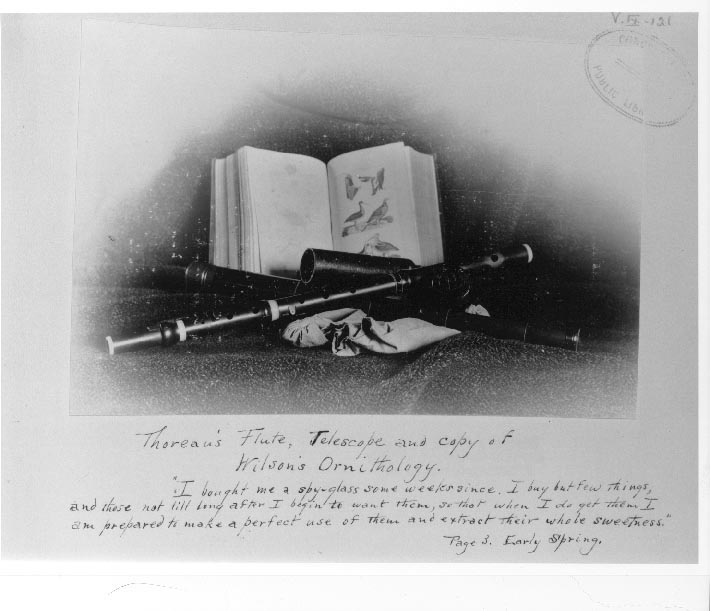
Bought a telescope to-day.

March 13. 

Bought a telescope to-day for eight dollars. 

Thoreau's Flute, Telescope, and a Copy of Wilson's Ornithology
Alfred Winslow Hosmer 1851 - 1903, Photographer
(Concord Free Public Library)

Best military spy glass with six slides, which shuts up to about same size, fifteen dollars, and very powerful. Saw the squares of achromatic glass from Paris which Clark uses; fifty-odd dollars apiece, the larger. 

My glass tried by Clark and approved.  

C. was making a glass for Amherst College.

H. D. Thoreau, Journal, March 13, 1854


Bought a telescope to-day for eight dollars.
See April 10, 1854 ("I bought me a spy-glass some weeks since. I buy but few things, and those not till long after I begin to want them, so that when I do get them I am prepared to make a perfect use of them and extract their whole sweet"); April 23, 1854 ("I think I have got the worth of my glass now that it has revealed to me the white-headed eagle"); March 13, 1853 ("All enterprises must be self-supporting, must pay for themselves.")

See also March 14, 1854 (""Counted over forty robins with my glass in the meadow north of Sleepy Hollow , in the grass and on the snow ."); March 16, 1854 ("I see ducks afar , sailing on the meadow , leav- ing a long furrow in the water behind them . Watch them at leisure without scaring them , with my glass ; observe their free and undisturbed motions ."); March 21, 1854 ("River skimmed over at Willow Bay last night . Thought I should find ducks cornered up by the ice ; they get behind this hill for shelter . Saw what looked like clods of plowed meadow rising above the ice . Looked with glass and found it to be more than thirty black ducks asleep with their heads in [ sic ] their backs , motionless , and thin ice formed about them . "); March 22, 1854 ("Saw a small black duck with glass , — a dipper ( ? )"); April 2, 1854 ("Saw black ducks in water and on land . Can see their light throats a great way with my glass . They do not dive , but dip . "); April 3, 1854 ("April 3. Saw from window with glass seven ducks on meadow - water , only one or two conspicuously white , these , black heads , white throats and breasts and along sides , the rest of the ducks , brownish , probably young males and females . Probably the golden - eye . "); April 8, 1854 ("Saw a large bird sail along over the edge of Wheeler's cranberry meadow just below Fair Haven , which I at first thought a gull , but with my glass found it was a hawk and had a perfectly white head and tail and broad or blackish wings . It sailed and circled along over the low cliff , and the crows dived at it in the field of my glass , and I saw it well , both above and beneath , as it turned , and then it passed off to hover over the Cliffs at a greater height . It was undoubtedly a white- headed eagle . It was to the eye but a large hawk . "); April 23 1854 ("Saw my white - headed eagle again , first at the same place , the outlet of Fair Haven Pond . It was a fine sight , he is mainly — i . e . his wings and body black against the sky , and they contrast so strongly with his white head and tail . He was first flying low over the water ; then rose gradually and circled west- ward toward White Pond . Lying on the ground with my glass , I could watch him very easily , and by turns he gave me all possible views of himself . When I ob- served him edgewise I noticed that the tips of his wings curved upward slightly more , like a stereotyped the undulation . He rose very high at last , till I almost lost him in the clouds , circling or rather looping along west- е ward , high over river and wood and farm , effectually concealed in the sky . We who live this plodding life here below never know how many eagles fly over us . . . I Now I see him edgewise like a black ripple in the air , his white head still as ever turned to earth , and now he turns his under side to me , and I behold the full breadth of his broad black wings , some- what ragged at the edges . ") and Bill Uhrich: Thoreau a pioneer in watching rather than shooting birds

Alvan Clark of Cambridge Clark began to sell telescopes around 1850, and eventually became the premier telescope builder in the United States.

My glass tried by Clark and approved.
In this journal entry for March 13 Thoreau roughly describes what is known as the "star test," still used to evaluate telescopes today.~ Thoreau Society Bulletin
Only a part of the object ( ? ) glass available . Bring the edge of the diaphragm against middle of the light , and your nail on object glass in line with these shows what is cut off . Sometimes may enlarge the hole in diaphragm . But , if you do so , you may have to enlarge the hole in diaphragm near small end , which must be exactly as large as the pencil of light there . As the diameter of the pencil is to the diameter of the available portion of the object glass , so is the power , so many times it magnifies . A good glass because the form of the blurred object is the same on each side of the focus , i . e . , shoved in or drawn out . 

Sunday, February 27, 2011

Lighting up of the mist by the sun.


February 27. 

Saw to-day on Pine Hill behind Mr. Joseph Merriam's house a Norway pine, the first I have seen in Concord. Mr. Gleason pointed it out to me as a singular pine which he did not know the name of. It was a very handsome tree, about twenty-five feet high.

E. Wood thinks that he has lost the surface of two acres of his meadow by the ice. Got fifteen cartloads out of a hummock left on another meadow. Blue-joint was introduced into the first meadow where it did not grow before. 

Of two men, one of whom knows nothing about a subject, and, what is extremely rare  knows that he knows nothing, and the other really knows something about it, but thinks that he knows all, — what great advantage has the latter over the former ? which is the best to deal with? 

I do not know that knowledge amounts to anything more definite than a novel and grand surprise, or a sudden revelation of the insufficiency of all that we had called knowledge before; an indefinite sense of the grandeur and glory of the universe. It is the lighting up of the mist by the sun. But man cannot be said to know in any higher sense, than he can look serenely and with impunity in the face of the sun. 

H. D. Thoreau, Journal, February 27, 1851

Blue-joint was introduced into the first meadow where it did not grow before. See February 25, 1851 ("The crust of the meadow afloat. . . .When the ice melts or the soil thaws, of course it falls to the bottom, wherever it may be. Here is another agent employed in the distribution of plants.")

It is the lighting up of the mist by the sun
. See Walking


Sunday, April 18, 2010

Bricking up a new well


Cold, and still a strong wind. 46 at 2 P. M. 

The Salix discolor peels well; also the aspen (early) has begun to peel. 

As i go by the site of Staples' new barn on the Kettle place, I see that they have just dug a well and are bricking it up. 

Melvin, with a bundle of apple scions in his hand, is sitting close by looking over into the well from time to time. Humphrey Buttrick is at the bottom, bricking up the well.

Melvin says he has heard snipe some days, but thinks them scarce. Clark, who had been mining lately in California and who dug the well, is passing down bricks to Buttrick. Clark has heard a partridge drum.

Melvin says he fears that, the water being so low, the snipes would be overtaken by it and their nests broken up when it rose. He says Josh Haynes told him that he found woodcock's nest, and afterward he sailed over the nest in a boat, an yet, when the water went down, the bird went on and hatched the eggs.

I see that they have dug twenty four feet through  sand and have some four feet of water in the well.

Melvin has seen a dandelion in bloom.  

I find that the side-hill just below the Dutch house is more loose and sandy than half a dozen years ago, and I attribute it to the hens wallowing in the earth and dusting themselves, and also pecking the grass and preventing its growing.

H. D. Thoreau, Journal, April 18, 1860

Tuesday, June 9, 2009

Surveying for D. B. Clark


June 10.

Surveying for D. B. Clark on “College Road,” so-called, cut a line in a thick wood that passed within two feet of a blue jay's nest about four feet up a birch, quite exposed beneath the leafy branches. The bird sat perfectly still upon its large young with its head up and bill open, not moving in the least, while we drove a stake close by, within three feet, and cut and measured, being about there twenty minutes at least.

H.D. Thoreau, Journal, June 10, 1859


A blue jay’s nest. See June 8, 1855 ("A jay’s nest with three young half fledged in a white pine, six feet high, by the Ingraham cellar, made of coarse sticks.”); June 5, 1856 (“A blue jay’s nest on a white pine, eight feet from ground, next to the stem, of twigs lined with root-fibres; three fresh eggs, dark dull greenish, with dusky spots equally distributed all over”) See also A Book of the Seasons, by Henry Thoreau, The Blue Jay

Popular Posts Last 30 Days.

The week ahead in Henry’s journal

The week ahead in Henry’s journal
A journal, a book that shall contain a record of all your joy.
"A stone fruit. Each one yields me a thought." ~ H. D. Thoreau, March 28, 1859


I sit on this rock
wrestling with the melody
that possesses me.