Showing posts with label black ducks. Show all posts

Wednesday, November 24, 2021

The fauna and flora of Ministerial Swamp.


November 24. 

Setting stakes in the swamp (Ministerial). Saw seven black ducks fly out of the peat-hole.
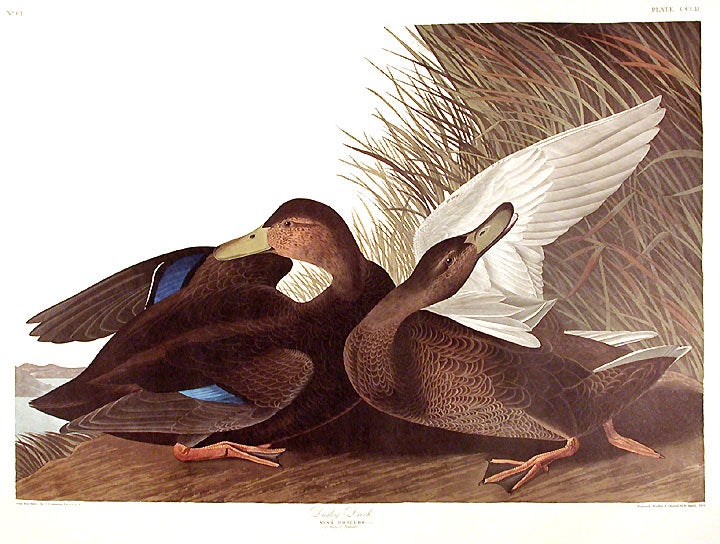
J.J. Audubon (The flight of this Duck, which, in as far as I know, is peculiar to America, is powerful, rapid, and as sustained as that of the Mallard. While travelling by day they may be distinguished from that species by the whiteness of their lower wing-coverts, which form a strong contrast to the deep tints of the rest of their plumage )

Saw there also a tortoise still stirring, the painted tortoise, I believe.

Found on the south side of the swamp the Lygodium palmatum, which Bigelow calls the only climbing fern in our latitude, an evergreen, called (with others) snake tongue, as I find in Loudon.

The Irishman who helped me says, when I ask why his countrymen do not learn trades, — do something but the plainest and hardest work, — they are too old to learn trades when they come here.

H. D. Thoreau, Journal, November 24, 1851


Setting stakes in the swamp (Ministerial). See November 14, 1851 ("Surveying the Ministerial Lot in the southwestern part of the town."); November 18,1851 ("Surveying these days the Ministerial Lot . . .I hear the hooting of an owl . . . Here hawks also circle by day, and chickadees are heard, and rabbits and partridges abound.");  December 21, 1851 (“As I stand by the edge of the swamp (Ministerial), a heavy-winged hawk flies home to it at sundown, just over my head, in silence.”); December 13, 1857 ("I go this afternoon thinking I may find the stakes set for auction lots on the Ministerial Lot in December, '51") See also  July 7, 1854 ("See a pretty large hawk. . . circling over the Ministerial Swamp.") 

Saw seven black ducks fly out of the peat-hole. See September 24, 1855 ("See coming from the south in loose array some twenty apparently black ducks, . . .At first they were in form like a flock of blackbirds, then for a moment assumed the outline of a fluctuating harrow. ); September 29, 1851 ("Scared up three black ducks, which rose with a great noise of their wings, striking the water. "); September 30, 1853 ("Saw a large flock of black ducks flying northwest in the form of a harrow."); November 3, 1852 ("At Andromeda Pond, started nine black (?) ducks just at sunset, as usual they circling far round to look at me."); November 11, 1851 ("In the withered grass at Nut Meadow Brook, two black ducks, . . .rise black between me and the sun, but, when they have circled round to the east, show some silvery sheen on the under side of their wings. "); March 12, 1859 ("See two ducks flying over Ministerial Swamp.") See also  A Book of the Seasons, by Henry Thoreau, the American Black Duck)

Saw a tortoise still stirring, the painted tortoise, I believe. See November 14, 1855 ("A painted tortoise swimming under water and a wood tortoise out on the bank."); November 27, 1856 ("Take a turn down the river. A painted tortoise sinking to the bottom, and apparently tree sparrows along the shore"); December 2, 1857 ("Measuring Little Goose Pond, I observed two painted tortoises moving about under the thin transparent ice"); December 3, 1852 (" In a ditch near by, under ice half an inch thick, I saw a painted tortoise moving about.") See also A Book of the Seasons, by Henry Thoreau, the Painted Turtle (Emys picta)

Found on the south side of the swamp the Lygodium palmatum See November 30, 1851 ("The Lygodium palmatum is quite abundant on that side of the swamp, twining round the goldenrods, etc., etc"); October 2, 1859 (“The climbing fern is perfectly fresh, — and apparently therefore an evergreen, — the more easily found amid the withered cinnamon and flowering ferns.”); May 1, 1859 ("The climbing fern is persistent, i.e. retains its greenness still, though now partly brown and withered.") See also November 24, 1852 ("At this time last year the andromeda in the Ministerial Swamp was red . Now it has not turned from brown."): November 20, 1857 ("I enter the Ministerial Swamp at the road below Tarbell’s. The water andromeda leaves are brown now, except where protected by trees. In some places where many of the bright-crimson shoots of high blueberry are seen together, they have a very pretty effect");  April 29, 1857 ("Sweet-fern at entrance of Ministerial Swamp.");  May 19, 1860 (“At the Ministerial Swamp I see a white lady's-slipper almost out, fully grown, with red ones.”); August 28, 1860 ("The Lycopodium inundatum common by Harrington's mud-hole, Ministerial Swamp.")  

Friday, April 16, 2021

The contents of creatures' stomachs


April 16. 

Horace Mann says that he killed a bullfrog in Walden Pond which had swallowed and contained a common striped snake which measured one foot and eight inches in length.

Says he saw two blue herons (?) go over a fortnight ago.

He brought me some days ago the contents of a stake driver's stomach or crop. It is apparently a perch (?), some seven inches long originally, with three or four pebble-shaped, compact masses of the fur of some very small quadruped, as a meadow mouse, some one fourth inch thick by three fourths in diameter, also several wing-cases of black beetles such as I see on the meadow flood.

He brought me also some time ago the contents of a black duck's crop (killed at Goose Pond), -- green gobbets of fine grass (?) or weeds (?), apparently from the bottom of the pond (just then begun to spring up), but I have not yet examined these out of the bottle.

H. D. Thoreau, Journal, April 16, 1861

Horace Mann says that he killed a bullfrog which had swallowed and contained a common striped snake. See May 19, 1856 ("Saw a small striped snake in the act of swallowing a Rana palustris, within three feet of the water. The snake, being frightened, released his hold, and the frog hopped off to the water. ")

Says he saw two blue herons go over.  See April 14, 1859 ("You have not seen our weedy river, you do not know the significance of its weedy bars, until you have seen the blue heron wading and pluming itself on it"); April 15, 1855 ("We have a fine view of a blue heron, standing erect and open to view on a meadow island, by the great swamp south of the bridge."); April 29, 1854 ("I meet a blue heron flying slowly down stream. He flaps slowly and heavily, his long, level, straight and sharp bill projecting forward, then his keel-like neck doubled up, and finally his legs thrust out straight behind.") See also A Book of the Seasons, by Henry Thoreau, the Blue Heron and April 16, 1855 ("At sunset, the mountains, after this our warmest day as yet, have a peculiar soft mantle of blue haze, pale blue as a blue heron.")

Wednesday, September 30, 2020

Black ducks flying northwest

September 30

September 30, 2023

Friday. Saw a large flock of black ducks flying northwest in the form of a harrow.

H. D. Thoreau, Journal, September 30, 1853

A large flock of black ducks flying northwest in the form of a harrow. See September 24, 1855 ("See coming from the south in loose array some twenty apparently black ducks . . .At first they were in form like a flock of blackbirds, then for a moment assumed the outline of a fluctuating harrow. "); September 29, 1851 ("Scared up three black ducks, which rose with a great noise of their wings, striking the water.") See also A Book of the Seasons, by Henry Thoreau, the American Black Duck


A large flock of black
ducks flying northwest in the
form of a harrow.


https://tinyurl.com/HD7530930

Tuesday, March 24, 2020

The duck most common and most identified with the stream at this season.


March 24. 

Cold and rather blustering again, with flurries of snow. 

March 24, 2020
The boatman, when the chain of his boat has been broken with a stone by some scamp, and he cannot easily transport his boat to the blacksmith's to have it mended, gets the latter to bend him a very stout iron wire in the form of an S, then, hooking this to the two broken ends and setting it upright on a rock, he hammers it down till it rests on itself in the form of an 8, which is very difficult to pry open. 

2 P. M. — About 39. To Copan. 

I see a male frog hawk beating a hedge, scarcely rising more than two feet from the ground for half a mile, quite below the level of the wall within it. How unlike the hen-hawk in this! 

They are real wind-clouds this afternoon; have an electric, fibry look. Sometimes it is a flurry of snow falling, no doubt. Peculiar cold and windy cumuli are mixed with them, not black like a thunder cloud, but cold dark slate with very bright white crowns and prominences. 

I find on Indian ground, as to-day on the Great Fields, very regular oval stones like large pebbles, sometimes five or six inches long, water-worn, of course, and brought hither by the Indians. They commonly show marks of having been used as hammers. Often in fields where there is not a stone of that kind in place for a mile or more. 

From Holbrook's clearing I see five large dark-colored ducks, probably black ducks, far away on the meadow, with heads erect, necks stretched, on the alert, only one in water. Indeed, there is very little water on the meadows. For length of neck those most wary look much like geese. They appear quite large and heavy. They probably find some sweet grass, etc., where the water has just receded. 

There are half a dozen gulls on the water near. They are the large white birds of the meadow, the whitest we have. As they so commonly stand above water on a piece of meadow, they are so much the more conspicuous. They are very conspicuous to my naked eye a mile off, or as soon as I come in sight of the meadow, but I do not detect the sheldrakes around them till I use my glass, for the latter are not only less conspicuously white, but, as they are fishing, sink very low in the water. Three of the gulls stand together on a piece of meadow, and two or three more are standing solitary half immersed, and now and then one or two circle slowly about their companions. 

The sheldrakes appear to be the most native to the river, briskly moving along up and down the side of the stream or the meadow, three-fourths immersed and with heads under water, like cutters collecting the revenue of the river bays, or like pirate crafts peculiar the stream. They come the earliest and seem to be most at home. The water is so low that all these birds are collected near the Holt. 

The inhabitants of the village, poultry fanciers, perchance, though they be, [know not] these active and vigorous wild fowl (the sheldrakes) pursuing their finny prey ceaselessly within a mile of them, in March and April. Probably from the hen-yard fence with a good glass you can see them at it. 

They are as much at home on the water as the pickerel is within it. Their serrated bill reminds me of a pickerel's snout. You see a long row of these schooners, black above with a white stripe beneath, rapidly gliding along, and occasionally one rises erect on the surface and flaps its wings, showing its white lower parts  They are the duck most common and most identified with the stream at this season. They appear to get their food wholly within the water. Less like our domestic ducks. 

I saw two red squirrels in an apple tree, which were rather small, had simply the tops of their backs red and the sides and beneath gray! 

Fox-colored sparrows go flitting past with a faint, sharp chip, amid some oaks. 

According to a table in the "American Almanac" for ’49, page 84, made at Cambridge, from May, '47, to May, '48, the monthly mean force of the wind . . . March, April, and May were equal, and were inferior to July and June; for quantity of clouds March and May were equal, and were preceded by December, November, September, January, June, and August. 

For depth of rain, September stood first, and March ninth, succeeded only by May, October, and April. 

The wind's force was observed at sunrise, 9 A. M., 3 P. M., and 9 P. M., and in March the greatest force was at 3 P. M., the least at 9 P. M. So, for the whole year the greatest force was at 3 P. M., but the least at sunrise and 9 P. M. both alike. 

The clouds were observed at the same time, and in March there was the greatest quantity at 9 P. M. and the least at sunrise, but for the year the greatest quantity at 3 P. M. and the least at sunrise and 9 A. M. alike. 

At Mendon, Mass., for the whole year 1847 alone (i. e. a different January, February, March, and April from the last) it stood, for force of wind,. . . March , July , September , November , and December were equal, and were inferior to April , June , August , and October; and for clouds March was sixth . 

The wind's force for March was greatest at 9 A. M. and 3 P. M., which were equal; but for the year greatest at 9 A. M. and least at sunrise. 

For March there was the greatest quantity of clouds at 9 A. M., but for the year at both sunrise and 9 A. M. 

In the last table eight points of the wind were noticed viz. northwest, north, northeast, east, southeast, south, southwest, west. During the year the wind was southwest 130 days, northwest 87, northeast 59, south 33, west 29, east 14, southeast 10, north 3 days.

In March it was northwest 9 days, southwest 8, northeast 5, south 4, west 3, north 2.

H. D. Thoreau, Journal, March 24, 1860

They are real wind-clouds this afternoon; have an electric, fibry look. Peculiar cold and windy cumuli are mixed with them. See March 4, 1860 ("Very strong and gusty northwest wind, with electric-looking wind-clouds");   March 22, 1858 ("I see those peculiar spring clouds, scattered cumuli with dark level bases. No doubt the season is to be detected by the aspect of the clouds no less than by that of the earth."); March 23, 1860 ("Small dark-based cumuli spring clouds, mostly in rows parallel with the horizon.").

I see a male frog hawk beating a hedge, scarcely rising more than two feet from the ground for half a mile. See March 27, 1855 ("See my frog hawk. (C. saw it about a week ago.) It is the hen-harrier, i.e. marsh hawk, male. Slate-colored; beating the bush; black tips to wings and white rump") See Also Henry Thoreau, A Book of the Seasons, The Marsh Hawk (Northern Harrier)

They are the duck most common and most identified with the stream at this season. See  February 27, 1860 ("This is the first bird of the spring that I have seen or heard of."); and note to March 16, 1860  ("Saw a flock of sheldrakes a hundred rods off, on the Great Meadows, mostly males with a few females, all intent on fishing. ") See also Henry Thoreau, A Book of the Seasons, The Sheldrake (Merganser, Goosander)

March 24. See A Book of the Seasons, by Henry Thoreau, March 24


Cold and blustering
again with flurries of snow--
cold dark slate wind-clouds.
March 24, 1860


A Book of the Seasons, by Henry Thoreau, Cold and rather blustering again
A Book of the Seasons, by Henry Thoreau
"A book, each page written in its own season,
out-of-doors, in its own locality."
~edited, assembled and rewritten by zphx © 2009-2024

Tuesday, December 17, 2019

What a change there will be in a few years, this little forest of goldenrod giving place to a forest of pines!

December 17.

P. M. — To Walden.

The snow being some three or four inches deep, I see rising above it, generally, at my old bean-field, only my little white pines set last spring in the midst of an immense field of Solidago nemoralis, with a little sweet-fern (i.e. a large patch of it on the north side).

What a change there will be in a few years, this little forest of goldenrod giving place to a forest of pines!

By the side of the Pout's Nest, I see on the pure white snow what looks like dust for half a dozen inches under a twig. Looking closely, I find that the twig is hardhack and the dust its slender, light-brown, chaffy looking seed, which falls still in copious showers, dusting the snow, when I jar it; and here are the tracks of a sparrow which has jarred the twig and picked the minute seeds a long time, making quite a hole in the snow. The seeds are so fine that it must have got more snow than seed at each peck. But they probably look large to its microscopic eyes.

I see, when I jar it, that a meadow-sweet close by has quite similar, but larger, seeds.

This the reason, then, that these plants rise so high above the snow and retain their seed, dispersing it on the least jar over each successive layer of snow beneath them; or it is carried to a distance by the wind.

What abundance and what variety in the diet of these small granivorous birds, while I find only a few nuts still!

These stiff weeds which no snow can break down hold their provender. What the cereals are to men, these are to the sparrows. The only threshing they require is that the birds fly against their spikes or stalks.

A little further I see the seed-box (?) (Ludwigia) full of still smaller, yellowish seeds.

And on the ridge north is the track of a partridge amid the shrubs. It has hopped up to the low clusters of smooth sumach berries, sprinkled the snow with them, and eaten all but a few. Also, here only, or where it has evidently jarred them down — whether intentionally or not, I am not sure — are the large oval seeds of the stiff-stalked lespedeza, which I suspect it ate, with the sumach berries. There is much solid food in them. When the snow is deep the birds could easily pick the latter out of the heads as they stand on the snow.

I observe, then, eaten by birds to-day, the seed of hardhack and meadow-sweet, sumach, and probably lespedeza, and even seed-box.

Under the hill, on the southeast side of R. W. E.'s lot, where the hemlock stands, I see many tracks of squirrels. The dark, thick green of the hemlock (amid the pines) seems to attract them as a covert. The snow under the hemlock is strewn with the scales of its cones, which they (and perhaps birds?) have stripped off, and some of its little winged seeds. It is pleasant to see the tracks of these squirrels (I am not sure whether they are red or gray or both, for I see none) leading straight from the base of one tree to that of another, thus leaving untrodden triangles, squares, and polygons of every form, bounded by much trodden highways.

One, two, three, and the track is lost on the upright bole of a pine, — as if they had played at base-running from goal to goal, while pine cones were thrown at them on the way. The tracks of two or three suggest a multitude. You come thus on the tracks of these frisky and volatile (semivolitant) creatures in the midst of perfect stillness and solitude, as you might stand in a hall half an hour after the dancers had departed.

I see no nests in the trees, but numerous holes through the snow into the earth, whence they have emerged. They have loitered but little on the snow, spending their time chiefly on the trees, their castles, when abroad.

The snow is strewn not only with hemlock scales, but, under other trees, with the large white pine scales for rods together where there is no track, the wind having scattered them as they fell, and also the shells of hickory-nuts. It reminds me of the platform before a grocery where nuts are sold.

You see many places where they have probed the snow for these white pine cones, evidently those which they cut off green and which accordingly have not opened so as to drop the seeds. This was perhaps the design in cut ting them off so early, — thus to preserve them under the snow (not dispersed). Do they find them by the scent?

At any rate they will dig down through the snow and come right upon a pine cone or a hickory-nut or an acorn, which you and I cannot do.

Two or three acres of Walden, off the bar, not yet frozen.

Saw in [it] a good-sized black duck, which did not dive while I looked. I suspect it must have been a Fuligula, though I saw no white.

H. D. Thoreau, Journal, December 17, 1859

What abundance and what variety in the diet of these small granivorous birds. These stiff weeds which no snow can break down hold their provender.  See January 16, 1860 ("Though you may have never noticed this shrub, the tree sparrow comes from the north in the winter straight to it, and confidently shakes its panicle, and then feasts on the fine shower of seed that falls from it. The bird understands how to get its dinner perfectly.")

Two or three acres of Walden, off the bar, not yet frozen. Saw in it a good-sized black duck. See December 27, 1852 ("Not a particle of ice in Walden to-day. . . . A black and white duck on it, Flint's and Fair Haven being frozen up.")

Sunday, September 29, 2019

The poet writes the history of his body.


September 29

September 29, 2019

Van der Donck says of the water-beech (buttonwood), "This tree retains the leaves later than any other tree of the woods." 

P. M. — To Goose Pond via E. Hosmer's; return by Walden. 

Found Hosmer carting out manure from under his barn to make room for the winter. He said he was tired of farming, he was too old. Quoted Webster as saying that he had never eaten the bread of idleness for a single day, and thought that Lord Brougham might have said as much with truth while he was in the opposition, but he did not know that he could say as much of himself. However, he did not wish to be idle, he merely wished to rest. 

Looked on Walden from the hill with the sawed pine stump on the north side. Scared up three black ducks, which rose with a great noise of their wings, striking the water. The hills this fall are unusually red, not only with the huckleberry, but the sumach and the blackberry vines. Walden plainly can never be spoiled by the wood- chopper, for, do what you will to the shore, there will still remain this crystal well. 

The intense brilliancy of the red-ripe maples scattered here and there in the midst of the green oaks and hickories on its hilly shore is quite charming. They are unexpectedly and incredibly brilliant, especially on the western shore and close to the water's edge, where, alternating with yellow birches and poplars and green oaks, they remind me of a line of soldiers, redcoats and riflemen in green mixed together. 

The pine is one of the richest of trees to my eye. It stands like a great moss, a luxuriant mildew, — the pumpkin pine, — which the earth produces without effort.

The poet writes the history of his body. 

Query: Would not the cellular tissue of the grass poly make good tinder? I find that, when I light it, it burns up slowly and entirely, without blaze, like spunk.

H. D. Thoreau, Journal, September 29, 1851

The intense brilliancy of the red-ripe maples scattered here and there in the midst of the green oaks and hickories on its hilly shore is quite charming. See September 25, 1857 ("A single tree becomes the crowning beauty of some meadowy vale and attracts the attention of the traveller from afar."); September 26, 1854 ("Some single red maples are very splendid now, the whole tree bright-scarlet against the cold green pines; now, when very few trees are changed, a most remarkable object in the landscape; seen a mile off."); September 27, 1855 ("Some single red maples now fairly make a show along the meadow. I see a blaze of red reflected from the troubled water."); October 3, 1856 (" Especially the hillsides about Walden begin to wear these autumnal tints in the cooler air. These lit leaves, this glowing, bright-tinted shrubbery, is in singular harmony with the dry, stony shore of this cool and deep well."); October 3, 1858 ("Some particular maple among a hundred will be of a peculiarly bright and pure scarlet, and, by its difference of tint and intenser color, attract our eyes even at a distance in the midst of the crowd"); October 8, 1852 (“Nothing can exceed the brilliancy of some of the maples which stand by the shore and extend their red banners over the water.”)


Scared up three black ducks, which rose with a great noise of their wings, striking the water.
See September 24, 1855 ("See coming from the south in loose array some twenty apparently black ducks . . . for a moment assumed the outline of a fluctuating harrow"); September 30, 1853 ("Friday. Saw a large flock of black ducks flying northwest in the form of a harrow."). See also A Book of the Seasons, by Henry Thoreau, the American Black Duck

The poet writes the history of his body. See August 19, 1851 ("The poet must be continually watching the moods of his mind,"); May 23, 1853 ("The poet must bring to Nature the smooth mirror in which she is to be reflected. Every new flower that opens, no doubt, expresses a new mood of the human mind.”);  April 8, 1854 ("The poet deals with his privatest experience."); October 21, 1857 ("Is not the poet bound to write his own biography?")

Wednesday, June 5, 2019

A yellowbird's nest; four eggs, developed

June 5. 

Sunday. P. M. — To Ball's Hill. 

Cat-briar in flower, how long? 

Allium not out. 

See several ducks, I think both summer and black. 

A yellowbird's nest; four eggs, developed. 

Pigeon woodpecker's nest in a hollow black willow over river; six eggs, almost hatched. 

The new white maple leaves look reddish, and at a distance brown, as if they had not put out yet.

H. D. Thoreau, Journal, June 5, 1859

Allium not out. See June 7, 1857 ("Garlic . . . not yet out"); June 14, 1853 ("The Allium Canadense in Tarbell's meadow. Wild meadow garlic, with its head of bulbs and a few flower- buds, not yet").

Several ducks, both summer and black. See June 4, 1856 (“Found, on a hummock in the open swamp, in the midst of bushes, at the foot of a pitch pine, a nest about ten inches over, made of dry sedge and moss. I think it must have been a duck’s nest.”)

A yellowbird's nest; four eggs, developed. See  June 7, 1855 ("A yellowbird’s nest on a willow bough against a twig, ten feet high, four eggs."); June 9, 1855 ("A yellowbird’s nest eight feet from ground in crotch of a very slender maple"); June 9, 1856 ("A yellowbird’s nest in a poplar on Hubbard’s Bridge; four fresh eggs; ten feet high, three rods beyond fence.")

Pigeon woodpecker's nest in a hollow black willow over river; six eggs, almost hatched. See June 10, 1856 ("In a hollow apple tree, hole eighteen inches deep, young pigeon woodpeckers, large and well feathered.");  June 13, 1855 ("C. finds a pigeon woodpecker’s nest in an apple tree, five of those pearly eggs, about six feet from the ground."); June 13, 1858 ("In the great apple tree front of the Miles house I hear young pigeon woodpeckers")  See also A Book of the Seasons, by Henry Thoreau, The Pigeon Woodpecker (flicker).


. 


Friday, April 12, 2019

The origins of the islands in the meadow.

April 12. 

Clears up in afternoon. 

April 12, 2019

P. M. — Paddle to Cliffs. 

I saw a minnow on the 10th which looked like a young brook minnow, not one inch long. When was it spawned? 

The small alder (A. serrulata) is sometimes yellow- flowered, sometimes reddish-flowered. It grows with the incana at Cardinal Shore. 

I see where the musquash has eaten the white base of the pontederia leaves. 

I first perceived the pickerel dart on the 10th, the river having gone down so much that you could not cross the meadows, and that being the first really warm and pleasant day since March 17th. 

Saw a duck, apparently a sheldrake, at the northeast end of Cyanean Meadow. It disappeared at last by diving, and I could not find it. But I saw what looked like a ripple made by the wind, which moved slowly down the river at least forty rods toward the shore and there disappeared. Though I saw no bird there, I suspect that the ripple was made by it. 

Two sheldrakes flew away from this one when first observed. Why did this remain? Was it wounded? Or can those which dart so swiftly across the river and dive be another species and not the young of the season or females of the common one? Is it not, after all, the red-breasted merganser, and did I not see them in Maine? 

I see half a dozen sheldrakes very busily fishing around the base of Lupine Hill or Promontory. There are two full-plumaged males and the rest females, or perhaps some of them young males. They are coasting along swiftly with their bodies sunk low and their heads half under, looking for their prey, one behind another, frequently turning and passing over the same ground again. Their crests are very conspicuous, thus: 

When one sees a fish he at first swims rapidly after it, and then, if necessary, flies close over the water after it, and this excites all the rest to follow, swimming or flying, and if one seizes the fish, which I suspect is commonly a pickerel, they all pursue the lucky fisher, and he makes the water fly far in his efforts to get away and gulp down his fish. I can see the fish in his bill all the while, and he must swallow it very skillfully and quickly, if at all. 

I was first attracted to them by seeing these great birds rushing, shooting, thus swiftly through the air and water and throwing the water high about them. Sometimes they dive and swim quietly beneath, looking for their game. At length they spy me or my boat, and [I] hear a faint quack indicative of alarm, and suddenly all arise and go off. 

In the meanwhile I see two black ducks sailing with them along the shore. These look considerably smaller, and of course carry their heads more erect. They have a raw, gosling look beside the others, and I see their light bills against their dusky necks and heads. At length, when I get near them, I hear their peculiar quack also, and off they go. 

The sheldrakes appear to be a much more lively bird than the black duck. How different from the waddling domestic duck! The former are all alive, eagerly fishing, quick as thought, as they need to be to catch a pickerel. 

I look again at the meadow-crust carried off by the ice. There is one by the railroad bridge, say three rods by one, covered with button-bushes and willows. Another, some five rods by three, at the south end of  Potter Swamp Meadow, also covered densely with button-bushes, etc. It is far from the river, by the edge of the wood. 

Another, and the most interesting one, lies up high some thirty rods north of this near the wood-side and fifteen rods from the river. I measure it with a tape. It is rudely triangular and about four rods on a side, though the sides are longer on the convex line. As well as the other, it is from one to three feet thick and very densely covered with button-bushes, with a few black and other willows and late roses from four to seven feet high. As dense and impassable as any kind of thicket that we have, and there are, besides, countless great yellow and white lily and pontederia roots in it. It is a large and densely bushy island in the meadow. It would surprise any one to behold it. 

Suppose that you were to find in the morning such a slice of the earth's crust with its vegetation dropped in your front yard, if it could contain it. I think we should not soon hear the last of it. It is an island such as might almost satisfy Sancho Panza's desires. It is a forest, in short, and not a very small one either. It is Birnam wood come to Dunsinane. It contained at least eight square rods. 

There was another piece covered in like manner, some five rods long and three wide, sunk off Cardinal Shore on a hard sandy bottom, and so deep that its whole size did not appear above water. I could not touch the bottom with my oars on the outside. This no one would have detected for an immigrant or new-come land unless very familiar with the shore, for if the raw edge is concealed it looks exactly as if it grew there like the others near by. There was a strip with out anything but grass on it, some five rods long by twenty feet wide, and two pieces making as much more in length end to end with it on the [sic]. In all there must have been from a third to half an acre on this single meadow, which came from far up-stream, I could not tell from where. 

I saw more up the stream, and they were all dropped nearly in a line on the east side for half a mile or more. Such revolutions can take place and none but the proprietor of the meadow notice it, for the traveller passing within sight does not begin to suspect that the bushy island which he sees in the meadow has floated from elsewhere, or if he saw it when on its voyage, he would not know it for a voyager. 

In one year all the raw edge is concealed, and the vegetation thus transplanted does not appear to find it out. These must have been carried off about the 16th of March or when the river broke up, perhaps in that strong southwest wind of the 19th. The ice, being eighteen or twenty inches thick and having ten thousand strong handles to take hold by, aided too often by the lightness of the frozen meadow, can easily lift these masses, and if there were rocks imbedded in them, would move them also. For the cake of ice may be a dozen rods or more in breadth.

These have generally grounded high on the meadows, where the lilies, etc., will all die. Indeed, most of them have already been killed by frost, and probably the button-bush will much of it die too. Also that which has sunk in deep water will die. 

I saw one piece a rod wide nearly in the middle of the river, and detected it only by the top [of] a few twigs seen above the surface. The willows or osiers will do well, and the roses, wherever they may lodge on the banks or in the meadow, but the button-bush must stand immediately on the edge of the river or other water, and there they are most likely to be placed. 

The present islands, bushy or wooded, in the meadow have no doubt commonly had this origin. The soil is there doubled, and so elevated, and the plants set out at the same time. The surface being at once elevated one to three feet for four rods or more, though the button-bush dies, willows will live and maples and alders, etc., spring up there. When the flood comes with icy hands you have got a mighty lifter at work. Black willows ten feet high and these four or five rods of button-bushes are all taken up together with their soil and carried upright and without jarring to a new locality half a mile or more distant. 

I observe that different meadows are at different levels above the river. The great Sudbury meadows are low. Cyanean Meadow is generally higher than the ammannia meadow. I can cross the last still, but not the first. The surface has been much taken off the last by the ice, and perhaps more has lodged on the other. Mantatuket Meadow appears to be about the height of Cyanean Meadow generally, or hardly so low. The Potter Swamp Meadow is lower than any that I have named in Concord. 

Perhaps those valleys parallel with the river are where the water has swept off the meadow-crust the most, and not old channels? It is evident that this transportation of the meadow surface affects the relative height of the meadows very much. Some meadows are now saved by the causeways and bridges and willow-rows. Though there were a hundred pieces in Potter Swamp Meadow, there were none in the meadow this side the causeway. Probably more meadow, etc., was transported two hundred years ago than to-day there, when the river, at high water especially, was less obstructed. This is the origin of almost all inequalities of surface in the meadows, and it is impossible to say how many of the clumps of bushes you see there have been thus transplanted. 

As for that mass which sunk in deep water off Cardinal Shore, the cake of ice which transported it may have struck the shore many rods from its burden and melted in that position. Consider what a new arrangement of the clumps in the mead is thus made every year. The revolution from each source is now confined to the space between two causeways and bridges, or two willow-rows, while formerly it was only confined by the form or dimensions of the meadow. 

I find, on that most interesting mass of meadow and button-bushes, or the top of a sort of musquash-mound, a very peculiar stercus, precisely like a human one in size and form and color externally, so that I took it for such. But it was nearly inodorous and contained some fish-scales, and it was about the color of fireproof-brick dust within. I think it was that of an otter, quite fresh. 

I hear that the epigsea is no more forward than on the 8th.

Pine warblers heard in the woods by C. to-day. This, except the pigeon woodpecker and pigeon and hawks, as far as they are migratory, is the first that I should call woodland (or dry woodland) birds that arrives. 

The red-wings generally sit on the black willows and the swamp white oaks and maples by the water, and sing o-gurgle-ee this evening, as if glad to see the river's brink appearing again and smooth waters also. 

The grackles are feeding on the meadow-edge.

H. D. Thoreau, Journal, April 12, 1859

The small alder (A. serrulata) is sometimes yellow-flowered, sometimes reddish-flowered. It grows with the incana at Cardinal Shore. See   May 25, 1851 ("Alnus serrulata, the common alder, with a grayish stem, leaves smooth on both sides. Alnus incana, the speckled alder, downy on under side of leaves.");  April 13, 1855 ("The Alnus incana blossoms begin generally to show. The serrulata will undoubtedly blossom to-morrow in some places. "); April 16, 1852 ("I think that the tassels of the Alnus incana are rather earlier, longer, and more yellow, with smaller scales, than those of the A. serrulata, which are not yellow but green, mixed with the purplish or reddish brown scales."); April 17, 1858 ("The female flowers of the alder are now very pretty when seen against the sun, bright-crimson."); April 18, 1852 ("The catkins of the Alnus incana at Jenny's Brook are longer than ever, — three or four inches.") See also A Book of the Seasons, by Henry Thoreau, The Alders

When one sees a fish he at first swims rapidly after it, and then, if necessary, flies close over the water after it, and this excites all the rest to follow, swimming or flying, and if one seizes the fish, which I suspect is commonly a pickerel, they all pursue the lucky fisher, and he makes the water fly far in his efforts to get away and gulp down his fish. See March 30, 1858 ("I saw one come up with a large fish, whereupon all the rest, as they successively came to the surface, gave chase to it, while it held its prey over the water in its bill, and they pursued with a great rush and clatter a dozen or more rods over the surface, making a great furrow in the water,") See also A Book of Seasons,  by Henry Thoreau, The Sheldrake (Goosander, Merganser)

Pine warblers heard in the woods, the first that I should call woodland (or dry woodland) birds that arrives. See note to  April 12, 1858 ("The woods are all alive with pine warblers now. Their note is the music to which I survey.") See also A Book of the Seasons, by Henry Thoreau, the Pine Warbler

I look again at the meadow-crust carried off by the ice. There is one by the railroad bridge, say three rods by one, covered with button-bushes and willows. See August 3, 1859 ("The low water reveals a mass of meadow sunk under the railroad bridge. Both this and Lee’s Bridge are thus obstructed this year."); August 9, 1859 ("I see under the railroad bridge a mass of meadow which lodged there last spring") See also April 13, 1854 ("The transplanting of fluviatile plants is carried on on a very large and effective scale. Even in one year a considerable plantation will thus be made on what had been a bare shore, and its character changed. The meadow cannot be kept smooth.")

The red-wings generally sit on the black willows and the swamp white oaks and maples by the water, and sing o-gurgle-ee this evening, as if glad to see the river's brink appearing again and smooth waters also. See March 19, 1858 (" A new era has come. The red-wing's gurgle-ee is heard when smooth waters begin; they come together. "); March 22, 1855 ("[T]he blackbirds already sing o-gurgle ee-e-e from time to time on the top of a willow or elm or maple.");  April 9, 1856 ("The red-wing’s o’gurgle-ee-e is in singular harmony with the sound and impression of the lapsing stream or the smooth, swelling flood beneath his perch. He gives expression to the flood.") See also A Book of the Seasons, by Henry Thoreau, the Red-wing in Spring

April 12. See A Book of the Seasons, by Henry Thoreau, April 12

The red-wings  sing  as 
if glad to see the river's 
brink and smooth waters.

Wednesday, April 10, 2019

The twenty-two herbaceous flowers which I have known to be open before the first of May.

April 10. 

A calm day at last, the water almost smooth and now so low that I cannot cross the meadows. 

So ends the spring freshet (apparently), which began (not to include the winter one) March 8th and was at its height the 17th and 18th. It has lasted a month, and to-day, too, ends the windy spell. Since the 6th (q. v.) there have been two days, the 7th and 8th, of strong northwest wind, and one, the 9th, of very strong and yet colder and more northerly wind than before.

This makes twenty-two days of windy weather in all, reckoning only from the last still days (the 17th and 18th of March) and not including to-day. Of these, eleven days have been of very strong and cold northwest wind, the last, or yesterday, more northerly, — except the first, when the wind was southwest, — seven of strong wind and generally northwest, and four only of moderate wind. 

We had rain on the 18th, 22d, 24th, 25th, 29th of March, and 3d of April, and always with an easterly or southerly wind; or as often as the wind came from the east or south it brought rain, with generally considerable wind driving it, and it invariably cleared off cold with a wind from the northwest. 

The wind has regularly gone down with the sun, and risen again with it. It has been so strong as to interfere with all outdoor occupations. Yet I have not observed a single tree which was blown down by it. 

P. M. — Paddle to Well Meadow. 

I see some remarkable examples of meadow-crust floated off on the A. Wheeler meadow and above, densely covered with button-bushes and willows, etc. One sunk in five feet of water on a sandy shore, which I must examine again. 

I hear of a cinquefoil found in bloom on the 8th. It was in this sprout-land, where it was protected. 

This, with bluets, mouse-ear, and Viola ovata (of the herbaceous plants), I should call pasture flowers (among those of March and April). 

I might class the twenty-two herbaceous flowers which I have known to be open before the first of May thus: — 
  • Garden flowers Chickweed and shepherd's-purse. 
  • Meadow flowers Skunk-cabbage, caltha, chrysosplenium, dandelion, strawberry, Viola cucullata. Ranunculus repens (?). 
  • Rock flowers Saxifrage, crowfoot, columbine, and tower-mustard. 
  • Woodland flowers Epigaea, anemone, and thalictrum. 
  • Pasture flowers Cinquefoil, bluets, mouse-ear, and Viola sagittata. 
  • Water flowers Callitriche verna and nuphar. 

The woody plants — trees and shrubs — might be arranged under three heads, viz. : — 

Wet Land             Dry Land     Intermediate 
Alders, both (?)      Aspens            Elms 
White maple          Hazels           Red maple 
Most willows         Arbutus             Peach 
Sweet-gale        (?)Arbor-vitae       Abele 
Benzoin        Red cedar   Cultivated cherry Cassandra         Fir-balsam 
White alder [?]   (?) Sweet-fern 
Larch                   Shad-bush 
                          Salix humilis 
                          S. tristis 
                           S. rostrata 
                           Yew 


The hellebore buds [?] are quite conspicuous and interesting to-day, but not at all unrolled, though six or eight inches high. 

The Alnus serrulata appears to grow on drier land than the other sometimes. 

See a kingfisher flying very low, in the ricochet manner, across the water. 

Sheldrakes and gulls and black ducks still. 

Hear the first stuttering frog croak — probably halecina — in the last Cassandra Pond.

H. D. Thoreau, Journal,  April 10, 1859

The twenty-two herbaceous flowers which I have known to be open before the first of May.
See A Book of the Seasons, by Henry Thoreau, the Earliest Flower

This makes twenty-two days of windy weather. See April 6, 1859 ("For nineteen days, from the 19th of March to the 6th of April, both inclusive, we have had remarkably windy weather. For ten days of the nineteen the wind has been remarkably strong and violent . . .The last seven, including to-day, have all been windy, five of them remarkably so; wind from northwest."); April 8, 1859 ("We have had, most of the time, during this windy weather for a month past, when the wind was northwest, those peculiar brushy clouds which look as if a little snow or rain was falling in the northwest, but they prove to be wind chiefly.")

See a kingfisher flying very low, in the ricochet manner, across the water.  See  April 11, 1856 ("Does not its arrival mark some new movement in its finny prey?"); See also A Book of the Seasons, by Henry Thoreau The Kingfisher

Hear the first stuttering frog croak — probably halecina.:Rana halecina (Lithobates pipiens)  – Northern Leopard Frog. See   April 3, 1858 (“I stood perfectly still, and ere long they began to reappear one by one, and spread themselves out on the surface. They were the R. halecina. I could see very plainly the two very prominent yellow lines along the sides of the head and the large dark ocellated marks, even under water, on the thighs, etc. Gradually they begin to recover their voices, but it is hard to say at first which one of the dozen within twenty feet is speaking. . . .. Their note is a hard dry tut tut tut tut, not at all ringing like the toad’s, and produced with very little swelling or motion of the throat, but as much trembling of the whole body; and from time to time one makes that faint somewhat bullfrog-like er er er. Both these sounds, then, are made by one frog, and what I have formerly thought an early bullfrog note was this. This, I think, is the first frog sound I have heard from the river meadows or anywhere, except the croaking leaf-pool frogs and the hylodes. . . . This might be called the Day of the Snoring Frogs, or the Awakening of the Meadows. “); April 5, 1855 ("Hear from one half-flooded meadow that low, general, hard, stuttering tut tut tut of frogs,—the awakening of the meadow.”);  April 8, 1852 ("To-day I hear the croak of frogs in small pond-holes in the woods"); ; April 9, 1853 (“The whole meadow resounds, probably from one end of the river to the other, this evening, with this faint, stertorous breathing. It is the waking up of the meadows." );April 13, 1855 ("The small croaking frogs are now generally heard in all those stagnant ponds or pools in woods floored with leaves, which are mainly dried up in the summer.");  ; April 13, 1856 ("As I go by the Andromeda Ponds, I hear the tut tut of a few croaking frogs. . ."); April 15, 1855 ("That general tut tut tut tut, or snoring, of frogs on the shallow meadow heard first slightly the 5th. )

Thursday, March 28, 2019

Stone fruit II

March 28. 

P. M. — Paddle to the Bedford line. 

It is now high time to look for arrowheads, etc. I spend many hours every spring gathering the crop which the melting snow and rain have washed bare. When, at length, some island in the meadow or some sandy field elsewhere has been plowed, perhaps for rye, in the fall, I take note of it, and do not fail to repair thither as soon as the earth begins to be dry in the spring. If the spot chances never to have been cultivated before, I am the first to gather a crop from it. 

The farmer little thinks that another reaps a harvest which is the fruit of his toil. As much ground is turned up in a day by the plow as Indian implements could not have turned over in a month, and my eyes rest on the evidences of an aboriginal life which passed here a thousand years ago perchance. 

Especially if the knolls in the meadows are washed by a freshet where they have been plowed the previous fall, the soil will be taken away lower down and the stones left, — the arrow heads, etc., and soapstone pottery amid them, — some what as gold is washed in a dish or torn. 

I landed on two spots this afternoon and picked up a dozen arrowheads. It is one of the regular pursuits of the spring. As much as sportsmen go in pursuit of ducks, and gunners of musquash, and scholars of rare books, and travellers of adventures, and poets of ideas, and all men of money, I go in search of arrowheads when the proper season comes round again. 

So I help my self to live worthily, and loving my life as I should. 

It is a good collyrium to look on the bare earth, — to pore over it so much, getting strength to all your senses, like Antaeus. If I did not find arrowheads, I might, per chance, begin to pick up crockery and fragments of pipes, — the relics of a more recent man. Indeed, you can hardly name a more innocent or wholesome entertainment. As I am thus engaged, I hear the rumble of the bowling-alley's thunder, which has be gun again in the village. It comes before the earliest natural thunder. But what its lightning is, and what atmospheres it purifies, I do not know. Or I might collect the various bones which I come across. They would make a museum that would delight some Owen at last, and what a text they might furnish me for a course of lectures on human life or the like! I might spend my days collecting the fragments of pipes until I found enough, after all my search, to compose one perfect pipe when laid together. 

I have not decided whether I had better publish my experience in searching for arrowheads in three volumes, with plates and an index, or try to compress it into one. These durable implements seem to have been suggested to the Indian mechanic with a view to my entertainment in a succeeding period. After all the labor expended on it, the bolt may have been shot but once perchance, and the shaft which was devoted to it decayed, and there lay the arrowhead, sinking into the ground, awaiting me.

They lie all over the hills with like expectation, and in due time the husbandman is sent, and, tempted by the promise of corn or rye, he plows the land and turns them up to my view. 

Many as I have found, methinks the last one gives me about the same delight that the first did.

 Some time or other, you would say, it had rained arrowheads, for they lie all over the surface of America. 

You may have your peculiar tastes. Certain localities in your town may seem from association unattractive and uninhabitable to you. You may wonder that the land bears any money value there, and pity some poor fellow who is said to survive in that neighborhood. 

But plow up a new field there, and you will find the omnipresent arrow-points strewn over it, and it will appear that the red man, with other tastes and associations, lived there too. 

No matter how far from the modern road or meeting-house, no matter how near. 

They lie in the meeting-house cellar, and they lie in the distant cow-pasture. 

And some collections which were made a century ago by the curious like myself have been dispersed again, and they are still as good as new. 

You cannot tell the third-hand ones (for they are all second-hand) from the others, such is their persistent out-of-door durability; for they were chiefly made to be lost. 

They are sown, like a grain that is slow to germinate, broadcast over the earth. 

Like the dragon's teeth which bore a crop of soldiers, these bear crops of philosophers and poets, and the same seed is just as good to plant again. 

It is a stone fruit. Each one yields me a thought. I come nearer to the maker of it than if I found his bones. 

His bones would not prove any wit that wielded them, such as this work of his bones does. It is humanity inscribed on the face of the earth, patent to my eyes as soon as the snow goes off, not hidden away in some crypt or grave or under a pyramid. No disgusting mummy, but a clean stone, the best symbol or letter that could have been transmitted to me. 


The Red Man, his mark 

At every step I see it, and I can easily supply the "Tahatawan" or 'Mantatuket " that might have been written if he had had a clerk. 

It is no single inscription on a particular rock, but a footprint — rather a mind-print — left everywhere, and altogether illegible. No vandals, however vandalic in their disposition, can be so industrious as to destroy them. 

Time will soon destroy the works of famous painters and sculptors, but the Indian arrowhead will balk his efforts and Eternity will have to come to his aid.

They are not fossil bones, but, as it were, fossil thoughts, forever reminding me of the mind that shaped them.

 I would fain know that I am treading in the tracks of human game, — that I am on the trail of mind, — and these little reminders never fail to set me right. When I see these signs I know that the subtle spirits that made them are not far off, into whatever form transmuted. What if you do plow and hoe amid them, and swear that not one stone shall be left upon another ? They are only the less like to break in that case. When you turn up one layer you bury another so much the more securely. They are at peace with rust. This arrow-headed character promises to outlast all others. The larger pestles and axes may, perchance, grow scarce and be broken, but the arrowhead shall, perhaps, never cease to wing its way through the ages to eternity. 

It was originally winged for but a short flight, but it still, to my mind's eye, wings its way through the ages, bearing a message from the hand that shot it. Myriads of arrow-points lie sleeping in the skin of the revolving earth, while meteors revolve in space. The footprint, the mind-print of the oldest men. 

When some Vandal chieftain has razed to the earth the British Museum, and, perchance, the winged bulls from Nineveh shall have lost most if not all of their features, the arrowheads which the museum contains will, perhaps, find themselves at home again in familiar dust, and resume their shining in new springs upon the bared surface of the earth then, to be picked up for the thousandth time by the shepherd or savage that may be wandering there, and once more suggest their story to him. Indifferent they to British Museums, and, no doubt, Nineveh bulls are old acquaintances of theirs, for they have camped on the plains of Mesopotamia, too, and were buried with the winged bulls. 

They cannot be said to be lost nor found. Surely their use was not so much to bear its fate to some bird or quadruped, or man, as it was to lie here near the surface of the earth for a perpetual reminder to the generations that come after. As for museums, I think  it is better to let Nature take care of our antiquities. These are our antiquities, and they are cleaner to think of than the rubbish of the Tower of London, and they are a more ancient armor than is there. It is a re commendation that they are so inobvious, — that they occur only to the eye and thought that chances to be directed toward them. When you pick up an arrowhead and put it in your pocket, it may say : 

"Eh, you think you have got me, do you ? But I shall wear a hole in your pocket at last, or if you put me in your cabinet, your heir or great-grandson will forget me or throw me out the window directly, or when the house falls I shall drop into the cellar, and there I shall lie quite at home again. Ready to be found again, eh ? Perhaps some new red man that is to come will fit me to a shaft and make me do his bidding for a bow-shot. What reck I ?" 

As we were paddling over the Great Meadows, I saw at a distance, high in the air above the middle of the meadow, a very compact flock of blackbirds advancing against the sun. Though there were more than a hundred, they did not appear to occupy more than six feet in breadth, but the whole flock was dashing first to the right and then to the left. When advancing straight toward me and the sun, they made but little impression on the eye, — so many fine dark points merely, seen against the sky, — but as often as they wheeled to the right or left, displaying their wings flat wise and the whole length of their bodies, they were a very conspicuous black mass. This fluctuation in the amount of dark surface was a very pleasing phenomenon. It reminded me [of] those blinds whose sashes [sic] ting nearly all the light and now entirely excluding it; so the flock of blackbirds opened and shut. But at length they suddenly spread out and dispersed, some flying off this way, and others that, as, when a wave strikes against a cliff, it is dashed upward and lost in fine spray. So they lost their compactness and impetus and broke up suddenly in mid-air. 

We see eight geese floating afar in the middle of the meadow, at least half a mile off, plainly (with glass) much larger than the ducks in their neighborhood and the white on their heads very distinct. When at length they arise and fly off northward, their peculiar heavy undulating wings, blue-heron-like and unlike any duck, are very noticeable. 

The black, sheldrake, etc., move their wings rapidly, and remind you of paddle-wheel steamers. Methinks the wings of the black duck appear to be set very far back when it is flying. The meadows, which are still covered far and wide, are quite alive with black ducks. 

When walking about on the low east shore at the Bedford bound, I heard a faint honk, and looked around over the water with my glass, thinking it came from that side or perhaps from a farmyard in that direction. I soon heard it again, and at last we detected a great flock passing over, quite on the other side of us and pretty high up. From time to time one of the company uttered a short note, that peculiarly metallic, clangorous sound. These were in a single undulating line, and, as usual, one or two were from time to time crowded out of the line, apparently by the crowding of those in the rear, and were flying on one side and trying to recover their places, but at last a second short line was formed, meeting the long one at the usual angle and making a figure somewhat like a hay-hook. I suspect it will be found that there is really some advantage in large birds of passage flying in the wedge form and cleaving their way through the air, — that they really do overcome its resistance best in this way, — and perchance the direction and strength of the wind determine the comparative length of the two sides. 

The great gulls fly generally up or down the river valley, cutting off the bends of the river, and so do these geese. These fly sympathizing with the river, — a stream in the air, soon lost in the distant sky. 

We see these geese swimming and flying at midday and when it is perfectly fair. 

If you scan the horizon at this season of the year you are very likely to detect a small flock of dark ducks moving with rapid wing athwart the sky, or see the undulating line of migrating geese against the sky. 

Perhaps it is this easterly wind which brings geese, as it did on the 24th. 


Ball's Hill, with its withered oak leaves and its pines, looks very fair to-day, a mile and a half off across the water, through a very thin varnish or haze. It reminds me of the isle which was called up from the bottom of the sea, which was given to Apollo. 

How charming the contrast of land and water, especially a temporary island in the flood, with its new and tender shores of waving outline, so withdrawn yet habitable, above all if it rises into a hill high above the water and contrasting with it the more, and if that hill is wooded, suggesting wildness ! 

Our vernal lakes have a beauty to my mind which they would not possess if they were more permanent. Everything is in rapid flux here, suggesting that Nature is alive to her extremities and superficies. To-day we sail swiftly on dark rolling waves or paddle over a sea as smooth as a mirror, unable to touch the bottom, where mowers work and hide their jugs in August; coasting the edge of maple swamps, where alder tassels and white maple flowers are kissing the tide that has risen to meet them. 

But this particular phase of beauty is fleeting. Nature has so many shows for us she cannot afford to give much time to this. In a few days, perchance, these lakes will have all run away to the sea. 

Such are the pictures which she paints. When we look at our masterpieces we see only dead paint and its vehicle, which suggests no liquid life rapidly flowing off from beneath. In the former case — in Nature — it is constant surprise and novelty. In many arrangements there is a wearisome monotony. We know too well what [we] shall have for our Saturday's dinner, but each day's feast in Nature's year is a surprise to us and adapted to our appetite and spirits. She has arranged such an order of feasts as never tires. Her motive is not economy but satisfaction. 

As we sweep past the north end of Poplar Hill, with a sand-hole in it, its now dryish, pale-brown mottled sward clothing its rounded slope, which was lately saturated with moisture, presents very agreeable hues. In this light, in fair weather, the patches of now dull- greenish mosses contrast just regularly enough with the pale-brown grass. It is like some rich but modest- colored Kidderminster carpet, or rather the skin of a monster python tacked to the hillside and stuffed with earth. 


These earth colors, methinks, are never so fair as in the spring. Now the green mosses and lichens contrast with the brown grass, but ere long the surface will be uniformly green. I suspect that we are more amused by the effects of color in the skin of the earth now than in summer. Like the skin of a python, greenish and brown, a fit coat for it to creep over the earth and be concealed in. Or like the skin of a pard, the great leopard mother that Nature is, where she lies at length, exposing her flanks to the sun. I feel as if I could land to stroke and kiss the very sward, it is so fair. It is homely and domestic to my eyes like the rug that lies before my hearth-side. Such ottomans and divans are spread for us to recline on. Nor are these colors mere thin superficial figures, vehicles for paint, but wonderful living growths, — these lichens, to the study of which learned men have devoted their lives, — and libraries have been written about them. The earth lies out now like a leopard, drying her lichen and moss spotted skin in the sun, her sleek and variegated hide. I know that the few raw spots will heal over. Brown is the color for me, the color of our coats and our daily lives, the color of the poor man's loaf.  The bright tints are pies and cakes, good only for October feasts, which would make us sick if eaten every day. 

One side of each wave and ripple is dark and the other light blue, reflecting the sky, — as I look down on them from my boat, — and these colors (?) combined produce a dark blue at a distance. These blue spaces ever remind me of the blue in the iridescence produced by oily matter on the surface, for you are slow to regard it as a reflection of the sky. The rippling undulating surface over which you glide is like a changeable blue silk garment. 

Here, where in August the bittern booms in the grass, and mowers march en echelon and whet their scythes and crunch  the ripe wool-grass, raised now a  few feet, you scud before the wind in your tight bark and listen to the surge (or sough ?) of the great waves sporting around you, while you hold the steering-oar and your mast bends to the gale and you stow all your ballast to windward. The crisped sound of surging waves that rock you, that ceaseless roll and gambol, and ever and anon break into your boat. 

Deep lie the seeds of the rhexia now, absorbing wet from the flood, but in a few months this mile-wide lake will have gone to the other side of the globe; and the tender rhexia will lift its head on the drifted hum mocks in dense patches, bright and scarlet as a flame, — such succession have we here, — where the wild goose and countless wild ducks have floated and dived above them. So Nature condenses her matter. She is a thousand thick. So many crops the same surface bears. 

Undoubtedly the geese fly more numerously over rivers which, like ours, flow northeasterly, — are more at home with the water under them. Each flock runs the gantlet of a thousand gunners, and when you see them steer off from you and your boat you may remember how great their experience in such matters may be, how many such boats and gunners they have seen and avoided between here and Mexico, and even now, perchance (though you, low plodding, little dream it), they see one or two more lying in wait ahead. They have an experienced ranger of the air for their guide. The echo of one gun hardly dies away before they see another pointed at them. How many bullets or smaller shot have sped in vain toward their ranks! Ducks fly more irregularly and shorter distances at a time. The geese rest in fair weather by day only in the midst of our broadest meadow or pond. So they go, anxious and earnest to hide their nests under the pole. 

The gulls seem used to boats and sails and will often fly quite near without manifesting alarm.

H. D. Thoreau, Journal, March 28, 1859

See November 2, 1852 (“The pond, dark before, was now a glorious and indescribable blue, mixed with dark, perhaps the opposite side of the wave, a sort of changeable or watered-silk blue, more cerulean if possible than the sky itself, which was now seen overhead. It required a certain division of the sight, however, to discern this. Like the colors on a steel sword-blade.”); April 9, 1859 (“ You could sit there and watch these blue shadows playing over the surface like the light and shade on changeable silk, for hours. Looking down from a hillside partly from the sun, these points and dashes look dark-blue, almost black. Standing low and more opposite to the sun, then all these dark-blue ripples are all sparkles too bright to look at. Water agitated by the wind is both far brighter and far darker than smooth water.”) See also A Book of the Seasons,  by Henry Thoreau, Blue Waters in Spring


Each found arrow-point 
wings its way through the ages, 
bearing a message. 

It is a stone fruit,
mind-print of the oldest men.
Each one yields a thought.


Popular Posts Last 30 Days.

The week ahead in Henry’s journal

The week ahead in Henry’s journal
A journal, a book that shall contain a record of all your joy.
"A stone fruit. Each one yields me a thought." ~ H. D. Thoreau, March 28, 1859


I sit on this rock
wrestling with the melody
that possesses me.