Showing posts with label natural history. Show all posts

Thursday, March 5, 2020

The song sparrows begin to sing hereabouts.


March 5, 2020


The meadows skim over at night. 

White pine cones half fallen. 

The old naturalists were so sensitive and sympathetic to nature that they could be surprised by the ordinary events of life. It was an incessant miracle to them, and therefore gorgons and flying dragons were not incredible to them. The greatest and saddest defect is not credulity, but our habitual forgetfulness that our science is ignorance. 

Chickweed and shepherd's-purse in bloom in C.'s garden, and probably all winter, or each month.

The song sparrows begin to sing hereabouts. 

I see some tame ducks in the river, six of them. It is amusing to see how exactly perpendicular they will stand, with their heads on the bottom and their tails up, plucking some food there, three or four at once. Perhaps the grass, etc., is a little further advanced there for them. 

George Buttrick thinks that forty musquash have been killed this spring between Hunt's and Flint's Bridge. The best time to hunt them is early morning and evening. His father goes out at daybreak, and can kill more in one hour after that than from that time to near sunset. He says that he has found eleven young in one musquash, and that Joel Barrett observed that one pair near his house bred five times in one year. Thought it would hardly pay to shoot them for their fur alone, but would if you owned river-meadow banks, they undermine them so. 

So far as the natural history is concerned, you often have your choice between uninteresting truth and interesting falsehood. 

As the ancients talked about ”hot and cold, moist and dry,” so the moderns talk about ”electric” qualities. 

As we sat under Lupine Promontory the other day, watching the ripples that swept over the flooded meadow and thinking what an eligible site that would be for a cottage, C. declared that we did not live in the country as long as we lived on that village street and only took walks into the fields, any more than if we lived in Boston or New York. We enjoyed none of the immortal quiet of the country as we might here, for instance, but per chance the first sound that we hear in the morning, instead of the tinkling of a bird, is your neighbor hawking and spitting.

Our spiræas have been considerably unfolded for several days. 

Ways fairly settled generally.

H. D. Thoreau, Journal, March 5, 1860

White pine cones half fallen. See February 25, 1860 (“ The white pine cones have been blowing off more or less in every high wind ever since the winter began, and yet perhaps they have not more than half fallen yet.”); March 7, 1855 ("Picked up a very handsome white pine cone some six and a half inches long by two and three eighths near base and two near apex, perfectly blossomed. It is a very rich and wholesome brown color, of various shades as you turn it in your hand, —a light ashy or gray brown, somewhat like unpainted wood. as you look down on it, or as if the lighter brown were covered with a gray lichen, seeing only those parts of the scales always exposed, —with a few darker streaks or marks and a drop of pitch at the point of each scale. Within, the scales are a dark brown above (i.e. as it hangs) and a light brown beneath, Very distinctly being marked beneath by the same darker brown, down the centre and near the apex somewhat anchor wise. “) See also A Book of the Seasons, by Henry Thoreau, The White Pines

Gorgons and flying dragons. See February 18, 1860 ("The old writers have left a more lively and lifelike account of the gorgon than modern writers give us of real animals.")

Chickweed in bloom in C.'s garden, and probably all winter. See February 2, 1853 ("The Stellaria media is full of frost-bitten blossoms, containing stamens, etc., still and half-grown buds. Apparently it never rests.")

The song sparrows begin to sing hereabouts. See March 2, 1860 ("Looking up a narrow ditch in a meadow, I see a modest brown bird flit along it furtively, — the first song sparrow, -- and then alight far off on a rock. Ed. Hoar says he heard one February 27th.");  March 3, 1860 (" The first song sparrows are very inconspicuous and shy on the brown earth. You hear some weeds rustle, or think you see a mouse run amid the stubble, and then the sparrow flits low away.");  March 11, 1854 ("On Tuesday, the 7th, I heard the first song sparrow chirp, and saw it flit silently from alder to alder. This pleasant morning after three days' rain and mist, they generally forthburst into sprayey song from the low trees along the river. The developing of their song is gradual but sure, like the expanding of a flower. This is the first song I have heard.”);  March 11, 1859 ("By riverside I hear the song of many song sparrows, the most of a song of any yet. . . .The birds anticipate the spring; they come to melt the ice with their songs.") See also note to February 24, 1857 ("I am surprised to hear the strain of a song sparrow from the riverside.") and A Book of Seasons, by Henry Thoreau, the Song Sparrow (Fringilla melodia)

George Buttrick thinks that forty musquash have been killed this spring between Hunt's and Flint's Bridge.  See February 24, 1860 ("The river risen and quite over the meadows yesterday and to-day, and musquash begun to be killed."); March 2, 1860 ("Men shooting musquash these days.")

Sunday, October 20, 2013

Uncluttered Nature. The economy of leaves.

October 20. 

How pleasant to walk over beds of these fresh, crisp, and rustling fallen leaves, — clean, crisp, and wholesome! How beautiful they go to their graves!  — painted of a thousand hues.  How they are mixed up, all species, — oak and maple and chestnut and birch! 

Merrily they go scampering over the earth, selecting their graves, whispering all through the woods about it. They that waved so loftily, how contentedly they return to dust again and afford nourishment to new generations of their kind, as well as to flutter on high!

So they troop to their graves, light and frisky. 

They are about to add a leaf's breadth to the depth of the soil. We are all the richer for their decay. Nature is not cluttered with them. She is a perfect husbandman; she stores them all. 

H. D. Thoreau, Journal, October 20, 1853

See October 22, 1853 ("The year's great crop. . . .. It prepares the virgin mould for future corn fields on which the earth fattens. They teach us how to die. How many flutterings before they rest quietly in their graves! A myriad wrappers for germinating seeds. By what subtle chemistry they will mount up again, climbing by the sap in the trees. The ground is all parti-colored with them. For beautiful variety can any crop be compared with them? ')

Beautiful they go 
painted of a thousand hues, 
oak maple and birch. 

Merrily they go 
scampering over the earth, 
selecting their graves. 

Oct. 20. How pleasant to walk over beds of these fresh, crisp, and rustling fallen leaves, — young hyson, green tea, clean, crisp, and wholesome! How beautiful they go to their graves ! how gently lay themselves down and turn to mould ! — painted of a thousand hues and fit to make the beds of us living. So they troop to their graves, light and frisky. They put on no weeds. Merrily they go scampering over the earth, selecting their graves, whispering all through the woods about it. They that waved so loftily, how contentedly they return to dust again and are laid low, resigned to lie and decay at the foot of the tree and afford nourishment to new generations of their kind, as well as to flutter on high ! How they are mixed up, all species, — oak and maple and chestnut and birch! They are about to add a leaf's breadth to the depth of the soil. We are all the richer for their decay. Nature is not cluttered with them. She is a perfect husbandman; she stores them all. 

Monday, August 22, 2011

The progress of the blue vervain. The history of hawkweed.


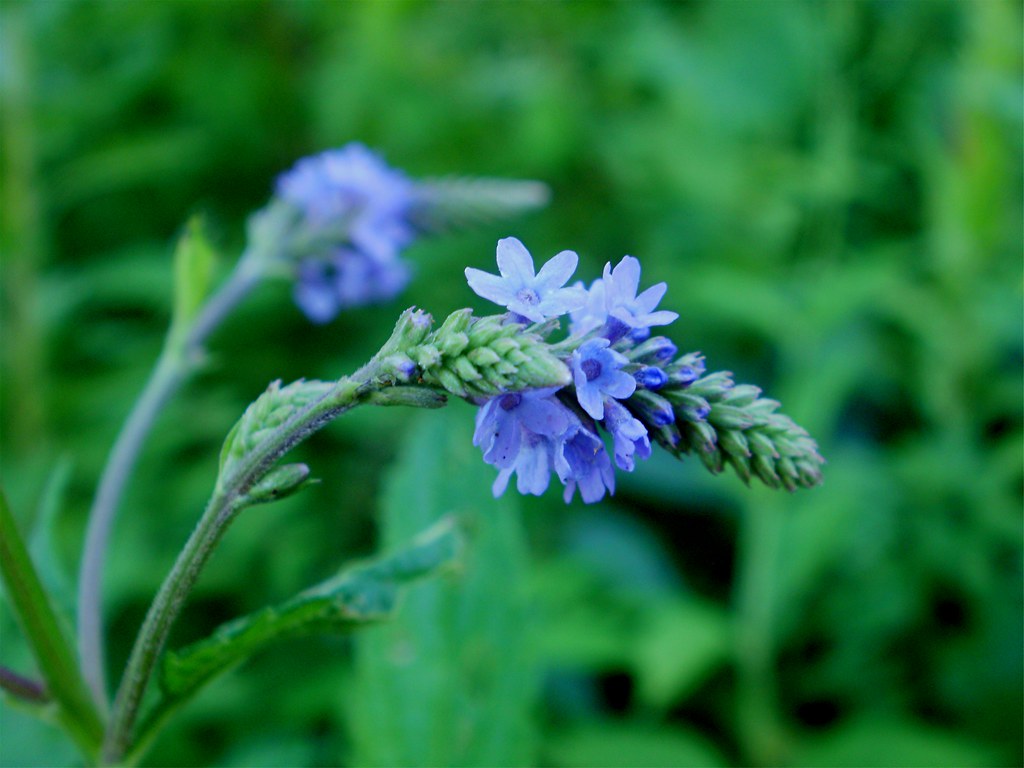
Bigelow, speaking of the spikes of the blue vervain (Verbena hastata), says, “The flowering commences at their base and is long in reaching their summit.” 

I perceive that only one circle of buds, about half a dozen, blossoms at a time, -- and there are about thirty circles in the space of three inches -- while the next circle of buds above at the same time shows the blue. Thus this triumphant blossoming circle travels upward, driving the remaining buds off into space. I think it was the 16th of July when I first noticed them (on another plant), and now they are all within about half an inch of the top of the spikes. 

Yet the blossoms have got no nearer the top on long spikes, which had many buds, than on short ones only an inch long. Perhaps the blossoming commenced enough earlier on the long ones to make up for the difference in length. 


Blue vervain (Verbena hastata)

It is very pleasant to measure the progress of the season by this and similar clocks. So you get, not the absolute time, but the true time of the season.


The prevailing conspicuous flowers at present are:
  •  The early goldenrods,
  •  tansy,
  •  the life-everlastings,
  •  flea bane (though not for its flower),
  •  yarrow (rather dry),
  •  hardhack and meadow-sweet (both getting dry, also mayweed),
  •  Eupatorium purpureum,
  •  scabish,
  •  clethra (really a fine, sweet-scented, and this year particularly fair and fresh, flower, some unexpanded buds at top tinged with red),
  •  Rhexia Virginica,
  •  thoroughwort,
  •  Polygala sanguinea,
  •  prunella, and dog’s-bane (getting stale), etc., etc.
Touch-me-not (less observed), Canada snap dragon by roadside (not conspicuous).

The purple gerardia now, horsemint, or Mentha borealis, Veronica scutellata (marsh speedwell), Ranunculus acris (tall crow foot) still.

Mowing to some extent improves the landscape to the eye of the walker. The aftermath, so fresh and green, begins now to recall the spring to my mind. In some fields fresh clover heads appear.


There is some advantage, intellectually and spiritually, in taking wide views with the bodily eye and not pursuing an occupation which holds the body prone. There is some advantage, perhaps, in attending to the general features of the landscape over studying the particular plants and animals which inhabit it. 

A man may walk abroad and no more see the sky than if he walked under a shed. The poet is more in the air than the naturalist, though they may walk side by side. Granted that you are out-of-doors; but what if the outer door is open, if the inner door is shut! 

You must walk sometimes perfectly free, not prying nor inquisitive, not bent upon seeing things. Throw away a whole day for a single expansion, a single inspiration of air.

It is remarkable that animals are often obviously, manifestly, related to the plants which they feed upon or live among, - as caterpillars, butterflies, tree-toads, partridges, chewinks, - and this afternoon I noticed a yellow spider on a goldenrod; as if every condition might have its expression in some form of animated being.

Spear-leaved goldenrod in path to northeast of Flint's Pond.


Hieracium paniculatum, a very delicate and slender hawkweed. I have now found all the hawkweeds. Singular these genera of plants, plants manifestly related yet distinct. 

They suggest a history to nature, a natural history in a new sense.

H. D. Thoreau, Journal, August 21, 1851

Bigelow. See December 4, 1856 ("My first botany, as I remember, was Bigelow's "Plants of Boston and Vicinity," which I began to use about twenty years ago".)

It is very pleasant to measure the progress of the season by this and similar clocks. See. August 6, 1852 (" Blue vervain is now very attractive to me, and then there is that interesting progressive history in its rising ring of blossoms. It has a story");  August 20, 1851 ("The flowers of the blue vervain have now nearly reached the summit of their spikes."); August 22, 1859 ("The circles of the blue vervain flowers, now risen near to the top, show how far advanced the season is") see also A Book of the Seasons by Henry Thoreau,   the Blue Vervain

The prevailing conspicuous flowers at present.  See August 21, 1852 ("There are as few or fewer birds heard than flowers seen. The sound of the crickets gradually prevails more and more. I hear the year falling asleep.")

There is some advantage, perhaps, in attending to the general features of the landscape over studying the particular plants and animals which inhabit it.
See March 5, 1852 ("The habit of looking at things microscopically, as the lichens on the trees and rocks, really prevents my seeing aught else in a walk")

A man may walk abroad and no more see the sky than if he walked under a shed. See September 13, 1859 ("There are various degrees of living out-of-doors. You must be outdoors long, early and late, and travel far and earnestly, in order to perceive the phenomena of the day. Even then much will escape you. Few live so far outdoors as to hear the first geese go over.")

You must walk sometimes perfectly free, not prying nor inquisitive, not bent upon seeing things. See August 5, 1851 ("The question is not what you look at, but what you see.”); November 18 1851 ("The chopper who works in the woods all day is more open in some respects to the impressions they are fitted to make than the naturalist who goes to see them. He really forgets himself, forgets to observe, and at night he dreams of the swamp, its phenomena and events. Not so the naturalist; enough of his unconscious life does not pass there. A man can hardly be said to be there if he knows that he is there, or to go there if he knows where he is going. The man who is bent upon his work is frequently in the best attitude to observe what is irrelevant to his work."); March 23, 1853 ("Man cannot afford to be a naturalist, to look at Nature directly, but only with the side of his eye"); June 14, 1853 (" that favorable frame of mind described by De Quincey, open to great impressions, and you see those rare sights with the unconscious side of the eye, which you could not see by a direct gaze before.”); September 13, 1852 ("I must walk more with free senses. I must let my senses wander as my thoughts, my eyes see without looking. Carlyle said that how to observe was to look, but I say that it is rather to see, and the more you look the less you will observe. Be not preoccupied with looking. Go not to the object; let it come to you. What I need is not to look at all, but a true sauntering of the eye.")

It is remarkable that animals are often obviously, manifestly, related to the plants which they feed upon or live among.
See August 22, 1852 ("Perhaps fruits are colored like the trillium berry and the scarlet thorn to attract birds to them.")

The aftermath, so fresh and green, begins now to recall the spring to my mind. See  July 24, 1852 ("There is a short, fresh green on the shorn fields, the aftermath. When the first crop of grass is off, and the aftermath springs, the year has passed its culmination."); July 24, 1860 ("Many a field where the grass has been cut shows now a fresh and very lit-up light green as you look toward the sun."); July 28, 1852 ("There is a yellowish light now from a low, tufted, yellowish, broad-leaved grass, in fields that have been mown."); August 4, 1853 ("The low fields which have been mown now look very green again in consequence of the rain, as if it were a second spring.) August 7, 1852 ("At this season we have gentle rain-storms, making the aftermath green . . . as if it were a second spring ."); August 10, 1854 ("As I go along the railroad, I observe the darker green of early-mown fields. "); August 17, 1858 ("The aftermath on early mown fields is a very beautiful green. ");  August 20, 1858  ("
In some meadows, as I look southwesterly, the aftermath looks a bright yellowish-green in patches.")

August 21,  See A Book of the Seasons, by Henry Thoreau, August 21

The progress of the
blue vervain measures the true
time of the season.

A Book of the Seasons,  by Henry Thoreau.
"A book, each page written in its own season,
out-of-doors, in its own locality."
 ~edited, assembled and rewritten by zphx ©  2009-2025

Wednesday, November 10, 2010

Inches Wood

November 10

How little there is on an ordinary map! How little, I mean, that concerns the walker and the lover of nature.

Between those lines indicating roads is a plain blank space in the form of a square or triangle or polygon or segment of a circle, and there is naught to distinguish this from an other area of similar size and form. Yet the one,may be covered, in fact, with a primitive oak wood, like that of Boxboro, waving and creaking in the wind, such as may make the reputation of a county, while the other is a stretching plain with scarcely a tree on it.

The waving woods, the dells and glades and green banks and smiling fields, the huge boulders, etc., etc., are not on the map, nor to be inferred from the map.

How little we insist on truly grand and beautiful natural features! How many have ever heard of the Boxboro oak woods? How many have ever explored them?

I have lived so long in this neighborhood and but just heard of this noble forest, - probably as fine an oak wood as there is in New England, only eight miles west of me.

Seeing this, I can realize how this country appeared when it was discovered - a full-grown oak forest stretching uninterrupted for miles, consisting of sturdy trees from one to three and even four feet in diameter, whose interlacing branches form a complete and uninterrupted canopy. Such were the oak woods which the Indian threaded hereabouts.

Such a wood must have a peculiar fauna to some extent. Many trunks old and hollow, in which wild beasts den. Hawks nesting in the dense tops, and deer glancing between the trunks. Warblers must pass through it in the spring, which we do not see here.


H. D. Thoreau, Journal, November 10, 1860


How little we insist on truly grand and beautiful natural features! How many have ever heard of the Boxboro oak woods? How many have ever explored them? See October 23, 1860 ("Anthony Wright . . . tells me of a noted large and so-called primitive wood, Inches Wood, between the Harvard turnpike and Stow, sometimes called Stow Woods.") ;November 9, 1860 ("Inches’ Woods in Boxboro. This wood is some one and three quarters miles from West Acton, .. . . in the east part of Boxboro, on both sides of the Harvard turnpike."); January 3, 1861 ("Far the handsomest thing I saw in Boxboro was its noble oak wood. I doubt if there is a finer one in Massachusetts. Let her keep it a century longer, and men will make pilgrimages to it from all parts of the country.")

How little a map
concerns the walker and the 
lover of nature.

Popular Posts Last 30 Days.

The week ahead in Henry’s journal

The week ahead in Henry’s journal
A journal, a book that shall contain a record of all your joy.
"A stone fruit. Each one yields me a thought." ~ H. D. Thoreau, March 28, 1859


I sit on this rock
wrestling with the melody
that possesses me.