Showing posts with label Great Meadows. Show all posts

Tuesday, September 27, 2022

Light and shadows along the Concord River.


September 27

Here is a cloudy day, and now the fisherman is out. 

Some tall, many-flowered, bluish-white asters are still abundant by the brook-sides. 

I never found a pitcher-plant without an insect in it. The bristles about the nose of the pitcher all point inward, and insects which enter or fall in appear for this reason unable to get out again. It is some obstacle which our senses cannot appreciate. 

Pitcher-plants more obvious now.

***

2 P. M. Rowed down the river to Ball's Hill.

The maples by the riverside look very green yet, have not begun to blush, nor are the leaves touched by frost.  Not so on the uplands.

The river is so low that, off N. Barrett's shore, some low islands are exposed, covered with a green grass like mildew. 

There are all kinds of boats chained to stumps and trees by the riverside some from Boston and the salt — but I think that none after all is so suitable and convenient as the simple flat-bottomed and light boat that has long been made here by the farmers themselves. They are better adapted to the river than those made in Boston. 

From Ball's Hill the Great Meadows, now smoothly shorn  have a quite imposing appearance, so spacious and level. There is so little of this level land in our midst. 

There is a shadow on the sides of the hills surrounding (a cloudy day), and where the meadow meets them it is darkest. The shadow deepens down the woody hills and is most distinctly dark where they meet the meadow line. 

Now the sun in the west is coming out and lights up the river a mile off, so that it shines with a white light like a burnished silver mirror. 

The poplar tree seems quite important to the scene.

The pastures are so dry that the cows have been turned on to the meadow, but they gradually desert it, all feeding one way. 

The patches of sunlight on the meadow look luridly yellow, as if flames were traversing it. 

It is a day for fishermen. 

The farmers are gathering in their corn. 

The Mikania scandens and the button-bushes and the pickerel-weed are sere and flat with frost. 

We looked down the long reach toward Carlisle Bridge. The river, which is as low as ever, still makes a more than respectable appearance here and is of generous width. 

Rambled over the hills toward Tarbell's. The huckleberry bushes appear to be unusually red this fall, reddening these hills. 

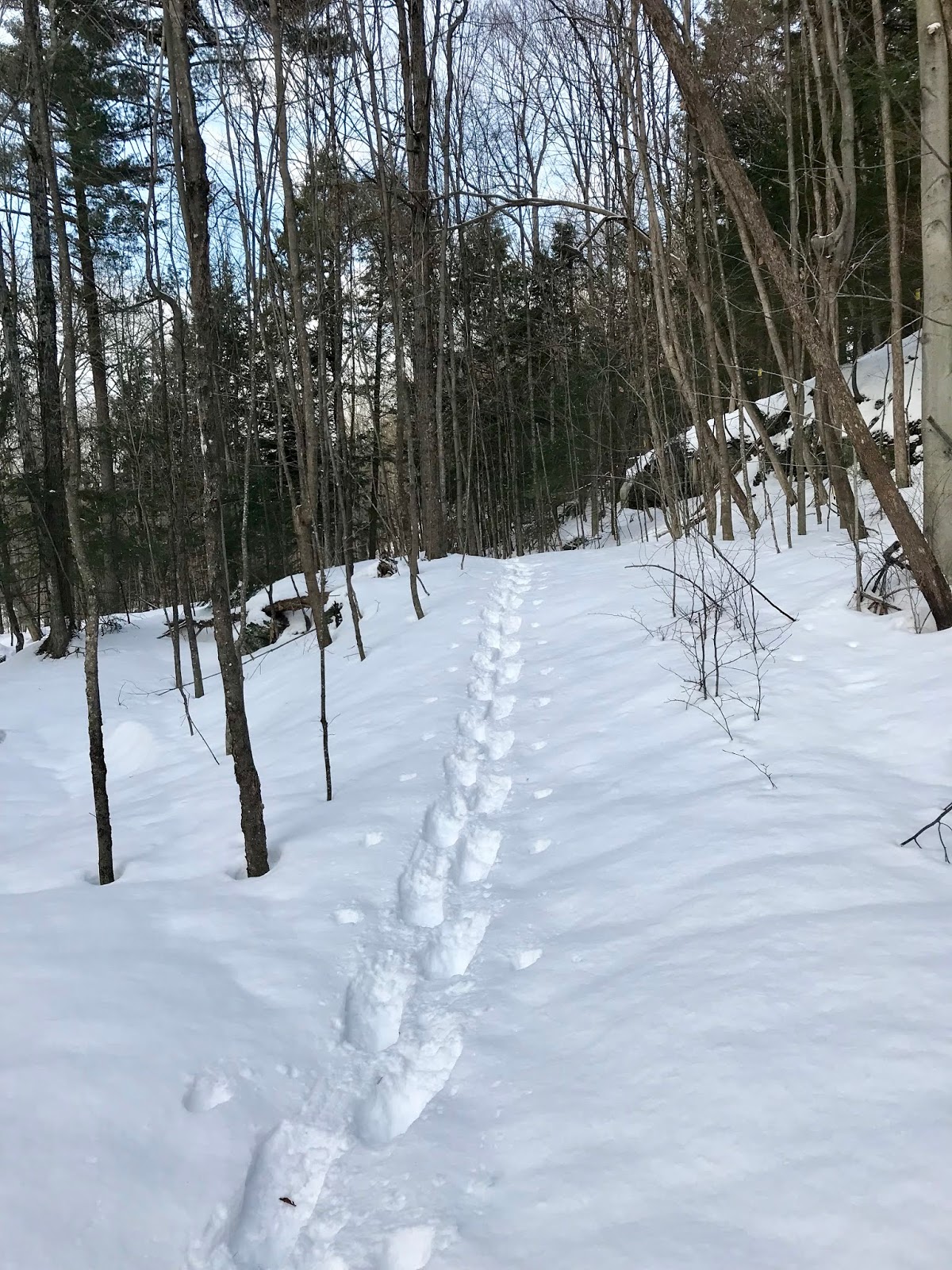
We scared a calf out of the meadow which ran like a ship tossed on the waves, over the hills toward Tarbell's. They run awkwardly , red oblong squares tossing up and down like a vessel in a storm, with great commotion.  We fell into the path, printed by the feet of the calves, with no cows' tracks. 

The note of the yellow-hammer is heard from the edges of the fields. 

The soapwort gentian looks like a flower prematurely killed by the frost. 

The soil of these fields looks as yellowish white as the corn-stalks themselves. 

Tarbell's hip roofed house looked the picture of retirement, - of cottage size, under its noble elm with its heap of apples before the door and the wood coming up within a few rods, it being far off the road. The smoke from his chimney so white and vapor-like, like a winter scene. 

The lower limbs of the willows and maples and button bushes are covered with the black and dry roots of the water-marigold and the ranunculi, plants with filiform, capillary, root-like submerged leaves.


H. D. Thoreau, Journal, September 27, 1851


Pitcher-plants more obvious now. 
See September 11, 1851 ("We have had no rain for a week, and yet the pitcher-plants have water in them. Are they ever quite dry? Are they not replenished by the dews always, and, being shaded by the grass, saved from evaporation?"); September 28, 1851 ("This swamp contains beautiful specimens of the sidesaddle-flower (Sarracenia purpurea), better called pitcher-plant . . .These leaves are of various colors from plain green to a rich striped yellow or deep red. No plants are more richly painted and streaked than the inside of the broad lips of these."). See also 
A Book of the Seasonsby Henry Thoreau, The Purple Pitcher Plant

Here is a cloudy day, and now the fisherman is out. September 25, 1851 ("Both air and water are so transparent that the fisherman tries in vain to deceive the fish with his baits")

There are all kinds of boats chained to stumps and trees by the riverside. See October 15, 1851 ("We comment on the boats of different patterns, – dories (?), punts, bread-troughs, flatirons, etc., etc., — which we pass, the prevailing our genuine dead-river boats, not to be matched by Boston carpenters."); April 22, 1857 (“We pass a dozen boats sunk at their moorings, at least at one end, being moored too low.”).

Cows all feeding one way. See July 5, 1853 ("Such a habit have cows in a pasture of moving forward while feeding that, in surveying on the Great Fields to-day, I was interrupted by a herd of a dozen cows, which successively passed before my line of vision, feeding forward, and I had to watch my opportunity to look between them.")

The farmers are gathering in their corn. See August 27, 1853 ("Topping corn now reveals the yellowing pumpkins."); September 4, 1859 ("Topping the corn, which has been going on some days, now reveals the yellow and yellowing pumpkins."); September 5, 1851 ("A field of ripening corn, now at night, that has been topped, with the stalks stacked up to dry, – an inexpressibly dry, rich, sweet ripening scent."); September 14,1851 ("The corn-stalks standing in stacks, in long rows along the edges of the corn-fields, remind me of stacks of muskets."); September 16, 1852 ("The jay screams; the goldfinch twitters; the barberries are red. The corn is topped"); September 17, 1852 ("The corn-stalks are stacked like muskets along the fields."); October 6, 1858 ("The corn stands bleached and faded — quite white in the twilight");  October 10, 1857 ("See the heaps of apples in the fields and at the cider mill, of pumpkins in the fields, and the stacks of corn stalks and the standing corn. Such is the season.") See also September 27, 1858 ("The farmers digging potatoes on shore pause a moment to watch my sail and bending mast.")

We looked down the long reach toward Carlisle Bridge. See October 6, 1851 ("The reach of the river between Bedford and Carlisle, seen from a distance in the road to-day, as formerly, has a singularly ethereal, celestial, or elysian look.. . . I have often noticed it. I believe I have seen this reach from the hill in the middle of Lincoln."); April 10, 1852 ("This meadow is about two miles long at one view from Carlisle Bridge southward, appearing to wash the base of Pine hill, and it is about as much longer northward and from a third to a half a mile wide."); August 24, 1858 ("I look down a straight reach of water to the hill by Carlisle Bridge, —and this I can do at any season, — the longest reach we have. It is worth the while to come here for this prospect, — to see a part of earth so far away over the water"); July 14, 1859 ("There extends from Tarbell Hill to Skelton Bend what I will call the Straight Reach, a mile and a third long and quite straight. This is the finest water view, making the greatest impression of size, of any that I know on the river.")

The soapwort gentian looks like a flower prematurely killed by the frost.  See September 6, 1857 ("Soapwort gentian, out not long."); September 8, 1852 ("Gentiana saponaria out."); September 19, 1851 ("The soapwort gentian now.");  September 19, 1852 ("The soapwort gentian cheers and surprises, -- solid bulbs of blue from the shade, the stale grown purplish. It abounds along the river, after so much has been mown"); September 22, 1852 ("The soapwort gentian the flower of the river-banks now.") September 25, 1857 ("You notice now the dark-blue dome of the soapwort gentian in cool and shady places under the bank.") See also A Book of the Seasons, by Henry Thoreau, The Soapwort Gentian (Gentiana saponaria)

September 27.  See A Book of the Seasons,  by Henry Thoreau, September 27

Now the sun lights up 
the river so it shines like 
a silver mirror.  
A Book of the Seasons, by Henry Thoreau
"A book, each page written in its own season,
out-of-doors, in its own locality.”
~edited, assembled and rewritten by zphx © 2009-2025


Sunday, September 19, 2021

And in the distance a maple by the water beginning to blush.


September 19


And in the distance a maple by the water beginning to blush
September 19, 2014

P. M. - To Great Meadows.

The red capsules of the sarothra.

Many large crickets about on the sand.

Observe the effects of frost in particular places.

Some blackberry vines are very red.

I see the oxalis and the tree primrose and the Norway cinquefoil and the prenanthes and the Epilobium coloratum and the cardinal-flower and the small hypericum and yarrow, and I think it is the Ranunculus repens, between Ripley Hill and river, with spotted leaves lingering still.

The soapwort gentian cheers and surprises, - solid bulbs of blue from the shade, the stale grown purplish. It abounds along the river, after so much has been mown.

The polygala and the purple gerardia are still common and attract by their high color.

The small-flowering Bidens cernua (?) and the fall dandelion and the fragrant everlasting abound.

The Viola lanceolata has blossomed again, and the lambkill.

What pretty six-fingered leaves the three oxalis leafets make! 

I see the effects of frost on the Salix Purshiana, imbrowning their masses; and in the distance is a maple or two by the water, beginning to blush.

That small, slender-leaved, rose-tinted (white petals, red calyx) polygonum by the river is perhaps in its prime now; slender spikes and slender lanceolate sessile leaves, with rent hairy and ciliate sheaths, eight stamens, and three styles united in middle. Not biting. I cannot find it described.

Cicuta maculata

And what is that white flower which I should call Cicuta maculata, except that the veins do not terminate in the sinuses?

H. D. Thoreau, Journal, September 19, 1852


The soapwort gentian cheers and surprises,  September 19, 1851 ("The soapwort gentian now."); See also September 8, 1852 ("Gentiana saponaria out."); September 19, 1851 ("The soapwort gentian now."); .("September 22, 1852 ("The soapwort gentian the flower of the river-banks now.") September 25, 1857 ("You notice now the dark-blue dome of the soapwort gentian in cool and shady places under the bank.") See also A Book of the Seasons, by Henry Thoreau, The Soapwort Gentian (Gentiana saponaria)

The red capsules of the sarothra. See August 3, 1852 ("The Hypericum Sarothra appears to be out.."); August 3, 1856 ("Sarothra apparently now in prime."); August 12, 1856 (“The sarothra — as well as small hypericums generally — has a lemon scent.”); August 19, 1856 ("The small hypericums have a peculiar smart, somewhat lemon-like fragrance, but bee-like. ); August 30, 1856 ("The sarothra is now apparently in prime on the Great Fields, and comes near being open now, at 3 p. m. Bruised, it has the fragrance of sorrel and lemon, rather pungent or stinging, like a bee.”); September 2, 1859 ("The sarothra grows thickly, and is now abundantly in bloom, on denuded places, i.e., where the sod and more or less soil has been removed, by sandy roadsides. "); September 23, 1852 ("The sarothra in bloom");   See also A Book of the Seasons,  by Henry Thoreau, St. Johns-wort (Hypericum)

The Norway cinquefoil. See August 30, 1851 ("I perceive in the Norway cinquefoil (Potentilla Norvegica), now nearly out of blossom, that the alternate five leaves of the calyx are closing over the seeds to protect them. There is one door closed, of the closing year.")

The purple gerardia are still common and attract by their high color.
See August 12, 1856 ("Gerardia purpurea, two or three days."); August 20, 1852 ("The purple gerardia is very beautiful now in green grass."); August 21, 1851 ("The purple gerardia now."); September 11, 1852 ("How much fresher some flowers look in rainy weather! When I thought they were about done, they appear to revive, and moreover their beauty is enhanced, as if by the contrast of the louring atmosphere with their bright colors. Such are the purple gerardia and the Bidens cernua.")

The small-flowering Bidens cernua (?) and the fall dandelion and the fragrant everlasting abound. See September 19, 1851 ("Large-flowered bidens, or beggar-ticks, or bur-marigold, now abundant by riverside."); . September 13, 1856 ("Surprised at the profusion of autumnal dandelions in their prime on the top of the hill, about the oaks. Never saw them thicker in a meadow. A cool, spring-suggesting yellow. They reserve their force till this season, though they begin so early. Cool to the eye, as the creak of the cricket to the ear. "); August 29, 1856 ("Fragrant everlasting in prime and very abundant")

The Viola lanceolata has blossomed again. See September 28, 1852 ("I have now seen all but the blanda, palmata, and pubescens blooming again .. . This is the commencement, then, of the second spring"). See also A Book of the Seasons, by Henry Thoreau, the Violets

And in the distance is a maple or two by the water, beginning to blush. See  September 12, 1858 ("Some small red maples by water begun to redden."); September 18, 1858 ("Many red maples are now partly turned dark crimson along the meadow-edge."); September 18, 1860 ("The first autumnal tints (of red maples) are now generally noticed"); September 20, 1857 ("A great many small red maples in Beck Stow's Swamp are turned quite crimson, when all the trees around are still perfectly green. It looks like a gala day there."); September 21, 1854 ("The red maples, especially at a distance, begin to light their fires, some turning yellow, "); September 24, 1851 ("I notice one red tree, a red maple, against the green woodside in Conant's meadow. It is a far brighter red than the blossoms of any tree in summer and more conspicuous."); September 24, 1855 ("the maples are but just beginning to blush"); September 25, 1857 ("The whole tree, thus ripening in advance of its fellows, attains a singular preéminence"); September 25, 1857 ("The red maple has fairly begun to blush in some places by the river. I see one, by the canal behind Barrett’s mill, all aglow against the sun."); September 25, 1857 ("A single tree becomes the crowning beauty of some meadowy vale and attracts the attention of the traveller from afar."); September 26, 1854 ("Some single red maples are very splendid now, the whole tree bright-scarlet against the cold green pines; now, when very few trees are changed, a most remarkable object in the landscape; seen a mile off."); September 27, 1855 ("Some single red maples now fairly make a show along the meadow. I see a blaze of red reflected from the troubled water."); September 27, 1857 ("At last, its labors for the year being consummated and every leaf ripened to its full, it flashes out conspicuous to the eye of the most casual observer, with all the virtue and beauty of a maple, – Acer rubrum."); September 29, 1851 ("The intense brilliancy of the red-ripe maples scattered here and there in the midst of the green oaks and hickories on its hilly shore is quite charming. They are unexpectedly and incredibly brilliant, especially on the western shore and close to the water's edge, where, alternating with yellow birches and poplars and green oaks, they remind me of a line of soldiers, redcoats and riflemen in green mixed together."); September 30, 1854 ("I am surprised to see that some red maples, which were so brilliant a day or two ago, have already shed their leaves, and they cover the land and the water quite thickly."); October 3, 1858 ("Some particular maple among a hundred will be of a peculiarly bright and pure scarlet, and, by its difference of tint and intenser color, attract our eyes even at a distance in the midst of the crowd"); October 8, 1852 (“Nothing can exceed the brilliancy of some of the maples which stand by the shore and extend their red banners over the water.”)

And what is that white flower which I should call Cicuta maculata? See June 6, 1851 ("Gathered to-night the Cicuta maculata, American hemlock, the veins of the leaflets ending in the notches and the root fasciculated."); August 20, 1851 ("Sium lineare, a kind of water-parsnip, whose blossom resembles the Cicuta maculata.") August 29, 1858 ("Cicuta maculata, apparently generally done."); August 30, 1857 ("The flower of Cicuta maculata smells like the leaves of the golden senecio.."); October 2, 1859 ("The Cicuta maculata, for instance, the concave umbel is so well spaced, the different um-bellets (?) like so many constellations or separate systems in the firmament.") Note. Cicuta maculata is a highly poisonous species of flowering plant in the carrot family known by several common names, including spotted water hemlock, spotted parsley, spotted cowbane, and suicide root. It is considered to be North America's most toxic plant.Wikipedia

September 19. See A Book of the Seasons, by Henry Thoreau, September 19

And in the distance
a maple by the water
beginning to blush.

A Book of the Seasons, by Henry Thoreau
"A book, each page written in its own season,
out-of-doors, in its own locality.”
~edited, assembled and rewritten by zphx © 2009-2024


https://tinyurl.com/hdt-520919 

Tuesday, April 21, 2020

I have not this season heard more robins sing than this rainy day.


The storm still continues. 

When I walked in the storm day before yesterday, I felt very cold when my clothes were first wet through, but at last they, being saturated with water, were tight and kept out the air and fresh wet like a thicker and closer garment, and, the water in them being warmed by my person, I felt warmer and even drier. 

The color of the water changes with the sky. It is as dull and sober as the sky to-day. 

The woodchuck has not far to go to his home. In foul weather, if he chooses, he can turn in anywhere. He lives on and in the earth. A little parasite on the skin of the earth, that knows the taste of clover and bean leaves and beetles. 

2 P. M. – Another walk in the rain. 

The river is remarkably high. Nobody remembers when the water came into so many cellars. 

The water is up to the top of the easternmost end of the eastern most iron truss on the south side of the stone bridge. It is over the Union Turnpike that was west of the bridge, so that it is impassable to a foot-traveller, and just over the road west of Wood’s Bridge. Of eight carriage roads leading into Concord, the water to my knowledge is now over six, viz., Lee’s Bridge, the Corner road, Wood’s Bridge, Stone Bridge, Red Bridge (on both sides, full half a mile in all, over the walls), and the Turnpike. All of these are impassable to foot-travellers except Wood’s Bridge, where only a lady would be stopped. I should think that nine inches more would carry it over Flint’s Bridge road. How it is at the East Quarter schoolhouse I don’t know, nor at the further stone bridge and above, nor at Derby’s Bridge. It is probably over the road near Miles’s in the Corner, and in two places on the Turnpike, perhaps between J. P. Brown’s and C. Miles’s. This may suggest how low Concord is situated. 

Most of the cellars on both sides of the main street east of our house have water in them, and some that are on high ground. All this has been occasioned by the repeated storms of snow and rain for a month or six weeks past, especially the melting of the deep snow of April 13th, and, added to this, the steady rain from Sunday morning, April 18th, to this moment, 8 P. M., April 21st. 

The element of water is in the ascendant. 

From the Poplar Hill, the expanse of water looks about as large on the southwest as the northeast. Many new islands are made, -- of grassy and sometimes rocky knolls, and clumps of trees and bushes where there is no dry land. Straight willow hedges rising above the water in some places, marking the boundaries of some man’s improvements, look prettily. 

Some of the bushy islands on the Great Meadows are distinctly red at this distance, even a mile off, from the stems of some bush not red (distinctly) in fair weather, wet now. Is it cornel

In front of Peter’s. — The grass has been springing in spite of the snow and rain, and the earth has an  increased greenish tinge, though it is still decidedly tawny. 

Men are out in boats in the rain for muskrats, ducks, and geese. 

It appears to me, as I stand on this hill, that the white houses of the village, seen through the whitish misty storm and rain, are a very suitable color and harmonize well with the scenery, like concentrations of the mist. It is a cheerful color in stormy weather. 

A few patches of snow are still left. 

The robins sing through the ceaseless rain, and the song sparrows, and I hear a lark’s plaintive strain.

I am glad that men are so dispersed over the earth. The need of fuel causes woods to be left, and the use of cattle and horses requires pastures, and hence men live far apart and the walkers of every town have this wide range over forest and field.

Sitting behind the wall on the height of the road beyond N. Barrett’s (for we have come down the north bank of the river), I love in this weather to look abroad and let my eye fall on some sandy hill clothed with pitch pines on its sides, and covered on its top with the whitish cladonia lichen, usually so dry but now saturated with water. It reminds me of northern regions. 

I am thinking of the hill near Tarbell’s, three quarters of a mile from me. They are agreeable colors to my eye, the green pine and, on the summit, the patches of whitish moss like mildew seen through the mist and rain, for I think, perhaps, how much moisture that soil can bear, how grateful it is to it. 

Proceed toward Hubbard’s black birch hill. The grass is greenest in the hollows where some snow and ice are still left melting, showing by its greenness how much space they recently covered.

On the east side of Ponkawtasset I hear a robin singing cheerily from some perch in the wood, in the midst of the rain, where the scenery is now wild and dreary. His song a singular antagonism and offset to the storm. As if Nature said, “Have faith, these two things I can do.” It sings with power, like a bird of great faith that sees the bright future through the dark present, to reassure the race of man, like one to whom many talents were given and who will improve its talents. They are sounds to make a dying man live. They sing not their despair. It is a pure, immortal melody. 

The side of the hill is covered first with tall birches rising from a reddish ground, just above a small swamp; then comes a white pine wood whose needles, covered with the fine rain-drops, have a light sheen on them. I see one pine that has been snapped off half-way up in the storm, and, seen against the misty background, it is a diştinct yellow mark. 

The sky is not one homogeneous color, but somewhat mottled with darker clouds and white intervals, and anon it rains harder than before. 

(I saw the other day the rootlets which spring from the alder above the ground, so tenacious of the earth is it.) 

Was that a large shad-bush where Father’s mill used to be? There is quite a waterfall beyond, where the old dam was. Where the rapids commence, at the outlet of the pond, the water is singularly creased as it rushes to the fall, like braided hair, as the poet has it. I did not see any inequalities in the rock it rushed over which could make it so plaited. Here is enough of that suds which in warm weather disperses such a sense of coolness through the air. 

Sat under the dark hemlocks, gloomy hemlocks, on the hillside beyond. In a stormy day like this there is the gloom of night beneath them. The ground beneath them almost bare, with wet rocks and fine twigs, without leaves (but hemlock leaves) or grass.

The birds are singing in the rain about the small pond in front, the inquisitive chickadee that has flown at once to the alders to reconnoitre us, the blackbirds, the song sparrow, telling of expanding buds. 

But above all the robin sings here too, I know not at what distance in the wood. “Did he sing thus in Indian days?” I ask myself ; for I have always associated this sound with the village and the clearing, but now I do detect the aboriginal wildness in his strain, and can imagine him a woodland bird, and that he sang thus when there was no civilized ear to hear him, a pure forest melody even like the wood thrush. 

Every genuine thing retains this wild tone, which no true culture displaces. 

I heard him even as he might have sounded to the Indian, singing at evening upon the elm above his wigwam, with which was associated in the red man’s mind the events of an Indian’s life, his childhood. Formerly I had heard in it only those strains which tell of the white man’s village life; now I heard those strains which remembered the red man’s life, such as fell on the ears of Indian children,-as he sang when these arrowheads, which the rain has made shine so on the lean stubble-field, were fastened to their shaft. 

Thus the birds sing round this piece of water, some on the alders which fringe, some farther off and higher up the hills; it is a centre to them. Here stand buttonwoods, an uncommon tree in the woods, naked to look at, and now covered with little tufts of twigs on the sides of the branches in consequence of the disease which has attacked them. The singing of birds implies fair weather. 

I see where some farmer has been at pains to knock to pieces the manure which his cattle have dropped in the pasture, so to spread it over the sward. 

The yellow birch is to me an interesting tree from its remarkable and peculiar color, like a silvery gold. 

In the pasture beyond the brook, where grow the barberries, huckleberries, — creeping juniper, etc., are half a dozen huge boulders, which look grandly now in the storm, covered with greenish-gray lichens, alternating with the slatish-colored rock. Slumbering, silent, like the exuviæ of giants; some of their cattle left. From a height I look down on some of them as on the backs of oxen. A certain personality, or at least brute life, they seem to have. 

C. calls it Boulder Field. There is a good prospect southward over the pond, between the two hills, even to the river meadows now. 

As we stand by the monument on the Battle-Ground, I see a white pine dimly in the horizon just north of Lee’s Hill, at 5. 30 P. M., its upright stem and straight horizontal feathered branches, while at the same time I hear a robin sing. Each enhances the other.

That tree seems the emblem of my life; it stands for the west, the wild. The sight of it is grateful to me as to a bird whose perch it is to be at the end of a weary flight. I [am] not sure whether the music I hear is most in the robin’s song or in its boughs. My wealth should be all in pine-tree shillings. 

The pine tree that stands on the verge of the clearing, whose boughs point westward; which the village does not permit to grow on the common or by the roadside; which is banished from the village; in whose boughs the crow and the hawk have their nests. 

We have heard enough nonsense about the Pyramids. If Congress should vote to rear such structures on the prairies to-day, I should not think it worth the while, nor be interested in the enterprise. It was the foolish undertaking of some tyrant. “ But, ” says my neighbor, “ when they were built, all men believed in them and were inspired to build them. ” Nonsense ! nonsense ! I believe that they were built essentially in the same spirit in which the public works of Egypt, of England, and America are built to-day, — the Mahmoudi Canal, the Tubular Bridge, Thames Tunnel, and the Washington Monument. The inspiring motive in the actual builders of these works is garlic, or beef, or potatoes. For meat and drink and the necessaries of life men can be hired to do many things. “ Ah, ” says my neighbor, “ but the stones are fitted with such nice joints ! ” But the joints were nicer yet before they were disjointed in the quarry. Men are wont to speak as if it were a noble work to build a pyramid, — to set, forsooth, a hundred thousand Irishmen at work at fifty cents a day to piling stone. As if the good joints could ennoble it, if a noble motive was wanting ! To ramble round the world to see that pile of stones which ambitious Mr. Cheops, an Egyptian booby, like some Lord Timothy Dexter, caused a hundred thousand poor devils to pile up for low wages, which contained for all treasure the thigh-bone of a cow. The tower of Babel has been a good deal laughed at. It was just as sensible an undertaking as the Pyramids, which, because they were completed and have stood to this day, are admired. I don’t believe they made a better joint than Mr. Crab, the joiner, can.

I have not this season heard more robins sing than this rainy day.

H. D. Thoreau, Journal, April 21, 1852

When I walked in the storm day before yesterday, I felt very cold when my clothes were first wet through, but at last they, being saturated with water, were tight and kept out the air and fresh wet like a thicker and closer garment, and, the water in them being warmed by my person, I felt warmer and even drier. See April 19, 1852 ("It is a violent northeast storm, in which it is very difficult and almost useless to carry an umbrella. I am soon wet to my skin over half my body. At first, and for a long time, I feel cold and as if I had lost some vital heat by it, but at last the water in my clothes feels warm to me, and I know not but I am dry. ")See also February 28, 1852 (“To get the value of the storm we must be out a long time and travel far in it, so that it may fairly penetrate our skin, . . . and there be no part in us but is wet or weather beaten, - so that we become storm men instead of fair weather men.”) ; December 25, 1856 ("Take long walks in stormy weather or through deep snows in the fields and woods, if you would keep your spirits up. Deal with brute nature. Be cold and hungry and weary."); March 8, 1859 ("If there is a good chance to be cold and wet and uncomfortable, in other words to feel weather-beaten, you may consume the afternoon to advantage.").

Of eight carriage roads leading into Concord, the water to my knowledge is now over six.This may suggest how low Concord is situated. See February 3, 1855 ("I still recur in my mind to that skate of the 3lst. I was thus enabled to get a bird’s-eye view of the river, -— to survey its length and breadth within a few hours, connect one part (one shore) with another in my mind, and realize what was going on upon it from end to end, —to know the whole as I ordinarily knew a few miles of it only. It is all the way of one character, — a meadow river, or dead stream,—Musketicook,—the abode of muskrats, pickerel, etc., crossed within these dozen miles each way, —or thirty in all, —by some twenty low wooden bridges, connected with the mainland by willowy causeways. Thus the long, shallow lakes divided into reaches. These long causeways all under water and ice now, only the bridges peeping out from time to time like a dry eyelid.")

I have not this season heard more robins sing than this rainy day. See  March 8, 1855 ("This sound reminds me of rainy, misty April days in past years."); April 2, 1854  ("Sitting on the rail over the brook, I hear something which reminds me of the song of the robin in rainy days in past springs."); April 13, 1852 ("The robin is the only bird as yet that makes a business of singing, steadily singing, — sings continuously out of pure joy and melody of soul"); April 16, 1856 ("A moist, misty, rain-threatening April day. . . The robin sings throughout it. "); April 26, 1855 ("We see and hear more birds than usual this mizzling and still day, and the robin sings with more vigor and promise than later in the season.") See also  A Book of the Seasons, by Henry Thoreau, Robins in Spring and A Book of the Seasonsby Henry Thoreau, Birds in the Rain   A Book of the Seasons, by Henry Thoreau, Robins in Spring

Walkers have wide range 
over forest and field as 
men live far apart 


Sunday, January 26, 2020

Great revolutions of this sort take place before you are aware of it.


January 26

Fair, but overcast. Thermometer about 32°. 

Pretty good skating on the Great Meadows, slightly raised and smoothed by the thaw and also the rain of (I think) the 23d-24th. 

Great revolutions of this sort take place before you are aware of it. 


January 26, 2019

Though you walk every day, you do not foresee the kind of walking you will have the next day.

Skating, crusted snow, slosh, etc., are wont to take you by surprise. 

P. M. — To Eleazer Davis's Hill, and made a fire on the ice, merely to see the flame and smell the smoke. We soon had a slender flame flashing upward some four feet, — so many parallel undulating tongues. The air above and about it was all in commotion, being heated so that we could not see the landscape distinctly or steadily through it. If only to see the pearl ashes and hear the brands sigh.

H.D. Thoreau, Journal,  January 26, 1860

Great revolutions of this sort take place before you are aware of it. See June 22, 1859 ("One who is not almost daily on the river will not perceive the revolution constantly going on.")

Though you walk every day, you do not foresee the kind of walking you will have the next day. See January 10, 1854 ("What you can recall of a walk on the second day will differ from what you remember on the first day");  January 10, 1851 ("Who can foretell the sunset . . .the art of taking walks daily"); December 29, 1851 ("What a fine and measureless joy the gods grant us thus, letting us know nothing about the day that is to dawn! This day, yesterday, was as incredible as any other miracle."); January 7, 1851 ("There is no account of the blue sky in history. I must live above all in the present.");

Live in the present.
There is no account of this 
blue sky in history.
January 7, 1851

The art of walking
is to saunter daily with
no specific ends.

What measureless joy
to know nothing about the
day that is to dawn!
December 29, 1851

What you recall of a walk the second day will differ from the first. January 10, 1854

Though you walk each day, 
you do not foresee the walk
you have the next day. 
January 26, 1860

Made a fire on the ice, merely to see the flame and smell the smoke. See February 7, 1854 ("Made a fire on the snow-covered ice half a mile below Ball's Hill -- a large warm fire, whose flame went up straight, there being no wind, and without smoke,");  February 20, 1854 ("We skate home in the dusk, with an odor of smoke in our clothes.")

A Book of the Seasons,  by Henry Thoreau
 "A book, each page written in its own season,
out-of-doors, in its own locality."
 ~edited, assembled and rewritten by zphx ©  2009-2024

tinyurl.com/hdt18600126

Wednesday, August 21, 2019

There is quite a drought.

August 21

Sunday. P. M. — Walk over the Great Meadows and observe how dry they are. 

There is quite a drought, and I can walk almost anywhere over these meadows without wetting my feet. It is much drier than it was three weeks ago there. It is like the summer of '54. 

Almost all the grass has been cut and carried off. It is quite dry crossing the neck of the Holt. 

In many holes in the meadow, made by the ice, the water having dried up, I see many small fishes — pouts and pickerel and bream — left dead and dying. In one place there were fifty or one hundred pouts from four to five inches long with a few breams, all dead and dry. It is remarkable that these fishes have not all been devoured by birds or quadrupeds. 

The blue herons must find it easy to get their living now. Are they not more common on our river such years as this?

In holes where the water has just evaporated, leaving the mud moist, I see a hundred little holes near together, with occasionally an indistinct track of a bird between. Measuring these holes, I find them to be some two inches deep, or about the length of a snipe's bill, and doubtless they were made by them. I start one snipe. 

People now (at this low stage of water) dig mud for their compost-heaps, deepen wells, build bank walls, perchance, along the river, and in some places make bathing-places by raking away the weeds. Many are ditching.

H. D. Thoreau, Journal, August 21, 1859

There is quite a drought, and I can walk almost anywhere over these meadows without wetting my feet. It is much drier than it was three weeks ago there. It is like the summer of '54.. See August 19, 1854 ("There is now a remarkable drought, some of whose phenomena I have referred to during several weeks past.”); August 22, 1854 ("I go again to the Great Meadows, to improve this remarkably dry season and walk where in ordinary times I cannot go.")

The blue herons must find it easy to get their living now. See August 22, 1854 ("Thus the drought serves the herons, etc., confining their prey within narrower limits, and doubtless they are well acquainted with suitable retired pools far in the marshes to go a-fishing in.")

In holes where the water has just evaporated, leaving the mud moist, I see a hundred little holes near together, with occasionally an indistinct track of a bird between. . . .I start one snipe.  See August 3, 1859 (". To-day I can walk dry over the greater part of the meadows, . . . many think it has not been so dry for ten years! Goodwin is there after snipes. I scare up one in the wettest part.")

People now (at this low stage of water) dig mud for their compost-heaps. See August 28, 1854 ("The farmers improve this dry spell to cut ditches and dig mud in the meadows and pond-holes. I see their black heaps in many places. ")

A Book of the Seasons, by Henry Thoreau
"A book, each page written in its own season,
out-of-doors, in its own locality.”
~edited, assembled and rewritten by zphx © 2009-2025

Popular Posts Last 30 Days.

The week ahead in Henry’s journal

The week ahead in Henry’s journal
A journal, a book that shall contain a record of all your joy.
"A stone fruit. Each one yields me a thought." ~ H. D. Thoreau, March 28, 1859


I sit on this rock
wrestling with the melody
that possesses me.