Showing posts with label muskrats. Show all posts

Thursday, November 25, 2021

The satisfaction of existence.


November 25


I feel a little alarmed when it happens that I have walked a mile into the woods bodily, without getting there in spirit. 

November 25, 2017

I would fain forget all my morning's occupation, my obligations to society. But some times it happens that I cannot easily shake off the village; the thought of some work, some surveying, will run in my head, and I am not where my body is, I am out of my senses.

In my walks I would return to my senses like a bird or a beast.

What business have I in the woods, if I am thinking of something out of the woods?

This afternoon, late and cold as it is, has been a sort of Indian summer. Indeed, I think that we have summer days from time to time the winter through, and that it is often the snow on the ground makes the whole difference.

This afternoon the air was indescribably clear and exhilarating, and though the thermometer would have shown it to be cold, I thought that there was a finer and purer warmth than in summer; a wholesome, intellectual warmth, in which the body was warmed by the mind's contentment. The warmth was hardly sensuous, but rather the satisfaction of existence.


I found Fair Haven skimmed entirely over, though the stones which I threw down on it from the high bank on the east broke through.Yet the river was open.

The landscape looked singularly clean and pure and dry, the air, like a pure glass, being laid over the picture, the trees so tidy, stripped of their leaves; the meadows and pastures, clothed with clean dry grass, looked as if they had been swept; ice on the water and winter in the air, but yet not a particle of snow on the ground.

The woods, divested in great part of their leaves, are being ventilated.

It is the season of perfect works, of hard, tough, ripe twigs, not of tender buds and leaves. The leaves have made their wood, and a myriad new withes stand up all around pointing to the sky, able to survive the cold.

It is only the perennial that you see, the iron age of the year.

These expansions of the river skim over before the river itself takes on its icy fetters. What is the analogy?


I saw a muskrat come out of a hole in the ice. He is a man wilder than Ray or Melvin. While I am looking at him, I am thinking what he is thinking of me. He is a different sort of a man, that is all.

He would dive when I went nearer, then reappear again, and had kept open a place five or six feet square so that it had not frozen, by swimming about in it. Then he would sit on the edge of the ice and busy himself about something, I could not see whether it was a clam or not.

What a cold blooded fellow! thoughts at a low temperature, sitting perfectly still so long on ice covered with water, mumbling a cold, wet clam in its shell. What safe, low, moderate thoughts it must have! It does not get on to stilts.

The generations of muskrats do not fail. They are not preserved by the legislature of Massachusetts.


Boats are drawn up high which will not be launched again till spring.


There is a beautiful fine wild grass which grows in the path in sprout land, now dry, white, and waving, in light beds soft to the touch.

I experience such an interior comfort, far removed from the sense of cold, as if the thin atmosphere were rarefied by heat, were the medium of invisible flames, as if the whole landscape were one great hearthside, that where the shrub oak leaves rustle on the hillside, I seem to hear a crackling fire and see the pure flame, and I wonder that the dry leaves do not blaze into yellow flames.

I find but little change yet on the south side of the Cliffs; only the leaves of the wild apple are a little frostbitten on their edges and curled dry there, but some wild cherry leaves and blueberries are still fresh and tender green and red, as well as all the other leaves and plants which I noticed there the other day.

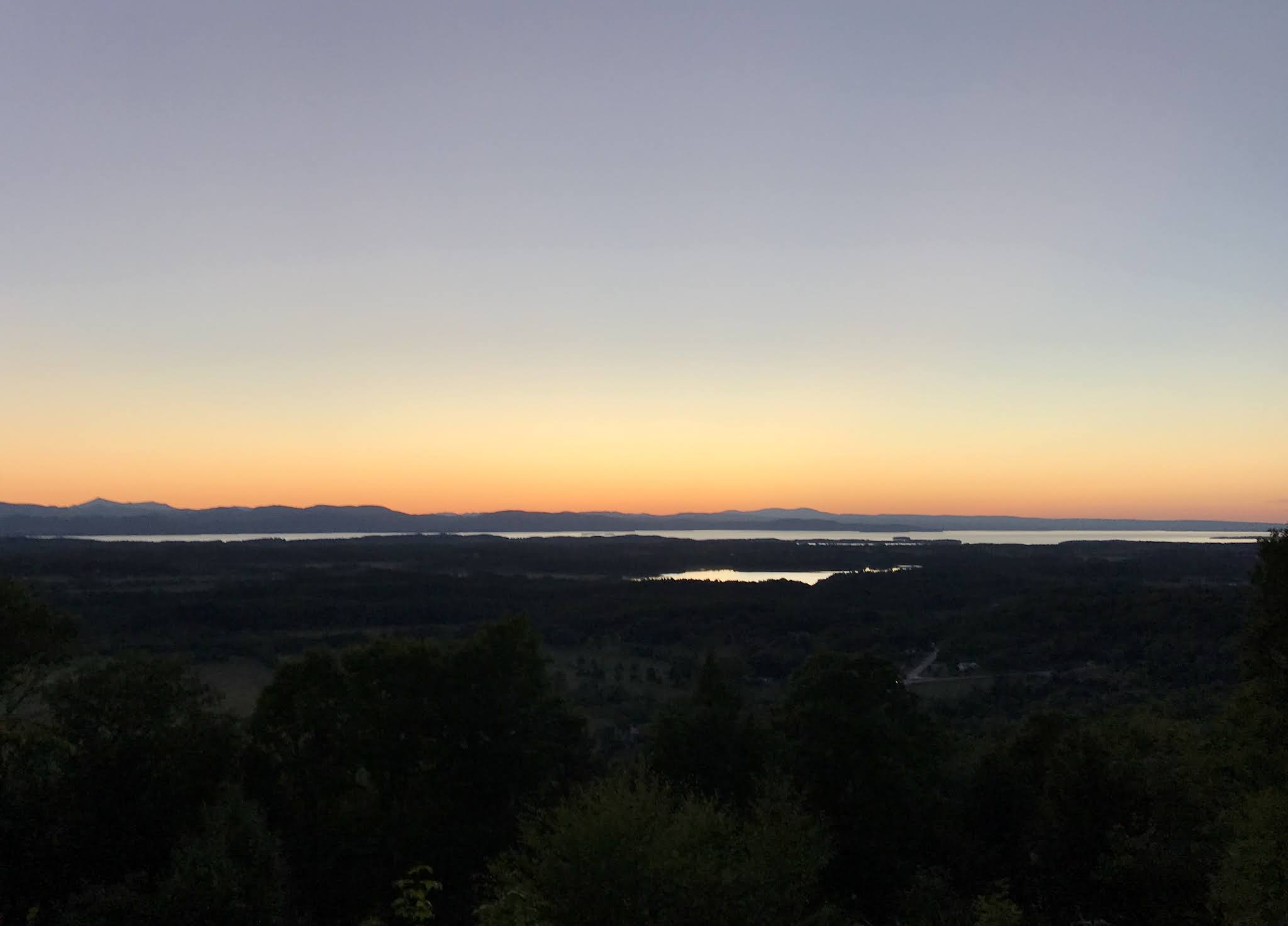
When I got up so high on the side of the Cliff the sun was setting like an Indian-summer sun. There was a purple tint in the horizon. It was warm on the face of the rocks, and I could have sat till the sun disappeared, to dream there. It was a mild sunset such as is to be attended to. 

November 25, 2021

Just as the sun shines into us warmly and serenely, our Creator breathes on us and re-creates us.

H. D. Thoreau, Journal, November 25, 1850

What business have I in the woods, if I am thinking of something out of the woods? See Walking (“I am alarmed when it happens that I have walked a mile into the woods bodily, without getting there in spirit. … But sometimes it happens that I cannot easily shake off the village. The thought of some work will run in my head and I am not where my body is. I am out of my senses. In my walks I would fain return to my senses. What business have I in the woods, if I am thinking of something out of the woods?” ); August 21, 1851 ("A man may walk abroad and no more see the sky than if he walked under a shed."); November 18 1851 ("The chopper who works in the woods all day is more open in some respects to the impressions they are fitted to make than the naturalist who goes to see them.. . .A man can hardly be said to be there if he knows that he is there, or to go there if he knows where he is going."); November 6, 1853 (“It is remarkable how little we attend to what is passing before us constantly, unless our genius directs our attention that way.”); January 7, 1857 ("I have told many that I walk every day about half the daylight, but I think they do not believe it. I wish to get the Concord, the Massachusetts, the America, out of my head and be sane a part of every day. . . .and therefore I come out to these solitudes, where the problem of existence is simplified."); September 13, 1859 ("Few live so far outdoors as to hear the first geese go over."); February 12, 1860 ("Surrounded by our thoughts or imaginary objects, living in our ideas, not one in a million ever sees the objects which are actually around him."); March 1, 1860 ("I have thoughts, as I walk, on some subject that is running in my head, but all their pertinence seems gone before I can get home to set them down.") See also December 20, 1851 ("Go out before sunrise or stay out till sunset "); December 29, 1856 (“We must go out and re-ally ourselves to Nature every day. . . .. Staying in the house breeds a sort of insanity always.”)

I found Fair Haven skimmed entirely over, . . . Yet the river was open. . . .Boats are drawn up high which will not be launched again till spring See November 18, 1858 ("Am surprised to see Fair Haven Pond completely frozen over during the last four days. It will probably open again."); November 21, 1852 ("I am surprised this afternoon to find the river skimmed over in some places, and Fair Haven Pond one-third frozen or skimmed over, though commonly there is scarcely any ice to be observed along the shores."); November 23, 1852 ("I am surprised to see Fair Haven entirely skimmed over"); November 24, 1858 ("Fair Haven Pond is closed still ");. November 26, 1855 ("The ice next the shore bears me and my boat"); November 26, 1857 ("Got my boat up this afternoon. (It is Thanksgiving Day.) One end had frozen in"):November 26, 1858 ("Got in boat on account of Reynolds’s new fence going up (earlier than usual)."); November 29, 1860 ("Get up my boat, 7 a. m. Thin ice of the night is floating down the river."); November 30, 1855 ("River skimmed over behind Dodd’s and elsewhere. Got in my boat. River remained iced over all day."); November 30, 1858 ("The river may be said to have frozen generally last night.")
.
When I got up so high on the side of the Cliff the sun was setting . . . and I could have sat till the sun disappeared.  See November 25, 1851 ("the sun had set and there was a very clear amber light in the west, and, turning about, we were surprised at the darkness in the east, the crescent of night, almost as if the air were thick, a thick snow-storm were gathering, which, as we had faced the west, we were not prepared for; yet the air was clear."); November 25, 1857 ("I shiver about awhile on Pine Hill, waiting for the sun to set. Methinks the air is dusky soon after four these days. . . . There is the sun a quarter of an hour high, shining on it through a perfectly clear sky, but to my eye it is singularly dark or dusky. And now the sun has disappeared"); November 27, 1853 ("The days are short enough now. The sun is already setting before I have reached the ordinary limit of my walk."); November 28, 1859 ("We make a good deal of the early twilights of these November days, they make so large a part of the afternoon.") See also December 25, 1851 (“I go forth to see the sun set. Who knows how it will set, even half an hour beforehand ?”) June 5, 1854 ("I have come to this hill to see the sun go down, to recover sanity and put myself again in relation with Nature.”); August 14, 1854 ("I have come forth to this hill at sunset. . . to behold and commune with something grander than man.”)

The satisfaction of existence . . . our Creator breathes on us and re-creates us
. See May 12, 1851 ("
Imagine yourself alone in the world, a musing, wondering, reflecting spirit, lost in thought, and imagine thereafter the creation of man— man made in the image of God!");  June 22, 1851 ("Sometimes we are clarified and calmed . . ., so that we become like a still lake of purest crystal and without an effort our depths are revealed to our selves . All the world goes by us and is reflected in our deeps . . . . We live and rejoice . . . I feel my Maker blessing me."); July 16, 1851 (" My life was ecstasy. In youth,. . .I was all alive, and inhabited my body with inexpressible satisfaction;. . .To have such sweet impressions made on us, such ecstasies begotten of the breezes! I can remember how I was astonished. I said to myself, — I said to others, — "There comes into my mind such an indescribable, infinite, all-absorbing, divine, heavenly pleasure, a sense of elevation and expansion, and [I] have had nought to do with it. I perceive that I am dealt with by superior powers. This is a pleasure, a joy, an existence which I have not procured myself. . . .. The maker of me is improving me."); August 5, 1851 ("As the twilight deepens and the moonlight is more and more bright, I begin to distinguish myself, who I am and where. I become more collected and composed, and sensible of my own existence, as when a lamp is brought into a dark apartment. ... I am sobered by the moonlight. I bethink myself.”);  August 3, 1852 ("By some fortunate coincidence of thought or circumstance I am attuned to the universe, I am fitted to hear, my being moves in a sphere of melody, my fancy and imagination are excited to an inconceivable degree. "); August 23, 1852 ("There is something invigorating in this air, which I am peculiarly sensible is a real wind blowing from over the surface of a planet.”); March 30, 1853 ("Ah, those youthful days! are they never to return? when the walker . . . sees, hears, scents, tastes, and feels only himself, - the phenomena that show themselves in him, - his expanding body, his intellect and heart.”); May 23, 1854 ("There was a time when the beauty and the music were all within, and I sat and listened to my thoughts, and there was a song in them. I sat for hours on rocks and wrestled with the melody which possessed me. I sat and listened by the hour to a positive though faint and distant music . . .. When I walked with a joy which knew not its own origin."); December 11, 1855 ("To perceive freshly, with fresh senses, is to be inspired. My body is all sentient. As I go here or there, I am tickled by this or that I come in contact with, as if I touched the wires of a battery. The age of miracles is each moment thus returned. Now it is wild apples, now river reflections, now a flock of lesser redpolls.”) 

November 25. See A Book of the Seasons,  by Henry Thoreau, November 25

Just as the sun shines
our Creator breathes on us 
and re-creates us.

A Book of the Seasons,  by Henry Thoreau
 "A book, each page written in its own season, 
out-of-doors, in its own locality."
 ~edited, assembled and rewritten by zphx ©  2009-2022


Friday, October 15, 2021

Rowed about twenty-four miles.


October 15. 

Wednesday. 8.30 A. M. Up the river in a boat to Pelham's Pond with W. E. C. 

(But first 
  • a neighbor sent in a girl to inquire if I knew where worm-seed grew, otherwise called “Jerusalem oak” (so said the recipe which she brought cut out of a newspaper), for her mistress's hen had the “gapes.” But I answered that this was a Southern plant and  knew not where it was to be had. Referred her to the poultry book. 
  • Also the next proprietor commenced stoning and settling down the stone for a new well, an operation which I wished to witness, purely beautiful, simple, and necessary. The stones laid on a wheel, and continually added to above as it is settled down by digging under the wheel.
  • Also Goodwin, with a partridge and a stout mess of large pickerel, applied to me to dispose of a mud turtle which he had found moving the mud in a ditch. Some men will be in the way to see such movements.)

The muskrat-houses appear now for the most part to be finished. Some, it is true, are still rising. They line the river all the way. Some are as big as small hay cocks.

The river is still quite low, though a foot or more higher than when I was last on it.

There is quite a wind, and the sky is full of flitting clouds, so that sky and water are quite unlike that warm, bright, transparent day when I last sailed on the river, when the surface was of such oily smoothness.

You could not now study the river bottom for the black waves and the streaks of foam.

When the sun shines brightest to-day, its pyramidal-shaped sheen (when for a short time we are looking up-stream, for we row) is dazzling and blinding.

It is pleasant to hear the sound of the waves and feel the surging of the boat, 
 an inspiriting sound, as if you were bound on adventures. It is delightful to be tossed about in such a harmless storm, and see the waves look so angry and black.

We see objects on shore-trees, etc., — much better from the boat, — from a low point of view. It brings them against the sky, into a novel point of view at least.

The otherwise low on the meadows, as well as the hills, is conspicuous.

I perceive that the bulrushes are nibbled along the shore, as if they had been cut by a scythe, yet in such positions as no mower could have reached, even outside the flags. Probably the muskrat was the mower, for his houses.

In this cool sunlight, Fair Haven Hill shows to advantage. Every rock and shrub and protuberance has justice done it, the sun shining at an angle on the hill and giving each a shadow. The hills have a hard and distinct outline, and I see into their very texture.

On Fair Haven I see the sunlit light-green grass in the hollows where snow makes water sometimes, and on the russet slopes.

Cut three white pine boughs opposite Fair Haven, and set them up in the bow of our boat for a sail. It was pleasant to hear the water begin to ripple under the prow, telling of our easy progress. We thus without a tack made the south side of Fair Haven, then threw our sails overboard, and the moment after mistook them for green bushes or weeds which had sprung from the bottom unusually far from shore.

Then to hear the wind sough in your sail, — that is to be a sailor and hear a land sound.

The grayish-whitish mikania, all fuzzy, covers the endless button-bushes, which are now bare of leaves.

Observed the verification of the Scripture saying "as a dog returneth to his vomit.” Our black pup, sole passenger in the stern, perhaps made seasick, vomited, then cleaned the boat again most faithfully and with a bright eye, licking his chops and looking round for more.

We comment on the boats of different patterns, – dories (?), punts, bread-troughs, flatirons, etc., etc., — which we pass, the prevailing our genuine dead-river boats, not to be matched by Boston carpenters. One farmer blacksmith whom we know, whose boat we pass in Sudbury, has got a horseshoe nailed about the sculling-hole; 
 keeps off the witches too? 

The water carriages of various patterns and in various conditions, — some for pleasure (against the gentleman's seat?); some for ducking, small and portable; some for honest fishing, broad and leaky but not cranky; some with spearing fixtures; some stout and square-endish for hay boats; one canal-boat or mud-scow in the weeds, not worth getting down the stream, like some vast pike that could swallow all the rest, proper craft for our river.

In some places in the meadows opposite Bound Rock, the river seemed to have come to an end, it was so narrow suddenly.

After getting in sight of Sherman's Bridge, counted nineteen birches on the right-hand shore in one whirl.

Now commenced the remarkable meandering of the river, so that we seemed for some time to be now running up, then running down parallel with a long, low hill, tacking over the meadow in spite of ourselves.

Landed at Sherman's Bridge.

An apple tree, made scrubby by being browsed by cows. Through what early hardships it may attain to bear a sweet fruit! No wonder it is prompted to grow thorns at last, to defend itself from such foes.?

The pup nibbles clams, or plays with a bone no matter how dry.

Thus the dog can be taken on a river voyage, but the cat cannot. She is too set in her ways.

Now again for the Great Meadows.

What meandering! The Serpentine, our river should be called. What makes the river love to delay here? Here come to study the law of meandering.

We see the vast meadow studded with haycocks. We suspect that we have got to visit them all. It proves even so. Now we run down one haycock, now another.

The distance made is frequently not more than a third the distance gone. Between Sherman's Bridge and Causeway Bridge is about a mile and three quarters in a straight line, but we judged that we went more than three miles.

Here the pipes (at first) line the shore, and muskrat-houses still.

A duck (a loon ?) sails within gunshot, unwilling to fly; also a stake-driver (Ardea minor) rises with prominent breast or throat bone, as if badly loaded, his ship.

Now no button-bushes line the stream, the changeable (?) stream; no rocks exist; the shores are lined with, first, in the water, still green polygonum, then wide fields of dead pontederia, then great bulrushes, then various reeds, sedges, or tall grasses, also dead thalictrum (?), — or is it cicuta? 

Just this side the causeway bridges a field, like a tall corn-field, of tall rustling reeds (?), ten feet high with broadish leaves and large, now seedy tufts, standing amid the button-bushes and great bulrushes.

I remember to have seen none elsewhere in this vicinity, unless at Fresh Pond, and there are they not straighter? Also, just beyond the bridges, very tall flags from six to eight feet high, leaves like the cat-tail but no tail. What are they ?? 

We pass under two bridges above the Causeway Bridge. After passing under the first one of these two, at the mouth of Larnum Brook, which is fed from Blandford's Pond, comes from Marlborough through Mill Village, and has a branch, Hop Brook, from south of Nobscot, — we see Nobscot, very handsome in a purplish atmosphere in the west, over a very deep meadow, which makes far up.

A good way to skate to Nobscot, or within a mile or two.

To see a distant hill from the surface of water over a low and very broad meadow, much better than to see it from another hill. This perhaps the most novel and so memorable prospect we got.

Walked across half a mile to Pelham's Pond, whose waves were dashing quite grandly. A house near, with two grand elms in front.
I have seen other elms in Wayland.

This pond a good point to skate to in winter, when it is easily accessible. Now we should have to draw our boat.

On the return, as in going, we expended nearly as much time and labor in counteracting the boat's tendency to whirl round, it is so miserably built. Now and then, — aye, aye, almost an everlasting now, — it will take the bits in its mouth and go round in spite of us, though we row on one side only, for the wind fills the after part of the boat, which is nearly out of water, and we therefore get along best and fastest when the wind is strong and dead ahead.

That's the kind of wind we advertise to race in.

To row a boat thus all the day, with an hour's intermission, making fishes of ourselves as it were, putting on these long fins, realizing the finny life! Surely oars and paddles are but the fins which a man may use.

The very pads stand perpendicular (on their edges) before this wind, — which appears to have worked more to the north, 
 showing their red undersides.

The muskrats have exposed the clamshells to us in heaps all along the shore; else most would not know that a clam existed. If it were not for muskrats, how little would the fisherman see or know of fresh-water clamshells or clams! 

In the Great Meadows again the loon (?) rises, and again alights, and a heron (?) too flies sluggishly away, with vast wings, and small ducks which seem to have no tails, but their wings set quite aft.

The crows ashore are making an ado, perchance about some carrion.

We taste some swamp white oak acorns at the south end of Bound Rock Meadow.

The sun sets when we are off Israel Rice's. 
A few golden coppery clouds, intensely glowing, like fishes in some molten metal of the sky, and then the small scattered clouds grow blue-black above, or one half, and reddish or pink the other half, and after a short twilight the night sets in.

We think it is pleasantest to be on the water at this hour.

We row across Fair Haven in the thickening twilight and far below it, steadily and with out speaking. As the night draws on her veil, the shores retreat; we only keep in the middle of this low stream of light; we know not whether we float in the air or in the lower regions.

We seem to recede from the trees on shore or the island very slowly, and yet a few reaches make all our voyage. Nature has divided it agreeably into reaches.

The reflections of the stars in the water are dim and elongated like the zodiacal light straight down into the depths, but no mist rises to-night.

It is pleasant not to get home till after dark, — to steer by the lights of the villagers. The lamps in the houses twinkle now like stars; they shine doubly bright.

Rowed about twenty-four miles, going and coming. In a straight line it would be fifteen and one half.

H. D. Thoreau, Journal, October 15, 1851

Up the river in a boat to Pelham's Pond . . .Rowed about twenty-four miles, going and coming. In a straight line it would be fifteen and one half. See September 14, 1854 ("To opposite Pelham’s Pond by boat. . . We went up thirteen or fourteen miles at least."); January 31, 1855 ("Skated up the river to explore further than I had been. I skated up as far as the boundary between Wayland and Sudbury just above Pelham’s Pond, about twelve miles,. . .and walked three quarters of a mile further. It was, all the way that I skated, a chain of meadows, with the muskrat-houses still rising above the ice. I skated past three bridges above Sherman’s —or nine in all—and walked to the fourth. "); July 31, 1859 ("This sixteen miles up, added to eleven down, makes about twenty-seven that I have boated on this river, to which may be added five or six miles of the Assabet."); December 28, 1859 ("It is remarkable that the river should so suddenly contract at Pelham Pond. It begins to be Musketaquid there.")


Walked across half a mile to Pelham's Pond.
See July 31, 1859 ("We could not now detect any passage into Pelham Pond, which at the nearest, near the head of this reach, came within thirty rods of the river")

What meandering! 
Study what makes the river 
love to delay here 
,

Thursday, October 14, 2021

The Yankee belongs properly to the northern temperate fauna.


October 14.

Down the railroad before sunrise. A freight-train in the Deep Cut. The sun rising over the woods.

When the vapor from the engine rose above the woods, the level rays of the rising sun fell on it. It presented the same redness, — morning red, — inclining to saffron, which the clouds in the eastern horizon do.

There was but little wind this morning, yet I heard the telegraph harp. It does not require a strong wind to wake its strings; it depends more on its direction and the tension of the wire apparently. A gentle but steady breeze will often call forth its finest strains, when a strong but unsteady gale, blowing at the wrong angle withal, fails to elicit any melodious sound.

In the psychological world there are phenomena analogous to what zoologists call alternate reproduction, in which it requires several generations unlike each other to evolve the perfect animal. Some men's lives are but an aspiration, a yearning toward a higher state, and they are wholly misapprehended, until they are referred to, or traced through, all their metamorphoses.

We cannot pronounce upon a man's intellectual and moral state until we foresee what metamorphosis it is preparing him for.

It is said that “the working bees. are barren females. The attributes of their sex seem to consist only in their solicitude for the welfare of the new generation, of which they are the natural guardians, but not the parents.” (Agassiz and Gould.) This phenomenon is paralleled in man by maiden aunts and bachelor uncles, who perform a similar function.

“The muskrat,” according to Agassiz and Gould, “ is found from the mouth of Mackenzie's River to Florida." It is moreover of a type peculiar to temperate America. He is a native American surely. He neither dies of consumption in New England nor of fever and ague at the South and West. Thoroughly acclimated and naturalized.

“The hyenas, wild-boars, and rhinoceroses of the Cape of Good Hope have no analogues on the American continent.” At the last menagerie I visited they told me that one of the hyenas came from South America! There is something significant and interesting in the fact that the fauna of Europe and that of the United States are very similar, pointing to the fitness of this country for the settlement of Europeans.

They say, “There are . . .  many species of animals whose numbers are daily diminishing, and whose extinction may be foreseen; as the Canada deer (Wapiti), the Ibex of the Alps, the Lämmergeyer, the bison, the beaver, the wild turkey, etc.” With these, of course, is to be associated the Indian.

They say that the house-fly has followed man in his migrations.

One would say that the Yankee belonged properly to the northern temperate fauna, the region of the pines.

H. D. Thoreau, Journal, October 14, 1851

The telegraph harp. See note to January 3, 1852 ("Why was it made that man should be thrilled to his inmost being by the vibrating of a wire?")

The muskrat. . . peculiar to temperate America . . .a native American surely. See December 23, 1858 ("How perfectly at home the musquash is on our river.") See also A Book of the Seasons, by Henry Thoreau, the Musquash

Monday, November 30, 2020

There was more light in the water than in the sky.


November 30


8 A. M. To river, to examine roots,

I rake up almost everywhere from the bottom of the river that very fresh and bright green ranunculus, the handsomely divided leaf.

I ascertain this morning that that white root with eyes and slaty-tinged fibres and sharp leaves rolled up, found gnawed off and floating about muskrat-houses, is the root of the great yellow lily. The leaf-stalk is yellow, while that of the white lily is a downy or mildewy blue black. The yellow lily root is, then, a principal item, it would seem, in their vegetable diet. 

I find that those large triangular or rhomboidal or shell-shaped eyes or shoulders on this root are the bases of leaf-stalks which have rotted off, but toward the upper end of the root are still seen decaying.  They are a sort of abutment on which the leaf-stalk rested, and the fine black dots on them are the bases of the fine threads or fibres of the leaf-stalk, which, in the still living leaf-stalk, are distinguished by their purple color.

These eyes, like the leaves, of course, are arranged spirally around the roots in parallel rows, in quincunx order, so that four make a diamond figure,

The slate-tinged fibres spring from the bare white intervals between the bases of the leaves, Closely packed between, and protected by the under leaf stalk, I find already the tender club-shaped yellow flower-bud a quarter of an inch in diameter, with a stem two inches long and wider than the bud. 

I am surprised to find these roots, even within to the bases of the leaves about the buds, infested with white grubs nearly half an inch long and minute, threadlike red dish and speckled worms.

Also on the fibres are transparent elliptical chrysalids, the color of a snail-shell, containing insects apparently just ready to fly,

The white lily roots are more enveloped in down and fibre, a dark-blue or blackish down.

I raked up one dark-brown root somewhat like a white lily, except that it was smooth and the leaf-stalks were very slender and the leaf-buds minute. Perhaps it was the kalmiana lily.

I raked up one live clam in deep water, and could feel them like stones on the bottom.

All these leaves are lightly rolled up in the form of arrowheads, as thus best prepared to pierce whatever obstacles the mud or water may present.

There is a vast amount of decaying vegetable matter at the bottom of the river, and what I draw up on my rake emits a very offensive odor. 


1 P. M. – Down river by boat and inland to the green house beyond Blood's.

A mild and summery afternoon with much russet light on the landscape.

I think it was a flock of low-warbling tree sparrows which I saw amid the weeds beyond the monument, though they looked larger,

I am attracted nowadays by the various withered grasses and sedges, of different shades of straw-color and of various more or less graceful forms.

That which I call fescue grass is quite interesting, gracefully bending to the zephyr, and many others are very perfect and pure.

Wool-grass is one of the largest and most conspicuous. I observe it rising thinly above the water in which it is reflected, two or three feet, and all its narrow rustling leaves stream southeasterly from the stems, though it is now quite calm, proving the prevalence of northwesterly winds.

An abundance of withered sedges and other coarse grasses, which in the summer you scarcely noticed, now cover the low grounds, -- the granary of the winter birds.

A very different end they serve from the flowers which decay so early.

Their rigid culms enable them to withstand the blasts of winter. Though divested of color, fairly bleached, they are not in the least decayed but seasoned and living like the heart-wood.

Now, first since spring, I take notice of the cladonia lichens, which the cool fall rains appear to have started.

The Callitriche verna is perfectly fresh and green, though frozen in, in the pools.

We are going across the Hunt and Mason pastures.

The twigs of young cedars with apparently staminate buds have even a strawberry-like fragrance, and what a heavenly blue have the berries! - a peculiar light blue, whose bloom rubs off, contrasting with the green or purplish-brown leaves.

I do not know so fine a pine grove as that of Mason's. The young second-growth white pines are peculiarly soft, thick, and bushy there. They branch directly at the ground and almost horizontally, for the most part four or five large stems springing from the ground together, as if they had been broken down by cattle originally. But the result is a very dark and dense, almost impenetrable, but peculiarly soft and beautiful grove, which any gentleman might covet on his estate.

We returned by the bridle-road across the pastures.

When I returned to town the other night by the Walden road through the meadows from Brister's Hill to the poorhouse, I fell to musing upon the origin of the meanders in the road; for when I looked straight before or behind me, my eye met the fences at a short distance, and it appeared that the road, instead of being built in a straight line across the meadows, as one might have expected, pursued a succession of curves like a cow-path.  In fact, it was just such a meandering path as an eye of taste requires, and the landscape-gardener consciously aims to make, and the wonder is that a body of laborers left to themselves, without instruments or geometry, and perchance intending to make a straight road, — in short, that circumstances ordinarily, — will so commonly make just such a meandering road as the eye requires.

A man advances in his walk somewhat as a river does, meanderingly, and such, too, is the progress of the race.

The law that plants the rushes in waving lines along the edge of a pond, and that curves the pond shore itself, incessantly beats against the straight fences and highways of men and makes them conform to the line of beauty which is most agreeable to the eye at last.


There was more light in
 the water than in the sky
as we paddled home.

But to return to the walk of the day.

Though there were some clouds in the west, there was a bright silver twilight before we reached our boat.

C. remarked it descending into the hollows immediately after sunset,

A red house could hardly be distinguished at a distance, but a white one appeared to reflect light on the landscape. 

At first we saw no redness in the sky, but only some peculiar dark wisp-like clouds in the west, but on rising a hill I saw a few red stains like veins of red quartz on a ground of feldspar.

The river was perfectly smooth except the upwelling of its tide, and as we paddled home westward, the dusky yellowing sky was all reflected in it, together with the dun-colored clouds and the trees, and there was more light in the water than in the sky.

The reflections of the trees and bushes on the banks were wonderfully dark and distinct, for though frequently we could not see the real bush in the twilight against the dark bank, in the water it appeared against the sky.  We were thus often enabled to steer clear of the overhanging bushes. 

It was an evening for the muskrats to be abroad, and we saw one, which dove as he was swimming rapidly, turning over like a wheel.

H. D. Thoreau, Journal, November 30, 1853


A flock of low-warbling tree sparrows.
See December 3, 1853 ("Saw two tree sparrows on Monroe's larch by the waterside. Larger than chip-birds, with more bay above and a distinct white bar on wings, not to mention bright-chestnut crown and obscure spot on breast; all beneath pale-ash. . . . uttering from time to time a faint, tinkling chip")

.I do not know so fine a pine grove as that of Mason's. See November 30, 1851 ("My eye wanders across the valley to the pine woods which fringe the opposite side, and in their aspect my eye finds something which addresses itself to my nature.. . .I experienced a transient gladness, at any rate, at something which I saw. I am sure that my eye rested with pleasure on the white pines, now reflecting a silvery light, the infinite stories of their boughs, tier above tier, a sort of basaltic structure, a crumbling precipice of pine horizontally stratified. Each pine is like a great green feather stuck in the ground. A myriad white pine boughs extend themselves horizontally, one above and behind another, each bearing its burden of silvery sunlight, ")

Though frequently we could not see the real bush in the twilight against the dark bank, in the water it appeared against the sky. See November 2, 1857 ("In the reflection the tree is black against the clear whitish sky, though as I see it against the opposite woods it is a warm greenish yellow. But the river sees it against the bright sky, and hence the reflection is like ink. The water tells me how it looks to it seen from below.");
 November 23, 1853 ("What lifts and lightens and makes heaven of the earth is the fact that you see the reflections of the humblest weeds against the sky, but you cannot put your head low enough to see the substance so. The reflection enchants us, just as an echo does.") See also A Book of the Seasons,  by Henry Thoreau, Reflections

It was an evening for the muskrats to be abroad, and we saw one, which dove as he was swimming rapidly, turning over like a wheel. See December 2, 1852 ("There goes a muskrat. He leaves so long a ripple behind that in this light you cannot tell where his body ends, and think him longer than he is.") See also A Book of the Seasons by Henry Thoreau, the Musquash

November 30. See A Book of the Seasons, by Henry Thoreau, November 30

There was more light in
 the water than in the sky
as we paddled home.


A Book of the Seasons
,  by Henry Thoreau
 "A book, each page written in its own season, 
out-of-doors, in its own locality."
 ~edited, assembled and rewritten by zphx ©  2009-2024

https://tinyurl.com/hdt-531130


Thursday, November 12, 2020

The last cricket, full of cheer and faith, piping to himself, as the last man might.


November 12.

I cannot but regard it as a kindness in those who have the steering of me that, by the want of pecuniary wealth, I have been nailed down to this my native region so long and steadily, and made to study and love this spot of earth more and more.

What would signify in comparison a thin and diffused love and knowledge of the whole earth instead, got by wandering? The traveller's is but a barren and comfortless condition.

Wealth will not buy a man a home in nature, — house nor farm there. The man of business does not by his business earn a residence in nature, but is denaturalized rather.

What is a farm, house and land, office or shop, but a settlement in nature under the most favorable conditions? It is insignificant, and a merely negative good fortune, to be provided with thick garments against cold and wet, an unprofitable, weak, and defensive condition, compared with being able to extract some exhilaration, some warmth even, out of cold and wet themselves, and to clothe them with our sympathy.

The rich man buys woollens and furs, and sits naked and shivering still in spirit, besieged by cold and wet. But the poor Lord of Creation, cold and wet he makes to warm him, and be his garments.

Tansy is very fresh still in some places.

Tasted to-day a black walnut, a spherical and corrugated nut with a large meat, but of a strong oily taste.

November 12, 2020

8 P. M. — Up river to Hubbard Bathing-Place.

Moon nearly full.

A mild, almost summer evening after a very warm day, alternately clear and overcast. The meadows, with perhaps a little mist on them, look as if covered with frost in the moonlight.

At first it is quite calm, and I see only where a slight wave or piece of wet driftwood along the shore reflects a flash of light, suggesting that we have come to a season of clearer air. This occasional slight sparkling on either hand along the water ' s edge attends me.

I come out now on the water to see our little river broad and stately as the Merrimack or still larger tides, for though the shore be but a rod off, the meeting of land and water being concealed, it is as good as if a quarter of a mile distant, and the near bank is like a distant hill.

There is now and of late months no smell of muskrats, which is probably confined to the spring or rutting season.

While the sense of seeing is partly slumbering, that of hearing is more wide awake than by day, and, now that the wind is rising, I hear distinctly the chopping of every little wave under the bow of my boat.

Hear no bird, only the loud plunge of a muskrat from time to time.

The moon is wading slowly through broad squadrons of clouds, with a small coppery halo, and now she comes forth triumphant and burnishes the water far and wide, and makes the reflections more distinct.

Trees stand bare against the sky again. This the first month in which they do.

I hear one cricket singing still, faintly deep in the bank, now after one whitening of snow. His theme is life immortal. The last cricket, full of cheer and faith, piping to himself, as the last man might.

The dark squadrons of hostile clouds have now swept over the face of the moon, and she appears unharmed and riding triumphant in her chariot. Suddenly they dwindle and melt away in her mild, and all-pervading light, dissipated like the mists of the morning. They pass away and are forgotten like bad dreams.

Landed at the bathing-place.

There is no sound of a frog from all these waters and meadows which a few months ago resounded so with them; not even a cricket or the sound of a mosquito.

I can fancy that I hear the sound of peeping hylodes ringing in my ear, but it is all fancy.

How short their year! How early they sleep! Nature is desert and iron-bound; she has shut her door. How different from the muggy nights of summer, teeming with life! That resounding life is now buried in the mud, returned into Nature's womb, and most of the birds have retreated to the warm belt of the earth.

Yet still from time to time a pickerel darts away. And still the heavens are unchanged; the same starry geometry looks down on their active and their torpid state.

And the first frog that puts his eye forth from the mud next spring shall see the same everlasting starry eyes ready to play at bo-peep with him, for they do not go into the mud.

However, you shall find the muskrats lively enough now at night, though by day their cabins appear like deserted cabins. When I paddle near one, I hear the sudden plunge of one of its inhabitants, and some times see two or three at once swimming about it. Now is their day.

It is remarkable that these peculiarly aboriginal and wild animals, whose nests are perhaps the largest of any creatures hereabouts, should still so abound in the very midst of civilization and erect their large and conspicuous cabins at the foot of our gardens. However, I notice that unless there is a strip of meadow and water on the garden side they erect their houses on the wild side of the stream.

The hylodes, as it is the first frog heard in the spring, so it is the last in the autumn. I heard it last, me thinks, about a month ago.

I do not remember any hum of insects for a long time, though I heard a cricket to-day.


H. D. Thoreau, Journal, November 12, 1853

The meadows, with perhaps a little mist on them, look as if covered with frost in the moonlight. See November 12, 1851 ("The moonlight reflected from (apparently) the fine frost crystals on the withered grass"). See also September 22, 1854 ("By moonlight all is simple.."); November 13, 1858 (“We looked out the window at 9 P. M. and saw the ground for the most part white with the first sugaring, which at first we could hardly tell from a mild moonlight, – only there was no moon."); December 10, 1856 ("The nights are light on account of the snow, and, there being a moon, there is no distinct interval between the day and night."); and Li Po :(Thoughts in Night Quiet):

Seeing moonlight here at my bed,
and thinking it’s frost on the ground,

I look up, gaze at the mountain moon,
then back, dreaming of my old home.

Trees stand bare against the sky again. This the first month in which they do. See November 12, 1851 ("The openness of the leafless woods is particularly apparent now by moonlight.")
 
And still the heavens are unchanged; the same starry geometry looks down. See November 12, 1851 ("It is worth the while always to go to the waterside when there is but little light in the heavens and see the heavens and the stars reflected. There is double the light that there is elsewhere, and the reflection has the force of a great silent companion."); See also October 28, 1852 ("After whatever revolutions in my moods and experiences, when I come forth at evening, as if from years of confinement to the house, I see the few stars which make the constellation of the Lesser Bear in the same relative position, - the everlasting geometry of the stars.") 

You shall find the muskrats lively enough now at night . .  . Now is their day. See October 7, 1852 ("The muskrats have begun to erect their cabins . . .  Do they build them in the night? "); November 7, 1858 ("I pass a musquash-house, apparently begun last night."); November 16, 1852 ("Muskrat-houses completed. Interesting objects looking down a river-reach at this season, and our river should not be represented without one or two of these cones. They are quite conspicuous half a mile distant, and are of too much importance to be omitted in the river landscape.")  See also A Book of the Seasons, by Henry Thoreau, the Musquash

The moon is wading slowly through broad squadrons of clouds, with a small coppery halo, and now she comes forth triumphant and burnishes the water far and wide, and makes the reflections more distinct. See August 12, 1851 ("The traveller’s whole employment is to calculate what cloud will obscure the moon and what she will triumph over. . . And when she has fought her way through all the squadrons of her foes, and rides majestic in a clear sky, he cheerfully and confidently pursues his way, and rejoices in his heart.") See also A Book of the Seasons,  by Henry Thoreau, November Moonlight

The last cricket, full of cheer and faith, piping to himself, as the last man might. See November 12, 1851 ("The ground is frozen and echoes to my tread. There are absolutely no crickets to be heard now. They are heard, then, till the ground freezes.") See also November 8, 1853 ("Perchance I heard the last cricket of the season yesterday. They chirp here and there at longer and longer intervals, till the snow quenches their song."); November 8, 1859 (" I hear a small z-ing cricket."); November 11, 1855 ("Frogs are rare and sluggish, as if going into winter quarters. A cricket also sounds rather rare and distinct. "); November 11, 1858 ("I afterward hear a few of the common cricket on the side of Clamshell. Thus they are confined now to the sun on the south sides of hills and woods. They are quite silent long before sunset. "); November 13, 1851 ("Not a mosquito left. Not an insect to hum. Crickets gone into winter quarters."); November 13, 1858 ("Of course frozen ground, ice, and snow have now banished the few remaining skaters (if there were any ?), crickets, and water-bugs."); November 15, 1859 ("I hear in several places a faint cricket note, either a fine z-ing or a distincter creak, also see and hear a grasshopper's crackling flight."); November 19, 1857 ("Turning up a stone on Fair Haven Hill, I find many small dead crickets about the edges, which have endeavored to get under it and apparently have been killed by the frost"); November 22, 1851 ("He turned over a stone, and I saw under it many crickets and ants still lively, which had gone into winter quarters there apparently. . . . That is the reason, then, that I have not heard the crickets lately.") See also A Book of the Seasons, by Henry Thoreau, The Cricket in November

November 12. See A Book of the Seasons, by Henry Thoreau, November 12

The moon is a small
halo wading slowly through 
broad squadrons of clouds.

With a little mist 
and moonlight the meadows look
as covered with frost.

I hear one cricket – 
his theme is life immortal
now after one snow.


A Book of the Seasons
,  by Henry Thoreau, 
"A book, each page written in its own season,
out-of-doors, in its own locality.”
~edited, assembled and rewritten by zphx © 2009-2024

https://tinyurl.com/hdt-531112
 

Tuesday, November 10, 2020

Nature prepared for an infinity of springs.


November 10

November 10, 2023

P. M. – Sail to Ball's Hill with W. E. C. 

See where the muskrats have eaten much pontederia root. 

Got some donacia grubs for Harris, but find no chrysalids. 

The sight of the masses of yellow hastate leaves and flower-buds of the yellow lily, already four or six inches long, at the bottom of the river, reminds me that nature is prepared for an infinity of springs yet.

H. D. Thoreau, Journal, November 10, 1854

Harris. Thaddeus William Harris 1795-1856: the librarian of Harvard University and one of Thoreau's professors. See  note to January 1, 1853 ("Sibley told me that Agassiz told him that Harris was the greatest entomologist in the world, and gave him permission to repeat his remark.")

Got some donacia grubs for Harris. See January 19, 1854 ("[Dr, Harris] thinks that small beetle, slightly metallic, which I saw with grubs, etc., on the yellow lily roots last fall was. . . one of the Donasia (?).")

The muskrats have eaten much pontederia root.
See November 11, 1853 ("
There were in the water green butts and roots of the pontederia, which I think they [muskrats]eat. I find the roots gnawed off."); December 26, 1859 ("So many of these houses being broken open, — twenty or thirty I see, — I look into the open hole, and find in it, in almost every instance, many pieces of the white root with the little leaf-bud curled up which I take to be the yellow lily root . . . Also I see a little coarser, what I take to be green leaf-stalk of the pontederia.")

The sight of the masses of yellow hastate leaves and flower-buds of the yellow lily reminds me that nature is prepared for an infinity of springs yet. See October 15, 1858 ("The yellow lily in the brook by the Turnpike is still expanding fresh leaves with wrinkled edges, as in the spring. "); March 7, 1853 ("Find the yellow bud of a Nuphar advena in the ditch on the Turnpike on E. Hosmer's land, bud nearly half an inch in diameter on a very thick stem, three fourths of an inch thick at base and ten inches long, four or five inches above the mud. This may have swollen somewhat during the warmest weather in the winter, after pushing up in the fall. And I see that it may, in such a case, in favorable locations, blossom at very early but irregular periods in the spring."); March 28, 1852 ("The yellow lily leaves are pushing up in the ditch beyond Hubbard's Grove, hard-rolled and triangular, with a sharp point with which to pierce the mud; green at the tips and yellow below. The leaf is rolled in from both sides to the midrib. This is, perhaps, to be regarded as the most obvious sign of advancing spring."); June 29, 1852 ("The great yellow lily, the spatter-dock, expresses well the fertility of the river."). See also October 30, 1853 ("Now, now is the time to look at the buds.”); December 1, 1852 ("At this season I observe the form of the buds which are prepared for spring,"); December 2, 1852 ("There is a certain resonance and elasticity in the air that makes the least sound melodious as in spring. It is an anticipation, a looking through winter to spring."); January 12, 1855 (" Well may the tender buds attract us at this season, no less than partridges, for they are the hope of the year, the spring rolled up. The summer is all packed in them.") and A Book of the Seasons, by Henry Thoreau, Reminiscence and Prompting

Nature prepared for 
an infinity of springs –
yellow lily buds.

A Book of the Seasons
,  by Henry Thoreau, 
 "A book, each page written in its own season,
out-of-doors, in its own locality."

 ~edited, assembled and rewritten by zphx ©  2009-2024

https://tinyurl.com/hdt-541110

Friday, July 24, 2020

It is a sacrament, a communion. The not-forbidden fruits, which no serpent tempts us to taste


July 24.

Sunday. 4.30 A. M. – By boat to Island.

Robins, larks, peawais, etc., as in the spring, at this hour.

The mikania to-morrow or next day.

The zizania, some days.

The low, front-rank polygonums are still imbrowned in many places; as I think, have not recovered from the effect of late frosts.

Mr. Pratt asked me to what animal a spine and broken skull found in the wall of James Adams’s shop belonged, — within the partition.

I found by its having but two kinds of teeth, and they incisive and molar, that it belonged to the order Rodentia, which, with us, consists of the Beaver, Hare, Rat ( including squirrels ), and Porcupine families.

From its having “ incisors 3, molars 3 ” and “ molars with a flat crown and zigzag plates of enamel, ” I knew it to be a muskrat, which probably got into the building at a time of high water.

The molars appeared like one long tooth, their flat, smooth tops zigzagged with the edges of hard plates of 1 in this and some but after looking long and sharply with a microscope, though on the side I could not distinguish the separate teeth, I made out, by tracing about the edges of the enamel which intertwined and m broke joints curiously for strength, three separate inclosures, and, with full faith in this and in science, I told Pratt it was a muskrat, and gave him my proofs; but he could not distinguish the three molars even with a glass, or was still plainly uncertain, for he had thought them one tooth, when, taking his pincers, he pulled one out and was convinced, much to his and to my satisfaction and our confidence in science ! How very hard must be the teeth of this animal whose food is clams!

What keeps his incisors so sharp?

Look at this strong head, with its upper jaw and incisor curved somewhat like a turtle’s beak.

What an apparatus for cutting, holding, crushing ! What a trap to be caught in ! It is amusing to think what grists have come to this mill, though now the upper and nether stones fall loosely apart, and the brain-chamber above, where the miller lodged, is now empty ( passing under the portcullis of the incisors ), and the windows are gone. 


With or without reason, I find myself associating with the idea of summer a certain cellar-like coolness, resulting from the depth of shadows and the luxuriance of foliage.

I think that after this date the crops never suffer so severely from drought as in June, because of their foliage shading the ground and producing dews.

We had fog this morning, and no doubt often the last three weeks, which my surveying has prevented my getting up to see.

It is the palmer-worm which has attacked the apple trees this year.

Surveying one very hot day, a week or two ago, and having occasion to strip a sapling of its bark, I was surprised to observe how cool the freshly exposed and sappy wood was, as if it extracted coolness from the cool cellars of the earth.

Sophia's Viola pedata, taken up in the spring, blossomed again a day or two ago. 


I perceive the peculiar scent of corn-fields.

Yesterday a dew-like, gentle summer rain.

You scarcely know if you are getting wet.

At least two kinds of grass as tall as the zizania have preceded it along the river.

One has long since gone to seed, and looks flavid or yellowish now.

The other is still in blossom, its chaff ( ? ) being remarkably and regularly on one side of the glume (?). 


For a week or more I have perceived that the evenings were considerably longer and of some account to sit down and write in.


Ate an early-harvest apple of my own raising yesterday; not quite ripe.

The scent of some very early ones which I have passed in my walks, imparting some ripeness to the year, has excited me somewhat.

It affects me like a performance, a poem, a thing done; and all the year is not a mere promise of Nature’s.

How far behind the spring seems now, — farther off, perhaps, than ever, for this heat and dryness is most opposed to spring.

Where most I sought for flowers in April and May I do not think to go now; it is either drought and barrenness or fall there now.

The reign of moisture is long since over.

For a long time the year feels the influence of the snows of winter and the long rains of spring, but now how changed! It is like another and a fabulous age to look back on, when earth’s veins were full of moisture, and violets burst out on every hillside. 


Spring is the reign of water; summer, of heat and dryness; winter, of cold. 


Whole families of plants that lately flourished have disappeared.

Now the phenomena are tropical.

Let our summer last long enough, and our land would wear the aspect of the tropics.

The luxuriant foliage and growth of all kinds shades the earth and is con verting every copse into a jungle.

Vegetation is rampant.

There is not such rapid growth, it is true, but it slumbers like a serpent that has swallowed its prey.

Summer is one long drought.

Rain is the exception.

All the signs of it fail, for it is dry weather.

Though’it may seem so, the current year is not peculiar in this respect.

It is a slight labor to keep count of all the showers, the rainy days, of a summer.

You may keep it on your thumb nail.


P. M.--To Corner Spring and Fair Haven Hill.

Mimulus ringens at Heywood Brook, probably several days.

The fruit of the skunk-cabbage is turned black.

At Hubbard’s Bathing-Place I tread on clams all across the river in mid-channel, flattening them down, for they are on their edges.

The small linear leaved hypericum (H. Canadense) shows red capsules.

The black choke-berry, probably some days.

The dark indigo-blue (Sophia says), waxy, and like blue china blue berries of the clintonia are already well ripe. For some time, then, though a few are yet green.  They are numerous near the edge of Hubbard’s lower meadow. They are in clusters of half a dozen on brittle stems eight or ten inches high, oblong or squarish round, the size of large peas with a dimple atop.

Seen thus, above the handsome, regular green leaves which are still perfect in form and color and which, here growing close together, checker the ground, and also in the dense shade of the copse, there is something peculiarly celestial about them. This is the plant’s true flower, for which it has preserved its leaves fresh and unstained so long.

Eupatorium pubescens at Hubbard’s burnt meadow.

There is much near his grove.

Also Epilobium molle there (put it with the coloratum), and coloratum and the common still in blossom.

There is erechthites there, budded.

Also Lysimachia ciliata and, by the causeway near, the ovate-leaved, quite distinct from the lanceolate, — I think not so early as the last.

At the Corner Spring the berries of the trillium are already pink.

The medeola is still in flower, though with large green berries.

The swamp-pink still blooms and the morning-glory is quite fresh; it is a pure white, like a lady’s morning gown.

The aspect of vegetation about the spring reminds me of fall.

The angelica, skunk-cabbage, trillium, arum, and the lodged and flattened grass are all phenomena of the fall.

A spikenard just beyond the spring has already pretty large green berries, though a few flowers. Say July 10th.

It is a great plant, six feet high, seven long, with the largest pinnate leaves of this kind I think of. More than two feet by two, with single leafets eleven inches by nine.

The two-leaved convallaria and the Smilacina racemosa show ripening clusters.

I hear incessantly a cricket or locust, inspired by the damp, cool shade, telling of autumn.

I have not observed it more than a week.

Scutellaria galericulata, maybe some time.

The berries of the Vaccinium vacillans are very abundant and large this year on Fair Haven, where I am now.

Indeed these and huckleberries and blackberries are very abundant in this part of the town.

Nature does her best to feed man.

The traveller need not go out of the road to get as many as he wants; every bush and vine teems with palatable fruit.

Man for once stands in such relation to Nature as the animals that pluck and eat as they go.

The fields and bills are a table constantly spread.

Wines of all kinds and qualiities, of noblest vintage, are bottled up in the skins of countless berries, for the taste of men and animals.

To men they seem offered not so much for food as for sociality, that they may picnic with Nature, — diet drinks, cordials, wines.

We pluck and eat in remembrance of Her.

It is a sacrament, a communion.

The not-forbidden fruits, which no serpent tempts us to taste.

Slight and innocent savors, which relate us to Nature, make us her guests and entitle us to her regard and protection.

It is a Saturnalia, and we quaff her wines at every turn.

This season of berrying is so far respected that the children have a vacation to pick berries, and women and children who never visit distant hills and fields and swamps on any other errand are seen making baste thither now, with half their domestic utensils in their hands.

The woodchopper goes into the swamp for fuel in the winter; his wife and children for berries in the summer.

The late rose, — R. Carolina, swamp rose, – I think has larger and longer leaves; at any rate they are duller above (light beneath), and the bushes higher.

The shaggy hazelnuts now greet the eye, always an agreeable sight to me, with which when a boy I used to take the stains of berries out of my hands and mouth.

These and green grapes are found at berry time.

High blueberries, when thick and large, bending the twigs, are a very handsome cool, rich, acid berry.

On Fair Haven a quarter of an hour before sunset.

— How fortunate and glorious that our world is not roofed in, but open like a Roman house, — our skylight so broad and open! We do not climb the hills in vain.

It is no crystal palace we dwell in.

The windows of the sky are always open, and the storms blow in at them.

The field sparrow sings with that varied strain.

The night wind rises.

On the eastern side of this hill it is already twilight.

The air is cooler and clearer.

The mountains which were almost invisible grow more distinct.

The various heights of our hills are plainly shown by the more or less of the mountain bases seen * from them.

The atmosphere of the western horizon is impurpled, tingeing the mountains.

A golden sheen is reflected from the river so brightly that it dazzles me as much as the sun.

The now silver-plated river is burnished gold there, and in midst of all I see a boat ascending with regular dip of its seemingly gilt oars.

That which appears a strip of smooth, light silvery water on each side of the stream, not reflecting the sky, is the reflection of light from the pads.

From their edges, there stream into the smooth channel sharp blue serrations or ripples of various lengths, sometimes nearly across, where seemingly a zephyr gliding off the pads strikes it.

A boy is looking after his cows, calling “ker ker ker ker,” impatient to go home.

The sun is passing under the portcullis of the west.

The nighthawk squeaks, and the chewink jingles his strain, and the wood thrush; but I think there is no loud and general serenade from the birds.

I hear no veery. 


How much more swiftly the sun seems to perform the morning and evening portions of his journey, when he is nearest his starting-place or goal!

He is now almost ready to dip, — a round red disk shorn of his beams, — his head shaved like a captive led forth for execution.

Meanwhile the night is rapidly gathering her forces in deepening lines of shade under the east side of the willow causeway and the woods.

Now the sun has dipped into the western ocean.

He is one half below the horizon, and I see lines of distinct forest trees, miles and miles away on some ridge, now revealed against his disk.

It takes many a western woodland — go far enough, a whole Iowa-to span it.

Now only the smallest segment of its sphere, like a coal of fire rising above the forest, is seen sending a rosy glow up the horizon sky.

The illustrious traveller with whom we have passed a memorable day has gone his way, and we return slowly to our castle of the night.

But for some minutes the glowing portal clouds are essentially unchanged.

Pycnanthemum muticum behind Wheeler’s cottages; put it with the earliest of its class


H. D. Thoreau, Journal, July 24, 1853


Sophia's Viola pedata blossomed again a day or two ago. August 12, 1858 ("Saw a Viola pedata blooming again. "); September 4, 1856 ("Viola pedata again."); October 22, 1859 (" I see perfectly fresh and fair Viola pedata flowers, as in the spring, though but few together. No flower by its second blooming more perfectly brings back the spring to us.") See also A Book of the Seasons,  by Henry Thoreau, the Violets

The small linear leaved hypericum (H. Canadense) shows red capsules. See July 19, 1856 ("It is the Hypericum ellipticum and Canadense (linear- leaved) whose red pods are noticed now.");  August 15, 1859 ("Hypericum Canadense, Canadian St. John's-wort, distinguished by its red capsules.");  August 19, 1851 ("Now for the pretty red capsules or pods of the Hypericum Canadense") See also A Book of the Seasons,  by Henry Thoreau, St. Johns-wort (Hypericum)

Where most I sought for flowers in April and May I do not think to go now. See July 18, 1854 ("Where I looked for early spring flowers I do not look for midsummer ones.")

The dark indigo-blue (Sophia says), waxy, and like blue china blue berries of the clintonia are already well ripe. See July 19, 1854 ("Clintonia berries in a day or two."); August 27, 1856 ("the peculiar large dark blue indigo clintonia berries of irregular form and dark-spotted, in umbels of four or five on very brittle stems which break with a snap and on erectish stemlets or pedicels.")

At the Corner Spring the berries of the trillium are already pink See July 22, 1852 ("The green berries of the arum are seen, and the now reddish fruit of the trillium, and the round green-pea-sized green berries of the axil-flowering Solomon's-seal.")

This season of berrying is so far respected that the children have a vacation to pick berries. See July 16, 1851 ("Berries are just beginning to ripen, and children are planning expeditions after them."); July 31, 1856 ("The children should grow rich if they can get eight cents a quart for black berries, as they do."); August 5, 1852 ("The men, women, and children who perchance come hither blueberrying in their season get more than the value of the berries in the influences of the scene")

A golden sheen is reflected from the river so brightly that it dazzles me as much as the sun
. See October 19 1855 ("if there were eyes enough to occupy all the east shore, the whole pond would be seen as one dazzling shimmering lake of melted gold.")

Popular Posts Last 30 Days.

The week ahead in Henry’s journal

The week ahead in Henry’s journal
A journal, a book that shall contain a record of all your joy.
"A stone fruit. Each one yields me a thought." ~ H. D. Thoreau, March 28, 1859


I sit on this rock
wrestling with the melody
that possesses me.