Showing posts with label yellow-rump warbler. Show all posts

Sunday, April 11, 2021

I hear the clear, loud whistle of a purple finch.


April 11

I hear the clear, loud whistle of a purple finch, somewhat like and nearly as loud as the robin, from the elm by Whiting's.

The maple which I think is a red one, just this side of Wheildon's, is just out this morning.

9 A. M. – To Haverhill via Cambridge and Boston.

Dr. Harris says that that early black-winged, buff edged butterfly is the Vanessa Antiopa, and is introduced from Europe, and is sometimes found in this state alive in winter.

The orange-brown one with scalloped wings, and smaller somewhat, is Vanessa Progne.

The early pestle-shaped bug or beetle is a cicindela, of which there are three species, one of them named from a semicolon-like mark on it.

Vide Hassley on spiders in Boston Journal of Natural History.

At Natural History Rooms, saw the female red-wing, striped white and ash; female cow-bird, ashy-brown.

First.

The swamp sparrow is ferruginous-brown (spotted with black) and ash above about neck; brownish-white beneath; undivided chestnut crown.

Second.

The grass-bird, grayish-brown, mingled with ashy-whitish above; light, pencilled with dark brown beneath; no marked crown; outer tail feathers whitish, perhaps a faint bar on wing.

Third.

Field sparrow, smaller than either; marked like first, with less black, and less distinct ash on neck, and less ferruginous and no distinct crown.

Fourth.

Savannah sparrow, much like second, with more black, but not noticeable white in tail, and a little more brown; no crown marked.

Emberiza miliaria Gmel* (What is it in Nuttall?) appears to be my young of purple finch.

One Maryland yellow-throat, probably female, has no black on side head, and is like a summer yellow bird except that the latter has ends of the wings and tail black.

The yellow-rump warbler (what is it in Nuttall?) is bluish-gray, with two white bars on wings, a bright yellow crown, side breasts, and rump. Female less distinct.

Blackburnian is orange-throated.

American redstart, male, is black forward, coppery orange beneath and stripe on wings and near base of tail. Female dark ashy and fainter marks.
American Redstart


J. E. Cabot thought my small hawk might be Cooper's hawk.

Says that Gould, an Englishman, is the best authority on birds.

H. D. Thoreau, Journal, April 11, 1853

I hear the clear, loud whistle of a purple finch from the elm by Whiting's. See April 15, 1854 ("The arrival of the purple finches appears to be coincident with the blossoming of the elm, on whose blossom it feeds"); See also A Book of the Seasons, by Henry Thoreau, Elms and the Purple Finch and note to April 10, 1861 ("Purple finch.")

The maple which I think is a red one, just this side of Wheildon's, is just out this morning. See April 10, 1853 (''The male red maple buds now show eight or ten (ten counting everything) scales, alternately crosswise, and the pairs successively brighter red or scarlet, which will account for the gradual reddening of their tops. They are about ready to open.");

Dr. Harris says that that early black-winged, buff edged butterfly is the Vanessa Antiopa. See  A Book of the Seasons, by Henry Thoreau, the Buff-edged Butterfly

The orange-brown one with scalloped wings, and smaller somewhat, is Vanessa Progne. See April 9, 1853 ("A middling-sized orange-copper butterfly on the mill road, at the clearing, with deeply scalloped wings. You see the buff-edged and this, etc., in warm, sunny southern exposures on the edge of woods or sides of rocky hills and cliffs, above dry leaves and twigs, where the wood has been lately cut and there are many dry leaves and twigs about.")

The grass-bird, grayish-brown, mingled with ashy-whitish above; light, pencilled with dark brown beneath; no marked crown; outer tail feathers whitish, perhaps a faint bar on wing.  [The Vesper Sparrow (Pooecetes gramineus).] See October 16, 1855 ("I look at a grass-bird on a wall in the dry Great Fields. There is a dirty-white or cream-colored line above the eye and another from the angle of the mouth beneath it and a white ring close about the eye. The breast is streaked with this creamy white and dark brown in streams, as on the cover of a book"); April 13, 1855 ("See a sparrow without marks on throat or breast, running peculiarly in the dry grass in the open field beyond, and hear its song, and then see its white feathers in tail; the bay-wing."); April 29, 1855 ("The bay on its wings is not obvious except when it opens them. The white circle about the eye is visible afar. . . . It is rather . . .concealed by its color . . . with its chestnut crown and light breast.") See also A Book of the Seasons, by Henry Thoreau, the Bay-Wing Sparrow

Field sparrow, . . . marked like [swamp sparrow], with less  black, and less distinct ash on neck, and less ferruginous and no distinct crown. See  April 8, 1853 ("Heard the field sparrow again"); April 27, 1852 ("Heard the field or rush sparrow this morning (Fringilla juncorum), George Minott's "huckleberry-bird." ") See also A Book of the Seasons, by Henry Thoreau, the Field Sparrow

Savannah sparrow, much like [grass-bird], with more black, but not noticeable white in tail, and a little more brown; no crown marked. According to Guide to Thoreau’s Birds "Thoreau frequently called the Savannah Sparrow Passerculus sandwichensis the seringo or seringo-bird, but he also applied the name to other small birds."  See June 10, 1854 ("The bay-wing sparrow apparently is not my seringo, after all. What is the seringo? I see some with clear, dirty-yellow breasts, but others, as to-day, with white breasts, dark-streaked. Both have the yellow over eye and the white line on crown, and agree in size, but I have seen only one with distinct yellow on wings. Both the last, i. e. except only the bay-wing, utter the seringo note. Are they both yellow-winged sparrows? or is the white-breasted with streaks the Savannah sparrow?"); June 12, 1854 ("Do I not see two birds with the seringo note, — the Savannah (?) sparrow, larger with not so bright a yellow over eye, none on wing, and white breast, and beneath former streaked with dark and perhaps a dark spot, and the smaller yellow-winged, with spot on wing also and ochreous breast and throat ?"); July 16, 1854 ("Is it the yellow-winged or Savannah sparrow with yellow alternating with dark streaks on throat, as well as yellow over eye, reddish flesh-colored legs, and two light bars on wings?“); April 22, 1856 ("The seringo also sits on a post, with a very distinct yellow line over the eye,"); June 26, 1856 ("According to Audubon’s and Wilson’s plates, . . .the Savannah sparrow [has] no conspicuous yellow on shoulder, a yellow brow, and white crown line. . . .saw, apparently, the F. Savanna. . . Distinctly yellow-browed and spotted breast."); December 7, 1858  ("Dr. Bryant calls my seringo (i. e. the faint-noted bird) Savannah sparrow.”); April 27, 1859 (“Hear and see the seringo in fields next the shore. No noticeable yellow shoulder, pure whitish beneath, dashed throat and a dark-brown line of dashes along the sides of the body.”) 

One Maryland yellow-throat, probably female, has no black on side head, and is like a summer yellow bird. See May 18, 1856 ("I see. . .what you would call a Maryland yellow-throat, but less chubby, yellow throat, beneath, and vent, and dark under tail, black side; but hear no note."); May 17, 1860; ("I see a female Maryland yellow-throat busily seeking its food amid the dangling fruit of the early aspen, in the top of the tree.")
  
The yellow-rump warbler (what is it in Nuttall?) is bluish-gray, with two white bars on wings, a bright yellow crown, side breasts, and rump.  See October 28, 1853 ("Little sparrow-sized birds flitting about amid the dry corn stalks and the weeds, — one, quite slaty with black streaks and a bright-yellow crown and rump, which I think is the yellow-crowned warbler,"); April 23, 1854 ("The myrtle-bird, –yellow-rumped warbler . . . on the willows, alders, and the wall by Hubbard's Bridge, slate and white spotted with yellow. Its note is a fine, rapid, somewhat hissing or whistling se se se se se ser riddler se, somewhat like the common yellowbird's.");  September 23, 1855 (“A little wren-like (or female goldfinch) bird on a.willow at Hubbard’s Causeway, eating a miller: with bright-yellow rump when wings open, and white on tail. Could it have been a yellow-rump warbler?”); October 14, 1855 ("Black bill and feet, yellow rump, brown above, yellowish-brown on head, cream-colored chin, two white bars on wings, tail black, edged with white, — the yellow-rump warbler or myrtle-bird without doubt.");  September 29, 1858 ("One or two myrtle-birds in their fall dress, with brown head and shoulders, two whitish bars on wings, and bright-yellow rump.") See also Thomas Nuttall, A Manual of the Ornithology of the United States and of Canada 31  (1832) (naming it "Yellow-Crowned Warbler or Myrtle-Bird (Sylvia coronet)")

Female [redstart] dark ashy and fainter marks. See May 29, 1855 ("females of the redstart, described by Wilson, — very different from the full-plumaged black males."); September 12, 1857 ("Crossing east through the spruce swamp, I think that I saw a female redstart.")  See also A Book of Seasons,  by Henry Thoreau, The American Redstart

Cabot thought my small hawk might be Cooper's hawk. See April 7, 1853 ("A hawk above Ball’s Hill which, though with a distinct white rump, I think was not the harrier but sharp-shinned, from its broadish, mothlike form, light and slightly spotted beneath, with head bent downward, watching for prey");April 10, 1853 ("What was that smaller, broader-winged hawk with white rump of April 7th ? For, after all, I do not find it described."); December 7, 1858 ("Dr. Bryant . . . says Cooper’s hawk is just like the sharp-shinned, only a little larger commonly. He could not tell them apart.")

Saturday, September 29, 2018

What astronomer can calculate the orbit of my thistle-down?


September 29

Fine weather. P. M. — To White Pond. 

September 29, 2018

One or two myrtle-birds in their fall dress, with brown head and shoulders, two whitish bars on wings, and bright-yellow rump. 

Sit on Clamshell, looking up the smooth stream. Two blue herons, or “herns,” as Goodwin calls them, fly sluggishly up the stream. Interesting even is a stake, with its reflection, left standing in the still river by some fisherman. 

Again we have smooth waters, yellow foliage, and faint warbling birds, etc., as in spring. The year thus repeats itself. 

Catch some of those little fuzzy gnats dancing in the air there over the shelly bank, and these are black, with black plumes, unlike those last seen over the Cassandra Pond. 

Brushed a spectrum, ghost-horse, off my face in a birch wood, by the J. P. Brown cold Heart-Leaf Pond. Head somewhat like a striped snake. 

That pond is drier than I ever saw it, perhaps [No, have seen it so before.]—all but a couple of square rods in the middle, —and now covered with cyperus, etc. The mud is cracked into large polygonal figures of four to six sides and six to twelve inches across, with cracks a half to three quarters of an inch wide.

See what must be a solitary tattler feeding by the water’s edge, and it has tracked the mud all about. It cannot be the Tringa pectoralis, for it has no conspicuous white chin, nor black dashes on the throat, nor brown on the back and wings, and I think I see the round white spots on its wings. It has not the white on wing of the peetweet, yet utters the peetweet note!— short and faint, not protracted, and not the “sharp whistle” that Wilson speaks of. 

The lespedeza leaves are all withered and ready to fall in the frosty hollows near Nut Meadow, and [in] the swamps the ground is already strewn with the first maple leaves, concealing the springiness of the soil, and many plants are prostrate there, November-like.

High up in Nut Meadow, the very brook — push aside the half-withered grass which (the farmer disdaining to cut it) conceals it — is as cool as a spring, being near its sources. 

Take perhaps our last bath in White Pond for the year. Half a dozen F. hyemalis about. 

Looking toward the sun, some fields reflect a light sheen from low webs of gossamer which thickly cover the stubble and grass. 

On our way, near the Hosmer moraine, let off some pasture thistle-down. One steadily rose from my hand, freighted with its seed, till it was several hundred feet high, and then passed out of sight eastward. Its down was particularly spreading or open. Is not here a hint to balloonists? 

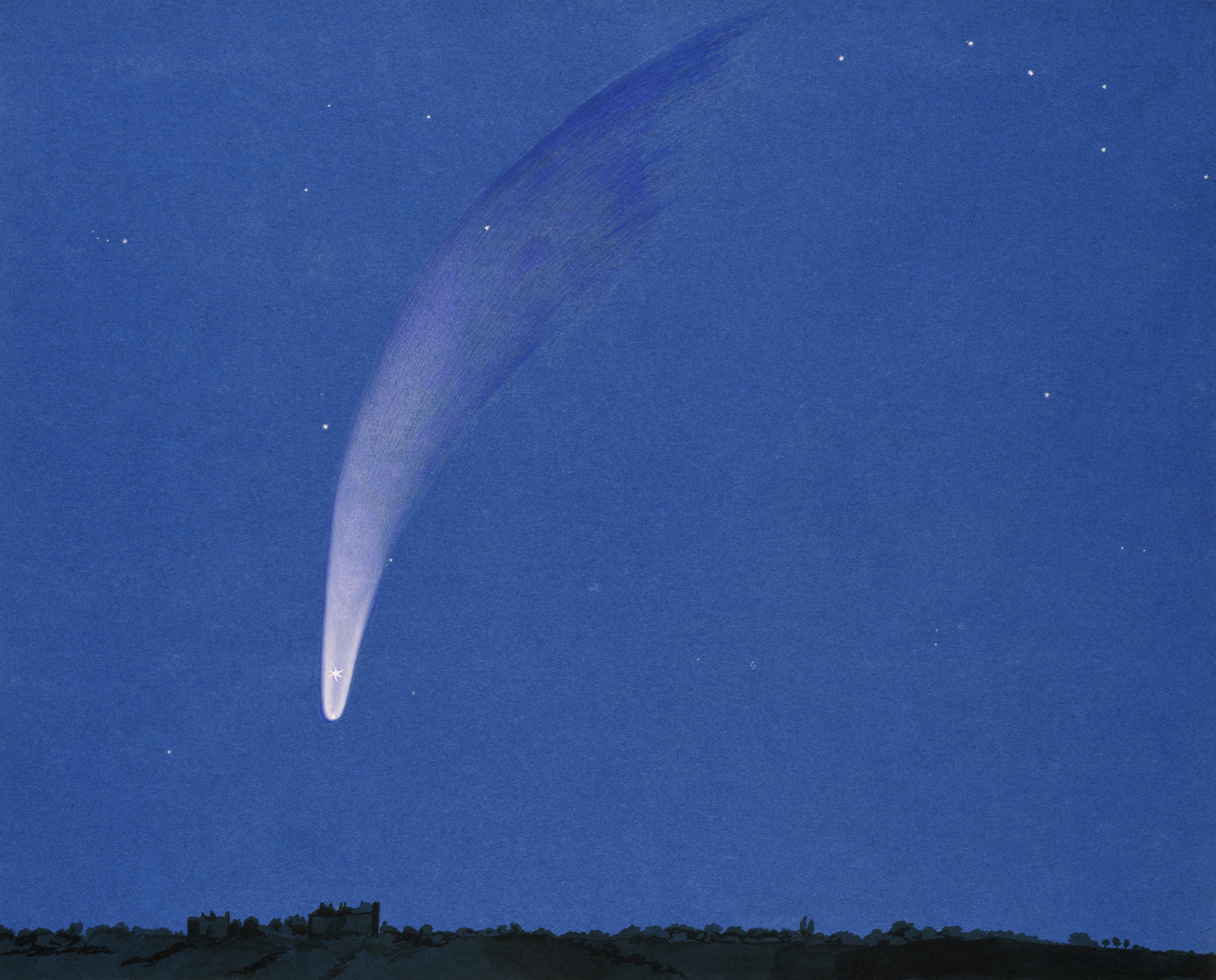
Astronomers can calculate the orbit of that thistle-down called the comet, now in the northwest sky, conveying its nucleus, which may not be so solid as a thistle’s seed, some whither, but what astronomer can calculate the orbit of my thistle-down and tell where it will deposit its precious freight at last? It may still be travelling when I am sleeping. 

Donati’s Comet 1858

Some Lobelia inflata leaves peculiar hoary-white.

September 29, 2018

H. D. Thoreau,  Journal, September 29, 1858

One or two myrtle-birds in their fall dress, with brown head and shoulders, two whitish bars on wings, and bright-yellow rump. See September 23, 1855 (“A little wren-like (or female goldfinch) bird on a.willow at Hubbard’s Causeway, eating a miller: with bright-yellow rump when wings open, and white on tail. Could it have been a yellow-rump warbler?”); October 14, 1855 ("Black bill and feet, yellow rump, brown above, yellowish-brown on head, cream-colored chin, two white bars on wings, tail black, edged with white, — the yellow-rump warbler or myrtle-bird without doubt.”)

Half a dozen F. hyemalis about. See  September 29, 1854 ("I hear a very pleasant and now unusual strain on the sunny side of an oak wood from many — I think F. hyemalis, though I do not get a clear view of them. Even their slight jingling strain is remarkable at this still season.") See also September 24, 1854 (" Do I see an F. hyemalis in the Deep Cut? It is a month earlier than last yea"); October 5, 1857 ("It is evident that some phenomena which belong only to spring and autumn here . . . the myrtle-bird and F. hyemalis which breed there, but only transiently visit us in spring and fall.") 

The year thus repeats itself. See May 5, 1860 ("It takes us many years to find out that Nature repeats herself annually”)

Brushed a spectrum, ghost-horse, off my face in a birch wood. See ;  August 29, 1858 (“The ghost-horse (Spectrum) is seen nowadays, — several of them.”)

Take perhaps our last bath in White Pond for the year. See September 27, 1856 ("Bathed at Hubbard's Bath, but found the water very cold. Bathing about over”) See also A Book of the Seasons, by Henry Thoreau, The Luxury of Bathing

The comet, now in the northwest sky. See September 23 , 1858 (Saw the comet very bright in the northwest. "); October 5, 1858 ("The comet makes a great show these nights.")

Thistle-down See September 1, 1852 ("These white faery vessels are annually wafted over the cope of their sky. Bethink thyself, O man, when the first thistle-down is in the air. Buoyantly it floated high in air over hills and fields all day, and now, weighed down with evening dews, perchance, it sinks gently to the surface of the lake. Nothing can stay the thistle-down, but with September winds it unfailingly sets sail. The irresistible revolution of time. It but comes down upon the sea in its ship, and is still perchance wafted to the shore with its delicate sails. The thistle-down is in the air. Tell me, is thy fruit also there? Dost thou approach maturity? ") See also A Book of the Seasons,  by Henry Thoreau, the Thistles

What astronomer
can calculate the orbit 
of my thistle-down?


A Book of the Seasons,  by Henry Thoreau
 "A book, each page written in its own season,
out-of-doors, in its own locality."
 ~edited, assembled and rewritten by zphx ©  2009-2025

tinyurl.com/HDT580929

Monday, May 2, 2016

The tea lee of the "yellow-rump warbler".


May 2.

The tea lee of the yellow-rump warbler in the street, at the end of a cool, rainy day.*

May 2, 2016

H. D. Thoreau, Journal, May 2, 1856

*In a footnote HDT later identified this "tea lee" bird as the white-throated  sparrow. 
According to Torrey, in May 1853 HDT confused the white-throated sparrow's "tull lull" song as that of the myrtle bird, and as late as "1857, the song of the white-throat is still attributed to the myrtle-bird." Not until January, 1858, did Thoreau get "what appears to be his first intimation as to the real authorship of this song."  See January 15, 1858 ("Dr. Kneeland . . . making the note of the myrtle-bird, ah, te-te-te te-te-te te-te-te, exactly . . . said that that was the note of the white throated sparrow"); June 21, 1858 ("Mr. Bryant at the Natural History Rooms agrees with Kneeland in thinking that what I call the myrtle-bird’s is the white-throat sparrow’s note.") See also September 20, 1853 ("I saw the Fringilla hyemalis; also a bird a little smaller  maybe, brownish and yellowish  with some white tail-feathers, which I think makes the tull-lull sound, hopping on the wood-pile. Is not this the myrtle-bird? Their note interested me because I formerly had many a chase in a spring morning in the direction of this sound, in vain, to identify the bird.");  October 28, 1853 ("The yellow-crowned warbler . . . my tull-lulls of the Moosehead Carry."); April 26, 1854 ("The woods are full of myrtle-birds this afternoon, more common and commonly heard than any, especially along the edge of woods on oaks, etc., — their note an oft-repeated fine jingle, a tea le, tea le, tea le."); April 19,1855 ("Hear the tull-lull of the white-throated sparrow in street”); May 4, 1855 (" Myrtle-birds numerous, and sing their tea lee, tea lee in morning");  May 6, 1855 (“Myrtle-birds very numerous just beyond Second Division. They sing like an instrument, teee teee te, t t t, t t t, on very various keys . . . Many white-throated sparrows there.”); May 5, 1857 ('Hear the tull-lull of a myrtle-bird (very commonly heard for three or four days after");  May 6, 1858 ("Heard a myrtle-bird's tull-lull yesterday, and that somebody else heard it four or five days ago."); May 3, 1859 ("Hear the te-e-e of a white-throat sparrow. "); May 6, 1859 ("Hear the tea-lee of the white-throat sparrow");  May 7, 1860 ("Hear the white throat sparrow’s peabody note in gardens.")

The yellow-rump warbler / myrtle-bird / yellow-crowned warbler, See April 11, 1853   ("At Natural History Rooms . . . The yellow-rump warbler (what is it in Nuttall?) is bluish-gray, with two white bars on wings, a bright yellow crown, side breasts, and rump. Female less distinct.");  October 28, 1853 ("Little sparrow-sized birds flitting about amid the dry corn stalks and the weeds, — one, quite slaty with black streaks and a bright-yellow crown and rump, which I think is the yellow-crowned warbler,"); April 23, 1854 ("The myrtle-bird, –yellow-rumped warbler . . . on the willows, alders, and the wall by Hubbard's Bridge, slate and white spotted with yellow. Its note is a fine, rapid, somewhat hissing or whistling se se se se se ser riddler se, somewhat like the common yellowbird's."); May 7, 1855 (" I believe the yellow-rumped warbler has a note somewhat like the tweezer's.");  September 23, 1855 (“A little . . . bird on a.willow at Hubbard’s Causeway, eating a miller: with bright-yellow rump when wings open, and white on tail. Could it have been a yellow-rump warbler?”); October 14, 1855 ("Black bill and feet, yellow rump, brown above, yellowish-brown on head, cream-colored chin, two white bars on wings, tail black, edged with white, — the yellow-rump warbler or myrtle-bird without doubt."); September 29, 1858 ("One or two myrtle-birds in their fall dress, with brown head and shoulders, two whitish bars on wings, and bright-yellow rump.") See also Thomas Nuttall, A Manual of the Ornithology of the United States and of Canada 31  (1832) ("Yellow-Crowned Warbler or Myrtle-Bird (Sylvia coronet)")


Wednesday, October 14, 2015

The yellow-rump warbler or myrtle-bird

October 14


Some sparrow-like birds with yellow on rump flitting about our wood-pile. One flies up against the house and alights on the window-sill within a foot of me inside. 

Black bill and feet, yellow rump, brown above, yellowish-brown on head, cream-colored chin, two white bars on wings, tail black, edged with white, — the yellow-rump warbler or myrtle-bird without doubt. 

They fly to several windows, though it is not cold. 

P. M. - Up Assabet. 

The muskrats eat a good many clams now and leave their pearly shells open on the shore. Sometimes I find a little one which they have brought ashore in the night but left entire and alive. The green-rayed ones, – are they not a peculiar light blue within? 

I still see the Emys insculpta coupled, the upper holding with its claws under the edge of the lower shell. 

H. D. Thoreau, Journal, October 14, 1855


The yellow-rump warbler or myrtle-bird. See October 3, 1859 ("I see on a wall a myrtle-bird in its October dress, looking very much like a small sparrow.");  October 5, 1857 ("The myrtle-bird  . . . only transiently visit us in spring and fall"): October 10, 1859 ("White-throated sparrows in yard and close up to house, together with myrtle-birds (which fly up against side of house and alight on window-sills)"); October 15, 1859 ("I think I see myrtle-birds on white birches, and that they are the birds I saw on them a week or two ago, — apparently, or probably, after the birch lice."); October 19, 1856 ("See quite a flock of myrtle-birds, — which I might carelessly have mistaken for slate-colored snowbirds, — flitting about on the rocky hillside under Conantum Cliff. They show about three white or light-colored spots when they fly, commonly no bright yellow, though some are pretty bright."); October 21, 1857 ("I see many myrtle-birds now about the house this forenoon, on the advent of cooler weather. They keep flying up against the house and the window and fluttering there, as if they would come in, or alight on the wood-pile or pump. They would commonly be mistaken for sparrows, but show more white when they fly, beside the yellow on the rump and sides of breast seen near to and two white bars on the wings."); October 28, 1853 ("Little sparrow-sized birds flitting about amid the dry corn stalks and the weeds, — one, quite slaty with black streaks and a bright-yellow crown and rump, which I think is the yellow-crowned warbler,")
 
The muskrats eat a good many clams now. See October 15, 1851 ("The muskrat-houses appear now for the most part to be finished.");  October 16, 1859 ("For thirty years I have annually observed, about this time or earlier, the freshly erected winter lodges of the musquash along the riverside"); October 25, 1855 (The muskrats must now prepare for winter in earnest. I see many places where they have left clamshells recently.); October 25, 1857 ("The fresh clamshells opened by the musquash begin to be conspicuous.");  November 11, 1855  ("The building of these cabins appears to be coincident with the commencement of their clam diet.") See also A Book of the Seasons, by Henry Thoreau, the Musquash

I still see the Emys insculpta coupled. See September 15, 1855 ("An Emys insculpta which I mistook for dead, under water near shore; head and legs and tail hanging down straight. Turned it over, and to my surprise found it coupled with another. It was at first difficult to separate them with a paddle."); See also October 21, 1857 ("I saw wood tortoises coupled up the Assabet, the back of the upper above water. It held the lower with its claws about the head, and they were not to be parted."); November 11, 1859 ("I observed, October 23d, wood turtles copulating in the Assabet.")A Book of the Seasons,  by Henry Thoreau The Wood Turtle (Emys insculpta) and A Year in the Life of a Wood Turtle ("In late November. . .you might expect Wood Turtles in Vermont to be hunkered down in their hibernacula. Instead, I spotted 15 Wood Turtles, most of which were active underwater, including two mating pairs.")

October 14.  See A Book of the Seasons,  by Henry Thoreau,  October 14

Yellow-rump warbler
on the window-sill within 
a foot of me inside. 


A Book of the Seasons,  by Henry Thoreau
"A book, each page written in its own season,
out-of-doors, in its own locality."
 ~edited, assembled and rewritten by zphx ©  2009-2025

https://tinyurl.com/hdt551014

Wednesday, September 23, 2015

A screech owl in moonlight/confusing fall warblers


September 23


Small sparrows, with yellow on one side above eye in front and white belly, erectile (?) crown divided by a light line. 

Those weeds, etc., on the bared meadow come up spontaneously. 

8 P. M. — I hear from my chamber a screech owl about Monroe’s house this bright moonlight night, — a loud, piercing scream, much like the whinny of a colt perchance, a rapid trill, then subdued or smothered a note or two. 

A little wren-like (or female goldfinch) bird on a willow at Hubbard’s Causeway, eating a miller: with bright-yellow rump when wings open, and white on tail. Could it have been a yellow-rump warbler?

H. D. Thoreau, Journal, September 23, 1855

I hear from my chamber a screech owl — a loud, piercing scream, much like the whinny of a colt. See   June 2, 1860 ("I soon hear its mournful scream. . . not loud now but, though within twenty or thirty rods, sounding a mile off.”); June 25, 1860 ("At evening up the Assabet hear four or five screech owls on different sides of the river, uttering those peculiar low screwing or working, ventriloquial sounds.”); August 14, 1854 (“I hear the tremulous squealing scream of a screech owl in the Holden Woods.”); October 9, 1851 ("Heard two screech owls in the night")

Popular Posts Last 30 Days.

The week ahead in Henry’s journal

The week ahead in Henry’s journal
A journal, a book that shall contain a record of all your joy.
"A stone fruit. Each one yields me a thought." ~ H. D. Thoreau, March 28, 1859


I sit on this rock
wrestling with the melody
that possesses me.