Showing posts with label fragrance. Show all posts

Monday, September 5, 2022

By moonlight in forests like this we listen to hear wolves howl to Cynthia.


By moonlight at Potter's Field toward Bear Garden Hill, 8 P. M. 

The whip-poor-wills sing . . . Moonlight on Fair Haven Pond seen from the Cliffs. A sheeny lake in the midst of a boundless forest, the windy surf sounding freshly and wildly in the single pine behind you; the silence of hushed wolves in the wilderness, and, as you fancy, moose looking off from the shore of the lake. 

September 5, 2019

The stars of poetry and history and unexplored nature looking down on the scene.  This is my world now, with a dull whitish mark curving north ward through the forest marking the outlet to the lake. 

Fair Haven by moonlight lies there like a lake in the Maine wilderness in the midst of a primitive forest untrodden by man. This light and this hour take the civilization all out of the landscape. 

Even in villages dogs bay the moon; in forests like this we listen to hear wolves howl to Cynthia.

Even at this hour in the evening the crickets chirp, the small birds peep, the wind roars in the wood, as if it were just before dawn. 
The moonlight seems to linger as if it were giving way to the light of coming day. 

The landscape seen from the slightest elevation by moonlight is seen remotely, and flattened, as it were, into mere light and shade, open field and forest, like the surface of the earth seen from the top of a mountain.


How much excited we are, how much recruited, by a great many particular fragrances! A field of ripening corn, now at night, that has been topped, with the stalks stacked up to dry, – an inexpressibly dry, rich, sweet ripening scent. I feel as if I were an ear of ripening corn myself. Is not the whole air then a compound of such odors undistinguishable? Drying corn-stalks in a field; what an herb-garden!


H. D. Thoreau, Journal, September 5, 1851

Moonlight on Fair Haven Pond seen from the Cliffs. A sheeny lake in the midst of a boundless forest. See June 14, 1851 ("The moon was now seen rising over Fair Haven and at the same time reflected in the river, pale and white like a silvery cloud,");September 4, 1854 ("To Fair Haven Pond by boat. Full moon; bats flying about; skaters and water bugs like sparks of fire on the surface between us and the moon.") See also A Book of the Seasons, by Henry Thoreau, September Moonlight

I feel as if I were an ear of ripening corn myself.
See July 12, 1851 ("The earliest corn is beginning to show its tassels now, and I scent it as I walk, — its peculiar dry scent."); September 2, 1851 ("A writer, a man writing, is the scribe of all nature; he is the corn and the grass and the atmosphere writing."); September 4, 1859 ("Topping the corn, which has been going on some days, now reveals the yellow and yellowing pumpkins. This is a genuine New England scene. The earth blazes not only with sun-flowers but with sun-fruits.") September 14, 1851 ("The corn-stalks standing in stacks, in long rows along the edges of the corn-fields."); October 6, 1858 ("The corn stands bleached and faded — quite white in the twilight")

Monday, June 14, 2021

An evening for poets to describe.


June 14.

Saturday.

Full moon last night.

Set out on a walk to Conantum at 7 P. M. A serene evening, the sun going down behind clouds, a few white or slightly shaded piles of clouds floating in the eastern sky, but a broad, clear, mellow cope left for the moon to rise into. An evening for poets to describe.

Met a man driving home his cow from pasture and stopping to chat with his neighbor; then a boy, who had set down his pail in the road to stone a bird most perseveringly, whom I heard afterward behind me telling his pail to be quiet in a tone of assumed anger, because it squeaked under his arm.

As I proceed along the back road I hear the lark still singing in the meadow, and the bobolink, and the gold robin on the elms, and the swallows twittering about the barns.

A small bird chasing a crow high in the air, who is going home at night.

All nature is in an expectant attitude.

Before Goodwin's house, at the opening of the Sudbury road, the swallows are diving at a tortoise-shell cat, who curvets and frisks rather awkwardly, as if she did not know whether to be scared or not.

And now, having proceeded a little way down this road, the sun having buried himself in the low cloud in the west and hung out his crimson curtains,  I hear, while sitting by the wall, the sound of the stake-driver at a distance, — like that made by a man pumping in a neighboring farmyard, watering his cattle, or like chopping wood before his door on a frosty morning, and I can imagine like driving a stake in a meadow.

The pumper.


I immediately went in search of the bird, but, after going a third of a mile, it did not sound much nearer, and the two parts of the sound did not appear to proceed from the same place.  What is the peculiarity of these sounds which penetrate so far on the keynote of nature? At last I got near to the brook in the meadow behind Hubbard's wood, but I could not tell if were further or nearer than that. When I got within half a dozen rods of the brook, it ceased, and I heard it no I suppose that I scared it.  As before I was further off than I thought, so now I was nearer than I thought.  It is not easy to understand how so small a creature can make so loud a sound by merely sucking in or throwing out water with pump-like lungs.

As yet no moon, but downy piles of cloud scattered here and there in the expectant sky.

Saw a blue flag blossom in the meadow while waiting for the stake-driver. 

It was a sound as of gulping water.

Where my path crosses the brook in the meadow there is a singularly sweet scent in the heavy air bathing the brakes, where the brakes grow, — the fragrance of the earth, as if the dew were a distillation of the fragrant essences of nature.

When I reach the road, the farmer going home from town invites me to ride in his high set wagon, not thinking why I walk, nor can I shortly explain. He remarks on the coolness of the weather.

The angelica is budded, a handsome luxuriant plant.

And now my senses are captivated again by a sweet fragrance as I enter the embowered willow causeway, and I know not if it be from a particular plant or all together, 
— sweet-scented vernal grass or sweet-briar.

Now the sun is fairly gone, I hear the dreaming frog, [toad?] and the whip-poor-will from some darker wood, — it is not far from eight,
— and the cuckoo. The song sparrows sing quite briskly among the willows, as if it were spring again, and the blackbird's harsher note resounds over the meadows, and the veery's comes up from the wood.

Fishes are dimpling the surface of the river, seizing the insects which alight.

A solitary fisherman in his boat inhabits the scene.

As I rose the hill beyond the bridge, I found myself in a cool, fragrant, dewy, up-country, mountain morning air, a new region. When I had issued from the willows on to the bridge, it was like coming out of night into twilight, the river reflected so much light.)

The moon was now seen rising over Fair Haven and at the same time reflected in the river, pale and white like a silvery cloud, barred with a cloud, not promising how it will shine anon.

Now I meet an acquaintance coming from a remote field in his hay-rigging, with a jag of wood; who reins up to show me how large a woodchuck he has killed, which he found eating his clover. But now he must drive on, for behind comes a boy taking up the whole road with a huge roller drawn by a horse, which goes lumbering and bouncing along, getting out of the way of night,
— while the sun has gone the other way, — and making such a noise as if it had the contents of a tinker's shop in its bowels, and rolls the whole road smooth like a newly sown grain-field.

In Conant's orchard I hear the faint cricket-like song of a sparrow saying its vespers, as if it were a link between the cricket and the bird. The robin sings now, though the moon shines silverly, and the veery jingles its trill.

I hear the fresh and refreshing sound of falling water, as I have heard it in New Hampshire. It is a sound we do not commonly hear.

I see that the whiteweed is in blossom, which, as I had not walked by day for some time, I had not seen before.

How moderate, deliberate, is Nature!
How gradually the shades of night gather and deepen, giving man ample leisure to bid farewell to-day, conclude his day's affairs, and prepare for slumber!

The twilight seems out of proportion to the length of the day. Perchance it saves our eyes.

Now for some hours the farmers have been getting home. Since the alarm about mad dogs a couple of years ago there are comparatively few left to bark at the traveller and bay the moon. All nature is abandoned to me.

You feel yourself — your body, your legs, — more at night, for there is less beside to be distinctly known, and hence perhaps you think yourself more tired than you are.

I see indistinctly oxen asleep in the fields, silent in majestic slumber, like the sphinx, — statuesque, Egyptian, reclining. What solid rest! How their heads are supported! 

A sparrow or a cricket makes more noise.

From Conant's summit I hear as many as fifteen whip poor-wills — or whip-or-I-wills — at once, the succeeding cluck sounding strangely foreign, like a hewer at work elsewhere.

The moon is accumulating yellow light and triumphing over the clouds, but still the west is suffused here and there with a slight red tinge, marking the path of the day. Though inexperienced ones might call it night, it is not yet.

Dark, heavy clouds lie along the western horizon, exhibiting the forms of animals and men, while the moon is behind a cloud. Why do we detect these forms so readily? — whales or giants reclining, busts of heroes, Michael-Angelic.

There is the gallery of statuary, the picture gallery of man, — not a board upon an Italian's head, but these dark figures along the horizon, the board some Titan carries on his head. What firm and heavy outlines for such soft and light material!

How sweet and encouraging it is to hear the sound of some artificial music from the midst of woods or from the top of a hill at night, borne on the breeze from some distant farmhouse, — the human voice or a flute! That is a civilization one can endure, worth having. I could go about the world listening for the strains of music: Men use this gift but sparingly, methinks.

What should we think of a bird which had the gift of song but used it only once in a dozen years, like the tree which blossoms only once in a century?

Now the dorbug comes humming by, the first I have heard this year.

In three months it will be the Harvest Moon. I cannot easily believe it. Why not call this the Traveller's Moon?  It would be as true to call the last (the May) the Planter's Moon as it is to call September's the Harvest Moon, for the farmers use one about as little as the other.

Perhaps this is the Whip-poor-will's Moon.

The bullfrog now, which I have not heard before, this evening.

It is nearly nine.

They are much less common and their note more intermittent than that of the dreamers.

I scared up a bird on a low bush, perchance on its nest. It is rare that you start them at night from such places.

Peabody says that the nighthawk retires to rest about the time the whip-poor-will begins its song. The whip poor-will begins now at 7.30. I hear the nighthawk after 9 o'clock.

He says it flies low in the evening, but it also flies high, as it must needs do to make the booming sound.

I hear the lowing of cows occasionally, and the barking of dogs.

The pond by moonlight, which may make the object in a walk, suggests little to be said.

Where there was only one firefly in a dozen rods, I hastily ran to one which had crawled up to the top of a grass head and exhibited its light, and instantly another sailed in to it, showing its light also; but my presence made them extinguish their lights. The latter retreated, and the former crawled slowly down the stem.

It appeared to me that the first was a female who thus revealed her place to the male, who was also making known his neighborhood as he hovered about, both showing their lights that they might come together.  It was like a mistress who had climbed to the turrets of her castle and exhibited there a blazing taper for a signal, while her lover had displayed his light on the plain. If perchance she might have any lovers abroad.

Not much before 10 o'clock does the moonlight night begin.

When man is asleep and day fairly forgotten, then is the beauty of moonlight seen over lonely pastures where cattle are silently feeding.

Then let me walk in a diversified country, of hill and dale, with heavy woods one side, and copses and scattered trees and bushes enough to give me shadows.

Returning, a mist is on the river. The river is taken into the womb of Nature again.

Now is the clover month, but haying is not yet begun.


Evening. — Went to Nawshawtuct by North Branch. 

Overtaken by a slight shower. The same increased fragrance from the ground-sweet-fern, etc.-as in the night, and for the like reason probably.

The houstonias still blossom freshly, as I believe they continue to do all summer.

The fever-root in blossom; pictured in Bigelow's “Medical Botany."

Triosteum perfoliatum
, near the top of Hill, under the wall, looks somewhat like a milkweed.

The Viburnum dentatum, very regularly toothed, just ready to blossom; sometimes called arrow-wood.

Nature seems not [to] have designed that man should be much abroad by night, and in the moon proportioned the light fitly. By the faintness and rareness of the light compared with that of the sun, she expresses her intention with regard to him.


H. D. Thoreau, Journal, June 14, 1851

I hear, while sitting by the wall, the sound of the stake-driver at a distance,. . . .  The pumper. See April 24, 1854 ("I hear the loud and distinct pump-a-gor of a stake-driver. Thus he announces himself.”); May 9, 1853 ("The pump-like note of a stake-driver from the fenny place across the Lee meadow."); May 20, 1856 ("See and hear a stake-driver in the swamp. It took one short pull at its pump and stopped."); October 26, 1858 ("[Minott] says that some call the stake-driver “'belcher squelcher,” and some, “wollerkertoot. ” I used to call them “pump-er-gor’. ” Some say “slug-toot.”)


And now my senses are captivated again by a sweet fragrance as I enter the embowered willow causeway, and I know not if it be from a particular plant or all together. See June 20, 1853 ("Walking amid the bushes and the ferns just after moonrise, I am refreshed with many sweet scents which I cannot trace to their source.")

Fishes are dimpling the surface of the river, seizing the insects which alight. See June 9, 1854 ("The fishes continue to leap by moonlight. A full moon."); June 2, 1860 ("Water-bugs dimple the surface now quite across the river, in the moonlight, for it is a full moon.")

As yet no moon, but downy piles of cloud scattered here and there in the expectant sky. See Basho: 

how many rising clouds
collapse and fall on
this moonlit mountain


The moon was now seen rising and at the same time reflected in the river, pale and white like a silvery cloud. See June 30, 1852 ("Moon nearly full; rose a little before sunset. . . . At first a mere white cloud,"); April 30, 1852 ("Then when I turned, I saw in the east, just over the woods, the modest, pale, cloud-like moon, two thirds full, looking spirit-like on these daylight scenes.")  See also May 28, 1853 ("Last night in the dark [the lupines]were all a pale, whitish color like the moon by day — a mere dull luminousness, as if they reflected light absorbed by day. ")

The moon is accumulating yellow light and triumphing over the clouds. See June 1, 1852 ("You can never foretell the fate of the moon, -- whether she will prevail over or be obscured by the clouds half an hour hence. The traveller's sympathy with the moon makes the drama of the shifting clouds interesting.")

And now my senses 
are captivated again 
by a sweet fragrance.

How gradually
the shades of night deepen to
bid farewell to-day.

As yet no moon but
downy piles of scattered cloud
in expectant sky.

The moon reflected
in the river, pale and white,
a silvery cloud.


Saturday, June 6, 2020

Gathered last night the strong, rank, penetrating-scented angelica.


June 6. 

Friday. 

Gathered last night the strong, rank, penetrating-scented angelica. 

Under the head of the Cicuta maculata, or American hemlock, — “It is a rule sanctioned by the observations of medical botanists , that umbelliferous plants, which grow in or about the water, are of a poisonous nature.” He [Bigelow] does not say that the angelica is poisonous, but I suppose that it is. 

It has such a rank, offensive, and killing odor as makes me think of the ingredients of the witches' cauldron. It did not leave my hands, which had carried it, long after I had washed them. A strong, penetrating, lasting, and sickening odor. 

Gathered to-night the Cicuta maculata, American hemlock, the veins of the leaflets ending in the notches and the root fasciculated.

Bigelow says, “The leaves of the Solidago odora have a delightfully fragrant odor, partaking of that of anise and sassafras, but different from either.”

H. D. Thoreau, Journal, June 6, 1851

Gathered last night the strong, rank, penetrating-scented angelica. See July 16, 1851 ("The angelica,with its large umbels, is gone to seed.")

Gathered to-night the Cicuta maculata. See August 30, 1857 ("The flower of Cicuta maculata smells like the leaves of the golden senecio..")

Friday, June 5, 2020

The summer is begun sweet and spicy to the smell.

June 5

To-night, June 5th, after a hot day, I hear the first peculiar summer breathing of the frogs.

Yesterday, when I walked to Goodman's Hill, it seemed to me that the atmosphere was never so full of fragrance and spicy odors. There is a great variety in the fragrance of the apple blossoms as well as their tints. Some are quite spicy. The air seemed filled with the odor of ripe strawberries, though it is quite too early for them. The earth was not only fragrant but sweet and spicy to the smell, reminding us of Arabian gales and what mariners tell of the spice islands. 
Silene caroliniana, (wild pink)
The first of June, when the lady’s-slipper and the wild pink have come out in sunny places on the hillsides, then the summer is begun according to the clock of the seasons.

H. D. Thoreau, Journal, June 5, 1850

Yesterday, when I walked to Goodman's Hill.
 See June 3, 1850 ("I visited this afternoon (June 3d) Goodman's Hill in Sudbury, going through Lincoln over Sherman's Bridge and Round Hill, and returning through the Corner. It probably affords the best view of Concord River meadows of any hill")

 The earth was not only fragrant but sweet and spicy to the smell. See June 5, 1853 ("The world now full of verdure and fragrance and the air comparatively clear . . . through which the distant fields are seen, reddened with sorrel, and the meadows wet green.")

When the lady’s-slipper and the wild pink have come out in sunny places on the hillsides, then the summer is begun according to the clock of the seasons. See  June 5, 1856 ("Everywhere now in dry pitch pine woods stand the red lady’s-slippers over the red pine leaves on the forest floor, rejoicing in June, with their two broad curving green leaves."); April 25, 1859 ("This is the beginning of that season which, methinks, culminates with the buttercup and wild pink and Viola pedata")

Friday, May 17, 2019

I was surprised, on turning round, to behold the serene and everlasting beauty of the world

 May 17. 
May 17, 2019

5 a. m. — To Island by boat.

 Everything has sensibly advanced during the warm and moist night. Some trees, as the small maples in the street, already look verdurous. The air has not sensibly cooled much. The chimney swallows are busily skimming low over the river and just touching the water without regard to me, as a week ago they did, and as they circle back overhead to repeat the experiment, I hear a sharp snap or short rustling of their wings. 

The button-bush now shows the first signs of life, on a close inspection, in its small round, smooth, greenish buds. 

The polygonums and pontederias are getting above water, the latter like spoons on long handles. 

The Cornus florida is blossoming; will be fairly out to-day.1 

The Polygonatum pubescens; one on the Island has just opened. This is the smaller Solomon's-seal.

 A thorn there will blossom to-day. 

The Viola palmata is out there, in the meadow. 

Everywhere the huckleberry's sticky leaves are seen expanding, and the high blueberry is in blossom. Now is the time to ad mire the very young and tender leaves. The blossoms of the red oak hang down under its young leaves as under a canopy. 

The petals have already fallen from the Amelanchier Botryapium, and young berries are plainly forming. 

I hear the wood pewee, — pe-a-wai. The heat of yesterday has brought him on. 

P. M. — To Corner Spring and Fair Haven Cliffs. 

Myosotis laxa is out a day or two. At first does not run; is short and upright like M. stricta.

 Golden senecio will be out by to-morrow at least.

 The early cinquefoil is now in its prime and spots the banks and hillsides and dry meadows with its dazzling yellow. How lively! It is one of the most interesting yellow flowers. 

The fields are also now whitened, perhaps as much as ever, with the houstonia. 

The buck-bean is out, apparently to-day, the singularly fuzzy- looking blossom. How inconspicuous its leaves now!

 The rhodora is peculiar for being, like the peach, a profusion of pink blossoms on a leafless stem. This shrub is, then, a late one to leaf out. 

The bobolink skims by before the wind how far without motion of his wings! sometimes borne sidewise as he turns his head — for thus he can fly — and tinkling, linking, incessantly all the way. 

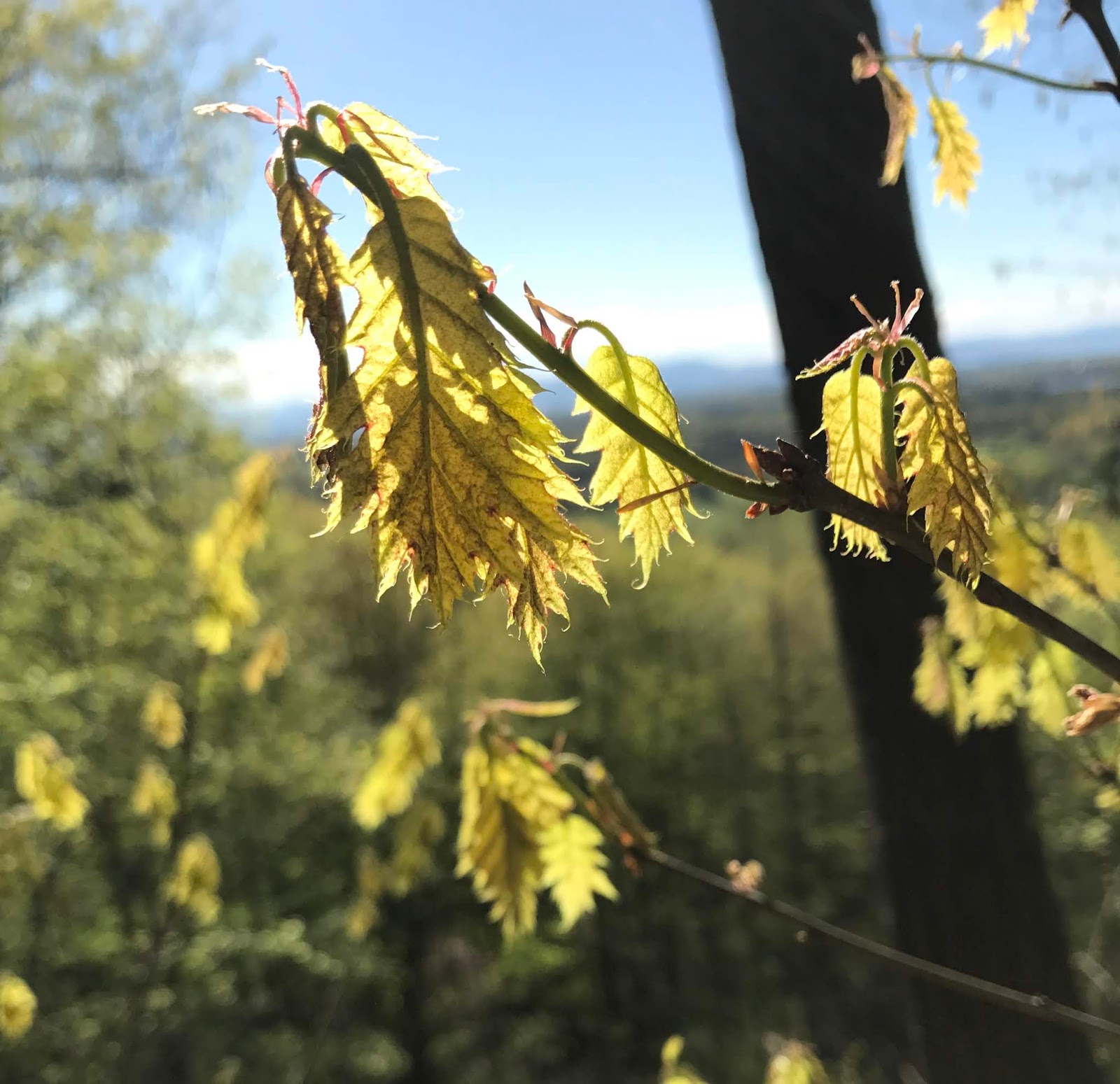
How very beautiful, like the fairest flowers, the young black oak shoots with leaves an inch long now! like red velvet on one side and downy white on the other, with only a red edge. Compare this with the pinker white oak. 

The Salix nigra just in bloom.

May 19, 2023
 The trientalis, properly called star-flower, is a white star, single, double, or treble. 

The fringed polygala surprises us in meadows or in low woods as a rarer, richer, and more delicate color, with a singularly tender or delicate-looking leaf. 

As you approach midsummer, the color of flowers is more intense and fiery. The reddest flower is the flower especially. Our blood is not white, nor is it yellow, nor even blue. 

The nodding trillium has apparently been out a day or two. Methinks it smells like the lady's-slipper.

Also the Ranunculus recurvatus for a day or two. The small two or three leaved Solomon's- seal is just out.

 The Viola cucullata is sometimes eight inches high, and leaves in proportion. It must be the largest of the violets except perhaps the yellow. 

The V. blanda is almost entirely out of bloom at the spring. 

Returning toward Fair Haven, I perceive at Potter's fence the first whiff of that ineffable fragrance from the Wheeler meadow, — as it were the promise of strawberries, pineapples, etc., in the aroma of their flowers, so blandly sweet, — aroma that fitly fore runs the summer and the autumn's most delicious fruits. It would certainly restore all such sick as could be conscious of it. The odors of no garden are to be named with it. It is wafted from the garden of gardens. It appears to blow from the river meadow from the west or southwest, here about forty rods wide or more. If the air here always possessed this bland sweetness, this spot would become famous and be visited by sick and well from all parts of the earth. It would be carried off in bottles and become an article of traffic which kings would strive to monopolize. The air of Elysium cannot be more sweet. 

Cardamine hirsuta out some time by the ivy tree.

The Viola lanceolata seems to pass into the cucullata insensibly, but can that small round-leaved white violet now so abundantly in blossom in open low ground be the same with that large round-leaved one now about out of blossom in shady low ground ? *

Arabis rhomboidea just out by the willow on the Corner causeway. 

The Ranunculus repens perhaps yesterday, with its spotted leaves and its not recurved calyx though furrowed stem. Was that a very large Veronica serpyllifolia by the Corner Spring? Who shall keep with the lupines? They will apparently blossom within a week under Fair Haven. 

The Viola sagittata, of which Viola ovata is made a variety, is now very marked there. 

The V. pedata there presents the greatest array of blue of any flower as yet. The flowers are so raised above their leaves, and so close together, that they make a more indelible impression of blue on the eye; it is almost dazzling. I blink as I look at them, they seem to reflect the blue rays so forcibly, with a slight tinge of lilac. To be sure, there is no telling what the redder ovata might not do if they grew as densely, so many eyes or scales of blue side by side, forming small shields of that color four or five inches in diameter. The effect and intensity is very much increased by the numbers. 

I hear the first unquestionable nighthawk squeak and see him circling far off high above the earth. It is now about 5 o'clock p. m. 

The tree-toads are heard in the rather moist atmosphere, as if presaging rain. 

I hear the dumping sound of bull(?)frogs, telling the weather is warm. The paddocks, as if too lazy to be disturbed, say now to the intruder, " don't, don't, don't, don't ; " also in the morning after the first sultry night. 

The chinquapin oak may be said to flower and leave out at the same time with the ilicifolia. It is distinguished as well by its yellow catkins as by its leaves. 

Pyrus arbutifolia is out, to-day or yesterday. 

A Crataegus just out.

I sit now on a rock on the west slope of Fair Haven orchard, an hour before sunset, this warm, almost sultry evening, the air filled with the sweetness of apple blossoms (this is blossom week) , — or I think it is mainly that meadow fragrance still, — the sun partly concealed behind a low cloud in the west, the air cleared by last evening's thunder-shower, the river now beautifully smooth (though a warm, bland breeze blows up here), full of light and reflecting the placid western sky and the dark woods which overhang it. 

I was surprised, on turning round, to behold the serene and everlasting beauty of the world, it was so soothing. I saw that I could not go home to supper and lose it. It was so much fairer, serener, more beautiful, than my mood had been. 

The fields beyond the river have unexpectedly a smooth, lawn-like beauty, and in beautiful curves sweep round the edge of the woods. The rapidly expanding foliage of the deciduous (last evening's rain or moisture has started them) lights up with a lively yellow green the dark pines which we have so long been used to. Some patches (I speak of woods half a mile or more off) are a lively green, some gray or reddish-gray still, where white oaks stand. 

With the stillness of the air comes the stillness of the water. 

The sweetest singers among the birds are heard more distinctly now, as the reflections are seen more distinctly in the water, — the veery constantly now. 

Methinks this serene, ambrosial beauty could hardly have been but for last evening's thunder-shower, which, to be sure, barely touched us, but cleared the air and gave a start to vegetation. 

The elm on the opposite side of the river has now a thin but dark verdure, almost as dark as the pines, while, as I have said, the prevailing color of the deciduous woods is a light yellowish and sunny green. 

The woods rarely if ever present a more beautiful aspect from afar than now. 

Methinks the black oak at early leafing is more red than the red oak. 

Ah, the beauty of this last hour of the day — when a power stills the air and smooths all waters and all minds — that partakes of the light of the day and the stillness of the night ! 

Sit on Cliffs. 

The Shrub Oak Plain, where are so many young white oaks, is now a faint rose-color, almost like a distant peach orchard in bloom and seen against sere red ground. What might at first be taken for the color of some sere leaves and bare twigs still left, its tender red expanding leaves. 

You might say of the white oaks and of many black oaks at least, "When the oaks are in the red." 

The perfect smoothness of Fair Haven Pond, full of light and reflecting the wood so distinctly, while still occasionally the sun shines warm and brightly from behind a cloud, giving the completest contrast of sunshine and shade, is enough to make this hour memorable. 

The red pin cushion gall is already formed on the new black oak leaves, with little grubs in them, and the leaves, scarcely more than two inches long, are already attacked by other foes. 

Looking down from these rocks, the black oak has a very light hoary or faint silvery color; the white oak, though much less advanced, has a yet more hoary color; but the red oaks (as well as the hickories) have a lively, glossy aspen green, a shade lighter than the birch now, and their long yellowish catkins appear further advanced than the black. 

Some black as well as white oaks are reddish still. 

The new shoots now color the whole of the juniper (creeping) with a light yellow tinge. It appears to be just in blossom,1 and those little green berries must be already a year old; and, as it is called dioecious, these must be the fertile blossoms. 

This must be Krigia Virginica now budded, close by the juniper,  and will blossom in a day or two.

The low black berry, apparently, on Cliffs is out, earlier than else where, and Veronica arvensis (?), very small, obscure pale-blue flower, and, to my surprise, Linaria Canadensis. 

Returning slowly, I sit on the wall of the orchard by the white pine. 

Now the cows begin to low, and the river reflects the golden light of the sun just before his setting. The sough of the wind in the pines is more noticeable, as if the air were otherwise more still and hollow. 

The wood thrush has sung for some time. He touches a depth in me which no other bird's song does. He has learned to sing, and no thrumming of the strings or tuning disturbs you. Other birds may whistle pretty well, but he is the master of a finer-toned instrument. His song is musical, not from association merely, not from variety, but the character of its tone. It is all divine, — a Shakespeare among birds, and a Homer too. 

This sweetness of the air, does it not always first succeed a thunder-storm? Is it not a general sweetness, and not to be referred to a particular plant? 

He who cuts down woods beyond a certain limit exterminates birds. 

How red are the scales of some hickory buds, now turned back! 

The fragrance of the apple blossom reminds me of a pure and innocent and unsophisticated country girl bedecked for church.

The purple sunset is reflected from the surface of the river, as if its surface were tinged with lake. 

Here is a field sparrow that varies his strain very sweetly.

Coming home from Spring by Potter's Path to the Corner road in the dusk, saw a dead-leaf-colored hylodes; detected it by its expanding and relapsing bubble, nearly twice as big as its head, as it sat on an alder twig six inches from ground and one rod from a pool. 

The beach plum is out to-day.

The whip-poor- will sings. Large insects now fly at night. This is a somewhat sultry night. We must begin now to look out for insects about the candles.

The lilac out. 

Genius rises above nature; in spite of heat, in spite of cold, works and lives.


H. D. Thoreau, Journal , May 17, 1853

The Polygonatum pubescens; one on the Island has just opened. This is the smaller Solomon's-seal. See  May 12, 1858 ("The Polygonatum pubescens is strongly budded."); May 22, 1856 ("Polygonatum pubescens at rock.") See also A Book of the Seasons,  by Henry Thoreau, Solomon's Seal

That ineffable fragrance from the Wheeler meadow, — as it were the promise of strawberries, pineapples, etc., in the aroma of their flowers. See May 16, 1852 (“The whole earth is fragrant as a bouquet held to your nose. A fine, delicious fragrance, which will come to the senses only when it will.”); May 16, 1854 ("The earth is all fragrant as one flower. . . .. Nature now is perfectly genial to man.”); May 6, 1855 ("that unaccountable fugacious fragrance, as of all flowers”)

The air filled with the sweetness of apple blossoms (this is blossom week).
Compare May 27, 1857 ("This is blossom week, beginning last Sunday (the 24th).") and note to May 25, 1852 (It is blossom week with the apples.”).

I was surprised, on turning round, to behold the serene and everlasting beauty of the world. See May 1850 ("I still sit on its Cliff in a new spring day, and look over the awakening woods and the river, and hear the new birds sing, with the same delight as ever. It is as sweet a mystery to me as ever, what this world is. . . ."); May 5, 1852 ("Every part of the world is beautiful today.."). May 16, 1854 (" It is a splendid day, so clear and bright and fresh; the warmth of the air and the bright tender verdure putting forth on all sides make an impression of luxuriance and genialness, so perfectly fresh");  May 17, 1852 ("Now the sun has come out after the May storm, how bright, how full of freshness and tender promise and fragrance is the new world!"): May 18, 1852 ("The world can never be more beautiful than now.”); May 22, 1854 ("How many times I have been surprised  thus, on turning about on this very spot, at the fairness of the earth!”); October 7, 1857 ("When I turn round half-way up Fair Haven Hill, by the orchard wall, and look northwest, I am surprised for the thousandth time at the beauty of the landscape.”); March 18, 1858 ("When I get two thirds up the hill, I look round and am for the hundredth time surprised by the landscape of the river valley and the horizon with its distant blue scalloped rim.") See also August 6, 1852 ("All men beholding a rainbow begin to understand the significance of the Greek name for the world,- Kosmos, or beauty. We live, as it were, within the calyx of a flower.");  December 11, 1855 ("We get only transient and partial glimpses of the beauty of the world."); October 4, 1859 ("In what book is this world and its beauty described?”)

I hear the first unquestionable nighthawk squeak and see him circling far off high above the earth.. See May 17, 1860 (" A nighthawk with its distinct white spots ") See also   April 1, 1853 ("Hear what I should not hesitate to call the squeak of the nighthawk , - only Wilson makes them arrive early in May"); April 19, 1853 ("Hear again that same nighthawk-like sound over a meadow at evening. "); May 5, 1852 ("No nighthawks heard yet.");  May 9, 1853 ("Now at starlight that same nighthawk or snipe squeak is heard but no hovering.");   May 16, 1859 ("At eve the first spark of a nighthawk. ");. May 25, 1852 (" First nighthawks squeak and boom") and also see  A Book of Seasons,  by Henry Thoreau,, the Nighthawk

This sweetness of the air, does it not always first succeed a thunder-storm? See May 17, 1852 (" After a storm at this season, the sun comes out and lights up the tender expanding leaves, and all nature is full of light and fragrance, and the birds sing without ceasing, and the earth is a fairyland . . . how bright, how full of freshness and tender promise and fragrance is the new world! ") ; May 11, 1854 (" I suspect that summer weather may be always ushered in in a similar manner, — thunder-shower, rainbow, smooth water, and warm night.")

Surprised to behold 
the serene and everlasting 
beauty of the world.


Saturday, May 11, 2019

Youn fresh-expanding, oak leaves form a leafy mist throughout the forest.

May 11. 

Wednesday. 

Golden robin yesterday.

Fir-balsam well out in the rain; so say 9th. 

P. M. — To Flint's Pond. 

Arum triphyllum out. Almost every one has a little fly or two concealed within. One of the handsomest- formed plants when in flower. 

Sorrel out in rain, apparently a day or two, — say 9th. 

A blue heron flies away from the shore of the pond. 

Scirpus planifolius in bloom on Smith's wooded hill, side of Saw Mill Brook. 

A partridge-nest, with eleven fresh eggs, at foot of a chestnut, one upon another. It is quite a deep cavity amid the leaves, with some feathers of the bird in it.

Young, or fresh-expanding, oak leaves are very handsome now, showing their colors. It is a leafy mist throughout the forest. 


May 12, 2017
Uvularia perfoliata out in rain; say, then, the 9th. Just after plucking it I perceived what I call the meadow fragrance, though in the woods; but I afterward found that this flower was peculiarly fragrant, and its fragrance like that, so it was probably this which I had perceived. S. was reminded of the lily-of-the-valley by it. 

The witch-hazel has one of the broadest leaves now.

In the path in Stow's wood-lot, I find apparently Thaspium aureum (Zizia aurea), which will open the first fair day. Shows quite yellow now. 

Found in the path in the woods by the Mill Brook ditch, Flint's Pond, dead, the Coluber punctatus, 13 1/4 inches long, but no row of spots in middle of abdomen. The head above blackish with a blackish ring behind the yellow. Tail 3 inches long; breadth of body 5/16 ; plates 162; scales 55. Above, uniform glossy slate-color, with a yellowish-white band across the occiput; the head above blackish, and a blackish band close behind the yellowish one. Beneath, yellow or buff (whitish under head), with a row of small slanting black spots, one on each side of each abdominal plate except the first 3/4 inch behind the head. In the midst of the path in the woods. I admired the iridescence from its glossy belly. It differs from Storer's C. punctatus, for it is not brown above, nor "reddish yellow" beneath, and has no row of spots in middle of the abdomen. 

In that first thunder-shower, the evening of the 9th, the grass evidently erected itself and grew darker, as  it were instantaneously. Was it the effect of electricity in the air? It looked very differently from what it had ten minutes before.

H. D. Thoreau, Journal, May 11, 1859

Golden robin yesterday. See. May 10, 1853 (“Hear higher the clear whistle of the oriole. New days, then, have come, ushered in by the warbling vireo, yellowbird, Maryland yellow-throat, and small pewee, and now made perfect by the twittering of the kingbird and the whistle of the oriole amid the elms, which are but just beginning to leaf out, thinking of his nest there, -. . .The warbling vireo promised warmer days, but the oriole ushers in summer heats.”); May 10, 1858 ("The oriole is seen darting like a bright flash with clear whistle from one tree-top to another over the street.”)

Arum triphyllum out. See May 1, 1857 ("Plucked the Arum triphyllum, three inches high, with its acrid corm.”);  May 19, 1851 ("Find the Arum triphyllum . .   in Conant's Swamp.")

Young, or fresh-expanding, oak leaves are very handsome now, showing their colors. It is a leafy mist throughout the forest.  See May 15, 1854 ("The aspect of oak and other woods at a distance is somewhat like that of a very thick and reddish or yellowish mist about the evergreens. . . . Oak leaves are as big as a mouse's ear.”); May 15, 1860 ("Looking from the Cliffs through the haze, the deciduous trees are a mist of leaflets.”);  May 18, 1851 ("The oak leaves of all colors are just expanding, and are more beautiful than most flowers"); May 23, 1860 ("The quarter-grown red oak leaves between you and the sun, how yellow-green! "); May 26, 1857 ("Very interesting now are the red tents of expanding- oak leaves, as you go through sprout-lands, — the crimson velvet of the black oak and the more pinkish white oak. The salmon and pinkish-red canopies or umbrellas of the white oak")

Uvularia perfoliata out in rain; say, then, the 9th. See September 22, 1852 ("Sophia has in her herbarium and has found in Concord these which I have not seen this summer ...Uvularia perfoliata”);  May 30, 1857 ("By the path near the northeast shore of Flint's Pond, just before reaching the wall by the brook, I . . .am surprised to find ... the Uvularia perfoliata, which I have not found hereabouts before.  . . . It is considerably past its prime”); May 3, 1858 ("Ride to Flint's Pond to look for Uvularia perfoliata. ... It apparently will not bloom within ten days”); May 16, 1858 (“The Uvularia perfoliata, which did not show itself at all on the 3d, is now conspicuous, and one is open but will not shed pollen before to-morrow. It has shot up about ten inches in one case and bloomed within thirteen days!!”)

Just after plucking it I perceived what I call the meadow fragrance,  but I afterward found that this flower was peculiarly fragrant. See May 6, 1855 ("that unaccountable fugacious fragrance, as of all flowers,”);  May 15, 1856 ("Perceive some of that delicious meadow fragrance coming over the railroad causeway”); May 27, 1855 ("The meadow fragrance to-day”); May 27, 1856 ("perceived the meadow fragrance”); May 27, 1857 ("I perceived that rare meadow fragrance on the 25th.”); June 3, 1860 ("I perceive the meadow fragrance.”)

The Coluber punctatus [ringneck snake],  uniform glossy slate-color above, with a yellowish-white band across the occiput; the head above blackish, and a blackish band close behind the yellowish one. Beneath, yellow or buff (whitish under head), with a row of small slanting black spots. Nnot brown above, nor "reddish yellow" beneath,. Compare and see note to May 1, 1859 (“a little snake . . . uniformly brown (or reddish-brown) above except a yellowish ring on the occiput, the head also lighter than the body; beneath vermilion, with apparently a row of light dots along each side.”)

Saturday, August 11, 2018

I smell the fragrant everlasting concealed in the higher grass and weeds, some distance off.

August 11

P. M. — To Beck Stow’s. 

I see of late a good many young sparrows (and old) of different species flitting about. That blackberry-field of Gowing’s in the Great Fields, this side of his swamp, is a famous place for them. I see a dozen or more, old and young, perched on the wall. As I walk along, they fly up from the grass and alight on the wall, where they sit on the alert with outstretched necks. 

Nearest and unalarmed sit the huckleberry-birds; next, quite on the alert, the bay-wings, with which and further off the yellow-browed sparrows, of whom one at least has a clear yellowish breast; add to which that I heard there abouts the seringo note. If made by this particular bird, I should infer it was Fringilla passerina. I still hear there at intervals the bay-wing, huckleberry-bird, and seringo. 

Now is our rainy season. It has rained half the days for ten days past. Instead of dog-day clouds and mists, we have a rainy season. You must walk armed with an umbrella. It is wettest in the woods, where the air has had no chance to dry the bushes at all. 

The Myriophyllum ambiguum, apparently variety natans, is now apparently in its prime. Some buds have gone to seed; others are not yet open. It is floating all over the surface of the pool, by the road, at the swamp, — long utricularia-like masses without the bladders. The emersed part, of linear or pectinate leaves, rises only about half an inch; the rest, eighteen inches more or less in length, consists of an abundance of capillary pinnate leaves, covered with slime or conserve (?) as a web. Evidently the same plant, next the shore and creeping over the mud, only two or three inches long, is without the capillary leaves, having roots instead, and apparently is the variety limosum (?), I suspect erroneously so called. 

Heard a fine, sprightly, richly warbled strain from a bird perched on the top of a bean-pole. It was at the same time novel yet familiar to me. I soon recognized it for the strain of the purple finch, which I have not heard lately. But though it appeared as large, it seemed a different-colored bird. With my glass, four rods off, I saw it to be a goldfinch. It kept repeating this warble of the purple finch for several minutes. A very surprising note to be heard now, when birds generally are so silent. Have not heard the purple finch of late. 

I conclude that the goldfinch is a very fine and powerful singer, and the most successful and remarkable mocking-bird that we have. In the spring I heard it imitate the thrasher exactly, before that bird had arrived, and now it imitates the purple finch as perfectly, after the latter bird has ceased to sing! It is a surprising vocalist. It did not cease singing till I disturbed it by my nearer approach, and then it went off with its usual mew, succeeded by its watery twitter in its ricochet flight. Have they not been more common all summer than formerly?

I go along plum path behind Adolphus Clark’s. This is a peculiar locality for plants. The Desmodium Canadense is now apparently in its prime there and very common, with its rather rich spikes of purple flowers, — the most (?) conspicuous of the desmodiums. It might be called Desmodium Path. 

Also the small rough sunflower (now abundant) and the common apocynum (also in bloom as well as going and gone to seed) are very common. 

I smell the fragrant everlasting concealed in the higher grass and weeds there, some distance off. It reminds me of the lateness of the season. 

Saw the elodea (not long) and a dangle-berry ripe (not long) at Beck Stow’s. 

See a small variety of helianthus growing with the divaricatus, on the north side of Peter’s path, two rods east of bars southeast of his house. It is an imperfect flower, but apparently answers best to the H. tracheliifolius. There is evidently a great variety in respect to form, petiole, venation, roughness, thickness, and color of the leaves of helianthuses. 

Saw yesterday the Utricularia vulgaris, apparently in its prime, yellowing those little pools in Lincoln at the town bound by Walden. Their stems and leaves seem to half fill them. Some pools, like that at bath-place by pond in R. W. E.’s wood, will have for all vegetation only the floating immersed stems and leaves, light brown, of this plant, without a flower, perhaps on account of shade. 

The great bullfrogs, of various colors from dark brown to greenish yellow, lie out on the surface of these slimy pools or in the shallow water by the shore, motionless and philosophic. Toss a chip to one, and he will instantly leap and seize and drop it as quick. Motionless and indifferent as they appear, they are ready to leap upon their prey at any instant.

H. D. Thoreau, Journal, August 11, 1858

Nearest sit the huckleberry-birds; next the bay-wings, with which and further off the yellow-browed sparrows, of whom one at least has a clear yellowish breast I infer was Fringilla passerina. See August 8, 1858 (“I see at Clamshell Hill a yellow-browed sparrow sitting quite near on a haycock, pluming itself.”); and note to July 26, 1858 (“ A broad egg, white with large reddish and purplish brown spots chiefly about large end. . .  Could not see the bird; only saw bay-wings and huckleberry-birds. I suspect it may be the Fringilla passerina? He says the bird had a clear yellowish-white breast!”); June 28, 1858 (“According to Audubon’s and Wilson’s plates, the Fringilla passerina has for the most part clear yellowish-white breast.... Audubon says that the eggs . . .of the yellow-winged sparrow are “of a dingy white, sprinkled with brown spots.”); May 28, 1856 (“A seringo or yellow-browed (?) sparrow’s nest . . .Egg, bluish-white ground, thickly blotched with brown, yet most like a small ground bird’s egg, rather broad at one end, pretty fresh.”)

The seringo note. See April 22, 1856 ("The seringo also sits on a post, with a very distinct yellow line over the eye,and the rhythm of its strain is ker chick | ker che | ker-char—r-r-r-r | chick, the last two bars being the part chiefly heard."). See June 26, 1856 (" According to Audubon’s and Wilson’s plates, ... the Savannah sparrow no conspicuous yellow on shoulder, a yellow brow, and white crown line. Rode to Sconticut Neck or Point in Fairhaven, five or six miles, and saw, apparently, the F. Savanna near their nests (my seringo note), restlessly flitting about me from rock to rock within a rod. Distinctly yellow-browed and spotted breast, not like plate of passerina. Audubon says that the eggs of the Savannah sparrow “are of a pale bluish color, softly mottled with purplish brown,””); May 28, 1856 ("A seringo or yellow-browed (?) sparrow’s nest . . . Egg, bluish-white ground, thickly blotched with brown . . ..”); October 22, 1855 ("I sit on a bank at the brook crossing, beyond the grove, to watch a flock of seringos, perhaps Savannah sparrows, which, with some F. hyemalis and other sparrows, are actively flitting about amid the alders and dogwood. "); July 16, 1854 ("Is it the yellow-winged or Savannah sparrow with yellow alternating with dark streaks on throat, as well as yellow over eye, reddish flesh-colored legs, and two light bars on wings?“). See also Guide to Thoreau’s Birds "(Thoreau frequently called the Savannah Sparrow Passerculus sandwichensis the seringo or seringo-bird, but he also applied the name to other small birds.)”


Heard a fine, sprightly, richly warbled strain from a bird perched on the top of a bean-pole.I conclude that the goldfinch is a very fine and powerful singer, and the most successful and remarkable mocking-bird that we have. See April 19, 1858 ("This was the most varied and sprightly performer of any bird I have heard this year, and it is strange that I never heard the strain before. It may be this note which is taken for the thrasher’s before the latter comes.") See also June 25, 1853 ("I think it must be the purple finch . . . which I see and hear singing so sweetly and variedly in the gardens . .. on a bean-pole or fence-picket. It has a little of the martin warble and of the canary bird.") and A Book of the Seasons, by Henry Thoreau, the Goldfinch

I smell the fragrant everlasting concealed in the higher grass and weeds. See August 10, 1856 ("Fragrant everlasting, maybe some days.”);  August 13, 1856 (“Is there not now a prevalence of aromatic herbs in prime?. . . Does not the season require this tonic?“); August 29, 1856 ("Fragrant everlasting in prime and very abundant, whitening Carter's pasture.”); September 19, 1852 ("The small-flowering Bidens cernua (?) and the fall dandelion and the fragrant everlasting abound. "); September 26, 1852 ("The small cottony leaves of the fragrant everlasting in the fields for some time, protected, as it were, by a little web of cotton against frost and snow, — a little dense web of cotton spun over it, — entangled in it, — as if to restrain it from rising higher."); February 25, 1857 (“The fragrant everlasting has retained its fragrance all winter.”) See also A Book of the Seasons, by Henry Thoreau, Aromatic Herbs

The small rough sunflower (now abundant) and see a small variety of helianthus growing with the divaricatus, on the north side of Peter’s path. See August 1, 1852 ("The small rough sunflower (Helianthus divaricatus) tells of August heats”); August 11, 1856 ("A new sunflower at Wheeler's Bank, . . ., which I will call the tall rough sunflower; opened say August 1st”); August 12, 1856 (“Am surprised to see still a third species or variety of helianthus (which may have opened near August 1st)”); August 29, 1856 (The Helianthus decapetalus, apparently a variety, with eight petals, about three feet high, leaves petioled, but not wing-petioled, and broader-leaved than that of August 12th“)

It reminds me of the lateness of the season. See July 26, 1853 ("This the afternoon of the year. How apt we are to be reminded of lateness, even before the year is half spent!”); July 30 1852 (After midsummer we have a belated feeling . . .") ; August 18, 1853 ("What means this sense of lateness that so comes over one now”)

August 11.  See A Book of the Seasons, by Henry Thoreau, August 11


A Book of the Seasons,  by Henry Thoreau
"A book, each page written in its own season,
out-of-doors, in its own locality.”
~edited, assembled and rewritten by zphx © 2009-2021

Popular Posts Last 30 Days.

The week ahead in Henry’s journal

The week ahead in Henry’s journal
A journal, a book that shall contain a record of all your joy.
"A stone fruit. Each one yields me a thought." ~ H. D. Thoreau, March 28, 1859


I sit on this rock
wrestling with the melody
that possesses me.