Showing posts with label Second Division Meadow. Show all posts

Wednesday, May 6, 2015

I perceive the general fragrance of the year.

May 6.

The young sugar maples leafing are more conspicuous now than any maples. Black oak buds are large and silvery. Peach leafed yesterday. 

P. M. -- To epigaea. 

Salix alba opened yesterday. Gilead not leafing yet, but perhaps to-morrow? 

A robin’s nest with two eggs, betrayed by peeping. 

On the 30th of April a phoebe flew out from under the arched bridge; probably building. 
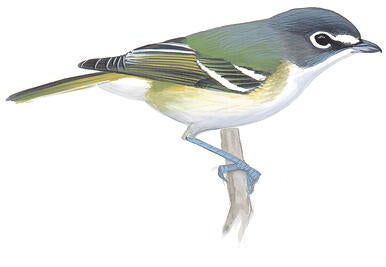
Vireo solitarius
Saw again a slender vireo-like bird (seen yesterday, near R. Brown’s); head somewhat crested behind; made me think of small pewee, —catches insects somewhat like it. As I remember, maybe ashy-white beneath, dusky-olive above, with two whitish bars on wings and dusky tail. Can it be the solitary vireo? 

Equisetum sylvaticum, probably yesterday or day before. Strawberry. That low sedge-like plant under Clamshell very common, with brownish, somewhat umbelled spikes, probably Luzula campestris (?), one of the wood rushes. 

Viola lanceolata, yesterday at least. High blackberry has begun to leaf; say two days. 
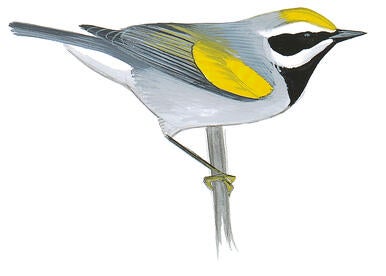

Vermivora chrysoptera
(golden-winged warbler)
Hear near Second Division the er er twe, ter ter twe, evergreen-forest note. Bright-yellow head and shoulders and beneath, and dark legs and bill catching insects along base of pitch pine plumes, some, what creeper-like; very active and restless, darting from tree to tree; darts at and drives off a chickadee. I find I have thus described its colors last year at various times, viz.: black throat, this often with dark and light beneath; again, black streak from eyes, slate-colored back (?), forked tail, white beneath (?); another bird with yellow throat near by, perhaps female; again, June 17 , black wings with white bars.  


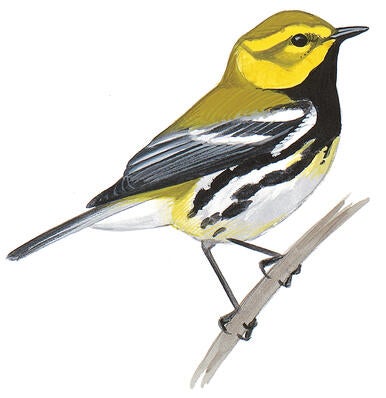
Setophaga virens
(black-throated green warbler)
Is it black throated green, or Latham’s yellow-fronted, or the golden-winged warbler? From Wilson I should think it the last, which he thinks the same with Pennant and Latham’s yellow-front.

The small juncus at Second Division shows a field of dark green with reddish top, the flower just beginning to peep out; this the earliest plant of this kind to make a show; more than a foot high. 


Trailing arbutus (epigaea) May 4, 2015
Epigaea in full bloom.

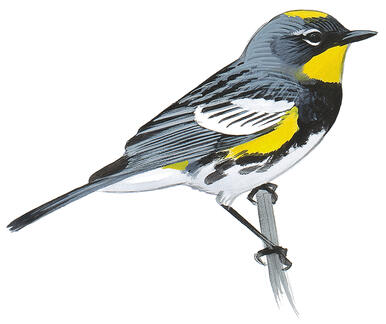
Setophaga coronata
(yellow-rumped warbler)
Myrtle-birds very numerous just beyond Second Division. They sing like an instrument, teee teee te, t t t, t t t, on very various keys; i.e. high or low, some times beginning like phe-be. As I sat by roadside one drew near, perched within ten feet, and dived once or twice with a curve to catch the little black flies about my head, coming once within three feet, not minding me much. I could not tell at first what attracted it toward me. It saw them from twenty-five feet off. There was a little swarm of small flies, regularly fly-like with large shoulders, about my head. 

Many white-throated sparrows there.

Road full of cattle going up country. 
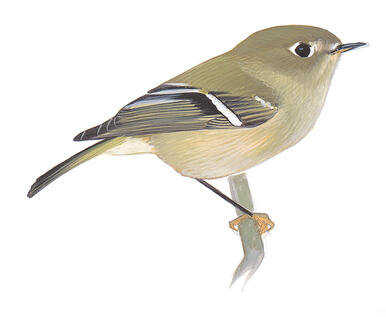

Regulus calendula
Hear at a distance a ruby(?)-crowned wren, so robin-like and spirited. After see one within ten or fifteen feet. Dark bill and legs, apparently dark olivaceous ashy head, a little whitish before and behind the full black eyes, ash breast, olive-yellow on primaries, with a white bar, dark tail and ends of wings, white belly and vent. Did not notice vermilion spot on hindhead. It darts off from apple tree for insects like a pewee, and returns to within ten feet of me as if curious. I think this the only Regulus I have ever seen.

Near Jenny Dugan’s, perceive that unaccountable fugacious fragrance, as of all flowers, bursting forth in air, not near a meadow, which perhaps I first perceived on May 1st. It is the general fragrance of the year. I am almost afraid I shall trace it to some particular plant. It surpasses all particular fragrances. I am not sitting near any flower that I can perceive.

Two or three rods this side of John Hosmer’s pitch pines, beyond Clamshell, some white Viola ovata, some with a faint bluish tinge. 

A beautiful sunset, the sun behind a gilt-edged cloud, with a clear bright crimson space beneath.

H. D. Thoreau, Journal, May 6, 1855

The er er twe, ter ter twe, evergreen-forest note. See. May 12, 1854 (" Heard again the evergreen -forest note. It is a slender bird , about size of white-eyed vireo, with a black throat and I think some yellow above, with dark and light beneath , in the tops of pines and oaks. The only warblers at all like it are black-throated green, black-throated blue, black-poll, and golden winged, and maybe orange-crowned");.June 12, 1854 (" Hear the evergreen-forest note , and see the bird on the top of a white pine , somewhat creeper like , along the boughs , and golden head except a black streak from eyes , black throat , slate - colored back , forked tail , white beneath , er te , ter ter te . Another bird with yellow throat near by may have been the other sex . Is it the golden - winged warbler ?");  June 17, 1854 ("The evergreen - forest bird at old place in white pine and oak tops, top of Brister's Hill on right. I think it has black wings with white bars. Is it not the black-throated green warbler") See also May 11, 1854("Hear the evergreen-forest note"); June 1, 1854 ("Hear my evergreen-forest note, sounding rather raspingly as usual, where there are large oaks and pines mingled. It is very difficult to discover now that the leaves are grown, as it frequents the tops of the trees. But I get a glimpse of its black throat and, I think, yellow head "); July 10 1854 ("Evergreen-forest note, I think, still.") and May 30, 1855 ("In the thick of the wood between railroad and Turnpike, hear the evergreen forest note, and see probably the bird,-- black throat, greenish-yellow or yellowish-green head and back, light-slate (?) wings with two white bars. Is it not the black-throated green warbler?”) and A Book of the Seasons, by Henry Thoreau, The Black-throated Green Warbler

That unaccountable fugacious fragrance, as of all flowers, bursting forth in air, . . .the general fragrance of the year. See April 21, 1854 ("As I go up the hill beyond the brook, while the hylodes are heard behind, I perceive the faintest possible flower-like scent as from the earth, reminding me of anemonies and houstonias.”); May 16, 1854 ("The earth is all fragrant as one flower. And bobolinks tinkle in the air. Nature now is perfectly genial to man.”) May 16, 1852 (“The whole earth is fragrant as a bouquet held to your nose. A fine, delicious fragrance, which will come to the senses only when it will.”); June 5, 1853 (“The heavens and the earth are one flower."). See also Basho:

From which tree's bloom
it comes, I do not know —
this fragrance.


Dark bill and legs, apparently dark olivaceous ashy head, a little whitish before and behind the full black eyes, ash breast, olive-yellow on primaries, with a white bar, dark tail and ends of wings, white belly and vent. Compare J. J. Audubon (“Bill black, yellow at the base of the lower, and on the edges of the upper mandible. Iris light brown. Feet yellowish-brown, the under parts yellow. The general colour of the upper parts is dull olivaceous ”) See note to April 20, 1859 ("My ruby-crowned or crested wren”)

I  think this the only Regulus I have ever seen.   See May 7, 1854  ("This was the same I have called golden-crowned . . . except that I saw its ruby crest. I didn't see the crest of the golden-crowned,  . . Have I seen the two?); May 11, 1854 (" I am in a little doubt about the wrens . . .  whether I have seen more than one. All that makes me doubt is that I saw a ruby, or perhaps it might be called fiery, crest on the last — not golden.”);  December 25, 1859 ("I can see a brilliant crown even . . . when I can detect no other part. It is evidently the golden-crested wren, which I have not made out before.”)

Unaccountable
flowery fragrance– yet not
near any flower.


Friday, March 6, 2015

This the third day of wind.

March 6

March 6, 2015
Still stronger wind, shaking the house, and rather cool. This the third day of wind.

Our woods are now so reduced that the chopping of this Winter has been a cutting to the quick. At least we walkers feel it as such. There is hardly a wood lot of any consequence left but the chopper’s axe has been heard in it this season. They have even infringed fatally on White Pond, on the south of Fair Haven Pond, shaved ofl’ the topknot of the Cliffs, the Colburn farm, Beck Stow’s, etc., etc.

Observed a mouse or mole's nest in the Second Division Meadow, where it had been made under the snow, —a nice warm globular nest some five inches in diameter, amid the sphagnum and cranberry vines, etc., — made of dried grass and lined with a still finer grass. The hole was on one side, and the bottom was near two inches thick. There were many small paths or galleries in the meadow leading to this from the brook some rod or more distant.

H. D. Thoreau, Journal, March 6, 1855

 Still stronger wind, shaking the house, and rather cool. This the third day of wind. See March 4, 1855 ("Though a cold and strong wind, it is very warm in the sun, and we can sit in the sun where sheltered on these rocks with impunity. It is a genial warmth. "); March 5, 1855 ("This strong, warm wind, rustling the leaves on the hillsides, this blue haze, and the russet earth seen through it, remind me that a new season has come.") See also A Book of the Seasons,  by Henry Thoreau, Signs of the Spring, March is famous for its winds

Observed a mouse nest where it had been made under the snow, —a nice warm globular nest some five inches in diameter. See  February 3, 1856 (“Track some mice to a black willow by riverside, just above spring, against the open swamp; and about three feet high, in apparently an old woodpecker’s hole, was probably the mouse-nest, a double handful, consisting, four ninths, of fine shreds of inner bark, perhaps willow or maple; three ninths, the greenish moss, apparently, of button-bush; two ninths, the gray-slate fur, apparently, of rabbits or mice. Half a dozen hog’s bristles might have been brought by some bird to its nest there. These made a very warm and soft nest.”); February 18, 1857 ("Picked up a mouse-nest in the stubble at Hubbard's mountain sumachs, left bare by the melting snow. It is about five inches wide and three or four high, with one, if not two, small round indistinct entrances on the side, not very obvious till you thrust your finger through them and press aside the fine grass that closes them, . . .A very snug and warm nest, where several might have lain very cosily under the snow in the hardest winter.”); March 22,1855  (“A (probably meadow) mouse nest in the low meadow by stone bridge, where it must have been covered with water a month ago; probably made in fall. Low in the grass, a little dome four inches in diameter, with no sign of entrance, it being very low on one side. Made of fine meadow-grass.”) See also A Book of the Seasons,  by Henry Thoreau, The Wild Mouse

March 6. See A Book of the Seasons, by Henry Thoreau, March 6


 A Book of the Seasons, by Henry Thoreau, The third day of wind.

A Book of the Seasons, by Henry Thoreau
"A book, each page written in its own season,
out-of-doors, in its own locality.”
~edited, assembled and rewritten by zphx © 2009-2025

Popular Posts Last 30 Days.

The week ahead in Henry’s journal

The week ahead in Henry’s journal
A journal, a book that shall contain a record of all your joy.
"A stone fruit. Each one yields me a thought." ~ H. D. Thoreau, March 28, 1859


I sit on this rock
wrestling with the melody
that possesses me.