Showing posts with label barred owl. Show all posts

Tuesday, December 25, 2018

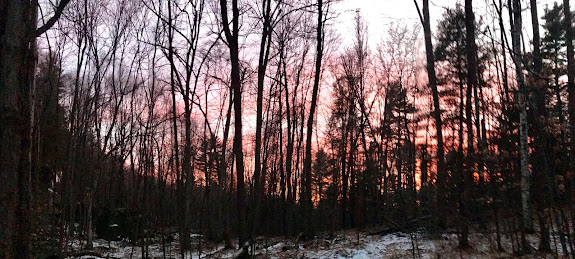
Now after sunset the light of the western sky – the outlines of pines.


December 25

December 25, 2018

P. M. —Up river on ice to Fair Haven Pond and across to Walden. 

The ground is still for the most part bare. Such a December is at least as hard a month to get through as November. You come near eating your heart now.

There is a good deal of brown or straw-color in the landscape now, especially in the meadows, where the ranker grasses, many of them uncut, still stand. They are bleached a shade or two lighter. Looking from the sun, there is a good deal of warm sunlight in them. 

I see where one farmer has been getting this withered sedge on the ice within a day or two for litter, in a meadow which had not been cut. Of course he could not cut very close. 

The ice on the river is about half covered with light snow, it being drifted thus, as usual, by the wind. (On Walden, however, which is more sheltered, the ice is uniformly covered and white.) I go running and sliding from one such snow-patch to another. It is easiest walking on the snow, which gives a hold to my feet, but I walk feebly on the ice. It is so rough that it is but poor sliding withal. 

I see, in the thin snow along by the button-bushes and willows just this side of the Hubbard bridge, a new track to me, looking even somewhat as if made by a row of large rain-drops, but it is the track of some small animal. The separate tracks are at most five eighths of an inch in diameter, nearly round, and one and three quarters to two inches apart, varying perhaps half an inch from a straight line. Sometimes they are three or four inches apart. The size is but little larger than that of a mouse, but it is never like a mouse. Goodwin, to whom I described it, did not know what it could be. 

The sun getting low now, say at 3.30, I see the ice green, southeast. 

Goodwin says that he once had a partridge strike a twig or limb in the woods as she flew, so that she fell and he secured her. 

Going across to Walden, I see that the fuzzy purple wool-grass is now bleached to a dark straw-color with out any purple. 

I notice that a fox has taken pretty much my own course along the Andromeda Ponds. 

The sedge which grows in tufts eighteen or twenty inches high there is generally recurving. 

I see that the shiners which Goodwin is using for bait to-day have no longitudinal dark bar or line on their sides, such as those minnows of the 11th and 18th had. Yet I thought that by the position of their fins, etc., the latter could not be the banded minnow. 

Walden at length skimmed over last night, i. e. the two holes that remained open. One was very near the middle and deepest part, the other between that and the railroad. 

Now that the sun is setting, all its light seems to glance over the snow-clad pond and strike the rocky shore under the pitch pines at the northeast end. Though the bare rocky shore there is only a foot or a foot and a half high as I look, it reflects so much light that the rocks are singularly distinct, as if the pond showed its teeth. 

I stayed later to hear the pond crack, but it did not much. 
December 25, 2019
How full of soft, pure light the western sky now, after sunset! I love to see the outlines of the pines against it. Unless you watch it, you do not know when the sun goes down. It is like a candle extinguished without smoke. A moment ago you saw that glittering orb amid the dry oak leaves in the horizon, and now you can detect no trace of it. In a pensive mood I enjoy the complexion of the winter sky at this hour.

Those small sphagnous mountains in the Andromeda Ponds are grotesque things. Being frozen, they bear me up like moss-clad rocks and make it easy getting through the water-brush. 

But for all voice in that serene hour I hear an owl hoot. How glad I am to hear him rather than the most eloquent man of the age! 

I saw a few days ago the ground under a swamp white oak in the river meadow quite strewn with brown dry galls about as big as a pea and quite round, like a small fruit which had fallen from it.

H. D. Thoreau, Journal, December 25, 1858

As hard a month to get through as November. You come near eating your heart now.
See November 27, 1853 ("Now a man will eat his heart, if ever, now while the earth is bare, barren and cheerless, and we have the coldness of winter without the variety of ice and snow"); November 25, 1857 (“November Eatheart, — is that the name of it? “)

Looking from the sun, there is a good deal of warm sunlight in them. See January 4, 1858 (“It is surprising how much sunny light a little straw that survives the winter will reflect . . .
That bright and warm reflection of sunlight from the insignificant edging of stubble”)

I notice that a fox has taken pretty much my own course along the Andromeda Ponds. See December 13, 1859 ("I see that the fox too has already taken the same walk before me, just along the edge of the button-bushes, where not even he can go in the summer.”)

The shiners which Goodwin is using for bait to-day have no longitudinal dark bar or line on their sides. See March 29, 1854 ("poised over the sand on invisible fins, the outlines of a shiner. . . distinct longitudinal light-colored line midway along their sides and a darker line below it”); July 16, 1856 ("I see many young shiners (?) (they have the longitudinal bar)"): July 17, 1856 (“They have . . . a broad, distinct black band along sides (which methinks marks the shiner)"); December 11, 1858 (“a minnow — apparently a young shiner, but it has a dark longitudinal line along side ”); December 18, 1858 (“They are little shiners with the dark longitudinal stripe”)

The sun getting low now, say at 3.30, I see the ice green, southeast. See January 7, 1856 (“Returning just before sunset, the few little patches of ice look green as I go from the sun . . .It is probably a constant phenomenon in cold weather when the ground is covered with snow and the sun is low, morning or evening, and you are looking from it.”); February 12, 1860 ("Returning just before sunset, I see the ice beginning to be green.”)

Walden at length skimmed over last night, i. e. the two holes that remained open. See note to December 20, 1858 (“Walden is frozen over, except two small spots, less than half an acre in all, in middle.”); 
December 22, 1858 (“The pond is no more frozen than on the 20th.”); December 24, 1858 ("Those two places in middle of Walden not frozen over yet, though it was quite cold last night! "); December 28, 1858 (“The ice is about six inches thick.”) See also December 25, 1859 ("The last our coldest night, as yet. No doubt Walden froze over last night entirely.") and A Book of the Seasons, by Henry Thoreau, Annual ice-in at Walden

Now that the sun is setting, all its light seems to glance over the snow-clad pond and strike the rocky shore under the pitch pines at the northeast end.
See December 25, 1858 ("That rocky shore under the pitch pines which so reflects the light, is only three feet wide by one foot high")

Unless you watch it, you do not know when the sun goes down.  See December 25, 1851 (“I go forth to see the sun set. Who knows how it will set, even half an hour beforehand ?”); See also July 20, 1852 (“We see the first star in the southwest, and know not how much earlier we might have seen it had we looked.”)

How full of soft, pure light the western sky now, after sunset! I love to see the outlines of the pines against it.
Full of soft pure light
western sky after sunset –
the outlines of pines.


See December 3, 1856   ("The pine forest's edge seen against the winter horizon"); December 12, 1859 ("The night comes on early these days, and I soon see the pine tree tops distinctly outlined against the dun (or amber) but cold western sky."); December 20, 1851 (In the west the sun goes down apace behind glowing pines, and golden clouds like mountains skirt the horizon."); January 5, 1853 ("A fine rosy sky in the west after sunset; and later an amber-colored horizon, in which a single tree-top showed finely."); January 9, 1859 ("It is worth the while to stand here at this hour and look into the soft western sky, over the pines whose outlines are so rich and distinct against the clear sky."); January 19, 1859 ("It occurs to me that I know of no more agreeable object to bound our view . . . than the pyramidal tops of a white pine forest in the horizon.");  See also October 20, 1858 ("There is one advantage in walking eastward these afternoons, at least, that in returning you may have the western sky before you.");   December 8, 1854 (“There is a glorious clear sunset sky, soft and delicate and warm”); December 9, 1859 (“I observe at mid-afternoon that peculiarly softened western sky . . . giving it a slight greenish tinge.”); December 11, 1854 ("I see the sun setting far through the woods, and there is that peculiar clear vitreous greenish sky in the west, as it were a molten gem.The day is short; it seems to be composed of two twilights merely"); December 18, 1853 (“The western hills, these bordering it, seen through the clear, cold air, have a hard, distinct edge against the sunset sky.”); January 17, 1852 (“In proportion as I have celestial thoughts, is the necessity for me to be out and behold the western sky sunset these winter days")

Clear yellow light of
the western sky reflected
from the smooth water.

Night comes on early.  
Pine tree tops outlined against
the cold western sky,

To look over pines
so rich and distinct into
the soft western sky.
January 9, 1859

The unclouded mind,
serene, pure, ineffable
like the western sky.

See also A Book of the Seasons,  by Henry Thoreau, the Western Sky

I hear an owl hoot. How glad I am to hear him. See November 18, 1851 ("I rejoice that there are owls. . . . This sound faintly suggests the infinite roominess of nature”); January 7, 1854 (“It is a sound which the wood or horizon makes”) See also A Book of Seasons, by Henry Thoreau, The Voice of the Barred Owl

December 25.  See A Book of the Seasons,  by Henry Thoreau, December 25


Now after sunset
the light of the western sky –
the outlines of pines.

I hear an owl hoot.
How glad I am to hear him
in this serene hour.


A Book of the Seasons
,  by Henry Thoreau, 
"A book, each page written in its own season,
out-of-doors, in its own locality.”
~edited, assembled and rewritten by zphx © 2009-2024

https://tinyurl.com/hdt-581225

Friday, December 14, 2018

A barred owl, representative of the night

December 14 

I see at Derby’s shop a barred owl (Strix nebulosa), taken in the woods west of the factory on the 11th, found (with its wing broke) by a wood chopper. 

It measures about three and a half feet in alar extent by eighteen to twenty inches long, or nearly the same as the cat owl, but is small and without horns. It is very mild and quiet, bears handling perfectly well, and only snaps its bill with a loud sound at the sight of a cat or dog. 

It is apparently a female, since it is large and has white spots on the wings. The claws are quite dark rather than dark horn-color. 

It hopped into the basin of the scales, and I was surprised to find that it weighed only one pound and one ounce. It may be thin-fleshed on account of its broken wing, but how light-bodied these fliers are! 

It has no yellow iris like the cat owl, and has the bristles about its yellow bill which the other has not. It has a very smooth and handsome round head, a brownish gray. 

Solemnity is what they express, — fit representatives of the night.

H. D. Thoreau, Journal, December 14, 1858


A barred owl (Strix nebulosa).
 See December 9, 1856 (“Every week almost I hear the loud voice of the hooting owl, though I do not see the bird more than once in ten years.”); January 7, 1854 ("Strange that we should hear this sound so often, loud and far, — a voice which we call the owl, — and yet so rarely see the bird.”); 
Walden, Former Inhabitants; and Winter Visitors ("One afternoon I amused myself by watching a barred owl (Strix nebulosa) sitting on one of the lower dead limbs of a white-pine . . . when he launched himself off and flapped through the pines, spreading his wings to unexpected breadth, I could not hear the slightest sound from them."); See also A Book of Seasons, by Henry Thoreau, The Voice of the Barred Owl

The injured barred owl
snaps its bill with a loud sound
weighs only one pound.

A Book of the Seasons,  by Henry Thoreau, A barred owl
 A Book of the Seasons, by Henry Thoreau
"A book, each page written in its own season,
out-of-doors, in its own locality.”
~edited, assembled and rewritten by zphx © 2009-2026

https://tinyurl.com/hdt-581214

Monday, December 19, 2016

The voice of the wood.


December 19.

December 19, 2021

I rode back to Nashua in the morning  —   Knew the road by some yellow birch trees in a swamp and some rails set on end around a white oak in a pasture. These it seems were the objects I had noticed. 

In Nashua observed, as I thought, some elms in the distance which had been whitewashed. It turned out that they were covered from top to bottom, on one side, with the frozen vapor from a fall on the canal.

Walked a little way along the bank of the Merrimack, which was frozen over, and was agreeably reminded of my voyage up it. 

The night previous, in Amherst, I had been awaked by the loud cracking of the 'ground, which shook the house like the explosion of a powder-mill. In the morning there was to be seen a long crack across the road in front. I saw several of these here in Nashua, and ran a bit of stubble into them but in no place more than five inches. This is a sound peculiar to the coldest nights. 

Observed that the Nashua in Pepperell was frozen to the very edge of the fall, and even further in some places. 

Got home at 1.30 p. m. 

P. M. — To Walden. 

Walden froze completely over last night. This is very sudden, for on the evening of the 15th there was not a particle of ice in it. In just three days, then, it has been completely frozen over, and the ice is now from two and a half to three inches thick, a transparent green ice, through which I see the bottom where it is seven or eight feet deep. I detect its thickness by looking at the cracks, which are already very numerous, but, having been made at different stages of the ice, they indicate very various thicknesses. Often one only an inch deep crosses at right angles another two and a half inches deep, the last having been recently made and indicating the real thickness of the ice. 

I advance confidently toward the middle, keeping within a few feet of some distinct crack two inches or more deep, but when that fails me and I see only cracks an inch or an inch and a half deep, or none at all, I walk with great caution and timidity, though the ice may be as thick as ever, but I have no longer the means of determining its thickness. 

The ice is so transparent that it is too much like walking on water by faith. 

The portion of the pond which was last frozen is a thinner and darker ice stretching about across the middle from southeast to northwest, i. e. from the shoulder of the Deep Cove to nearly midway between the bar and Ice-Fort Cove Cape. 

Close to the northwest end of this, there is a small and narrow place twenty feet long east and west, which is still so thin that a small stone makes a hole. The water, judging from my map, may[be] seventy or seventy-five feet deep there. It looks as if that had been the warmest place in the surface of the pond and therefore the last to yield to the frost king. 

Into this, or into the thinner ice at this point, there empties, as it were, a narrow meandering creek from near the western shore, which was nearly as late to freeze as any part. All this, I think, I have noticed in previous years. 

About the edge of all this more recent and darker ice, the thicker ice is white with a feathery frost, which seems to have been produced by the very fine spray, or rather the vapor, blown from the yet unfrozen surface on to the ice by the strong and cold wind. Here is where, so to speak, its last animal heat escaped, the dying breath of the pond frozen on its lips. It had the same origin with the frost about the mouth of a hole in the ground whence warm vapors had escaped. 

The fluid, timid pond was encircled within an ever-narrowing circle by the icy grasp of winter, and this is a trace of the last vaporous breath that curled along its trembling surface. Here the chilled pond gave up the ghost. 

As I stand here, I hear the hooting of my old acquaintance the owl in Wheeler's Wood. Do I not oftenest hear it just before sundown? This sound, heard near at hand, is more simply animal and guttural, without resonance or reverberation, but, heard here from out the depths of the wood, it sounds peculiarly hollow and drum-like, as if it struck on a tense skin drawn around, the tympanum of the wood, through which all we denizens of nature hear. 

Thus it comes to us an accredited and universal or melodious sound; is more than the voice of the owl, the voice of the wood as well. The owl only touches the stops, or rather wakes the reverberations. For all Nature is a musical instrument on which her creatures play, celebrating their joy or grief unconsciously often. It sounds now, hoo | hoo hoo (very fast) | hoo-rer | hoo. 

Withered leaves! this is our frugal winter diet, in stead of the juicy salads of spring and summer. I think I could write a lecture on "Dry Leaves," carrying a specimen of each kind that hangs on in the winter into the lecture-room as the heads of my discourse. They have long hung to some extent in vain, and have not found their poet yet. 

The pine has been sung, but not, to my knowledge, the shrub oak. Most think it is useless. How glad I am that it serves no vulgar use! It is never seen on the woodman's cart. The citizen who has just bought a sprout-land on which shrub oaks alone come up only curses it. But it serves a higher use than they know. Shrub oak! how true its name! 

Think first what a family it belongs to. The oak, the king of trees, is its own brother, only of ampler dimensions. The oaks, so famous for grandeur and picturesqueness, so prized for strength by the builder, for knees or for beams; and this is the oak of smaller size, the Esquimau of oaks, the shrub oak! The oaken shrub! I value it first for the noble family it belongs to. 

It is not like brittle sumach or venomous dogwood, which you must beware how you touch, but wholesome to the touch, though rough; not producing any festering sores, only honest scratches and rents.

Dr. Kane says in his "Arctic Explorations," page 21, that at Fiskernaes in Greenland "the springs, which well through the mosses, frequently remain unfrozen throughout the year."

H. D. Thoreau, Journal, December 19, 1856

In Amherst, I had been awaked by the loud cracking of the 'ground, which shook the house like the explosion of a powder-mill.
See December 23, 1856 (“The cracking of the ground is a phenomenon of the coldest nights”); February 7, 1855 (“The ground cracked in the night as if a powder-mill had blown up, ”)

Walden froze completely over last night. .. . See December 21, 1856 ("The pond is open again in the middle, owing to the rain of yesterday."); December 24, 1856 ("Am surprised to find Walden still open in the middle.”); December 27, 1856 "Walden is still open in one place of considerable extent, just off the east cape of long southern bay.”); December 28, 1856 ("Walden completely frozen over again last night.”)  Also December 20, 1858 ("Walden is frozen over, except two small spots, less than half an acre in all, in middle"); December 21, 1855 (" Walden is skimmed over, all but an acre, in my cove. It will probably be finished to-night. (No, it proved too warm.)"); December 21, 1854 ("Walden is frozen over, apparently about two inches thick. It must have frozen, the whole of it, since the snow of the 18th,-— probably the night of the 18th");   December 25, 1858 ("Walden at length skimmed over last night, i. e. the two holes that remained open. One was very near the middle and deepest part, the other between that and the railroad.");  December 26, 1850 ("Walden not yet more than half frozen over."); December 27, 1857 ("Walden is almost entirely skimmed over. It will probably be completely frozen over to-night."); December 29, 1855 ("Am surprised to find eight or ten acres of Walden still open, notwithstanding the cold of the 26th, 27th, and 28th and of to-day. It must be owing to the wind partly."); December 30, 1853 ("The pond [Walden] not yet frozen entirely over; about six acres open, the wind blew so hard last night."); December 31, 1850 ("Walden pond has frozen over since I was there last.”).

The ice is now from two and a half to three inches thick, a transparent green ice, through which I see the bottom where it is seven or eight feet deep. See November 23, 1850 (“I lay down on the ice and look through at the bottom.”) Also Walden (“The first ice is especially interesting and perfect, being hard, dark, and transparent, and affords the best opportunity that ever offers for examining the bottom where it is shallow; for you can lie at your length on ice only an inch thick, like a skater insect on the surface of the water, and study the bottom at your leisure, only two or three inches distant, like a picture behind a glass.”); February 3, 1856 (" [the Forth Branch] In one square rod, where they have got out ice and a thin transparent-ice has formed, I can see the pebbly bottom the same as in summer.")

I detect its thickness by looking at the cracks..See December 19, 1854 ("It takes a little while to learn to trust the new black ice; I look for cracks to see how thick it is.")

I hear the hooting of my old acquaintance the owl in Wheeler's Wood. Do I not oftenest hear it just before sundown? Compare December 19, 1851 ("In all woods is heard now far and near the sound of the woodchopper's axe, a twilight sound, now in the night of the year")

For all Nature is a musical instrument on which her creatures play, celebrating their joy or grief unconsciously often. See June 22, 1851 ("The world is a musical instrument. The very touch affords an exquisite pleasure. I awake to its music with the calmness of a lake when there is not a breath of wind. . . .And without effort our depths are revealed to ourselves.”); July 16, 1851 ("This earth was the most glorious musical instrument, and I was audience to its strains.); October 26, 1851 ("The instant that I awoke, methought I was a musical instrument ")

December 19. See A Book of the Seasons, by Henry Thoreau, December 19

A Book of the Seasons,  by Henry Thoreau
 "A book, each page written in its own season, 
out-of-doors, in its own locality."
 ~edited, assembled and rewritten by zphx ©  2009-2023

tinyurl.com/hdt561219

Thursday, December 15, 2016

A winter eve in memory.


December 15

It still blows hard at 2 p. m., but it is not cold.

8 p.m.- To Walden. 

The high northwest wind of this morning, with what of cold we have, has made some of those peculiar rake-toothed icicles on the dead twigs, etc., about the edge of the pond at the east end. To produce this phenomenon is required only open water, a high wind, and sufficiently cold weather to freeze the spray. 

I observe B 's boat left out at the pond, as last winter. When I see that a man neglects his boat thus, I do not wonder that he fails in his business. It is not only shiftlessness or unthrift, but a sort of filthiness to let things go to wrack and ruin thus. 

December 15, 2023

I still recall to mind that characteristic winter eve of December 9th; the cold, dry, and wholesome diet my mind and senses necessarily fed on, —

· oak leaves, bleached and withered weeds that rose above the snow,

· the now dark green of the pines, and

· perchance the faint metallic chip of a single tree sparrow;

· the hushed stillness of the wood at sundown, aye, all the winter day;

· the short boreal twilight;

· the smooth serenity and the reflections of the pond, still alone free from ice;

· the melodious hooting of the owl, heard at the same time with the yet more distant whistle of a locomotive, more aboriginal, and perchance more enduring here than that, heard above the voices of all the wise men of Concord, as if they were not (how little he is Anglicized!);

· the last strokes of the woodchopper, who presently bends his steps homeward;

· the gilded bar of cloud across the apparent outlet of the pond, conducting my thoughts into the eternal west;

· the deepening horizon glow; and

· the hasty walk homeward to enjoy the long winter evening.


The hooting of the owl! That is a sound which my red predecessors heard here more than a thousand years ago. It rings far and wide, occupying the spaces rightfully, — grand, primeval, aboriginal sound. There is no whisper in it of the Buckleys, the Flints, the Hosmers who recently squatted here, nor of the first parish, nor of Concord Fight, nor of the last town meeting. 

Mrs. Moody very properly calls eating nuts "a mouse like employment." It is quite too absorbing; you can't read at the same time, as when you are eating an apple.

H. D.Thoreau, Journal, December 15, 1856

That characteristic winter eve of December 9th. See December 9, 1856 ("Such is a winter's eve.")

I observe B 's boat left out at the pond, as last winter . . . See January 5, 1856 ("Boats . . . half filled with ice and almost completely buried in snow, so neglected by their improvident owners . . .") See also A Book of the Seasons, by Henry Thoreau, Boat in. Boat out.

The smooth serenity and the reflections of the pond, still alone free from ice. See December 15, 1854 ("How interesting a few clean, dry weeds on the shore a dozen rods off, seen distinctly against the smooth, reflecting water between ice!"). See also December 14, 1854 ("Your eye slides first over a plane surface of smooth ice of one color to a water surface of silvery smoothness, like a gem set in ice, and reflecting the weeds and trees and houses and clouds with singular beauty. The reflections are particularly simple and distinct."); December 20, 1855 ("How placid, like silver or like steel in different lights, the surface of the still, living water between these borders of ice, reflecting the weeds and trees, and now the warm colors of the sunset sky! ") See also A Book of the Seasons, by Henry Thoreau, Reflections

The hooting of the owl! . . . grand, primeval, aboriginal sound. See. December 9, 1856 ("Every week almost I hear the loud voice of the hooting owl, though I do not see the bird more than once in ten years"); December 19, 1856 ("More than the voice of the owl, the voice of the wood as well . . . It sounds now, hoo | hoo hoo (very fast) | hoo-rer | hoo."); See also A Book of Seasons, by Henry Thoreau, The Voice of the Barred Owl

December 15. See A Book of the Seasons, by Henry Thoreau, December 15


A Book of the Seasons, by Henry Thoreau
"A book, each page written in its own season,
out-of-doors, in its own locality.”
~edited, assembled and rewritten by zphx © 2009-2023

Friday, December 9, 2016

Such is a winter eve.


December 9


P. M. — Railroad to Lincoln Bridge and back by road.

December 9, 2023

There is scarcely a particle of ice in Walden yet, and that close to the edge, apparently, on the west and northwest sides. Yet Fair Haven was so solidly frozen on the 6th that there was fishing on it, and yesterday I met Goodwin bringing a fine lot of pickerel from Flint's, which was frozen at least four inches thick. This is, no doubt, owing solely to the greater depth of Walden. 

As I stand on the railroad against Heywood's meadow, the sun now getting low in the west, the leaves of the young oaks in Emerson's sprout-land on the side of the hill make a very agreeable thick, rug-like stuff for the eye to rest on. The white oak leaves are a very pale brown, but the scarlet oaks are quite red now in the sun. Near at hand they are conspicuously ruddy in any light, the scarlet oaks. (Those black oaks which I examine near at hand afterward are a pure, somewhat yellowish brown.) This slight difference of shading makes a very pleasing variety on this densely covered hillside, like a rich embroidered stuff. One species does not stand by itself, but they are dispersed and intimately mingled. 

These oak leaves have more distinct characters now at this distance than in summer. It is as if a rich rug, with stuff six or eight feet deep, had been dropped over this hill, opening the stuff on the brow, dyed of various shades of enduring brown, the wholesome and strong color which Nature loves; and here and there the now dark green of a pine is seen. When the wind rises, the leaves rustle their content. The sunlight reveals no redness in the white oak leaves. 

The bright colors of autumn are transient; these browns are permanent. These are not so much withered leaves, for they have a wintry life in them still, and the tanned or bronzed color of assured health. They are a sort of epidermis or bark, not at once thrown off, serving, perhaps, to protect the trees as well as the quadrupeds and birds. 

Coming through the Walden woods, I see already great heaps of oak leaves collected in certain places on the snow-crust by the roadside, where an eddy deposited them. It suggests that a certain law has attended their movements, which appeared so lawless, even as with the iron filings under the influence of music. The greater part that have fallen are deposited in clear and crispy heaps in particular places. They are beds which invite the traveller to repose on them, even in this wintry weather. 

From a little east of Wyman's I look over the pond westward. The sun is near setting, away beyond Fair Haven. A bewitching stillness reigns through all the woodland and over the snow-clad landscape. Indeed, the winter day in the woods or fields has commonly the stillness of twilight. The pond is perfectly smooth and full of light. 

I hear only the strokes of a lingering woodchopper at a distance, and the melodious hooting of an owl, which is as common and marked a sound as the axe or the locomotive whistle. Yet where does the ubiquitous hooter sit, and who sees him? In whose wood-lot is he to be found? Few eyes have rested on him hooting. Few on him silent on his perch even. 

Yet cut away the woods never so much year after year, though the chopper has not seen him and only a grove or two is left, still his aboriginal voice is heard indefinitely far and sweet, mingled oft, in strange harmony, with the newly invented din of trade, like a sentence of Allegri sounded in our streets, — hooting from invisible perch at his foes the woodchoppers, who are invading his domains. 

As the earth only a few inches beneath the surface is undisturbed and what it was anciently, so are heard still some primeval sounds in the air. Some of my townsmen I never see, and of a great proportion I do not hear the voices in a year, though they live within my horizon; but every week almost I hear the loud voice of the hooting owl, though I do not see the bird more than once in ten years. 

I perceive that more or other things are seen in the reflection than in the substance. As I look now over the pond westward, I see in substance the now bare outline of Fair Haven Hill a mile beyond, but in the reflection I see not this, only the tops of some pines, which stand close to the shore but are invisible against  the dark hill beyond, and these are indefinitely prolonged into points of shadow. 

The sun is set, and over the valley, which looks like an outlet of Walden toward Fair Haven, I see a burnished bar of cloud stretched low and level, as if it were the bar over that passageway to Elysium, the last column in the train of the sun. 

When I get as far as my bean-field, the reflected white in the winter horizon of this perfectly cloudless sky is being condensed at the horizon's edge, and its hue deepening into a dun golden, against which the tops of the trees — pines and elms — are seen with beautiful distinctness, and a slight blush begins to suffuse the eastern horizon, and so the picture of the day is done and set in a gilded frame. 

December 9, 2021

Such is a winter eve. 

Now for a merry fire, some old poet's pages, or else serene philosophy, or even a healthy book of travels, to last far into the night, eked out perhaps with the walnuts which we gathered in November. 

The worker who would accomplish much these short days must shear a dusky slice off both ends of the night. The chopper must work as long as he can see, often returning home by moonlight, and set out for the woods again by candle-light. 

In many parts of the river the ice has been formed with remarkably coarse crystallization, the surface being starred with great raised rays as thick as your thumb and several feet long, as it were the beginning of a bony system, as if under the action of a strong wind which rippled the water while it was freezing. All covered with these rounded plaits. Soon, where there is much current, even in pretty cold weather, the ice is worn thin during the day, and when you are following the tracks of one who has preceded you by half a dozen hours over the black ice, you are surprised by seeing the trembling water reveal itself at numerous holes other wise not noticeable close about you. 

The northwest wind, meeting the current in an exposed place, produces that hobbly ice which I described at Cardinal Shore day before yesterday. This is the case in this place every year, and no doubt this same phenomenon occurred annually at this point on this river a thousand years before America was discovered. This regularity and permanence make these phenomena more interesting to me.

H. D. Thoreau, Journal, December 9, 1856

There is scarcely a particle of ice in Walden yet. Fair Haven was so solidly frozen on the 6th and yesterday Flint’s, was frozen at least four inches thick
. See December 9, 1854 ("White Pond mostly skimmed over.”); December 9, 1859 ("The river and Fair Haven Pond froze over generally last night . . . This is unusually sudden.”). See also December 19, 1856 ("Walden froze completely over last night. This is very sudden, for on the evening of the 15th there was not a particle of ice in it. In just three days, then, it has been completely frozen over, and the ice is now from two and a half to three inches thick.") See also A Book of the Seasons, by Henry Thoreau, Annual ice-in at Walden

 The sun is near setting . . . The pond is perfectly smooth and full of light. See December 8, 1853 (" But, now the sun is set, Walden . . . is more light than the sky")

And so the picture of the day is done and set in a gilded frame. See January 7, 1852 (" Every day a new picture is painted and framed, held up for half an hour, in such lights as the Great Artist chooses, and then withdrawn, and the curtain falls.")

Such is a winter eve. See December 15, 1856 ("I still recall to mind that characteristic winter eve of December 9th")
Smooth serenity 
and reflections of the pond, 
alone free from ice. 

Hooting of the owl
with the distant whistle of 
a locomotive.

The last strokes of the 
woodchopper, who presently 
bends his steps homeward.

Gilded bar of cloud
conducting my thoughts into
the eternal west. 

The horizon glow
and the hasty walk homeward.
Long winter evening.

As I look now over the pond westward, I see in substance the now bare outline of Fair Haven Hill a mile beyond, but in the reflection I see not this, only the tops of some pines, which stand close to the shore but are invisible against the dark hill beyond. See December 8, 1853 (" I saw from the peak the entire reflection of large white pines very distinctly against a clear white sky, though the actual tree was completely lost in night against the dark distant hillside."); See also October 16, 1858 (“[Objects] appear in the reflection as they would if viewed from that point on the surface from which they are reflected to my eye, so that it is as if I had another eye placed there to see for me.”)

Yet where does the ubiquitous hooter sit, and who sees him? In whose wood-lot is he to be found?. . . I do not see the bird more than once in ten years. See January 7, 1854 ("Strange that we should hear this sound so often, loud and far, — a voice which we call the owl, — and yet so rarely see the bird. Oftenest at twilight. It has a singular prominence as a sound; is louder than the voice of a dear friend. Yet we see the friend perhaps daily and the owl but few times in our lives. It is a sound which the wood or horizon makes."); November 18, 1851 ("I rejoice that there are owls. This sound suggests the infinite roominess of nature, that there is a world in which owls live.”)

I perceive that more or other things are seen in the reflection than in the substance. See December 11, 1853 (“It occurs to me that the reflection of objects in still water is . . .fairer than the substance . . . we see terrestrial objects with the sky or heavens for a background or field.”); October 14, 1857 (“Not even reflections in still water are like their substances as seen by us. This, too, accounts for my seeing portions of the sky through the trees in reflections often when none appear in the substance. . . .[T]he reflection is never a true copy or repetition of its substance, but a new composition, and this may be the source of its novelty and attractiveness, and of this nature, too, may be the charm of an echo."); November 27, 1857 ("I think that Ruskin is wrong about reflections . . . He says . . . 'Whatever you can see from the place in which you stand, of the solid objects so reversed under the water, you will see in the reflection’”).

The worker who would accomplish much these short days must shear a dusky slice off both ends of the night. See December 11, 1854 ("The day is short; it seems to be composed of two twilights merely; the morning and the evening twilight make the whole day. You must make haste to do the work of the day before it is dark.”)

The hushed stillness of
the winter day at twilight –
the pond full of light.

And so the picture 
of the day is done and set 
in a gilded frame.


A Book of the Seasons
,  by Henry Thoreau, 
"A book, each page written in its own season,
out-of-doors, in its own locality.”
~edited, assembled and rewritten by zphx © 2009-2024

https://tinyurl.com/hdt-561209

Monday, January 6, 2014

The voice of the woods

January 7.

Cold last night; rough walking; snow crusted. 

Now that the snow has lain more than a week, it begins to be spotted and darkened in the woods, with various dry leaves and scales from the trees. The wind and thaw have brought down a fresh crop of dry pine and spruce needles. The little roundish and stemmed scales of the alder catkins spot it thickly. 

The bird-shaped scales of the white birch are blown more than twenty rods from the trees. 


I see also the wings of pine seeds, — the seed being gone, — which look exactly like the wings of ants. 

I went to these woods partly to hear an owl, but did not; but, now that I have left them nearly a mile behind, I hear one distinctly, hoorer hoo. Strange that we should hear this sound so often, loud and far, — a voice which we call the owl, — and yet so rarely see the bird. Oftenest at twilight. It has a singular prominence as a sound; is louder than the voice of a dear friend. Yet we see the friend perhaps daily and the owl but few times in our lives.  It is a sound which the wood or horizon makes.

H. D. Thoreau, Journal, January 7, 1854

The bird-shaped scales of the white birch are blown more than twenty rods from the trees. See January 7, 1856 ("I see birch scales (bird-like) on the snow on the river more than twenty rods south of the nearest and only birch, and trace them north to it”); January 7, 1853 (“Still the snow is strewn with the seeds of the birch, the small winged seeds or samarae and the larger scales or bracts shaped like a bird in flight, — a hawk or dove. The least touch or jar shakes them off, and it is difficult to bring the female catkins home in your pocket. They cover the snow like coarse bran. On breaking the male catkins, I am surprised to see the yellow anthers so distinct, promising spring. I did not suspect that there was so sure a promise or prophecy of spring. These are frozen in December or earlier, — the anthers of spring, filled with their fertilizing dust.”)

Strange that we should hear this sound so often . . . and [see] the owl but few times in our lives. It is a sound which the wood or horizon makes. See December 9, 1856 (“ I do not see the bird more than once in ten years.”) December 19, 1856 (“[it] is more than the voice of the owl, the voice of the wood as well.”)


January 7. See A Book of the Seasons, by Henry Thoreau, January 7

A Book of the Seasons,  by Henry Thoreau
"A book, each page written in its own season,
out-of-doors, in its own locality.”
~edited, assembled and rewritten by zphx © 2009-2024

Tuesday, April 9, 2013

Sounds of Early Spring. A warm and hazy but breezy day.


April 9.


P. M. – To Second Division. 

The chipping sparrow, with its ashy-white breast and white streak over eye and undivided chestnut crown, holds up its head and pours forth its che che che che che che. 


On a pitch pine on side of J. Hosmer's river hill, a pine warbler, by ventriloquism sounding farther off than it was, which was seven or eight feet, hopping and flitting from twig to twig, apparently picking the small flies at and about the base of the needles at the extremities of the twigs. Saw two afterward on the walls by roadside. 

A warm and hazy but breezy day. The sound of the laborers' striking the iron rails of the railroad with their sledges, is as in the sultry days of summer, — resounds, as it were, from the hazy sky as a roof, — a more confined and, in that sense, domestic sound echoing along between the earth and the low heavens. The same strokes would produce a very different sound in the winter. 

Men fishing for trout.

Small light-brown lizards, about five inches long, with somewhat darker tails, and some a light line along back, are very active, wiggling off, in J. P. Brown ' s ditch, with pollywogs. 

Beyond the desert, hear the hooting owl, which, as formerly, I at first mistook for the hounding of a dog, — a squealing eee followed by hoo hoo hoo deliberately, and particularly sonorous and ringing. This at 2 P. M. Now mated. Pay their addresses by day, says Brooks. 

Winkle lichens, some with greenish bases, on a small prostrate white oak, near base. Also large white ear like ones higher up. 

A middling-sized orange-copper butterfly on the mill road, at the clearing, with deeply scalloped wings. You see the buff-edged and this, etc., in warm, sunny southern exposures on the edge of woods or sides of rocky hills and cliffs, above dry leaves and twigs, where the wood has been lately cut and there are many dry leaves and twigs about. 

An ant-hill covered with a firm sward except at top. 

The cowslips are well out, – the first conspicuous herbaceous flower, for the cabbage is concealed in its spathe. 

The Populus tremuliformis, just beyond, resound with the hum of honey-bees, flies, etc. These male trees are frequently at a great distance from the females. Do not the bees and flies alone carry the pollen to the latter? I did not know at first whence the humming of bees proceeded. 

At this comparatively still season, before the crickets begin, the hum of bees is a very noticeable sound, and the least hum or buzz that fills the void is detected. Here appear to be more bees than on the willows. On the last, where I can see them better, are not only bees with pellets of pollen, but more flies, small bees, and a lady-bug. What do flies get here on male flowers, if not nectar? Bees also in the female willows, of course without pellets. It must be nectar alone there. 

That willow by H.'s Bridge is very brittle at base of stem, but hard to break above. The more I study willows, the more I am confused. 

The epigæa will not be out for some days. 

Elm blossoms now in prime. Their tops heavier against the sky, a rich brown; their outlines further seen. 

Most alders done. Some small upright ones still fresh. 

Evening. — 

Hear the snipe a short time at early starlight. 

I hear this evening for the first time, from the partially flooded meadow across the river, I standing on this side at early starlight, a general faint, prolonged stuttering or stertorous croak, — probably same with that heard April 7th, — that kind of growling, like wild beasts or a coffee-mill, which you can produce in your throat. It seems too dry and wooden, not sonorous or pleasing enough, for the toad. 

I hear occasionally the bullfrog's. note, croakingly and hoarsely but faintly imitated, in the midst of it, — which makes me think it may be they, though I have not seen any frogs so large yet, but that one by the railroad which I suspect may have been a fontinalis. 

What sound do the tortoises make beside hissing? 

There were the mutilated Rana palustris seen in the winter, the hylodes, the small or middling-sized croakers in pools (a shorter, less stuttering note than this to-night), and next the note of the 7th, and to night the last, the first I have heard from the river. I occasionally see a little frog jump into a brook. 

The whole meadow resounds, probably from one end of the river to the other, this evening, with this faint, stertorous breathing. It is the waking up of the meadows. 

Louder than all is heard the shrill peep of the hylodes and the hovering note of the snipe, circling invisible above them all. 

Vide again in Howitt, pp. 31, 32, 33, 34, 35, 37, 49, 54, 95. 

Is it the red-eye or white-eye whose pensile nest is so common?

H. D. Thoreau, Journal, April 9, 1853

A pine warbler, by ventriloquism sounding farther off than it was. See April 9, 1856 (" I hear . . . the note of the pine warbler. It sounds far off and faint, but, coming out and sitting on the iron rail, I am surprised to see it within three or four rods, on the upper part of a white oak, where it is busily catching insects, . . . When heard a little within the wood, as he hops to that side of the oak, they sound particularly cool and inspiring, like a part of the evergreen forest itself, the trickling of the sap. Its bright yellow or golden throat and breast, etc., are conspicuous at this season, — a greenish yellow above, with two white bars on its bluish-brown wings."). See also A Book of the Seasons, by Henry Thoreau, the Pine Warbler.

The sound of the laborers' striking the iron rails of the railroad with their sledges. . .echoing along between the earth and the low heavens. See February 24, 1852 ("I now hear at a distance the sound of the laborer's sledge on the rails. The very sound of men's work reminds, advertises, me of the coming of spring.”);February 16, 1855 ("Sounds sweet and musical through this air . . . striking on the rails at a distance.”)

The cowslips are well out, – the first conspicuous herbaceous flower. See April 8, 1856 ("There, in that slow, muddy brook near the head of Well Meadow, within a few rods of its source, . . . find two cowslips in full bloom, shedding pollen; and they may have opened two or three days ago; for I saw many conspicuous buds here on the 2d which now I do not see. . . .What an arctic voyage was this in which I find cowslips, the pond and river still frozen over for the most part as far down as Cardinal Shore! "); April 13, 1855 ("Many cowslip buds show a little yellow, but they will not open there [Second Division]for two or three days. The road is paved with solid ice there."); April 29, 1852 ("At the Second Division Brook the cowslip is in blossom. "). See also A Book of the Seasons, by Henry Thoreau, Signs of Spring: the Cowslip

Hear the snipe a short time at early starlight. . . the hovering note of the snipe, circling invisible above them all. See  April 9, 1855 ("Some twenty minutes after sundown I hear the first booming of a snipe."). April 9, 1858 ("I hear the booming of snipe this evening, . . . Persons walking up or down our village street in still evenings at this season hear this singular winnowing sound in the sky over the meadows and know not what it is. This “booming” of the snipe is our regular village serenade. I heard it this evening for the first time, as I sat in the house, through the window. Yet common and annual and remarkable as it is, not one in a hundred of the villagers hears it, and hardly so many know what it is. "). See also A Book of Seasons, by Henry Thoreau, The Snipe

I hear this evening for the first time, from the partially flooded meadow across the river, I standing on this side at early starlight, a general faint, prolonged stuttering or stertorous croak, — probably same with that heard April 7th, — that kind of growling, like wild beasts or a coffee-mill, which you can produce in your throat . . .the first I have heard from the river. . . . The whole meadow resounds, probably from one end of the river to the other, this evening, with this faint, stertorous breathing. It is the waking up of the meadows. See April 3, 1858 ("We hear the stertorous tut tut tut of frogs from the meadow, with an occasional faint bullfrog-like er er er intermingled. . . . Both these sounds, then, are made by one frog [Rana halecina], . . . This, I think, is the first frog sound I have heard from the river meadows or anywhere, except the croaking leaf-pool frogs and the hylodes"); April 5, 1855 ("Hear from one half-flooded meadow that low, general, hard, stuttering tut tut tut of frogs,—the awakening of the meadow.”); April 3, 1858 ("This might be called the Day of the Snoring Frogs, or the Awakening of the Meadows.”);

Popular Posts Last 30 Days.

The week ahead in Henry’s journal

The week ahead in Henry’s journal
A journal, a book that shall contain a record of all your joy.
"A stone fruit. Each one yields me a thought." ~ H. D. Thoreau, March 28, 1859


I sit on this rock
wrestling with the melody
that possesses me.