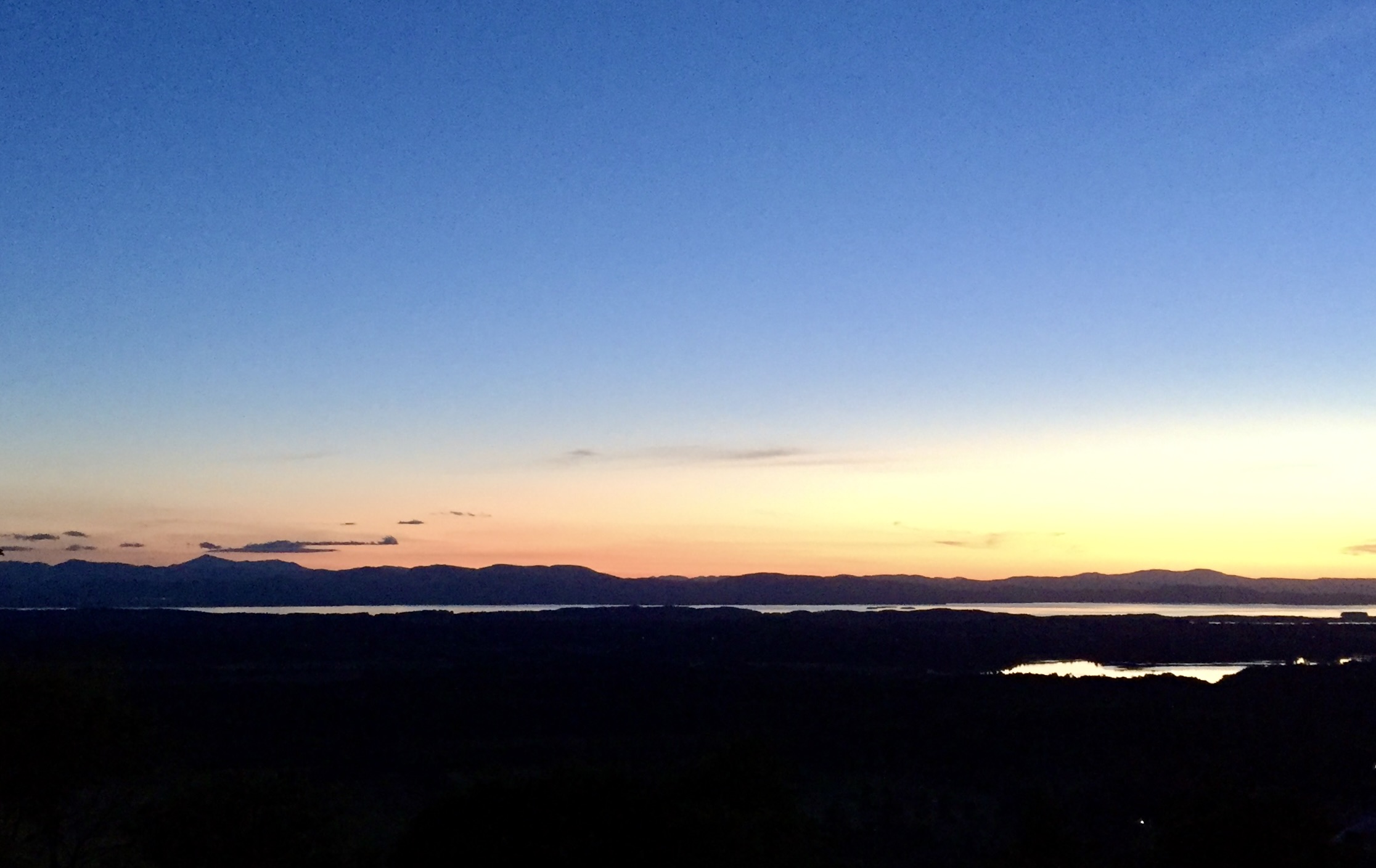
Showing posts with label horizon. Show all posts

Thursday, August 24, 2023

The universe built round us.

August 24. 


Let us wander where we will, the universe is built round about us, and we are central still. 

By reason of this, if we look into the heavens, they are concave, and if we were to look into a gulf as bottomless, it would be concave also. 

The sky is curved downward to the earth in the horizon, because I stand in the plain. I draw down its skirts. 

The stars so low there seem loth to go away from me, but by a circuitous path to be remembering and returning to me. 

H. D Thoreau, Journal, August 24, 1841

Wednesday, November 9, 2022

Distant well-known blue mountains in the horizon - pine leaves are fallen.


November 9.

November 9, 2022

It is a pleasant surprise to walk over a hill where an old wood has recently been cut off, and, on looking round, to see, instead of dense ranks of trees almost impermeable to light, distant well-known blue mountains in the horizon and perchance a white village over an expanded open country. I now take this in preference to all my old familiar walks. So a new prospect and walks can be created where we least expected it.

***

The chickadees, if I stand long enough, hop nearer and nearer inquisitively, from pine bough to pine bough, till within four or five feet, occasionally lisping a note.

The pitcher plant, though a little frost-bitten and often cut off by the mower, now stands full of water in the meadows. I never found one that had not an insect in it. 

***

I found many fresh violets (Viola pedata) to-day (November 9th) in the woods. 

***

The leaves of the larch are now yellow and falling off. 

Just a month ago, I observed that the white pines were parti-colored, green and yellow, the needles of the previous year now falling. Now I do not observe any yellow ones, and I expect to find that it is only for a few weeks in the fall after the new leaves have done growing that there are any yellow and falling, — that there is a season when we may say the old pine leaves are now yellow, and again, they are fallen.

The trees were not so tidy then; they are not so full now. They look best when contrasted with a field of snow.  

H. D. Thoreau, Journal, November 9, 1850

A pleasant surprise to walk over a hill . . . to see. . . distant well-known blue mountains in the horizon and perchance a white village. See November 9, 1851 ("To-day the mountains seen from the pasture above are dark blue, so dark that they look like new mountains and make a new impression, and the intervening town of Acton is seen against them in a new relation, a new neighborhood"); November 11, 1851 ("The horizon has one kind of beauty and attraction to him who has never explored the hills and mountains in it, and another ... to him who has."); November 22, 1860 ("Simply to see to a distant horizon through a clear air, - the fine outline of a distant hill or a blue mountaintop through some new vista, - this is wealth enough for one afternoon.") See also September 12, 1851 ("It is worth the while to see the mountains in the horizon once a day."); October 22, 1857 (" But what a perfect crescent of mountains we have in our northwest horizon! Do we ever give thanks for it?"); November 4, 1857("But those grand and glorious mountains, how impossible to remember daily that they are there, and to live accordingly! They are meant to be a perpetual reminder to us, pointing out the way."); December 8, 1854("Why do the mountains never look so fair as from my native fields?"); See also
A Book of the Seasons
, by Henry Thoreau, Mountains in the Horizon

November 9, 2024
Distant mountain top
as blue to the memory
as now to the eyes.

I found many fresh violets. See  November 7, 1851 ("Viola pedata in blossom."); November 8, 1851 ("Like Viola pedata, I shall be ready to bloom again here in my Indian summer days.") See also 
A Book of the Seasons,  by Henry Thoreau, the Violets

The chickadees, if I stand long enough, hop nearer and nearer See November 8, 1857 ("I do not know exactly what that sweet word is which the chickadee says when it hops near to me now in those ravines.
The chickadee /Hops near to me.") See also 
A Book of the Seasons,by Henry Thoreau, the Chickadee in Winter

The pitcher plant, though a little frost-bitten . . . now stands full of water in the meadows. See November 11, 1858 ("In the meadows the pitcher-plants are bright-red. "); November 15, 1857 ("The water is frozen solid in the leaves of the pitcher plants.") See also A Book of the Seasons, by Henry Thoreau, The Purple Pitcher Plant

The leaves of the larch are now yellow and falling off.  See November 9, 1858 (" The trees on the hill just north of Alcott’s land, which I saw yesterday so distinctly from Ponkawtasset, and thought were either larches or aspens, prove to be larches. On a hill like this it seems they are later to change and brighter now than those in the Abel Heywood swamp, which are brownish-yellow. The first-named larches were quite as distinct amid the pines seen a mile off as near at hand.") See also November 8, 1853("The yellow larch leaves still hold on, — later than those of any of our pines. "); November 13, 1858 ("Larches now look dark or brownish yellow. Now, on the advent of much colder weather, the last Populus tremuliformis has lost its leaves, the sheltered dogwood is withered, and even the scarlet oak may be considered as extinguished, and the larch looks brown and nearly bare."). and 
A Book of the Seasons, by Henry Thoreau, the Larch

It is only for a few weeks in the fall after the new leaves have done growing that there are any yellow and falling. See .November 21, 1850 ("It is remarkable that the old leaves turn and fall in so short a time")

There is a season when we may say the old pine leaves are now yellow, and again, they are fallen.
 
See
A Book of the Seasons
, by Henry Thoreau, The October Pine Fall

November 9. See A Book of the Seasons,  by Henry Thoreau,  November 9

There is a season 
when old pine leaves are yellow – 
then they are fallen.


A Book of the Seasons, by Henry Thoreau
"A book, each page written in its own season,
out-of-doors, in its own locality."
~edited, assembled and rewritten by zphx © 2009-2024

https://tinyurl.com/hdt-501109

Tuesday, September 6, 2022

From Strawberry Hill the first glimpse of Nagog Pond.


September 6

September 6, 2022


2 P. M. — To Hapgood's in Acton direct, returning via Strawberry Hill and Smith's Road.

The ripening grapes begin to fill the air with their fragrance.

The vervain will hardly do for a clock, for I perceive that some later and smaller specimens have not much more than begun to blossom, while most have done.

Saw a tall pear tree by the roadside beyond Harris's in front of Hapgood's.

Saw the lambkill (Kalmia angustifolia) in blossom – a few fresh blossoms at the ends of the fresh twigs-on Strawberry Hill, beautiful bright flowers. Apparently a new spring with it, while seed vessels apparently of this year, hung dry below.

From Strawberry Hill the first, but a very slight, glimpse of Nagog Pond by standing up on the wall. That is enough to relate of a hill, methinks, that its elevation gives you the first sight of some distant lake.

The horizon is remarkably blue with mist this afternoon. Looking from this hill over Acton, successive valleys filled with blue mist appear, and divided by darker lines of wooded hills.

The shadows of the elms are deepened, as if the whole atmosphere were permeated by floods of ether.

Annursnack never looked so well as now seen from this hill.

The ether gives a velvet softness to the whole landscape. The hills float in it. A blue veil is drawn over the earth.

The elecampane (Inula Helenium) with its broad leaves wrinkled underneath and the remains of sunflower-like blossoms, in front of Nathan Brooks's, Acton, and near J. H. Wheeler's.

Prenanthes alba; this Gray calls Nabalus albus, white lettuce or rattlesnake-root. Also I seem (?) to have found Nabalus Fraseri, or lion's foot.

Every morning for a week there has been a fog which all disappeared by seven or eight o'clock.

A large field of sunflowers for hens now in full bloom at Temple's, surrounding the house, and now, at 6 o'clock P. M., facing the east.

The larches in the front yards, both Scotch and American, have turned red. Their fall has come.

H. D. Thoreau, Journal, September 6, 1851

The ripening grapes begin to fill the air with their fragrance. See August 29, 1853 ("Walking down the street in the evening, I detect my neighbor’s ripening grapes by the scent twenty rods off"); August 29, 1859 ("The very earliest ripe grapes begin to be scented in the cool nights "); September 8, 1854 (I bring home a half-bushel of grapes to scent my chamber with"; September 8, 1858 (“Gather half my grapes, which for some time have perfumed the house.”)

The vervain will hardly do for a clock
. Compare August 21, 1851 ("It is very pleasant to measure the progress of the season by this and similar clocks. So you get, not the absolute time, but the true time of the season.") See also A Book of the Seasons, by Henry Thoreau, the Blue Vervain

Saw the lambkill (Kalmia angustifolia) in blossom. See September 10, 1857 ("I see lambkill ready to bloom a second time. Saw it out on the 20th; how long?"); September 19, 1852 ("The Viola lanceolata has blossomed again, and the lambkill. "); September 28, 1852 ("This is the commencement, then, of the second spring. Violets, Potentilla Canadensis, lambkill, wild rose, yellow lily, etc., etc., begin again"); September 29, 1853 ("Lambkill blossoms again.") See also A Book of the Seasons, by Henry Thoreau, Lambkill (Kalmia augustifolia)

Nabalus albus, white lettuce or rattlesnake-root. Also I seem (?) to have found Nabalus Fraseri, or lion's foot. See August 27, 1858 ("The Nabalus albus has been out some ten days, but N. Fraseri at Walden road will not open, apparently, for some days yet."); September 13, 1857 ("Nabalus Fraseri, top of Cliffs, — a new plant, — yet in prime and not long out. The nabalus family generally, apparently now in prime")

From Strawberry Hill the first, but a very slight, glimpse of Nagog Pond . See July 6, 1851 ("The distant hills look unusually near in this atmosphere. Acton meeting-houses seen to stand on the side of some hills, Nagog or Nashoba, beyond, as never before."); August 15, 1854 ("Cross from top of Annursnack to top of Strawberry Hill. The locomotive whistle, far southwest, sounds like a bell. From Strawberry Hill we steer northeast . . . We are completely lost, and see not one familiar object. At length see steeples which we think Westford, but the monument proves it Acton."); January 30, 1860 ("I see, when I look over our landscape from any eminence as far as the horizon, certain rounded hills, amid the plains and ridges and cliffs, which have a marked family likeness, like eggs that belong to one nest though scattered. They suggest a relation geologically. Such are, for instance, Nashoba, Annursnack, Nawshawtuct, and Ponkawtasset, all which have Indian names, as if the Indian, too, had regarded them as peculiarly distinct. There is also Round Hill in Sudbury, and perhaps a hill in Acton")

Looking from this hill over Acton, successive valleys filled with blue mist appear, and divided by darker lines of wooded hills. See November 9, 1851 ("To-day the mountains seen from the pasture above are dark blue, so dark that they look like new mountains and make a new impression, and the intervening town of Acton is seen against them in a new relation, a new neighborhood.")

The shadows of the elms are deepened. See June 2, 1852 ("The elms now hold a good deal of shade and look rich and heavy with foliage. You see darkness in them.")

Thursday, May 20, 2021

It flies through the green foliage as if it would ignite the leaves.


May 20

The 18th and 19th a rather gentle and warm May storm, more rain, methinks, than we have had before this spring at one time.

Began with thunder-showers on the night of the 18th, the flashing van of the storm, followed by the long, dripping main body, with, at very long intervals, an occasional firing or skirmishing in the rear or on the flanks.

6 A. M. To Island by river.

Probably a red-wing blackbird's nest, of grass, hung between two button-bushes; whitish eggs with irregular black marks.

Sarsaparilla (Aralia nudicaulis), probably two days.

White oak, swamp white, and chestnut oak probably will open by the 22d.

The white ashes are in full flower now, and how long ? 8 A. M.-To Flint's Pond.

Cornus Canadensis just out.

Probably the C. florida should be set down to-day, since it just begins to shed pollen and its involucre is more open.

It is a fair but cool and windy day, a strong northwest wind, and the grass, to which the rain has given such a start, conspicuously waves, showing its lighter under side, and the buttercups toss in the wind.

The pitch and white pines have grown from one to five inches.

On Pine Hill.

In this clear morning light and a strong wind from the northwest, the mountains in the horizon, seen against some low, thin clouds in the background, look darker and more like earth than usual; you distinguish forest and pasture on them. This in the clear, cool atmosphere in the morning after a rain-storm, with the wind northwest. They will grow more ethereal, melting into the sky, as the day advances.

The beech is already one of the most densely clothed trees, or rather makes a great show of verdure from the size of its fully expanded light-green leaves, though some are later. The fresh shoots on low branches are five or six inches long.

It is an interesting tree to me, with its neat, close, tight-looking bark, like the dress which athletes wear, its bare instep, and roots beginning to branch like bird's feet, showing how it is planted and holds by the ground. Not merely stuck in the ground like a stick.

It gives the beholder the same pleasure that it does to see the timbers of a house above and around.

Do they blossom here? I found nuts, but apparently not sound, at Haverhill the other day,-last year's.

There are some slender, perfectly horizontal limbs which go zigzagging, as it were creeping through the air, only two or three feet above the ground, over the side-hill, as if they corresponded to concealed rills in the ground beneath.

Plenty of arums now in bloom. Probably my earliest one was in bloom, for I did not look within it.

What is that pretty, transparent moss in the brooks, which holds the rain or dewdrops so beautifully on the undersides of the leafets, through which they sparkle crystallinely? 

Fresh checkerberry shoots now.

The cedars are full of yellowish cedar apples and minute berries just formed, the effete staminiferous blossom still on. When did they begin to bloom? 

I find none of the rare hedyotis yet on Bare Hill.

The peach bloom is now gone and the apple bloom come.

Heard the seringo note, like a rattling watch-spring, from a flock passing swiftly overhead.

The wind makes such a din in the woods that the notes of birds are lost, and added to this is the sound of the waves of Flint's Pond breaking on the shore, the fresh su
rf. The pond is spotted with whitecaps, five or six feet long by one foot, like a thin flock of sheep running toward the southeast shore. The smallest lakes can be lashed into a sort of fury by the wind, and are quite ocean-like then. These caps are a striving to dilute the water with air.

The barberry will probably blossom to-day.

Here, by the side of the pond, a fire has recently run through the young woods on the hillside. It is surprising how clean it has swept the ground; only the very lowest and dampest rotten leaves remaining, but uvularias and smilacinas have pushed up here and there conspicuously on the black ground, a foot high.

At first you do not observe the full effect of the fire, walking amid the bare dead or dying trees, which wear a perfect winter aspect, which, as trees generally are not yet fully leaved out and you are still used to this, you do not notice, till you look up and see the still green tops everywhere above the height of fifteen feet.

Yet the trees do not bear many marks of fire commonly; they are but little blackened except where the fire has run a few feet up a birch, or paused at a dry stump, or a young evergreen has been killed and reddened by it and is now dropping a shower of red leaves.

Hemlock will blossom to-morrow.

The geranium is just out, 


May 20, 2018

and the lady’s-slipper. 

Some with old seed vessels are still seen.

Hear again, what I have heard for a week or more sometimes, that rasping, springy note, a very hoarse chirp, ooh, twee twee twee, from a bluish bird as big as a bluebird, with some bright yellow about head, white beneath and lateral tail-feathers, and black cheeks (?).

This and that sort of brown-creeper-like bird of May 12 — and the chickadee-like bird (which may be the chickadee), and the ah te ter twee of deep pine woods (which also may be the chickadee), I have not identified.

Arbor-vitæ has been out some time and the butter nut some days.

Mountain-ash on the 18th.

Larch apparently ten days.

Nemopanthes several days.

The swamp blueberry abundantly out.

Saw a tanager in Sleepy Hollow. It most takes the eye of any bird. You here have the red-wing reversed,-the deepest scarlet of the red-wing spread over the whole body, not on the wing-coverts merely, while the wings are black. It flies through the green foliage as if it would ignite the leaves.

Of deciduous trees and shrubs, the latest to leaf out, as I find by observation to-day, must be the panicled andromeda, rhodora, and button-bush.

In some places, however, the first has perfectly formed leaves, the rhodora at most not half unfolded, the button-bush for the most part just bursting buds.

But I have not seen the prinos and perhaps one or two other shrubs.

I have no doubt that the button-bush may be called the latest of all.

Is that female ash by river at Lee's Hill a new kind
? In bloom fully May 18th.

Even this remote forest, which stands so far away and innocent, has this terrible foe Fire to fear. Lightning may ignite a dead tree or the dry leaves, and in a few minutes a green forest be blackened and killed. This liability to accident from which no part of nature is exempt.

Plucked to-day a bunch of Viola pedata, consisting of four divisions or offshoots around a central or fifth root, all united and about one inch in diameter at the ground and four inches at top. [contained 49 Flowers, 22 Buds] And perhaps more buds would still make their appearance, and undoubtedly half a dozen more would have blown the next day. Forming a complex, close little testudo of violet scales above their leaves.

H. D. Thoreau, Journal, May 20, 1853

Probably a red-wing blackbird's nest, of grass, hung between two button-bushes; whitish eggs with irregular black marks. See May 25, 1855 ("Red-wing’s nest with four eggs. . .curiously and neatly marked with brown-black spots and lines on the large end.”); June 1, 1857 ("A red-wing's nest, four eggs, . . the hieroglyphics on these eggs . . ..who determines the style of the marking?") See See also A Book of the Seasons, by Henry Thoreau, the Red-wing in Spring

It flies through the green foliage as if it would ignite the leaves
. See   May 20, 1858 ("See tanagers, male and female, in the top of a pine, one red, other yellow, from below. We have got to these high colors among birds.") See also  A Book of Seasons, by Henry Thoreau, the Scarlet Tanager

The lady’s-slipper just out. See May 20, 1852 ("A lady’s-slipper well budded and now white."); see also May 18, 1851 ("Lady's-slipper almost fully blossomed”).; May 19, 1860 (“At the Ministerial Swamp I see a white lady's-slipper almost out, fully grown, with red ones.”); May 30, 1858 ("Hear of lady's-slipper seen the 23d; how long?")

Friday, April 30, 2021

Now is the time to set trees and consider what things you will plant in your garden.


April 30. 

2 P. M. Down the Boston road and across to Turnpike, etc., etc. 


The elms are now generally in blossom and Cheney's elm still also.

The last has leaf - buds which show the white.

Now, before any leaves have appeared, their blossoms clothe the trees with a rich, warm brown color, which serves partially for foliage to the street walker, and makes the tree more obvious. Held in the hand, the blossoms of some of the elms are quite rich and variegated, now purple and yellowish specked with the dark anthers and two light styles.

I know not why some should be so much earlier than others.


It is a beautiful day, - a mild air, — and all farmers and gardeners out and at work.

Now is the time to set trees and consider what things you will plant in your garden.

Yesterday I observed many fields newly plowed, the yellow soil looking very warm and dry in the sun; and one boy had fixed his handkerchief on a stick and elevated it on the yoke, where it flapped or streamed and rippled gayly in the wind, as he drove his oxen dragging a harrow over the plowed field.

I see now what I should call a small-sized bullfrog in the brook in front of Alcott's house that was.


The sweet gale is in blossom.  Its rich reddish-brown buds have expanded into yellowish and brown blossoms, all male blossoms that I see.  Those handsome buds that I have observed are the male blossom buds then. This has undoubtedly been in bloom a day or two in some places.


I saw yesterday a large-sized water-bug; to-day many in the brook; yesterday a trout; to-day shiners, I think.

The huckleberry-bird sings.


When I look, the inhabitants are beginning to plant in their gardens, the air is so fine and peculiar that I seem to see the hills and woods through a mirage. I am doubtful about their distance and exact form and elevation. The sound of a spade, too, sounds musical on the spring air.

(To-night for the first time I sit without a fire.)

One plower in a red flannel shirt, who looks picturesquely under the hill, suggests that our dress is not commonly of such colors as to adorn the landscape.

(To-night and last night the spearer's light is seen on the meadows; he has been delayed by the height of the water.)


I like very well to walk here on the low ground on the meadow; to see the churches and houses in the horizon against the sky and the now very blue Mt. Wachusett seeming to rise from amid them. When you get still further off on the lowest ground, you see distant barns and houses against the horizon, and the mountain appears to preside over this vale alone, which the adjacent hills on right and left fence in.


The season advances by fits and starts; you would not believe that there could be so many degrees to it. If you have had foul and cold weather, still some advance has been made, as you find when the fair weather comes, new lieferungs of warmth and summeriness, which make yesterday seem far off and the dog-days or midsummer incredibly nearer.

Yesterday I would not have believed that there could have been such an improvement on that day as this is, short of midsummer or June.

My pocket being full of the flowers of the maple, elm, etc., my handkerchief by its fragrance reminded me of some fruitful or flowery bank, I know not where.

A pleasant little
green knoll north of the Turnpike
near the Lincoln line.

I thought that the greenness of the sward there on the highest ground was occasioned by the decay of the roots of two oaks, whose old stumps still remained.

The greenness covered a circle about two rods in diameter.

It was too late to feel the influence of the drip of the trees.

We have had no such summer heat this year (unless when I was burned in the Deep Cut), yet there is an agreeable balmy wind.

I see here, while looking for the first violet, those little heaps made by the mole cricket (?), or by worms (?)

I observe to-day the bright-crimson (?) perfect flowers of the maple, —  crimson styles, sepals, and petals (crimson or scarlet ?), — whose leaves are not yet very handsome in the rain as you look to the sky; and the hum of small bees from them. So much color have they.


Crossing the Turnpike, we entered Smith's high lands.

Dodging behind a swell of land to avoid the men who were plowing, I saw unexpectedly (when I looked to see if we were concealed by the field) the blue mountains' line in the west (the whole intermediate earth and towns being concealed), this greenish field for a foreground sloping upward a few rods, and then those grand mountains seen over it in the background, so blue, — seashore, earth-shore, — and, warm as it is, covered with snow which reflected the sun.

Then when I turned, I saw in the east, just over the woods, the modest, pale, cloud-like moon, two thirds full, looking spirit-like on these daylight scenes.  Such a sight excites me.

The earth is worthy to inhabit.

The far river-reach from this hill.

It is not so placid a blue as if with a film of azure over it to-day, however. The more remote the water, the lighter the blue, perchance.

It is like a lake in Tartary; there our camels will find water.

Here is a rock made to sit on, — large and inviting, which you do not fear to crush.

I hear the flicker and the huckleberry bird.

Yet no leaves apparent.

This in some measure corresponds to the fine afternoon weather after the leaves have fallen, though there is a different kind of promise now than then.  We are now going out into the field to work; then we were going into the house to think.

I love to see alders and dogwood instead of peach trees.

May we not see the melted snow lapsing over the rocks on the mountains in the sun, as well as snow? The white surfaces appear declivitous.

While we sit here, I hear for the first time the flies buzz so dronishly in the air.

I see travellers like mere dark objects in the yellow road afar, — the Turnpike.

Hosmer's house and cottage under its elms and on the summit of green smooth slopes looks like a terrestrial paradise, the abode of peace and domestic happiness.

Far over the woods westward, a shining vane, glimmering in the sun.

At Saw Mill Run the swamp (?) gooseberry (is it?) is partly leaved out.

This, being in the shade of the woods, and not, like the thimble-berry, in a warm and sunny place, methinks is the earliest shrub or tree that shows leaves.
[The Missouri currant in gardens is equally forward; the cultivated gooseberry nearly so; the lilac not so.]

The neatly and closely folded, plaited, leaves of the hellebore are rather handsome objects now.

As you pull them apart, they emit a slight marshy scent, somewhat like the skunk-cabbage.

They are tender and dewy within, folded fan-like.

I hear a wood thrush here, with a fine metallic ring to his note. This sound most adequately expresses the immortal beauty and wildness of the woods.

I go in search of him. He sounds no nearer.

On a low bough of a small maple near the brook in the swamp, he sits with ruffled feathers, singing more low or with less power, as it were ventriloquizing; for though I am scarcely more than a rod off, he seems further off than ever.


Caught three little peeping frogs.

When I approached, and my shadow fell on the water, I heard a peculiarly trilled and more rapidly vibrated note, somewhat, in kind, like that which a hen makes to warn her chickens when a hawk goes over, and most stopped peeping; another trill, and all stopped.

It seemed to be a note of alarm.

I caught one. It proved to be two coupled. They remained together in my hand.

This sound has connection with their loves probably.

(I hear a trilled sound from a frog this evening. It is my dreaming midsummer frog, and he seems to be toward the depot.) 

I find them generally sitting on the dead leaves near the water's edge, from which they leap into the water.
 

On the hill behind Hosmer's, half an hour before sunset --  

The hill on the Boston road is very handsome with its regular promontories, and the smokes seen against it rising from the chimneys, what time the laborer takes his tea.

The robins sing power fully on the elms; the little frogs peep; the woodpecker's harsh and long-continued cry is heard from the woods; the huckleberry-bird's simple, sonorous trill.

The plowed land shines where a drag has passed over it.

It is a pleasant place for a house, because you overlook the road, and the near land seems to run into the meadow.

Saw male willow catkins in Tuttle's lane, now just out of bloom, about two inches long.

The flower of some of the earliest elms is by no means to be despised at this season.

It is conspicuous and rich in any nosegay that can now be made.

The female plants of the sweet-gale are rare (?) here. The scales of the male catkins are "set with amber-colored resinous dots” (Emerson).


H. D. Thoreau, Journal, April 30, 1852

The sweet gale is in blossom. Its rich reddish-brown buds have expanded into yellowish and brown blossoms, all male blossoms that I see. See April 13, 1860 ("– I go up the Assabet to look at the sweet-gale, which is . . . abundantly out at Pinxter Swamp."); April 22, 1855 ("The blossoms of the sweet-gale are now on fire over the brooks, contorted like caterpillars.") December 31, 1859 ("The oblong-conical sterile flower-buds or catkins of the sweet-gale, half a dozen at the end of each black twig, dark-red, oblong-conical, spotted with black, and about half an inch long, are among the most interesting buds of the winter. . . . The sterile and fertile flowers are not only on distinct plants, but they commonly grow in distinct patches. . . . It grows along the wet edge of banks and the river and in open swamps.")

The huckleberry-bird sings. See April 27, 1852 ("Heard the field or rush sparrow this morning (Fringilla juncorum), George Minott's "huckleberry-bird." It sits on a birch and sings at short intervals, apparently answered from a distance. It is clear and sonorous heard afar; but I found it quite impossible to tell from which side it came; sounding like phe, phe, phe, pher-pher-tw-tw-tw-t-t-t-t, — the first three slow and loud, the next two syllables quicker, and the last part quicker and quicker, becoming a clear, sonorous trill or rattle, like a spoon in a saucer.") See also A Book of the Seasons, by Henry Thoreau, The Field Sparrow

The season advances by fits and starts. . . lieferungs of warmth and summeriness, which make yesterday seem far off and the dog-days or midsummer incredibly nearer. See April 25, 1854 ("The summer approaches by almost insensibly increasing lieferungs of heat, each awakening some new bird or quadruped or reptile.")

So much color have they. See April 29, 1856 ("How pretty a red maple in bloom (they are now in prime), seen in the sun against a pine wood, . . . they are of so cheerful and lively a color."); April 29, 1859 ("Those red maples are reddest in which the fertile flowers prevail.") See also A Book of the Seasons,  by Henry Thoreau, The Red Maple

Then when I turned, I saw in the east, just over the woods, the modest, pale, cloud-like moon, two thirds full, looking spirit-like on these daylight scenes. See June 30, 1852 (" Moon nearly full; rose a little before sunset. . . . At first a mere white cloud."); See also April 12, 1851 (" I realize that I may not see her again in her glory this night, that. . . the sun will have risen, and she will appear but as a cloud herself, and sink unnoticed into the west.")

To see the churches and houses in the horizon against the sky and the now very blue Mt. Wachusett seeming to rise from amid them. See December 27, 1853 ("The outline of the mountains is wonderfully distinct and hard, and they are a dark blue and very near. Wachusett looks like a right whale over our bow, plowing the continent, with his flukes well down.")

On the hill behind Hosmer's, half an hour before sunset --See May 17, 1853 ("Ah, the beauty of this last hour of the day — when a power stills the air and smooths all waters and all minds — that partakes of the light of the day and the stillness of the night")

Saturday, December 19, 2020

A twilight sound in the night of the year.


December 19

In all woods is heard now far and near the sound of the woodchopper's axe, a twilight sound, now in the night of the year, men having come out for fuel to the forests, as if men had stolen forth in the arctic night to get fuel to keep their fires a-going.

Men go to the woods now for fuel who never go other time.

Why should it be so pleasing to look into a thick pine wood where the sunlight streams in and gilds it?

The sound of the axes far in the horizon sounds like the dropping of the eaves. 


Now the sun sets suddenly without a cloud – & with scarcely any redness following so pure is the atmosphere – only a faint rosy blush along the horizon.


H. D. Thoreau, Journal, December 19, 1851

In all woods is heard now far and near the sound of the woodchopper's axe. See  December 9, 1856 ("I hear only the strokes of a lingering woodchopper at a distance, and the melodious hooting of an owl."); December 15, 1856 (“The last strokes of the woodchopper, who presently bends his steps homeward”);  December 20, 1854 ("The woodchoppers are making haste to their work far off, walking fast to keep warm, before the sun has risen, their ears and hands well covered, the dry, cold snow squeaking under their feet."); January 8, 1852 ("Even as early as 3 o'clock these winter afternoons the axes in the woods sound like nightfall, like the sound of a twilight labor."); January 9, 1855 ("This winter I hear the axe in almost every wood of any consequence left standing in the township."); January 21, 1852 ("This winter they are cutting down our woods more seriously than ever. . . Thank God, they cannot cut down the clouds!"); February 17, 1852 ("The shortness of the days, when we naturally look to the heavens and make the most of the little light, when we live an arctic life, when the woodchopper's axe reminds us of twilight at 3 o'clock p. m., when the morning and the evening literally make the whole day"); March 11, 1852 (The woods I walked in in my youth are cut off. Is it not time that I ceased to sing?").

Why should it be so pleasing to look into a thick pine wood where the sunlight streams in and gilds it? See December 3, 1856   ("The pine forest's edge seen against the winter horizon . . .The silvery needles of the pine straining the light.");  December 21, 1851 ("Sunlight on pine-needles is the phenomenon of a winter day.")

So pure is the atmosphere, only a faint rosy blush along the horizon. See December 21, 1851 ("Long after the sun has set . . . some rosy clouds will be seen in the upper sky over the portals of the darkening west."); December 24, 1851 (“When I had got home and chanced to look out the window from supper, I perceived that all the west horizon was glowing with a rosy border.”); December 25, 1851 (“I go forth to see the sun set. Who knows how it will set, even half an hour beforehand?”); January 5, 1853 ("A fine rosy sky in the west after sunset; and later an amber-colored horizon.")

December 19. See A Book of the Seasons,  by Henry Thoreau,  December 19

Suddenly sunset
horizon without a cloud –
a faint rosy blush.

Twilight sound now heard far and near – woodchopper's axe the night of the year.


A Book of the Seasons
,  by Henry Thoreau, 
"A book, each page written in its own season,
out-of-doors, in its own locality.”
~edited, assembled and rewritten by zphx © 2009-2025

https://tinyurl.com/hdt-511219

Wednesday, September 23, 2020

A farmer in his field.


September 23

P. M. — Round by Clematis Brook.

The forget-me-not still.

I observe the rounded tops of the dogwood bushes, scarlet in the distance, on the edge of the meadow (Hubbard's), more full and bright than any flower.

The maples are mostly darker, the very few boughs that are turned, and the tupelo, which is reddening.

The ash is just beginning to turn.

The scarlet dogwood is the striking bush to-day.

I find huckleberries on Conantum still sound and blackening the bushes.

How much longer a mile appears between two blue mountain peaks thirty or more miles off in the horizon than one would expect!

Some acorns and hickory nuts on the ground, but they have not begun to shell.

Is it the nut of the Carya amara, with raised seams, but not bitter, that I perceive?

I suppose that is the Carya tomentosa, or mockernut hickory, with large rounded nuts on Lee's land.

The bitternuts (?), rubbed together, smell like varnish.

The sarothra in bloom.

The wind from the north has turned the white lily pads wrong side up, so that they look red, and their stems are slanted up-stream.

Almost all the yellow ones have disappeared.

September 23, 2018

A blue-stemmed goldenrod, its stem and leaves red.

The woodbine high on trees in the shade a delicate pink.

I gathered some haws very good to eat to-day. I think they must be the senelles of the Canadians.

Hamamelis Virginiana out, before its leaves fall.

A woodchuck out.

The waxwork not opened.

The "feathery tails" of the clematis fruit conspicuous and interesting now.

Yellow lily out (again?) in the pond-holes.

Passing a corn-field the other day, close by a hat and coat on a stake, I recognized the owner of the farm. Any of his acquaintances would. He was only a trifle more weather-[beaten] than when I saw him last. His back being toward me, I missed nothing, and I thought to myself if I were a crow I should not fear the balance of him, at any rate.

In northern latitudes, where other edible fruits are scarce, they make an account of haws and bunch-berries.

The barberry bushes in Clematis Hollow are very beautiful now, with their wreaths of red or scarlet fruit drooping over a rock.

H. D. Thoreau, Journal, September 23, 1852


The scarlet dogwood is the striking bush to-day. See note to September 25, 1852 ("The scarlet of the dogwood is the most conspicuous and interesting of the autumnal colors at present.")

A blue-stemmed goldenrod, its stem and leaves red. See September 23, 1860 ("I see everywhere in the shady yew wood those pretty round-eyed fungus-spots on the upper leaves of the blue-stemmed goldenrod, contrasting with the few bright-yellow flowers above them, -- yellowish-white rings (with a slate-colored centre), surrounded by green and then dark."); See also November 10, 1858 ("In the path below the Cliff, I see some blue-stemmed goldenrod turned yellow as well as purple.") and 
A Book of the Seasons,  by Henry Thoreau, Blue-stemmed Goldenrod (solidago caesia)

How much longer a mile appears between two blue mountain peaks thirty or more miles off in the horizon. See March 31, 1853 ("It is affecting to see a distant mountain-top,. . . still as blue and ethereal to your eyes as is your memory of it.'); May 17, 1858 ("I doubt if in the landscape there can be anything finer than a distant mountain-range. They are a constant elevating influence."); August 14, 1854 (“I have come forth to this hill at sunset to see the forms of the mountains in the horizon.— to behold and commune with something grander than man. “); August 30, 1854 ("The clearness of the air makes it delicious to gaze in any direction. . . ., and I see with new pleasure to distant hillsides and farmhouses . . and to the mountains in the horizon."); October 20, 1852 ("This is an advantage of mountains in the horizon: they show you fair weather from the midst of foul."); October 22, 1857 ("But what a perfect crescent of mountains we have in our northwest horizon! Do we ever give thanks for it? "); November 4, 1857 ("But those grand and glorious mountains, how impossible to remember daily that they are there, and to live accordingly! They are meant to be a perpetual reminder to us, pointing out the way."): November 22, 1860 ("Simply to see to a distant horizon through a clear air, - the fine outline of a distant hill or a blue mountaintop through some new vista, - this is wealth enough for one afternoon.")  

The wind from the north has turned the white lily pads wrong side up, so that they look red. See June 29, 1852 ("The wind exposes the red undersides of the white lily pads. This is one of the aspects of the river now."); August 24,1854 ("The bright crimson-red under sides of the great white lily pads, turned up by the wind in broad fields on the sides of the stream, are a great ornament to the stream. It is not till August, methinks, that they are turned up conspicuously.”)

Carya amara, bitternut -- Carya tomentosa, mockernut hickory,( North American hickories include:

·        Carya glabra – pignut hickory

·       Carya laciniosa - shagbark hickory

·     Carya ovata – shagbark hickory

·      Carya texana  black hickory

·      Carya tomentosa  – mockernut hickory

·      Carya cordiformis (amara)  – bitternut hickory)


Saturday, June 27, 2020

Fishing for the Pond.


Very cool day.

Had for dinner a pudding made of service-berries.

It was very much like a rather dry cherry pudding without the stones.

A slight hail-storm in the afternoon. [see after the rain]

Euphorbia maculata.

Our warmest night thus far this year was June 21st.

It began to be cooler the 24th.
  
5.30 P. M. – To Cliffs.

Carrot by railroad.

Mine apparently the Erigeron strigosus, yet sometimes tinged with purple.

The tephrosia is an agreeable mixture of white, straw color, and rose pink; unpretending.

What is the result of that one leaf (or more), much and irregularly, or variously, divided and cut, with milk in it, in woods, either a lactuca or prenanthes, probably, one foot or more high? 


Such is oftenest the young man’s introduction to the forest and wild.

He goes thither at first as a hunter and fisher, until at last the naturalist or poet distinguishes that which attracted him and leaves the gun and fishing-rod behind.

The mass of men are still and always young in this respect.

I have been surprised to observe that the only obvious employment which ever to my knowledge detained at Walden Pond for a whole half-day, unless it was in the way of business, any of my “fellow-citizens,” whether fathers or children of the town, with just one exception, was fishing.

They might go there a thousand times, perchance, before the sediment of fishing would sink to the bottom and leave their purpose pure, — before they began to angle for the pond itself.

Thus, even in civilized society, the embryo man (speaking intellectually) passes through the hunter stage of development.

They did not think they were lucky or well paid for their time unless they got a long string of fish, though they had the opportunity of seeing the pond all the while.

They measured their success by the length of a string of fish.

The Governor faintly remembers the pond, for he went a-fishing there when he was a boy, but now he is too old and dignified to go a-fishing, and so he knows it no longer.

If the Legislature regards it, it is chiefly to regulate the number of hooks to be used in fishing there, but they know nothing about the hook of hooks.

   
H. D. Thoreau, Journal, June 26, 1853

They might go there a thousand times, perchance, before the sediment of fishing would sink to the bottom and leave their purpose pure, — before they began to angle for the pond itself. See January 26, 1853 ("Now I go a-fishing and a-hunting every day, but omit the fish and the game  which are the least important part. ");  December 2, 1856 ("There they sit, ever and anon scanning their reels to see if any have fallen, and, if not catching many fish, still getting what they went for, though they may not be aware of it, i. e. a wilder experience than the town affords.") ; October 4, 1858 ("There he stands at length, per chance better employed than ever, holding communion with nature and himself and coming to understand his real position and relation to men in this world. ")

At length the fisher
leaves rod behind and angles
for the pond itself.


Wednesday, June 10, 2020

The cool peep of the robin calling to its young.

June 10.

Friday.

June 10, 2016

Another great fog this morning.

Haying commencing in front yards.

P. M. – To Mason ‘s pasture in Carlisle.

Cool but agreeable easterly wind.

Streets now beautiful with verdure and shade of elms, under which you look, through an air clear for summer, to the woods in the horizon.

By the way, I amused myself yesterday afternoon with looking from my window, through a spy glass, at the tops of the woods in the horizon.

It was pleasant to bring them so near and individualize the trees, to examine in detail the tree-tops which before you had beheld only in the mass as the woods in the horizon.

It was an exceedingly rich border, seen thus against (sic), and the imperfections in a particular tree-top more than two miles off were quite apparent.

I could easily have seen a hawk sailing over the top of the wood, and possibly his nest in some higher tree.

Thus to contemplate, from my attic in the village, the hawks circling about their nests above some dense forest or swamp miles away, almost as if they were flies on my own premises! I actually distinguished a taller white pine with which I am well acquainted, with a double top rising high above the surrounding woods, between two and three miles distant, which, with the naked eye, I had confounded with the nearer woods.

But to return, as C. and I go through the town, we hear the cool peep of the robin calling to its young, now learning to fly.

The locust bloom is now perfect, filling the street with its sweetness, but it is more agreeable to my eye than my nose.

The curled dock out.

The fuzzy seeds or down of the black (?) willows is filling the air over the river and, falling on the water, covers the surface.

By the 30th of May, at least, white maple keys were falling. How early, then, they had matured their seed!

Cow-wheat out, and Iris Virginica, and the grape.

The mountain laurel will begin to bloom to-morrow.

The frost some weeks since killed most of the buds and shoots, except where they were protected by trees or by themselves, and now new shoots have put forth and grow four or five inches from the sides of what were the leading ones.

It is a plant which plainly requires the protection of the wood. It is stunted in the open pasture.

We continued on, round the head of “Cedar Swamp,” and may say that we drank at the source of it or of Saw Mill Brook, where a spring is conducted through a hollow log to a tub for cattle.

Crossed on to the old Carlisle road by the house north of Isaiah Green ‘s, and then across the road through the woods to the Paul Adams house by Bateman‘s Pond.

Saw a hog-pasture of a dozen acres in the woods, with thirty or forty large hogs and a shelter for them at night, a half-mile east of the last house, — something rare in these days here abouts.

What shall this great wild tract over which we strolled be called?

Many farmers have pastures there, and wood-lots, and orchards. It consists mainly of rocky pastures.

It contains what I call the Boulder Field, the Yellow Birch Swamp, the Black Birch Hill, the Laurel Pasture, the Hog-Pasture, the White Pine Grove, the Easterbrooks Place, the Old Lime-Kiln, the Lime Quarries, Spruce Swamp, the Ermine Weasel Woods; also the Oak Meadows, the Cedar Swamp, the Kibbe Place, and the old place northwest of Brooks Clark‘s.

Ponkawtasset bounds it on the south.

There are a few frog-ponds and an old mill-pond within it, and Bateman‘s Pond on its edge.

What shall the whole be called?

The old Carlisle road, which runs through the middle of it, is bordered on each side with wild apple pastures, where the trees stand without order, having, many if not most of them, sprung up by accident or from pomace sown at random, and are for the most part concealed by birches and pines.

These orchards are very extensive, and yet many of these apple trees, growing as forest trees, bear good crops of apples.

It is a paradise for walkers in the fall.

There are also boundless huckleberry pastures as well as many blueberry swamps.

Shall we call it the Easterbrooks Country? It would make a princely estate in Europe, yet it is owned by farmers, who live by the labor of their hands and do not esteem it much.

Plenty of huckleberries and barberries here.

A second great uninhabited tract is that on the Marlborough road, stretching westerly from Francis Wheeler‘s to the river, and beyond about three miles, and from Harrington‘s on the north to Dakin‘s on the south, more than a mile in width.

A third, the Walden Woods.

A fourth, the Great Fields.

These four are all in Concord.

There are one or two in the town who probably have Indian blood in their veins, and when they exhibit any unusual irascibility, their neighbors say they have got their Indian blood roused.

C. proposes to call the first-named wild the Melvin Preserve, for it is favorite hunting-ground with George Melvin. It is a sort of Robin Hood Ground.

Shall we call it the Apple Pastures?

Now, methinks, the birds begin to sing less tumultuously, with, as the weather grows more constantly warm, morning and noon and evening songs, and suitable recesses in the concert.

High blackberries conspicuously in bloom, whitening the side of lanes.

Mention is made in the Town Records, as quoted by Shattuck, page 33, under date of 1654, of “the Hogepen-walke about Annursnake," and reference is at the same time made to “the old hogepen.” The phrase is “in the Hogepen-walke about Annursnake," i. e. in the hog-pasture.

There is some propriety in calling such a tract a walk, methinks, from the habit which hogs have of walking about with an independent air and pausing from time to time to look about from under their flapping ears and snuff the air.

The hogs I saw this afternoon, all busily rooting without holding up their heads to look at us, — the whole field looked as if it had been most miserably plowed or scarified with a harrow, — with their shed to retreat to in rainy weather, affected me as more human than other quadrupeds.

They are comparatively clean about their lodgings, and their shed, with its litter bed, was on the whole cleaner than an Irishman ‘s shanty.

I am not certain what there was so very human about them.

In 1668 the town had a pasture near Silas Holden‘s and a herd of fifty cattle constantly watched by a “herdsman,” etc. (page 43).

In 1672 there is an article referring to the “crane field and brickil field.”

H. D. Thoreau, Journal, June 10, 1853


Streets now beautiful with verdure and shade of elms, under which you look, through an air clear for summer, to the woods in the horizon. See May 27, 1853 ("A new season has commenced - summer - leafy June. The elms begin to droop and are heavy with shade."); June 2, 1852 ("The elms now hold a good deal of shade and look rich and heavy with foliage. You see darkness in them"); June 4, 1860 ("The foliage of the elms over the street impresses me as dense and heavy already."); June 9, 1856 ("Now I notice where an elm is in the shadow of a cloud,—the black elm-tops and shadows of June. It is a dark eyelash which suggests a flashing eye beneath")

I amused myself yesterday afternoon with looking from my window, through a spy glass. See June 9, 1853 ("I have come with a spy-glass to look at the hawks.")

Crossed on to the old Carlisle road by the house north of Isaiah Green ‘s, and then across the road through the woods . . . saw a hog-pasture of a dozen acres in the woods, with thirty or forty large hogs. See September 19, 1851 ("Mr. Isaiah Green of Carlisle. . .spoke of one old field, now grown up, which [we] were going through, as the "hog-pasture.");  October 3, 1859 ("Looking from the hog-pasture over the valley of Spencer Brook westward, we see the smoke rising from a huge chimney above a gray roof amid the woods, at a distance, where some family is preparing its evening meal.")

Shall we call it the Easterbrooks Country? See October 20, 1857 (“What a wild and rich domain that Easterbrooks Country . . . the miles of huckleberries, and of barberries, and of wild apples, so fair, both in flower and fruit,”); October 15, 1859 (“Each town should have a park, or rather a primitive forest, of five hundred or a thousand acres, where a stick should never be cut for fuel, a common possession forever, for instruction and recreation. . . All Walden Wood might have been preserved for our park forever, with Walden in its midst, and the Easterbrooks Country, an unoccupied area of some four square miles, might have been our huckleberry-field”) See also A Book of the Seasons, by Henry Thoreau, The Cedar Swamps

We hear the cool peep of the robin calling to its young, now learning to fly. See June 9, 1856 ("A young robin abroad. ");  June 18, 1854 ("I think I heard the anxious peep of a robin whose young have just left the nest.") See also A Book of the Seasons,  by Henry Thoreau,  Robins in Spring

The locust bloom is now perfect, filling the street with its sweetness. See June 7, 1854 ("The locusts so full of pendulous white racemes five inches long, filling the air with their sweetness and resounding with the hum of humble and honey bees"); June 9, 1852 ("The locust in bloom"); June 11, 1856 ("The locust in graveyard shows but few blossoms yet.")

June 10. 
See A Book of the Seasons, by Henry Thoreau, June 10

The cool peep of the 
robin calling to its young
now learning to fly.

A Book of the Seasons, by Henry Thoreau
"A book, each page written in its own season,
out-of-doors, in its own locality."

~edited, assembled and rewritten by zphx © 2009-2025

https://tinyurl.com/hdt-530610

Popular Posts Last 30 Days.

The week ahead in Henry’s journal

The week ahead in Henry’s journal
A journal, a book that shall contain a record of all your joy.
"A stone fruit. Each one yields me a thought." ~ H. D. Thoreau, March 28, 1859


I sit on this rock
wrestling with the melody
that possesses me.