Showing posts with label Cliffs. Show all posts

Thursday, November 25, 2021

The satisfaction of existence.


November 25


I feel a little alarmed when it happens that I have walked a mile into the woods bodily, without getting there in spirit. 

November 25, 2017

I would fain forget all my morning's occupation, my obligations to society. But some times it happens that I cannot easily shake off the village; the thought of some work, some surveying, will run in my head, and I am not where my body is, I am out of my senses.

In my walks I would return to my senses like a bird or a beast.

What business have I in the woods, if I am thinking of something out of the woods?

This afternoon, late and cold as it is, has been a sort of Indian summer. Indeed, I think that we have summer days from time to time the winter through, and that it is often the snow on the ground makes the whole difference.

This afternoon the air was indescribably clear and exhilarating, and though the thermometer would have shown it to be cold, I thought that there was a finer and purer warmth than in summer; a wholesome, intellectual warmth, in which the body was warmed by the mind's contentment. The warmth was hardly sensuous, but rather the satisfaction of existence.


I found Fair Haven skimmed entirely over, though the stones which I threw down on it from the high bank on the east broke through.Yet the river was open.

The landscape looked singularly clean and pure and dry, the air, like a pure glass, being laid over the picture, the trees so tidy, stripped of their leaves; the meadows and pastures, clothed with clean dry grass, looked as if they had been swept; ice on the water and winter in the air, but yet not a particle of snow on the ground.

The woods, divested in great part of their leaves, are being ventilated.

It is the season of perfect works, of hard, tough, ripe twigs, not of tender buds and leaves. The leaves have made their wood, and a myriad new withes stand up all around pointing to the sky, able to survive the cold.

It is only the perennial that you see, the iron age of the year.

These expansions of the river skim over before the river itself takes on its icy fetters. What is the analogy?


I saw a muskrat come out of a hole in the ice. He is a man wilder than Ray or Melvin. While I am looking at him, I am thinking what he is thinking of me. He is a different sort of a man, that is all.

He would dive when I went nearer, then reappear again, and had kept open a place five or six feet square so that it had not frozen, by swimming about in it. Then he would sit on the edge of the ice and busy himself about something, I could not see whether it was a clam or not.

What a cold blooded fellow! thoughts at a low temperature, sitting perfectly still so long on ice covered with water, mumbling a cold, wet clam in its shell. What safe, low, moderate thoughts it must have! It does not get on to stilts.

The generations of muskrats do not fail. They are not preserved by the legislature of Massachusetts.


Boats are drawn up high which will not be launched again till spring.


There is a beautiful fine wild grass which grows in the path in sprout land, now dry, white, and waving, in light beds soft to the touch.

I experience such an interior comfort, far removed from the sense of cold, as if the thin atmosphere were rarefied by heat, were the medium of invisible flames, as if the whole landscape were one great hearthside, that where the shrub oak leaves rustle on the hillside, I seem to hear a crackling fire and see the pure flame, and I wonder that the dry leaves do not blaze into yellow flames.

I find but little change yet on the south side of the Cliffs; only the leaves of the wild apple are a little frostbitten on their edges and curled dry there, but some wild cherry leaves and blueberries are still fresh and tender green and red, as well as all the other leaves and plants which I noticed there the other day.

When I got up so high on the side of the Cliff the sun was setting like an Indian-summer sun. There was a purple tint in the horizon. It was warm on the face of the rocks, and I could have sat till the sun disappeared, to dream there. It was a mild sunset such as is to be attended to. 

November 25, 2021

Just as the sun shines into us warmly and serenely, our Creator breathes on us and re-creates us.

H. D. Thoreau, Journal, November 25, 1850

What business have I in the woods, if I am thinking of something out of the woods? See Walking (“I am alarmed when it happens that I have walked a mile into the woods bodily, without getting there in spirit. … But sometimes it happens that I cannot easily shake off the village. The thought of some work will run in my head and I am not where my body is. I am out of my senses. In my walks I would fain return to my senses. What business have I in the woods, if I am thinking of something out of the woods?” ); August 21, 1851 ("A man may walk abroad and no more see the sky than if he walked under a shed."); November 18 1851 ("The chopper who works in the woods all day is more open in some respects to the impressions they are fitted to make than the naturalist who goes to see them.. . .A man can hardly be said to be there if he knows that he is there, or to go there if he knows where he is going."); November 6, 1853 (“It is remarkable how little we attend to what is passing before us constantly, unless our genius directs our attention that way.”); January 7, 1857 ("I have told many that I walk every day about half the daylight, but I think they do not believe it. I wish to get the Concord, the Massachusetts, the America, out of my head and be sane a part of every day. . . .and therefore I come out to these solitudes, where the problem of existence is simplified."); September 13, 1859 ("Few live so far outdoors as to hear the first geese go over."); February 12, 1860 ("Surrounded by our thoughts or imaginary objects, living in our ideas, not one in a million ever sees the objects which are actually around him."); March 1, 1860 ("I have thoughts, as I walk, on some subject that is running in my head, but all their pertinence seems gone before I can get home to set them down.") See also December 20, 1851 ("Go out before sunrise or stay out till sunset "); December 29, 1856 (“We must go out and re-ally ourselves to Nature every day. . . .. Staying in the house breeds a sort of insanity always.”)

I found Fair Haven skimmed entirely over, . . . Yet the river was open. . . .Boats are drawn up high which will not be launched again till spring See November 18, 1858 ("Am surprised to see Fair Haven Pond completely frozen over during the last four days. It will probably open again."); November 21, 1852 ("I am surprised this afternoon to find the river skimmed over in some places, and Fair Haven Pond one-third frozen or skimmed over, though commonly there is scarcely any ice to be observed along the shores."); November 23, 1852 ("I am surprised to see Fair Haven entirely skimmed over"); November 24, 1858 ("Fair Haven Pond is closed still ");. November 26, 1855 ("The ice next the shore bears me and my boat"); November 26, 1857 ("Got my boat up this afternoon. (It is Thanksgiving Day.) One end had frozen in"):November 26, 1858 ("Got in boat on account of Reynolds’s new fence going up (earlier than usual)."); November 29, 1860 ("Get up my boat, 7 a. m. Thin ice of the night is floating down the river."); November 30, 1855 ("River skimmed over behind Dodd’s and elsewhere. Got in my boat. River remained iced over all day."); November 30, 1858 ("The river may be said to have frozen generally last night.")
.
When I got up so high on the side of the Cliff the sun was setting . . . and I could have sat till the sun disappeared.  See November 25, 1851 ("the sun had set and there was a very clear amber light in the west, and, turning about, we were surprised at the darkness in the east, the crescent of night, almost as if the air were thick, a thick snow-storm were gathering, which, as we had faced the west, we were not prepared for; yet the air was clear."); November 25, 1857 ("I shiver about awhile on Pine Hill, waiting for the sun to set. Methinks the air is dusky soon after four these days. . . . There is the sun a quarter of an hour high, shining on it through a perfectly clear sky, but to my eye it is singularly dark or dusky. And now the sun has disappeared"); November 27, 1853 ("The days are short enough now. The sun is already setting before I have reached the ordinary limit of my walk."); November 28, 1859 ("We make a good deal of the early twilights of these November days, they make so large a part of the afternoon.") See also December 25, 1851 (“I go forth to see the sun set. Who knows how it will set, even half an hour beforehand ?”) June 5, 1854 ("I have come to this hill to see the sun go down, to recover sanity and put myself again in relation with Nature.”); August 14, 1854 ("I have come forth to this hill at sunset. . . to behold and commune with something grander than man.”)

The satisfaction of existence . . . our Creator breathes on us and re-creates us
. See May 12, 1851 ("
Imagine yourself alone in the world, a musing, wondering, reflecting spirit, lost in thought, and imagine thereafter the creation of man— man made in the image of God!");  June 22, 1851 ("Sometimes we are clarified and calmed . . ., so that we become like a still lake of purest crystal and without an effort our depths are revealed to our selves . All the world goes by us and is reflected in our deeps . . . . We live and rejoice . . . I feel my Maker blessing me."); July 16, 1851 (" My life was ecstasy. In youth,. . .I was all alive, and inhabited my body with inexpressible satisfaction;. . .To have such sweet impressions made on us, such ecstasies begotten of the breezes! I can remember how I was astonished. I said to myself, — I said to others, — "There comes into my mind such an indescribable, infinite, all-absorbing, divine, heavenly pleasure, a sense of elevation and expansion, and [I] have had nought to do with it. I perceive that I am dealt with by superior powers. This is a pleasure, a joy, an existence which I have not procured myself. . . .. The maker of me is improving me."); August 5, 1851 ("As the twilight deepens and the moonlight is more and more bright, I begin to distinguish myself, who I am and where. I become more collected and composed, and sensible of my own existence, as when a lamp is brought into a dark apartment. ... I am sobered by the moonlight. I bethink myself.”);  August 3, 1852 ("By some fortunate coincidence of thought or circumstance I am attuned to the universe, I am fitted to hear, my being moves in a sphere of melody, my fancy and imagination are excited to an inconceivable degree. "); August 23, 1852 ("There is something invigorating in this air, which I am peculiarly sensible is a real wind blowing from over the surface of a planet.”); March 30, 1853 ("Ah, those youthful days! are they never to return? when the walker . . . sees, hears, scents, tastes, and feels only himself, - the phenomena that show themselves in him, - his expanding body, his intellect and heart.”); May 23, 1854 ("There was a time when the beauty and the music were all within, and I sat and listened to my thoughts, and there was a song in them. I sat for hours on rocks and wrestled with the melody which possessed me. I sat and listened by the hour to a positive though faint and distant music . . .. When I walked with a joy which knew not its own origin."); December 11, 1855 ("To perceive freshly, with fresh senses, is to be inspired. My body is all sentient. As I go here or there, I am tickled by this or that I come in contact with, as if I touched the wires of a battery. The age of miracles is each moment thus returned. Now it is wild apples, now river reflections, now a flock of lesser redpolls.”) 

November 25. See A Book of the Seasons,  by Henry Thoreau, November 25

Just as the sun shines
our Creator breathes on us 
and re-creates us.

A Book of the Seasons,  by Henry Thoreau
 "A book, each page written in its own season, 
out-of-doors, in its own locality."
 ~edited, assembled and rewritten by zphx ©  2009-2022


Monday, March 30, 2020

Though the frost is nearly out of the ground, the winter has not broken up in me

March 30. 

March 30, 2013

Dug some parsnips this morning. They break off about ten inches from the surface, the ground being frozen there.

The Cliffs remind me of that narrow place in the brook where two meadows nearly meet, with floating grass, though the water is deeper there under the bank than anywhere. So the Cliffs are a place where two summers nearly meet. 

Put up a bluebird-box, and found a whole egg in it. Saw a pewee from the rail road causeway. 

Having occasion to-day to put up a long ladder against the house, I found, from the trembling of my nerves with the exertion, that I had not exercised that part of my system this winter  How much I may have lost! It would do me good to go forth and work hard and sweat. Though the frost is nearly out of the ground, the winter has not broken up in me. It is a backward season with me. 

Perhaps we grow older and older till we no longer sympathize with the revolution of the seasons, and our winters never break up. 

To-day, as frequently for some time past, we have a raw east wind, which is rare in winter. 

I see as yet very little, perhaps no, new growth in the plants in open fields, but only the green radical leaves which have been kept fresh under the snow; but if I should explore carefully about their roots, I should find some expanding buds and even new-rising shoots. 

The farmers are making haste to clear up their wood-lots, which they have cut off the past winter, to get off the tops and brush, that they may not be too late and injure the young sprouts and lose a year's growth in the operation, also that they may be ready for their spring work.

From the Cliffs I see that Fair Haven Pond is open over the channel of the river, — which is in fact thus only revealed, of the same width as elsewhere, running from the end of Baker' s Wood to the point of the Island. The slight current there has worn away the ice. I never knew before exactly where the channel was. It is pretty central. 

I perceive the hollow sound from the rocky ground as I tread and stamp about the Cliffs, and am reminded how much more sure children are to notice this peculiarity than grown persons. I remember when I used to make this a regular part of the entertainment when I conducted a stranger to the Cliffs. 

On the warm slope of the Cliffs the radical (?) leaves of the St. John's- wort (somewhat spurge-like), small on slender sprigs, have been evergreen under the snow. In this warm locality there is some recent growth nearest the ground. 

The leaves of the Saxifraga vernalis on the most mossy rocks are quite fresh. 

That large evergreen leaf sometimes mistaken for the mayflower is the Pyrola rotundifolia and perhaps some other species. 

What are those leaves in rounded beds, curled and hoary beneath, reddish-rown above, looking as if covered with frost? It is now budded, - a white, downy bud. [The Gnaphalium plantaginifolium and G. purpureum.]


H. D. Thoreau, Journal, March 30, 1852

Perhaps we grow older and older till we no longer sympathize with the revolution of the seasons, and our winters never break up. See March 31, 1852 ("Perchance as we grow old we cease to spring with the spring, and we are indifferent to the succession of years, and they go by without epoch as months"); August 23, 1853 ("Perhaps after middle age man ceases to be interested in the morning and in the spring.”)

Though the frost is nearly out of the ground, the winter has not broken up in me. See March 9, 1852 (" When the frost comes out of the ground, there is a corresponding thawing of the man.”); March 21, 1853 ("Winter breaks up within us; the frost is coming out of me, and I am heaved like the road; accumulated masses of ice and snow dissolve, and thoughts like a freshet pour down unwonted channels.")

I see that Fair Haven Pond is open over the channel of the river. See March 30, 1856 ("I walk over the pond and down on the middle of the river to the bridge, without seeing an opening."); March 26, 1860 ("Fair Haven Pond may be open by the 20th of March, as this year, or not till April 13 as in '56, or twenty-three days later.”)  See Also A Book of the Seasons, by Henry Thoreau, Ice-out


On the warm slope of the Cliffs the radical leaves of the St. John's- wort  have been evergreen under the snow. See January 9, 1855 ("How pretty the evergreen radical shoots of the St. John’s-wort now exposed, partly red or lake, various species of it.. . .A little wreath of green and red lying along on the muddy ground amid the melting snows.")

The leaves of the Saxifraga vernalis on the most mossy rocks are quite fresh. See March 30, 1856 ("[I]n this warm recess at the head of the meadow, though the rest of the meadow is covered with snow a foot or more in depth, I am surprised to see . . . the golden saxifrage, green and abundant")

Friday, November 1, 2019

In November, a man will eat his heart, if in any month

November 1

November 1, 2019

A warm, mizzling kind of rain for two days past and still. 

Stellaria media in Cheney's garden, as last spring, butter-and-eggs, that small white aster (A. dumosus?), the small white fleabane, hedge-mustard. 

Day before yesterday to the Cliffs in the rain, misty rain. 

As I approached their edge, I saw the woods beneath, Fair Haven Pond, and the hills across the river, — which, owing to the mist, was as far as I could see, and seemed much further in consequence. I saw these between the converging boughs of two white pines a rod or two from me on the edge of the rock; and I thought that there was no frame to a landscape equal to this, — to see, between two near pine boughs, whose lichens are distinct, a distant forest and lake, the one frame, the other picture. 

November 1, 2019

In November, a man will eat his heart, if in any month. 

The birches have almost all lost their leaves. 

On the river this afternoon, the leaves, now crisp and curled, when the wind blows them on to the water become rude boats which float and sail about awhile conspicuously before they go to the bottom, — oaks, walnuts, etc. 

It is remarkable how native man proves himself to the earth, after all, and the completeness of his life in all its appurtenances. His alliances, how wide! He has domesticated not only beasts but fowl, not only hens and geese and ducks and turkeys, but his doves, winging their way to their dovecots over street and village and field, enhance the picturesqueness of his sky, to say nothing of his trained falcons, his beautiful scouts in the upper air. He is lord of the fowl and the brute. His allies are not only on the land, but in the air and water. The dove, the martin, the bluebird, the swallow, and, in some countries, the hawk have attached themselves to his fortunes. The doves that wing their way so near the clouds, they too are man's retainers.

H. D. Thoreau, Journal, November 1, 1852

Stellaria media in Cheney's garden, as last spring, butter-and-eggs, that small white aster (A. dumosus?), the small white fleabane, hedge-mustard. See August 6,1852 ("Stellaria media at R. W. E.'s. Is it the same, then, which I saw in Cheney's garden so early ?"); November 5, 1855 (“I see the shepherd’s-purse, hedge-mustard, and red clover, — November flowers. ”)

To see, between two near pine boughs, whose lichens are distinct, a distant forest and lake, the one frame, the other picture. See November 3, 1857 ("To see a remote landscape between two near rocks!") See also 
 A Book of the Seasons by Henry Thoreau, Fair Haven Pond

In November, a man will eat his heart, if in any month. See November 13, 1851 ("Such a day as will almost oblige a man to eat his own heart. A day in which you must hold on to life by your teeth."); November 14, 1858 ("I walk on frozen ground two thirds covered with a sugaring of dry snow, and this strong and cutting northwest wind makes the oak leaves rustle dryly enough to set your heart on edge."); November 25, 1857 ("November Eatheart, — is that the name of it?"); November 27, 1853 ("Now a man will eat his heart, if ever, now while the earth is bare, barren and cheerless, and we have the coldness of winter without the variety of ice and snow; but methinks the variety and compensation are in the stars now."); Compare November 20, 1858 ("The glory of November is in its silvery, sparkling lights .")

The birches have almost all lost their leaves. November 1, 1853 ("The white birch seeds begin to fall and leave the core bare."

On the river this afternoon, the leaves, now crisp and curled, ... become rude boats which float and sail about. See note to October 17, 1856  ("Countless leafy skiffs are floating on pools and lakes and rivers and in the swamps and meadows.")

November 1. See A Book of the Seasons, by Henry Thoreau, November 1

Two white pines on the
rock edge frame a picture of
the forest and lake.

A Book of the Seasons,  by Henry Thoreau, A  man will eat his heart,
A Book of the Seasons,  by Henry Thoreau
 "A book, each page written in its own season,
out-of-doors, in its own locality."

 ~edited, assembled and rewritten by zphx ©  2009-2024

Sunday, November 19, 2017

Under the Cliffs

November 19

P. M. – To Cliffs. 

In Stow's sprout-land west of railroad cut, I see where a mouse which has a hole under a stump has eaten out clean the insides of the little Prinos verticillatus berries. These may be the doubtful seeds of the 14th. What pretty fruit for the mice, these bright prinos berries! They run up the twigs in the night and gather this shining fruit, take out the small seeds, and eat their kernels at the entrance to their burrows. The ground is strewn with them there. 

Turning up a stone on Fair Haven Hill, I find many small dead crickets about the edges, which have endeavored to get under it and apparently have been killed by the frost; quite under it and alive, two or three small purplish-brown caterpillars; and many little ants, quite active, with their white grubs, in spacious galleries, somewhat semicylindrical, whose top often was the bottom of the stone. You would think they had been made by a worm. 

Going along close under the Cliffs, I see a dozen or more low blackberry vines dangling down a perpendicular rock at least eight feet high, and blown back and forth, with leaves every six inches, and one or two have reached the ground and taken firm root there. 

There are also many of the common cinquefoil with its leaves five inches asunder, dangling down five or six feet over the same rock.

I see many acorn and other nut shells which in past years have been tucked into clefts in the rocks.

H. D. Thoreau, Journal, November 19, 1857

These may be the doubtful seeds of the 14th. See November 14, 1857 (“I have but little doubt that these seeds were placed there by a Mus leucopus, our most common wood mouse. ”) See also
A Book of the Seasons
, by Henry Thoreau, The Wild Mouse

I find many small dead crickets. See November 22, 1851 ("He turned over a stone, and I saw under it many crickets and ants still lively,"); see also A Book of the Seasons, by Henry Thoreau, The Cricket in November (Listening for the Last Cricket)

Many little ants, quite active, with their white grubs, in spacious galleries. ee November 15, 1857 (“My walk is the more lonely when I perceive that there are no ants now upon their hillocks in field or wood. These are deserted mounds. They have commenced their winter's sleep.”); November 22, 1851 (", He turned over a stone, and I saw under it many crickets and ants still lively, which had gone into winter quarters there apparently. There were many little galleries leading under the stone, indenting the hardened earth like veins")

The common cinquefoil dangling down over the rock. See May 1, 1854 (“At Lee's Cliff find the early cinquefoil”) See also A Book of the Seasons, by Henry Thoreau, Cinquefoil in Autumn

Friday, March 3, 2017

Lichens from dry ash and leather-color turn a lively olive-green.

March 3

P. M. —To Fair Haven Hill. 

3 p.m., 24° in shade. 

The red maple sap, which I first noticed the 21st of February, is now frozen up in the auger-holes and thence down the trunk to the ground, except in one place where the hole was made in the south side of the tree, where it is melted and is flowing a little. Generally, then, when the thermometer is thus low, say below freezing-point, it does not thaw in the auger-holes. 

There is no expanding of buds of any kind, nor early birds, to be seen. 

Nature was thus premature — anticipated her own revolutions — with respect to the sap of trees, the buds (spiraea at least), and birds. The warm spell ended with February 26th. 

The crust of yesterday's snow has been converted by the sun and wind into flakes of thin ice from two or three inches to a foot in diameter, scattered like a mackerel sky over the pastures, as if all the snow had been blown out from beneath. Much of this thin ice is partly opaque and has a glutinous look even, reminding me of frozen glue. Probably it has much dust mixed with it. 

I go along below the north end of the Cliffs. The rocks in the usual place are buttressed with icy columns, for water in almost imperceptible quantity is trickling down the rocks. 

It is interesting to see how the dry black or ash-colored umbilicaria, which get a little moisture when the snow melts and trickles down along a seam or shallow channel of the rock, become relaxed and turn olive-green and enjoy their spring, while a few inches on each side of this gutter or depression in the face of the rock they are dry and crisp as ever. Perhaps the greater part of this puny rill is drunk up by the herbage on its brink. 

These are among the consequences of the slight robin snow of yesterday. It is already mostly dissipated, but where a heap still lingers, the sun on the warm face of this cliff leads down a puny trickling rill, moistening the gutters on the steep face of the rocks where patches of umbilicaria lichens grow, of rank growth, but now thirsty and dry as bones and hornets' nests, dry as shells, which crackle under your feet. 

The more fortunate of these, which stand by the moistened seams or gutters of the rock, luxuriate in the grateful moisture — as in their spring. Their rigid nerves relax, they unbend and droop like limber infancy, and from dry ash and leather-color turn a lively olive-green. 

You can trace the course of this trickling stream over the rock through such a patch of lichens by the olive-green of the lichens alone. Here and there, too, the same moisture refreshes and brightens up the scarlet crowns of some little cockscomb lichen, and when the rill reaches the perpendicular face of the cliff, its constant drip at night builds great organ-pipes of a ringed structure, which run together, buttressing the rock. 

Skating yesterday and to-day.

H. D. Thoreau, Journal, March 3, 1857

The red maple sap, which I first noticed the 21st of February, is now frozen up. See note to February 21, 1857 ("Am surprised to see this afternoon a boy collecting red maple sap from some trees behind George Hubbard's.”)

There is no expanding of buds of any kind, nor early birds, to be seen. Compare March 5, 1852 ("As I sit under their boughs, looking into the sky, I suddenly see the myriad black dots of the expanded buds against the sky. Their sap is flowing.”)

Nature . . . anticipated her own revolutions. See April 18, 1852 ("Can I not by expectation affect the revolutions of nature, make a day to bring forth something new?")

Great organ-pipes of a ringed structure, which run together, buttressing the rock. See February 14, 1852 ("icicles . . .hang perpendicularly, like organ pipes."); January 11, 1854 ("Now is the time to go out and see the ice organ-pipes.”)

Moisture refreshes and brightens up the scarlet crowns of some little cockscomb lichen, See January 26, 1852 ("The lichens look rather bright to-day, . . .The beauty of lichens, with their scalloped leaves, the small attractive fields, the crinkled edge! I could study a single piece of bark for hour.”);  February 5, 1853 ("It is a lichen day. . . . All the world seems a great lichen and to grow like one to-day, - a sudden humid growth.”); March 5, 1852 ("Such is the mood of my mind, and I call it studying lichens . . .really prevents my seeing aught else in a walk"); March 6, 1856 ("The snow is softening . Methinks the lichens are a little greener for it . "); See also  A Book of the Seasons,  by Henry Thoreau   The Lichens and the lichenst

March 3.  See A Book of the Seasons,  by Henry Thoreau March 3

Lichens from dry ash 
and leather-color turn a 
lively olive-green. 

A Book of the Seasons,  by Henry Thoreau,  Lichens turnng green

A Book of the Seasons
,  by Henry Thoreau
"A book, each page written in its own season,
out-of-doors, in its own locality.”
~edited, assembled and rewritten by zphx © 2009-2025

Friday, May 22, 2015

The deciduous trees leafing begin to clothe or invest the evergreens.

May 22, 2015
May 22.

Cerasus pumila in full bloom. How long?

Bank swallows -- ashy-brown above -- have holes at Deep Cut. Have not surely distinguished them before, this season. 


 May 22, 2015

Sage willow may have begun to leaf a week or ten days ago or more. 


Cuckoo. 

Scared up a nighthawk—from the white on wings—amid the dry leaves on the edge of a copse on Fair Haven Hill, where apparently it had been scratching, the leaves looking as if they had been turned up. 

Linaria Canadensis on Cliffs open. 

The deciduous trees leafing begin to clothe or invest the evergreens. The oaks are a little more than in the gray. 

Huckleberry open, possibly yesterday. 


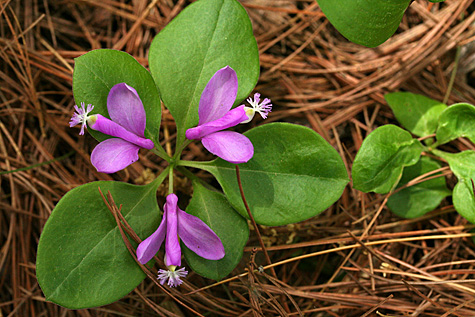
Fringed polygala
Fringed polygala, how long? 

Herd’s-grass (?) on Channing’s bank, pollen. 


Lupine not open yet for two or three days. Not yet chinquapin oak.

H.D. Thoreau, Journal, May 22, 1855

Deciduous trees "investing" the evergreens: See May 18, 1852 ("They are now being invested with the light, sunny, yellowish-green of the deciduous trees.")

Fringed polygala. See May 27, 1852 ("The fringed polygala near the Corner Spring is a delicate flower, with very fresh tender green leaves and red-purple blossoms; beautiful from the contrast of its clear red-purple flowers with its clear green leaves.") See also GoBotany, Polygala paucifolia (fringed milkwort, gaywings).  See also A Book of the Seasons, by Henry Thoreau,The Polygala

Linaria Canadensis:  A native annual or biennial that prefers highly disturbed areas with sandy soils. Its attractive light-blue to blue-violet flowers have a white throat and a nectar spur. (Nuttallanthus canadensisis, Blue Toadflax,, Canada Toadflax. Old-field Toadflax)

Tuesday, April 21, 2015

It affects us as a part of our unfallen selves.


April 21

5 A. M. — To Cliffs. 

Fair and still. There is a fog over the river, which shows at a distance more than near by. Not much.


The frost conceals the green of the gooseberry leaves just expanding. 

The shallow puddles left by yesterday’s rain in the fields are skimmed over.

At Cliffs, I hear at a distance a wood thrush. It affects us as a part of our unfallen selves.

The Populus grandidentata there may open to-morrow. 

The frost saves my feet a wetting probably. 

As I sit on the Cliffs, the sound of the frost and frozen drops melting and falling on the leaves in the woods below sounds like a gentle but steady rain all the country over, while the sun shines clear above all. 

P. M. — Sail to meadow near Carlisle Bridge. 

A fine, clear, and pleasant day with a little west wind.

Saw a painted turtle not two inches in diameter. This must be more than one year old. 

A female red wing. 

I see yellow redpolls on the bushes near the water, — handsome birds, -— but hear no note. 

Watch for some time a dozen black ducks on the meadow’s edge in a retired place, some on land and some sailing. Fifty rods off and without the glass, they look like crows feeding on the meadow’s edge, with a scarcely perceptible tinge of brown.

Examining the ground afterward, find that the whitish lichen thallus (which formed a crust, a sort of scurfy bald place, here and there in the meadow where the water had just risen) was loosened up and floating over the bare spaces mixed with a few downy feathers. I thought the flat meadow islets showed traces of having been probed by them. 

All the button-bushes, etc., etc., in and about the water are now swarming with those minute fuzzy gnats about an eighth of an inch long. The insect youth are on the wing. The whole shore resounds with their hum wherever we approach it, and they cover our boat and persons. They are in countless myriads the whole length of the river. 

A peep, peetweet, on the shore. 

There is some gossamer on the willows. 

The river has risen considerably, owing to yesterday’s rain, and new drift is brought down. The greater fullness of the Assabet is perceptible at the junction. 

The New York Tribune said on the 19th, “The caterpillar-blossoms, and the slightest peeping of green leaves among the poplars and willows, and a tolerable springing of grass, are the only vegetable proofs yet to be seen.” I should think they were just with our gooseberry.

H. D. Thoreau, Journal, April 21, 1855

The frost conceals the green of the gooseberry leaves just expanding. See April 13, 1856 ("The early gooseberry leaf-buds in garden have burst,"); April 17, 1855("The earliest gooseberry leaves are fairly unfolding now, and show some green at a little distance"); April 23, 1855 ("The currant and second gooseberry are bursting into leaf"); April 24, 1856 ("The earliest gooseberry leaf has spread a third of an inch or more.") April 28, 1854 ("The leafing of the gooseberry, or earliest native shrub.") See alsoA Book of the Seasons,  by Henry Thoreau, Leaf-Out

At Cliffs, I hear at a distance a wood thrush. .See April 21, 1858 ("Ed. Hoar says he heard a wood thrush the 18th.");  April 21, 1861 ("H. Mann brings me the hermit thrush."); see also April 20, 1860 ("C. sees bluets and some kind of thrush to-day, size of wood thrush, — he thought probably hermit thrush.") and note to April 24, 1856 ("Returning, in the low wood just this side the first Second Division Brook, near the meadow, see a brown bird flit, and behold my hermit thrush, with one companion, flitting silently through the birches") See also  A Book of the Seasonsby Henry Thoreau, Signs of Spring: The Arrival of the Hermit Thrush  and I hear the Hermit Thrush for the first time. Have I heard it before and not noticed? 

The Populus grandidentata may open to-morrow. See April 21, 1858 ("Populus grandidentata some days at least. ") ;see also. April 19, 1854 ("The Populus grandidentata will not open for a day or two"); April 22, 1859 (" Go by a Populus grandidentata. . . just begun to shed their pollen, not hanging loose and straight yet, but curved, are a very rich crimson,. . . much the handsomest now before the crimson anthers have burst, and are all the more remarkable for the very open and bare habit of the tree.") and A Book of the Seasons, by Henry Thoreau, the Big-toothed Aspen (Populus grandidentata)

Saw a painted turtle not two inches in diameter. This must be more than one year old. See  April 24, 1856 ("I find, on the southeast side of Lupine Hill, nearly four rods from the water and a dozen feet above its level, a young Emys picta, one and five eighths inches long and one and a half wide. I think it must have been hatched year before last. ") See also A Book of the Seasons, by Henry Thoreau, the Painted Turtle (Emys picta)

A female red wing.
See April 13, 1854 ("Think I see a female red wing flying with some males"); April 30, 1855 ("Red-wing blackbirds now fly in large flocks, covering the tops of trees like a black fruit, and keep up an incessant gurgling and whistling.") See also A Book of the Seasons, by Henry Thoreau, the Red-wing in Spring

I see yellow redpolls on the bushes near the water, — handsome birds, -— but hear no note. See April 30, 1855 (".Hear a short, rasping note, somewhat tweezer-bird like, I think from a yellow redpoll.") See also A Book of the Seasonsy Henry Thoreau, The Yellow Redpoll ( Palm) Warbler

Watch for some time a dozen black ducks on the meadow’s edge. See April 27, 1860 ("The hurry of the duck migration is, methinks, over"); May 13, 1854 ("The black ducks are probably all gone.") See also  
A Book of the Seasons by Henry Thoreau, the American Black Duck

The insect youth are on the wing in countless myriads the whole length of the river. See April 30, 1855 (Those myriads of little fuzzy gnats mentioned on the 21st and 28th must afford an abundance of food to insectivorous birds. Many new birds should have arrived about the 21st. There were plenty of myrtle-birds and yellow redpolls where the gnats were"") See also A Book of the Seasons, by Henry Thoreau, Fuzzy Gnats (tipulidæ)

A peep, peetweet, on the shore.  SeeApril 30, 1856 (“As I go along the Assabet, a peetweet skims away from the shore.”)May 2, 1859 ("The river seems really inhabited when the peetweet is back . . . This bird does not return to our stream until the weather is decidedly pleasant and warm. . . .Its note peoples the river, like the prattle of children once more in the yard of a house that has stood empty."); May 4, 1856 (“As soon as the rocks begin to be bare the peetweet comes and is seen teetering on them and skimming away from me.”) [Thoreau's Peetweet  is the Spotted Sandpiper  (Actitis macularia)]

Heard at a distance
the hermit thrush affects us 
as part of ourselves.


A Book of the Seasons,  by Henry Thoreau 
"A book, each page written in its own season,
out-of-doors, in its own locality.”
edited, assembled and rewritten by zphx © 2009-2025

https://tinyurl.com/hdt-550421

Saturday, April 18, 2015

Overtaken by a sudden sun-shower.

April 18.

6 A. M. —See and hear tree sparrows, and hear hyemalis still. 

Rained last evening and was very dark. Fair this morning and warm. White-bellied swallows and martins twitter now at 9 A. M. 

P. M. — To Cliffs and Walden and Hubbard’s Close. 

Almost did without a fire this morning. Coming out, I find it very warm, warmer than yesterday or any day yet. It is a reminiscence of past summers. 

It is perfectly still and almost sultry, with wet-looking clouds hanging about, and from time to time hiding the sun. First weather of this kind. 

And as I sit on Fair Haven Hill-side, the sun actually burns my cheek; yet I left some fire in the house, not knowing behind a window how warm it was. 

The hillside and especially low bank-sides are now conspicuously green. The flooded meadows and river are smooth, and just enough in shadow for reflections. 

The rush sparrows tinkle now at 3 P. M. far over the bushes, and hylodes are peeping in a distant pool. Robins are singing and peeping, and jays are screaming. 

I see one or two smokes in the horizon. I can still see the mountains slightly spotted with snow. The frost is out enough for plowing probably in most open ground. 

When I reach the top of the hill, I see suddenly all the southern horizon (east or south from Bear Hill in Waltham to the river) full of a mist, like a dust, already concealing the Lincoln hills and producing distinct wreaths of vapor, the rest of the horizon being clear. Evidently a sea-turn, — a wind from over the sea, condensing the moisture in our warm atmosphere and putting another aspect on the face of things. 

All this I see and say long before I feel the change, while still sweltering on the rocks, for the heat is oppressive. 

Nature cannot abide this sudden heat, but calls for her fan. In ten minutes I hear a susurrus in the shrub oak leaves at a distance, and soon an agreeable fresh air washes these warm rocks, and some mist surrounds me. 

A low blackberry on the rocks is now expanding its leaves just after the gooseberry. A little sallow, about two feet high and apparently intermediate between tristis and the next, with reddish anthers not yet burst, will bloom to-morrow in Well Meadow Path. 

The shad-bush flower-buds, beginning to expand, look like leaf-buds bursting now.  

Am overtaken by a sudden sun-shower, after which a rainbow. In the evening hear far and wide the ring of toads, and a thunder-shower with its lightning is seen and heard in the west.

H. D. Thoreau, Journal, April 18, 1855


The rush sparrows tinkle now at 3 P. M. far over the bushes, and hylodes are peeping in a distant pool. 
See April 18, 1857 ("Hear the huckleberry-bird”); .April 18, 1859 ("Hear a field sparrow."); April 18, 1856 ("This evening I hear the snipes generally and peeping of hylas from the door."); April 9, 1856 (“This degree of heat, then, brings the Fringilla juncorum and pine warbler and awakes the hyla.”) See also A Book of the Seasons, by Henry Thoreau, the Field Sparrow(Fringilla juncorum)

Am overtaken by a sudden sun-shower, after which a rainbow. See  March 13, 1855 ("Rainbow in east this morning."); April 9, 1855 ("With April showers, me thinks, come rainbows. Why are they so rare in the winter?");May 11, 1854 ("A rainbow on the brow of summer.")

In the evening hear far and wide the ring of toads. See A Book of the Seasons, by Henry Thoreau, The ring of toads

Popular Posts Last 30 Days.

The week ahead in Henry’s journal

The week ahead in Henry’s journal
A journal, a book that shall contain a record of all your joy.
"A stone fruit. Each one yields me a thought." ~ H. D. Thoreau, March 28, 1859


I sit on this rock
wrestling with the melody
that possesses me.