Showing posts with label dark blue. Show all posts

Tuesday, February 25, 2020

High dark-blue waves half a mile off running incessantly along the edge of white ice.

February 25. 

P. M. - Round via Clamshell to Hubbard's Bridge. 

Colder, and frozen ground; strong wind, northwest. 

I noticed yesterday in the street some dryness of stones at crossings and in the road and sidewalk here and there, and even two or three boys beginning to play at marbles, so ready are they to get at the earth. 

The fields of open water amid the thin ice of the meadows are the spectacle to-day. They are especially dark blue when I look southwest. Has it anything to do with the direction of the wind? 

It is pleasant to see high dark-blue waves half a mile off running incessantly along the edge of white ice. There the motion of the blue liquid is the most distinct. As the waves rise and fall they seem to run swiftly along the edge of the ice. 

The white pine cones have been blowing off more or less in every high wind ever since the winter began, and yet perhaps they have not more than half fallen yet. 

For a day or two past I have seen in various places the small tracks apparently of skunks. They appear to come out commonly in the warmer weather in the latter part of February. 

I noticed yesterday the first conspicuous silvery sheen from the needles of the white pine waving in the wind. A small one was conspicuous by the side of the road more than a quarter of a mile ahead. I suspect that those plumes which have been appressed or contracted by snow and ice are not only dried but opened and spread by the wind. 

Those peculiar tracks which I saw some time ago, and still see, made in slosh and since frozen at the Andromeda Ponds, I think must be mole-tracks, and those “nicks” on the sides are where they shoved back the snow with their vertical flippers. This is a very peculiar track, a broad channel in slosh, and at length in ice.

H. D. Thoreau, Journal, February 25, 1860


The fields of open water amid the thin ice of the meadows are the spectacle to-day. They are especially dark blue when I look southwest. Has it anything to do with the direction of the wind. See 
February 12, 1860 ("That dark-eyed water, especially when I see it at right angles with the direction of the sun, is it not the first sign of spring? "); February 25, 1851 ("The waves on the meadows make a fine show."); March 29, 1852 ("The water on the meadows looks very dark from the street. Their color depends on the position of the beholder in relation to the direction of the wind.") See alsoo A Book of the Seasons, by Henry Thoreau, Signs of the Spring: Bright Blue Water

For a day or two past I have seen in various places the small tracks apparently of skunks. They appear to come out commonly in the warmer weather in the latter part of February. see February 24, 1857 ("I have seen the probings of skunks for a week or more. “); March 10, 1854 ("See a skunk in the Corner road, which I follow. . .. It is a slender black (and white) animal, with its back remarkably arched, standing high behind and carrying its head low; runs, even when undisturbed, with singular teeter or undulation, like the walking of a Chinese lady. Very slow; I hardly have to run to keep up with it. It has a long tail, which it regularly erects when I come too near and prepares to discharge its liquid. It is white at the end of the tail, and the hind head and a line on the front of the face, — the rest black, except the flesh-colored nose (and I think feet). . . .I have no doubt they have begun to probe already where the ground permits, — or as far as it does. But what have they eat all winter?") See also A Book of the Seasons, by Henry Thoreau, Signs of the Spring: Skunks Active

I noticed yesterday the first conspicuous silvery sheen from the needles of the white pine waving in the wind . . .those plumes which have been appressed or contracted by snow and ice are not only dried but opened and spread by the wind. See February 4, 1852 ("Now the white pine are a misty blue; anon a lively, silvery light plays on them, and they seem to erect themselves unusually"); February 5, 1852 ("The boughs, feathery boughs, of the white pines, tier above tier, reflect a silvery light against the darkness of the grove.");  February 10, 1860 ("I see that Wheildon's pines are rocking and showing their silvery under sides as last spring, — their first awakening, as it were. "); March 2, 1860 ("I see a row of white pines, too, waving and reflecting their silvery light.")

This is a very peculiar track, a broad channel in slosh, and at length in ice. See February 20, 1852 ("No wonder that we so rarely see these animals, though their tracks are so common.  . . .The mole goes behind and beneath, rather than before and above.")

Sunday, January 13, 2019

Hoar frost, crystallized fog, on the north side of every twig.


January 13


January 13, 2019

The cold spell is over, and here this morning is a fog or mist; the wind, if there is any, I think, northerly; and there is built out horizontally on the north side of every twig and other surface a very remarkable sort of hoar frost, the crystallized fog, which is still increasing. 

Mr. Edwin Morton was telling me night before last of a similar phenomenon witnessed in central New York, the fog of highlands or mountains crystallizing in this way and forming a white fringe or frost on the trees even to an inch and a half. 

This is already full an inch deep on many trees, and gets to be much more, perhaps an inch and a half even, on some in the course of the day. It is quite rare here, at least on  this scale. 

The mist lasts all this day, though it is far from warm (+ 11° at 8 A. M.), and till noon of the 14th, when it becomes rain, and all this time there is exceedingly little if any wind. 

I go to the river this morning and walk up it to see the trees and bushes along it. 

As the frostwork (which is not thin and transparent like ice, but white and snow-like, or between the distinctly leaf with veins and a mere aggregation of snow, though you easily distinguish the distinct leaves) is built out northward from each surface, spreading at an angle of about forty-five degrees, i. e. some twenty-odd each side of the north, you must stand on the north side and look south at the trees, etc., when they appear, except the large limbs and trunk, wholly of snow or frostwork, mere ghosts of trees, seen softly against the mist for a background. 

It is mist on mist. 

The outline and character of each tree is more distinctly exhibited, being exaggerated, and you notice any peculiarity in the disposition of the twigs. 

  • Some elm twigs, thus enlarged into snowy fingers, are strikingly regular and handsome.
  • In the case of most evergreens, it amounts to a very rich sugaring, being so firmly attached. 
  • The weeping willow seems to weep with more remarkable and regular curve than ever, and stands still and white with thickened twigs, as if carved in white marble or alabaster. 
  • Those trees, like alders, which have not grown much the past year — which have short and angular twigs—are the richest in effect. The end of each alder twig is recurved where the drooping catkin is concealed. On one side you see the dark-brown fruit, but on the north that too is concealed. 

I can see about a quarter of a mile through the mist, and when, later, it is somewhat thinner, the woods, the pine woods, at a distance are a dark-blue color.

H. D. Thoreau, Journal, January 13, 1859

A very remarkable sort of hoar frost, the crystallized fog, which is still increasing, an inch deep on many trees, and gets to be much more, perhaps an inch and a half even, on some in the course of the day. It is quite rare here, at least on this scale. See November 23, 1852 (“You must go forth very early to see a hoar frost, which is rare here”); December 16 1853 (“These days, when the earth is still bare and the weather is so warm as to create much vapor by day, are the best for these frost works.”); February 9, 1860 ("A hoar frost on the ground this morning — for the open fields are mostly bare — was quite a novel sight. I had noticed some vapor in the air late last evening"); February 12, 1855 (“All trees covered this morning with a hoar frost, very handsome looking toward the sun, —the ghosts of trees.”)

Through the mist the woods, the pine woods, at a distance are a dark-blue color.
 See January 21, 1855 ("The snow is turning to rain through a fine hail.Pines and oaks seen at a distance — say two miles off — are considerably blended and make one harmonious impression. The former, if you attend, are seen to be of a blue or misty black," ); February 7, 1856 ("During the rain the air is thick, the distant woods bluish, and the single trees on the hill, under the dull mist-covered sky, remarkably distinct and black."); February 7, 1859 ("Evidently the distant woods are more blue in a warm and moist or misty day in winter."); see also note to February 6, 1852 ("mistiness makes the woods look denser, darker, and more imposing."


A Book of the Seasons,  by Henry Thoreau
"A book, each page written in its own season,
out-of-doors, in its own locality.”
~edited, assembled and rewritten by zphx © 2009-2022

Tuesday, October 9, 2018

It is quite Novemberish.

October 9

Cold and northwest wind still. 

The maple swamps begin to look smoky, they are already so bare. Their fires, so faded, are pale-scarlet or pinkish. 

Some Cornus sericea looks quite greenish yet. 

Huckleberry leaves falling fast. 

I go to the Cliffs. 

The air is clear, with a cold northwest wind, and the trees beginning to be bare. 

The mountains are darker and distincter, and Walden, seen from this hill, darker blue. It is quite Novemberish. 

People are making haste to gather the remaining apples this cool evening.

Bay-wings flit along road. 

Crows fly over and caw at you now. 

Methinks hawks are more commonly seen now, — the slender marsh hawk for one. I see four or five in different places. 

I watch two marsh hawks which rise from the woods before me as I sit on the Cliff, at first plunging at each other, gradually lifting themselves as they come round in their gyrations, higher and higher, and floating toward the southeast. Slender dark motes they are at last, almost lost to sight, but every time they come round eastward I see the light of the westering sun reflected from the undersides of their wings. 

Those little bits of phosphorescent wood which I picked up on the 4th have glowed each evening since, but required wetting to get the most light out of them. This evening only one, about two inches long, shows any light. This was wet last evening, but is now apparently quite dry. If I should wet it again, it would, no doubt, glow again considerably.

H. D. Thoreau, Journal, October 9, 1858


Bay-wings flit along road.  See April 15, 1859 (“The bay-wing now sings — the first I have been able to hear ”); October 9, 1858 (“Bay-wings flit along road.”); October 11, 1856 ("Bay-wing sparrows numerous"); ;October 12, 1859 ("I see scattered flocks of bay-wings amid the weeds and on the fences.") October 16, 1855 ("I look at a grass-bird on a wall in the dry Great Fields. There is a dirty-white or cream-colored line above the eye and another from the angle of the mouth beneath it and a white ring close about the eye. The breast is streaked with this creamy white and dark brown in streams, as on the cover of a book.") See also A Book of the Seasons, by Henry Thoreau, the Bay-Wing Sparrow

Crows fly over and caw at you now. See September 18, 1852 ("The crows congregate and pursue me through the half-covered woodland path, cawing loud and angrily above me, and when they cease, I hear the winnowing sound of their wings."); November 18, 1857 ("Crows will often come flying much out of their way to caw at me.")

Methinks hawks are more commonly seen now. See   September 16, 1852 (What makes this such a day for hawks?"); September 27, 1857 (“As I sit there I see the shadow of a hawk flying above and behind me. I think I see more hawks nowadays.”); October 9, 1860 ("See one crow chasing two marsh hawks over E. Hosmer's meadow. Occasionally a hawk dives at the crow, but the crow perseveres in pestering them.. . .The crow is at length joined by an other.")

The mountains are darker and distincter. See May 17, 1858 ("I doubt if in the landscape there can be anything finer than a distant mountain-range. They are a constant elevating influence."); May 24, 1854 ("As I return down the hill, my eyes are cast toward the very dark mountains in the northwest horizon."); August 14, 1854(“I have come forth to this hill at sunset to see the forms of the mountains in the horizon.— to behold and commune with something grander than man. “); September 12, 1858 ("The mountains are of a darker blue. "); October 13, 1852 (" The air is singularly fine-grained; the mountains are more distinct from the rest of the earth and slightly purple."); October 17, 1857 ("The mountains are more distinct in the horizon "); October 20, 1852 (“I see the mountains in sunshine, all the more attractive from the cold I feel here, with a tinge of purple on them”); October 22, 1857 (" Look from the high hill, just before sundown, over the pond. The mountains are a mere cold slate-color. But what a perfect crescent of mountains we have in our northwest horizon! Do we ever give thanks for it?"); November 4, 1857 ("The mountains north . . . stand out grand and distinct, a decided purple.").; November 11, 1851 ("The horizon has one kind of beauty and attraction to him who has never explored the hills and mountains in it, and another ... to him who has.")

Walden, seen from this hill, darker blue. Compare August 27, 1852 ("Viewed from a hilltop, it is blue in the depths and green in the shallows, but from a boat it is seen to be a uniform dark green."); September 1, 1852 ("Viewed from the hilltop, [Walden] reflects the color of the sky. Beyond the deep reflecting surface, near the shore, it is a vivid green.").  See also Walden ("Walden is blue at one time and green at another ...")

Wednesday, September 12, 2018

Thus gradually and successively each plant lends its richest color to the general effect, and in the fittest place, and passes away

September 12


Sunday. P. M. — To Cliffs.

The handsome crimson-tipped hazelnut burs now and for some time have reminded us that it was time to gather these nuts. They are worth gathering, if only to see the rich color of the fruit brought together in a quantity.

Lycopodium complanatum, how long? 

Have seen the pigeon’s-egg fungus in pastures some time. 

Yew berries still hold on. 

The cinnamon fern has begun to yellow and wither. How rich in its decay! Sic transit gloria mundi! Die like the leaves, which are most beautiful in their decay. 

Thus gradually and successively each plant lends its richest color to the general effect, and in the fittest place, and passes away. Amid the October woods we hear no funereal bell, but the scream of the jay. Coming to some shady meadow’s edge, you find that the cinnamon fern has suddenly turned this rich yellow. Thus each plant surely acts its part, and lends its effect to the general impression. 

See petty morel berries ripe. 

Woodsia llvensis under the cave at Cliffs in fruit. 

Very heavy rain all yesterday afternoon, and to-day it is somewhat cooler and clearer and the wind more northwesterly, and I see the unusual sight of ripples  or waves curving up-stream off Cardinal Shore, so that the river might seem to be flowing that way. 

The mountains are of a darker blue. 

The spring on the west side of Fair Haven Hill is nearly dry; there is no stream flowing from it. What a disappointment to a herd of cows to find their accustomed spring dry! 

Even in that little hollow on the hill side, commonly moistened by the spring, grow the soft rush, rhyncospora, etc. What an effect a little moisture on a hillside produces, though only a rod square! The Juncaceoe and Cyperaceoa soon find it out and establish themselves there. 

The Panicum filiforme is very abundant in that old mullein-field of Potter’s, by the Corner road. Its slender culms are purple, and, seen in the right light, where they stand thick, they give a purple gleam to the field. More purple far than the P. sanguinale

Some small red maples by water begun to redden. 

In Hubbard’s ditched meadow, this side his grove, I see a great many large spider’s webs stretched across the ditches, about two feet from bank to bank, though the thick woven part is ten or twelve inches. They are parallel, a few inches or a foot or more apart, and more or less vertical, and attached to a main cable stretched from bank to bank. They are the yellow-backed spider, commonly large and stout but of various sizes. I count sixty-four such webs there, and in each case the spider occupies the centre, head downward. This is enough, methinks, to establish the rule. They are not afraid of turning their brains then. Many insects must be winging their way over this small river. It reminds me of the Indians catching ducks at Green Bay with nets in old times.

H. D. Thoreau, Journal, September 12, 1858

Lycopodium complanatum, how long? See August 31, 1857  ("Lycopodium complanatum out, how long?")

Yew berries still hold on. See August 10, 1858 ("Am surprised to find the yew with ripe fruit (how long ?),. . . It fruits very sparingly, the berries growing singly here and there, on last year’s wood, and hence four to six inches below the extremities of the upturned twigs. It is the most surprising berry that we have")

The cinnamon fern has begun to yellow and wither. See September 27, 1857 ("The large common ferns (either cinnamon or interrupted) are yellowish, and also many as rich a deep brown now as ever."); September 6, 1854("The cinnamon ferns along the edge of woods next the meadow are many yellow or cinnamon, or quite brown and withered.")

Woodsia llvensis under the cave at Cliffs in fruit. See September 4, 1857 ("The sides of Cornus florida Ravine at Bateman’s Pond are a good place for ferns. There is a Woodsia Ilvensis, a new one to Concord. ")

Thursday, January 1, 2015

Between frozen spew and broken ice


January 1.

P. M. —Skate to Pantry Brook with C. 

All the tolerable skating is a narrow strip, often only two or three feet wide, between the frozen spew and the broken ice of the middle.

We see the pink light on the snow within a rod of us. The shadow of the bridges on the snow is a dark indigo blue.

H. D. Thoreau, Journal, January 1, 1855


Frozen spew. See December 20, 1854 (The river is "uneven like frozen suds, in rounded pan cakes, as when bread spews out in baking.)

Pink light on the snow. See December 20, 1854 ("In some places, where the sun falls on it, the snow has a pinkish tinge"); December 21, 1854 ("The last rays of the sun falling on the Baker Farm reflect a clear pink color. "); December 31, 1854 ("The shadows on the snow are indigo-blue"); January 10, 1859 ("This is one of the phenomena of the winter sunset, this distinct pink light reflected from the brows of snow-clad hills on one side of you as you are facing the sun."); January 15, 1856 ("My shadow is a most celestial blue. This only requires a clear bright day and snow-clad earth, not great cold. "); January 19, 1859 ("Methinks this pink on snow (as well as blue shadows) requires a clear, cold evening.");January 31, 1859 ("the pink light reflected from the low, flat snowy surfaces amid the ice on the meadows, just before sunset, is a constant phenomenon these clear winter days. "); February 10, 1855 (“My shadow is blue. It is especially blue when there is a bright sunlight on pure white snow.”)

January 1. See A Book of the Seasons  by Henry Thoreau, January 1

Pink light on the snow –
the shadow of the bridges
dark indigo blue.

A Book of the Seasons,  by Henry Thoreau
"A book, each page written in its own season,
out-of-doors, in its own locality.”
~edited, assembled and rewritten by zphx © 2009-2025

https://tinyurl.com/hdt-550101


Jan. 1. P. M. —Skated to Pantry Brook with C. All the tolerable skating was a narrow strip, often only two or three feet wide, between the frozen spew and the broken ice of the middle.

Jan. 2. I see, in the path near Goose Pond, where the rabbits have eaten the bark of smooth sumachs and young locusts rising above the snow; also bar berry. Yesterday we saw the pink light on the snow within a rod of us. The shadow of the bridges, etc., on the snow was a dark indigo blue.

Monday, November 25, 2013

A clear, cold, windy day.


November 25.

 
November 25, 2013


A clear, cold, windy day. 

The water on the meadows, which are rapidly becoming bare, is skimmed over and reflects a whitish light, like silver plating, while the unfrozen river is a dark blue. 

In plowed fields I see the asbestos-like ice-crystals, more or less mixed with earth, frequently curled and curved like crisped locks, where the wet ground has frozen dry.

By the spring under Fair Haven Hill, I see the frost about the cistus now at 11 a. m. in the sun. 

The landscape, seen from the side of the hill looking westward to the horizon through this clear and sparkling air, though simple to barrenness, is very handsome. There is first the clean light-reflecting russet earth, the dark-blue water, the dark or dingy green evergreens, the dull reddish-brown of young oaks and shrub oaks, the gray of maples and other leafless trees, and the white of birch stems. 

The mountains are remarkably distinct and appear near and elevated, but there is no snow on them. The white houses of the village, also, are remarkably distinct and bare and brought very near.

H. D. Thoreau, Journal, November 25, 1853

A clear, cold, windy day. See November 25, 1857 (“A clear, cold, windy afternoon. ”)

Sunday, March 31, 2013

Distant mountain top as blue to the memory as now to the eyes.

March 31

The robins sing at the very earliest dawn. I wake with their note ringing in my ear.

To Lincoln, surveying for Mr. Austin. 

The catkins of the hazel are now trembling in the wind and much lengthened, showing yellowish and beginning to shed pollen.

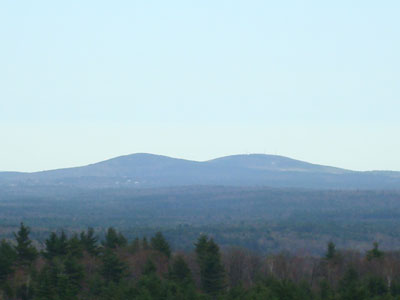
When the air is a little hazy, the mountains are particularly dark blue. It is affecting to see a distant mountain-top, like the summits of Uncanoonuc, well seen from this hill, whereon you camped for a night in your youth, which you have never revisited, still as blue and ethereal to your eyes as is your memory of it.

H. D. Thoreau, Journal, March 31, 1853

The robins sing at the very earliest dawn . . . See May 4, 1855 ("A robin sings when I, in the house, cannot distinguish the earliest dawning from the full moon light.”) See also A Book of the Seasons, by Henry Thoreau, Robins in Spring

The catkins of the hazel are now trembling in the wind. . . See March 27, 1853 ("The hazel is fully out. The 23d was perhaps full early to date them. It is in some respects the most interesting flower yet, so minute that only an observer of nature, or one who looked for them, would notice it.");  April 13, 1855 (“Half a dozen catkins, one and three quarters inches long, trembling in the wind, shedding golden pollen . . .They know when to trust themselves to the weather.”) See also A Book of the Seasons: the Hazel.

It is affecting to see a distant mountain-top, like the summits of Uncanoonuc, well seen from this hill, whereon you camped for a night in your youth, which you have never revisited, still as blue and ethereal to your eyes as is your memory of it. Compare November 11, 1851 (“That blue mountain in the horizon is certainly the most heavenly, the most elysian, which we have not climbed, on which we have not camped for a night.”); July 9, 1851 ("What can be more impressive than to look up a noble river just at evening, – one, perchance, which you have never explored, — and behold its placid waters, reflecting the woods and sky, lapsing inaudibly toward the ocean; to behold as a lake, but know it as a river, tempting the beholder to explore it and his own destiny at once?") See also A Book of the Seasons, by Henry Thoreau, Mountains in the Horizon

March 31. See A Book of the Seasonsby Henry Thoreau, March 31

Distant mountain top 
as blue to the memory 
as now to the eyes.
 A Book of the Seasons, by Henry Thoreau,  
"A book, each page written in its own season,
out-of-doors, in its own locality.”
~edited, assembled and rewritten by zphx © 2009-2025


https://tinyurl.com/hdt-530331 

***** 


Easter Sunday 2013 I  walk to the newspaper box with the dogs there is some excitement when the neighbors drive in with four cars family or friends I guess Buda particularly barks and chases the cars they both bark at the people who get out but eventually follow me up the road I feel quite refreshed it's cool but springlike  the streams are rushing I find that orange stick and place it by the culvert where I can the ground still being frozen in places there's only a few snow piles remaining the dogs climb on top of them and eat the snow

cool rushing spring streams –
climbing  on the last snow piles
the dogs eat the snow
March 31, 2013

Monday, November 12, 2012

A narrow white cloud resting on every mountain

November 12.

It clears up. A very bright rainbow. Three reds and greens, in the southeast, heightening the green of the pines. 

From Fair Haven Hill, I see a very distant, long, low dark-blue cloud in the northwest horizon beyond the mountains, and against this I see, apparently, a narrow white cloud resting on every mountain and conforming exactly to its outline as if the white frilled edge of the main cloud were turned up over them. In fact, the massive dark-blue cloud beyond revealed these distinct white caps resting on the mountains this side, for twenty miles along the horizon. 

The sun having set, my long dark cloud has assumed the form of an alligator, and where the sun has just disappeared it is split into two tremendous jaws, between which glows the eternal city, its crenate lips all coppery golden, its serrate fiery teeth. Its body lies a slumbering mass along the horizon.

November 12, 2022

H. D, Thoreau, Journal, November 12, 1852

A narrow white cloud resting on every mountain and conforming exactly to its outline.  See August 9, 1860 ("A beautiful and serene object, a sort of fortunate isle in the sunset sky, the local cloud of the mountain.”) See also November 11, 1851 ("The horizon has one kind of beauty and attraction to him who has never explored the hills and mountains in it, and another . . . to him who has."); November 22, 1860 ("Simply to see to a distant horizon through a clear air, - the fine outline of a distant hill or a blue mountaintop through some new vista, - this is wealth enough for one afternoon.") and A Book of the Seasons, by Henry Thoreau, Mountains in the Horizon

The sun having set, my long dark cloud has assumed the form of an alligator. See A Book of the Seasons, by Henry Thoreau, November Sunsets

November 12. See A Book of the Seasons, by Henry Thoreau, November 12

A narrow white cloud 
resting on every mountain
in the horizon.


A Book of the Seasons
,  by Henry Thoreau, 
"A book, each page written in its own season,
out-of-doors, in its own locality.”
~edited, assembled and rewritten by zphx © 2009-2022

https://tinyurl.com/hdt-521112
.

Sunday, February 26, 2012

Now we begin to see lichens.

February 26.

The east side of Deep Cut nearly dry; sand has ceased flowing; west side just beginning. 

Now we begin to see the Cladonia rangiferina ("reindeer moss") in the dry pastures.

Observe for the first time on and about Bear Hill in Lincoln the "greenish straw-colored" Parmelia conspersa, a very handsome and memorable lichen, which every child has admired. I love to find it where the rocks will split into their laminae so that I can easily carry away a specimen.

The low hills in the northeast beyond Bedford, seen from Bear Hill about 4.30 P. M., were remarkably dark blue, much more blue than the mountains in the northwest. The sky was in great part concealed by white clouds. Had this blue the same cause with the blue in the crevices of the snow? 


H. D. Thoreau, Journal, February 26, 1852


Now we begin to see the Cladonia rangiferina.  See November 30, 1853 ("Now, first since spring, I take notice of the cladonia lichens, which the cool fall rains appear to have started."); December 7, 1853 ("I observe the beds of greenish cladonia lichens."); February 5, 1860 ("I see where crows have pecked the tufts of cladonia lichens which peep out of the snow."); March 12, 1859 (" It is a very barren, exhausted soil, where the cladonia lichens abound . . . the very visible green of the cladonias thirty rods off, and the rich brown fringes where the broken sod hung over the edge of the sand-bank . . . methinks these terrestrial lichens were never more fair and prominent. On some knolls these vivid and rampant lichens as it were dwarf the oaks."); March 14, 1857 ("Now each hill is a dry moss-bed, of various species of cladonia.");  June 25, 1852 ("The light, dry cladonia lichens on the brows of hills reflect the moonlight well, looking like rocks.")

The "greenish straw-colored" Parmelia conspersa, a very handsome and memorable lichen.  See 
January 26, 1852 ("The beauty of lichens, with their scalloped leaves, the small attractive fields, the crinkled edge! I could study a single piece of bark for hour."); February 6, 1852 ("Near the C. Miles house there are some remarkably yellow lichens (parmelias?) on the rails, – ever as if the sun were about to shine forth clearly . . . Found three or four parmelias caperata) in fruit on a white oak on the high river-bank between Tarbell's and Harrington’s"); March 18, 1852 ("There is more rain than snow now falling, and the lichens, especially the Parmelia conspersa, appear to be full of fresh fruit, though they are nearly buried in snow."); See also A Book of the Seasons, by Henry Thoreau, the Lichens and the lichenst .

Had this blue the same cause with the blue in the crevices of the snow? See January 9, 1852 ("The sky shut out by snow-clouds . . . I see little azures, little heavens, in the crannies and crevices . . . Apparently the snow absorbs the other rays and reflects the blue"); January 14, 1852 ("There is no blueness in the ruts and crevices in the snow to-day. What kind of atmosphere does this require? . . . It is one of the most interesting phenomena of the winter."); January 18, 1852 ("To-day, again, I see some of the blue in the crevices of the snow. Perhaps the snow in the air, as well as on the ground, takes up the white rays and reflects the blue."); January 26, 1852 ("To-day I see . . . a slight blueness in the chinks, it being cloudy and melting.")

The low hills in the northeast . . . were remarkably dark blue. 
Compare  January 16, 1860 ("The hills eight or ten miles west are white, but the mountains thirty miles off are blue, though both may be equally white at the same distance."); November 13, 1851("The mountains are of an uncommonly dark blue to-day. Perhaps this is owing . . . to the greater clearness of the atmosphere, which brings them nearer"); March 31, 1853 ("When the air is a little hazy, the mountains are particularly dark blue.'); August 25, 1853 ("Seen through this lower stratum, the mountain is a very dark blue."); September 27, 1853 ("From our native hills we look out easily to the far blue mountains.")

We begin to see 
the Cladonia lichen 
in the dry pastures.


A Book of the Seasons,  by Henry Thoreau 
"A book, each page written in its own season,
out-of-doors, in its own locality.”
~edited, assembled and rewritten by zphx © 2009-2025

Popular Posts Last 30 Days.

The week ahead in Henry’s journal

The week ahead in Henry’s journal
A journal, a book that shall contain a record of all your joy.
"A stone fruit. Each one yields me a thought." ~ H. D. Thoreau, March 28, 1859


I sit on this rock
wrestling with the melody
that possesses me.