6 P. M. —To Hill.
I judge that the larch blossomed when the anthers began to be loose and dry and yellow on their edges. Say then the 28th.
The water on the meadows is rapidly going down. I am now confined to the river for the most part. The water begins to feel as warm or warmer than the air when cool.
The scrolls of the ferns clothed in wool at Sassafras Shore, five or six inches high.
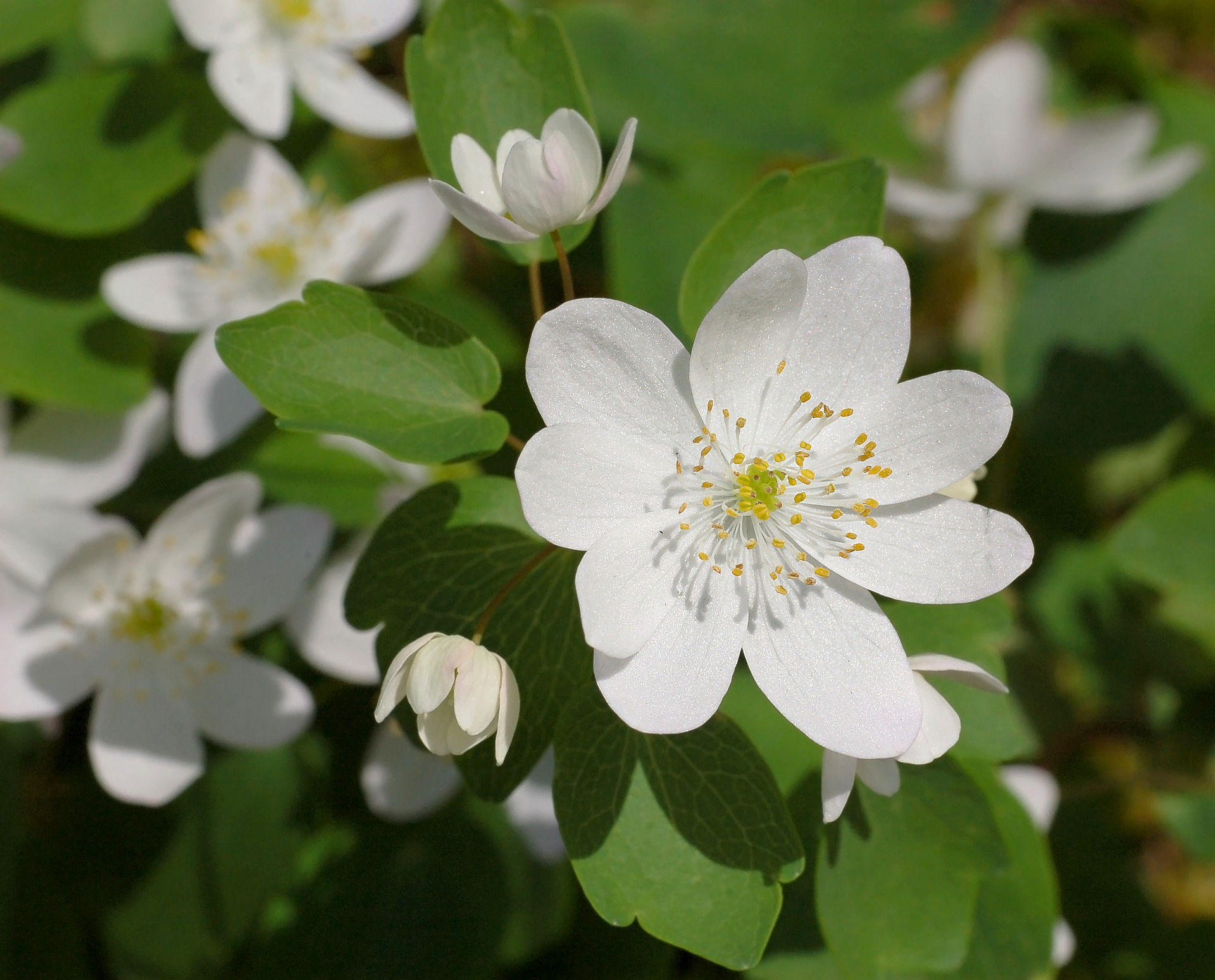
Thalictrum anemonoides well out, probably a day or two, same shore, by the apple trees.
Viola ovata on southwest side of hill, high up near pines.
How pleasing that early purple grass in smooth water! Half a dozen long, straight purple blades of different lengths but about equal width, close together and exactly parallel, resting flat on the surface of the water. There is something agreeable in their parallelism and flatness.
From the hilltop I look over Wheeler’s maple swamp. The maple-tops are now, I should say, a bright brick red. It is the red maple’s reign now, as the peach and the apple will have theirs. Looking over the swamps a quarter of a mile distant, you see dimly defined crescents of bright brick red above and amid a maze of ash-colored branches.
H. D. Thoreau, Journal, May 1, 1856
I judge that the larch blossomed when the anthers began to be loose and dry and yellow on their edges. Say then the 28th. . . . See April 23, 1855 ("The anthers of the larch are conspicuous, but I see no pollen.”) April 24, 1854 ("The larch will apparently blossom in one or two days at least, both its low and broad purple-coned male flowers and its purple-tipped female cones.”); April 25, 1856 ("Larch not yet sheds pollen.”); April 27, 1856 ("I find none of Monroe’s larch buds shedding pollen, but the anthers look crimson and yellow, and the female flowers are now fully expanded and very pretty, but small. I think it will first scatter pollen to-morrow.”) April 29, 1855 (“A few of the cones within reach on F. Monroe’s larches shed pollen; say, then, yesterday The crimson female flowers are now handsome but small); April 29, 1856 ("Monroe’s larch staminate buds have now erected and separated their anthers, and they look somewhat withered, as if they had shed a part of their pollen. If so, they began yesterday. ”); April 30, 1857 (“The larch plucked yesterday sheds pollen to-day in house, probably to-day abroad.”) See also A Book of the Seasons, by Henry Thoreau the Larch in Spring
It is the red maple’s reign now. . . See April 24, 1857 ("I see the now red crescents of the red maples in their prime . . . above the gray stems."); April 28, 1855 ("The red maples, now in bloom, are quite handsome at a distance over the flooded meadow beyond Peter’s. The abundant wholesome gray of the trunks and stems beneath surmounted by the red or scarlet crescents.”) April 26, 1855 ("The blossoms of the red maple (some a yellowish green) are now most generally conspicuous and handsome scarlet crescents over the swamps. “);May 1, 1855 ("The maples of Potter’s Swamp, seen now nearly half a mile off against the russet or reddish hillside, are a very dull scarlet, like Spanish brown . . .”); May 7, 1854 (A spreading red maple in bloom, seen against a favorable background, as water looking down from a hillside, presenting not a dense mass of color but an open, graceful and ethereal top of light crimson or scarlet . . .”).
Thalictrum anemonoides [rue-anemone] well out, probably a day or two, same shore, by the apple trees. See May 1, 1855 ("Thalictrum anemonoides at Conant Cliff. Did not look for pollen.”). See also April 8, 1859 ("The earliest peculiarly woodland herbaceous flowers are epigaea, anemone, thalictrum, and — by the first of May — Viola pedata.”); April 27, 1860 (“Thalictrum anemonoides are abundant, maybe two or three days, at Blackberry Steep”); May 5, 1854 (“Thalictrum anemonoides by Brister's Spring on hillside.”); May 5, 1860 (“Anemone and Thalictrum anemonoides are apparently in prime about the 10th of May.”); May 11, 1854 (“The Thalictrum anemonoides is a perfect and regular white star..”)
How pleasing that early purple grass in smooth water! See April 29, 1855 ("That lake grass — or perhaps I should call it purple grass — is now apparently in perfection on the water.” . . . )
Viola ovata on southwest side of hill, high up near pines.
How pleasing that early purple grass in smooth water! Half a dozen long, straight purple blades of different lengths but about equal width, close together and exactly parallel, resting flat on the surface of the water. There is something agreeable in their parallelism and flatness.
From the hilltop I look over Wheeler’s maple swamp. The maple-tops are now, I should say, a bright brick red. It is the red maple’s reign now, as the peach and the apple will have theirs. Looking over the swamps a quarter of a mile distant, you see dimly defined crescents of bright brick red above and amid a maze of ash-colored branches.
H. D. Thoreau, Journal, May 1, 1856
I judge that the larch blossomed when the anthers began to be loose and dry and yellow on their edges. Say then the 28th. . . . See April 23, 1855 ("The anthers of the larch are conspicuous, but I see no pollen.”) April 24, 1854 ("The larch will apparently blossom in one or two days at least, both its low and broad purple-coned male flowers and its purple-tipped female cones.”); April 25, 1856 ("Larch not yet sheds pollen.”); April 27, 1856 ("I find none of Monroe’s larch buds shedding pollen, but the anthers look crimson and yellow, and the female flowers are now fully expanded and very pretty, but small. I think it will first scatter pollen to-morrow.”) April 29, 1855 (“A few of the cones within reach on F. Monroe’s larches shed pollen; say, then, yesterday The crimson female flowers are now handsome but small); April 29, 1856 ("Monroe’s larch staminate buds have now erected and separated their anthers, and they look somewhat withered, as if they had shed a part of their pollen. If so, they began yesterday. ”); April 30, 1857 (“The larch plucked yesterday sheds pollen to-day in house, probably to-day abroad.”) See also A Book of the Seasons, by Henry Thoreau the Larch in Spring
It is the red maple’s reign now. . . See April 24, 1857 ("I see the now red crescents of the red maples in their prime . . . above the gray stems."); April 28, 1855 ("The red maples, now in bloom, are quite handsome at a distance over the flooded meadow beyond Peter’s. The abundant wholesome gray of the trunks and stems beneath surmounted by the red or scarlet crescents.”) April 26, 1855 ("The blossoms of the red maple (some a yellowish green) are now most generally conspicuous and handsome scarlet crescents over the swamps. “);May 1, 1855 ("The maples of Potter’s Swamp, seen now nearly half a mile off against the russet or reddish hillside, are a very dull scarlet, like Spanish brown . . .”); May 7, 1854 (A spreading red maple in bloom, seen against a favorable background, as water looking down from a hillside, presenting not a dense mass of color but an open, graceful and ethereal top of light crimson or scarlet . . .”).
Thalictrum anemonoides [rue-anemone] well out, probably a day or two, same shore, by the apple trees. See May 1, 1855 ("Thalictrum anemonoides at Conant Cliff. Did not look for pollen.”). See also April 8, 1859 ("The earliest peculiarly woodland herbaceous flowers are epigaea, anemone, thalictrum, and — by the first of May — Viola pedata.”); April 27, 1860 (“Thalictrum anemonoides are abundant, maybe two or three days, at Blackberry Steep”); May 5, 1854 (“Thalictrum anemonoides by Brister's Spring on hillside.”); May 5, 1860 (“Anemone and Thalictrum anemonoides are apparently in prime about the 10th of May.”); May 11, 1854 (“The Thalictrum anemonoides is a perfect and regular white star..”)
How pleasing that early purple grass in smooth water! See April 29, 1855 ("That lake grass — or perhaps I should call it purple grass — is now apparently in perfection on the water.” . . . )


