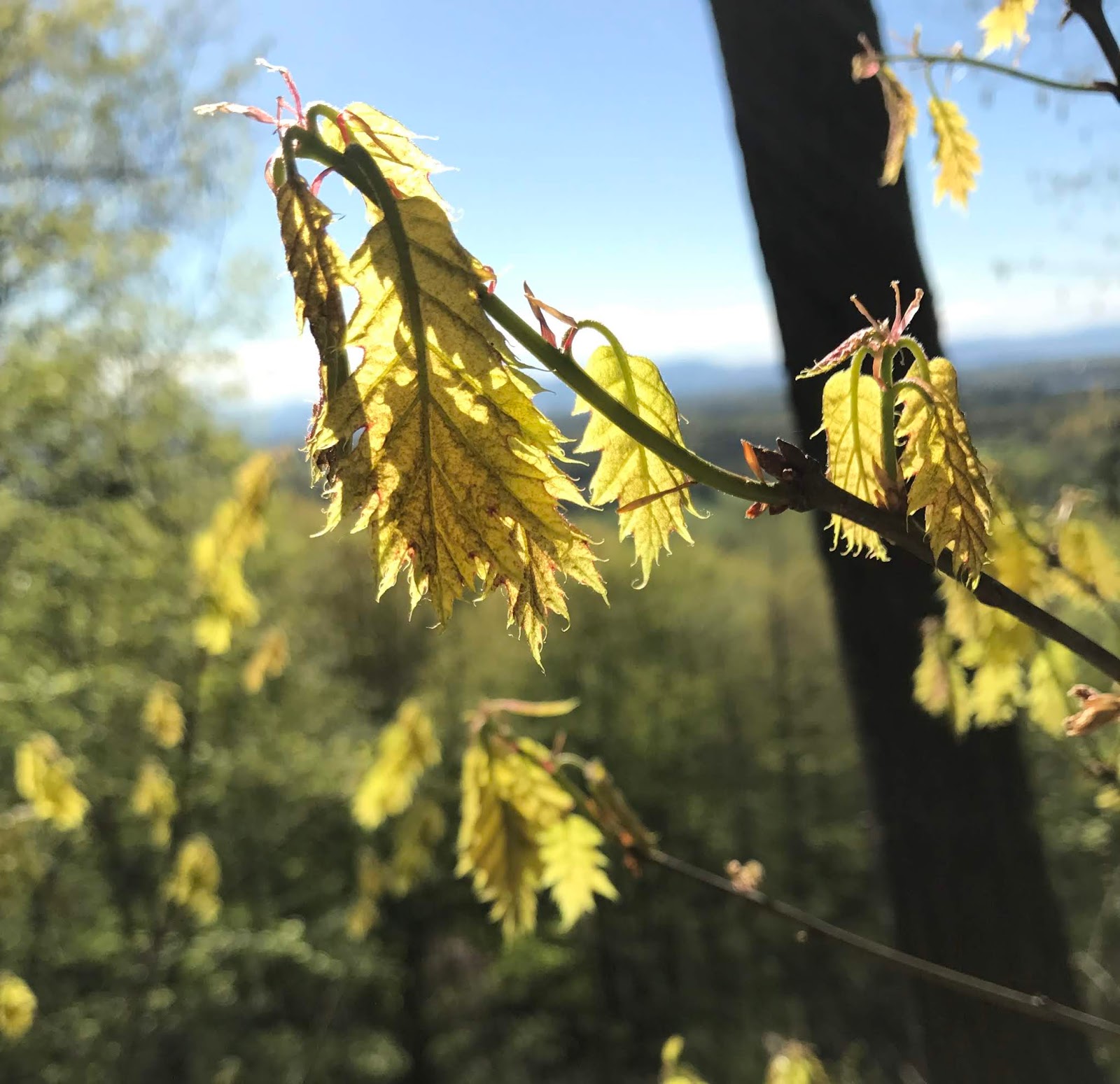
Showing posts with label sorrel. Show all posts

Saturday, June 12, 2021

I feel well into summer when I see this redness.


June 12

June 12, 2019

Saturday. P. M. – To Lupine Hill via Depot Field Brook.

For some time I have noticed the grass whitish and killed at top by worms (?).

The meadows are yellow with golden senecio.

Marsh speedwell (Veronica scutellata), lilac - tinted, rather pretty.

The mouse-ear forget me-not (Myosotis laxa) has now extended its racemes (?) very much, and hangs over the edge of the brook. It is one of the most interesting minute flowers. It is the more beautiful for being small and unpretending, for even flowers must be modest.

The blue flag (Iris versicolor). Its buds are a dark indigo-blue tip beyond the green calyx. It is rich but hardly delicate and simple enough; a very handsome sword-shaped leaf.

The blue-eyed grass is one of the most beautiful of flowers. It might have been famous from Proserpine down. It will bear to be praised by poets.

The blue flag, notwithstanding its rich furniture, its fringed recurved parasols over its anthers, and its variously streaked and colored petals, is loose and coarse in its habit.

How completely all character is expressed by flowers !

This is a little too showy and gaudy, like some women's bonnets. Yet it belongs to the meadow and ornaments it much.

The critchicrotches are going to seed.

I love the sweet-flag as well as the muskrat (?). Its tender inmost leaf is very palatable below.

Enothera pumila, dwarf tree-primrose. Ever it will be some obscure small and modest flower that will most please us.

Some of the ferns have branches wholly covered with fruit.

How difficult, if not impossible, to do the things we have done! as fishing and camping out. They seem to me a little fabulous now.

Boys are bathing at Hubbard's Bend, playing with a boat (I at the willows).

The color of their bodies in the sun at a distance is pleasing, the not often seen flesh-color. I hear the sound of their sport borne over the water.

As yet we have not man in nature.

What a singular fact for an angel visitant to this earth to carry back in his note-book, that men were forbidden to expose their bodies under the severest penalties ! A pale pink, which the sun would soon tan.

White men ! There are no white men to contrast with the red and the black; they are of such colors as the weaver gives them. I wonder that the dog knows his master when he goes in to bathe and does not stay by his clothes.

Small white-bellied (?) swallows in a row ( a dozen ) on the telegraph - wire over the water by the bridge. This perch is little enough departure from unobstructed air to suit them. Pluming themselves.

If you could furnish a perch aerial enough, even birds of paradise would alight.

Swallows have forked tails, and wings and tails are about the same length. They do not alight on trees, methinks, unless on dead and bare boughs, but stretch a wire over water and they perch on it.

This is among the phenomena that cluster about the telegraph.

Hedge-mustard.

(Turned into the lane beyond Dennis's.) 

Some fields are almost wholly covered with sheep's-sorrel, now turned red, — its valves (?). It helps thus agreeably to paint the earth, contrasting even at a distance with the greener fields, blue sky, and dark or downy clouds. It is red, marbled, watered, mottled, or waved with greenish, like waving grain, — three or four acres of it.

To the farmer or grazier it is a troublesome weed, but to the landscape-viewer an agreeable red tinge laid on by the painter. I feel well into summer when I see this redness.

It appears to be avoided by the cows.

The petals of the sidesaddle-flower, fully expanded, hang down. How complex it is, what with flowers and leaves! It is a wholesome and interesting plant to me, the leaf especially.

Rye that has sown itself and come up scatteringly in bunches is now nearly ripe.

They are beginning to cut rank grass on the village street.

I should say the summer began with the leafiness, umbrageous summer! 

The glory of Dennis's lupines is departed, and the white now shows in abundance beneath them.

So I cannot walk longer in those fields of Enna in which Proserpine amused herself gathering flowers.

The steam whistle at a distance sounds even like the hum of a bee in a flower.

So man's works fall into nature.

The flies hum at mid-afternoon, as if peevish and weary of the length of the days.

The river is shrunk to summer width; on the sides smooth whitish water, or rather it is the light from the pads; - in the middle, dark blue or slate, rippled.

The color of the earth at a distance where a wood has been cut off is a reddish brown.

Nature has put no large object on the face of New England so glaringly white as a white house.

The Ranunculus filiformis on the muddy shore of the river.

The locusts' blossoms in the graveyard fill the street with their sweet fragrance.

It is day, and we have more of that same light that the moon sent us, but not reflected now, but shining directly. The sun is a fuller moon.

Who knows how much lighter day there may be?


H. D. Thoreau, Journal, June 12, 1852

The meadows are yellow with golden senecio. See June 9, 1853 ("The meadows are now yellow with the golden senecio, a more orange yellow, mingled with the light glossy yellow of the buttercup."); June 10, 1854 ("The meadows now begin to be yellow with senecio.") See also A Book of the Seasons, by Henry Thoreau, The Golden Senecio

It is one of the most interesting minute flowers. See A Book of the Seasons, by Henry Thoreau, the Mouse-ear forget-me-not (Myosotis laxa small-flowered forget- me- not)

The blue-eyed grass is one of the most beautiful of flowers . . .It will bear to be praised by poets.  See June 15, 1851 ("The blue-eyed grass, wellnamed, looks up to heaven."); A Book of the Seasons,  by Henry Thoreau,  Blue-Eyed Grass

The critchicrotches are going to seed. I love the sweet-flag as well as the muskrat (?). Its tender inmost leaf is very palatable below. See May 23, 1860 ("Critchicrotches some two or three days; now tender to eat . How agreeable and surprising the peculiar fragrance of the sweet flag when bruised! That this plant alone should have extracted this odor surely for so many ages each summer from the moist earth!");   May 27, 1852 ("The fruit of the sweet flag is now just fit to eat, and reminds me of childhood, — the critchicrotches. They would help sustain a famished traveller. The inmost tender leaf, also, near the base, is quite palatable, as children know. I love it as well as muskrats (?)."); July 20, 1852. "Dug open a muskrat's gallery ... there was half a critchicrotch in it." May 29 1854  (Critchicrotches have been edible some time in some places. It must be a kind of water milfoil, whose leaves I now see variously divided under water, and some nearly two feet long. ") See also Critchicrotches · iNaturalist ("It turns out Thoreau is referring to the fruit of Acorus calamus. This wetland plant goes by dozens of common names . . . sweet flag, calamus, beewort, bitter pepper root, gladdon, myrtle grass, myrtle sedge, pine root, rat root, sea sedge, sweet cane, sweet cinnamon, sweet grass, sweet myrtle, sweet root, sweet rush, and sweet sedge. . . . I continue to be amazed at how often I can observe the same plant or animal on the exact same date as Thoreau observes it.") and Journal IV 74, 92, 240, V 155, VI 307, VII 387.

Sheep's-sorrel, now turned red, helps thus agreeably to paint the earth, contrasting even at a distance with the greener fields, blue sky, and dark or downy clouds. See June 12, 1859 ("I am struck with the beauty of the sorrel now. . . . What a wholesome red! . . . There is hardly a more agreeable sight at this season."); June 12, 1854 ("Clover now reddens the fields."); See also June 11, 1853 ("In the sorrel-fields, also, what lately was the ruddy, rosy cheek of health, now that the sorrel is ripening and dying, has become the tanned and imbrowned cheek of manhood."); May 22, 1854 ("The sorrel beginning to redden the fields with ruddy health, — all these things make earth now a paradise. How many times I have been surprised thus, on turning about on this very spot, at the fairness of the earth!"); June 5, 1853 ("The distant fields are seen, reddened with sorrel, and the meadows wet green, full of fresh grass, and the trees in their first beautiful, bright, untarnished and unspotted green."); June 6, 1857(“A year is made up of a certain series and number of sensations and thoughts which have their language in nature. Now I am ice, now I am sorrel. Each experience reduces itself to a mood of the mind.”)

The petals of the sidesaddle-flower, fully expanded, hang down. See note to June 12, 1856 ("Sidesaddle flower numerously out now.") See also A Book of the Seasons, by Henry Thoreau, The Purple Pitcher Plant

I should say the summer began with the leafiness, umbrageous summer! See May 27, 1853 ("A new season has commenced - summer - leafy June.”); June 1, 1853 ("Summer begins now about a week past, with the expanded leaves, the shade and warm weather");June 4, 1860 (''The leafy season has fairly commenced."); June 6, 1855 ("The dark eye and shade of June”); June 9, 1852 (The general leafiness, shadiness, and waving of grass and boughs in the breeze characterize the season")

Nature has put no large object on the face of New England so glaringly white as a white house. See June 24, 1852 ("I have not heard that white clouds, like white houses, made any one's eyes ache.");  November 25, 1853 ("The white houses of the village, also, are remarkably distinct and bare and brought very near."); November 29, 1858 ("[After a snowfall ] White houses no longer stand out and stare in the landscape.")

The locusts' blossoms in the graveyard fill the street with their sweet fragrance.  See June 7, 1854 ("The locusts so full of pendulous white racemes five inches long, filling the air with their sweetness and resounding with the hum of humble and honey bees"); June 9, 1852 ("The locust in bloom"); June 10, 1853 ("The locust bloom is now perfect, filling the street with its sweetness."); June 11, 1856 ("The locust in graveyard shows but few blossoms yet.")


Saturday, January 30, 2021

The most common and conspicuous green leaf on the ground when the snow is off at this season.


January 30.  

Buda  January 30 2021


The most common and conspicuous green leaf on the ground when the snow is off at this season, as at present, is that of the buttercup. 

Sorrel is also very common, and johnswort, and the purplish gnaphaliums. There is also the early crowfoot in some places, strawberry, mullein, and thistle leaves, and hawkweeds, etc., etc.

On Cliffs.

The westering sun is yet high above the horizon, but, concealed by clouds, shoots down to earth on every side vast misty rays like the frame of a tent, to which clouds perchance are the canvas, under which a whole country rests. 

BTV February 1, 2023

The northern and southern rays appear very much slanted and long; those between us and the west, steeper and shorter.

What I have called the Shrub Oak Plain contains comparatively few shrub oaks, — rather, young red and white and, it may be, some scarlet (?).

The shrub oak leaf is the firmest and best preserved. The white oak is the most sere and curled and brittle, frequently with discolored, mould-like spots.

H. D Thoreau, Journal, January 30, 1853


The most common and conspicuous green leaf on the ground when the snow is off at this season, as at present, is that of the buttercup.
See November 8, 1858 ("The now more noticeable green radical leaves of the buttercup in the russet pastures remind me of the early spring to come, of which they will offer the first evidence."); January 9, 1853 ("On the face of the Cliff the crowfoot buds lie unexpanded just beneath the surface"); January 25, 1853 ("The buttercup leaves appear everywhere when the ground is bare.);  February 18, 1857 ("The snow is nearly all gone, and . . . I step excited over the moist mossy ground, dotted with the green stars of thistles, crowfoot, etc., the outsides of which are withered."); February 23, 1860 ("I walk over the moist Nawshawtuct hillside and see the green radical leaves of the buttercup"); February 28, 1857 ("At the Cliff, the tower-mustard, early crowfoot, and perhaps buttercup appear to have started of late.")

The westering sun, concealed by clouds, shoots down to earth on every side vast misty rays. See August 9, 1851 ("It was a splendid sunset that day, a celestial light on all the land, so that all people went to their doors and windows to look on the grass and leaves and buildings and the sky. . . We were in the westernmost edge of the shower at the moment the sun was setting, and its rays shone through the cloud and the falling rain. We were, in fact, in a rainbow.")

The shrub oak leaf is the firmest and best preserved. The white oak is the most sere and curled and brittle. See October 2, 1852 ("From Cliffs the shrub oak plain has now a bright-red ground, perhaps of maples.");  October 13, 1852 ("The shrub oak plain is now a deep red, with grayish, withered, apparently white oak leaves intermixed."); November 3, 1852 ("The shrub oak plain is all withered."); May 14, 1855 ("All the oak leaves off the shrub oak plain, except apparently a few white oaks.")

Friday, May 22, 2020

This is the first truly lively summer Sunday.


May 22, 2015

Sunday. 

To Nobscot with W. E. C. 

This is the third windy day following the two days’rain. A washing day, such as we always have at this season, methinks. 

The grass has sprung up as by magic since the rains. The birds are heard through the pleasant dashing wind, which enlivens everything. It is clear June, the first day of summer. 

The rye, which, when I last looked, was one foot high, is now three feet high and waving and tossing its heads in the wind. We ride by these bluish-green waving rye fields in the woods, as if an Indian juggler had made them spring up in a night. Why, the sickle and cradle will soon be taken up. Though I walk every day I am never prepared for this magical growth of the rye. I am advanced by whole months, as it were, into summer. 

Sorrel reddens the fields. Cows are preparing the milk for June butter. 

Already the falling apple blossoms fill the air and spot the roads and fields, and some are already turned dark with decay on the ground. 

With this warmth and wind the air is full of haze, such as we have not had before. 

The lilac is scented at every house. 

The wood pewee’s warm note is heard. 

We ride through warm, sandy shrub oak roads, where the Viola pedata blues the edge of the path, and the sand cherry and the choke-cherry whiten it. The crickets now first are generally heard. Houstonias whiten the fields and are now in their prime. The thorn bushes are full of bloom. 

Observed a large sassafras tree in bloom, – a rich lemon (?) yellow. 

Left our horse at the Howe tavern. The oldest date on the sign is “ D. H. 1716. ” An old woman, who had been a servant in the family and said she was ninety-one, said this was the first house built on the spot. 

Went on to Nobscot. Very warm in the woods, — and hear the hoarse note of the tanager and the sweet pe-a-wai, — but pleasantly breezy on the bare hilltops. Can’t see the mountains. 

Found an abundance of the Viola Muhlenbergii (debilis of Bigelow), a stalked violet, pale blue and bearded. 

The krigia out, a redder, more July, yellow than the dandelion; also a yellow Bethlehem-star and ribwort; and the mountain cranberry still here and there in blossom, though for the most part small berries formed. 

An abundance of saxifrage going to seed, and in their midst two or three looking densely white like the pearly everlasting — round dense white heads, apparently an abortion, an abnormal state, without stamens, etc., which I cannot find described. 

The pastures on this hill and its spurs are sprinkled profusely with thorny pyramidal apple scrubs, very thick and stubborn, first planted by the cows, then browsed by them and kept down stubborn and thorny for years, till, as they spread, their centre is protected and beyond reach and shoots up into a tree, giving a wine-glass form to the whole; and finally perchance the bottom disappears and cows come in to stand in the shade and rub against and redden the trunk. They must make fine dark shadows, these shrubs, when the sun is low; perfectly pyramidal, they are now, many of them. You see the cow-dung every where now with a hundred little trees springing up in it. Thus the cows create their own shade and food. 

This hill, Nobscot, is the summit of the island (?) or cape between the Assabet and Musketaquid — per haps the best point from which to view the Concord River valley. The Wayland hills bound it on the east; Berlin, Bolton, [and] Harvard hills on the west. The Sudbury meadows, seen here and there in distance, are of a peculiar bluish green. 

This is the first truly lively summer Sunday, what with lilacs, warm weather, waving rye, slight dusty sandy roads in some places, falling apple blossoms, etc., etc., and the wood pewee. 

The country people walk so quietly to church, and at five o’clock the farmer stands reading the newspaper while his cows go through the bars. 

I ought perhaps to have measured the great white oak by Howe’s. 

A remarkably thick white pine wood this side of Willis’s Pond ! !
...

Our quince blossomed yesterday. 

Saw many low blackberries in bloom to-day

H. D. Thoreau, Journal, May 22, 1853

The wood pewee’s warm note is heard. See May 22, 1854 ("I hear also pe-a-wee pe-a-wee, and then occasionally pee-yu, the first syllable in a different and higher key emphasized, — all very sweet and naive and innocent") See also May 17, 1853 ("I hear the wood pewee, — pe-a-wai. The heat of yesterday has brought him on."); May 17, 1854 ("Hear the wood pewee, the warm weather sound."). And see A Book of the Seasons,  by Henry Thoreau, the Eastern Wood-Pewee

Already the falling apple blossoms fill the air and spot the roads and fields. See May 17, 1853 ("The air filled with the sweetness of apple blossoms ( this is blossom week )"); May 20, 1854 ("Methinks we always have at this time those washing winds as now, when the choke-berry is in bloom, — bright and breezy days blowing off some apple blossoms”); May 25, 1852 (It is blossom week with the apples.”); May 27 1852 ("The road is white with the apple blossoms fallen off, as with snowflakes.”); June 1, 1855 ("A very windy day, . . . scattering the remaining apple blossoms.”)

Found an abundance of the Viola Muhlenbergii (debilis of Bigelow), a stalked violet, pale blue and bearded. See May 22, 1856 ("To Viola Muhlenbergii, which is abundantly out; how long? A small pale-blue flower growing in dense bunches, but in spots a little drier than the V. cucullata and blanda.") See also A Book of the Seasons, by Henry Thoreau, the Violets

The pastures on this hill and its spurs are sprinkled profusely with thorny pyramidal apple scrubs, very thick and stubborn, first planted by the cows, then browsed by them and kept down stubborn and thorny for years, till, as they spread, their centre is protected and beyond reach and shoots up into a tree. See October 28, 1857 ("I see some shrubs which cattle have browsed for twenty years, keeping them down and compelling them to spread, until at last they are so broad they become their own fence and some interior shoot darts upward and bears its fruit. ")

Thursday, May 21, 2020

The hickories are budded and show the red anthers.

May 21. 

May 11, 2020
(Avesong)

P. M. — Up Assabet to cress, with Sophia. 

Land on Island.

One of the most beautiful things to me now is the reddish-ash, and, higher, the silvery, canopies of half a dozen young white oak leaves over their catkins, — thousands of little tents pitched in the air for the May training of the flowers, so many little parasols to their tenderer flowers. 

Young white oaks and shrub oaks have a reddish look quite similar to their withered leaves in the winter. 

It is still windy weather, and while I hear the bobolink strain dying away in the distance through the maples, I can [ sic ] the falling apple blossoms which I do not see, as if they were his falling notes. 

Yet the water is quite still and smooth by the Hemlocks, and as the weather is warm, it is a soothing sight to see it covered with dust there over the Deep Eddy. 

Landed beyond the grape-vine bower and cleared out the spring of leaves and sticks and mud, and deepened it, making an outlet, and it soon ran clear and cold. 

The cress, which proves to be the rock cress, or herb of St. Barbara, is now luxuriant and in bloom in many places along the river, looking like mustard. 

Found the Ranunculus abortivus, apparently some time in blossom, in the woods opposite to the cress. Put it after the repens. 

There are, apparently, two kinds of thorns close together on Nawshawtuct,-one now and for some days in blossom, both bushes and the largest tree, – which are evidently varieties of the Cratægus coccinea, or scarlet-fruited thorn. The tree one is about eleven feet high by ten feet, and would be taken for an apple tree; is crowded full with white bloom very compact and handsome; the most showy of any native tree in these parts when in bloom. Its thorns are stout. 

But there is another kind, thin, wisp-shaped trees, not yet in bloom, with very long, slender, straight needle-shaped thorns and two or three stipules to each peduncle. As it has the usual petioles, is not the cockspur, but may be a variety of the first-named. 

The grass begins to be conspicuously reddened with sorrel. 

The white maple keys are nearly two inches long by a half-inch wide, in pairs, with waved inner edges like green moths ready to bear off their seeds. 

The red maple keys are not half so large now, and are a dull red, of a similar form. 

The hickories are budded and show the red anthers.

H. D. Thoreau, Journal, May 21, 1853

Canopies of half a dozen young white oak leaves over their catkins. See May 17, 1853 ("The blossoms of the red oak hang down under its young leaves as under a canopy.")

The Deep Eddy. See March 29, 1853 ("A pleasant short voyage is that to the Leaning Hemlocks on the Assabet, just round the Island under Nawshawtuct Hill. The river here has in the course of ages gullied into the hill, at a curve, making a high and steep bank, on which a few hemlocks grow and overhang the deep, eddying basin.")

The grass begins to be conspicuously reddened with sorrel. See May 21, 1852 ("Sorrel in bloom, beginning. I am eager to taste a handful.") See also May 22, 1854 ("The sorrel beginning to redden the fields with ruddy health, — all these things make earth now a paradise. How many times I have been surprised thus, on turning about on this very spot, at the fairness of the earth!")

The hickories are budded and show the red anthers
. See May 14, 1855 ("Some hickories, just opening their leaves, make quite a show with the red inner sides of the bud-scales turned back."); May 17, 1853 ("How red are the scales of some hickory buds, now turned back!"); May 24, 1860 (“I notice the first shadows of hickories, - not dense and dark shade, but open-latticed, a network of sun and shadow on the north sides of the trees.”); May 26, 1857 ("The very sudden expansion of the great hickory buds, umbrella-wise."); May 29, 1857 (“Those great hickory buds, how much they contained! You see now the large reddish scales turned back at the base of the new twigs. Suddenly the buds burst, and those large pinnate leaves stretched forth in various directions.”)


Wednesday, June 12, 2019

I am struck with the beauty of the sorrel now.

June 12. 

Sunday. P. M. — To Gowing's Swamp. 

I am struck with the beauty of the sorrel now, e. g. Lepidium campestre field. What a wholesome red! It is densest in parallel lines according to the plowing or cultivation. There is hardly a more agreeable sight at this season. 

Maryland yellow-throat four eggs, fresh, in sphagnum in the interior omphalos.

H. D. Thoreau, Journal, June 12, 1859

I am struck with the beauty of the sorrel now. There is hardly a more agreeable sight at this season.
See June 12, 1852 ("It helps thus agreeably to paint the earth, contrasting even at a distance with the greener fields, blue sky, and dark or downy clouds. It is red, marbled, watered, mottled, or waved with greenish, like waving grain, — three or four acres of it.")  See also May 22, 1854 ("The sorrel beginning to redden the fields with ruddy health, — all these things make earth now a paradise. How many times I have been surprised thus, on turning about on this very spot, at the fairness of the earth!"); June 5, 1853 ("The distant fields are seen, reddened with sorrel, and the meadows wet green, full of fresh grass, and the trees in their first beautiful, bright, untarnished and unspotted green.");  June 6, 1857 (“A year is made up of a certain series and number of sensations and thoughts which have their language in nature. Now I am ice, now I am sorrel. Each experience reduces itself to a mood of the mind. ”); June 11, 1853 ("In the sorrel-fields, also, what lately was the ruddy, rosy cheek of health, now that the sorrel is ripening and dying, has become the tanned and imbrowned cheek of manhood.");  See also A Book of the Seasons,  by Henry Thoreau, Wood Sorrel (Oxalis) and also .June 12, 1854 ("Clover now reddens the fields.."); June 15, 1851 (“the clover gives whole fields a rich appearance, -- the rich red and the sweet-scented white. The fields are blushing with the red species as the western sky at evening.”); June 15, 1853 ("Clover now in its prime. What more luxuriant than a clover-field");  June 15, 1853 ("The rude health of the sorrel cheek has given place to the blush of clover") 

Maryland yellow-throat four eggs, fresh, in sphagnum.
See June 7, 1857 ("In a tuft a little from under the east edge of an apple tree, below violet wood-sorrel, a nest well made outside of leaves, then grass, lined with fine grass, very deep and narrow, with thick sides, with four small somewhat cream-colored eggs with small brown and some black spots chiefly toward larger end. . . It was a Maryland yellow-throat. Egg fresh. She is very shy and will not return to nest while you wait, but keeps up a very faint chip in the bushes or grass at some distance."); June 8, 1855 ("What was that little nest on the ridge near by, made of fine grass lined with a few hairs and containing five small eggs (two hatched the 11th), nearly as broad as long, yet pointed, white with fine dull-brown spots especially on the large end—nearly hatched? . . .(June 11.—It is a Maryland yellow-throat.)”); June 10, 1858 ("Perfectly concealed under the loose withered grass at the base of a clump of birches, with no apparent entrance. The usual small deep nest (but not raised up) of dry leaves, fine grass stubble, and lined with a little hair. Four eggs, white, with brown spots, chiefly at larger end, and some small black specks or scratches. The bird flits out very low and swiftly and does not show herself, so that it is hard to find the nest or to identify the bird.”)


The interior omphalos.
See May 31, 1857 ("That central meadow and pool in Gowing's Swamp is its very navel, omphalos, where the umbilical cord was cut that bound it to creation's womb.”)

Tuesday, June 11, 2019

The vertebrae and talons of a partridge in the dry excrement of a fox, left on a rock.

June 11 

Saturday. Another fog this morning. 

The mosquitoes first troubled me a little last night. 

On the river at dusk I hear the toads still, with the bullfrogs. 

The black willow, having shed its fuzzy seeds and expanded its foliage, now begins to be handsome, so light and graceful. 

The upland fields are already less green where the June-grass is ripening its seeds. They are greenest when only the blade is seen. 

In the sorrel-fields, also, what lately was the ruddy, rosy cheek of health, now that the sorrel is ripening and dying, has become the tanned and imbrowned cheek of manhood. 

Probably blackbirds were never less numerous along our river than in these years. They do not depend on the clearing of the woods and the cultivation of or chards, etc. Streams and meadows, in which they delight, always existed. Most of the towns, soon after they were settled, were obliged to set a price upon their heads. In 1672, according to the town records of Concord, instruction was given to the selectmen, "That incorigment be given for the destroying of blackbirds and jaies." (Shattuck, page 45.) 

Murder will out. I find, in the dry excrement of a fox left on a rock, the vertebrae and talons of a partridge (?) which he has consumed. They are memoires pour servir. 

I remember Helen's telling me that John Marston of Taunton told her that he was on board a vessel during the Revolution, which met another vessel, — and, as I think, one hailed the other, — and a French name being given could not be understood, whereupon a sailor, probably aboard his vessel, ran out on the bowsprit and shouted "La Sensible,"  and that sailor's name was Thoreau. 

["La Sensible," was] the vessel in which John Adams was being brought back from or carried out to France. My father has an idea that he stood on the wharf and cried this to the bystanders.] 

My father tells me that, when the war came on, my grandfather, being thrown out of business and being a young man, went a-privateering. I find from his Diary that John Adams set sail from Port Louis at L'Orient in the French frigate Sensible, Captain Chavagnes, June 17th, 1779, the Bonhomme Richard, Captain Jones, and four other vessels being in company at first, and the Sensible arrived at Boston the 2d of August. 

On the 13th of November following, he set out for France again in the same frigate from Boston, and he says that a few days before the 24th, being at the last date "on the Grand Bank of Newfoundland," "we spoke an American privateer, the General Lincoln, Captain Barnes." If the above-mentioned incident occurred at sea, it was probably on this occasion.

H. D. Thoreau, Journal, June 11, 1853

The mosquitoes first troubled me a little last night. At dusk I hear the toads still, with the bullfrogs.  See June 7, 1858 "Mosquitoes quite troublesome here."); June 7, 1854 ("[M]osquitoes are very troublesome in the woods."); June 15, 1860 ("The bullfrogs now commonly trump at night, and the mosquitoes are now really troublesome."); June 16, 1852 ("The sonorous note of bullfrogs is heard a mile off in the river, the loudest sound this evening"). See also June 16, 1860 ("It appears to me that these phenomena occur simultaneously, say June 12th . . .")


A partridge which he has consumed.  See January 27, 1855 ("What a life is theirs, venturing forth only at night for their prey, ranging a great distance, trusting to pick up a sleeping partridge or a hare, and at home again before morning!”); January 1, 1856 (“In the other direction you trace the retreating steps of the disappointed fox until he has forgotten this and scented some new game, maybe dreams of partridges or wild mice.”); June 25, 1860 ("What an unfailing supply of small game it secures that its excrement should be so generally of fur! ")

The French frigate Sensible sailed from L'Orient, France to Boston, Ma between June 17-August 2, 1779, carrying John Adams and his son, and also the french minister to the U.S., Chevalier Anne-Cesar de La Luzerne. See John Adams Journals.  The ship sailed from Boston, MA destination France on November 14, 1779, but a storm damaged the hull and she ended up in Ferrol, Spain on December 8, 1779. John Adams and two suns were traveling with it.  see link.  From Adam's diary:
We were on the Grand Bank of Newfound Land, and about this time, We spoke with an American Privateer, The General Lincoln Captain Barnes. He came on board and our Captain supplied him with some Wood and other Articles he wanted. 
Jean Thoreau, grandfather of Henry, born at St. Helier's, Jersey, April, 1754, was a sailor on board the American privateer General Lincoln, November, 1779

Thursday, June 6, 2019

A kingfisher's nest, six or seven feet deep in the bank.

June 6.

June 6, 2019

P. M. — To Well Meadow. 

Yellow wood-sorrel out. Umbelled thesium, how long? 

Red avens, how long? 

Stellaria longifolia, at Well Meadow Head, how long? 

Cardamine rhomboidea has green seed.

Hear of a kingfisher's nest, just found in a sand bank behind Abner Buttrick's, with six fresh eggs, of which I have one. The boy said it was six or seven feet deep in the bank.

H. D. Thoreau, Journal, June 6, 1859

Stellaria longifolia, at Well Meadow Head, how long? See June 6, 1854 ("The Stellaria longifolia has been out, apparently, a day or two."); See also June 8, 1856 ("Stellaria longrfolia opposite Barbarea Shore not yet out")

Hear of a kingfisher's nest, just found in a sand bank. See June 16, 1859  ("Examined a kingfisher's nest, — though there is a slight doubt if I found the spot. . . .Could feel nothing in it, but it may have been removed. Have an egg from this.”). See also  April 10, 1859 ("See a kingfisher flying very low, in the ricochet manner, across the water. "); April 11, 1856 ("Saw a kingfisher on a tree over the water. Does not its arrival mark some new movement in its finny prey? He is the bright buoy that betrays it!"); April 15, 1855 ("See and hear a kingfisher—do they not come with the smooth waters of April? — hurrying over the meadow as if on urgent business.”); April 17, 1858 ("See several kingfishers"); April 22, 1855 ("The bluish band on the breast of the kingfisher leaves the pure white beneath in the form of a heart"); April 23, 1854 (“A kingfisher with his crack, — cr-r-r-rack.”); April 24, 1854 ("The kingfisher flies with a crack cr-r-r-ack and a limping or flitting flight from tree to tree before us ”); May 10, 1854 ("Above the railroad bridge I see a kingfisher twice sustain himself in one place, about forty feet above the meadow, by a rapid motion of his wings, somewhat like a devil's-needle, not progressing an inch, apparently over a fish.”); June 9, 1854 ("The air is now full of shad-flies, and there is an incessant sound made by the fishes leaping for their evening meal, . . .Meanwhile the kingfishers are on the lookout for the fishes as they rise. I see one dive in the twilight and go off uttering his cr-r-ack, cr-r-rack. "); June 12, 1854 ("Scare a kingfisher on a bough over Walden. As he flies off, he hovers two or three times thirty or forty feet above the pond, and at last dives and apparently catches a fish, with which he flies off low over the water to a tree."); June 25, 1854 ("I observe many kingfishers at Walden and on the Assabet, very few on the dark and muddy South Branch.”); July 28, 1858 ("Heard a kingfisher, which had been hovering over the river, plunge forty rods off. "); August 6, 1858 ("The kingfisher is seen hovering steadily over one spot, or hurrying away with a small fish in his mouth, sounding his alarum nevertheless. ") See also A Book of the Seasons, by Henry Thoreau. The Kingfisher


Thursday, May 30, 2019

He may have thought that no one but he came to Gowing's Swamp these afternoons

May 30.

 P. M. — To Gowing's Swamp. 
Gowing's Swamp
August 23, 1854
amid the sphagnum, lambkill, Kalmia glauca, andromeda, cranberry, etc

Sorrel begins to redden fields. 


The peculiarly tender foliage (yellowish) which began to invest the dark evergreens on the 22d lasts a week or more, growing darker.


May 30, 2019
No American mountain-ash out. 

When I entered the interior meadow of Gowing's Swamp I heard a slight snort, and found that I had suddenly come upon a woodchuck amid the sphagnum, lambkill, Kalmia glauca, andromeda, cranberry, etc., there. It was only seven feet off, and, being surprised, would not run. It would only stand erect from time to time, — perfectly erect with its blackish paws held like hands near together in front, — just so as to bring its head, or eyes, above the level of the lambkill, kalmia, etc., and look round, turning now this ear toward me, then that; and every now and then it would make a short rush at me, half a foot or so, with a snort, and then draw back, and also grit its teeth — which it showed — very audibly, with a rattling sound, evidently to intimidate me. I could not drive it, but it would steadily face me and rush toward me thus. Also it made a short motion occasionally as if to bury itself by burrowing there. It impressed me as a singularly wild and grizzly [sic] native, survivor of the red man. 

He may have thought that no one but he came to Gowing's Swamp these afternoons. 

Its colors were gray, reddish brown, and blackish, the gray-tipped wind hairs giving it a grizzly look above, and when it stood up its distinct rust-color beneath was seen, while the top of its head was dark-brown, becoming black at snout, as also its paws and its little rounded ears. Its head from snout to ears, when it stood up erect, made a nearly horizontal line. It did much looking round. When thus erect, its expression and posture were very bear-like, with the clumsiness of the bear. Though I drew off three or four rods, it would not retreat into the thicket (which was only a rod off) while I was there so near. 

The scheuchzeria is at height or past. 

E. Emerson's Calla palustris out the 27th. 

Eleocharis palustris, R. W. E.'s meadow, not long. 

Hear of linnaea out, the 28th.

H. D. Thoreau, Journal, May 30, 1859

Sorrel begins to redden fields. See May 19, 1860 ("Sorrel just begins to redden some fields"); May 22, 1854 ("The grass so short and fresh, the tender yellowish-green and silvery foliage of the deciduous trees lighting up the landscape, the birds now most musical, the sorrel beginning to redden the fields with ruddy health, — all these things make earth now a paradise.");  May 26, 1852 ("Walking home from surveying, the fields are just beginning to be reddened with sorrel. "); June 12, 1859 ("I am struck with the beauty of the sorrel now. . . What a wholesome red! . . . There is hardly a more agreeable sight at this season.")


The peculiarly tender foliage (yellowish) which began to invest the dark evergreens on the 22d lasts a week or more, growing darker. See note to May 22, 1859 ("The foliage is never more conspicuously a tender yellow than now. This lasts a week from this date, and then begins to be confounded with the older green. "). See also May 27, 1855("How important the dark evergreens now seen through the haze in the distance and contrasting with the gauze-like, as yet thin-clad deciduous trees"); May 26, 1857 ("The silvery leafets of the deciduous trees invest the woods like a permanent mist. At the same season with this haze of buds comes also the kindred haziness of the air.")


The interior meadow of Gowing's Swamp. See note to January 30, 1858  ("The pool, where there is nothing but water and sphagnum to be seen and where you cannot go in the summer, is about two rods long and one and a half wide.")

Its colors were gray, reddish brown, and blackish, the gray-tipped wind hairs giving it a grizzly look above, and when it stood up its distinct rust-color beneath was seen, while the top of its head was dark-brown, becoming black at snout, as also its paws and its little rounded ears. See note to April 29, 1855 ("See his shining black eyes and black snout and his little erect ears. He is of a light brown forward at this distance (hoary above, yellowish or sorrel beneath), gradually darkening backward to the end of the tail, which is dark-brown. The general aspect is grizzly.")

May 30 See A Book of the Seasons, by Henry Thoreau, May 30


A Book of the Seasons,  by Henry Thoreau
"A book, each page written in its own season,
out-of-doors, in its own locality.”


~edited, assembled and rewritten by zphx © 2009-2021

Saturday, May 11, 2019

Youn fresh-expanding, oak leaves form a leafy mist throughout the forest.

May 11. 

Wednesday. 

Golden robin yesterday.

Fir-balsam well out in the rain; so say 9th. 

P. M. — To Flint's Pond. 

Arum triphyllum out. Almost every one has a little fly or two concealed within. One of the handsomest- formed plants when in flower. 

Sorrel out in rain, apparently a day or two, — say 9th. 

A blue heron flies away from the shore of the pond. 

Scirpus planifolius in bloom on Smith's wooded hill, side of Saw Mill Brook. 

A partridge-nest, with eleven fresh eggs, at foot of a chestnut, one upon another. It is quite a deep cavity amid the leaves, with some feathers of the bird in it.

Young, or fresh-expanding, oak leaves are very handsome now, showing their colors. It is a leafy mist throughout the forest. 


May 12, 2017
Uvularia perfoliata out in rain; say, then, the 9th. Just after plucking it I perceived what I call the meadow fragrance, though in the woods; but I afterward found that this flower was peculiarly fragrant, and its fragrance like that, so it was probably this which I had perceived. S. was reminded of the lily-of-the-valley by it. 

The witch-hazel has one of the broadest leaves now.

In the path in Stow's wood-lot, I find apparently Thaspium aureum (Zizia aurea), which will open the first fair day. Shows quite yellow now. 

Found in the path in the woods by the Mill Brook ditch, Flint's Pond, dead, the Coluber punctatus, 13 1/4 inches long, but no row of spots in middle of abdomen. The head above blackish with a blackish ring behind the yellow. Tail 3 inches long; breadth of body 5/16 ; plates 162; scales 55. Above, uniform glossy slate-color, with a yellowish-white band across the occiput; the head above blackish, and a blackish band close behind the yellowish one. Beneath, yellow or buff (whitish under head), with a row of small slanting black spots, one on each side of each abdominal plate except the first 3/4 inch behind the head. In the midst of the path in the woods. I admired the iridescence from its glossy belly. It differs from Storer's C. punctatus, for it is not brown above, nor "reddish yellow" beneath, and has no row of spots in middle of the abdomen. 

In that first thunder-shower, the evening of the 9th, the grass evidently erected itself and grew darker, as  it were instantaneously. Was it the effect of electricity in the air? It looked very differently from what it had ten minutes before.

H. D. Thoreau, Journal, May 11, 1859

Golden robin yesterday. See. May 10, 1853 (“Hear higher the clear whistle of the oriole. New days, then, have come, ushered in by the warbling vireo, yellowbird, Maryland yellow-throat, and small pewee, and now made perfect by the twittering of the kingbird and the whistle of the oriole amid the elms, which are but just beginning to leaf out, thinking of his nest there, -. . .The warbling vireo promised warmer days, but the oriole ushers in summer heats.”); May 10, 1858 ("The oriole is seen darting like a bright flash with clear whistle from one tree-top to another over the street.”)

Arum triphyllum out. See May 1, 1857 ("Plucked the Arum triphyllum, three inches high, with its acrid corm.”);  May 19, 1851 ("Find the Arum triphyllum . .   in Conant's Swamp.")

Young, or fresh-expanding, oak leaves are very handsome now, showing their colors. It is a leafy mist throughout the forest.  See May 15, 1854 ("The aspect of oak and other woods at a distance is somewhat like that of a very thick and reddish or yellowish mist about the evergreens. . . . Oak leaves are as big as a mouse's ear.”); May 15, 1860 ("Looking from the Cliffs through the haze, the deciduous trees are a mist of leaflets.”);  May 18, 1851 ("The oak leaves of all colors are just expanding, and are more beautiful than most flowers"); May 23, 1860 ("The quarter-grown red oak leaves between you and the sun, how yellow-green! "); May 26, 1857 ("Very interesting now are the red tents of expanding- oak leaves, as you go through sprout-lands, — the crimson velvet of the black oak and the more pinkish white oak. The salmon and pinkish-red canopies or umbrellas of the white oak")

Uvularia perfoliata out in rain; say, then, the 9th. See September 22, 1852 ("Sophia has in her herbarium and has found in Concord these which I have not seen this summer ...Uvularia perfoliata”);  May 30, 1857 ("By the path near the northeast shore of Flint's Pond, just before reaching the wall by the brook, I . . .am surprised to find ... the Uvularia perfoliata, which I have not found hereabouts before.  . . . It is considerably past its prime”); May 3, 1858 ("Ride to Flint's Pond to look for Uvularia perfoliata. ... It apparently will not bloom within ten days”); May 16, 1858 (“The Uvularia perfoliata, which did not show itself at all on the 3d, is now conspicuous, and one is open but will not shed pollen before to-morrow. It has shot up about ten inches in one case and bloomed within thirteen days!!”)

Just after plucking it I perceived what I call the meadow fragrance,  but I afterward found that this flower was peculiarly fragrant. See May 6, 1855 ("that unaccountable fugacious fragrance, as of all flowers,”);  May 15, 1856 ("Perceive some of that delicious meadow fragrance coming over the railroad causeway”); May 27, 1855 ("The meadow fragrance to-day”); May 27, 1856 ("perceived the meadow fragrance”); May 27, 1857 ("I perceived that rare meadow fragrance on the 25th.”); June 3, 1860 ("I perceive the meadow fragrance.”)

The Coluber punctatus [ringneck snake],  uniform glossy slate-color above, with a yellowish-white band across the occiput; the head above blackish, and a blackish band close behind the yellowish one. Beneath, yellow or buff (whitish under head), with a row of small slanting black spots. Nnot brown above, nor "reddish yellow" beneath,. Compare and see note to May 1, 1859 (“a little snake . . . uniformly brown (or reddish-brown) above except a yellowish ring on the occiput, the head also lighter than the body; beneath vermilion, with apparently a row of light dots along each side.”)

Popular Posts Last 30 Days.

The week ahead in Henry’s journal

The week ahead in Henry’s journal
A journal, a book that shall contain a record of all your joy.
"A stone fruit. Each one yields me a thought." ~ H. D. Thoreau, March 28, 1859


I sit on this rock
wrestling with the melody
that possesses me.