Showing posts with label Sam Barrett. Show all posts

Saturday, October 3, 2020

Bay-wings about. Sparrows in flocks.


October 3

See Vanessa Antiopa.

The hard frost of September 28th, 29th, and 30th, and especially of October 1st, has suddenly killed, crisped, and caused to fall a great many leaves of ash, hickory, etc., etc. These ( and the locusts generally ) look shrivelled and hoary, and of course they will not ripen or be bright. They are killed and withered green, — all the more tender leaves. Has killed all the burdock flowers and no doubt many others.

Sam Barrett says that last May he waded across the Assabet River on the old dam in front of his house with out going over his india - rubber boots, which are sixteen and a half inches high. I do not believe you could have done better than this a hundred years ago, or before the canal dam was built.

Bay-wings about.

I have seen and heard sparrows in flocks, more as if flitting by, within a week, or since the frosts began.

Gathered to-day my apples at the Texas house. I set out the trees, fourteen of them fourteen years ago and five of them several years later, and I now get between ten and eleven barrels of apples from them.
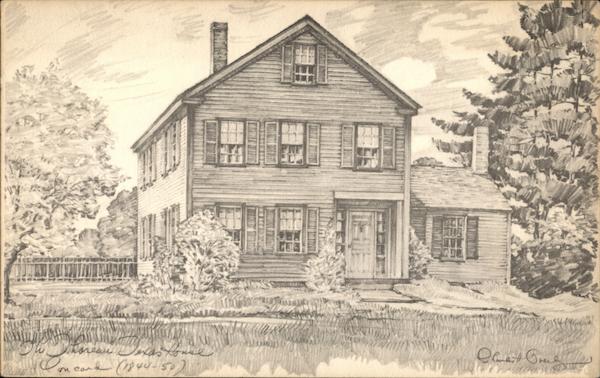
“Texas” House
(Thoreau Family Residence, 1844-1850)

H. D. Thoreau, Journal, October 3, 1860

See Vanessa Antiopa. See . April 17, 1860 (“It is unexpectedly very warm on lee side of hilltop just laid bare and covered with dry leaves and twigs. See my first Vanessa Antiopa”); October 1, 1860.(“C. saw the first Vanessa Antiopa since spring.”) See also A Book of the Seasons,  by Henry Thoreau, the Buff-edged Butterfly

The hard frost of September 28th, 29th, and 30th, and especially of October 1st. See October 1, 1860 ("Remarkable frost and ice this morning . . . I do not remember such cold at this season.").”); Compare October 3, 1856 (“The frost keeps off remarkably .” )

Sam Barrett says that last May he waded across the Assabet River on the old dam. See August 17, 1858 (“Being overtaken by a shower, we took refuge in the basement of Sam Barrett’s sawmill, where we spent an hour, and at length came home with a rainbow over arching the road before us”)

Bay-wings about. See April 15, 1859 (“The bay-wing now sings — the first I have been able to hear — . . . about the Texas house ”); October 9, 1858 (“Bay-wings flit along road.”); October 11, 1856 (“Bay-wing sparrows numerous.”); October 12, 1859 (“ I see scattered flocks of bay-wings amid the weeds and on the fences.”); October 16, 1855 ("I look at a grass-bird on a wall in the dry Great Fields. There is a dirty-white or cream-colored line above the eye and another from the angle of the mouth beneath it and a white ring close about the eye. The breast is streaked with this creamy white and dark brown in streams, as on the cover of a book.") See also A Book of the Seasons, by Henry Thoreau, the Bay-Wing Sparrow

I have seen and heard sparrows in flocks within a week. See September 17, 1858 (“Methinks, too, that there are more sparrows in flocks now about in garden”);  September 23, 1851 ("I scare up large flocks of sparrows in the garden.");September 26, 1858 (“Now is the time, too, when flocks of sparrows begin to scour over the weedy fields,”); September 27, 1858 ("What are those little birds in flocks in the garden and on the peach trees these mornings, about size of chip-birds, without distinct chestnut crowns?”); October 2, 1858 ("The garden is alive with migrating sparrows these mornings."); October 5, 1858 (“I still see large flocks, apparently of chip birds, on the weeds and ground in the yard.”); October 10, 1853 ("There are . . . large flocks of small sparrows,  which make a business of washing and pruning themselves in the puddles in the road, as if cleaning up after a long flight and the wind of yesterday.”)

October 3. See A Book of the Seasons, by Henry Thoreau,  October 3
See sparrows in flocks 
and have heard more flitting by 
since the frosts began.

A Book of the Seasons, by Henry Thoreau
"A book, each page written in its own season,
out-of-doors, in its own locality."
~edited, assembled and rewritten by zphx © 2009-2025
 

Wednesday, October 11, 2017

Harvest Days--the seventh day of glorious weather.


October 11.

Sunday. P. M. — Up Assabet.

River lower than before since winter at least; very low.

Another frost last night, although with fog, and this afternoon the maple and other leaves strew the water, and it is almost a leaf harvest.

I see some fine clear yellows from the Rhus Toxicodendron on the bank by the hemlocks and beyond.

The osmunda ferns are generally withered and brown except where very much protected from frost. The O. regalis is the least generally withered of them.

The onoclea is much later and still generally green along the bank, or faded white here and there.

Looking at the reflection of the bank by the Hemlocks, the reflected sun dazzles me, and I approach nearer to the bank in order to shut it out (of course it disappears sooner in the reflection than the substance, because every head is raised above the level of the water), and I see in the reflection the fine, slender grasses on the sharp or well-defined edge of the bank all glowing with silvery light, a singularly silvery light to be seen in the water, and whose substance I can not see to advantage with my head thus high, since the sun is in the way.

This is the seventh day of glorious weather. Perhaps, these might be called Harvest Days. Within the week most of the apples have been gathered; potatoes are being dug; corn is still left in the fields, though the stalks are being carried in.

Others are ditching and getting out mud and cutting up bushes along fences, – what is called “brushing up,” — burning brush, etc.

These are cricket days.

The river is so low that I run against several rocks, which I must have floated over three or four days ago, and I see many snags and water-logged trunks on the bottom or partly exposed, which were then invisible.

It is remarkable how many trees — maple and swamp white [oak], etc. — which stand on the bank of the river, being undermined by the water or broken off by the ice or other cause, fall into the stream and finally sink to the bottom and are half buried there for many years. A great deal of wood, especially of the kinds named, is thus lost. They last longer there probably than in favorable localities out of water. I see still the timber foundation of an old dam just above Spencer Brook, extending across the river on the bottom, though there has been nothing above water within my recollection. The large black oaks in front of Prescott Barrett's are one by one falling into the river, and there are none to succeed them. They were probably left to skirt the stream when the other wood was cut, and now, when they are undermined, there are none behind to supply their places.

Mr. Conant of Acton tells me that there was a grist mill built over the river there by Sam Barrett's grandfather, and that he remembers going to it when he was fourteen. He went in at the Lee house and crossed the river by a bridge at the mill. He says that it is as much as sixty years since the mill was standing. Minott thinks it is not quite so long since. He remembers the bridge there, not a town one, nor strong enough for a horse and cart. Thinks the mill was discontinued because Dr. Lee complained of its flowing his wood land. They used to stop with their carts this side and carry their bags back and forth over the bridge on their shoulders. Used a small and poor road across to Lee's farm.

H. D. Thoreau, Journal,  October 11, 1857

River lower than before since winter at least. See October 15, 1856 ("River lower than for some months")

Another frost last night, although with fog, and this afternoon the maple and other leaves strew the water, and it is almost a leaf harvest.. See October 12, 1855 ("The leaves fallen last night now lie thick on the water next the shore, concealing it, —fleets of dry boats . . ."); October 12, 1858 ("There are many maple, birch, etc., leaves on the Assabet, in stiller places along the shore, but not yet a leaf harvest"); October 13, 1860 ("Now, as soon as the frost strips the maples, and their leaves strew the swamp floor and conceal the pools, the note of the chickadee sounds cheerfully winteryish.")

The seventh day of glorious weather. See October 10, 1857 ("The sixth day of glorious weather, which I am tempted to call the finest in the year , so bright and serene the air and such a sheen from the earth, so brilliant the foliage, so pleasantly warm . . . Certainly these are .the most brilliant days in the year, ushered in, perhaps, by a frosty morning, as this."); October 10, 1856 (“”These are the finest days in the year, Indian summer.")

Sunday, January 22, 2017

I never knew it to make such a business of snowing and bring so little to pass.

January 22. 

January 22, 2017
Snows all day, clearing up at night, — a remarkably fine and dry snow, which, looking out, you might suspect to be blowing snow merely. Yet thus it snows all day, driving almost horizontally, but it does not amount to much. 

P. M. — To Walden.

I never knew it to make such a business of snowing and bring so little to pass. The air is filled, so that you cannot see far against it, i.e. looking north-north west, yet but an inch or two falls all day. There is some drifting, however. 

You wonder how the tree sparrows can seek their food on the railroad causeway, flying in the face of such a fine, cold, driving snow-storm. 

Within the woods it is comparatively still. 

In the woods by Abel Brooks's rye hollow I hear a faint note, and see undoubtedly a brown creeper inspecting the branches of the oaks. It has white and black bars on the head, uttering from time to time a fine, wiry, screeping tse, tse, or tse, tse, tse. 

Brown Creeper
Minott tells me that Sam Barrett told him once when he went to mill that a song sparrow took up its quarters in his grist-mill and stayed there all winter. When it did not help itself he used to feed it with meal, for he was glad of its company; so, what with the dashing water and the crumbs of meal, it must have fared well. 

I asked M. about the Cold Friday. He said, "It was plaguy cold; it stung like a wasp." He remembers seeing them toss up water in a shoemaker's shop, usually a very warm place, and when it struck the floor it was frozen and rattled like so many shot. 

Old John Nutting used to say, "When it is cold it is a sign it's going to be warm," and "When it 's warm it 's a sign it 's going to be cold.”

H. D. Thoreau, Journal, January 22, 1857

A remarkably fine and dry snow, . . . driving almost horizontally ... See January 19, 1857 ("A fine dry snow, intolerable to face.”);  December 14, 1859 ("Snow-storms might be classified. This is a fine, dry snow, drifting nearly horizontally from the north”)

I asked M. about the Cold Friday [January 19, 1810]. . . .See January 11, 2017 ("Mother remembers the Cold Friday very well. . . .“);February 7, 1855 ("The old folks still refer to the Cold Friday, when they sat before great fires of wood four feet long, with a fence of blankets behind them, and water froze on the mantelpiece.”)

A song sparrow took up its quarters in his grist-mill and stayed there all winter.
See January 15, 1857 ("I saw, to my surprise, that it must be a song sparrow, . . .taken refuge in this shed")

Monday, March 28, 2016

My path grows narrower and steeper, and the night is approaching.

March 28

Uncle Charles buried. He was born in February, 1780, the winter of the Great Snow, and he dies in the winter of another great snow,—a life bounded by great snows. 

Cold, and the earth stiff again, after fifteen days of steady warm and, for the most part, sunny days (with out rain), in which the snow and ice have rapidly melted. 

Sam Barrett tells me that a boy caught a crow in his neighborhood the other day in a trap set for mink. Its leg was broken. He brought it home under his arm, and laid it down in a shop, thinking to keep it there alive. It looked up sidewise, as it lay seemingly helpless on the floor, but, the door being open, all at once, to their surprise, it lifted itself on its wings and flitted out and away without the least trouble. Many crows have been caught in mink-traps the past winter, they have been compelled to visit the few openings in brooks, etc., so much for food. 

Barrett has suffered all winter for want of water. 

***

I think to say to my friend, There is but one interval between us. You are on one side of it, I on the other. You know as much about it as I, —how wide, how impassable it is. 

I will endeavor not to blame you. Do not blame me. There is nothing to be said about it. Recognize the truth, and pass over the intervals that are bridged

Farewell, my friends, my path inclines to this side the mountain, yours to that. 

For a long time you have appeared further and further off to me. I see that you will at length disappear altogether. 

For a season my path seems lonely without you. The meadows are like barren ground. The memory of me is steadily passing away from you. 

My path grows narrower and steeper, and the night is approaching. 

Yet I have faith that. in the definite future, new suns will rise, and new plains expand before me, and I trust that I shall therein encounter pilgrims who bear that same virtue that I recognized in you, who will be that very virtue that was you. I accept the everlasting and salutary law, which was promulgated as much that spring that I first knew you, as this that I seem to lose you. 

My former friends, I visit you as one walks amid the columns of a ruined temple. You belong to an era, a civilization and glory, long past. I recognize still your fair proportions, notwithstanding the convulsions which we have felt, and the weeds and jackals that have sprung up around. 

I come here to be reminded of the past, to read your inscriptions, the hieroglyphics, the sacred writings. 

We are no longer the representatives of our former selves. Love is a thirst that is never slaked. Under the coarsest rind, the sweetest meat. If you would read a friend aright, you must be able to read through some thing thicker and opaquer than horn. If you can read a friend, all languages will be easy to you. 

Enemies publish themselves. They declare war. The friend never declares his love.

H. D. Thoreau, Journal, March 28, 1856

Uncle Charles buried. See March 27, 1856 ("Uncle Charles died this morning, about midnight, aged seventy-six. The frost is now entirely out in some parts of the New Burying-Ground, the sexton tells me.")


The winter of another great snow.
See January 16, 1856 ("With this snow the fences are scarcely an obstruction to the traveller; he easily steps over them. Often they are buried. I suspect it is two and a half feet deep in Andromeda Swamps now."); February 19, 1856 ("The snow has been deeper since the 17th than before this winter. I think if the drifts could be fairly measured it might be found to be seventeen or eighteen inches deep on a level.”); March 19, 1856 ("The snow was constantly sixteen inches deep, at least, on a level in open land, from January 13th to March 13th"); March 23, 1856 ("I think I may say that the snow has been not less than a foot deep on a level in open land until to-day, since January 6th, about eleven weeks"). See also 
 September 8, 1851 ("As one year passes into another through the medium of winter, so does this our life pass into another through the medium of death.")

Many crows have been caught in mink-traps the past winter, they have been compelled to visit the few openings in brooks for food. See February 6, 1856 ("Goodwin says that he has caught two crows this winter in his traps set in water for mink, and baited with fish. The crows, probably put to it for food and looking along the very few open brooks, attracted by this bait, got their feet into the traps.”); March 10, 1856 ("The pinched crows are feeding in the road to-day in front of the house and alighting on the elms, and blue jays also, as in the middle of the hardest winter, for such is this weather.");. March 12, 1856 ("The crow has been a common bird in our street and about our house the past winter. "); March 20, 1856 ("Perhaps these [Paludina decisa] make part of the food of the crows which visit this brook and whose tracks I now see on the edge, and have all winter. Probably they also pick up some dead frogs"); March 22, 1856 ("Many tracks of crows in snow along the edge of the open water against Merrick’s at Island. They thus visit the edge of water—this and brooks —before any ground is exposed. Is it for small shellfish?")

Farewell, my friends, my path inclines to this side the mountain, yours to that.
See March 4, 1856 ("I had two friends."); See also Farewell, my friend

The night is appoaching.  See August 18, 1853 {The night of the year is approaching . . . The year is full of warnings of its shortness, as is life.)

Farewell, my friends, my 
path inclines to this side the 
mountain, yours to that. 

A Book of the Seasons
, by Henry Thoreau
"A book, each page written in its own season,
out-of-doors, in its own locality.”
~edited, assembled and rewritten by zphx © 2009-2025

https://tinyurl.com/hdt-560328

Popular Posts Last 30 Days.

The week ahead in Henry’s journal

The week ahead in Henry’s journal
A journal, a book that shall contain a record of all your joy.
"A stone fruit. Each one yields me a thought." ~ H. D. Thoreau, March 28, 1859


I sit on this rock
wrestling with the melody
that possesses me.