Showing posts with label sparrow hawk. Show all posts

Friday, September 24, 2021

One milkweed with faith in its seeds.


September 24

Returning over the causeway from Flint's Pond the other evening (22d ), just at sunset, I observed that while the west was of a bright golden color under a bank of clouds, — the sun just setting, — and not a tinge of red was yet visible there, there was a distinct purple tinge in the nearer atmosphere, so that Annursnack Hill, seen through it, had an exceedingly rich empurpled look.

It is rare that we perceive this purple tint in the air, telling of the juice of the wild grape and poke-berries. The empurpled hills! Methinks I have only noticed this in cooler weather.

Last night was exceedingly dark. I could not see the sidewalk in the street, but only felt it with my feet. I was obliged to whistle to warn travellers of my nearness, and then I would suddenly find myself abreast of them without having seen anything or heard their footsteps.

It was cloudy and rainy weather combined with the absence of the moon. So dark a night that, if a farmer who had come in a-shopping had spent but an hour after sunset in some shop, he might find himself a prisoner in the village for the night.

Thick darkness.

8 A. M. — To Lee's Bridge via Conantum.

It is a cool and windy morning, and I have donned a thick coat for a walk.

The wind is from the north, so that the telegraph harp does not sound where I cross.

This windy autumnal weather is very exciting and bracing, clear and cold, after the rain of yesterday, it having cleared off in the night.

I see a small hawk, a pigeon (?) hawk, over the Depot Field, which can hardly fly against the wind.

At Hubbard's Grove the wind roars loudly in the woods.

Grapes are ripe and already shrivelled by frost; barberries also.

It is cattle show day at Lowell.

Yesterday's wind and rain has strewn the ground with leaves, especially under the apple trees. Rain coming after frost seems to loosen the hold of the leaves, making them rot off.

Saw a woodchuck disappearing in his hole.

The river washes up-stream before the wind, with white streaks of foam on its dark surface, diagonally to its course, showing the direction of the wind. Its surface, reflecting the sun, is dazzlingly bright.

The outlines of the hills are remarkably distinct and firm, and their surfaces bare and hard, not clothed with a thick air.

I notice one red tree, a red maple, against the green woodside in Conant's meadow. It is a far brighter red than the blossoms of any tree in summer and more conspicuous.

The huckleberry bushes on Conantum are all turned red.


September 24, 2021

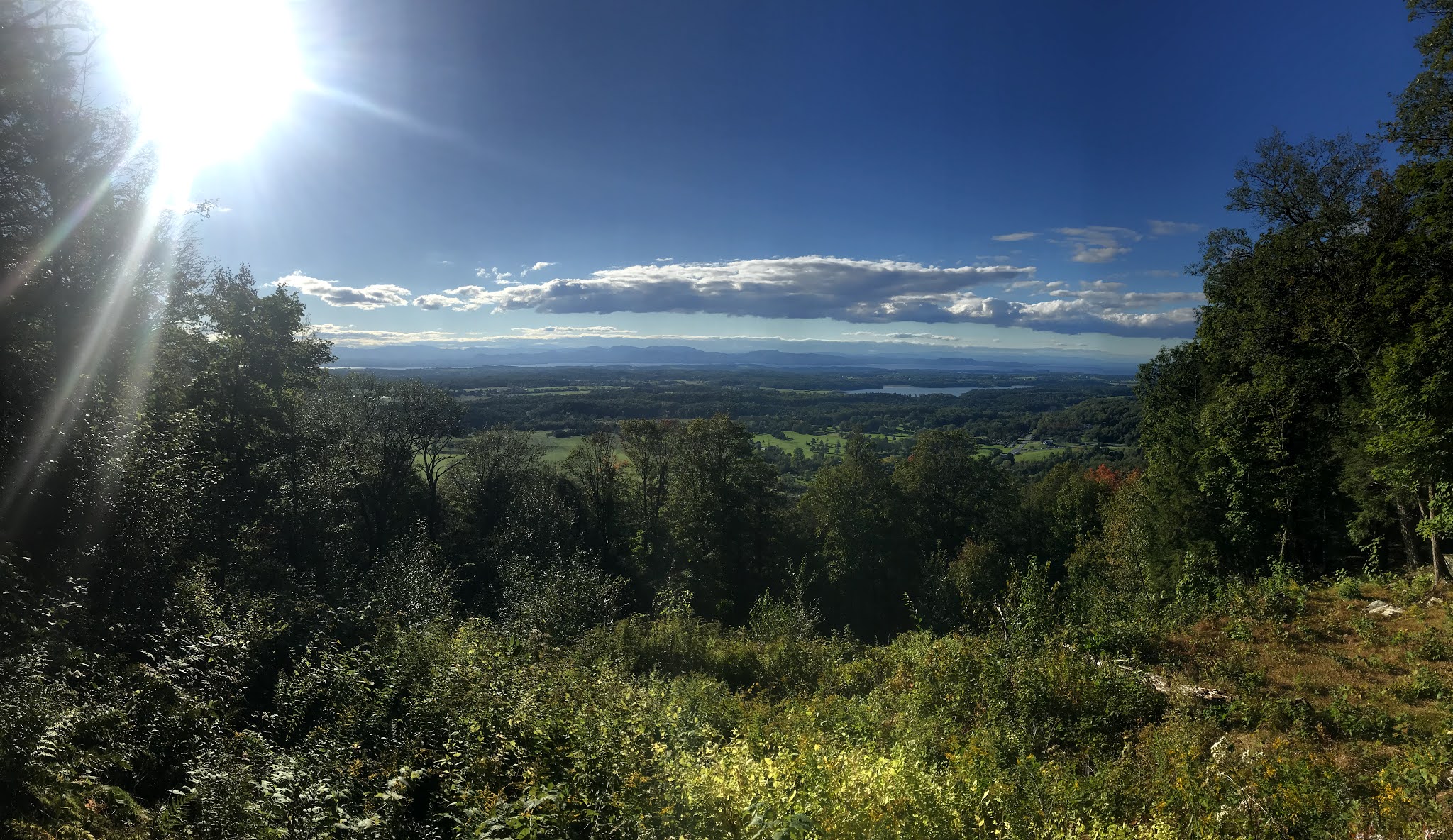
What can be handsomer for a picture than our river scenery now? Take this view from the first Conantum Cliff:
  • First this smoothly shorn meadow on the west side of the stream, with all the swaths distinct, sprinkled with apple trees casting heavy shadows black as ink, such as can be seen only in this clear air, this strong light, one cow wandering restlessly about in it and lowing; 
  • then the blue river, scarcely darker than and not to be distinguished from the sky, its waves driven southward, or up-stream, by the wind, making it appear to flow that way, bordered by willows and button-bushes; 
  • then the narrow meadow beyond, with varied lights and shades from its waving grass, which for some reason has not been cut this year, though so dry, now at length each grass-blade bending south before the wintry blast, as if bending for aid in that direction; 
  • then the hill rising sixty feet to a terrace-like plain covered with shrub oaks, maples, etc., now variously tinted, clad all in a livery of gay colors, every bush a feather in its cap; and
  •  further in the rear the wood crowned Cliff some two hundred feet high, where gray rocks here and there project from amidst the bushes, with its orchard on the slope; 
  • and to the right of the Cliff the distant Lincoln hills in the horizon.
The landscape so handsomely colored, the air so clear and wholesome; and the surface of the earth is so pleasingly varied, that it seems rarely fitted for the abode of man.


In Cohush Swamp the sumach leaves have turned a very deep red, but have not lost their fragrance. I notice wild apples growing luxuriantly in the midst of the swamp, rising red over the colored, painted leaves of the sumach, and reminding me that they were ripened and colored by the same influences, some green, some yellow, some red, like the leaves.

Fell in with a man whose breath smelled of spirit which he had drunk. How could I but feel that it was his own spirit that I smelt? 

Behind Miles's, Darius Miles's, that was, I asked an Irishman how many potatoes he could dig in a day, wishing to know how well they yielded. “Well, I don't keep any account,” he answered; “I scratch away, and let the day's work praise itself.” Aye, there's the difference between the Irish man and the Yankee; the Yankee keeps an account. The simple honesty of the Irish pleases me.

A sparrow hawk, hardly so big as a nighthawk, flew over high above my head, –
 a pretty little graceful fellow, too small and delicate to be rapacious.

Found a grove of young sugar maples (Acer saccharinum ) behind what was Miles's. How silently and yet startlingly the existence of these sugar maples was revealed to me, which I had not thought grew in my immediate neighborhood, — when first I perceived the entire edges of its leaves and their obtuse sinuses.

Such near hills as Nobscot and Nashoba have lost all their azure in this clear air and plainly belong to earth. Give me clearness nevertheless, though my heavens be moved further off to pay for it.

I perceive from the hill behind Lee's that much of the river meadows is not cut, though they have been very dry. The sun-sparkle on the river is dazzlingly bright in this atmosphere, as it has not been, perchance, for many a month.

It is so cold I am glad to sit behind the wall.

Still the great bidens blooms by the causeway side beyond the bridge.


At Clematis Brook I perceive that the pods or follicles of the Asclepias Syriaca now point upward. Did they before all point down? Have they turned up? They are already bursting.

I release some seeds with the long, fine silk attached. The fine threads fly apart at once, open with a spring, and then ray themselves out into a hemispherical form, each thread freeing itself from its neighbor and all reflecting prismatic or rainbow tints. The seeds, besides, are furnished with wings, which plainly keep them steady and prevent their whirling round. I let one go, and it rises slowly and uncertainly at first, now driven this way, then that, by currents which I cannot perceive, and I fear it will make shipwreck against the neighboring wood; but no, as it approaches it, it surely rises above it, and then, feeling the strong north wind, it is borne off rapidly in the opposite direction, ever rising higher and higher and tossing and heaved about with every fluctuation of the air, till, at a hundred feet above the earth and fifty rods off, steering south, I lose sight of it.

How many myriads go sailing away at this season, high over hill and meadow and river, on various tacks until the wind lulls, to plant their race in new localities, who can tell how many miles distant! And for this end these silken streamers have been perfecting all summer, snugly packed in this light chest,
— a perfect adaptation to this end, a prophecy not only of the fall but of future springs.

Who could believe in prophecies of Daniel or of Miller that the world would end this summer, while one milkweed with faith matured its seeds?


On Mt. Misery some very rich yellow leaves — clear yellow — of the Populus grandidentata, which still love to wag, and tremble in my hands. Also canoe birches there.

The river and pond from the side of the sun look comparatively dark.

As I look over the country westward and northwestward, the prospect looks already bleak and wintry. The surface of the earth between the forests is no longer green, but russet and hoary. You see distinctly eight or ten miles the russet earth and even houses, and then its outline is distinctly traced against the further blue mountains, thirty or thirty-five miles distant. You see distinctly perhaps to the height of land between the Nashua and Concord, and then the convexity of the earth conceals the further hills, though high, and your vision leaps a broad valley at once to the mountains.

Get home at noon.

At sundown the wind has all gone down.

H. D. Thoreau, Journal, September 24, 1851


 I observed that while the west was of a bright golden color under a bank of clouds, — the sun just setting, — and not a tinge of red was yet visible there, there was a distinct purple tinge in the nearer atmosphere, so that Annursnack Hill, seen through it, had an exceedingly rich empurpled look. See October 19, 1858 ("The sun just ready to set, I notice that its light on my note-book is quite rosy or purple")

Last night was exceedingly dark. I could not see the sidewalk in the street, but only felt it with my feet. I was obliged to whistle to warn travellers of my nearness. See September 12, 1860 ("A dark and stormy night . . . Where the fence is not painted white I can see nothing, and go whistling for fear I run against some one. . . .You walk with your hands out to feel the fences and trees"); September 18, 1857 ("It was exceedingly dark. I met two persons within a mile, and they were obliged to call out from a rod distant lest we should run against each other. ")

I notice one red tree, a red maple, against the green woodside in Conant's meadow. See September 24, 1855 ("the maples are but just beginning to blush") See also September 25, 1857 ("The whole tree, thus ripening in advance of its fellows, attains a singular preéminence"); September 25, 1857 ("The red maple has fairly begun to blush in some places by the river. I see one, by the canal behind Barrett’s mill, all aglow against the sun."); September 25, 1857 ("A single tree becomes the crowning beauty of some meadowy vale and attracts the attention of the traveller from afar."); September 26, 1854 ("Some single red maples are very splendid now, the whole tree bright-scarlet against the cold green pines; now, when very few trees are changed, a most remarkable object in the landscape; seen a mile off."); September 27, 1855 ("Some single red maples now fairly make a show along the meadow. I see a blaze of red reflected from the troubled water."

At Clematis Brook I perceive that the pods or follicles of the Asclepias Syriaca now point upward. Did they before all point down? Have they turned up? See August 24, 1851 ("The pods of the Asclepias pulchra stand up pointedly like slender vases on a salver, an open salver truly! Those of the Asclepias Syriaca hang down.")

The fine threads fly apart at once, open with a spring, and then ray themselves out into a hemispherical form, each thread freeing itself from its neighbor. . . .a prophecy not only of the fall but of future springs. See September 10, 1860 ("If you sit at an open attic window almost anywhere, about the 20th of September, you will see many a milkweed down go sailing by on a level with you, though commonly it has lost its freight, — notwithstanding that you may not know of any of these plants growing in your neighborhood."); October 23, 1852 ("The milkweed (Syriaca) now rapidly discounting. The lanceolate pods having opened, the seeds spring out on the least jar, or when dried by the sun, and form a little fluctuating white silky mass or tuft, each held by the extremities of the fine threads, until a stronger puff of wind sets them free. It is a pleasant sight to see it dispersing its seeds")

The further blue mountains, thirty or thirty-five miles distant. See June 3, 1850 ("The landscape is a vast amphitheatre rising to its rim in the horizon."); September 12, 1851 ("It is worth the while to see the mountains in the horizon once a day"); August 2, 1852 ("In many moods it is cheering to look across hence to that blue rim of the earth,"); March 31, 1853 ("It is affecting to see a distant mountain-top,. . . still as blue and ethereal to your eyes as is your memory of it.'); September 27, 1853 ("From our native hills we look out easily to the far blue mountains, which seem to preside over them.");October 22, 1857 ("But what a perfect crescent of mountains we have in our northwest horizon! Do we ever give thanks for it? "); November 22, 1860 ("Simply to see to a distant horizon through a clear air, - the fine outline of a distant hill or a blue mountaintop through some new vista, - this is wealth enough for one afternoon.")

Sunday, October 6, 2019

The pigeon and sparrow hawks

October 6


October 6, 2023              October 6, 2022

A. M. — To Boston. 

Examine the pigeon and sparrow hawks in the Natural History collection. 

My wings and tail are apparently the pigeon hawk's. 

The sparrow hawks are decidedly red-brown with bluish heads and blue or slate sides; also are much more thickly barred with dark on wing-coverts, back, and tail than the pigeon hawk.

H. D. Thoreau, Journal, October 6, 1859


The Natural History collection. See October 6, 1855 ("Return to Concord via Natural History Library.")

My wings and tail are apparently the pigeon hawk's. See  September 14, 1859 ("What kind of hawk is this? I can learn nothing from Wilson and Nuttall. The latter thinks that neither the pigeon nor sparrow hawk is found here !!") See also May 24, 1856 ("Pratt gave me the wing of a sparrow (?) hawk which he shot some months ago. . . .It must be a sparrow hawk, according to Wilson and Nuttall, for the inner vanes of the primaries and secondaries are thickly spotted with brownish white.”); July 2, 1856 (“Looked at the birds in the Natural History Rooms in Boston. Observed no white spots on the sparrow hawk’s wing, or on the pigeon or sharp-shinned hawk’s. Indeed they were so closed that I could not have seen them. Am uncertain to which my wing belongs.”) See also  A Book of the Seasons by Henry Thoreau, The Pigeon Hawk (Merlin)

Wednesday, October 17, 2018

Both by sounds and sights I am reminded that I am in the very midst of the fall.

October 17


October 17, 1858

 P. M. — Up Assabet. 

There are many crisped but colored leaves resting on the smooth surface of the Assabet, which for the most part is not stirred by a breath; but in some places, where the middle is rippled by a slight breeze, no leaves are seen, while the broad and perfectly smooth portions next the shore will be covered with them, as if by a current they were prevented from falling on the other parts. These leaves are chiefly of the red maple, with some white maple, etc. To be sure, they hardly begin to conceal the river, unless in some quiet coves, yet they remind me of ditches in swamps, whose surfaces are often quite concealed by leaves now. The waves made by my boat cause them to rustle, and both by sounds and sights I am reminded that I am in the very midst of the fall. 

Methinks the reflections are never purer and more distinct than now at the season of the fall of the leaf, just before the cool twilight has come, when the air has a finer grain. Just as our mental reflections are more distinct at this season of the year, when the evenings grow cool and lengthen and our winter evenings with their brighter fires may be said to begin. And painted ducks, too, often come and sail or float amid the painted leaves. 

Cattle are seen these days turned into the river meadows and straying far and wide. They have at length reached those “ pastures new” they dreamed of. 

I see one or two large white maples quite bare. 

Some late red maples are unexpectedly as fair and bright as ever, both scarlet and yellow, and still distance all competitors. There is no brighter and purer scarlet (often running into crimson) and no softer and clearer yellow than theirs now, though the greater part have quite lost their leaves. The fires I thought dulled, if not put out, a week ago seem to have burst forth again. This accounts for those red maples which were seen to be green while all around them were scarlet. They but bided their time. They were not so easily affected. 

I distinguish one large red oak — the most advanced one — from black ones, by its red brown, though some others are yellow-brown and greenish. The large red oaks are about in their prime. Some are a handsome light scarlet, with yellow and green.

The Cornus sericea is a very dark crimson, though it has lost some leaves. 

The Salix lucida lower leaves are all fallen (the rest are yellow). So, too, it is the. lower leaves of the willows generally which have fallen first. 

Saw a small hawk come flying over the Assabet, which at first I mistook for a dove, though it was smaller. It was blunt or round-shouldered like a dove. It alighted on a small elm and did not mind a wagon passing near by. Seen through my glass twenty rods off, it had a very distinct black head, with apparently a yellowish-brown , breast and beneath and a brown back, — both, however, quite light, — and a yellowish tail with a distinct broad black band at the tip. This I saw when, in pruning itself, it was tilted or flirted up. Could it have been a sparrow hawk?

One reason why I associate perfect reflections from still water with this and a later season may be that now, by the fall of the leaves, so much more light is let in to the water. The river reflects more light, therefore, in this twilight of the year, as it were an afterglow.

H. D. Thoreau, Journal, October 17, 1858

There are many crisped but colored leaves resting on the smooth surface of the Assabet,.Methinks the reflections are never purer and more distinct than now at the season of the fall of the leaf. See October 15, 1856 ("The water is very calm and full of reflections. Large fleets of maple and other leaves are floating on its surface as I go up the Assabet, leaves which apparently came down in a shower with yesterday morning's frost."); October 22,1854 ("Pretty hard frosts these nights. Many leaves fell last night, and the Assabet is covered with their fleets”)


The waves made by my boat cause them to rustle. See October 19, 1853 ("The leaves have fallen so plentifully that they quite conceal the water along the shore, and rustle pleasantly when the wave which the boat creates strikes them."); October 17, 1856 ("Countless leafy skiffs are floating on pools and lakes and rivers and in the swamps and meadows, often concealing the water quite from foot and eye."); October 17, 1857 ("The swamp floor is covered with red maple leaves, many yellow with bright-scarlet spots or streaks. Small brooks are almost concealed by them")

I see one or two large white maples quite bare. See note to October 14, 1858 ("The white maples are now apparently in their autumnal dress")

Could it have been a sparrow hawk? See May 4, 1855 (“ I think that what I have called the sparrow hawk falsely, and latterly pigeon hawk, is also the sharp-shinned")

By the fall of the leaves, so much more light is let in to the water. The river reflects more light, therefore, in this twilight of the year, as it were an afterglow. See August 19, 1853 ("As toward the evening of the day the lakes and streams are smooth, so in the fall, the evening of the year, the waters are smoothed more perfectly than at any other season. The day is an epitome of the year."); August 31, 1852 ("The evening of the year is colored like the sunset."); November 14, 1853 ("October is the month of painted leaves, . . .it is the sunset month of the year, when the earth is painted like the sunset sky. . . .This light fades into the clear, white, leafless twilight of November, and what ever more glowing sunset or Indian summer we have then is the afterglow of the year.”)

What an ample share
of the light of heaven each
pond and lake enjoys!

tinyurl.com/HDT581017

Saturday, July 2, 2016

Looked at the birds in the Natural History Rooms in Boston.

July 2
July 2, 2016

Return to Concord. Looked at the birds in the Natural History Rooms in Boston. 

Observed no white spots on the sparrow hawk’s wing, or on the pigeon or sharp-shinned hawk’s. Indeed they were so closed that I could not have seen them. Am uncertain to which my wing belongs. 

May I not have seen the white-crowned sparrow in company with the white-throated? They are much alike. Yet Wilson says they rarely associate. 

The hemlock and pine warbler are much alike. Is it possible I have confounded them?

H. D. Thoreau, Journal, July 2, 1856

Am uncertain to which my wing belongs.
See May 24, 1856 ("Pratt gave me the wing of a sparrow (?) hawk which he shot some months ago. . . .It must be a sparrow hawk, according to Wilson and Nuttall, for the inner vanes of the primaries and secondaries are thickly spotted with brownish white.”) See also May 4, 1855 (“I think that what I have called the sparrow hawk falsely, and latterly pigeon hawk, is also the sharp-shinned (vide April 26th and May 8th, 1854, and April 16th, 1855), for the pigeon hawk’s tail is white-barred.”); April 16, 1855 ( "What I call a pigeon hawk, probably sharp-shinned.”)   See also A Book of the Seasons, by Henry Thoreau, the sharp-shinned hawk.

Pine warbler.  See April 16, 1856 I(“See a pine warbler, much less yellow than the last. . . . “); April 9, 1856 ("Its bright yellow or golden throat and breast, etc., are conspicuous at this season.”) See also A Book of the Seasons, the Pine Warbler.

Tuesday, May 24, 2016

To-day is suddenly overpowering warm.

May 24 

Pratt gave me the wing of a sparrow (?) hawk which he shot some months ago. He was coming from his house to his shop early in the morning when he saw this small hawk, which looked like a pigeon, fly past him over the Common with a sparrow in his clutches, and alight about six feet up the south button wood in front of Tolman’s. Having a small Maynard’s revolver in his pocket, loaded with a ball size of a pea, he followed, and, standing twenty-two paces from the tree in the road, aimed and brought down both hawk and sparrow at a distance of about six rods, cutting off the wing of the former with the ball. This he confessed he could not do again if he should try a hundred times. 

It must be a sparrow hawk, according to Wilson and Nuttall, for the inner vanes of the primaries and secondaries are thickly spotted with brownish white.

Humphrey Buttrick says that he hears the note of the woodcock from the village in April and early in May (too late now); that there were some this year breeding or singing by the riverside in front of Abel Heywood’s. He says that when you see one spring right up straight into the air, you may go to the spot, and he will surely come down again after some minutes to within a few feet of the same spot and of you. 

Has known a partridge to fly at once from one to two miles after being wounded (tracked them by the blood) without alighting. Says he has caught as many as a dozen partridges in his hands. He lies right down on them, or where he knows them to be, then passes his hands back and forth under his body till he feels them. You must not lift your body at all or they will surely squeeze out, and when you feel one must be sure you get hold of their legs or head, and not feathers merely. 

To-day is suddenly overpowering warm. Thermometer at 1 P. M., 94° in the shade! but in the afternoon it suddenly fell to 56, and it continued cold the next two days.

H. D. Thoreau, Journal, May 24, 1856

It must be [the wing of] a sparrow hawk . . . 
for the inner vanes of the primaries and secondaries are thickly spotted with brownish white. See July 2, 1856 (“Looked at the birds in the Natural History Rooms in Boston. Observed no white spots on the sparrow hawk’s wing, or on the pigeon or sharp-shinned hawk’s. Indeed they were so closed that I could not have seen them. Am uncertain to which my wing belongs.”); See also September 24, 1851("A sparrow hawk, hardly so big as a nighthawk, flew over high above my head – a pretty little graceful fellow, too small and delicate to be rapacious."); May 8, 1854 (“Saw a small hawk flying low, about size of a robin — tail with black bars — probably a sparrow hawk; probably the same I have seen before . . . I saw these distinct bars at a distance as mine flew . . .The sparrow hawk is a rather reddish brown and finely and thickly barred above with black.”);  September 29, 1854 ("Saw two either pigeon or sparrow hawks, apparently male and female, the one much larger than the other.");  April 16, 1855 ( What I call a pigeon hawk, probably sharp-shinned.”); May 4, 1855 ("I think that what I have called the sparrow hawk falsely, and latterly pigeon hawk, is also the sharp-shinned”);  October 17, 1858 ("Saw a small hawk come flying over the Assabet . . . it had a very distinct black head, with apparently a yellowish-brown breast and beneath and a brown back, – both, however, quite light, – and a yellowish tail with a distinct broad black band at the tip . . . Could it have been a sparrow hawk?"); September 14, 1859 ("What kind of hawk is this? I can learn nothing from Wilson and Nuttall. The latter thinks that neither the pigeon nor sparrow hawk is found here !!") October 6, 1859 ("Examine the pigeon and sparrow hawks in the Natural History collection . . .The sparrow hawks are decidedly red-brown with bluish heads and blue or slate sides; also are much more thickly barred with dark on wing-coverts, back, and tail than the pigeon hawk"); April 27, 1860 ("I saw yesterday, and see to-day, a small hawk which I take to be a pigeon hawk . . . I am decided by his size (as well as color ) and his low, level skimming. [Methinks I saw a yet smaller hawk, perhaps sparrow hawk, fly or skim over the village about the 12th.]"); J. J. Audubon ("Every one knows the Sparrow-Hawk [Falco sparverius], the very mention of its name never fails to bring to mind some anecdote connected with its habits.”); and  A Book of the Seasons by Henry Thoreau, The Pigeon Hawk (Merlin) or Sparrow Hawk (Kestrel)?

Buttrick says that he hears the note of the woodcock from the village in April and early in May See  March 29, 1859 ("Minott thinks the middle of March is as early as they come and that they do not then begin to lay"); April 5, 1857 ("I hear . . . the speed speed over R.’s meadow, which I once referred to the snipe, but R. says is the woodcock, whose other strain he has already heard.");  April 22, 1860 ("Scare up woodcock on the shore by my boat's place, — the first I had seen.") See also A Book of the Seasons,  by Henry Thoreau, The American Woodcock

Thermometer at 1 P. M., 94° in the shade!  See  May 24, 1855 ("It is very hazy in consequence of the sudden warmth after cold, and I cannot see the mountains."); May 24, 1857 ("At 3 p. m. the thermometer is at 88°. It soon gets to be quite hazy.")

May 24. See A Book of the Seasons, by Henry Thoreau, May 24 

Pratt gave me the wing 
of a sparrow hawk which he 
shot some months ago.

A Book of the Seasons, by Henry Thoreau
"A book, each page written in its own season,
out-of-doors, in its own locality.”

~edited, assembled and rewritten by zphx © 2009-2026

Monday, September 29, 2014

Cool breezy evening with a prolonged white twilight.


September 29


September 29, 2018

P. M. —— To Lee’s Bridge via Mt. Misery and return by Conantum.

Yesterday was quite warm, requiring the thinnest coat. To-day is cooler. 

The elm leaves have in some places more than half fallen and strew the ground with thick rustling beds, — as front of Hubbard’s, — perhaps earlier than usual. 

Bass berries dry and brown. 

Now is the time to gather barberries. 

Looking from the Cliffs, the young oak plain is now probably as brightly colored as it will be. The bright reds appear here to be next the ground, the lower parts of these young trees, and I find on descending that it is commonly so as yet with the scarlet oak, which is the brightest. It is the lower half or two thirds which have changed, and this is surmounted by the slender, still green top. In many cases these leaves have only begun to be sprinkled with bloody spots and stains, — sometimes as if one had cast up a quart of blood from beneath and stained them.

I now see the effect of that long drought on some young oaks, especially black oaks. Their leaves are in many in stances all turned to a clear and uniform brown, having so far lost their vitality, but still plump and full veined and not yet withered. Many are so affected and, of course, show no bright tints. They are hastening to a premature decay. The tops of many young white oaks which had turned are already withered, apparently by frost.

See two either pigeon or sparrow hawks, apparently male and female, the one much larger than the other. 

I see in many places the fallen leaves quite thickly covering the ground in the woods. 

A large flock of crows wandering about and cawing as usual at this season. 

I hear a very pleasant and now unusual strain on the sunny side of an oak wood from many — I think F. hyemalis, though I do not get a clear view of them. Even their slight jingling strain is remarkable at this still season. 

The catbird still mews. 

I see two ducks alternately diving in smooth water near the shore of Fair Haven Pond. Sometimes both are under at once. 

The milkweed down is flying at Clematis Ditch. 

This evening is quite cool and breezy, with a prolonged white twilight, quite Septemberish. 

When I look at the stars, nothing which the astronomers have said attaches to them, they are so simple and remote. Their knowledge is felt to be all terrestrial and to concern the earth alone. It suggests that the same is the case with every object, however familiar; our so-called knowledge of it is equally vulgar and remote. 

One might say that all views through a telescope or microscope were purely visionary, for it is only by his eye and not by any other sense —not by his whole man —that the beholder is there where he is presumed to be. It is a disruptive mode of viewing as far as the beholder is concerned.

H. D. Thoreau, Journal, September 29, 1854

Yesterday was quite warm, requiring the thinnest coat.  See September 3, 1852 ("A warm night.  A thin coat sufficient."); September 9, 1851 ("A sultry night; a thin coat is enough."); September 14, 1851 ("A great change in the weather from sultry to cold, from one thin coat to a thick coat or two thin ones."); September 14, 1859 ("When cooler weather and frosts arrive . . . we shift from the shady to the sunny side of the house, and sit there in an extra coat for warmth.") September 28, 1852 ("It has been too cold for the thinnest coat since the middle of September"); October 2, 1852 ("A very warm day after the frosts, so that I wish — though I am afraid to wear — a thin coat")

The elm leaves have in some places more than half fallen and strew the ground with thick rustling beds. See September 28, 1853 ("The elm leaves are falling"); September 28, 1857 ("Had one of those sudden cool gusts, which . . . caused the elms to labor and drop many leaves, early in afternoon."); October 1, 1858 ("The harvest of elm leaves is come, or at hand.")

Bass berries dry and brown.
See September 30, 1859 ("Some acorns (swamp white oak) are browned on the trees, and some bass berries.") See also A Book of the Seasons, by Henry Thoreau, The Basswood

Looking from the Cliffs, the young oak plain is now probably as brightly colored as it will be. See September 24, 1854 ("On the shrub oak plain under Cliffs, the young white oaks are generally now tending to a dull inward red. The ilicifolia generally green stil , with a few yellowish or else scarlet leaves. The young black oaks with many red , scarlet , or yellowish leaves."); September 25, 1854 ("On the shrub oak plain, as seen from Cliffs, the red at least balances the green. It looks like a rich, shaggy rug now, before the woods are changed."); October 2, 1852 ("From Cliffs the shrub oak plain has now a bright-red ground, perhaps of maples."); October 13, 1852 ("The shrub oak plain is now a deep red, with grayish, withered, apparently white oak leaves intermixed."); January 30, 1853 (" What I have called the Shrub Oak Plain contains comparatively few shrub oaks, — rather, young red and white and, it may be, some scarlet (?).")

Now is the time to gather barberries. See September 29, 1853 ("Barberry ripe.") See also September 28, 1852 ("Children are now gathering barberries, — just the right time.") and A Book of the Seasons, by Henry Thoreau, The Common Barberry

A large flock of crows wandering about and cawing as usual at this season.See September 22, 1860 ("See a large flock of crows."); October 6, 1860 ("The crow, methinks, is our only large bird that hovers and circles about in flocks in an irregular and straggling manner, filling the air over your head and sporting in it as if at home here."); October 9, 1858 ("Crows fly over and caw at you now.") See also
A Book of the Seasons
, by Henry Thoreau, the American Crow

The catbird still mews.
See September 21, 1854 ("Hear the chewink and the cluck of the thrasher."); September 25, 1855 ("Meanwhile the catbird mews in the alders by my side");September 25, 1858 ("The catbird still mews occasionally, and the chewink is heard faintly."); October 4, 1857 ("Hear a catbird and chewink, both faint.")
 

The milkweed down is flying at Clematis Ditch. See September 10, 1860 ("If you sit at an open attic window almost anywhere, about the 20th of September, you will see many a milkweed down go sailing by.") September 24, 1852 ("At Clematis Brook I perceive that the pods or follicles of the Asclepias Syriaca . . . already bursting . . .How many myriads go sailing away at this season, high over hill and meadow and river, on various tacks until the wind lulls, to plant their race in new localities, who can tell how many miles distant! And for this end these silken streamers have been perfecting all summer, snugly packed in this light chest, — a perfect adaptation to this end, a prophecy not only of the fall but of future springs. Who could believe in prophecies . . .that the world would end this summer, while one milkweed with faith matured its seeds?")

This evening is quite cool and breezy, with a prolonged white twilight, quite Septemberish. See August 19, 1853 ("Now, while off Conantum, we have a cool, white, autumnal twilight, and as we pass the Hubbard Bridge, see the first stars."); August 28, 1853 ("A cool, white, autumnal evening."); August 30, 1856 ("A cold white horizon sky in the north, forerunner of the fall of the year."); September 11, 1854 "This is a cold evening with a white twilight, and threatens frost, the first in these respects decidedly autumnal evening."); October 27, 1858 (“The cool, white twilights of that season which is itself the twilight of the year.”); November 2, 1853("We come home in the autumn twilight . . . clear white light, which penetrates the woods”); November 14, 1853 ("the clear, white, leafless twilight of November”)

When I look at the stars, nothing which the astronomers have said attaches to them. See November 21, 1850(" I begin to see ... an object when I cease to understand it."); August 5, 1851 ("The astronomer is as blind to the significant phenomena, or the significance of phenomena . . . The question is not what you look at, but what you see."); February 18, 1852 ("I am grateful to the man who introduces order among the clouds. Yet I look up into the heavens so fancy free, I am almost glad not to know any law for the winds."); January 21, 1853 ("if I am elevated in the least toward the heavens, I do not accept their classification of them. I am not to be distracted by the names which they have imposed. The sun which I know is not Apollo, nor is the evening star Venus. The heavens should be as new, at least, as the world is new . . . Nobody sees the stars now. They study astronomy "); September 29, 1858 ("What astronomer can calculate the orbit of my thistle-down?");  October 4, 1859 ("It is only when we forget all our learning that we begin to know.")

Cool breezy evening
with a prolonged white twilight –
quite Septemberish.

A Book of the Seasons, by Henry Thoreau
"A book, each page written in its own season,
out-of-doors, in its own locality.”
~edited, assembled and rewritten by zphx © 2009-2024

https://tinyurl.com/hdt-540929

Tuesday, April 27, 2010

Under Lee's Cliff


River five eighths of an inch below summer level.

P. M. – Row to Conantum.

At the stone bridge the lower side outer end of the stone is about a quarter of an inch above summer level.

I saw yesterday, and see to-day, a small hawk which I take to be a pigeon hawk. This one skims low along over Grindstone Meadow, close to the edge of the water, and I see the blackbirds rise hurriedly from the button bushes and willows before him. I am decided by his size (as well as color) and his low, level skimming. [Methinks I saw a yet smaller hawk, perhaps sparrow hawk, fly or skim over the village about the 12th.]

The river meadows are now so dry that E. Wood is burning the Mantatuket one.

Fishes are rising to the shad-flies, probably because the river is so low. 

Luzula a day or two at Clamshell.

Strawberry well out; how long?

Viola ovata common.

One dandelion white, as if going to seed!

Thalictrum anemonoides are abundant, maybe two or three days, at Blackberry Steep.

I see where a robin has been destroyed, probably by a hawk. I think that I see these traces chiefly in the spring and fall. Why so?

Columbine, but perhaps' earlier, for I hear that it has been plucked here.

I see, close under the rocks at Lee's, some new polypody flatted out.

I stand under Lee's Cliff. 

There is a certain summeriness in the air now, especially under a warm cliff like this, where you smell the very dry leaves, and hear the pine warbler and the hum of a few insects, — small gnats, etc., — and see considerable growth and greenness.

Though it is still windy, there is, nevertheless, a certain serenity and long-lifeness in the air, as if it were a habitable place and not merely to be hurried through.

The noon of the year is approaching. Nature seems meditating a siesta.

The hurry of the duck migration is, methinks, over. But the woods generally, and at a distance, show no growth yet.

There is a large fire in the woods northwest of Concord, just before night. A column of smoke is blown away from it far southeast, and as the twilight approaches, it becomes more and more dun. At first some doubted if it was this side the North River or not, but I saw that Annursnack was this side of it, but I expected our bells would ring presently.

One who had just come down in the cars thought it must be in Groton, for he had left a fire there. And the passengers in the evening train from Boston said that they began to see the smoke of it as soon as they left the city! So hard is it to tell how far off a great fire is.


H.D. Thoreau, Journal, April 27, 1860

I stand under Lee's Cliff. See April 27, 1852 (“This is a place to look for early blossoms of the saxifrage, columbine, and plantain-leaved everlasting . . . The crevices of the rock (cliff) make natural hothouses for them, affording dryness, warmth, and shelter.”)

I saw yesterday, and see to-day, a small hawk which I take to be a pigeon hawk. See April 26, 1854 ("Saw probably a pigeon hawk skim straight and low over field and wood, and another the next day apparently dark slate-color."); September 14, 1859 ("What kind of hawk is this? I can learn nothing from Wilson and Nuttall. The latter thinks that neither the pigeon nor sparrow hawk is found here !!") October 6, 1859 ("Examine the pigeon and sparrow hawks in the Natural History collection . . .The sparrow hawks are decidedly red-brown with bluish heads and blue or slate sides; also are much more thickly barred with dark on wing-coverts, back, and tail than the pigeon hawk");  See also  A Book of the Seasons by Henry Thoreau, The Pigeon Hawk (Merlin)

Popular Posts Last 30 Days.

The week ahead in Henry’s journal

The week ahead in Henry’s journal
A journal, a book that shall contain a record of all your joy.
"A stone fruit. Each one yields me a thought." ~ H. D. Thoreau, March 28, 1859


I sit on this rock
wrestling with the melody
that possesses me.