Showing posts with label nightshade. Show all posts

Monday, July 11, 2022

Now is the time for meadow walking.

July 11. 

July 11, 2015

4.30 A. M. -To the river.

The shore is strewn with quite a long grove of young red maples two inches high, with the samaræ attached. So they are dispersed.

The heart-leaf flower is abundant more than ever, but shut up at this hour.

The first lily I noticed opened about half an hour after sunrise, or at 5 o'clock.

The Polygonum hydropiperoides, I think it is, now in blossom in the mud by the river.

Morning-glories are in perfection now, some dense masses of this vine with very red flowers, very attractive and cool-looking in dry mornings. They are very tender and soon defaced in a nosegay.

The large orange lily with sword-shaped leaves, strayed from cultivation, by the roadside beyond the stone bridge.

It is a sufficient reason for walking in the forenoon sometimes that some flowers shut up at noon and do not open again during the day, thus showing a preference for that portion of the day.

P. M. — To Conantum.

The wind makes it rather more comfortable to-day.

That small globose white flower with glossy radical leaves is common now on the muddy shore of the river.

The fishes' nests are left high and dry, and I perceive that they are distinctly hollowed, five or six inches deep, in the sand, i. e. below the surrounding surface.

Here are some which still contain their panful of water, but are no longer connected with the river. They have a distinct raised edge of sand about one and a half inches high and three or four wide.

The lilies I have tried in water this warmest weather have wilted the first day. Only the water can produce and sustain such flowers. Those which are left high and dry, or even in very shallow water, are wont to have a dwarfed growth.

The Victoria lily is a water flower.

The river is low. 

Now is the time for meadow walking. (I am in the meadow north of Hubbard's Bridge.) You go dry-shod now through meadows which were comparatively impassable before, —- those western reserves which you had not explored. We are thankful that the water has preserved them inviolate so long.

There is a cheerful light reflected from the undersides of the ferns in the drier meadows now, and has been for some time, especially in breezy weather.

It was so in June.

The dusty roads and roadsides begin to show the effects of drouth.

The corn rolls.

The bass on Conantum is now well in blossom. It probably commenced about the 9th. Its flowers are conspicuous for a tree, and a rather agreeable odor fills the air. The tree resounds with the hum of bees on the flowers. On the whole it is a rich sight.

Is it not later than the chestnut?

The elder is a very conspicuous and prevalent flower now, with its large flat cymes.

Pogonias and calopogons are very abundant in the meadows. They are interesting, if only for their high color.

Any redness is, after all, rare and precious. It is the color of our blood. The rose owes its preëminence in great measure to its color. It is said to be from the Celtic rhos, red. It is nature's most precious color.

Impatiens fulva, by Corner Spring.

I hear often nowadays the kingbird's chattering twitter.

As you walk under oaks, you perceive from time to time a considerable twig come gently falling to the ground, whose stem has been weakened by a worm, and here and there lie similar twigs whose leaves are now withered and changed.

How valuable and significant is shade now! Trees appear valuable for shade mainly, and we observe their shadows as much as their form and foliage.

The waving of the meadow-grass near Fair Haven Isle is very agreeable and refreshing to one looking down from an elevation. It appears not merely like a waving or undulation, but a progress, a creeping, as of an invisible army, over it, its flat curly head.

The grass appears tufted, watered.

On the river the ripple is continued into the pads, where it is smoother,-- a longer undulation.

Pines or evergreens do not attract so much attention now. They have retired on the laurels of the winter campaign.

What is called genius is the abundance of life or health, so that whatever addresses the senses, as the flavor of these berries, or the lowing of that cow, which sounds as if it echoed along a cool mountain-side just before night, where odoriferous dews perfume the air and there is everlasting vigor, serenity, and expectation of perpetual untarnished morning, — each sight and sound and scent and flavor, 
— intoxicates with a healthy intoxication.  The shrunken stream of life overflows its banks, makes and fertilizes broad intervals, from which generations derive their sustenances.

This is the true overflowing of the Nile. 

So exquisitely sensitive are we, it makes us embrace our fates, and, instead of suffering or indifference, we enjoy and bless. If we have not dissipated the vital, the divine, fluids, there is, then, a circulation of vitality beyond our bodies. The cow is nothing. Heaven is not there, but in the condition of the hearer.

I am thrilled to think that I owe a perception to the commonly gross sense of taste, that I have been inspired through the palate, that these berries have fed my brain. After I had been eating these simple, wholesome, ambrosial fruits on this high hillside, I found my senses whetted, I was young again, and whether I stood or sat I was not the same creature.

The yellow lily is not open-petalled like the red, nor is its flower upright, but drooping. On the whole I am most attracted by the red. They both make freckles beautiful.

Fragrances must not be overpowering, however sweet. I love the sweet fragrance of melilot.

The Circæa alpina, enchanter's-nightshade, by Corner Spring, low, weed-like, somewhat like touch-me-not leaves. Was it not the C. Lutetiana (a larger plant) that I found at Saw Mill Brook?


H. D. Thoreau, Journal, July 11, 1852

The shore is strewn with quite a long grove of young red maples two inches high, with the samaræ attached. See A Book of the Seasons, by Henry Thoreau, The Maple Keys

It is a sufficient reason for walking in the forenoon sometimes that some flowers shut up at noon and do not open again during the day. See June 20, 1853 (" Coming home at twelve, I see that the white lilies are nearly shut."); July 1, 1852 ("After eating our luncheon I can not find one open anywhere for the rest of the day.")

The bass on Conantum is now well in blossom. See July 16, 1852 ("The bass on Conantum is a very rich sight now, . . . The tree resounds with the hum of bees, — bumblebees and honey-bees ; rose-bugs and butterflies, also, are here, — a perfect susurrus, a sound, as C. says, unlike any other in nature, — not like the wind, as that is like the sea. . . . The air is full of sweetness. The tree is full of poetry.");. July 17, 1854 ("I was surprised by the loud humming of bees, etc., etc., in the bass tree; thought it was a wind rising at first. Methinks none of our trees attract so many"); . July 17, 1856 ("Hear at distance the hum of bees from the bass with its drooping flowers at the Island, a few minutes only before sunset. It sounds like the rumbling of a distant train of cars"); July 18, 1854 (" We have very few bass trees in Concord, but walk near them at this season and they will be betrayed, though several rods off, by the wonderful susurrus of the bees, etc., which their flowers attract. It is worth going a long way to hear. ") Compare June 3, 1857 (“The bass at the Island will not bloom this year. (?)”); June 21, 1853 (There are no flowers nor flower-buds on the bass this year, though it was so full last year.""); June 30, 1852 ("The bass tree is budded"); July 3, 1853("There are no flowers on bass trees commonly this year."); July 4, 1853 ("The bass appears now — or a few trees — to have bloomed here and there prematurely."); July 9, 1857 (“I see no flowers on the bass trees by this river this year, nor at Conantum.”); and see also A Book of Seasons, by Henry Thoreau, The Basswood

Now is the time for meadow walking. See August 22, 1854 ("I go again to the Great Meadows, to improve this remarkably dry season and walk where in ordinary times I cannot go."); August 21, 1859 ("There is quite a drought, and I can walk almost anywhere over these meadows without wetting my feet.."); June 26, 1860 ("You cross the meadows dry-shod by following the winding lead of the blue-eyed grass, which grows only on the firmer, more elevated, and drier parts.") Compare July 10, 1852 (“I make quite an excursion up and down the river in the water, a fluvial, a water walk. It seems the properest highway for this weather."); January 20, 1856 ("Here, where you cannot walk at all in the summer, is better walking than elsewhere in the winter.")

Whatever addresses the senses . . . each sight and sound and scent and flavor, — intoxicates with a healthy intoxication. See  July 16, 1851 ("To have such sweet impressions made on us,. . . This is a pleasure, a joy, an existence which I have not procured myself.");   August 3, 1852 ("By some fortunate coincidence of thought or circumstance I am attuned to the universe, I am fitted to hear, my being moves in a sphere of melody."); December 11, 1855 ("My body is all sentient. As I go here or there, I am tickled by this or that I come in contact with, as if I touched the wires of a battery."); See also A Book of the Seasons, by Henry Thoreau, A body awake in the world; Walden (“To him whose elastic and vigorous thought keeps pace with the sun, the day is a perpetual morning. It matters not what the clocks say . . . Morning is when I am awake and there is a dawn in me.”)

Tuesday, July 28, 2020

Nightshade berries begin to ripen


7 A. M. – To Azalea Brook.

The mikania is hardly out yet; like the eupatoriums, shows its color long before it opens.

The vernonia not quite yet.

The lilies, though a little less numerous, appear freer from insects than at first. Their pads not so much eaten as those of the nuphar.

The pickerel-weed has passed its prime.

The pettymorel at the brook not out, though that by the Corner Spring has berries.

P. M. – To Clematis Brook via Lee's with Mr. Conway.

Tells me of a kind of apple tree with very thick leaves near the houses in Virginia called the tea-tree, under which they take tea, even through an ordinary shower, it sheds the rain so well, and there the table constantly stands in warm weather.

The Gerardia flava in the hickory grove behind Lee's Cliff, some days. Answers apparently in every respect to the above, yet its lower leaves are like narrow white oak leaves. Have I seen the G. quercifolia? 


Is that the Cicuta bulbifera just out at Clematis Brook, with decompound leaves and linear leafets fringe toothed?? 

That low hieracium, hairy, especially the lower part, with several hairy, obovate or oblanceolate leaves, remotely, very slightly, toothed, and glandular hairs on peduncles and calyx, a few heads, some days at least. Vide herbarium.

Saw lower leaves of the white vervain turned a reddish lake or claret.

Nightshade berries begin to ripen, — to be red.

Is that rather coarse flower about Mrs. Brooks's house (escaped from cultivation), called Bouncing Bet, and which has been open ten days or more, Saponaria Vaccaria, — cow-herb?

The mullein pink is also escaped from gardens thereabouts.

Aster linariifolius
.


H. D. Thoreau, Journal, July 28, 1853

The Gerardia flava in the hickory grove behind Lee's Cliff .See July 28, 1856 (Gerardia flava, apparently several days.) See also July 22, 1854 ("Gerardia flava, apparently two or three days, Lupine Hillside up railroad, near fence") [Gerardia flava now know as Aureolaria flava (smooth false foxglove)]

That low hieracium, hairy, especially the lower part, with several hairy, obovate or oblanceolate leaves. some days at least.  See July 28, 1852 ("What is that slender hieracium or aster-like plant in woods on Corner road with lanceolate, coarsely feather-veined leaves, sessile and remotely toothed; minute, clustered, imbricate buds (?) or flowers and buds? Panicled hieracium?") See also  July 31, 1856 ("Hieracium paniculatum by Gerardia quercifolia path in woods unde
r Cliffs, two or three days."); August 21, 1851 ("Hieracium paniculatum, a very delicate and slender hawkweed. I have now found all the hawkweeds. Singular these genera of plants, plants manifestly related yet distinct. They suggest a history to nature, a natural history in a new sense.") See also A Book of the Seasons,  by Henry Thoreau, The Hawkweeds (hieracium)

Saw lower leaves of the white vervain turned a reddish lake or claret. See August 6, 1853 ("lower leaves of some catnip and a white vervain have turned.")

Nightshade berries begin to ripen, — to be red. See August 5, 1856 ("Nightshade berries, how long?"); August 20, 1851 ("Where the brook issues from the pond, the nightshade grows profusely, spreading five or six feet each way, with its red berries now ripe."); September 26, 1859 ("I do not know any clusters more graceful and beautiful than these drooping cymes of scarlet or translucent cherry-colored elliptical berries"); October 15, 1859 ("Solanum Dulcamara berries linger over water but mostly are shrivelled")

Aster linariifolius
. See July 29, 1852 ("That common rigid narrow-leaved faint-purplish aster in dry woods by shrub oak path, Aster linariifolius of Bigelow, but it is not savory leaved. I do not find it in Gray. "); see also A Book of the Seasons, by Henry Thoreau, Savory-leaved aster

July 28. See A Book of the Seasons, by Henry Thoreau, July 28

A Book of the Seasons,  by Henry Thoreau
 "A book, each page written in its own season, 
out-of-doors, in its own locality."
 ~edited, assembled and rewritten by zphx ©  2009-2024


Sunday, September 30, 2018

Steel-blue in the shade, but, seen against the sun, it is a rich purple.

September 30. 

September 30, 2018


A large flock of grackles amid the willows by the riverside, or chiefly concealed low in the button bushes beneath them, though quite near me. There they keep up their spluttering notes, though somewhat less loud, methinks, than in spring. These are the first I have seen, and now for some time, I think, the red wings have been gone. These are the first arrivers from the north where they breed. 

I observe the peculiar steel-bluish purple of the nightshade, i. e. the tips of the twigs, while all beneath is green, dotted with bright berries, over the water. Perhaps this is the most singular color of any autumnal tint. It is almost black in some lights, distinctly steel-blue in the shade and contrasting with the green beneath, but, seen against the sun, it is a rich purple, its veins full of fire. The form of the leaf, too, is peculiar. 

The pearly everlasting is an interesting white at present. Though the stem and leaves are still green, it is dry and unwithering like an artificial flower. Its white flexuous cotton. Its amaranthine quality is instead of high color. Neither is there any scent to betray it. Its very brown centre now afiects us as a fresh and original color. It monopolizes a small circle, in the midst of sweet-fem perchance, on a dry hillside. 

I see undoubtedly the little dipper by the edge of the pads this afternoon, and I think I have not seen it before this season. It is much smaller than I have seen this season, and is hard to detect even within four or five rods. It warily dives and comes up a rod or two further off amid the pads, scarcely disturbing the surface. 

The wind is northerly these afternoons, blowing pretty strong early in the afternoon, so that I can sail up the stream; but later it goes down, leaving the river glassy smooth, and only a leaping fish or an insect dimples it or makes a sparkle on it. 

Some young black cherry leaves are completely changed some time to their deep cherry-red. Also they are rather dull, but beneath quite lively, like the juice of a freshly crushed cherry. 

In our late walk on the Cape, we entered Gloucester each time in the dark at mid-evening, travelling partly across lots till we fell into a road, and as we were simply seeking a bed, inquiring the way of villagers whom we could not see, the town seemed far more homelike to us than when we made our way out of it in the morning. It was comparatively still, and the inhabitants were sensibly or poetically employed, too, and then we went straight to our chamber and saw the moonlight reflected from the smooth harbor and lighting up the fishing vessels, as if it had been the harbor of Venice. 

By day we went remarking on the peculiar angles of the bevelled roofs, of which there is a remarkable variety there. There are also many large, square, three-story houses with short windows in the upper story, as if the third story were as good as a gig for respectability. 

When entering the town in the moonlight we could not always tell whether the road skirted the back yards or the front yards of the houses, and the houses did not so impertinently stare after the traveller and watch his coming as by day. 

Walking early in the day and approaching the rocky shore from the north, the shadows of the cliffs were very distinct and grateful and our spirits were buoyant. Though we walked all day, it seemed the days were not long enough to get tired in. Some villages we went through or by without communicating with any inhabitant, but saw them as quietly and distantly as in a picture.

H. D. Thoreau,  Journal, September 30, 1858

A large flock of grackles amid the willows by the riverside keep up their spluttering notes, See October 14, 1857 ("I see a large flock of grackles, probably young birds, quite near me on William Wheeler's apple trees, pruning themselves and trying to sing. They never succeed; make a sort of musical spluttering.”)

I observe the peculiar steel-bluish purple of the nightshade . . . against the sun, it is a rich purple, its veins full of fire. See September 26, 1859 ("The peduncle and its branches are green, the pedicels and sepals only that rare steel-blue purple, and the berries a clear translucent cherry red."); October 4, 1857 (“Some nightshade leaves are a very dark purple.”)

The pearly everlasting is an interesting white at present. It monopolizes a small circle, in the midst of sweet-fem perchance, on a dry hillside
. See August 23, 1858 (“I see dense patches of the pearly everlasting, maintaining their ground in the midst of dense green sweet-fern, a striking contrast of snow-white and green.”)


From the smooth harbor
reflected  moonlight lights up
the fishing vessels.

Steel-bluish purple
nightshade seen against the sun –
its veins full of fire.

Though we walk all day
it seems the days are not long
enough to get tired.

Wednesday, October 4, 2017

When my umbrella frightened the horse . . .

October 4

October 4, 2017
A. M. — By boat to Conantum. 

River fallen again. 

Barberrying and graping. Many of the grapes shrivelled and killed by frost now, and the leaves mostly fallen. 

The yellow leaves of the white willow thickly strew the bottom of my boat. These willows shed their oldest leaves first, even like pines. The recent and green ones are seen mottling a yellowish ground, especially in the willow; and, in the case of the willow, at least, these green ones wither and fall for the most part without turning yellow at all. 

The button-bushes are generally greenish-yellow now; only the highest and most exposed points brown and crisp in some places.

The black willow, rising above them, is crisped yellowish-brown, so that the general aspect of the river's brim now is a modest or sober ripe yellowish-brown, — generally no bright colors. 

When I scare up a bittern from amid the weeds, I say it is the color of that bird's breast, — or body generally, for the darker part of its wings correspond to the sere pickerel-weed. 

Now that the pontederia is brown, the humble, weedy green of the shore is bur weed, polygonum, wool-grass, and, in some places, rushes. Such is the river's border ordinarily, — either these weeds mingled with the sere and dark-brown pontederia or a convex raised rim of button-bushes, two to four feet high by a rod wide, through [which] the black willows rise one to a dozen feet higher. 

Here and there, to be sure, are the purple-leaved Cornus sericea, yellowish sweet-gale, reddish rose bushes, etc., etc. Alders are still a fresh green. 

The grape leaves are generally crisp and curled, having a very light-colored appearance, but where it is protected by other foliage it is still a dense canopy of greenish-yellow shields. 

From the midst of these yellowing button-bushes, etc., I hear from time to time a half-warbled strain from some young sparrow who thinks it is spring. 

Scared up from the low shore at the bend, on the south side, opposite Clamshell, a flock of seventy-five or one hundred of what appeared solitary tattlers (??), that went off with a rippling note, wheeled, and alighted there again.

Now again, when other trees prove so fickle, the steadfast evergreenness of the pines is appreciated. 

Bright-tinted flaming scarlet or yellow maples amid pines show various segments of bright cones embosomed in green. At Potter's Swamp, where they are all maples, it adds to the beauty of the maple swamp at this season that it is not seen as a simple mass of color, but, different trees being of different tints, - green, yellow, scar let, crimson, and different shades of each, – the out line of each tree is distinct to where one laps on to another. Yet a painter would hardly venture to make them thus distinct a quarter of a mile off. 

Hear a catbird and chewink, both faint. 

Fever-bush has begun to yellow. Some nightshade leaves are a very dark purple. 

See a grackle on the shore, so near I see the light mark about the eye. 

While I lived in the woods I did various jobs about the town, - some fence-building, painting, gardening, carpentering, etc., etc. One day a man came from the east edge of the town and said that he wanted to get me to brick up a fireplace, etc., etc., for him. I told him that I was not a mason, but he knew that I had built my own house entirely and would not take no for an answer. So I went. 

It was three miles off, and I walked back and forth each day, arriving early and working as late as if I were living there. The man was gone away most of the time, but had left some sand dug up in his cow-yard for me to make mortar with. I bricked up a fireplace, papered a chamber, but my principal work was whitewashing ceilings. Some were so dirty that many coats would not conceal the dirt. In the kitchen I finally resorted to yellow-wash to cover the dirt. I took my meals there, sitting down with my employer (when he got home) and his hired men. I remember the awful condition of the sink, at which I washed one day, and when I came to look at what was called the towel I passed it by and wiped my hands on the air, and thereafter I resorted to the pump. I worked there hard three days, charging only a dollar a day. 

About the same time I also contracted to build a wood-shed of no mean size, for, I think, exactly six dollars, and cleared about half of it by a close calculation and swift working. The tenant wanted me to throw in a gutter and latch, but I carried off the board that was left and gave him no latch but a button. It stands yet, — behind the Kettle house. I broke up Johnny Kettle's old “trow,” in which he kneaded his bread, for material. 

Going home with what nails were left in a flower bucket on my arm, in a rain, I was about getting into a hay-rigging, when my umbrella frightened the horse, and he kicked at me over the fills, smashed the bucket on my arm, and stretched me on my back; but while I lay on my back, his leg being caught over the shaft, I got up, to see him sprawling on the other side. This accident, the sudden bending of my body backwards, sprained my stomach so that I did not get quite strong there for several years, but had to give up some fence-building and other work which I had undertaken from time to time. 

I built the common slat fence for $1.50 per rod, or worked for $1.00 per day. I built six fences. 

Minott and Rice are apt to tell me the same story many times over. Minott told me the other day again of his peach tree. John Richardson was going by with a basket full of peach-stones. “What are you going to do with them?” asked M. He said he was going to plant. “Well, give me two or three of them, and I'll try too.” So he raised one fine tree, which bore first rate rare-ripes as big as an apple, but after bearing once or twice something got into it and the tree died. They’re short-lived things.

H. D. Thoreau, Journal, October 4, 1857

The yellow leaves of the white willow thickly strew the bottom of my boat. See October 8, 1855 ("Found my boat yesterday full of willow leaves after the rain. ");October 13, 1857 ("Some white willows are very fresh and green yet. "); October 16, 1858 ("Willows generally turn yellow. . .  though the Salix alba hardly attains to more than a sheeny polish"); October 17, 1858 ("It is the lower leaves of the willows generally which have fallen first.") See also A Book of the Seasons,  by Henry Thoreau, A Book of the Seasons: White Willow (Salix Alba)

I hear from time to time a half-warbled strain from some young sparrow who thinks it is spring. See October 4, 1859 ('I hear half-strains from many of them, as the song sparrow, bluebird, etc., and the sweet phe-be of the chickadee.”) See also October 9, 1851 ("As I return over the bridge, I hear a song sparrow singing on the willows exactly as in spring. ")


Fever-bush has begun to yellow. See October 5, 1858 (“The fever-bush is in the height of its change and is a showy clear lemon yellow, contrasting with its scarlet berries.”)


Yellow leaves of the 
white willow thickly strew the 
bottom of my boat. 


Friday, August 5, 2016

Botanizing the Assabet near House-leek Rock

August 5

August 5, 2016

A. M. — On river. 

Mikania a day or two. Polygonum amphibium in water, slightly hairy, well out. Polygonum orientate, how long? 

P. M. — To house-leek via Assabet Bath. 

Trichostema, maybe several days in some places. Nightshade berries, how long? 

When I crossed the new stone bridge a great water adder lay on it, full five feet long and nearly as big round as my arm. It turned and ran along, with a coarse grating rustle, to the end of the railing, and then dropped deliberately head foremost from the last abutment, full nine feet, to the gravelly ground, amid the osiers, making a loud sound when he struck; at once took to the water, and showed his head amid the pads. I also saw another similar one at House-leek Rock. 

Centaurea well out, how long? 

Aster dumosus, apparently a day or two, with its large conspicuous flower-buds at the end of the branchlets and linear-spatulate involucral scales. 

At haunted house site, as at Bittern Cliff grain-field, I see much apparent Euphorbia maculata semi-erect in the grass. Eupatorium pubescens, by Pear Path. 

I now find an abundance of the clustered rubus ripe. It is not large and has a clammy, subacid taste, but some are very sweet. Clusters generally drooping.

Hypericum mutilum, dwart john’s-wort,
August 2, 2019
Now, at 4 p. m. this dog-day, cloudy weather, the Hypericum mutilum is abundantly open in the Solidago lanceolata path, sometimes fifteen inches high, while the Canadense and angulatum are shut.

S. lanceolata, some days. S. nemoralis, two or three days. 

Choke-cherries near House-leek Rock begin to be ripe, though still red. They are scarcely edible, but their beauty atones for it. See those handsome racemes of ten or twelve cherries each, dark glossy red, semi- transparent. You love them not the less because they are not quite palatable. Along fences or hedgerows. 


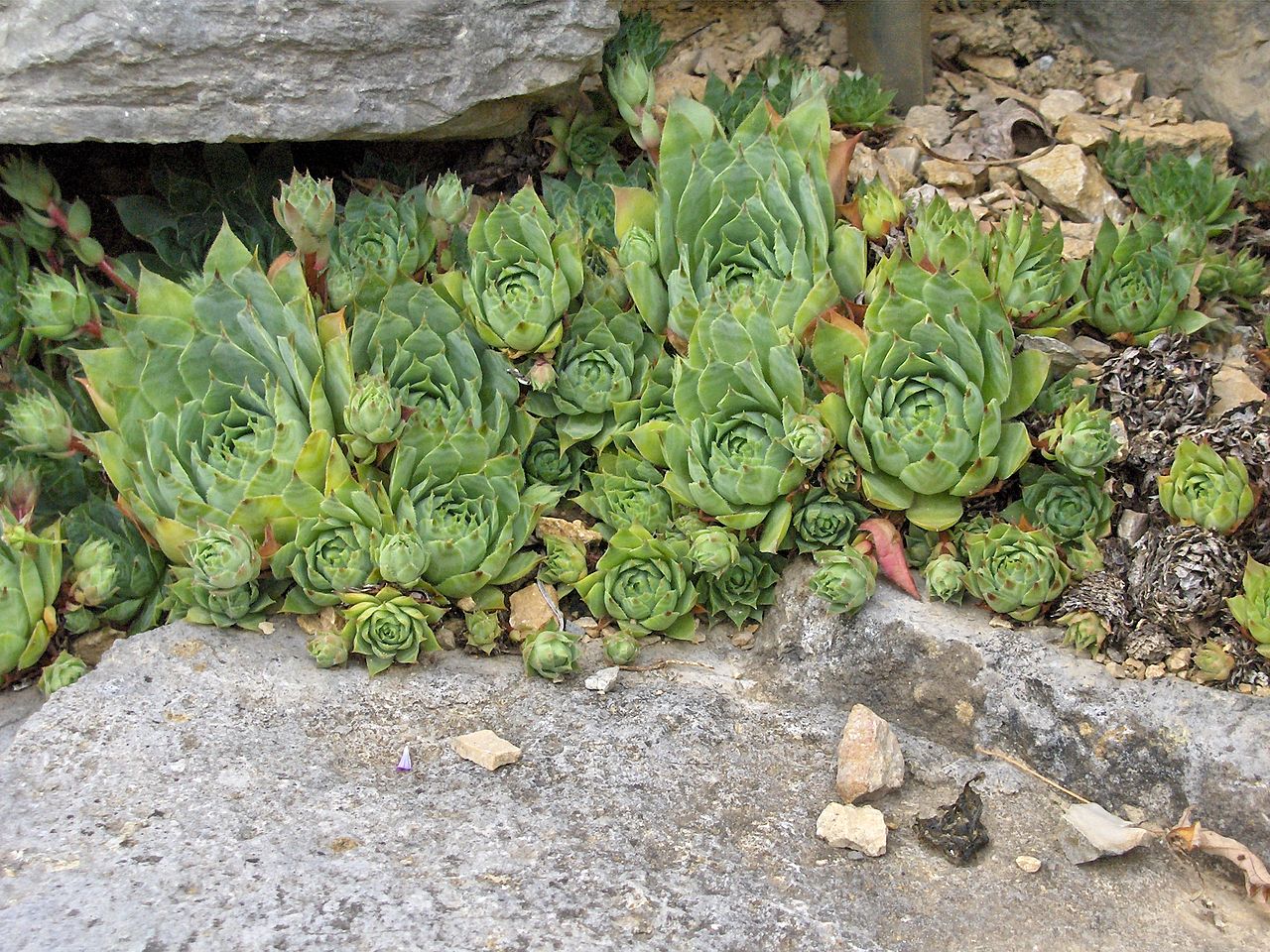
Sempervivium
(houseleek ~ hen & chickens)
To my surprise one house-leek (apparently Sempervivum tectorum of Dewey) has shot up twenty-two inches high and is apparently nearly out, though the petals are erect, not spread. The stem is clothed with the same thick leaves, only smaller and lessening up ward and forming a column about one and a half inches in diameter (with the leaves). The top is a broad raceme (?), about eight inches wide and two thirds as long, of eleven long, spreading, and recurved branches, lined with flowers on the upper side only. These consist of twelve to thirteen lanceolate calyx-segments and as many still longer dull-purple petals and about twenty pistils within and short stamens around them. It is a strange but rather stately cactus-like plant. 

The children call the pretty clusters of radical leaves hen and chickens. In this case the radical leaves are withered, and a fusiform root sustains the flower. This one is not on the bare rock, but lower amid the huckleberry bushes. 

At the Assabet stone bridge, apparently freshly in flower, — though it may have been out nearly as long as the androscemifolium, — apparently the Apocynum cannabinum var. hypericifolium (?). The tallest is four feet high. The flowers very small (hardly more than an eighth of an inch in diameter), the segments of the corolla not revolute but nearly erect. There are twenty to thirty flowers at end of a branch. The divisions of the calyx are longer than in the common, long ovate. Yet it differs from Gray's hypericifolium in having flowers rose-streaked within like the common, the cymes not shorter than the leaves, and the tube of the corolla rather longer than the divisions of the calyx. The leaves are hardly more downy or heart-shaped below than the common. Hypericifolium is a separate species in Pursh and some others. And the branches are less ascending than the common, making an angle of about 62° with the stem (the four lower), while three of the lower of a common one make an angle of 44°.

H. D. Thoreau, Journal, August 5, 1856

Trichostema, maybe several days in some places. See July 31, 1856  ("Trichostema has now for some time been springing up in the fields, giving out its aromatic scent when bruised, and I see one ready to open.");  August 17, 1851 ("The Trichostema dichotomum, — not only its bright blue flower above the sand, but its strong wormwood scent which belongs to the season, –– feed my spirit, endear the earth to me, make me value myself and rejoice.") See also  A Book of the Seasons, by Henry Thoreau, Blue-Curls

Now, at 4 p. m . .  .The Hypericum mutilum is abundantly open . . . sometimes fifteen inches high, while the Canadense and angulatum are shut
.  See August 12, 1856 ("11 a. m. . . .  The Hypericum mutilum is well out at this hour.");  August 17, 1856 ("Hypericum Canadense well out at 2 p. m"); .August 19, 1856 ("I see Hypericum Canadense and mutilum abundantly open at 3 p. m");  August 27, 1856  ("Hypericum Canadense and mutilum now pretty generally open at 4 P.M., thus late in the season, it being more moist and cooler."). See also  A Book of the Seasons,  by Henry Thoreau, St. Johns-wort (Hypericum)

A great water adder . . . full five feet long and nearly as big round as my arm. See July 23, 1856 ("water adder killed on the 15th and left hanging on a twig"); July 15, 1856 ("It was about three feet long, but large round in proportion, with about one hundred and forty abdominal plates and a long, slender tail.)

Aster dumosus, apparently a day or two, with its large conspicuous flower-buds. See August 10, 1856  ("Aster dumosus and pennyroyal out; how long? ");   August 24, 1853 ("The dumosus is the prevailing white one, very abundant.") See also   A Book of the Seasons,  by Henry Thoreau, Asters in August

Choke-cherries. . . scarcely edible, but their beauty atones for it. See August 5, 1858 ("Choke-berries, fair to the eye but scarcely palatable, hang far above your head, weighing down the bushes."); See 
also September 3, 1853 ("Now is the season for those comparatively rare but beautiful wild berries which are not food for man . . . it is strange that we do not devote an hour in the year to gathering those which are beautiful to the eye. It behooves me to go a-berrying in this sense once a year at least.”)

Apparently the Apocynum cannabinum var. hypericifolium (?). The tallest is four feet high. See August 7, 1856 ("Hemp, perhaps a week.");  August 13, 1856 ("I stripped off a shred of Indian hemp bark and could not break it. It is as strong as anything of the kind I know. ") August 16, 1856 (" I find the dog's-bane (Apocynum androsoemifolium) bark not the nearly so strong as that of the A. cannabinum.");  September 2, 1856 ("Some years ago I sought for Indian hemp (Apocynum cannabinum) hereabouts in vain, and concluded that it did not grow here. A month or two ago . . . my eyes fell on it, aye, in three different places, and different varieties of it.") See also A Book of the Seasons, by Henry Thoreau, Dogsbane and Indian hemp

August 5. See A Book of the Seasons, by Henry Thoreau, August 5

Now at 4 p. m.
this dog-day cloudy weather
dwarf johnswort open.

A Book of the Seasons, by Henry Thoreau. Near House-leek Rock

A Book of the Seasons, by Henry Thoreau. 

"A book, each page written in its own season,
out-of-doors, in its own locality."
~edited, assembled and rewritten by zphx © 2009-2026

https://tinyurl.com/hdt-560805

Saturday, August 1, 2015

Young Adams of Waltham tells me he has been moose-hunting at Chesuncook.


August 1.

P. M. -- To Conantum by boat. 

Squirrels have eaten and stripped pitch pine cones. 

Small rough sunflower a day or two. 

Diplopappus cornifolius (how long?) at Conant Orchard Grove. 

In the spring there, which has not been cleared out lately, I find a hairworm, eight or nine inches long and big as a pin-wire; is biggest in the middle and tapers thence to tail; at head is abruptly cut off; curly in your fingers like the tendril of a vine. 

I spent half an hour overhauling the heaps of clamshells under the rocks there. Was surprised to find the anodon and the green-rayed clams there. 
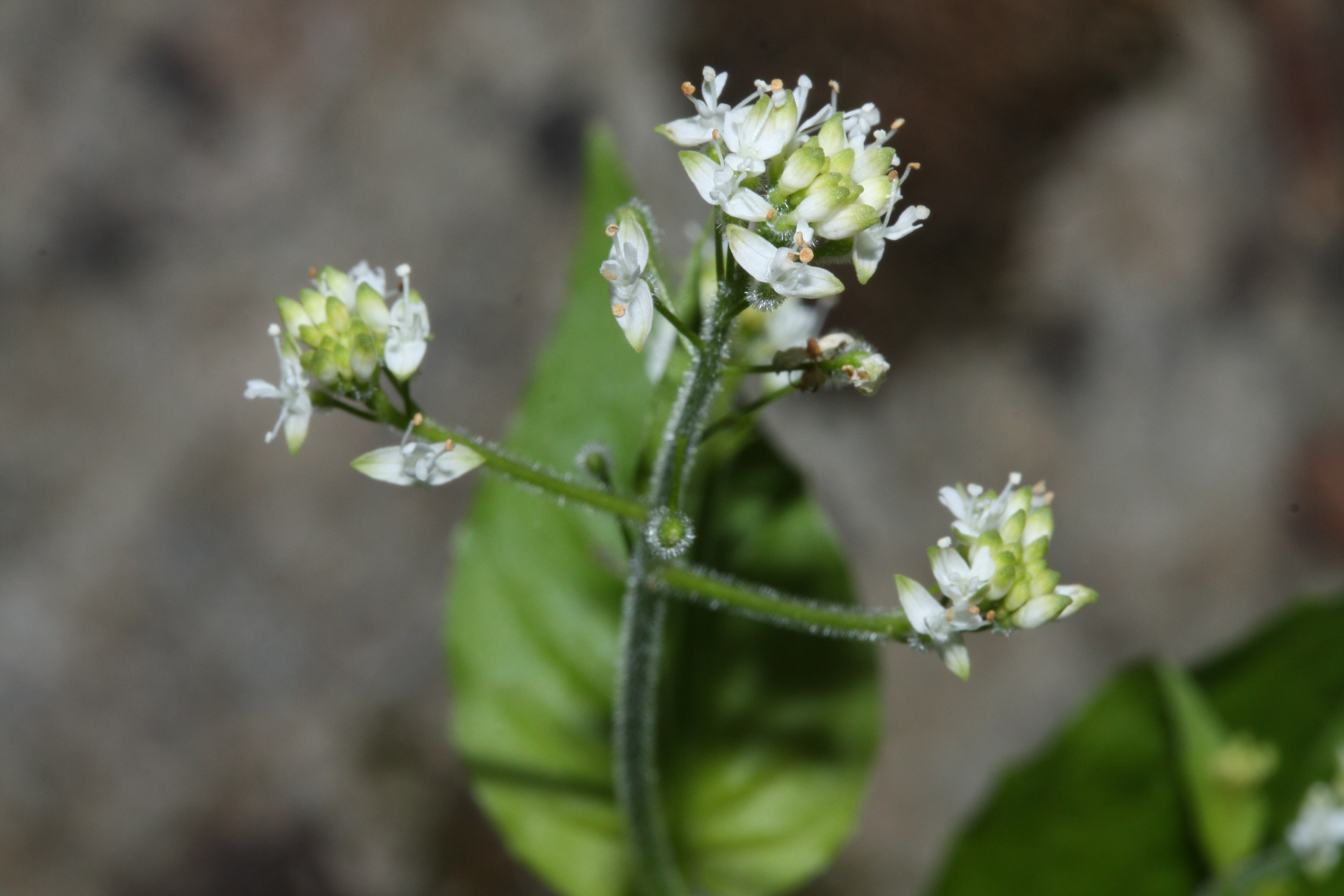
alpine enchanter’s-nightshade
(Circaea alpina)

Pennyroyal and alpine enchanter’s-nightshade well out, how long? 

Young Adams of Waltham tells me he has been moose-hunting at Chesuncook. Hunted with a guide in evening without horn, it being too early to call them out. Heard the water dropping from their muzzles when they lifted their heads from feeding on the pads, as they stood in the river.

H. D. Thoreau, Journal,  August 1, 1855


Small rough sunflower a day or two.
See August 1, 1852 ("The small rough sunflower (Helianthus divaricatus) tells of August heats") See also July 28, 1856 ("By factory road clearing, the small rough sunflower, two or three days."); July 29, 1853 (“The sight of the small rough sunflower about a dry ditch bank and hedge advances me at once further toward autumn.”); August 11, 1858 ("Also the small rough sunflower (now abundant)"); August 19, 1851 ("Small rough sunflower by side of road between canoe birch and White Pond")

Alpine enchanter’s-nightshade.  See June 19, 1856 ("enchanter’s-nightshade"); July 8, 1856 ("Circaea alpina, some days, a foot high with opaque leaves and bracts . . .  the same with the small, also bracted, one at Corner Spring”);;

Monday, August 31, 2009

The history of a shower

August 31


P. M. — To Fair Haven Hill.

Was caught in five successive showers, and took refuge in Hayden's barn, under the cliffs, and under a tree. 

A thunder-cloud, seen from a hilltop, as it is advancing rapidly across the sky on one side, whose rear at least will soon strike us. The dark-blue mass (seen edgewise) with its lighter upper surface and its copious curving rain beneath and behind, like an immense steamer holding its steady way to its port, with tremendous mutterings from time to time, a rush of cooler air, and hurried flight of birds. 

These later weeds, — chenopodiums, Roman wormwood, amaranth, etc., — now so rank and prevalent in the cultivated fields which were long since deserted by the hoers, now that the potatoes are for the most part ripened, are preparing a crop for the small birds of the fall and winter, those pensioners on civilization. These weeds require cultivated ground, and Nature perseveres each year till she succeeds in producing a bountiful harvest by their seeds, in spite of our early assiduity. Now that the potatoes are cared for, Nature is preparing a crop of chenopodium and Roman wormwood for the birds.

Now especially the crickets are seen and heard on dry and sandy banks and fields, near their burrows, and some hanging, back down, to the stems of grass, feeding. I entered a dry grassy hollow where the cricket alone seemed to reign, — open like a bowl to the sky. 

While I stand under a pine for shelter during the rain, on Fair Haven Hill-side, I see many sarsaparilla plants fallen and withering green, i. e. before changing. It is as if they had a weak hold on the earth, on the subterranean stocks. 

The nightshade berries are handsome, not only for their clear red, but the beautifully regular form of their drooping clusters, suggesting a hexagonal arrangement for economy of room. 

There was another shower in the night (at 9 p. m.), making the sixth after 1.30 p. m. It was evidently one cloud thus broken into six parts, with some broad intervals of clear sky and fair weather. 

It would have been convenient for us, if it had been printed on the first cloud, "Five more to come!" Such a shower has a history which has never been written. One would like to know how and where the cloud first gathered, what lands and water it passed over and watered, and where and when it ceased to rain and was finally dissipated.

H. D. Thoreau, Journal, August 31, 1859


These weeds require cultivated ground, and now that the potatoes are cared for, Nature is preparing a crop of chenopodium and Roman wormwood for the birds.
 See May 13, 1856 ("Wheeler says that many a pasture, if you plow it up after it has been lying still ten years, will produce an abundant crop of wormwood, and its seeds must have lain in the ground."); August 8, 1851 ("As I recross the string-pieces of the bridge, I see the water-bugs swimming briskly in the moonlight and scent the Roman wormwood in the potato fields."); August 26, 1859 ("Potato vines have taken a veil of wormwood."); August 31, 1854 ("Wormwood pollen yellows my clothes commonly")

Rush of cooler air
and a hurried flight of birds –
dark-blue thunder-cloud.

Popular Posts Last 30 Days.

The week ahead in Henry’s journal

The week ahead in Henry’s journal
A journal, a book that shall contain a record of all your joy.
"A stone fruit. Each one yields me a thought." ~ H. D. Thoreau, March 28, 1859


I sit on this rock
wrestling with the melody
that possesses me.