Showing posts with label Abel Brooks. Show all posts

Saturday, July 21, 2018

It was the Falco fuscus, the American brown or slate-colored hawk.

July 21

Wednesday. Concord. P. M.—To Walden, with E. Bartlett and E. Emerson. 

The former wished to show me what he thought an owl’s nest he had found. Near it, in Abel Brooks’s wood lot, heard a note and saw a small hawk fly over. It was the nest of this bird. Saw several of the young flitting about and occasionally an old bird. 

The nest was in a middling-sized white pine, some twenty feet from the ground, resting on two limbs close to the main stem, on the south side of it. It was quite solid, composed entirely of twigs about as big round as a pipe-stem and less; was some fifteen inches in diameter and one inch deep, or nearly flat, and perhaps five inches thick. It was very much dirtied on the sides by the droppings of the young. 

As we were standing about the tree, we heard again the note of a young one approaching. We dropped upon the ground, and it alighted on the edge of the nest; another alighted near by, and a third a little further off. The young were apparently as big as the old, but still lingered about the nest and returned to it. 

I could hear them coming some distance off. Their note was a kind of peeping squeal, which you might at first suspect to be made by a jay; not very loud, but as if to attract the old and reveal their whereabouts. 

The note of the old bird, which occasionally dashed past, was somewhat like that of the marsh hawk or pigeon woodpecker, a cackling or clattering sound, chiding us. The old bird was anxious about her inexperienced young, and was trying to get them off. At length she dashed close past us, and appeared to fairly strike one of the young, knocking him off his perch, and he soon followed her off. 

I saw the remains of several birds lying about in that neighborhood, and saw and heard again the young and old there abouts for several days thereafter. 

A young man killed one of the young hawks, and I saw it. It was the Falco fuscus, the American brown or slate-colored hawk. 
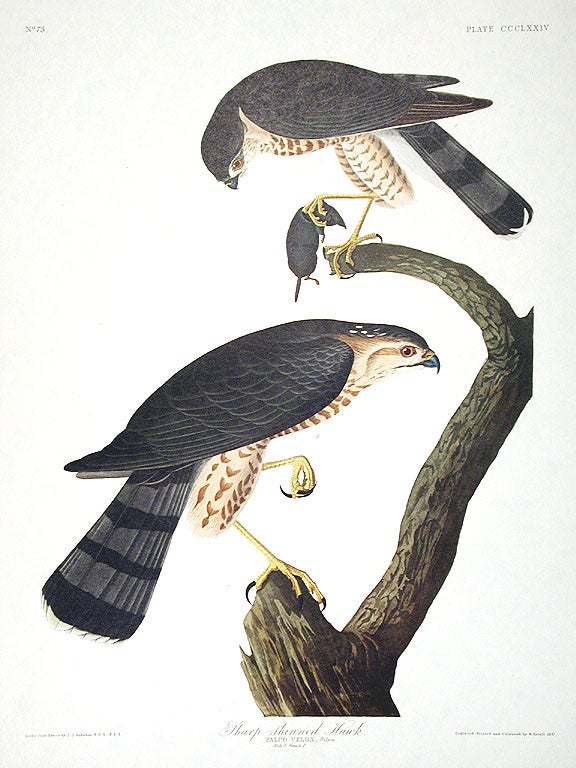
J. J. Audubon
Sharp-shinned Hawk

Its length was thirteen inches; alar extent, twenty-three. The tail reached two or more inches beyond the closed wings. Nuttall says the upper parts are “a deep slate color” (these were very dark brown); also that the nest is yet unknown. But Wilson describes his F. velox (which is the same as Nuttall’s F. fuscus) as “whole upper parts very dark brown,” but legs, greenish-yellow (these were yellow). The toes had the peculiar pendulous lobes which W. refers to. 

As I saw it in the woods, I was struck by its dark color above, its tawny throat and breast, brown-spotted, its clean, slender, long yellow legs, feathered but little below the knee, its white vent, its wings distinctly and rather finely dark-barred beneath, short, black, much curved bill, and slender black sharp claws. Its tail with a dark bar near edge beneath. 

In hand I found it had the white spots on scapulars of the F. fuscus, and had not the white bars on tail of the F. Pennsylvanicus. It also had the fine sharp shin.

But what then is my hawk killed by Farrar, with so stout a leg? Had that any white bars on tail? 

H. D. Thoreau, Journal, July 21, 1858

In Abel Brooks’s wood lot, heard a note and saw a small hawk fly over. It was the Falco fuscus, the American brown or slate-colored hawk.
See May 4, 1855 (“Sitting in Abel Brooks’s Hollow, see a small hawk go over high in the air, with a long tail and distinct from wings. It advanced by a sort of limping flight yet rapidly, not circling nor tacking, but flapping briskly at intervals and then gliding straight ahead with rapidity, controlling itself with its tail. It seemed to be going a journey. Was it not the sharp-shinned, or Falco fuscus?  I think that what I have called the sparrow hawk falsely, and latterly pigeon hawk, is also the sharp-shinned (vide April 26th and May 8th, 1854, and April 16th, 1855), for the pigeon hawk’s tail is white-barred.”); September 22, 1852 ("Some of those I see are probably the sharp-shinned hawk.");  March 28, 1854 (“See a small slate-colored hawk, with wings transversely mottled beneath, — probably the sharp-shinned hawk.”); April 26, 1854 (“Saw probably a pigeon hawk skim straight and low over field and wood, and another the next day apparently dark slate-color.”); May 8, 1854 (“Saw a small hawk flying low, about size of a robin — tail with black bars”);  April 16, 1855 ( "What I call a pigeon hawk, probably sharp-shinned.”); ; April 25, 1860 ("Looking up, I see what I take to be a sharp-shinned hawk just alighting on the trees . . . The hawk plumes himself, and then flies off, rising gradually and beginning to circle, and soon it joins its mate, and soars with it high in the sky and out of sight. . . It appeared to have a plain reddish-fawn breast. The size more than anything made me think it a sharp-shin."). See also A Book of the Seasons, by Henry Thoreau, the sharp-shinned hawk. and   A Book of the Seasons by Henry Thoreau, The Pigeon Hawk (Merlin)

But what then is my hawk killed by Farrar, with so stout a leg? See October 11, 1856 (“Farrar gave me a wing and foot of a hawk which he shot about three weeks ago . . . . This foot has a sharp shin and stout claws, but the wing is much larger than that of the Falco fuscus (or sharp-shinned hawk), being, . . . the size of the F. Pennsylvanicus. ”)

Monday, December 25, 2017

I find the true line.

December 25.  

Surveying for heirs of J. Richardson, G. Heywood and A. Brooks accompanying.

Skate on Goose Pond. 

Heywood says that some who have gone into Ebby Hubbard's barn to find him have seen the rats run over his shoulders, they are so familiar with him. This because I stopped to speak with Hubbard in his barn about bounds. 

I find the true line between Richardson and Mrs. Bigelow, which Captain Hubbard overlooked in 1840, and yet I find it by his own plan of 1827. Bigelow had set a split stone far into Richardson. After making the proper allowance for variation since 1827, I set my stake exactly on an old spotted line, which was overlooked in 1840 and is probably as old as the survey of ’27, or thirty years. It is on good-sized white pines, and is quite distinct now, though not blazed into the wood at first. 

It would not be detected unless you were looking for it.

H. D. Thoreau, JournaL December 25, 1857

I find the true line between Richardson and Mrs. Bigelow. See November 30, 1857 ("Northwest of Little Goose Pond, on the edge of Mrs. Bigelow's wood-lot are several hornbeams . . .”)

Thursday, November 9, 2017

Very warm to-day; rainy in forenoon. Settle a boundary dispute.

November 9

Surveying for Stedman Buttrick and Mr. Gordon. 

Jacob Farmer says that he remembers well a particular bound (which is the subject of dispute between the above two men) from this circumstance: He, a boy, was sent, as the representative of his mother, to witness the placing of the bounds to her lot, and he remembers that, when they had fixed the stake and stones, old Mr. Nathan Barrett asked him if he had a knife about him, upon which he pulled out his knife and gave it to him. Mr. Barrett cut a birch switch and trimmed it in the presence of young Farmer, and then called out, “Boy, here's your knife,” but as the boy saw that he was going to strike him when he reached his hand for the knife, he dodged into a bush which alone received the blow. And Mr. Barrett said that if it had not been for that, he would have got a blow which would have made him remember that bound as long as he lived, and explained to him that that was his design in striking him. He had before told his mother that since she could not go to the woods to see what bounds were set to her lot, she had better send Jacob as a representative of the family. 

This made Farmer the important witness in this case. He first, some years ago, saw Buttrick trimming up the trees, and told him he was on Gordon's land and pointed out this as the bound between them. 

One of the company to-day told of George Melvin once directing Jonas Melvin, for a joke, to go to the widow Hildreth's lot (along which we were measuring) and gather the chestnuts. They were probably both working there. He accordingly took the oxen and cart and some ladders and another hired man, and they worked all day and got half a bushel.

Mr. Farmer tells me that one Sunday he went to his barn, having nothing to do, and thought he would watch the swallows, republican swallows. The old bird was feeding her young, and he sat within fifteen feet, overlooking them. There were five young, and he was curious to know how each received its share; and as often as the bird came with a fly, the one at the door (or opening) took it, and then they all hitched round one notch, so that a new one was presented at the door, who received the next fly; and this was the invariable order, the same one never receiving two flies in succession. 

At last the old bird brought a very small fly, and the young one that swallowed it did not desert his ground but waited to receive the next, but when the bird came with another, of the usual size, she commenced a loud and long scolding at the little one, till it resigned its place, and the next in succession received the fly. 

Bigelow, the tavern-keeper, once, wrote C., put up this advertisement in the streets of Concord, “All those who are in favor of the universal salvation of mankind, are requested to meet at the school-house (?) next Saturday evening (?), to choose officers.” 

Very warm to-day; rainy in forenoon.

H. D. Thoreau, Journal, November 9, 1857

postscript 11/13/57:

My assistants and company in surveying on the 9th were, Gordon and Buttrick, the principals in the dispute; Jacob Farmer, the principal witness; George Buttrick, son of Stedman; and French, son-in-law of Gordon. 

I had the most to do with Gordon, who came after me. He was quite eloquent at our house on the subject of two neighbors disputing at his time of life about a ‘ seemed really to have a very good heart; thought that the main thing in this life was to keep up friendly relations; and as he rode along, would quote Scrip ture in a low tone, and put his whole soul into some half-whispered expression which I could not hear, but nevertheless nodded assent to. He thought it was too bad that he should have spent his seventy-third birthday settling that dispute in the woods. Apparently did not know it till afterwards. 

Buttrick is a rather large man, in more senses than one. His portly body as he stood over the bound was the mark at which I sighted through the woods, rather too wide a one for accuracy. He did not cease to regret for a day or two that I should have had no dinner, but Gordon detained me. Buttrick said that he had a piece of meat cooked and expected me at his house. Thought it too bad in Gordon to make a man go without his dinner, etc. He offered me a glass of gin, or wine, as I chose. Lamented the cutting down of apple orchards and scarcity of cider-mills. 

Told of an orchard in the town of Russell, on the side of a hill, where the apples rolled down and lay four feet deep (?) against a wall on the lower side, and this the owner cut down. 

Farmer, half a dozen years since, saw Buttrick trimming up the trees there and observed [to] him, “You are on Mr. Gordon's land.” This was the beginning of the trouble. Buttrick adhered to the bounds which Abel Brooks, who sold to him, had pointed out. 

Farmer was sure of the bounds between them, be cause when Jacob Brown's Bateman wood-lot was divided between Mrs. Farmer (his mother) and her sister, the mother of Mrs. Gordon, he had witnessed the setting of the bounds as the representative of his mother, and came near being whipped at this one.

Sunday, April 16, 2017

The Walden Pond Society.

April 16

At Concord. 

Get birch sap, — two bottles yellow birch and five of black birch,— now running freely, though not before I left Concord. 

Meanwhile I hear the note of the pine warbler. 

Last night was very cold, and some ditches are frozen this morning. 

This is Fast-Day. I think if you should tap all the trees in a large birch swamp, you would make a stream large enough to turn a mill. 

About a month ago, at the post-office, Abel Brooks, who is pretty deaf, sidling up to me, observed in a loud voice which all could hear, 
“Let me see, your society is pretty large, ain’t it ?” 
“Oh, yes, large enough,” said I, not knowing what he meant.  
“There ’s Stewart belongs to it, and Collier, he's one of them, and Emerson, and my boarder ” (Pulsifer), “and Channing, I believe, I think he goes there.” 
“You mean the walkers; don’t you?” 
“Ye-es, I call you the Society. All go to the woods; don’t you ?” 
“Do you miss any of your wood?” I asked. 
“No, I hain’t worried any yet. I believe you ’re a pretty clever set, as good as the average,” etc., etc.
Telling Sanborn of this, he said that, when he first came to town and boarded at Holbrook’s, he asked H. how many religious societies there were in town. H. said that there were three, -- the Unitarian, the Orthodox, and the Walden Pond Society. I asked Sanborm with which Holbrook classed himself. He said he believes that he put himself with the last.

H. D. Thoreau, Journal, April 16, 1857

Get birch sap, — two bottles yellow birch and five of black birch,— now running freely . . .See April 11, 1856 ("Now is apparently the very time to tap birches of all kinds.”)

Meanwhile I hear the note of the pine warbler. See note to April 16 1856 ("I see a pine warbler, . . . Its note is . . .a very rapid and continuous trill or jingle which I remind myself of by wetter wetter wetter wetter wet’, emphasizing the last syllable.") See also A Book of the Seasons, by Henry Thoreau, the Pine Warbler

Sunday, October 16, 2016

Fall flowers and a fetid fungus.

October 16.
October 16.
Ground all white with frost. 

P. M. — To chestnuts, down Turnpike. 

I notice these flowers on the way by the roadside, which survive the frost, i. e. a few of them: hedge-mustard, mayweed, tall crowfoot, autumnal dandelion, yarrow, some Aster Tradescanti, and some red clover.  

Polygonum orientate was finished by yesterday's frost. There was plenty of the front-rank polygonum freshly open along river on the 13th. Perhaps the frosts have nipped it. 

I saw a farmer busily collecting his pumpkins on the 14th, — Abel Brooks, — rambling over his corn-fields and bringing the pumpkins out to the sides on the path, on the side of the field, where he can load them. The ground was so stiff on the 15th, in the morning, that some could not dig potatoes. 

Bent is now making haste to gather his apples. I. Wright, too, is collecting some choice barrels of golden russets. Many times he turns it over before he leaves out a specked one. A poor story if the farmer cannot get rich, for everything he has is salable, even every load of mud on his farm. 

At the Everett meadow a large flock of mewing and lisping goldfinches, with but little yellow, pass over the Turnpike. 

Many chestnut burs are now open, yet a stone will not jar down many nuts yet. Burs which were quite green on the 8th are now all brown and dry, and the prickles come off in your hand when you touch them, yet the nuts do not readily drop out. Many nuts have fallen within two or three days, but many squirrels have been busily picking them up. 

Found amid the sphagnum on the dry bank on the south side of the Turnpike, just below Everett's meadow, a rare and remarkable fungus, such as I have heard of but never seen before. The whole height six and three quarters inches, two thirds of it being buried in the sphagnum. It may be divided into three parts, pileus, stem, and base, — or scrotum, for it is a perfect phallus. 

One of those fungi named impudicus, I think. This is very similar to if not the same with that represented in Loudon's Encyclopedia and called "Phallus impudicus, Stinking Morel, very fetid." In all respects a most disgusting object, yet very suggestive. 


It is hollow from top to bottom, the form of the hollow answering to that of the outside. The color of the outside white excepting the pileus, which is olive-colored and somewhat coarsely corrugated, with an oblong mouth at tip about one eighth of an inch long, or, measuring the white lips, half an inch. This cap is thin and white within, about one and three eighths inches high by one and a half wide. The stem (bare portion) is three inches long (tapering more rapidly than in the drawing), horizontally viewed of an oval form. Longest diameter at base one and a half inches, at top (on edge of pileus) fifteen sixteenths of an inch. Short diameters in both cases about two thirds as much. It is a delicate white cylinder of a finely honeycombed and crispy material about three sixteenths of an inch thick, or more, the whole very straight and regular. The base, or scrotum, is of an irregular bag form, about one inch by two in the extremes, consisting of a thick trembling gelatinous mass surrounding the bottom of the stem and covered with a tough white skin of a darker tint than the stem. The whole plant rather frail and trembling. There was at first a very thin delicate white collar (or volva?) about the base of the stem above the scrotum. 

In all respects a
most disgusting object, yet 
very suggestive. 

It was as offensive to the eye as to the scent, the cap rapidly melting and defiling what it touched with a fetid, olivaceous, semiliquid matter. In an hour or two the plant scented the whole house wherever placed, so that it could not be endured. I was afraid to sleep in my chamber where it had lain until the room had been well ventilated. It smelled like a dead rat in the ceiling, in all the ceilings of the house. 

Pray, what was Nature thinking of when she made this ? She almost puts her self on a level with those who draw in privies. 

The cap had at first a smooth and almost dry surface, of a sort of olive slate-color, but the next day this colored surface all melted out, leaving deep corrugations or gills — rather honeycomb-like cells — with a white bottom.

H. D. Thoreau, Journal, October 16, 1856

Burs which were quite green on the 8th are now all brown and dry . . .many squirrels have been busily picking them up. See October 8, 1856 ("A few chestnut burs are open, and have been some days, before they could have felt frost, showing that they would open without it, but a stone will not jar them down, nor a club thrown into the tree yet.. . ."); December 9, 1852 ("The chestnuts are almost as plenty as ever, . . .. There are more this year than the squirrels can consume.. . .")

Saturday, November 28, 2009

The joy of firewood.

November 28

Goodwin tells me that Therien, who lives in a shanty of his own building and alone in Lincoln, uses for a drink only checkerberry-tea. (G. also called it "ivory- leaf.") Is it not singular that probably only one tea-drinker in this neighborhood should use for his beverage a plant which grows here? Therien, really drinking his checkerberry-tea from motives of simplicity or economy and saying nothing about it, deserves well of his country. As he does now, we may all do at last. 

There is scarcely a wood of sufficient size and density left now for an owl to haunt in, and if I hear one hoot I may be sure where he is. 

Goodwin is cutting out a few cords of dead wood in the midst of E. Hubbard's old lot. This has been Hubbard's practice for thirty years or more, and so, it would seem, they are all dead before he gets to them.
Saw Abel Brooks there with a half-bushel basket on his arm. He was picking up chips on his and neighboring lots; had got about two quarts of old and blackened pine chips, and with these was returning home at dusk more than a mile. 

Such a petty quantity as you would hardly have gone to the end of your yard for, and yet he said that he had got more than two cords of them at home, which he had collected thus and sometimes with a wheelbarrow. He had thus spent an hour or two and walked two or three miles in a cool November evening to pick up two quarts of pine chips scattered through the woods. 

He evidently takes real satisfaction in collecting his fuel, perhaps gets more heat of all kinds out of it than any man in town. He is not reduced to taking a walk for exercise as some are. It is one thing to own a wood-lot as he does who perambulates its bounds almost daily, so as to have worn a path about it, and another to own one as many another does who hardly knows where it is. 

Evidently the quantity of chips in his basket is not essential; it is the chippy idea which he pursues. It is to him an unaccountably pleasing occupation. And no doubt he loves to see his pile grow at home. 

Think how variously men spend the same hour in the same village! The lawyer sits talking with his client in the twilight; the trader is weighing sugar and salt; while Abel Brooks is hastening home from the woods with his basket half full of chips. 

I think I should prefer to be with Brooks. He was literally as smiling as a basket of chips. A basket of chips, therefore, must have been regarded as a singularly pleasing (if not pleased) object. 


We make a good deal of the early twilights of these November days, they make so large a part of the afternoon.


H. D. Thoreau, Journal, November 28, 1859

Goodwin is cutting out a few cords of dead wood in the midst of E. Hubbard's old lot. See November 28, 1858 ("Goodwin cannot be a very bad man, he is so cheery.") See also October 22, 1853 ("One-eyed John Goodwin, the fisherman, was loading into a hand-cart and conveying home the piles of driftwood which of late he had collected with his boat. It was a beautiful evening, and a clear amber sunset lit up all the eastern shores; and that man's employment, so simple and direct, — . . . thus to obtain his winter's wood, — charmed me unspeakably"); November 4, 1858 ("I took out my glass, and beheld Goodwin, the one-eyed Ajax, in his short blue frock, short and square-bodied, as broad as for his height he can afford to be, getting his winter's wood; for this is one of the phenomena of the season.")

Early twilights of these November days. See  December 5, 1853 ("Now for the short days and early twilight”); December 9, 1856 ("The worker who would accomplish much these short days must shear a dusky slice off both ends of the night”);  and note to December 11, 1854 ("The day is short; it seems to be composed of two twilights merely; the morning and the evening twilight make the whole day.”); February 17, 1852 ("The shortness of the days, when we naturally look to the heavens and make the most of the little light, when we live an arctic life, when the woodchopper's axe reminds us of twilight at 3 o'clock p. m., when the morning and the evening literally make the whole day")

These November days
twilight makes so large a part
of the afternoon.

A Book of the Seasons
,  by Henry Thoreau, 
The joy of firewood.

A Book of the Seasons,  by Henry Thoreau.
"A book, each page written in its own season,
out-of-doors, in its own locality."
 ~edited, assembled and rewritten by zphx ©  2009-2025

***

Today I bring the chainsaw into the woods to clear fallen trees from the trails. A sunny refreshing afternoon. Careful with the saw, it does not bind except in one old rotten log I think will be like butter. I kick the log open and retrieve the saw.

On the porcupine trail a snarl of grape vines pulls the trees down. I cleared this same spot a few years ago. And here, on the upper trail a log across the main path with two old cuts where I ran out of gas long ago. I finish the work and head to the stream.

Next to the crossing a large maple is uprooted across the trail. The stream is rushing by with last night's rain. I cut a narrow opening for the trail, leaving the maple as a bench by the stream.

Now kneeling I put the saw to the side so it won't get wet, bring my mouth to the water and take two large gulps. The water is cold and fresh.

Zphx 20091128

November 28, 1859 ("We make a good deal of the early twilights of these November days, they make so large a part of the afternoon.”)


Popular Posts Last 30 Days.

The week ahead in Henry’s journal

The week ahead in Henry’s journal
A journal, a book that shall contain a record of all your joy.
"A stone fruit. Each one yields me a thought." ~ H. D. Thoreau, March 28, 1859


I sit on this rock
wrestling with the melody
that possesses me.