Showing posts with label man. Show all posts

Thursday, August 29, 2019

It is so cool a morning that for the first time I move into the entry to sit in the sun.

August 29

August 29, 2019

I hear in the street this morning a goldfinch sing part of a sweet strain.

It is so cool a morning that for the first time I move into the entry to sit in the sun. But in this cooler weather I feel as if the fruit of my summer were hardening and maturing a little, acquiring color and flavor like the corn and other fruits in the field. 

When the very earliest ripe grapes begin to be scented in the cool nights, then, too, the first cooler airs of autumn begin to waft my sweetness on the desert airs of summer. Now, too, poets nib their pens afresh. I scent their first-fruits in the cool evening air of the year. 

By the coolness the experience of the summer is condensed and matured, whether our fruits be pumpkins or grapes. 

Man, too, ripens with the grapes and apples. 

I find that the water-bugs (Gyrinus) keep amid the pads in open spaces along the sides of the river all day, and, at dark only, spread thence all over the river and gyrate rapidly. For food I see them eating or sucking at the wings and bodies of dead devil's-needles which fall on the water, making them too gyrate in a singular manner. If one gets any such food, the others pursue him for it. 

There was a remarkable red aurora all over the sky last night. 

P. M. — To Easterbrooks Country. 

The vernonia is one of the most conspicuous flowers now where it grows, — a very rich color. It is some what past its prime; perhaps about with the red eupatorium. 

Botrychium lunarioides now shows its fertile frond above the shorn stubble in low grounds, but not shedding pollen. 

See the two-leaved Solomon's-seal berries, many of them ripe; also some ripe mitchella berries, contrasting with their very fresh green leaves. 

White cohush berries, apparently in prime, and the arum fruit. The now drier and browner (purplish- brown) looking rabbit's clover, whose heads collected would make a soft bed, is an important feature in the landscape; pussies some call them; more puffed up than before. 

The thorn bushes are most sere and yellowish-brown bushes now. 

I see more snakes of late, methinks, both striped and the small green. 

The slate-colored spots or eyes — fungi — on several kinds of goldenrods are common now. 

The knife-shaped fruit of the ash has strewn the paths of late.

H. D. Thoreau, Journal, August 29, 1859

It is so cool a morning that for the first time I move into the entry to sit in the sun. See August 29, 1854 ("It is so cool that we are inclined to stand round the kitchen fire . . .I enjoy the warmth of the sun now that the air is cool") See also September 4, 1860 ("It is cooler these days and nights, and I move into an eastern chamber in the morning, that I may sit in the sun"); September 17, 1858 (“Cooler weather now for two or three days, so that I am glad to sit in the sun on the east side of the house mornings.”); September 18, 1852 ("In the forenoons I move into a chamber on the east side of the house, and so follow the sun round.”)


The very earliest ripe grapes begin to be scented in the cool nights
. See August 29, 1853 ("Walking down the street in the evening, I detect my neighbor’s ripening grapes by the scent twenty rods off."); August 27, 1859 ("The first notice I have that grapes are ripening is by the rich scent at evening from my own native vine against the house");August 30, 1853 ("Grapes are already ripe; I smell them first.");

Man, too, ripens with the grapes and apples.See November 14, 1853. ("October answers to that period in the life of man when . . . all his experience ripens into wisdom, but every root, branch, leaf of him glows with maturity. What he has been and done in his spring and summer appears. He bears his fruit".)

I see more snakes of late, methinks, both striped and the small green. See September 3, 1858 ("See a small striped snake, some fifteen or eighteen inches long, swallowing a toad"); September 13, 1858 (""Saw a striped snake run into the wall, and just before it disappeared heard a loud sound like a hiss") October 18, 1857 (" Snakes lie out now on sunny banks, amid the dry leaves, now as in spring. They are chiefly striped ones.")

There was a remarkable red aurora all over the sky last night. .See also Wikipedia (Solar Cycle 10 beginning in December 1855 and the Solar storm ( Carrington Event.) of September 1–2, 1859) and A Book of the Seasons, by Henry Thoreau, Northern Lights

So cool a morning 
that for the first time I move 
to sit in the sun.

Thursday, October 26, 2017

The seasons and all their changes are in me.

October 26

October 26, 2018

Hard rain in the night and almost steady rain through the day, the second day. Wind still easterly or northeasterly. 

P. M. – Round by Puffer's via Clamshell. 

A driving east or northeast storm. I can see through the drisk only a mile. The river is getting partly over the meadows at last, and my spirits rise with it. Me thinks this rise of the waters must affect every thought and deed in the town. It qualifies my sentence and life. I trust there will appear in this Journal some flow, some gradual filling of the springs and raising of the streams, that the accumulating grists may be ground. 

A storm is a new, and in some respects more active, life in nature. Larger migrating birds make their appearance. They, at least, sympathize with the movements of the watery element and the winds. 

I see two great fish hawks (possibly blue herons) slowly beating northeast against the storm, by what a curious tie circling ever near each other and in the same direction, as if you might expect to find the very motes in the air to be paired; two long undulating wings conveying a feathered body through the misty atmosphere, and this inseparably associated with another planet of the same species. I can just glimpse their undulating lines. Damon and Pythias they must be. The waves beneath, which are of kindred form, are still more social, multitudinous, dvip6aov. 

Where is my mate, beating against the storm with me? They fly according to the valley of the river, northeast or southwest. 

I start up snipes also at Clamshell Meadow. This weather sets the migratory birds in motion and also makes them bolder. 

These regular phenomena of the seasons get at last to be — they were at first, of course — simply and plainly phenomena or phases of my life. The seasons and all their changes are in me.  I see not a dead eel or floating snake, or a gull, but it rounds my life and is like a line or accent in its poem. Almost I believe the Concord would not rise and overflow its banks again, were I not here. After a while I learn what my moods and seasons are. I would have nothing subtracted. I can imagine nothing added. My moods are thus periodical, not two days in my year alike. The perfect correspondence of Nature to man, so that he is at home in her! 

Going along the road toward the baeomyces, I see, as I think, a space a yard or two square where the bank has been [burnt] over by accident, by some traveller or sportsman. Even as I stand within four or five feet I take it to be so. It was the fallen leaves of the Salix tristis, thickly covering the ground, so black, with an ashy reflection, that they look exactly like cinders of leaves. And the small twigs were also blackened and inconspicuous; I could hardly detect them. Just the right mingling of black and ash-color. It was a wet day, which made them look blacker.

Mere evergreen mossy banks, as that by this road in the woods, now more attract us when greenness is so rare. 

At the hewing-place on the flat above, many sparrows are flitting past amid the birches and sallows. They are chiefly Fringilla hyemalis. How often they may be  thus flitting along in a straggling manner from bush to bush, so that the hedgerow will be all alive with them, each uttering a faint chip from time to time, as if to keep together, bewildering you so that you know not if the greater part are gone by or still to come. One rests but a moment on the tree before you and is gone again. You wonder if they know whither they are bound, and how their leader is appointed. 

The pitch pine leaves not yet quite fallen. 

Yellowish leaves still adhere to the very tops of the birches. 

Those sparrows, too, are thoughts I have. They come and go; they flit by quickly on their migrations, uttering only a faint chip, I know not whither or why exactly. One will not rest upon its twig for me to scrutinize it. The whole copse will be alive with my rambling thoughts, bewildering me by their very multitude, but they will be all gone directly without leaving me a feather. 

My loftiest thought is somewhat like an eagle that suddenly comes into the field of view, suggesting great things and thrilling the beholder, as if it were bound hitherward with a message for me; but it comes no nearer, but circles and soars away, growing dimmer, disappointing me, till it is lost behind a cliff or a cloud. 

Spring is brown; summer, green; autumn, yellow; winter, white; November, gray.

H. D. Thoreau, Journal, October 26, 1857

Yellowish leaves still adhere to the very tops of the birches. See note to October 26, 1860 ("This is the season of the fall when the leaves are whirled through the air like flocks of birds, the season of birch spangles, when you see afar a few clear-yellow leaves left on the tops of the birches.”)

The seasons and all their changes are in me . . . My moods are thus periodical, not two days in my year alike.
See June 11, 1851 (“Hardly two nights are alike. . . .No one, to my knowledge, has observed the minute differences in the seasons.”); June 6, 1857 (“A year is made up of a certain series and number of sensations and thoughts which have their language in nature. . . . Each experience reduces itself to a mood of the mind. ”); August 7, 1853 ("The objects I behold correspond to my mood") See also A Book of the Seasons, by Henry Thoreau,  Moods and Seasons of the Mind.

October 26. See A Book of the Seasons, by Henry Thoreau, October 26 and A Book of the Seasons, by Henry Thoreau, The seasons and all their changes are in me.

The seasons in me – my moods periodical, not two days alike.

A Book of the Seasons,  by Henry Thoreau, The seasons and all their changes are in me.
A Book of the Seasons,  by Henry Thoreau
"A book, each page written in its own season,
out-of-doors, in its own locality.”
~edited, assembled and rewritten by zphx © 2009-2024

Friday, July 7, 2017

There were no human beings there, only a few imaginary lines on a map.


July 7. 

July 7, 2017 9:04PM

Some of the inhabitants of the Cape think that the Cape is theirs and all occupied by them, but in my eyes it is no more theirs than it is the blackbirds', and in visiting the Cape there is hardly more need of my regarding or going through the villages than of going through the blackbirds' nests. 

I am inclined to leave them both on one side, or perchance I just glance into them to see how they are built and what they contain. 

I know that they have spoken for the whole Cape, and lines are drawn on their maps accordingly, but I know that these are imaginary, having perambulated many such, and they would have to get me or one of my craft to find them for them. 

For the most part, indeed with very trifling exceptions, there were no human beings there, only a few imaginary lines on a map.

H. D. Thoreau, Journal, July 7, 1857

The inhabitants of the Cape. See June 20, 1857 ("I have now visited the Cape four times in as many different years, once in October, twice in June, and once in July, having spent in all about one month there."); June 16, 1857 ("I have found the compass and chart safer guides than the inhabitants"); July 6, 1855 ("Cape measures two miles in width here on the great chart.")

Tuesday, October 18, 2016

A yellow butterfly.

October 18


aglow with yellow,
red, and green
Rain all night and half this day. 

P. M. — A-chestnutting down Turnpike and across to Britton's, thinking that the rain now added to the frosts would relax the burs which were open and let the nuts drop. 

The sugar maples are now in their glory, all aglow with yellow, red, and green. They are remarkable for the contrast they afford of deep blushing red on one half and green on the other. 

The chestnuts are not so ready to fall as I expected. Perhaps the burs require to be dried now after the rain. In a day or two they will nearly all come down. They are a pretty fruit, thus compactly stowed away in this bristly chest, — three is the regular number, and there is no room to spare, — the two outside nuts having each one convex side without and a flat side within; the middle nut has two flat sides. Sometimes there are several more nuts in a bur, but this year the burs are small, and there are not commonly more than two good nuts, very often only one, the middle one, both sides of which will then be convex, each way bulging out into a thin abortive mere reminiscence of a nut, all shell, beyond it. 

It is a rich sight, that of a large chestnut tree with a dome-shaped top, where the yellowing leaves have become thin, — for most now strew the ground evenly as a carpet throughout the chestnut woods and so save some seed, — all richly rough with great brown burs, which are opened into several segments so as to show the wholesome-colored nuts peeping forth, ready to fall on the slightest jar. 

The individual nuts are very interesting, of various forms, according to the season and the number in a bur. The base of each where it was joined to the bur is marked with an irregular dark figure on a light ground, oblong or crescent-shaped commonly, like a spider or other insect with a dozen legs, while the upper or small end tapers into a little white, woolly spire crowned with a star, and the whole upper slopes of the nuts are covered with the same hoary wool, which reminds you of the frosts on whose advent they peep forth. 

Each nut stretches forth a little starry hand at the end of a slender arm — and by this, when mature, you may pull it out without fear of prickles. Within this thick prickly bur the nuts are about as safe until they are quite mature, as a porcupine behind its spines. Yet I see where the squirrels have gnawed through many closed burs and left the pieces on the stumps. 

There are sometimes two meats within one chestnut shell, divided transversely, and each covered by its separate brown-ribbed skin.

The late goldenrod (S. latifolia) is all gone, on account of frost. 

Men commonly exaggerate the theme. Some themes they think are significant and others insignificant. I feel that my life is very homely, my pleasures very cheap. Joy and sorrow, success and failure, grandeur and meanness, and indeed most words in the English language do not mean for me what they do for my neighbors. I see that my neighbors look with compassion on me, that they think it is a mean and unfortunate destiny which makes me to walk in these fields and woods so much and sail on this river alone.

But so long as I find here the only real elysium, I can not hesitate in my choice. My work is writing, and I do not hesitate, though I know that no subject is too trivial for me, tried by ordinary standards; for, ye fools, the theme is nothing, the life is everything. 

All that interests the reader is the depth and intensity of the life excited. We touch our subject but by a point which has no breadth, but the pyramid of our experience, or our interest in it, rests on us by a broader or narrower base. That is, man is all in all, Nature nothing, but as she draws him out and reflects him. Give me simple, cheap, and homely themes.

I still see a yellow butterfly occasionally zigzagging by the roadside. 

What a strong medicinal but rich scent now after the rain, from decaying weeds, perhaps ferns, by the road side! The rain, falling on the fresh dried herbs and filling the ditches into which they drooped, has converted them into tea.

Apple leaves are now pretty generally brown and crisp. 

I see where the chestnut trees have been sadly bruised by the large stones cast against them in previous years and which still lie around. 

That was an interesting sight described on the 12th, the winged insects of various kinds gathered on the last fragment of a watermelon in the garden, to taste the last sweets of the year. In midsummer they are dispersed and not observed, but now, as in the spring, they are congregated about the little sweet that is left. 

Minott told me one of his hunting stories yesterday, how he saw a very large hen-hawk come sailing from over the hill, just this side of where Moore lives now. He didn't expect to reach her, but he knew that he had a plaguy smart little piece, — it was a kind of half- stocked one (he always speaks of the gun he used on a particular occasion as if it were a new one, describing it minutely, though he never had more than three, perhaps not more than two, in his life, I suspect), — so he thought he'd give her a try, and, faith, she pitched down into the little meadow on the north side the road there, and when he came up she bristled up to him so that he was obliged to give her another charge.

H. D. Thoreau, Journal, October 18, 1856

The sugar maples are now in their glory, all aglow with yellow, red, and green. See October 18, 1858 ("The large sugar maples on the Common are now at the height of their beauty.")
We touch our subject but by a point which has no breadth. . . . See June 6, 1857 (" Each season is but an infinitesimal point. It no sooner comes than it is gone. It has no duration. It simply gives a tone
and hue to my thought. . . . We are conversant with only one point of contact at a time, . . .") December 11, 1855 ("I am tickled by this or that I come in contact with, as if I touched the wires of a battery. The age of miracles is each moment thus returned. ”); January 26, 1852 ("The moment always spurs us. The spurs of countless moments goad us incessantly into life.")

I still see a yellow butterfly occasionally zigzagging by the roadside. See July 14, 1852 ("See to-day for the first time this season fleets of yellow butterflies in compact assembly in the road like a mackerel fleet with their small hulls and great sails now suddenly dispersing on our approach and filling the air with yellow in their zigzag flight, as when a fair wind calls schooners out of haven and disperses them over the broad ocean. ");  October 7, 1857 ("I see many yellow butterflies fluttering about the Aster puniceus, still abundantly in bloom there."); October 20, 1858 ("I see yellow butterflies chasing one another, taking no thought for the morrow, but confiding in the sunny day as if it were to be perpetual."); October 23, 1853 ("Several yellow butterflies in the meadow." )  See also  A Book of the Seasons,  by Henry Thoreau, Yellow Butterflies

All that interests the reader is the depth and intensity of the life excited. See May 24, 1857 ("We want no[t] completeness but intensity of life."); May 6, 1854 ("Every important worker will report what life there is in him. All that a man has to say or do that can possibly concern mankind, is in some shape or other to tell the story of his love, — to sing; and, if he is fortunate and keeps alive, he will be forever in love."); May 23, 1853 ("The poet must bring to Nature the smooth mirror in which she is to be reflected.”) May 10, 1853 ("I pray for such inward experience as will make nature significant") August 7, 1853("The objects I behold correspond to my mood"); May 21, 1851 ("The existence of man in nature is the divinest and most startling of all facts. Man, the crowning fact, the god we know. . . .The standing miracle to man is man.")

Minott told me one of his hunting stories yesterday. . . . (he always speaks of the gun he used on a particular occasion as if it were a new one, describing it minutely, though he never had more than three, perhaps not more than two, in his life, I suspect). See  February 29, 1856 ("He loves to recall his hunting days and adventures, and I willingly listen to the stories he has told me half a dozen times already."); August 16, 1858 ("He tells me some of his hunting stories again. He always lays a good deal of stress on the kind of gun he used , as if he had bought a new one every year, when probably he never had more than two or three in his life.")

October 18.  See  A Book of the Seasons,  by Henry Thoreau,  October 18

The sugar maples
aglow in their glory now
yellow red and green.

Occasionally
zigzagging by the roadside –
a yellow butterfly.


 A Book of the Seasons,  by Henry Thoreau
 "A book, each page written in its own season,
out-of-doors, in its own locality."
 ~edited, assembled and rewritten by zphx ©  2009-2026

https://tinyurl.com/hdt-561018

Wednesday, May 11, 2016

A bluebird’s nest and five eggs in a hollow apple tree

Man is not completely one with Nature.
May 11, 2016
May 11

Rains still. 

I noticed the other day that the stump of the large oak at Clamshell Hill, cut down fifteen years ago or more, was quite rotten, while the trunk which lay by its side, having never been removed, was comparatively sound. 

The Roman writers Columella and Palladius warn not to build in a low valley or by a marsh, and the same here to-day. In the West the prudent settler avoids the banks of rivers, choosing high and open land. It suggests that man is not completely at one with Nature, or that she is not yet fitted to be his abode. Adam soon found that he must give a marsh a wide berth, — that he must not put his bower in or near a swamp in the new country, —else he would get the fever and ague or an intermittent fever. 

Either nature may be changed or man. Some animals, as frogs and musquash, are fitted to live in the marsh. Only a portion of the earth is habitable by man. Is the earth improving or deteriorating in this respect? Does it require to be improved by the hands of man, or is man to live more naturally and so more safely? 

P. M. — To Cedar Swamp up Assabet. 

There is at length a prospect of fair weather. It will clear up at evening this fourth day of the rain. The river is nearly as high as it has been this spring. 

The Salix alba by my boat is out and beaten by the rain; perhaps three or four days in some places, but not on the 6th. 

It does not rain now, though completely overcast, but looks as if it would clear up before night. 

There are many swallows circling low over the river behind Monroe’s, — bank swallows, barn, republican, chimney, and white-bellied. These are all circling together a foot or two over the water, passing within ten or twelve feet of me in my boat. It is remarkable how social the different species of swallow are one with another. They recognize their affinity more than usual. 

May 11, 2026

On the prospect of fair weather after so long a storm, through the Wheeler Indian field meadow, I see a veery hopping silent under the alders. 

The black and white creeper also is descending the oaks, etc., and uttering from time to time his seeser seeser seeser. What a rich, strong striped blue-black (?) and white bird, much like the myrtle-bird at a little distance, when the yellow of the latter is not seen. 

At a distance I hear the first yellow-bird. 

The Salix sericea at Island rock is out, also the S. cordata off Prichard’s, both apparently with S. alba. But I have not yet compared them (for date) quite accurately enough. I think I can pretty well distinguish the sericea by the grayness of the female catkins, twig and all, but am not sure I have seen the staminate. Neither am I sure that I see the staminate S. cordata. 

Those at Prichard’s are apparently all female. There are many staminate ones now in full bloom in the Wheeler meadow, I suspect like that of the railroad causeway, male and female side by side, five rods north of S. alba; also male, west side below ring-post (vide May 10th), or they may be staminate plants of S. cordata, or some perhaps of S. sericea. 

Vide how many different kinds of leaves and mark them six weeks hence. Vide if those just off the north end of Holden Wood (Conantum) are all S. cordata, for there are many staminate ones like the last-named; also vide that one on the north side of the road and root fence beyond brook on Corner road (perhaps like the railroad one), male and female now a little past prime. 

All these willows blossom when the early willows, which bloom before leafing, are going to seed. 

Large White maples are leafing. 

I see, near the top of the bank at the further end of the first hemlocks, dirty-white fungi in nests, each about three quarters of an inch diameter, without any thick rind which peels off. Each one is burst a little at top, and is full of dust of a yellowish rotten-stone color, which is perfectly dry and comes forth like a puff of smoke on being pinched, now after four days of rain, before the fair weather has come, and though each one is nearly half full of water. This dust certainly has but little affinity for moisture and might be of use in some cases. 

I leave my boat in Hosmer’s pokelogan and walk up the bank. 

A bluebird’s nest and five eggs in a hollow apple tree three feet from ground near the old bank swallow pit, made with much stubble and dried grass. Can see the bird sitting from without. 

There are a great many large flat black cockroach(?)- like beetles floating and paddling on the flood on the meadows, which have perhaps fallen in in the night (if not washed out of the grass); also a few of the thick dull reddish-brown ones.

H. D. Thoreau, Journal, May 11, 1856

Man is not completely at one with Nature . . .. Either nature may be changed or man. . . .  See August 23, 1853 ("For all Nature is doing her best each moment to make us well. She exists for no other end. . . . "Nature" is but another name for health, . . .."); July 14, 1854 ("Health is a sound relation to nature."); May 28, 1854 ("To be serene and successful we must be at one with the universe"); December 11, 1855 ("I am struck by the perfect confidence and success of nature"); March 23, 1856 ("The eternity which I detect in Nature I predicate of myself also"); December 5, 1856 ("I have never got over my surprise that I should have been born into the most estimable place in all the world, and in the very nick of time, too.").

Bank swallows, barn, republican, chimney, and white-bellied . . .all circling together a foot or two over the water, See April 30, 1856 ("I was surprised by the great number of swallows—white-bellied and barn swallows and perhaps republican — flying round and round, or skimming very low over the meadow. . .There were a thousand or more of swallows, and I think that they had recently arrived together on their migration."); May 20, 1858 (“Hundreds of swallows are now skimming close over the river. . .. There are bank, barn, cliff, and chimney swallows, all mingled together.”)

I see a veery hopping silent under the alders.  May 12, 1857 ("As usual, I have not heard them sing yet."); May 17, 1852 ("The first veery note."); May 17, 1853 ("The sweetest singers among the birds are heard more distinctly now, as the reflections are seen more distinctly in the water, — the veery constantly now"); May 17, 1856 ("Hear the first veery note."); May 18, 1855 ("First veery strain."); May 23, 1857 ("Hear the first veery strain.")

 The black and white creeper  uttering from time to time his seeser seeser seeser. See May 12, 1855 ("Watch a black and white creeper . . . utters its faint seeser seeser seeser. ") ;
 May 7, 1856 ("Hear and see many myrtle-birds, at the same time that I hear what I have called the black and white creeper’s note. Have I ever confounded them?")

At a distance I hear the first yellow-bird. . . . All these willows blossom. . .  See May 10, 1853 ("At this season the traveller passes through a golden gate on causeways where these willows are planted, as if he were approaching the entrance to Fairyland; and there will surely be found the yellowbird, and already from a distance is heard his note, a tche tche tche tcha tchar tcha, — ah, willow, willow."); May 10, 1858 (" For some days the Salix alba have shown their yellow wreaths here and there, suggesting the coming of the yellowbird, and now they are alive with them.");May 11, 1854 ("The willows on the Turnpike now resound with the hum of bees, and I hear the yellowbird and Maryland yellow-throat amid them. These yellow birds are concealed by the yellow of the willows."); May 12, 1853(" The yellowbird has another note, tchut tchut tchar te tchit e war. "). See also A Book of the Seasons: the Summer Yellowbird and A Book of the Seasons, by Henry Thoreau. Willows on the Causeway 

The Salix sericea at Island rock is out, also the S. cordata off Prichard’s, both apparently with S. alba. See May 29, 1855 (""That willow by the rock south of Island (of May 2d) appears to be without doubt the Salix sericea,); June 5, 1855 ("The Salix cordata (which apparently blossomed some days after the S. sericea) is very common on Prichard’s shore. ); June 6, 1856 ("The S. cordata is another of the ochre-flowered ones.") See also A Book of Seasons,  by Henry Thoreau. Salix cordata (heartleaf willow)

Large White maples are leafing. See May 7, 1855 ("Large white maples began to leaf yesterday at least, generally; one now shows considerably across the river."); May 10, 1855 ("Young red maples are generally later to leaf than young sugar maples; hardly began before yesterday; and large white are not so forward as young sugar.");  May 11, 1854 ("The full- grown white maples are as forward in leafing now as the young red and sugar ones are now, only their leaves are smaller than the last."); May 11, 1855 ("Larger rock maples not yet begun to leaf, later considerably than large white maples.") See also A Book of the Seasons,  by Henry Thoreau, Leaf-Out

A bluebird’s nest and five eggs in a hollow apple tree. See July 12, 1856 ("Apparently a bluebird's egg in a woodpecker's hole in an apple tree, second brood, just laid.”) See also June 14, 1855 ("The bluebird’s nest high in the black willow at Sassafras Shore has five eggs.")

Man is not at one 
with Nature. Either nature 
may be changed or man.

This forth day of rain
a veery hopping silent
under the alders. 

A Book of the Seasons,  by Henry Thoreau
 "A book, each page written in its own season, 
out-of-doors, in its own locality."
 ~edited, assembled and rewritten by zphx ©  2009-2026

https://tinyurl.com/HDT-560511

Friday, May 23, 2014

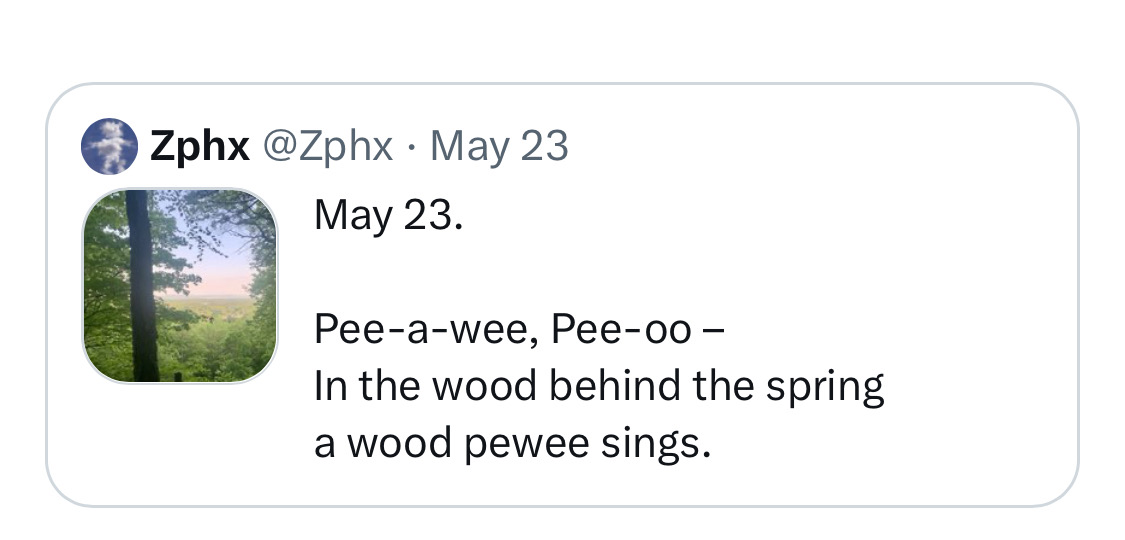
The wood pewee sings now in the woods behind the spring in the heat of the day. [We soon get through with Nature.]

May 23. 

The wood pewee sings now in the woods behind the spring in the heat of the day (2 p. m.), sitting on a low limb near me, pe-a-wee, pe-a-wee, etc., five or six times at short and regular intervals, looking about all the while, and then, naively, pee-a-oo, emphasizing the first syllable, and begins again. It flies off occasionally a few feet, catches an insect and returns to its perch between  the bars, not allowing this to interrupt their order.

We soon get through with Nature. She excites an expectation which she cannot satisfy. The merest child which has rambled into a copsewood dreams of a wilderness so wild and strange and inexhaustible as Nature can never show him. The red-bird which I saw on my companion's string on election days I thought but the outmost sentinel of the wild, immortal camp, — of the wild and dazzling infantry of the wilderness, — that the deeper woods abounded with redder birds still; but, now that I have threaded all our woods and waded the swamps, I have never yet met with his compeer, still less his wilder kindred.


The red-bird which is the last of Nature is but the first of God. The White Mountains, likewise, were smooth mole hills to my expectation. We condescend to climb the crags of earth. It is our weary legs alone that praise them. That forest on whose skirts the red-bird flits is not of earth. 

I expected a fauna more infinite and various, birds of more dazzling colors and more celestial song.

How many springs shall I continue to see the common sucker (Catostomus Bostoniensis) floating dead on our river! 

Will not Nature select her types from a new fount? The vignette of the year. This earth which is spread out like a map around me is but the lining of my inmost soul exposed. In me is the sucker that I see. No wholly extraneous object can compel me to recognize it. I am guilty of suckers. I go about to look at flowers and listen to the birds.

There was a time when the beauty and the music were all within, and I sat and listened to my thoughts, and there was a song in them. I sat for hours on rocks and wrestled with the melody which possessed me. I sat and listened by the hour to a positive though faint and distant music, not sung by any bird, nor vibrating any earthly harp. When I walked with a joy which knew not its own origin. When I was an organ of which the world was but one poor broken pipe. I lay long on the rocks, foundered like a harp on the seashore, that knows not how it is dealt with. I sat on the earth as on a raft, listening to music that was not of the earth, but which ruled and arranged it. 

Man should be the harp articulate. When your cords were tense.

Think of going abroad out of one's self to hear music, — to Europe or Africa! Instead of so living as to be the lyre which the breath of the morning causes to vibrate with that melody which creates worlds — to sit up late and hear Jenny Lind!

H. D. Thoreau, Journal, May 23, 1854


The wood pewee sings now in the woods behind the spring in the heat of the day.
See May 22, 1854 ("I hear also pe-a-wee pe-a-wee, and then occasionally pee-yu.") See also A Book of the Seasons, by Henry Thoreau, The Arrival of the Eastern Wood Pewee

We soon get through with Nature. She excites an expectation which she cannot satisfy. Compare May 10, 1853 ("I pray for such inward experience as will make nature significant") and August 7, 1853 ("Is it not as language that all natural objects affect the poet? He sees a flower or other object, and it is beautiful or affecting to him because it is a symbol of his thought, and what he indistinctly feels or perceives is matured in some other organization. The objects I behold correspond to my mood.")

How many springs shall I continue to see the common sucker (Catostomus Bostoniensis) floating dead on our river! In me is the sucker that I see. See note to March 28, 1857 "I can remember now some thirty years — after a fashion — of life in Concord, and every spring there are many dead suckers floating belly upward on the meadows."

I sat for hours on rocks and wrestled with the melody which possessed me.  See January 1, 1852 ("Perhaps the only thing that spoke to me on this walk was the bare, lichen-covered gray rock at the Cliff, in the moonlight, naked and almost warm as in summer.");  Auguat 7, 1854 ("Our mind is like the strings of a harp which is swept, and we stand and listen"); February 20, 1857 ("If I were to discover that a certain kind of stone by the pond-shore was affected, say partially disintegrated, by a particular natural sound, as of a bird or insect, I see that one could not be completely described without describing the other. I am that rock by the pond-side. ")

When I walked with a joy which knew not its own origin. July 16, 1851("This earth was the most glorious musical instrument, and I was audience to its strains. To have such sweet impressions made on us, such ecstasies begotten of the breezes ! I can remember how I was astonished. I said to myself, — I said to others, — " There comes into my mind such an indescribable, infinite, all-absorbing, divine, heavenly pleasure, a sense of elevation and expansion, and [I] have had nought to do with it. I perceive that I am dealt with by superior powers.1 This is a pleasure, a joy, an existence which I have not procured myself.”)

to sit up late and hear Jenny Lind. See August 30, 1856 (“I get my new experiences still, not at the opera listening to the Swedish Nightingale, but at Beck Stow's Swamp listening to the native wood thrush. ”)

May 23. See A Book of the Seasons, by Henry Thoreau May 23


A Book of the Seasons, by Henry Thoreau
"A book, each page written in its own season,
out-of-doors, in its own locality.”

~edited, assembled and rewritten by zphx © 2009-2024
https://tinyurl.com/hdt-540523

Monday, December 30, 2013

Measuring snow at every ten paces for two hundred paces.

December 30

The pond not yet frozen entirely over; about six acres open, the wind blew so hard last night. 

I carried a two-foot rule and measured the snow of yesterday in Abiel Wheeler's wood by the railroad, near the pond. In going a quarter of a mile it varied from fourteen to twenty-four inches. Then went to Potter's wood, by Lincoln road, near Lincoln line, and paced straight through a level wood where there was no drift perceptible, measuring at every ten paces for two hundred paces, and the average was twenty and one half inches. 

I see the tracks of mice, and squirrels, probably gray ones, leading straight to or from the feet of the largest pines and oaks, which they had plainly ascended.

In winter even man is to a slight extent dormant, just as some animals are but partially awake, though not commonly classed with those that hibernate. The summer circulations are to some extent stopped; the range of his afternoon walk is somewhat narrower; he is more or less confined to the highway and wood-path; the weather oftener shuts him up in his burrow; he begins to feel the access of dormancy and to assume the spherical form of the marmot; the nights are longest; he is often satisfied if he only gets out to the post-office in the course of the day.  Most men do not now extend their walks beyond the village street. 

H. D. Thoreau, Journal, December 30, 1853

The pond not yet frozen entirely over; about six acres open. See December 31, 1853 ("Walden froze completely over last night. It is, however, all snow ice, as it froze while it was snowing hard, and it looks like frozen yeast somewhat.”) See also December 30, 1855 ("There was yesterday eight or ten acres of open water at the west end of Walden, where is depth and breadth combined.”),December 31, 1850 ("Walden pond has frozen over since I was there last.”); January 1, 1856 (“Walden is covered with white snow ice six inches thick, for it froze while it was snowing, though commonly there is a thin dark beneath.  . . . A very small patch of Walden, frozen since the snow, looks at a little distance exactly like open water by contrast with the snow ice, the trees being reflected in it, and indeed I am not certain but a very small part of this patch was water.”)See also A Book of the Seasons, by Henry Thoreau, Annual ice-in at Walden

I carried a two-foot rule and measured the snow of yesterday. . . it varied from fourteen to twenty-four inches.. See December 30, 1855 ("The snow which began last night has continued to fall very silently but steadily, and now it is not far from a foot deep, much the most we have had yet"): December 30, 1859 ("I awake to find it snowing fast. Perhaps seven or eight inches have fallen, - the deepest snow yet.”); and note to January 16, 1856 ("With this snow the fences are scarcely an obstruction to the traveller; he easily steps over them. Often they are buried. I suspect it is two and a half feet deep in Andromeda Swamps now.")

I see the tracks of mice, and squirrels See December 30, 1855 ("The track of a squirrel on the Island Neck. Tracks are altered by the depth of the snow . . .The snow is too deep and soft yet for many tracks. No doubt the mice have been out beneath it.") See also December 22, 1852 ("The squirrel, rabbit, fox tracks, etc., attract the attention in the new-fallen snow . . . You cannot go out so early but you will find the track of some wild creature."): ); December 27, 1853 (“ I had not seen a meadow mouse all summer, but no sooner does the snow come and spread its mantle over the earth than it is printed with the tracks of countless mice"); December 27, 1857 ("Mice have been abroad in the night. We are almost ready to believe that they have been shut up in the earth all the rest of the year because we have not seen their tracks."); December 31, 1853 ("This animal probably I should never see the least trace of, were it not for the snow, the great revealer."); January 4, 1860 ("Again see what the snow reveals.. . . that the woods are nightly thronged with little creatures which most have never seen"); January 5, 1860 ("How much the snow reveals! "); January 7, 1858 ("I notice only one squirrel, and a fox, and perhaps partridge track, into which the snow has blown. . . .The mice have not been forth since the snow, or perhaps in some places where they have, their tracks are obliterated.")

In winter even man is to a slight extent dormant, just as some animals are but partially awake.See January 14, 1852 ("We are related to all nature, animate and inanimate, and accordingly we share to some extent the nature of the dormant creatures. We all feel somewhat confined by the winter. The nights are longer, and we sleep more.")

Tuesday, July 30, 2013

Green galls on a goldenrod

July 30

See some green galls on a goldenrod three quarters of an inch in diameter, shaped like a fruit or an Eastern temple, with two or three little worms inside, completely changing the destiny of the plant, showing the intimate relation between animal and vegetable life. 

The animal signifies its wishes by a touch, and the plant, instead of going on to blossom and bear its normal fruit, devotes itself to the service of the insect and becomes its cradle and food. It suggests that Nature is a kind of gall, that the Creator stung her and man is the grub she is destined to house and feed. The plant rounds off and paints the gall with as much care and love as its own flower and fruit, admiring it perchance even more.

H. D. Thoreau, Journal, July 30, 1853


 Green galls on a goldenrod. See August 7, 1856 ("I see that common gall on goldenrods now on an S. coesia. ")  See also  September 4, 1854 ("Is not Art itself a gall? Nature is stung by God and the seed of man planted in her.The artist changes the direction of Nature and makes her grow according to his idea. ")

July 30. See A Book of the Seasons, by Henry Thoreau, July 30

Nature is a gall –
man the grub she is destined
to house and to feed.

 A Book of the Seasons, by Henry Thoreau
"A book, each page written in its own season,
out-of-doors, in its own locality.”
~edited, assembled and rewritten by zphx © 2009-2025

Popular Posts Last 30 Days.

The week ahead in Henry’s journal

The week ahead in Henry’s journal
A journal, a book that shall contain a record of all your joy.
"A stone fruit. Each one yields me a thought." ~ H. D. Thoreau, March 28, 1859


I sit on this rock
wrestling with the melody
that possesses me.