Showing posts with label balsam fir. Show all posts

Saturday, May 11, 2019

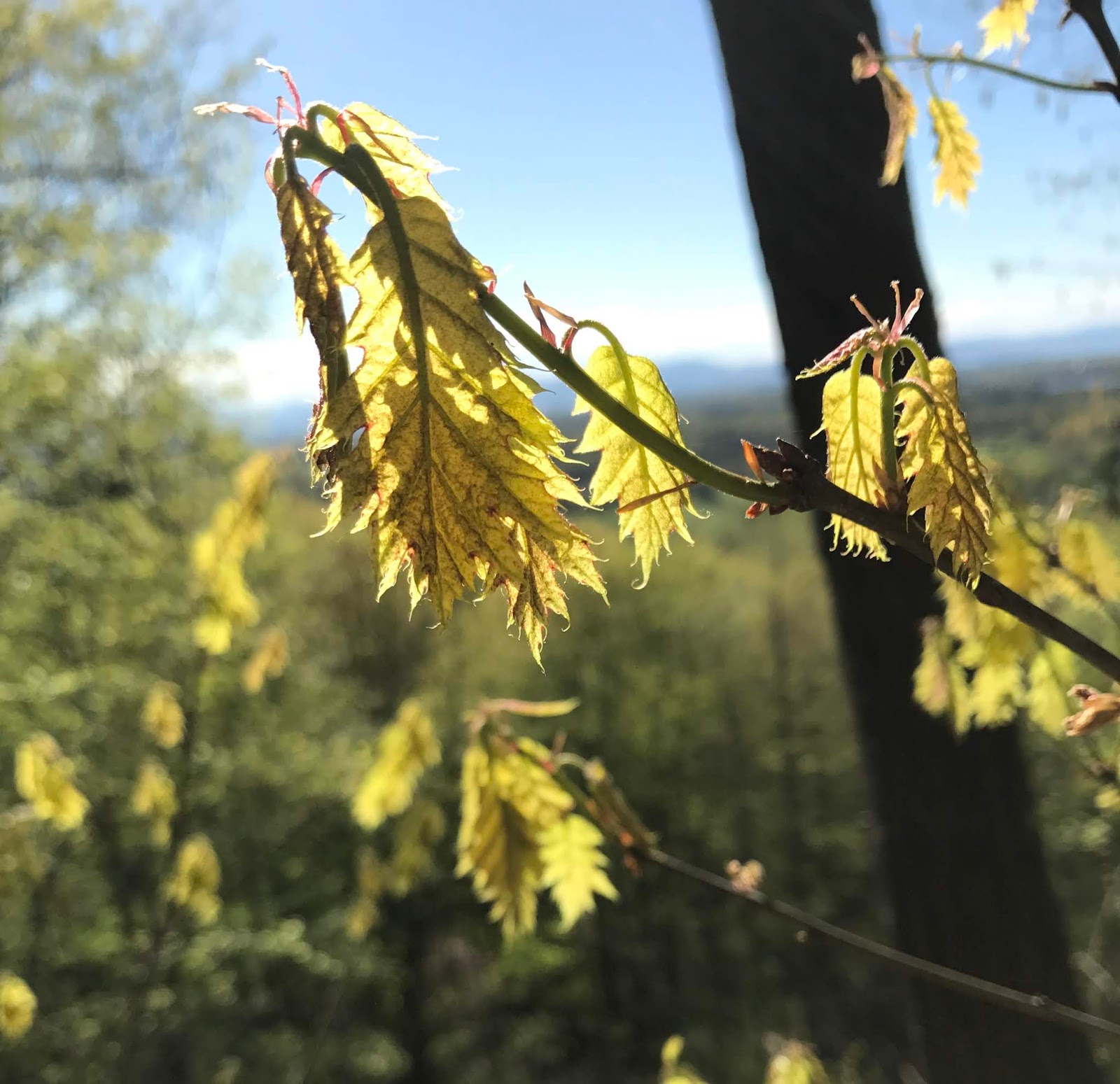
Youn fresh-expanding, oak leaves form a leafy mist throughout the forest.

May 11. 

Wednesday. 

Golden robin yesterday.

Fir-balsam well out in the rain; so say 9th. 

P. M. — To Flint's Pond. 

Arum triphyllum out. Almost every one has a little fly or two concealed within. One of the handsomest- formed plants when in flower. 

Sorrel out in rain, apparently a day or two, — say 9th. 

A blue heron flies away from the shore of the pond. 

Scirpus planifolius in bloom on Smith's wooded hill, side of Saw Mill Brook. 

A partridge-nest, with eleven fresh eggs, at foot of a chestnut, one upon another. It is quite a deep cavity amid the leaves, with some feathers of the bird in it.

Young, or fresh-expanding, oak leaves are very handsome now, showing their colors. It is a leafy mist throughout the forest. 

May 12, 2017
Uvularia perfoliata out in rain; say, then, the 9th. Just after plucking it I perceived what I call the meadow fragrance, though in the woods; but I afterward found that this flower was peculiarly fragrant, and its fragrance like that, so it was probably this which I had perceived. S. was reminded of the lily-of-the-valley by it. 

The witch-hazel has one of the broadest leaves now.

In the path in Stow's wood-lot, I find apparently Thaspium aureum (Zizia aurea), which will open the first fair day. Shows quite yellow now. 

Found in the path in the woods by the Mill Brook ditch, Flint's Pond, dead, the Coluber punctatus, 13 1/4 inches long, but no row of spots in middle of abdomen. The head above blackish with a blackish ring behind the yellow. Tail 3 inches long; breadth of body 5/16 ; plates 162; scales 55. Above, uniform glossy slate-color, with a yellowish-white band across the occiput; the head above blackish, and a blackish band close behind the yellowish one. Beneath, yellow or buff (whitish under head), with a row of small slanting black spots, one on each side of each abdominal plate except the first 3/4 inch behind the head. In the midst of the path in the woods. I admired the iridescence from its glossy belly. It differs from Storer's C. punctatus, for it is not brown above, nor "reddish yellow" beneath, and has no row of spots in middle of the abdomen. 

In that first thunder-shower, the evening of the 9th, the grass evidently erected itself and grew darker, as  it were instantaneously. Was it the effect of electricity in the air? It looked very differently from what it had ten minutes before.

H. D. Thoreau, Journal, May 11, 1859

Golden robin yesterday. See. May 10, 1853 (“Hear higher the clear whistle of the oriole. New days, then, have come, ushered in by the warbling vireo, yellowbird, Maryland yellow-throat, and small pewee, and now made perfect by the twittering of the kingbird and the whistle of the oriole amid the elms, which are but just beginning to leaf out, thinking of his nest there, -. . .The warbling vireo promised warmer days, but the oriole ushers in summer heats.”); May 10, 1858 ("The oriole is seen darting like a bright flash with clear whistle from one tree-top to another over the street.”)

Arum triphyllum out. See May 1, 1857 ("Plucked the Arum triphyllum, three inches high, with its acrid corm.”);  May 19, 1851 ("Find the Arum triphyllum . .   in Conant's Swamp.")

Young, or fresh-expanding, oak leaves are very handsome now, showing their colors. It is a leafy mist throughout the forest.  See May 15, 1854 ("The aspect of oak and other woods at a distance is somewhat like that of a very thick and reddish or yellowish mist about the evergreens. . . . Oak leaves are as big as a mouse's ear.”); May 15, 1860 ("Looking from the Cliffs through the haze, the deciduous trees are a mist of leaflets.”);  May 18, 1851 ("The oak leaves of all colors are just expanding, and are more beautiful than most flowers"); May 23, 1860 ("The quarter-grown red oak leaves between you and the sun, how yellow-green! "); May 26, 1857 ("Very interesting now are the red tents of expanding- oak leaves, as you go through sprout-lands, — the crimson velvet of the black oak and the more pinkish white oak. The salmon and pinkish-red canopies or umbrellas of the white oak")

Uvularia perfoliata out in rain; say, then, the 9th. See September 22, 1852 ("Sophia has in her herbarium and has found in Concord these which I have not seen this summer ...Uvularia perfoliata”);  May 30, 1857 ("By the path near the northeast shore of Flint's Pond, just before reaching the wall by the brook, I . . .am surprised to find ... the Uvularia perfoliata, which I have not found hereabouts before.  . . . It is considerably past its prime”); May 3, 1858 ("Ride to Flint's Pond to look for Uvularia perfoliata. ... It apparently will not bloom within ten days”); May 16, 1858 (“The Uvularia perfoliata, which did not show itself at all on the 3d, is now conspicuous, and one is open but will not shed pollen before to-morrow. It has shot up about ten inches in one case and bloomed within thirteen days!!”)

Just after plucking it I perceived what I call the meadow fragrance,  but I afterward found that this flower was peculiarly fragrant. See May 6, 1855 ("that unaccountable fugacious fragrance, as of all flowers,”);  May 15, 1856 ("Perceive some of that delicious meadow fragrance coming over the railroad causeway”); May 27, 1855 ("The meadow fragrance to-day”); May 27, 1856 ("perceived the meadow fragrance”); May 27, 1857 ("I perceived that rare meadow fragrance on the 25th.”); June 3, 1860 ("I perceive the meadow fragrance.”)

The Coluber punctatus [ringneck snake],  uniform glossy slate-color above, with a yellowish-white band across the occiput; the head above blackish, and a blackish band close behind the yellowish one. Beneath, yellow or buff (whitish under head), with a row of small slanting black spots. Nnot brown above, nor "reddish yellow" beneath,. Compare and see note to May 1, 1859 (“a little snake . . . uniformly brown (or reddish-brown) above except a yellowish ring on the occiput, the head also lighter than the body; beneath vermilion, with apparently a row of light dots along each side.”)

Friday, May 20, 2016

The distant crashing of thunder.

May 20

Fir-balsam (ours in grove) apparently two or three days, for it [is] almost entirely effete; cones white, one inch long nearly. 

Was awaked and put into sounder sleep than ever early this morning by the distant crashing of thunder, and now, — P. M. (to Beck Stow’s),— I hear it in mid-afternoon, muttering, crashing in the muggy air in mid-heaven, a little south of the village as I go through it, like the tumbling down of piles of boards, and get a few sprinkles in the sun. 

Nature has found her hoarse summer voice again, like the lowing of a cow let out to pasture. It is Nature’s rutting season. Even as the birds sing tumultuously and glance by with fresh and brilliant plumage, so now is Nature’s grandest voice heard, and her sharpest flashes seen. The air has resumed its voice, and the lightning, like a yellow spring flower, illumines the dark banks of the clouds. All the pregnant earth is bursting into life like a mildew, accompanied with noise and fire and tumult. Some oestrus stings her that she dashes headlong against the steeples and bellows hollowly, making the earth tremble. She comes dropping rain like a cow with overflowing udder. The winds drive her; the dry fields milk her. 

It is the familiar note of another warbler, just arrived, echoing amid the roofs. I see, on a locust in the burying-ground, the Sylvia striata, or black-poll warbler, busily picking about the locust buds and twigs. Black head and above, with olive (green) wings and two white bars; white all beneath, with a very distinct black line from throat to shoulders; flesh-colored legs; bill, dark above, light beneath. Hear no note. Saw it well. 

At Moore’s Swamp on Bedford road, myriads of pollywogs half an inch long darken or blacken the shore, chiefly head as yet. 

Bank swallows are very lively about the low sand-bank just beyond, in which are fifty holes.


I now see distinctly the chestnut-sided warbler (of the 18th and 17th), by Beck Stow’s. It is very lively on the maples, birches, etc., over the edge of the swamp. Sings eech eech eech | wichy wichy | tchea or itch itch itch | witty witty |  tchea. Yet this note I represented on the 18th by tche tche tche | tchut tchutter we. 

The andromeda has apparently been out several days, but no buck-bean there yet, nor will for a day or two. 

See and hear a stake-driver in the swamp. It took one short pull at its pump and stopped. 

Two marsh hawks, male and female, flew about me a long time, screaming, the female largest, with ragged wings, as I stood on the neck of the peninsula. This induced me to climb four pines, but I tore my clothes, got pitched all over, and found only squirrel; yet they have, no doubt, a nest thereabouts. 

Haynes the carpenter calls that large glaucous puff that grows on the Andromeda paniculata, swamp-apple; says he has eaten as much as three bushels (!) of them when he was a boy, and likes them. That is what he was raised on. 

After I got him home, I observed a large leech on the upper shell of my great turtle. He stoutly resisted being turned over, by sinking his claws into the ground; was aware that that was his weak side, and, when turned, would instantly run out his head and turn himself back. No wonder the Orientals rested the world on such a broad back. 

Such broad health and strength underlies Nature.

H. D. Thoreau, Journal,  May 20, 1856

I hear it in mid-afternoon, muttering, crashing in the muggy air in mid-heaven. . . .Nature has found her hoarse summer voice again. Compare May 20, 1854 ("See the lightning, but can not hear the thunder.”);  May 17, 1853 ("Does not summer begin after the May storm?”)

At Moore’s Swamp on Bedford road, myriads of pollywogs. See note to May 19, 1857 ("See myriads of minute pollywogs, recently hatched, in the water of Moore's Swamp.”)

I see, on a locust in the burying-ground, the Sylvia striata, or black-poll warbler, busily picking about the locust buds and twigs. See  May 27, 1860 ("The Sylvia striata are the commonest bird in the street, as I go to the post-office, for several days past. I see six (four males, two females) on one of our little fir trees; are apparently as many more on another close by."); June 4,1860 ("The black-poll warblers (Sylvia striata) appear to have left, and some other warblers, if not generally, with this first clear and bright and warm, peculiarly June weather, immediately after the May rain. ") See also A Book of the Seasons, by Henry Thoreau, The Black-poll Warbler

 Bank swallows are very lively about the low sand-bank just beyond, in which are fifty holes. See May 7, 1856 (“A hundred or more bank swallows at 2 P. M. (I suspect I have seen them for some time)”); May 11, 1856 ("There are many swallows circling low over the river behind Monroe’s, — bank swallows, barn, republican, chimney, and white-bellied. These are all circling together a foot or two over the water, passing within ten or twelve feet of me in my boat."); May 12, 1856 ("I see, in the road beyond Luther Hosmer’s, in different places, two bank swallows which were undoubtedly killed by the four days’ northeast rain we have just had."); May 13, 1856 ("In the swallows’ holes behind Dennis’s, I find two more dead bank swallows, and one on the sand beneath, and the feathers of two more which some creature has eaten. This makes at least seven dead bank swallows in consequence of the long, cold northeast rain.")

I now see distinctly the chestnut-sided warbler (of the 18th and 17th), by Beck Stow’s. See May 17, 1860 ("A chestnut - sided warbler , — the handsome bird , — with a bright-yellow crown and yellow and black striped back and bright-chestnut sides, not shy, busily picking about the expanding leaves of a white birch \"); May 18, 1856 (" Also another clear pure white beneath, and vent, and side-head; black above, finely marked with yellow; yellow bars on wings; and golden crown; black bill and legs; with a clear  sweet warble like tche tche tche , tchut tchutter we.  Can this be a chestnut-sided warbler, and I not see the chestnut? [It is. Vide 20th. Saw it also the 17th here.]") See also A Book of the Seasons, by Henry Thoreau, the Chestnut-sided Warbler

The andromeda has apparently been out several days. See May 24, 1854 ("Wade into Beck Stow's. . . . Surprised to find the Andromeda Polifolia in bloom and apparently past its prime at least a week or more.")

See and hear a stake-driver in the swamp. It took one short pull at its pump and stopped. See  April 24, 1854("I hear the loud and distinct pump-a-gor of a stake-driver. Thus he announces himself."); April, 25 1858 ("Goodwin says he heard a stake-driver several days ago."); May 9, 1853 ("At sundown paddled up the river. The pump-like note of a stake-driver from the fenny place across the Lee meadow."); May 9, 1857 (" Hear stake-driver."); June 15, 1851 ("The sound of the stake-driver at a distance, — like that made by a man pumping in a neighboring farmyard, watering his cattle, or like chopping wood before his door on a frosty morning, and I can imagine like driving a stake in a meadow. The pumper. . . .before I was further off than I thought, so now I was nearer than I thought"); October 26, 1858 ("[Minott] says that some call the stake-driver “'belcher squelcher,” and some, “wollerkertoot.” I used to call them “pump-er-gor’. ” Some say “slug-toot.”See also A Book of the Seasons,  by Henry Thoreau, American Bittern (the Stake-Diver)

Two marsh hawks, male and female, flew about me a long time, screaming . . . they have, no doubt, a nest thereabouts. See May 14, 1857 ("See a pair of marsh hawks, the smaller and lighter-colored male, with black tips to wings, and the large brown female, sailing low over J. Hosmer's sprout-land and screaming, apparently looking for frogs or the like. Or have they not a nest near? They hover very near me.") See also A Book of the Seasons, by Henry Thoreau,  the Marsh Hawk (Northern Harrier)

My great turtle . . . stoutly resisted being turned over, by sinking his claws into the ground. See May 18, 1856 ("He looked like an antediluvian under that green , shaggy shell , tougher than the rock you mistake it for . . . He was fourteen and one half inches long by twelve at the broadest places, and weighed twenty-five pounds and three ounces. The claws were an inch and a quarter long beyond the skin , and very stout. You had to exert yourself to turn him over on a plane surface, he held down so firmly with his claws, as if grown to it.")

No wonder the Orientals rested the world on such a broad back. See May 4, 1852 ("Hindoos made the world rest on an elephant, and the elephant on a tortoise, and had nothing to put under the tortoise.")

Such broad health and strength underlies Nature. See October 16, 1859 ("The snapping turtle, too, must find a place among the constellations, though . . . if there is no place for him overhead, he can serve us bravely underneath, supporting the earth.") ; See also  August 23, 1853 ("All Nature is doing her best each moment to make us well. She exists for no other end"); December 16, 1853 ("Would you be well, see that you are attuned to each mood of nature"); Walden ("Nature is as well adapted to our weakness as to our strength")

So now is Nature’s 
grandest voice heard, and her 
sharpest flashes seen.

A Book of the Seasons, by Henry Thoreau
"A book, each page written in its own season,
out-of-doors, in its own locality.”
~edited, assembled and rewritten by zphx © 2009-2026

https://tinyurl.com/hdt-560520


Monday, May 18, 2015

The clump of golden willows west of new stone bridge is very handsome now seen from hill.

May 18.

P. M. — Boat to Nut Meadow. 

MAY 18, 2015

Large devil’s-needle. 

Sassafras well open. How long? Celtis will probably shed pollen to-morrow; shoots already an inch long. Sorrel pollen. 

First veery strain. 

Green-briar leafed several days. Veronica serpylli folia well out (how long?) at Ash Bank Spring. 


See the yellow-legs feeding on shore. Legs not bright-yellow. Goes off with the usual whistle; also utters a long monotonous call as it is standing on the shore, not so whistling. Am inclined to think it the lesser yellow-legs (though I think the only one we see). Yet its bill appears quite two inches long. Is it curved up? 

Observe a blackbird’s (red-wing’s) nest finished. At Clamshell a bay-wing sparrow’s nest, four eggs (young half hatched) -- some black-spotted, others not.

These last warmer days a great many fishes dart away from close to the shore, where they seem to lie now more than ever. I see some darting about and rippling the water there with large back fins out, either pouts or suckers (not pickerel certainly). Apparently their breeding-season arrived. Is not this where the fish hawks get them? 

Rhodora; probably some yesterday. Black scrub oak pollen. Fir balsam pollen; say begins to leaf at same time. 

The clump of golden willows west of new stone bridge is very handsome now seen from hill, with its light-yellowish foliage, because the stems of the trees are seen through it.

H. D. Thoreau, Journal, May 18, 1855


Large devil’s-needle. See April 27, 1856 ("I see a rather large devil’s-needle coursing over the low osiers in Pinxter Swamp. Is it not early for one?");  April 29, 1856 ("I see great devil’s-needles whiz by, coupled."); May 23, 1856("A warm summer-like night. A bullfrog trumps once. A large devil’s—needle goes by after sundown."); May 30, 1860 ("Saw some devil’s-needles (the first) about the 25th."); June 6, 1852 ("First devil's-needles in the air, and some smaller, bright-green ones on flowers."); June 8, 1855  ("A great many devil’s-needles in woods within a day or two."); June 6, 1857 ("I see many great devil's-needles in an open wood") See also A Book of the Seasons,  by Henry Thoreau, the Devil's-needle

First veery strain. See  May 17, 1852 ("The first veery note."); May 17, 1853 ("the veery constantly now.");  May 17, 1856  ("Hear the first veery note."); May 23, 1857 ("Hear the first veery strain.") See also A Book of the Seasons,  by Henry Thoreau, The Veery

Tell tale, great yellow-legs. See May 31, 1854 ( "It acts the part of a telltale."   "watchful, but not timid, ... while it stands on the lookout ... wades in the water to the middle of its yellow legs; goes off with a loud and sharp phe phe phe phe. ...")

The clump of golden willows west of new stone bridge is very handsome now seen from hill, with its light-yellowish foliage. See   January 21, 1855 ("Few twigs are conspicuous at a distance like those of the golden willow. The tree is easily distinguished at a distance by its color."); May 14, 1852 ("These willows have yellow bark, bear yellow flowers and yellowish-green leaves, and are now haunted by the summer yellowbird and Maryland yellow-throat") ; May 15, 1853 ("The golden willow catkins begin to fall; their prime is past."); May 16, 1854 ("Yesterday, when the blossoms of the golden willow began to fall, the blossoms of the apple began to open."); May 19, 1853  ("The days of the golden willow are over for this season; their withered catkins strew the causeways and cover the water and also my boat, which is moored beneath them. ") See also A Book of Seasons,  by Henry Thoreau. Willows on the Causeway.   Compare May 18, 1853 ("A singular effect produced by a mass of ferns at a little distance, some rods square, their light yellow green tops seen above the dark masses of their fruit. ")

The clump of golden 
willows west of new stone bridge 
handsome seen from hill.

A Book of the Seasons, by Henry Thoreau
"A book, each page written in its own season,
out-of-doors, in its own locality.”
~edited, assembled and rewritten by zphx © 2009-2025

Popular Posts Last 30 Days.

The week ahead in Henry’s journal

The week ahead in Henry’s journal
A journal, a book that shall contain a record of all your joy.
"A stone fruit. Each one yields me a thought." ~ H. D. Thoreau, March 28, 1859


I sit on this rock
wrestling with the melody
that possesses me.