Showing posts with label fringed gentian. Show all posts

Sunday, November 7, 2021

It must be the largest lake in Middlesex.


November 7


8 A. M. – To Long Pond with W. E. C. . . .

Close by we found Long Pond, in Wayland, Framingham, and Natick, a great body of water with singularly sandy, shelving, caving, undermined banks; and there we ate our luncheon.

The mayflower leaves we saw there, and the Viola pedata in blossom.

We went down it a mile or two on the east side through the woods on its high bank, and then dined, looking far down to what seemed the Boston outlet (opposite to its natural outlet), where a solitary building stood on the shore.

It is a wild and stretching loch, where yachts might sail, — Cochituate.

It was not only larger but wilder and more novel than I had expected.

In some respects unlike New England.

I could hardly have told in what part of the world I was, if I had been carried there blindfolded.

Yet some features, at least the composition of the soil, were familiar.

The glorious sandy banks far and near, caving and sliding, — far sandy slopes, the forts of the land, where you see  the naked flesh of New England, her garment being blown aside like that of the priests (of the Levites?) when they ascend to the altar.

Seen through this November sky, these sands are dear to me, worth all the gold of California, suggesting Pactolus, while the Saxonville, factory-bell sounds o'er the woods.

That sound perchance it is that whets my vision. . . .

Dear to me to lie in, this sand; fit to preserve the bones of a race for thousands of years to come. And this is my home, my native soil; and I am a New-Englander. Of thee, O earth, are my bone and sinew made; to thee, O sun, am I brother. It must be the largest lake in Middlesex. To this dust my body will gladly return as to its origin. Here have I my habitat I am of thee.

Dear to me to lie in, this sand;
fit to preserve the bones of a race
for thousands of years to come.

And this is my home,
my native soil; and I am
a New-Englander.

Of thee, O earth,
are my bone
and sinew made.

To thee,
O sun,
am I brother.

To this dust
my body will gladly return
as to its origin.

Here have I
my habitat
I am of thee.

Returned by the south side of Dudley Pond, which looked fairer than ever, though smaller, - now so still, the afternoon somewhat advanced, Nobscot in the west in a purplish light . . .

At Nonesuch Pond, in Natick, we saw a boulder some thirty-two feet square by sixteen high, with a large rock leaning against it, -- under which we walked, -- forming a triangular frame, through which we beheld the picture of the pond. How many white Indians have passed under it! Boulder Pond!

Thence across lots by the Weston elm, to the bounds of Lincoln at the railroad.

Saw a delicate fringed purple flower, Gentiana crinita, between those Weston hills, in a meadow, and after on higher land.
. . .

The sun sets while we are perched on a high rock in the north of Weston.  It soon grows finger cold.

At Walden are three reflections of the bright full (or nearly) moon, one moon and two sheens further off.

H. D. Thoreau, Journal, November 7, 1851


It is a wild and stretching loch, where yachts might sail, —Cochituate. See August 24, 1857 ("B. says . . . that Cochituate Pond is only between three and four miles long, or five including the meadows that are flowed, yet it has been called even ten miles long.")

Lake Cochituate was created by the construction, beginning in 1846, of a dam to raise Long Pond, as it was then called , nine feet to create the first public drinking water reservoir for Boston. The Lake consists of three linked kettle ponds in "the Great Sand Plain of Framingham" having a general north and south direction, within the Middlesex County towns of Framingham, Wayland and Natick. The Pond is nearly three and one half miles long , and its greatest breadth about eighteen hundred feet. It naturally discharges into the Sudbury River about 14 miles above Concord where the Sudbury or North River joins the Assabet to form the Concord River. See Annual Report of the Cochituate Water Board For 1851.

And this is my home, my native soil; and I am a New-Englander. See November 8, 1851 ("When I saw the bare sand at Cochituate I felt my relation to the soil. These are my sands not yet run out. Not yet will the fates turn the glass. This air have I title to taint with my decay. In this clean sand my bones will gladly lie. Like Viola pedata, I shall be ready to bloom again here in my Indian summer days. Here ever springing, never dying, with perennial root I stand; for the winter of the land is warm to me. While the flowers bloom again as in the spring, shall I pine? When I see her sands exposed, thrown up from beneath the surface, it touches me inwardly, it reminds me of my origin; for I am such a plant, so native to New England, me thinks, as springs from the sand cast up from below")

The Weston elm. See October 24, 1852 ("There is an agreeable prospect from near the post-office in the northwest of Sudbury. The southeast (?) horizon is very distant. . .extending to the Weston elm in the horizon. You are more impressed with the extent of earth overlooked than if the view were bounded by mountains.")

Three reflections of the bright full (or nearly) moon. See October 8, 1851 ("The sun set red in haze,. . .and the moon rose in like manner at the same time. . . . The moon is full."); February 3, 1852 ("The moon is nearly full tonight,"); March 7, 1852 ("To the woods by the full moon."); April 3, 1852 ("I came out mainly to see the light of the moon reflected from the meadowy flood. It is a pathway of light, of sheeny ripples, extending across the meadow toward the moon, consisting of a myriad little bent and broken moons.")

Monday, September 28, 2020

The fringed gentian out.

September 28.

Wednesday. In Concord. 

The elm leaves are falling. 


The fringed gentian was out before Sunday; was (some of it) withered then, says Edith Emerson.

H. D. Thoreau, Journal, September 28, 1853

The elm leaves are falling. See September 28, 1857 ("Had one of those sudden cool gusts, which . . . caused the elms to labor and drop many leaves, early in afternoon. No such gust since spring.") See also  September 29, 1854 ("The elm leaves have in some places more than half fallen and strew the ground with thick rustling beds"); October 1, 1858 ("The elms are now great brownish-yellow masses hanging over the street. . . .The harvest of elm leaves is come, or at hand. ")

The fringed gentian was out before Sunday. See September 13, 1858 ("Fringed gentian out well, on easternmost edge of the Painted-Cup Meadows, by wall."); September 14, 1856 ("Fringed gentian well out."); September 18, 1854 ("Fringed gentian near Peter’s out a short time, . . ., it may after all be earlier than the hazel.”);  September 18, 1856 ("The gentian is now far more generally out here than the hazel."); September 18, 1859 ("From the observation of this year I should say that the fringed gentian opened before the witch-hazel"); September 29, 1857 ("I hear that some have gathered fringed gentian."); October 1, 1858 ("The fringed gentians are now in prime."); October 19, 1852 ("It is a very singular and agreeable surprise to come upon this conspicuous and handsome and withal blue flower at this season, when flowers have passed out of our minds and memories; the latest of all to begin to bloom.”) See also A Book of the Seasons by Henry Thoreau, The Fringed Gentian


Ediith Emerson

The Emerson children found blue and white violets May 1st at Hubbard's Close, probably Viola ovata and blanda; but I have not been able to find any yet. May 5, 1853

The fringed gentian was out before Sunday; was (some of it) withered then, says Edith Emerson. September 28, 1853 

A-barberrying by boat to Conantum, carrying Ellen, Edith, and Eddie Journal, October 1, 1853

To Tarbell Hill again with the Emersons, a-berrying. Very few berries this year. Journal, August 7, 1855

Found a painted-cup with more yellow than usual in it, and at length Edith found one perfectly yellow") [ Lepidium campestre--. Cow cress. May 29, 1856

The Emerson children say that Aralia nudicaulis berries are good to eat. Journal, August 12, 1856

I hear that the Emerson children found ladies’-delights out yesterday. January 18, 1858

Edith Emerson has found, in the field (Merriam’s) just south of the Beck Stow pine grove, Lepidium campestre, which may have been out ten days.June 6, 1858

Edith Emerson shows me Oldenlandia purpurea var. longifolia, which she saw very abundantly in bloom on the Blue Hills (Bigelow's locality) on the 29th of June. Says she has seen the pine-sap this year in Concord. July 8, 1857

Viola ovata on bank above Lee's Cliff. Edith Emerson found them there yesterday; also columbines and the early potentilla April 13th !!! Journal, April 19, 1858

Edith Emerson has found, in the field (Merriam’s) just south of the Beck Stow pine grove, Lepidium campestre, which may have been out ten days. Journal , June 6, 1858


Edith Emerson gives me an Asclepias tuberosa from Naushon, which she thinks is now in its prime there. August 9, 1858


A year ago last spring I gave to Edith Emerson and to Sophia some clasping hound’s-tongue seeds, it being very rare hereabouts, wishing to spread it. Now and for a long time it has been a pest in the garden (it does not bloom till the second year), by its seeds clinging to our clothes. Mrs. E. has carried it to Boston thus, and I have spent twenty minutes at once in clearing myself of it. So it is in a fair way to be dispersed.Journal, September 6, 1858

E. Emerson's Calla palustris out the 27th. Journal, May 30, 1859

I hear that the Viola ovata was found the 17th and the 20th, and the bloodroot in E. Emerson's garden the 20th. Journal, April 22, 1860

Saturday, November 3, 2018

At base of Annursnack I find one or two fringed gentians yet open.

November 3

November 3, 2014

Colder weather, true November weather, comes again to-night, and I must rekindle my fire, which I had done without of late. I must walk briskly in order to keep warm in my thin coat. 

P. M. — To Annursnack.

I am inclined to think that pignuts fall earlier than mocker-nuts, i. e. the leaves, and that the first are now about fallen (?). Those on Nawshawtuct are bare, but I see a great many hickories of some kind not nearly bare. 

Monroe’s arbor-vitae hedge has fallen. Put it with the white pine. 

The jay is the bird of October. I have seen it repeatedly flitting amid the bright leaves, of a different color from them all and equally bright, and taking its flight from grove to grove. It, too, with its bright color, stands for some ripeness in the bird harvest. And its scream! it is as if it blowed on the edge of an October leaf. It is never more in its element and at home than when flitting amid these brilliant colors. No doubt it delights in bright color, and so has begged for itself a brilliant coat. It is not gathering seeds from the sod, too busy to look around, while fleeing the country. It is wide awake to what is going on, on the qui vive. It flies to some bright tree and bruits its splendors abroad. 

By fall I mean literally the falling of the leaves, though some mean by it the changing or the acquisition of a brighter color. This I call the autumnal tint, the ripening to the fall. 

The only white birch leaves now seen are those lingering green terminal leaves of the 23d, now at last turned yellow, for they are now burnt upward to the last spark and glimmering. Methinks the birch ripens its leaves very perfectly though gradually. 

I should say that that tree which ripened its leaves well, like this, was better suited to the climate than one like the locust and most apples, —which was mostly killed by frost first annually. Perhaps this tells at last on the constitution of the tree, and that variety would be safest to cultivate which matured its leaves best. 

The pitch pine fallen and falling leaves now and for some time have not been bright or yellow, but brown. 

At base of Annursnack I find one or two fringed gentians yet open, but even the stems are generally killed. 

I notice that the cows lately admitted to the meadows and orchards have browsed the grass, etc., closely, on that strip between the dry hillside and the wet meadow, where it is undoubtedly sweetest and freshest yet, and where it chances that this late flower the gentian grows. There, too, grows the herbage which is now the most grateful to the cattle. 

Also Aster undulatus is still freshly in bloom; yarrow, etc., etc. Much Lycopodium complanatum not open yet. 

Returning, I see at the very northwest end of the White Cedar Swamp a little elder, still quite leafy and green, near the path on the edge of the swamp. Its leafets are commonly nine, and the lower two or more are commonly divided. This seemed peculiarly downy beneath, even “sub-pubescent,” as Bigelow describes the Sambucus pubens to be. Compare it with the common. 

Also by it is Viburnum nudum, still quite fresh and green, the slender shoots from starting plants very erect and straight. 

The lower leaves of the water andromeda are now red, and the lambkill leaves are drooping (is it more than before?) and purplish from the effect of frost in low swamps like this. 

Though I listen for them, I do not hear a cricket this afternoon. I think that I heard a few in the afternoon of November 1st. They then sounded peculiarly distinct, being but few here and there on a dry and warm hill, bird-like. Yet these seemed to be singing a little louder and in a little loftier strain, now that the chirp of the cricket generally was quenched. 

November 3, 2024

How long we will follow an illusion! On meeting that one whom I call my friend, I find that I had imagined something that was not there. I am sure to depart sadder than I came. Nothing makes me so dejected as to have met my friends, for they make me doubt if it is possible to have any friends. I feel what a fool I am. I cannot conceive of persons more strange to me than they actually are; not thinking, not believing, not doing as I do; interrupted by me. My only distinction must be that I am the greatest bore they ever had. Not me single thought agreed; regularly balking one another. But when I get far away, my thoughts return to them. That is the way I can visit them. Perhaps it is unaccountable to me why I care for them. Thus I am taught that my friend is not an actual person. When I have withdrawn and am alone, I forget the actual person and remember only my ideal. Then I have a friend again. 

I am not so ready to perceive the illusion that is in Nature. I certainly come nearer, to say the least, to an actual and joyful intercourse with her. Every day I have more or less communion with her, as I think. At least, I do not feel as if I must withdraw out of nature. I feel like a welcome guest. Yet, strictly speaking, the same must be true of nature and of man; our ideal is the only real. It is not the finite and temporal that satisfies or concerns us in either case.

I associate the idea of friendship, methinks, with the person the most foreign to me. This illusion is perpetuated, like superstition in a country long after civilization has been attained to. We are attracted toward a particular person, but no one has discovered the laws of this attraction. When I come nearest to that other actually, I am wont to be surprised at my selection. It may be enough that we have met some time, and now can never forget it. Some time or other we paid each other  this wonderful compliment, looked largely, humanly, divinely on one another, and now are fated to be acquaintances forever. 

In the case of nature I am not so conscious of this unsatisfied yearning.

Some oak woods begin to look bare, and even smoky, after their fashion. 

H. D. Thoreau, Journal, November 3, 1858


By fall I mean literally the falling of the leaves.
See November 11, 1851 (The fall of the year is over.")

Though I listen for them, I do not hear a cricket this afternoon. I think that I heard a few in the afternoon of November 1st. See November 8, 1853 ("Perchance I heard the last cricket of the season yesterday. They chirp here and there at longer and longer intervals, till the snow quenches their song."); Seee also A Book of the Seasons, by Henry Thoreau, The Cricket in November

At base of Annursnack I find one or two fringed gentians yet open, but even the stems are generally killed. See October 10, 1858 ("To Annursnack  . . . I find the fringed gentian abundantly open at 3 and at 4 P. M., — in fact, it must be all the afternoon, — open to catch the cool October sun and air in its low position. Such a dark blue! surpassing that of the male bluebird’s back, who must be encouraged by its presence."); October 12, 1857 ("To Annursnack . . . The fringed gentian by the brook opposite is in its prime.");  November 4, 1853 (“To Hubbard's Close. I find no traces of the fringed gentian here, so that in low meadows I suspect it does not last very late”); November 30, 1856 (“Minot Pratt tells me that he watched the fringed gentian this year, and it lasted till the first week in November..”) See allso A Book of the Seasons, by Henry Thoreau: The Fringed Gentian

Alone, I forget 
the real person – remember 
only my ideal.

Wednesday, October 10, 2018

The humblest fungus betrays a life akin to my own

October 10. 

October 10, 2018

Sunday. P. M. ——-To Annursnack. 

November has already come to the river with the fall of the black willow and the button-bush, and the fall and blackening of the pontederia. The leaves of the two former are the greater part fallen, letting in the autumn light to the water, and the ducks have less shelter and concealment. 

As I go along the Groton road, I see afar, in the middle of E. Wood’s field, what looks like a stone jug or post, but my glass reveals it a woodchuck, a great, plump gray fellow, and when I am nearly half a mile off, I can still see him nibbling the grass there, and from time to time, when he hears, perchance, a wagon on the road, sitting erect and looking warily around for approaching foes. I am glad to see the woodchuck so fat in the orchard. It proves that is the same nature that was of yore. 

The autumnal brightness of the foliage generally is less, or faded, since the fading of the maples and hickories, which began about the 5th. Oak leaves generally (perhaps except scarlet?) begin to wither soon after they begin to turn, and large trees (except the scarlet) do not generally attain to brilliancy.[?] 

Apparently Fringilla pusilla yet.

The Salix humilis leaves are falling fast in Wood Turtle Path (A. Hosmer’s), a dry Wood-path, looking curled and slaty-colored about the half-bare stems.

Thus each humble shrub is contributing its mite to the fertility of the globe. 

I find the under sides of the election-cake fungi there covered with pink-colored fleas, apparently poduras, skipping about when it is turned up to the light. 

The simplest and most lumpish fungus has a peculiar interest to us, compared with a mere mass of earth, because it is so obviously organic and related to ourselves, however mute. It is the expression of an idea; growth according to a law; matter not dormant, not raw, but inspired, appropriated by spirit. If I take up a handful of earth, however separately interesting the particles may be, their relation to one another appears to be that of mere juxtaposition generally. I might have thrown them together thus. But the humblest fungus betrays a life akin to my own. It is a successful poem in its kind. There is suggested something superior to any particle of matter, in the idea or mind which uses and arranges the particles. 

Genius is inspired by its own works; it is hermaphroditic. 

I find the fringed gentian abundantly open at 3 and at 4 P. M., — in fact, it must be all the afternoon, — open to catch the cool October sun and air in its low position. Such a dark blue! surpassing that of the male bluebird’s back, who must be encouraged by its presence. [Inclosing it in a mass of the sphagnum near or in which it often grows, I carry it home, and it opens for several days in succession.]

The indigo-weed, now partly turned black and broken off, blows about the pastures like the fiyaway grass.

I find some of those little rooty tubers (?), now woody, in the turtle field of A. Hosmer’s by Eddy Bridge.

Pulling up some Diplopappus linariifolius, now done, I find many bright-purple shoots, a half to three quarters of an inch long, freshly put forth underground and ready to turn upward and form new plants in the spring.

H. D. Thoreau, Journal, October 10, 1858


November has already come to the river with the fall of the black willow and the button-bush.
See note to  October 8, 1858 ("The button-bushes and black willows are rapidly losing leaves, and the shore begins to look Novemberish.")

The simplest and most lumpish fungus . . .betrays a life akin to my own. It is a successful poem in its kind.
See  February 19, 1854 ("The mind of the universe rather, which we share, has been intended upon each particular object. . .kindred mind with mine that admires and approves decided it so.") See also August 7, 1853 ("The past has been a remarkably wet week, and now the earth is strewn with fungi."); October 22, 1851 ("The rain and dampness have given birth to a new crop of mushrooms.")

Such a dark blue! surpassing that of the male bluebird’s back, who must be encouraged by its presence. See October 19, 1852 ("It is too remarkable a flower not to be sought out and admired each year, however rare. It is one of the errands of the walker, as well as of the bees, for it yields him a more celestial nectar still. It is a very singular and agreeable surprise to come upon this conspicuous and handsome and withal blue flower at this season, when flowers have passed out of our minds and memories")

Thus each humble shrub is contributing its mite to the fertility of the globe. See September 12, 1858 ("Thus gradually and successively each plant lends its richest color to the general effect, and in the fittest place, and passes away. "); October 14, 1860 (" Consider how many leaves there are to fall each year and how much they must add to the soil. We have had a remarkably fertile year."); October 16, 1857 ("How beautifully they die, making cheerfully their annual contribution to the soil! They fall to rise again; as if they knew that it was not one annual deposit alone that made this rich mould in which pine trees grow. They live in the soil whose fertility and bulk they increase, and in the forests that spring from it. "); October 20, 1853 ("Merrily they go scampering over the earth, selecting their graves, whispering all through the woods about it. They that waved so loftily, how contentedly they return to dust again and afford nourishment to new generations of their kind, as well as to flutter on high! So they troop to their graves, light and frisky. They are about to add a leaf's breadth to the depth of the soil. We are all the richer for their decay."); October 29, 1855 ("When the leaves fall, the whole earth is a cemetery pleasant to walk in. I love to wander and muse over them in their graves, returning to dust again. Here are no lying nor vain epitaphs. The scent of their decay is pleasant to me.")

The indigo-weed, now partly turned black and broken off, blows about the pastures like the fiyaway grass. See June 3, 1851 ("I noticed the indigo-weed a week or two ago pushing up like asparagus."); July 10, 1855 ("Indigo out."); July 17, 1852 ("Some fields are covered now with tufts or clumps of indigo- weed, yellow with blossoms, with a few dead leaves turned black here and there."); July 25, 1853 ("Bunches of indigo, still in bloom, more numerously than anywhere that I remember");  August 6, 1858 ("indigo, ' ' 'is still abundantly in bloom. "); August 17, 1851 ("Indigo-weed still in bloom by the dry wood-path-side,");  October 22, 1859 ("In my blustering walk over the Mason and Hunt pastures yesterday, I saw much of the withered indigo-weed which was broken off and blowing about, and the seeds in its numerous black pods rattling like the rattlepod though not nearly so loud"); February 28, 1860 ("As I stood by Eagle Field wall, I heard a fine rattling sound, produced by the wind on some dry weeds at my elbow. It was occasioned by the wind rattling the fine seeds in those pods of the indigo-weed which were still closed, — a distinct rattling din which drew my attention to it, — like a small Indian's calabash. Not a mere rustling of dry weeds, but the shaking of a rattle, or a hundred rattles, beside.")

Pulling up some Diplopappus linariifolius, now done. See August 22, 1859 ("The savory-leaved aster (Diplopappus linariifolius) out; how long?"); September 18, 1856 ("Diplopappus linariifolius in prime.")

The humblest fungus 

a life akin to my own –

poem in its kind. 


https://tinyurl.com/HDT581010

Friday, October 5, 2018

The comet makes a great show these nights.

October 5

Donati's Comet, Oxford, 7:30 p.m., 5 Oct. 1858

I still see large flocks, apparently of chip birds, on the weeds and ground in the yard; without very distinct chestnut crowns, and they are divided by a light line. They are eating seeds of the Amaranthus hybridus, etc. 

8 A. M. — I go to Hubbard’s Close to see when the fringed gentians open. They begin to open in the sun about 8.30 A. M., or say 9. 

Chewink note still. Grackles in flocks. Phebe note of Chickadee often these days. 

Much green is indispensable for maples, hickories, birches, etc., to contrast with, as of pines, oaks, alders, etc. The former are fairest when seen against these. The maples, being in their prime, say yesterday, before the pines, are conspicuously parti-colored. 

P. M. — To Easterbrooks Country. 

White pines in low ground and swamps are the first to change. Some of these have lost many needles. Some on dry ground have so far changed as to be quite handsome, but most only so far as to make the misty glaucous (green) leaves more soft and indefinite. 

The fever-bush is in the height of its change and is a showy clear lemon yellow, contrasting with its scarlet berries. The yellow birch is apparently at the height of its change, clear yellow like the black. I think I saw a white ash which was all turned clear yellowish, and no mulberry, in the Botrychium Swamp. 

Looking on the Great Meadows from beyond Nathan Barrett’s, the wool-grass, where uncut, is very rich brown, contrasting with the clear green of the portions which are mown; all rectangular. The staghorn sumach apparently in the prime of its change. 

In the evening I am glad to find that my phosphorescent wood of last night still glows somewhat, but I improve it much by putting it in water. The little chips which remain in the water or sink to the bottom are like so many stars in the sky. 

The comet makes a great show these nights. Its tail is at least as long as the whole of the Great Dipper, to whose handle, till within a night or two, it reached, in a great curve, and we plainly see stars through it. [It finally reaches between one fourth and one third from the horizon to the zenith.]

Huckleberry bushes generally red, but dull Indian red, not scarlet. 

The red maples are generally past their prime (of color). They are duller or faded. Their first fires, like those of genius, are brightest. In some places on the edges of swamps many of their tops are bare and smoky. 
October 5, 2019

The dicksonia fern is for the most part quite crisp and brown along the walls.

H. D. Thoreau, Journal, October 5, 1858

The comet makes a great show these nights. See September 23 , 1858 (Saw the comet very bright in the northwest. "); November 1, 1858 ("Here are all the friends I ever had or shall have . . .They see the comet from the northwest coast just as plainly as we do, and the same stars through its tail. ") see also Comet Donali (first observed it on June 2, 1858. After the Great Comet of 1811, it was the most brilliant comet that appeared in the 19th century. It was also the first comet to be photographed.)

I still see large flocks, apparently of chip birds, on the weeds and ground in the yard; without very distinct chestnut crowns.  See August 25, 1859 ("quite a flock of (apparently) Fringilla socialis in the garden"); September 1, 1854 ("Now I notice a few faint-chipping sparrows, busily picking the seeds of weeds in the garden"); September 16, 1854 (“I see little flocks of chip-birds along the roadside and on the apple trees, showing their light under sides when they rise.”); September 27, 1858 ("What are those little birds in flocks in the garden and on the peach trees these mornings, about size of chip-birds, without distinct chestnut crowns?”); October 7, 1860 (“Now and for a week the chip-birds in flocks; the withered grass and weeds, etc., alive with them.”) See also A Book of the Seasons, by Henry Thoreau, the Chipping Sparrow


8 A. M. — I go to Hubbard’s Close to see when the fringed gentians open. See September 12, 1854 (" I cannot find a trace of the fringed gentian."); September 14, 1855 ("To Hubbard's Close. I see no fringed gentian yet.");  September 14, 1856 (" To Hubbard's Close. Fringed gentian well out (and some withered or frost-bitten ?), say a week, though there was none to be seen here August 27th.");  September 28, 1853 ("The fringed gentian was out before Sunday; was (some of it) withered then, says Edith Emerson."); October 1, 1858 ("The fringed gentians are now in prime. . . .They who see them closed, or in the afternoon only, do not suspect their beauty.”); October 2, 1857 ("The fringed gentian at Hubbard's Close has been out some time, and most of it already withered"); .October 2, 1853 ("The gentian in Hubbard's Close is frost-bitten extensively"); October 18, 1857 ("The fringed gentian closes every night and opens every morning in my pitcher.");  October 19, 1852 ("It is too remarkable a flower not to be sought out and admired each year, however rare. It is one of the errands of the walker, as well as of the bees, for it yields him a more celestial nectar still. It is a very singular and agreeable surprise to come upon this conspicuous and handsome and withal blue flower at this season, when flowers have passed out of our minds and memories; the latest of all to begin to bloom"); November 4, 1853 (“To Hubbard's Close. I find no traces of the fringed gentian here, so that in low meadows I suspect it does not last very late”) See also A Book of the Seasons, by Henry Thoreau: The Fringed Gentian
 

Phebe note of Chickadee often these days. See  October 4, 1859 (" I hear. . . the sweet phe-be of the chickadee"); October 6, 1856 ("The common notes of the chickadee, so rarely heard for a long time, and also one phebe strain from it, amid the Leaning Hemlocks, remind me of pleasant winter days, when they are more commonly seen.”);  October 10, 1856 ("The phebe note of the chickadee is now often heard ");  October 20, 1856  ("The chickadees are more numerous and lively and familiar and utter their phebe note.") See also A Book of the Seasons,  by Henry Thoreau, the Chickadee in Winter

The fever-bush is in the height of its change and is a showy clear lemon yellow, contrasting with its scarlet berries. See September 24, 1859 ("Fever-bush berries are scarlet now, and also green. They have a more spicy taste than any of our berries, carrying us in thought to the spice islands. Taste like lemon-peel."); October 4, 1857 (“Fever-bush has begun to yellow.”); October 15, 1859 ("The fever-bush is for the most part bare, and I see no berries.")

The dicksonia fern is for the most part quite crisp and brown along the walls. See October 4, 1859 ("How interesting now, by wall-sides and on open springy hillsides, the large, straggling tufts of the dicksonia fern . . .. Long, handsome lanceolate green fronds, pointing in every direction, recurved and full of fruit, intermixed with yellowish and sere brown and shrivelled ones. . . .Their lingering greenness so much the more noticeable now that the leaves (generally) have changed. They affect us as if they were evergreen, such persistent life and greenness in the midst of their own decay") See also September 30, 1859 (" The evergreen ferns have been growing more and more distinct amid the fading and decaying and withering ones,")

https://tinyurl.com/HDT581005

Wednesday, October 3, 2018

The maples about Walden are quite handsome now.

October 3

One brings me this morning a Carolina rail alive, this year’s bird evidently from its marks. He saved it from a cat in the road near'the Battle-Ground. On being taken up, it peeked a little at first, but was soon quiet. It staggers about as if weak on my window sill and pecks at the glass, or stands with its eyes shut, half asleep, and its back feathers hunched up. Possibly it is wounded. I suspect it may have been hatched here. Its feet are large and spreading, qualifying it to run on mud or pads. Its crown is black, but chin white, and its back feathers are distinctly edged with white in streaks. 

I compare my hazelnuts gathered some time ago. The beaked are pointed nuts, while the common are blunt; and the former are a much paler brown, also have a yellower and much sweeter meat. 

A fringed gentian, plucked day before yesterday, at length, this forenoon, untwists and turns its petals partially, in my chamber.

Have noticed a very brilliant scarlet blackberry patch within a week. 

The red maples which changed first, along the river, are now faded and partly fallen. They look more pink. But others are lit, and so there is more color than before. Some particular maple among a hundred will be of a peculiarly bright and pure scarlet, and, by its difference of tint and intenser color, attract our eyes even at a distance in the midst of the crowd. Looking all around Fair Haven Pond yesterday, where the maples were glowing amid the evergreens, my eyes invariably rested on a particular small maple of the purest and intensest scarlet. 

P. M. — Paddle about Walden. 

As I go through the Cut, I discover a new locality for the crotalaria, being attracted by the pretty blue-black pods, now ripe and dangling in profusion from these low plants, on the bare sandy and gravelly slope of the Cut. The vines or plants are but half a dozen times longer (or higher) than the pods. It was the contrast of these black pods with the yellowish sand which betrayed them.

How many men have a fatal excess of manner! There was one came to our house the other evening, and behaved very simply and well till the moment he was passing out the door. He then suddenly put on the airs of a well-bred man, and consciously described some are of beauty or other with his head or hand. It was but a slight flourish, but it has put me on the alert. 

It is interesting to consider how that crotalaria spreads itself, sure to find out the suitable soil. One year I find it on the Great Fields and think it rare; the next I find it in a new and unexpected place. It flits about like a flock of sparrows, from field to field. 

The maples about Walden are quite handsome now. Standing on the railroad, I look across the pond to Pine Hill, where the outside trees and the shrubs scattered generally through the wood glow through the green, yellow, and scarlet, like fires just kindled at the base of the trees, — a general conflagration just fairly under way, soon to envelop every tree. The hillside forest is all aglow along its edge and in all its cracks and fissures, and soon the flames will leap upward to the tops of the tallest trees. About the pond I see maples of all their tints, and black birches (on the southwest side) clear pale yellow; and on the peak young chestnut clumps and walnuts are considerably yellowed. 

I hear, out toward the middle, or a dozen rods from me, the plashing made apparently by the shiners, — for they look and shine like them, — leaping in schools on the surface. Many lift themselves quite out for a foot or two, but most rise only part way out, — twenty black points at once. There are several schools indulging in this sport from time to time as they swim slowly along. This I ascertain by paddling out to them. Perhaps they leap and dance in the water just as gnats dance in the air at present. I have seen it before in the fall. Is it peculiar to this season? 

Hear a hylodes peeping on shore. 

A general reddening now of young and scrub oaks. Some chinquapin bright-red. 

White pines fairly begin to change. 

The large leaves of some black oak sprouts are dark-purple, almost blackish, above, but greenish beneath. 

See locust leaves all crisped by frost in Laurel Glen Hollow, but only part way up the bank, as on the shore of a lake.

H. D. Thoreau, Journal, October 3, 1858

A Carolina rail alive. Its crown is black, but chin white, and its back feathers are distinctly edged with white in streaks. Compare September 18, 1858 ("In R. Virginianus. . . the crown and whole upper parts are black, streaked with brown; the throat, breast, and belly, orange-brown; sides and vent, black tipped with white; legs and feet, dark red-brown; none of which is true of the R. Carolinus.")

The beaked are pointed nuts, while the common are blunt. See September 9, 1858 ("I find an abundance of beaked hazelnuts at Blackberry Steep, one to three burs together, but, gathering them, I get my fingers full of fine shining bristles, while the common hazel burs are either smooth or covered with a softer glandular down; i. e., its horns are brazen tipped.")

A fringed gentian, plucked day before yesterday, at length, this forenoon, untwists and turns its petals partially, in my chamber.See October 1, 1858 ("The fringed gentians are now in prime. . . .They who see them closed, or in the afternoon only, do not suspect their beauty.")

Have noticed a very brilliant scarlet blackberry patch within a week. See September 23, 1854 ("Low blackberry vines generally red. "); September 25, 1854 ("I am detained by the very bright red blackberry leaves strewn along the sod")

Some particular maple among a hundred will be of a peculiarly bright and pure scarlet, and, by its difference of tint and intenser color, attract our eyes even at a distance in the midst of the crowd. See September 25, 1857 (“A single tree becomes the crowning beauty of some meadowy vale and attracts the attention of the traveller from afar.”); September 26, 1854 ("Some single red maples are very splendid now, the whole tree bright-scarlet against the cold green pines; now, when very few trees are changed, a most remarkable object in the landscape; seen a mile off. "); September 27, 1855 ("Some single red maples now fairly make a show along the meadow. I see a blaze of red reflected from the troubled water.");  September 27, 1857 (“At last, its labors for the year being consummated and every leaf ripened to its full, it flashes out conspicuous to the eye of the most casual observer, with all the virtue and beauty of a maple, – Acer rubrum.”); October 8, 1852 (“Nothing can exceed the brilliancy of some of the maples which stand by the shore and extend their red banners over the water.”);)

I discover a new locality for the crotalaria, being attracted by the pretty blue-black pods, now ripe and dangling in profusion from these low plants, on the bare sandy and gravelly slope of the Cut. See October 3, 1856 ("I detect the crotalaria behind the Wyman site, by hearing the now rattling seeds in its pods as I go through the grass, like the trinkets about an Indian's leggins, or a rattlesnake.")

Hear a hylodes peeping on shore. See October 3, 1852 ("I hear a hylodes (?) from time to time.")

 White pines fairly begin to change. See October 3, 1852 ("The pine fall, i.e. change, is commenced, and the trees are mottled green and yellowish."); October 3, 1856 ("The white pines are now getting to be pretty generally parti-colored, the lower yellowing needles ready to fall.") See also November 9, 1850 (" I expect to find that it is only for a few weeks in the fall after the new leaves have done growing that there are any yellow and falling, — that there is a season when we may say the old pine leaves are now yellow, and again, they are fallen."); See also A Book of the Seasons, by Henry Thoreau, The October Pine Fall


Monday, October 1, 2018

The fringed gentians are now in prime.


October 1. 

P. M. — To Hubbard’s Close. 

Clintonia Maple Swamp is very fair now, especially a quarter of a mile off, where you get the effect of the light colors without detecting the imperfections of the leaves. Look now at such a swamp, of maples mixed with the evergreen pines, at the base of a pine-clad hill, and see their yellow and scarlet and crimson fires of all tints, mingled and contrasted with the green. Some maples are yet green, only yellow-tipped on the edges of their flakes, as the edges of a hazelnut bur. Some are wholly brilliant scarlet, raying out regularly and finely every way. Others, of more regular form, seem to rest heavily, flake on flake, like yellow or scarlet snow-drifts. 

The cinnamon ferns are crisp and sour in open grounds. 

The fringed gentians are now in prime. These are closed in the afternoon [No. Vide forward.], but I saw them open at 12 M. a day or two ago, and they were exceedingly beautiful, especially when there was a single one on a stem. They who see them closed, or in the afternoon only, do not suspect their beauty. 

Viola lanceolata again. 

See larks in small flocks. 

Was overtaken by a sudden gust and rain from the west. It broke off some limbs and brought down many leaves. Took refuge in Minott’s house at last. 

He told me his last duck-shooting exploit for the fifth or sixth time.

Says that Jake Potter, who died over eighty some dozen years since, told him that when he was a boy and used to drive his father Ephraim’s cows to pasture in the meadows near Fair Haven, after they were mown in the fall, returning with them at evening, he used to hear the wildcats yell in the Fair Haven woods. 

Minott tells of a great rise of the river once in August, when a great many “marsh-birds,” as peeps, killdees, yellow-legs, etc., came inland, and he saw a flock of them reaching from Flint’s Bridge a mile down-stream over the meadows, and making a great noise. 

Says the “killdees” used to be common here, and the yellow legs, called “humilities,” used commonly to breed here on the tussocks in the meadows. He has often found their nests. 

Let a full-grown but young cock stand near you. How full of life he is, from the tip of his bill through his trembling wattles and comb and his bright eye to the extremity of his clean toes! How alert and restless, listening to every sound and watching every motion! How various his notes, from the finest and shrillest alarum as a hawk sails over, surpassing the most accomplished violinist on the short strings, to a hoarse and terrene voice or cluck! He has a word for every occasion; for the dog that rushes past, and partlet cackling in the barn. And then how, elevating himself and flapping his wings, he gathers ear-piercing strain! not a vulgar note of defiance, but the mere effervescence of life, like the bursting of a bubble in a wine-cup. Is any gem so bright as his eye? 

The elms are now great brownish-yellow masses hanging over the street. Their leaves are perfectly ripe. I wonder if there is any answering ripeness in the lives of those who live beneath them. The harvest of elm leaves is come, or at hand. 

The cat sleeps on her head! What does this portend? It is more alarming than a dozen comets. 

How long prejudice survives! The big-bodied fisherman asks me doubtingly about the comet seen these nights in the northwest, — if there is any danger to be apprehended from that side! I would fain suggest that only he is dangerous to himself.

H. D. Thoreau, Journal, October 1, 1858

Maples mixed with the evergreen pines, at the base of a pine-clad hill, and see their yellow and scarlet and crimson fires of all tints, mingled and contrasted with the green. See October 1, 1854 ("The young black birches about Walden, next the south shore, are now commonly clear pale yellow, very distinct at distance, like bright-yellow white birches, so slender amid the dense growth of oaks and evergreens on the steep shores.")

The fringed gentians are now in prime. See October 2, 1853 ("The gentian in Hubbard's Close is frost-bitten extensively.”); ;October 2, 1857 ("The fringed gentian at Hubbard's Close has been out some time, and most of it already withered. “); October 12, 1857 ("To Annursnack. . . .The fringed gentian by the brook opposite is in its prime, and also along the north edge of the Painted-Cup Meadows”); October 18, 1857 (“The fringed gentian closes every night and opens every morning in my pitcher.”)
See larks in small flocks. See October 13, 1855 ("Larks in flocks in the meadows, showing the white in their tails as they fly, sing sweetly as in spring."); November 1, 1853 ("I see and hear a flock of larks in Wheeler's meadow on left of the Corner road, singing exactly as in spring and twittering also, but rather faintly ...")

I wonder if there is any answering ripeness in the lives of those who live beneath them. See October 9, 1857 ("The elms are now at the height of their change. As I look down our street, which is lined with them, now clothed in their very rich brownish-yellow dress, they remind me of yellowing sheaves of grain, as if the harvest had come to the village itself, and we might expect to find some maturity and flavor in the thoughts of the villagers at last.")

The comet seen these nights in the northwest. See September 23 , 1858 (Saw the comet very bright in the northwest. "); October 5, 1858 ("The comet makes a great show these nights.");  November 1, 1858 ("Here are all the friends I ever had or shall have . . .They see the comet from the northwest coast just as plainly as we do, and the same stars through its tail. ")

Thursday, September 13, 2018

Many yellow butterflies in road and fields all the country over.

September 13

P. M._—To Annursnack.


September 13, 2018
 Solidago puberula, apparently in prime and handsome, roadside, Colburn’s Hill. 

I noticed the black willows quite imbrowned on the 10th, and the button-bushes beginning to look yellowish. 

A. Hosmer is pleased because from the cupola of his new barn he can see a new round-topped mountain in the northwest. Is curious to know what one it is. Says that if he lived as near Annursnack as Heywood does, he should go up it once a week, but he supposes that Heywood does not go up it more than once a year. 

What is that grass still in bloom a foot or more in height in Heywood’s potato-field, some fifty rods west of house leek? It is somewhat like what I have wrongly called Danthonia spicata, but with a longer and a round spike, etc., etc. Vide press. 

There is a man there mowing the Panicum Crus-galli, which is exceedingly rank and dense, completely concealing the potatoes, which have never been hoed, it was so wet. He saves this grass and says the cattle like it well. 

I notice that the large ant-hills, though they prevent bushes and ferns from growing where they are built, keeping open a space four to seven feet wide in their midst, do not keep out grass, but they are commonly little grassy mounds with bare tops. 

Looking from the top of Annursnack, the aspect of the earth generally is still a fresh green, especially the woods, but many dry fields, where apparently the June-grass has withered uncut, are a very pale tawny or lighter still. It is fit that some animals should be nearly of this color. The cougar would hardly be observed stealing across these plains. In one place I still detect the ruddiness of sorrel. 

Euphorbia hypericifolia still, and gone to seed, on the top of Annursnack. 

From many a barn these days I hear the sound of the flail. For how many generations this sound will continue to be heard here! At least until they discover a new way of separating the chaff from the wheat.

Saw one raking cranberries on the 10th; rather early.

A small dense flock of wild pigeons dashes by over the side of the hill, from west to east, — perhaps from Wetherbee’s to Brooks’s, for I see the latter’s pigeon place. They make a dark slate-gray impression. 

Fringed gentian out well, on easternmost edge of the Painted-Cup Meadows, by wall.[Caroline Pratt tells me the 20th that her father found it out full a fortnight before that date!]

Saw a striped snake run into the wall, and just before it disappeared heard a loud sound like a hiss! I think it could hardly have been made by its tail among leaves. 

The squirrels know better than to open unsound hazelnuts. At most they only peep into them. I see some on the walls with a little hole gnawed in them, enough to show that they are empty. 

Muskmelons and squashes are turning yellow in the ‘  gardens, and ferns in the swamps. 

Hear many warbling vireos these mornings.

Many yellow butterflies in road and fields all the country over.

H. D. Thoreau, Journal, September 13, 1858

Fringed gentian out well, on easternmost edge of the Painted-Cup Meadows, by wall. See October 12, 1857 ("To Annursnack. . . .The fringed gentian by the brook opposite is in its prime, and also along the north edge of the Painted-Cup Meadows")

Many yellow butterflies in road and fields all the country over. See September 4, 1856 ("Butterflies in road a day or two. "); September 3, 1854 (“I see some fleets of yellow butterflies in the damp road after the rain, as earlier.”); September 11, 1852 ("I see some yellow butterflies and others occasionally and singly only."); September 17, 1852 ("Still the oxalis blows, and yellow butterflies are on the flowers"); September 19, 1859 (" See many yellow butterflies in the road this very pleasant day after the rain of yesterday. One flutters across between the horse and the wagon safely enough, though it looks as if it would be run down.")

Thursday, November 2, 2017

It is only a reflecting mind that sees reflections.

November 2

P. M. — To Bateman’s Pond. 


Row up Assabet as far as the Pokelogan, thence on foot. 

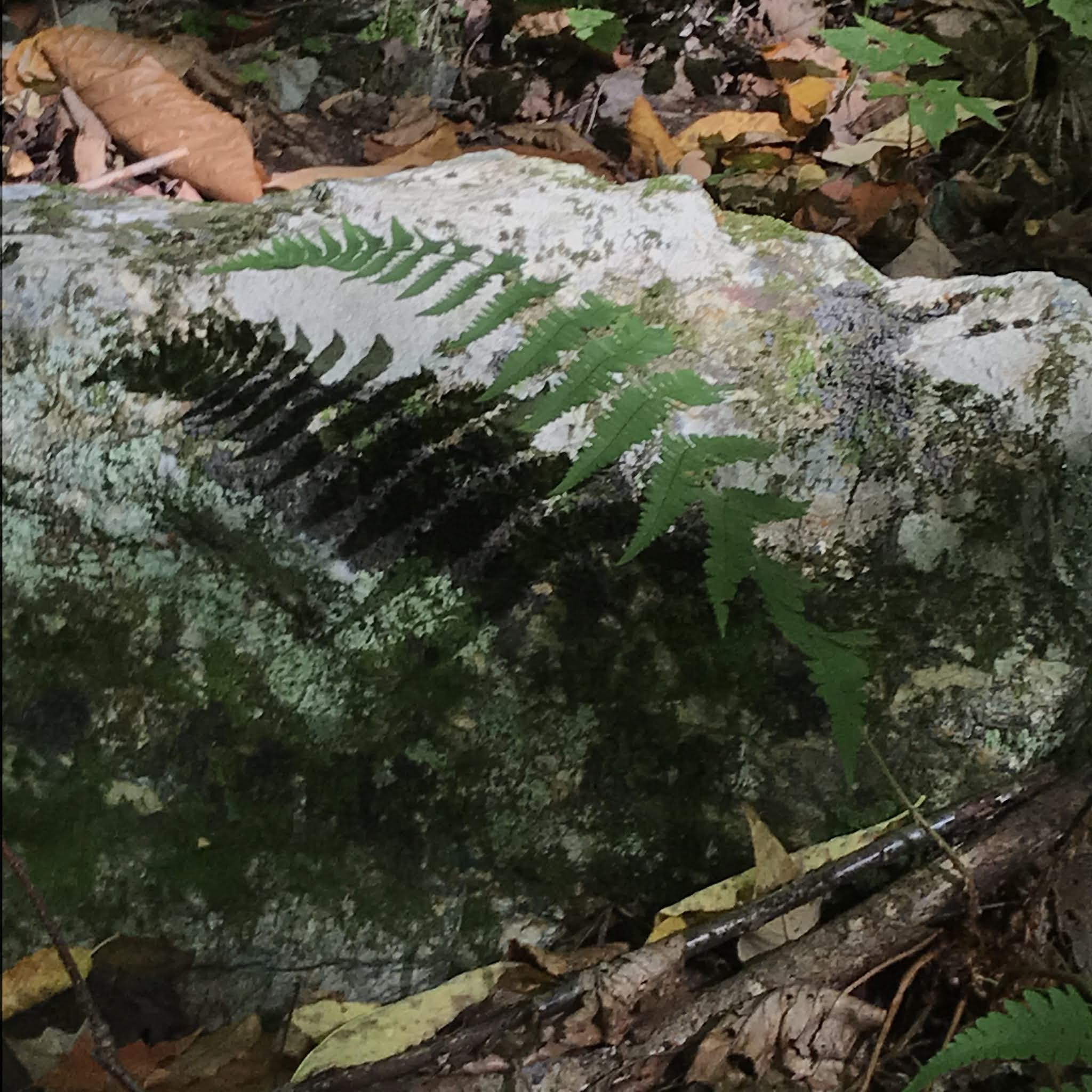
It is very pleasant and cheerful nowadays, when the brown and withered leaves strew the ground and almost every plant is fallen or withered, to come upon a patch of polypody on some rocky hillside in the woods, —as in abundance on hillside between Calla Swamp and Bateman’s Pond, and still more same hillside east of the callas, —where, in the midst of the dry and rustling leaves, defying frost, it stands so freshly green and full of life.  

The mere greenness, which was not remarkable in the summer, is positively interesting now. 

polypody
November 2, 2023

My thoughts are with the polypody a long time after my body has passed. 

The brakes, the sarsaparilla, the osmundas, the Solomon’s-seals, the lady's slippers have long since withered and fallen. The huckleberries and blueberries, too, have lost their leaves. The forest floor is covered with a thick coat of moist brown leaves. But what is that perennial and spring like verdure that clothes the rocks, of small green plumes pointing various ways?

It is the cheerful community of the polypody. It survives at least as the type of vegetation, to remind us of the spring which shall not fail. These are the green pastures where I browse now. 

Why is not this form copied by our sculptors instead of the foreign acanthus leaves and bays? The sight of this unwithering green leaf excites me like red at some seasons.  I don’t care for acanthus leaves; they are far-fetched. I do love this form, however, and would like to see it painted or sculptured, whether on your marble or my butter. How fit for a tuft about the base of a column! 


November 2, 2015

Are not the wood frogs the philosophers who walk (?) in these groves? Methinks I imbibe a cool, composed, frog-like philosophy when I behold them. 

I come to a black snake in the wood-path, with its crushed head resting on a stone and its uninjured body trailing thence. How often I see where thus some heel has bruised the serpent's head! I think it an unnatural antipathy. 

Crossed over that high, flat-backed rocky hill, where the rocks, as usual thereabouts, stand on their edges, and the grain, though usually running northeasterly and southwesterly, — by compass east-northeast, west southwest, — is frequently kinked up in a curious manner, reminding me of a curly head. Call the hill Curly-pate. 

November 2, 2017

Bateman's Pond is agitated by the strong wind, – a slate-colored surface under the cloudy sky. 

I find some good blue pearmains under their tree in a swamp, amid the huckleberry bushes, etc., all fallen. They lie with a rich bloom on them still, though half of them are gnawed by squirrels or rabbits; low in the sedge, with decayed leaves adhering to them. 

How contagious are boys' games! A short time ago they were spinning tops, as I saw and heard, all the country over. Now every boy has a stick curved at the end, a hawkie (?), in his hand, whether in yards or in distant lanes I meet them. 

The evergreen ferns and lycopodiums now have their day; now is the flower of their age, and their greenness is appreciated. They are much the clearest and most liquid green in the woods, more yellow and brown specked in the open places. 

The form of the polypody is strangely interesting; it is even outlandish. Some forms, though common in our midst, are thus perennially foreign as the growths of other latitudes; there being a greater interval between us and their kind than usual. We all feel the ferns to be further from us, essentially and sympathetically, than the phaenogamous plants, the roses and weeds, for instance. It needs no geology nor botany to assure us of that. We feel it, and told them of it first. The bare outline of the polypody thrills me strangely. It is a strange type which I cannot read. It only piques me. Simple as it is, it is as strange as an Oriental character. It is quite independent of my race, and of the Indian, and all mankind. It is a fabulous, mythological form, such as prevailed when the earth and air and water were inhabited by those extinct fossil creatures that we find. It is contemporary with them, and affects as the sight of them. 

As I stood on Curly-pate, the air had become gradually thick with mist in the southwest. The sky was overcast, and a cool, strong wind blew from the same quarter, and in the mist I perceived the strong scent of smoke from some burning. Standing on one of those curly-headed rocks, whose strata are vertical, gives me a sense of elevation like a mountain-top. In fact, they are on the axis of elevation. 

There are no fresh — or blue — fringed gentians by the swamp-side by Bateman’s now. 

Wild apples have lost some of their brilliancy now and are chiefly fallen. 

Returning, I see the red oak on R. W. E.'s shore reflected in the bright sky water. In the reflection the tree is black against the clear whitish sky, though as I see it against the opposite woods it is a warm greenish yellow. But the river sees it against the bright sky, and hence the reflection is like ink. The water tells me how it looks to it seen from below. 

I think that most men, as farmers, hunters, fishers, etc., walk along a river's bank, or paddle along its stream, without seeing the reflections. Their minds are not abstracted from the surface, from surfaces generally. It is only a reflecting mind that sees reflections. I am aware often that I have been occupied with shallow and commonplace thoughts, looking for something superficial, when I did not see the most glorious reflections, though exactly in the line of my vision. 

If the fisherman was looking at the reflection, he would not know when he had a nibble! I know from my own experience that he may cast his line right over the most elysian landscape and sky, and not catch the slightest notion of them. 

You must be in an abstract mood to see reflections however distinct. I was even startled by the sight of that reflected red oak as if it were a black water-spirit. 

When we are enough abstracted, the opaque earth itself reflects images to us; i. e., we are imaginative, see visions, etc. Such a reflection, this inky, leafy tree, against the white sky, can only be seen at this season. 


November 2, 2017

The water is falling fast, and I push direct over the meadow this evening, probably for the last time this fall, scraping the cranberry vines and hummocks from time to time with my flat-bottomed boat.

H. D. Thoreau, Journal, November 2, 1857

A black snake in the wood-path, with its crushed head resting on a stoneSee May 4, 1857 ("Wyman told Minott that he used to see black snakes crossing Walden and would wait till they came ashore and then kill them."); October 11, 1856 ("In the path, as I go up the hill beyond the springs, on the edge of Stow's sprout-land, I find a little snake which somebody has killed with his heel."); and note to April 26, 1857 ("I have the same objection to killing a snake that I have to the killing of any other animal, yet the most humane man that I know never omits to kill one.")

My thoughts are with the polypody a long time after my body has passed. See November 5, 1857 ("Sometimes I would rather get a transient glimpse or side view of a thing than stand fronting to it, — as those polypodies. The object I caught a glimpse of as I went by haunts my thoughts a long time, is infinitely suggestive, and I do not care to front it and scrutinize it, for I know that the thing that really concerns me is not there, but in my relation to that.") See also A Book of the Seasons, by Henry Thoreau, The Evergreen Ferns, Part Three: Polypody, Marginal Shield Fern, Terminal Sheild Fern

The form of the polypody is strangely interesting . . .  It is a strange type which I cannot read . . .such as prevailed when the earth and air and water were inhabited by those extinct fossil creatures that we find. See June 5, 1857 ([Wild] as those strange fossil plants whose impressions I see on my coal. . . [W]hat ages between me and the tree whose shade I enjoy! It is as if it stood substantially in a remote geological period.")

It is only a reflecting mind that sees reflections. See November 2, 1854 ("At length I discovered that it was the reflected sun which cast a higher shadow like the true one. "); October 7, 1857 ("Unless you look for reflections, you commonly will not find them.")

November 2. See A Book of the Seasons, by Henry Thoreau, November 2


My thoughts are with the
polypody long after
my body has passed.

A Book of the Seasons,  by Henry Thoreau,
 "A book, each page written in its own season,
out-of-doors, in its own locality."

 ~edited, assembled and rewritten by zphx ©  2009-2024

https://tinyurl.com/hdt-571102

Popular Posts Last 30 Days.

The week ahead in Henry’s journal

The week ahead in Henry’s journal
A journal, a book that shall contain a record of all your joy.
"A stone fruit. Each one yields me a thought." ~ H. D. Thoreau, March 28, 1859


I sit on this rock
wrestling with the melody
that possesses me.