Showing posts with label haze. Show all posts

Saturday, October 2, 2021

The white pine fall on Fair Haven Hill.


P. M.

October 2, 2014

Some of the white pines on Fair Haven Hill have just reached the acme of their fall; others have almost entirely shed their leaves, and they are scattered over the ground and the walls. The same is the state of the pitch pines.

At the Cliffs, I find the wasps prolonging their short lives on the sunny rocks, just as they endeavored to do at my house in the woods.

It is a little hazy as I look into the west to-day.

The shrub oaks on the terraced plain are now almost uniformly of a deep red.

H. D. Thoreau, Journal, October 2, 1851


Some of the white pines on Fair Haven Hill have just reached the acme of their fall
. See October 2, 1853 ("The white pines have scarcely begun at all to change here.") See also October 1, 1857 ("The pines now half turned yellow, the needles of this year are so much the greener by contrast"); October 3, 1852 ("The pine fall, i.e. change, is commenced, and the trees are mottled green and yellowish"); October 3, 1856 (" The white pines are now getting to be pretty generally parti-colored, the lower yellowing needles ready to fall ."); October 3, 1858 ("White pines fairly begin to change.") A Book of the Seasons, by Henry Thoreau, The October Pine Fall

I find the wasps prolonging their short lives on the sunny rocks. See note to September 10, 1859 ("See wasps, collected in the sun on a wall, at 9 A. M.")

It is a little hazy as I look into the west to-day.
See October 4, 1859 ("The birds seem to delight in these first fine days of the fall, in the warm, hazy light")

The shrub oaks on the terraced plain are now almost uniformly of a deep red. See October 2, 1852 ("From Cliffs the shrub oak plain has now a bright-red ground, perhaps of maples."); see also October 1, 1859 ("The shrub oaks on this hill are now at their height, both with respect to their tints and their fruit."); October 13, 1852 ("The shrub oak plain is now a deep red,"); October 22, 1858 ("I see, from the Cliffs, that color has run through the shrub oak plain like a fire or a wave, not omitting a single tree")

Wednesday, April 1, 2020

I hear the first hylodes by chance, but no doubt they have been heard some time.


Sunday. Warm, with the thick haze still concealing the sun. 

Worm-piles abundant this morning. 

Our gooseberry begins to show a little green, but not our currant. 

3 P. M. — Up Assabet in boat. 

There is another fire in the woods this afternoon. It is yet more hazy than before, — about as thick as a fog, and apparently clouds behind it. 

Still warmer than yesterday, — 71 at 3 P. M. 

The river was lowest for March yesterday, viz. just three feet below Hoar's wall. It is so low that the mouths of the musquash-burrows in the banks are exposed with the piles of shells before them. 

Willows about the stump on S. Brown's land are very well out. Are they discolor? 

The red maple buds are considerably expanded, and no doubt make a greater impression of redness. 

A kingfisher seen and heard. 

As we paddle up the Assabet we hear the wood turtles -- the first I have noticed — and painted turtles rustling down the bank into the water, and see where they have travelled over the sand and the mud. This and the previous two days have brought them out in numbers. Also see the sternothærus on the bottom.

The river being so low, we see lines of sawdust perfectly level and parallel to one another on the side of the steep dark bank at the Hemlocks, for thirty rods or more visible at once, reminding you of a coarse chalk line made by snapping a string, not more than half an inch wide much of it, but more true than that would be. The sawdust adheres to the perfectly upright bank and probably marks the standstill or highest water for the time. This level line drawn by Nature is agreeable to behold. 

The large Rana fontinalis sits enjoying the warmth on the muddy shore. I hear the first hylodes by chance, but no doubt they have been heard some time. 

Hear the hum of bees on the maples. 

Rye-fields look green. 

Pickerel dart, and probably have some time. 

The sweet-gale is almost in bloom; say next pleasant day. [It sheds its pollen the same night in my chamber, — from the old mill-site, north side.]

H. D. Thoreau, Journal, April 1, 1860

The red maple buds are considerably expanded, and no doubt make a greater impression of redness. See April 10, 1853 ( "The male red maple buds now show eight or ten (ten counting everything) scales, alternately crosswise, and the pairs successively brighter red or scarlet, which will account for the gradual reddening of their tops. They are about ready to open.")

As we paddle up the Assabet we hear the wood turtles and painted turtles rustling down the bank into the water, This and the previous two days have brought them out in numbers. See  April 1, 1858 ("See wood turtles coupled on their edges at the bottom, where the stream has turned them up.") See also  March 31, 1858 ("The painted and wood turtles have seemed to be out in surprising abundance at an unusually early date this year, but I think I can account for it. The river is remarkably low," ) and A Book of the Seasons, by Henry Thoreau,the Painted Turtle (Emys picta); A Book of the Seasons, by Henry Thoreau, The Wood Turtle (Emys insculpta)

I hear the first hylodes by chance, but no doubt they have been heard some time. See March 23, 1859 ("While reconnoitring there, we hear the peep of one hylodes somewhere in this sheltered recess in the woods."); March 31, 1855 (“I go listening for the croak of the first frog, or peep of a hylodes."); March 31, 1857 (“How gradually and imperceptibly the peep of the hylodes mingles with and swells the volume of sound which makes the voice of awakening nature! If you do not listen carefully for its first note, you probably will not hear it, and, not having heard that, your ears become used to the sound, so that you will hardly notice it at last, however loud and universal."); April 2, 1852 ("I hear a solitary hyla for the first time.")

The river being so low, we see lines of sawdust perfectly level and parallel to one another on the side of the steep dark bank at the Hemlocks. . . .reminding you of a coarse chalk line made by snapping a string, not more than half an inch wide much of it, but more true than that would be. See April 1, 1858 ("The river is at summer level. . . . It is remarkable that the river seems rarely to rise or fall gradually, but rather by fits and starts, and hence the water-lines, as indicated now by the sawdust, are very distinct parallel lines four or five or more inches apart.”) See also November 23, 1853 ("What an engineer this water is! It comes with its unerring level . . . an obvious piece of geometry in nature.") and alao A Book of the Seasons, by Henry Thoreau, at the Leaning Hemlocks.

The large Rana fontinalis sits enjoying the warmth on the muddy shore. See March 22. 1860 ("The yellow-spot turtle and wood turtle, Rana fontinalis, and painted tortoise come forth."); March 24, 1859 ("There sits also on the bank of the ditch a Rana fontinalis, and it is altogether likely they were this species that leaped into a ditch on the 10th. This one is mainly a bronze brown, with a very dark greenish snout, etc., with the raised line down the side of the back. This, methinks, is about the only frog which the marsh hawk could have found hitherto."); April 5, 1858 ("What I call the young bullfrog, about two and a half inches long, — though it has no yellow on throat. It has a bright-golden ring outside of the iris as far as I can see round it. Is this the case with the bullfrog? May it not be a young Rana fontinalis? No yellow to throat.."); See also A Book of Seasons,  by Henry Thoreau, Identifying the Green Frog in Spring.

Hear the hum of bees on the maples. See April 1, 1858 ("The white maples are abundantly out to-day. . . .We hold the boat beneath one, surprised to hear the resounding hum of honey-bees, which are busy about them,"); April 1, 1852 ('' Saw the first bee of the season on the railroad causeway,") See also A Book of the Seasons by Henry Thoreau, White Maple Buds and Flowers

The sweet-gale is almost in bloom; say next pleasant day. See April 22, 1855 ("The blossoms of the sweet-gale are now on fire over the brooks, contorted like caterpillars")

Tuesday, March 31, 2020

Prelude of the toad.


Surveying again for Ed. Hoar the wood land adjoining his farm. 

A yet warmer day. A very thick haze, concealing mountains and all distant objects like a smoke, with a strong but warm southwest wind. Your outside coat is soon left on the ground in the woods, where it first becomes quite intolerable. 

The small red butterfly in the wood-paths and sprout-lands, and I hear at midafternoon a very faint but positive ringing sound rising above the susurrus of the pines, — of the breeze, — which I think is the note of a distant and perhaps solitary toad; not loud and ringing, as it will be. 

Toward night I hear it more distinctly, and am more confident about it. I hear this faint first reptilian sound added to the sound of the winds thus each year a little in advance of the unquestionable note of the toad. Of constant sounds in the warmer parts of warm days there now begins to be added to the rustling or crashing, waterfall-like sound of the wind this faintest imaginable prelude of the toad. 

I often draw my companion's attention to it, and he fails to hear it at all, it is so slight a departure from the previous monotony of March. This morning you walked in the warm sprout-land, the strong but warm southwest wind blowing, and you heard no sound but the dry and mechanical susurrus of the wood; now there is mingled with or added to it, to be detected only by the sharpest ears, this first and faintest imaginable voice. 

I heard this under Mt. Misery. Probably they come forth earlier under the warm slopes of that hill. 

The pewee sings in earnest, the first I have heard; and at even I hear the first real robin's song. 

I hear that there has been a great fire in the woods this afternoon near the factory. Some say a thousand acres have been burned over. This is the dangerous time, —between the drying of the earth, or say when dust begins to fly, and the general leafing of the trees, when it is shaded again. These fires are a perfectly regular phenomenon of this season. 

Many refer to them this thick haze, but, though in the evening I smell the smoke (no doubt) of the Concord fire, I think that the haze generally is owing to the warm southwest wind having its vapor condensed by our cooler air. 

An engine sent from town and a crowd of boys; and I hear that one man had to swim across a pond to escape being burnt. 

One tells me he found the saxifrage out at Lee's Cliff this afternoon, and another, Ellen Emerson, saw a yellow or little brown snake, evidently either the Coluber ordinatus or else amænus, probably the first.

Sit without fire.

H. D. Thoreau, Journal, March 31, 1860

 
The small red butterfly in the wood-paths and sprout-lands. See  March 31, 1858 (“In the wood-paths now I see many small red butterflies”); April 8, 1855 (“Afterward I see a small red one over the shore.”); See also A Book of the Seasons  by Henry Thoreau, The Small Red Butterfly


Your outside coat is soon left on the ground in the woods, where it first becomes quite intolerable. See  March 31, 1855 ("I am uncomfortably warm, gradually unbutton both my coats, and wish that I had left the outside one at home.") See also  March 15, 1852 ("This afternoon I throw off my outside coat. A mild spring day.. . .My life partakes of infinity."); April 5, 1854 ("Whatever year it may be, I am surveying, perhaps, in the woods; I have taken off my outside coat, perhaps for the first time, and hung it on a tree; . . .; when I hear a single, short, well- known stertorous croak from some pool half filled with dry leaves.")

I hear this faint first reptilian sound added to the sound of the winds thus each year a little in advance of the unquestionable note of the toad. See  April 5, 1860 (" I hear, or think that I hear, a very faint distant ring of toads, which, though I walk and walk all the afternoon, I never come nearer to. . . .It merely gives a slightly more ringing or sonorous sound to the general rustling of inanimate nature. "); April 13, 1853 ("First hear toads (and take off coat), a loud, ringing sound filling the air, which yet few notice."); April 13, 1858 ("Hear the first toad in the rather cool rain, 10 A. M."); April 15, 1856 (" I hear a clear, shrill, prolonged ringing note from a toad, the first toad of the year"); May 1, 1857 ("There is a cool and breezy south wind, and the ring of the first toad leaks into the general stream of sound, unnoticed by most.") See also A Book of the Seasons, by Henry Thoreau, The Ring of Toads.

The pewee sings in earnest, the first I have heard. See  March 16, 1854 ("The first phoebe near the water is heard. ");  March 29, 1858 ("Hear a phoebe early in the morning over the street.");  March 30, 1851 ("Spring is already upon us.  . . . The pewee is heard, and the lark. "); April  1, 1857. (" Up Assabet . . .Hear a phoebe"); April 1, 1859("At the Pokelogan up the Assabet, I see my first phoebe, the mild bird. It flirts its tail and sings pre vit, pre vit, pre vit, pre vit incessantly, as it sits over the water, and then at last, rising on the last syllable, says pre-VEE, as if insisting on that with peculiar emphasis.") See also A Book of the Seasons,  by Henry Thoreau, the Eastern Phoebe

At even I hear the first real robin's song. See  March 31, 1852 ("The robins sing at the very earliest dawn. I wake with their note ringing in my ear.");  See also March 12, 1854 ("I hear my first robin peep distinctly at a distance. No singing yet. "); April  1, 1857.  ("Already I hear a robin or two singing their evening song."); April 1, 1852 ("I hear a robin singing in the woods south of Hosmer's, just before sunset. It is a sound associated with New England village life. It brings to my thoughts summer evenings when the children are playing in the yards before the doors and their parents conversing at the open windows. It foretells all this now, before those summer hours are come.") and A Book of the Seasons, by Henry Thoreau, Robins in Spring

A yellow or little brown snake, evidently either the Coluber ordinatus or else amænus, probably the first. See October 18, 1858 (“Noticed a little snake, eight or nine inches long, in the rut in the road in the Lincoln woods. It was brown above with a paler-brown dorsal stripe, which was bounded on each side by a row of dark-brown or blackish dots one eighth inch apart, the opposite rows alternating; beneath, light cream-color or yellowish white. Evidently Storer’s Coluber ordinatus.”); October 29, 1857 (“I see evidently what Storer calls the little brown snake (Coluber ordinatus). . . . Above it is pale-brown, with a still lighter brown stripe running down the middle of the back”); October 11, 1856 (“It is apparently Coluber amaenus, the red snake. Brown above, light-red beneath, about eight inches long . . . It is a conspicuous light red beneath, then a bluish-gray line along the sides, and above this brown with a line of lighter or yellowish brown down the middle of the back.”); September 9, 1857 ("It was a dark ash-color above, with darker longitudinal lines, light brick-red beneath. There were three triangular buff spots just behind the head, one above and one each side. It is apparently Coluber amaenus”); April 29, 1858 (“A little brown snake with blackish marks along each side of back and a pink belly. Was it not the Coluber amaenus?”)  

Some say a thousand acres have been burned over. See April 2, 1860 ("Walked to the Mayflower Path and to see the great burning of the 31st. I smelled the burnt ground a quarter of a mile off. It was a very severe burn, the ground as black as a chimney-back. The fire is said to have begun by an Irishman burning brush near Wild' s house in the south part of Acton, and ran north and northeast some two miles before the southwest wind, crossing Fort Pond Brook. I walked more than a mile along it and could not see to either end, and crossed it in two places. A thousand acres must have been burned.")

These fires are a perfectly regular phenomenon of this season. See March 29, 1858 ("I saw, on the hillside far across the meadow by Holbrook's clearing, what I at first took for a red flag or handkerchief carried along on a pole, just above the woods. It was a fire in the woods, and I saw the top of the flashing flames above the tree-tops. The woods are in a state of tinder, and the smoker and sportsman and the burner must be careful now."); April 4, 1856 ("Already I hear of a small fire in the woods in Emerson’s lot, set by the engine, the leaves that are bare are so dry."); April 9, 1856 ("Now look out for fires in the woods, for the leaves are never so dry and ready to burn as now. The snow is no sooner gone, —nay, it may still cover the north and west sides of hills, — when a day or two’s sun and wind will prepare the leaves to catch at the least spark."); April 21, 1859 ("Put out a fire in the woods, the Brister lot.");April 5, 1860  ("We heard of fires in the woods in various towns, and more or less distant, on the same days that they occurred here, — the last of March and first of April. The newspapers reported many. The same cause everywhere produced the same effect.") See also February 8, 1858 ("Two or three-acres were burned over, set probably by the engine. Such a burning as commonly occurs in the spring.")

One tells me he found the saxifrage out at Lee's Cliff this afternoon. See April 3, 1853("To my great surprise the saxifrage is in bloom. It was, as it were, by mere accident that I found it.. . . under a projecting rock in a little nook on the south side of a stump, I spied one little plant which had opened three or four blossoms high up the Cliff. "); April 27, 1852 ("On Conantum Cliffs I find to-day for the first time the early saxifrage (Saxifraga vernalis) in blossom, growing high and dry in the narrow seams, where there is no soil for it but a little green moss. It is one of the first flowers, not only in the spring of the year, but in the spring of the world.") See also A Book of the Seasons, by Henry Thoreau, Saxifrage in Spring (Saxifraga vernalis)

Sit without fire. See April 30, 1859 (" The warmest afternoon yet. Sat in sun without fire this forenoon."); May 2, 1858 ("Sit without fire to-day and yesterday."); May 3, 1857 ("To-day we sit without fire.")

Monday, October 14, 2019

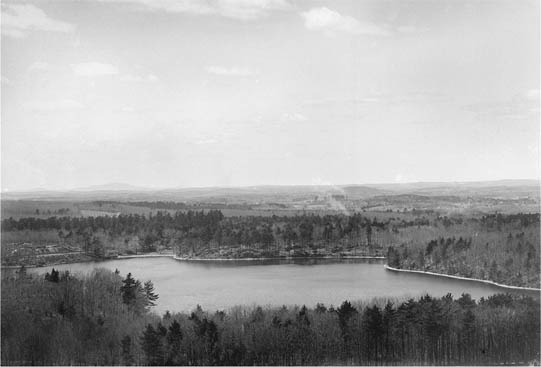
We sit on the rock on Pine Hill overlooking Walden.


October 14. 

9 a. m. — To and around Flint's Pond with Blake. 

A fine Indian-summer day. 

The 6th and 10th were quite cool, and any particularly warm days since may be called Indian summer (?), I think. 

We sit on the rock on Pine Hill overlooking Walden.


Overlooking Walden Pond from Pine Hill
April 28, 1906
There is a thick haze almost entirely concealing the mountains. There is wind enough to raise waves on the pond and make it bluer. What strikes me in the scenery here now is the contrast of the unusually blue water with the brilliant-tinted woods around it. 

The tints generally may be about at their height. The earth appears like a great inverted shield painted yellow and red, or with imbricated scales of that color, and a blue navel in the middle where the pond lies, and a distant circumference of whitish haze. 

The nearer woods, where chestnuts grow, are a mass of warm, glowing [yellow] (though the larger chestnuts have lost the greater part of their leaves and generally you wade through rustling chestnut leaves in the woods), but on other sides the red and yellow are intermixed. The red, probably of scarlet oaks on the south of Fair Haven Hill, is very fair. The beech tree at Baker's fence is past prime and many leaves fallen. 

The shrub oak acorns are now all fallen, — only one or two left on, — and their cups, which are still left on, are apparently somewhat incurved at the edge as they have dried, so that probably they would not hold the acorn now. 

The ground is strewn also with red oak acorns now, and, as far as I can discover, acorns of all kinds have fallen. 

At Baker's wall two of the walnut trees are bare but full of green nuts (in their green cases), which make a very pretty sight as they wave in the wind. So distinct you could count every one against the sky, for there is not a leaf on these trees, but other walnuts near by are yet full of leaves. You have the green nut contrasted with the clean gray trunks and limbs. These are pig nut-shaped. 

The chestnuts generally have not yet fallen, though many have. I find under one tree a great many burs, apparently not cast down by squirrels — for I see no marks of their teeth — and not yet so opened that any of the nuts fall out. They do not all wait till frosts open the burs before they fall, then. 

I see a black snake, and also a striped snake, out this warm day.

***
Some Rhus radicans was leafless on the 13th, and some tupelos bare maybe a week or more, and button-bushes nearly bare. 

My little white pines by Walden are now conspicuous in their rows, the grass, etc., having withered to tawny and the blackberry turned to scarlet. They have been almost inobvious through the summer. 

The dark evergreen leaves of the checkerberry also attract us now amid the shrub oaks, as on the southwest of Pine Hill.

I hear a man laughed at because he went to Europe twice in search of an imaginary wife who, he thought, was there, though he had never seen nor heard of her. But the majority have gone further while they stayed in America, have actually allied themselves to one whom they thought their wife and found out their mistake too late to mend it. It would be cruel to laugh at these. 

Wise, the balloonist, says that he lost a balloon "in a juniper bog in the State of Maine," which he mistook for a "prairie." Does he mean a larch swamp? 

Balloonists speak of hearing dogs bark at night and wagons rumbling over bridges.

Arbor-vitae falling (seeds), how long?

H. D. Thoreau, Journal, October 14, 1859

A fine Indian-summer day. See October 14, 1853 ("Fine, clear Indian-summer weather.")

We sit on the rock on Pine Hill overlooking Walden. See October 1, 1859 ("Looking down from Pine Hill, I see a fish hawk over Walden."); October 22, 1852 ("Looking over the forest on Pine Hill, I can hardly tell which trees are lit up by the sunshine and which are the yellow chestnut-tops."); October 20, 1852 (“Picking chestnuts on Pine Hill. . . . I see the mountains in sunshine, all the more attractive from the cold I feel here, with a tinge of purple on them”); October 25, 1858 ("Returning in an old wood-path from top of Pine Hill to Goose Pond, I see many goldenrods turned purple"); November 4, 1857 ("I climb Pine Hill just as the sun is setting, this cool evening. Sitting with my back to a thick oak sprout whose leaves still glow with life, Walden lies an oblong square endwise to, beneath me. Its surface is slightly rippled, and dusky prolonged reflections of trees extend wholly across its length, or half a mile, — I sit high."); November 5, 1857 ("I shiver about awhile on Pine Hill, waiting for the sun to set."); November 30, 1852 ("From Pine Hill, Wachusett is seen over Walden. The country seems to slope up from the west end of Walden to the mountain"); February 29, 1852 ("The ice on Walden is of a dull white as I look directly down on it, but not half a dozen rods distant on every side it is a light-blue color.From Pine Hill, looking westward, I see the snowcrust shine in the sun as far as the eye can reach. . ."); April 27, 1859 ("Through the cemetery, and over Pine Hill, where I heard a strange warbler, methought, a dark-colored, perhaps reddish-headed bird"); May 15, 1856 (“Checker-berries very abundant on south side of Pine Hill, by pitch pine wood. Now is probably best time to gather them.”); June 12, 1853 ("Going up Pine Hill, disturbed a partridge and her brood. She ran indeshabille directly to me, within four feet, while her young, not larger than a chicken just hatched, dispersed. "); July 29, 1858 ("To Pine Hill, looking for the Vaccinium Pennsylvanicum berries. I find plenty of bushes, but these bear very sparingly. They appear to bear but one or two years before they are overgrown."); August 27, 1854 ("I am surprised to see the top of Pine Hill wearing its October aspect, — yellow with changed maples and here and there faintly blushing with changed red maples. . . .. As I go up Pine Hill, gather the shrivelled Vaccinium vacillans berries, many as hard as if dried on a pan. They are very sweet and good."); September 12, 1851 ("Found a violet, apparently Viola cucullata, or hood-leaved violet, in bloom in Baker's Meadow beyond Pine Hill.")

The earth appears like a great inverted shield painted yellow and red. . .and a blue navel in the middle where the pond lies, and a distant circumference of whitish haze. See October 13, 1852 (" The water or lake from however distant a point seen is always the centre of the landscape. The pond is now most beautifully framed with the autumn-tinted woods and hills.");  November 4, 1857 ("I climb Pine Hill just as the sun is setting. . . Walden lies an oblong square endwise to, beneath me. Its surface is slightly rippled, and dusky prolonged reflections of trees extend wholly across its length");See also June 3, 1850 ("The landscape is a vast amphitheatre rising to its rim in the horizon."): June 25, 1852 ("The earth appears like a vast saucer sloping upward to its sharp mountain rim.")

The ground is strewn also with red oak acorns now, and, as far as I can discover, acorns of all kinds have fallen. See September 12, 1854 ("White oak acorns have many of them fallen. . . .. Some black scrub oak acorns have fallen, and a few black oak acorns also have fallen. The red oak began to fall first."); September 30, 1854 ("Acorns are generally now turned brown and fallen or falling; the ground is strewn with them and in paths they are crushed by feet and wheels."); October 1, 1859 ("The shrub oaks on this hill are now at their height, both with respect to their tints and their fruit. . . .Now is the time for shrub oak acorns if not for others."); October 11, 1860 ("There is a remarkably abundant crop of white oak acorns this fall, also a fair crop of red oak acorns; but not of scarlet and black, very few of them. The acorns are now in the very midst of their fall."); October 12, 1858 ("Acorns, red and white (especially the first), appear to be fallen or falling. They are so fair and plump and glossy that I love to handle them, and am loath to throw away what I have in my hand."); October 13, 1859 ("I see no acorns on the trees. They appear to have all fallen before this."); October 13, 1860 ("This is a white oak year, . . . I should think that there might be a bushel or two of acorns on and under some single trees.")

Some tupelos bare maybe a week or more. Compare October 14, 1857 ("Near by is a tupelo which is all a distinct yellow with a little green. ")

Saturday, August 31, 2019

There must be more smoke in this haze than I have supposed.

August 31

Warmer this morning and considerably hazy again. 

Wormwood pollen yellows my clothes commonly. 

Ferris in his " Utah," crossing the plains in '52, says that, on Independence Rock near the Sweetwater, "at a rough guess, there must be 35,000 to 40,000" names of travellers. [Benjamin G. Ferris, Utah and the Mormons. New York, 1854.]

1 P. M. — To Lincoln. 

Surveying for William Peirce. He says that several large chestnuts appear to be dying near him on account of the drought. 

Saw a meadow said to be still on fire after three weeks; fire had burned holes one and a half feet deep; was burning along slowly at a considerable depth. 

P. brought me home in his wagon. Was not quite at his ease and in his element; i. e., talked with some reserve, though well behaved, unless I approached the subject of horses. Then he spoke with a will and with authority, betraying somewhat of the jockey. 

He said that this dry weather was "trying to wagons ; it loosened the tires," — if that was the word. He did not use blinders nor a check-rein. Said a horse's neck must ache at night which has been reined up all day. 

He said that the outlet of F[lint's] Pond had not been dry before for four years, and then only two or three days; now it was a month. 

Notwithstanding this unprecedented drought our river, the main stream, has not been very low. It may have been kept up by the reservoirs. Walden is unaffected by the drought, and is still very high. But for the most part silent are the watercourses, when I walk in rocky swamps where a tinkling is commonly heard. 

At nine this evening I distinctly and strongly smell smoke, I think of burning meadows, in the air in the village. There must be more smoke in this haze than I have supposed. Is not the haze a sort of smoke, the sun parching and burning the earth?

H. D. Thoreau, Journal, August 31, 1854

Wormwood pollen yellows my clothes commonly. See August 31, 1859 ("These weeds require cultivated ground, and... now that the potatoes are cared for, Nature is preparing a crop of chenopodium and Roman wormwood for the birds.")

This unprecedented drought
See July 13, 1854 (“In the midst of July heat and drought.”); July 24, 1854 ("A decided rain-storm to-day and yesterday, such as we have not had certainly since May."); August 19, 1854 ("There is now a remarkable drought, some of whose phenomena I have referred to during several weeks past.”); August 22, 1854 (" Hundreds, if not thousands, of fishes have here perished on account of the drought."); September 10, 1854 ("The first fall rains after the long drought"). See also August 21, 2019 ("There is quite a drought, and I can walk almost anywhere over these meadows without wetting my feet., , , It is like the summer of '54.")

At nine this evening I distinctly and strongly smell smoke, I think of burning meadows . . .There must be more smoke in this haze than I have supposed. See August 25, 1854 ("Between me and Nawshawtuct is a very blue haze like smoke. Indeed many refer all this to smoke"): August 26, 1854 ("I hear of a great many fires around us, far and near, both meadows and woods; in Maine and New York also. There may be some smoke in this haze, but I doubt it."); August 28, 1854 ("I think that haze was not smoke;");  September 25, 1854 ("I think that if that August haze had been much of it smoke, I should have smelt it much more strongly, for I now smell strongly the smoke of this burning half a mile off,"); See also October 21, 1856 ("It is remarkably hazy , , , but when I open the door I smell smoke, which may in part account for it. .")


August 31. See A Book of the Seasons, by Henry Thoreau, August 31


Is not the haze a 
sort of smoke – the sun parching
and burning the earth?

A Book of the Seasons,  by Henry Thoreau, There must be more smoke in this haze than I have supposed.
A Book of the Seasons,  by Henry Thoreau, 
 "A book, each page written in its own season,
out-of-doors, in its own locality."
 ~edited, assembled and rewritten by zphx ©  2009-2024


The persistent song
of the eastern wood pewee,
high on an oak snag.
Zphx August 31, 2019

Tuesday, May 7, 2019

Such is the first hot weather.

May 7 
May  7, 2019

Saturday. Surveying Damon's Acton lot. 

It is hotter still, — 88° or more, as I hear in the afternoon. 

I frequently see pigeons dashing about in small flocks, or three or four at a time, over the woods here. Theirs is a peculiarly swift, dashing flight. 

The mayflower is still sparingly in bloom on what I will call Mayflower Path in this lot. It is almost the prevailing undershrub here. 

I think I hear the redstart. 

To-day and yesterday the sunlight is peculiarly yellow, on account of the smoky haze. I notice its peculiar yellowness, almost orange, even when, coming through a knot-hole in a dark room, it falls on the opposite wall. 

Such is the first hot weather.

H. D. Thoreau, Journal, May 7, 1856

The mayflower is still sparingly in bloom on what I will call Mayflower Path. See May 7, 1854 ("As I ascend Cliff Hill, the two leaves of the Solomon's-seal now spot the forest floor, pushed up amid the dry leaves.")  April 12, 1858 ("Surveying part of William P. Brown's wood-lot in Acton, west of factory . . . I find the mayflower, but not in bloom. It appears to be common thereabouts."); See also A Book of the Seasons, by Henry Thoreau, Two-leaved Solomon's Seal ( Canada mayflower or false lily-of-the-valley)

I think I hear the redstart.
See May 16, 1858 (“See and hear a redstart, the rhythm of whose strain is tse'-tse, tse'-tse, tse', emphasizing the last syllable of all and not ending with the common tsear”); May 17, 1856 (“At the Kalmia Swamp, see and hear the redstart, very lively and restless, flirting and spreading its reddish tail.”) See also  A Book of Seasons,  by Henry Thoreau, The American Redstart

May 7. See A Book of Seasons, by Henry Thoreau, May 7


Sunlight coming through 
a knot-hole in a dark room –
yellow, almost orange. 

A Book of the Seasons,  by Henry Thoreau 
"A book, each page written in its own season,
out-of-doors, in its own locality.”
~edited, assembled and rewritten by zphx © 2009-2025

https://tinyurl.com/hdt-560507

*****

A sunset walk. We walk to the view getting a late start, around 630 At the view there are beacons of light shining at spots all over the landscape through broken clouds. Parts of the lake are illuminated parts of the golf course suddenly bright bright green. 

The maple leaves are now lacy against the sky and probably will be forming shadows. The small maples go straight to leaf but the adult trees still have no leaves. This spring green color of the tree flowers is coloring the valley and the grass is bright green.

It is obviously going to be an incredibly good sunset. Gradually the clouds break up and we see the peachy orange color in the west. The mountains are blue to dark purple. Whiteface is concealed.

We wait until the sun is down and then notice the beam of red light illuminating the clouds behind the Adirondacks like a red fan silhouetting the mountains. Many pictures to document this beautiful evening.

Meanwhile through the hike we hear the hermit thrush,'the wood thrush, the oven bird, the black throated green the sapsuckers tapping and perhaps others. Rose breasted grosbeak –we have been been waiting for it; today it first is heard.

Just as the sun sets the peepers in the lower pond start up in earnest.

  zphx 20190507

Monday, May 6, 2019

Young red maples suddenly bursting into leaf are very conspicuous now in the woods,

May 6. 

Surveying for Willis & Damon at the factory. 

Hear the tea-lee of the white-throat sparrow. 

It is suddenly very warm and oppressive, especially in the woods with thick clothing. 

Viola pedata begins to be common about white pine woods there.

While surveying this forenoon behind Willis's house on the shore of the mill-pond, I saw remarkable swarms of that little fuzzy gnat (Tipulidae). Hot as it was, — oppressively so, — they were collected in the hollows in the meadow, apparently to be out of the way of the little breeze that there was, and in many such places in the meadow, within a rod of the water, the ground was perfectly concealed by them. Nay, much more than that. I saw one shallow hollow some three feet across which was completely filled with them, all in motion but resting one upon another, to the depth, as I found by measurement with a stick, of more than an inch, — a living mass of insect life. There were a hundred of these basins full of them, and I then discovered that what I had mistaken for some black dye on the wet shore was the bodies of those that were drowned and washed up, blackening the shore in patches for many feet together like so much mud. We were also troubled by getting them into our mouths and throats and eyes. 

This insect resembles the plate of the Chironomus plumosus ("Library of Entertaining Knowledge, Insect Transformations," page 305), also the Corethra plumicornis (page 287), both of which live at first in the water, like the mosquito. 

Young red maples suddenly bursting into leaf are very conspicuous now in the woods, among the most prominent of all shrubs or trees. The sprouts are reddish. 

Hear yellow-throat vireo, and probably some new warblers. 

See the strong-scented wood ants in a stump. 

Black suckers, so called, are being speared at the factory bridge.

This is about the last of the very dry leaves in the woods, for soon the ground will be shaded by expanded green leaves. It is quite hazy, if not smoky, and I smell smoke in the air, this hot day. 

My assistants, being accustomed to work indoors in the factory, are quite overcome by this sudden heat. The old leaves and earth are driest now, just before the new leaves expand and when the heat is greatest. 

I see the black traces of many a recent fire in the woods, especially in young woods. At evening I hear the first sultry buzz of a fly in my chamber, telling of sultry nights to come.

H. D. Thoreau, Journal, May 6, 1859

Viola pedata begins to be common about white pine woods there
. See May 10, 1858 ("How much expression there is in the Viola pedata! I do not know on the whole but it is the handsomest of them all, it is so large and grows in such large masses.") See also  May 5, 1853 ("The Emerson children found blue and white violets May 1st at Hubbard's Close, probably Viola ovata and blanda; but I have not been able to find any yet."); May 5, 1859  ("V. pedata and lanceolata rarer yet, or not seen.")  May 6, 1852 (“The first Viola blanda (sweet-scented white), in the moist ground by this spring.”);  May 6, 1855 ("Viola lanceolata, yesterday at least. . . .Two or three rods this side of John Hosmer’s pitch pines, beyond Clamshell, some white Viola ovata, some with a faint bluish tinge. ")// Also  A Book of the Seasons, by Henry Thoreau, The Violets

I saw remarkable swarms of that little fuzzy gnat (Tipulidae). See A Book of the Seasons, by Henry Thoreau, the Fuzzy Gnat

Young red maples suddenly bursting into leaf are very conspicuous now in the woods. Compare May 6, 1855 ("The young sugar maples leafing are more conspicuous now than any maples.”) . See A Book of the Seasons, by Henry Thoreau, Spring Leaf-Out

Hear yellow-throat vireo, and probably some new warblers. See May 6, 1852 ("Hear the first warbling vireo this morning on the elms. This almost makes a summer.”); May 7, 1852 ("One or more little warblers in the woods this morning are new to the season, . . .The first wave of summer from the south.”)


An evening hike it’s been a perfectly blue sky  and puffy white clouds day we hear the first tree frog of the season somewhere past the junction. I stop and cut a hop hornbeam there, dispose of the top over the bank and leave the trunk along one of the trails. I see there the sedge flowering for the first time. The spring beauties are out in profusion and  I smell them now the sweet smell of spring. They’re everywhere in the woods but seemingly thriving more so in the paths The sun is still a couple of hours high, but quite a bit north right in front of the view. We sit long enough for the sky below the clouds to have an orangey peach tint. There seems to be an oven bird trying to sing. We go down past the middle pond and approaching the top of  middle ridge I hear the first wood thrush. We spend a long time listening. It sings in groups of four  phrases which it repeats. One -- after the throat clearing – starts with  a bursting  high note.  More trail cleaning on a spur trail on the way out and home at dusk to feed the dogs. 20190586: tree frog wood thrush oven bird black-throated green spring beauties

Popular Posts Last 30 Days.

The week ahead in Henry’s journal

The week ahead in Henry’s journal
A journal, a book that shall contain a record of all your joy.
"A stone fruit. Each one yields me a thought." ~ H. D. Thoreau, March 28, 1859


I sit on this rock
wrestling with the melody
that possesses me.