Showing posts with label Nine Acre Corner. Show all posts

Thursday, April 22, 2021

In the river near the Nine-Acre Corner bridge.


April 22

It was high water again about a week ago, Mann thinks within three or four inches as high as at end of winter.

He obtained to-day the buffle-headed duck, diving in the river near the Nine-Acre Corner bridge. I identify it at sight as my bird seen on Walden. 

I hear a chip-bird.

H. D. Thoreau, Journal, April 22, 1861

My bird seen on Walden. See December 26, 1853 ("Saw in [Walden] a small diver, probably a grebe or dobchick, dipper, or what-not, ... It had a black head, a white ring about its neck, a white breast, black back, and apparently no tail.”); April 19, 1855 ("A little duck, asleep with its head in its back, exactly in the middle of the pond. It has a moderate-sized black head and neck, a white breast, and seems dark-brown above, with a white spot on the side of the head, not reaching to the out side, from base of mandibles, and another, perhaps, on the end of the wing, with some black there. . . .I think it is the smallest duck I ever saw.); and note to September 27, 1860 ("Looking up, I see a little dipper . . in the middle of the river. . .. I sit down and watch it . . . soon the dipper is thus tolled along to within twenty feet of where I sit, and I can watch it at my leisure. It has a dark bill and considerable white on the sides of the head or neck, with black between it, no tufts, and no observable white on back or tail.") See also A Book of the Seasons, by Henry Thoreau, The Little Dipper

I hear a chip-bird. See April 9, 1853("The chipping sparrow, with its ashy-white breast and white streak over eye and undivided chestnut crown, holds up its head and pours forth its che che che che che che. " ); April 17, 1860 ("It perches on a cherry tree, perchance, near the house, and unseen, by its steady che-che-che-che-che che, affecting us often without our distinctly hearing it, it blends all the other and previous sounds of the season together. It invites us to walk in the yard and inspect the springing plants."") See also A Book of the Seasons, by Henry Thoreau The Chipping Sparrow (Fringilla socialis).)

Sunday, July 1, 2012

The path by the wood-side is red with the effete staminiferous flowers of the white pine.


July 1

A cloudy and slightly showery morning. 

One object to see the white lilies in blossom. I wish to breathe the atmosphere of lilies, and get the full impression which lilies are fitted to make.

From the bridge I see a bream's nest in soft sand on the edge of deeper water, scooped out quite deep, with very sharp edges sloping both ways. 

Some peetweets, which probably have eggs in Conant's corn-field, make a great ado twittering and circling about the dog.
July 1, 2012


The path by the wood-side is red with the effete staminiferous flowers of the white pine. 


Roses are in their prime now, growing amid huckle-berry bushes, ferns, and sweet-ferns, especially about some dry pond-hole; some paler, some more red.

It is more agreeable walking this cloudy day, with a few harmless sun-showers, than it would be in a glaring sunny day. It is pleasant to behold so much of the landscape in the shadow of the clouds, especially to look off from the top of Conantum, under shady walnut boughs, to larger shades in valleys,- all Nine-Acre Corner in the cool shade of a cloud.

Borrow Brigham the wheelwright's boat at the Corner Bridge. 


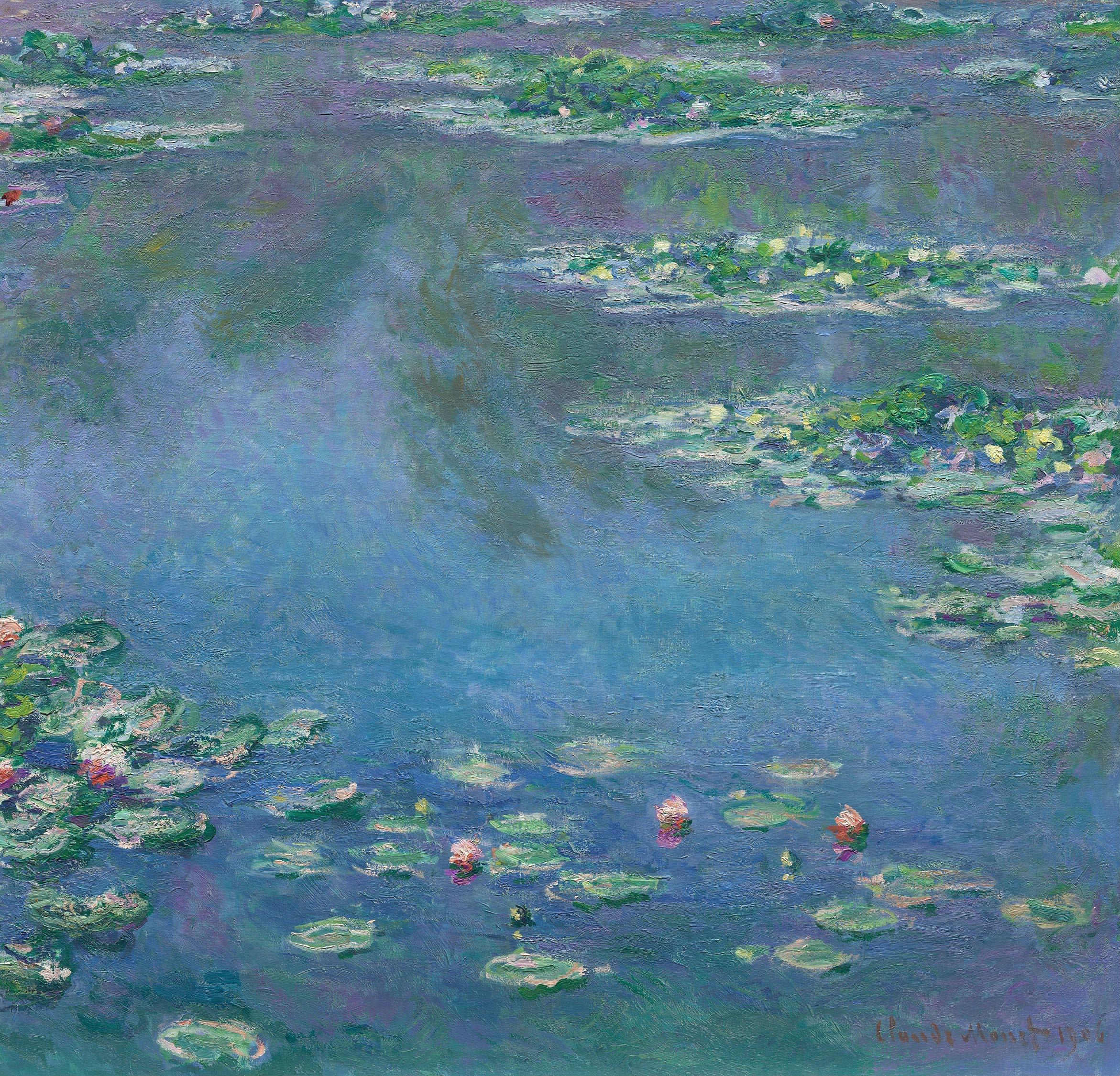
The white lilies are in all their splendor, fully open, sometimes their lower petals lying flat on the surface. The largest appeared to grow in the shallower water, where some stand five or six inches out of water, and are five inches in diameter. Two which I examine have twenty-nine petals each. We push our boat into the midst of some shallow bays covered with pads and spotted white with many hundreds of lilies just expanded. The freshly opened lilies are a pearly white, and though the water amid the pads is quite unrippled, the passing air gives a slight oscillating, boat-like motion to and fro to the flowers, like boats held fast by their cables.

After eating our luncheon at Rice's landing, I can not find one open anywhere for the rest of the day.

H. D. Thoreau, Journal, July 1, 1852


The path by the wood-side is red with the effete staminiferous flowers of the white pine. See note to  June 25, 1858 ("The ground under the white pines is now strewn with the effete flowers, like an excrement.”)

Roses are in their prime now . . .The white lilies are in all their splendor. See June 30, 1852 ("Is not this period more than any distinguished for flowers, when roses, swamp-pinks, morning-glories, arethusas, pogonias, orchises, blue flags, epilobiums, mountain laurel, and white lilies are all in blossom at once?"); See also A Book of the Seasons,  by Henry Thoreau, The Wild Rose

It is pleasant to behold so much of the landscape in the shadow of the clouds
See July 1,1854 ("I see from this hill their great shadows pass slowly here and there over the top of the green forest."); See also June 3, 1858 ("It was interesting to watch from that height the shadows of fair-weather clouds passing over the landscape."); July 27, 1852 ("It is pleasing to behold at this season contrasted shade and sunshine on the side of neighboring hills.")

 After eating our luncheon . . . I can not find one open anywhere for the rest of the day. See July 17, 1854 (“I watch them for an hour and a half. By about 1.30 they are all shut up, and no petal is to be seen up and down the river . . .I think that I could tell when it was 12 o'clock within half an hour by the lilies.”)

Monday, April 2, 2012

A Spring day.

April 2.

The sun is up. The water on the meadows is perfectly smooth and placid, reflecting the hills and clouds and trees. The air is full of the notes of birds, - song sparrows, red-wings, robins (singing a strain), bluebirds, - and I hear also a lark, - as if all the earth had burst forth into song. The influence of this April morning has reached them, for they live out-of-doors all the night, and there is no danger that they will oversleep themselves such a morning.

For a long distance, as we paddle up the river, we hear the two-stanza'd lay of the pewee on the shore, - pee-wet, pee-wee, etc. Those are the two obvious facts to eye and ear, the river and the pewee.

We hardly set out to return, when the water looked sober and rainy. There was more appearance of rain in the water than in the sky, - April weather look. And soon we saw the dimples of drops on the surface . The clouds, the showers, and the breaking away now in the west, all belong to the summer side of the year and remind me of long-past days.

We land in a steady rain and walk inland by R. Rice's barn, regardless of the storm, toward White Pond. At last the drops fall wider apart, and we pause in a sandy field near the Great Road of the Corner, where it was agreeably retired and sandy, drinking up the rain. The rain was soothing, so still and sober, gently beating against and amusing our thoughts, swelling the brooks. 

The robin now peeps with scared note in the heavy overcast air, among the apple trees. The hour is favorable to thought.

The rain now turns to snow with large flakes, so soft many cohere in the air as they fall. They make us white as millers and wet us through. I hear a solitary hyla for the first time. At Hubbard's Bridge, count eight ducks going over. Looking up, the flakes are black against the sky. And now the ground begins to whiten.


H. D. Thoreau, Journal, April 2, 1852

The air is full of the notes of birds, - song sparrows, red-wings, robins (singing a strain) 
See  April 2, 1854("I heard something which reminded me of the song of the robin in rainy days in past springs. ") April 2, 1856 ("Robins are peeping and flitting about. Am surprised to hear one sing regularly their morning strain,”) See also A Book of the Seasons, by Henry Thoreau, Robins in Spring


It appears to me that, to one standing on the heights of philosophy, mankind and the works of man will have sunk out of sight altogether; that man is altogether too much insisted on. The poet says the proper study of mankind is man. I say, study to forget all that; take wider views of the universe. That is the egotism of the race.   In order to avoid delusions, I would fain let man go by and behold a universe in which man is but as a grain of sand. It is a test I would apply to my companion, — can he forget man?  What is the village, city, State, nation, aye the civilized world, that it should concern a man so much?  I do not value any view of the universe into which man and the institutions of man enter very largely and absorb much of the attention. Man is but the place where I stand, and the prospect hence is infinite. It is not a chamber of mirrors which reflect me.  When I reflect, I find that there is other than me.  The universe is larger than enough for man's abode. Man is a past phenomenon to philosophy.   ~ April 2, 1852

Popular Posts Last 30 Days.

The week ahead in Henry’s journal

The week ahead in Henry’s journal
A journal, a book that shall contain a record of all your joy.
"A stone fruit. Each one yields me a thought." ~ H. D. Thoreau, March 28, 1859


I sit on this rock
wrestling with the melody
that possesses me.