Showing posts with label apples. Show all posts

Saturday, October 3, 2020

Bay-wings about. Sparrows in flocks.


October 3

See Vanessa Antiopa.

The hard frost of September 28th, 29th, and 30th, and especially of October 1st, has suddenly killed, crisped, and caused to fall a great many leaves of ash, hickory, etc., etc. These ( and the locusts generally ) look shrivelled and hoary, and of course they will not ripen or be bright. They are killed and withered green, — all the more tender leaves. Has killed all the burdock flowers and no doubt many others.

Sam Barrett says that last May he waded across the Assabet River on the old dam in front of his house with out going over his india - rubber boots, which are sixteen and a half inches high. I do not believe you could have done better than this a hundred years ago, or before the canal dam was built.

Bay-wings about.

I have seen and heard sparrows in flocks, more as if flitting by, within a week, or since the frosts began.

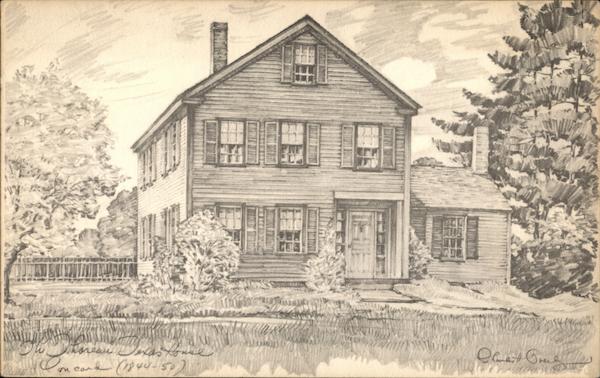
Gathered to-day my apples at the Texas house. I set out the trees, fourteen of them fourteen years ago and five of them several years later, and I now get between ten and eleven barrels of apples from them.

“Texas” House
(Thoreau Family Residence, 1844-1850)

H. D. Thoreau, Journal, October 3, 1860

See Vanessa Antiopa. See . April 17, 1860 (“It is unexpectedly very warm on lee side of hilltop just laid bare and covered with dry leaves and twigs. See my first Vanessa Antiopa”); October 1, 1860.(“C. saw the first Vanessa Antiopa since spring.”) See also A Book of the Seasons,  by Henry Thoreau, the Buff-edged Butterfly

The hard frost of September 28th, 29th, and 30th, and especially of October 1st. See October 1, 1860 ("Remarkable frost and ice this morning . . . I do not remember such cold at this season.").”); Compare October 3, 1856 (“The frost keeps off remarkably .” )

Sam Barrett says that last May he waded across the Assabet River on the old dam. See August 17, 1858 (“Being overtaken by a shower, we took refuge in the basement of Sam Barrett’s sawmill, where we spent an hour, and at length came home with a rainbow over arching the road before us”)

Bay-wings about. See April 15, 1859 (“The bay-wing now sings — the first I have been able to hear — . . . about the Texas house ”); October 9, 1858 (“Bay-wings flit along road.”); October 11, 1856 (“Bay-wing sparrows numerous.”); October 12, 1859 (“ I see scattered flocks of bay-wings amid the weeds and on the fences.”); October 16, 1855 ("I look at a grass-bird on a wall in the dry Great Fields. There is a dirty-white or cream-colored line above the eye and another from the angle of the mouth beneath it and a white ring close about the eye. The breast is streaked with this creamy white and dark brown in streams, as on the cover of a book.") See also A Book of the Seasons, by Henry Thoreau, the Bay-Wing Sparrow

I have seen and heard sparrows in flocks within a week. See September 17, 1858 (“Methinks, too, that there are more sparrows in flocks now about in garden”);  September 23, 1851 ("I scare up large flocks of sparrows in the garden.");September 26, 1858 (“Now is the time, too, when flocks of sparrows begin to scour over the weedy fields,”); September 27, 1858 ("What are those little birds in flocks in the garden and on the peach trees these mornings, about size of chip-birds, without distinct chestnut crowns?”); October 2, 1858 ("The garden is alive with migrating sparrows these mornings."); October 5, 1858 (“I still see large flocks, apparently of chip birds, on the weeds and ground in the yard.”); October 10, 1853 ("There are . . . large flocks of small sparrows,  which make a business of washing and pruning themselves in the puddles in the road, as if cleaning up after a long flight and the wind of yesterday.”)

October 3. See A Book of the Seasons, by Henry Thoreau,  October 3
See sparrows in flocks 
and have heard more flitting by 
since the frosts began.

A Book of the Seasons, by Henry Thoreau
"A book, each page written in its own season,
out-of-doors, in its own locality."
~edited, assembled and rewritten by zphx © 2009-2025
 

Saturday, August 29, 2020

A stream meanders as much in a zigzag as serpentine manner.


August 29.

The 25th and 26th I was surveying Tuttle's farm.

The northeast side bounds on the Mill Brook and its tributary and is very irregular.

I find, after surveying accurately the windings of several brooks and of the river, that their meanders are not such regular serpentine curves as is commonly supposed, or at least represented. 


They flow as much in a zigzag as serpentine manner.

The eye is very much deceived when standing on the brink, and one who had only surveyed a brook so would be inclined to draw a succession of pretty regular serpentine curves.

But, accurately plotted, the regularity disappears, and there are found to be many straight lines and sharp turns.

I want no better proof of the inaccuracy of some maps than the regular curving meanders of the streams, made evidently by a sweep of the pen.

No, the Meander no doubt flowed in a very crooked channel, but depend upon it, it was as much zigzag as serpentine.

This last brook I observed was doubly zigzag, or compoundly zigzag; i. e., there was a zigzag on a large scale including the lesser.

To the eye this meadow is perfectly level.

Probably all streams are (generally speaking) far more meandering in low and level and soft ground near their mouths, where they flow slowly, than in high and rugged ground which offers more obstacles.

The meadow being so level for long distances, no doubt as high in one direction as another, how, I asked myself, did the feeble brook, with all its meandering, ever find its way to the distant lower end?

What kind of instinct conducted it forward in the right direction?

How unless it is the relict of a lake which once stood high over all these banks, and knew the different levels of its distant shores?

How unless a flow which commenced above its level first wore its channel for it?

Thus, in regard to most rivers, did not lakes first find their mouths for them, just as the tide now keeps open the mouths of sluggish rivers?

And who knows to what extent the sea originally channelled the submerged globe?

Walking down the street in the evening, I detect my neighbor’s ripening grapes by the scent twenty rods off; though they are concealed behind his house, every passer knows of them.

So, too, ever and anon I pass through a little region possessed by the fragrance of ripe apples.

H. D. Thoreau, Journal, August 29, 1853


Probably all streams are far more meandering in low and level and soft ground near their mouths. See July 18, 1852 ("Thus by a natural law a river, instead of flowing straight through its meadows, meanders from side to side and fertilizes this side or that. . . The river has its active and its passive side, its right and left breast."); March 24, 1855 ("Rivers appear to have traveled back and worn into the meadows of their creating, and then they become more meandering than ever. Thus in the course of ages the rivers wriggle in their beds, till it feels comfortable under them. "); July 7, 1859 ("I learn from measuring on Baldwin's second map that the river . . . winds most in the broad meadows. The greatest meander is in the Sudbury meadows."); July 22, 1859 ("It is remarkable how the river, even from its very source to its mouth, runs with great bends or zigzags regularly recurring and including many smaller ones, first northerly, then northeasterly, growing more and more simple and direct as it descends, like a tree; as if a mighty current had once filled the valley of the river, and meandered in it according to the same law that this small stream does in its own meadows. ")


I detect my neighbor’s ripening grapes by the scent twenty rods off. See August 29, 1859 ("The very earliest ripe grapes begin to be scented in the cool nights "); see also  August 27, 1859 ("The first notice I have that grapes are ripening is by the rich scent at evening from my own native vine against the house"); August 30, 1853 ("Grapes are already ripe; I smell them first."); September 8, 1854 ("The grapes would no doubt be riper a week hence, but I am compelled to go now before the vines are stripped. I partly smell them out.");  September 8, 1858 (“Gather half my grapes, which for some time have perfumed the house.”); September 12, 1851 ("How autumnal )is the scent of ripe grapes now by the roadside!");September 13, 1856 ("Up Assabet. Gather quite a parcel of grapes, quite ripe.. . . the best are more admirable for fragrance than for flavor. Depositing them in the bows of the boat, they fill all the air with their fragrance, as we row along against the wind, as if we were rowing through an endless vineyard in its maturity.");October 9, 1853 ("I smell grapes, . . . their scent is very penetrating and memorable."

Friday, July 24, 2020

It is a sacrament, a communion. The not-forbidden fruits, which no serpent tempts us to taste


July 24.

Sunday. 4.30 A. M. – By boat to Island.

Robins, larks, peawais, etc., as in the spring, at this hour.

The mikania to-morrow or next day.

The zizania, some days.

The low, front-rank polygonums are still imbrowned in many places; as I think, have not recovered from the effect of late frosts.

Mr. Pratt asked me to what animal a spine and broken skull found in the wall of James Adams’s shop belonged, — within the partition.

I found by its having but two kinds of teeth, and they incisive and molar, that it belonged to the order Rodentia, which, with us, consists of the Beaver, Hare, Rat ( including squirrels ), and Porcupine families.

From its having “ incisors 3, molars 3 ” and “ molars with a flat crown and zigzag plates of enamel, ” I knew it to be a muskrat, which probably got into the building at a time of high water.

The molars appeared like one long tooth, their flat, smooth tops zigzagged with the edges of hard plates of 1 in this and some but after looking long and sharply with a microscope, though on the side I could not distinguish the separate teeth, I made out, by tracing about the edges of the enamel which intertwined and m broke joints curiously for strength, three separate inclosures, and, with full faith in this and in science, I told Pratt it was a muskrat, and gave him my proofs; but he could not distinguish the three molars even with a glass, or was still plainly uncertain, for he had thought them one tooth, when, taking his pincers, he pulled one out and was convinced, much to his and to my satisfaction and our confidence in science ! How very hard must be the teeth of this animal whose food is clams!

What keeps his incisors so sharp?

Look at this strong head, with its upper jaw and incisor curved somewhat like a turtle’s beak.

What an apparatus for cutting, holding, crushing ! What a trap to be caught in ! It is amusing to think what grists have come to this mill, though now the upper and nether stones fall loosely apart, and the brain-chamber above, where the miller lodged, is now empty ( passing under the portcullis of the incisors ), and the windows are gone. 


With or without reason, I find myself associating with the idea of summer a certain cellar-like coolness, resulting from the depth of shadows and the luxuriance of foliage.

I think that after this date the crops never suffer so severely from drought as in June, because of their foliage shading the ground and producing dews.

We had fog this morning, and no doubt often the last three weeks, which my surveying has prevented my getting up to see.

It is the palmer-worm which has attacked the apple trees this year.

Surveying one very hot day, a week or two ago, and having occasion to strip a sapling of its bark, I was surprised to observe how cool the freshly exposed and sappy wood was, as if it extracted coolness from the cool cellars of the earth.

Sophia's Viola pedata, taken up in the spring, blossomed again a day or two ago. 


I perceive the peculiar scent of corn-fields.

Yesterday a dew-like, gentle summer rain.

You scarcely know if you are getting wet.

At least two kinds of grass as tall as the zizania have preceded it along the river.

One has long since gone to seed, and looks flavid or yellowish now.

The other is still in blossom, its chaff ( ? ) being remarkably and regularly on one side of the glume (?). 


For a week or more I have perceived that the evenings were considerably longer and of some account to sit down and write in.


Ate an early-harvest apple of my own raising yesterday; not quite ripe.

The scent of some very early ones which I have passed in my walks, imparting some ripeness to the year, has excited me somewhat.

It affects me like a performance, a poem, a thing done; and all the year is not a mere promise of Nature’s.

How far behind the spring seems now, — farther off, perhaps, than ever, for this heat and dryness is most opposed to spring.

Where most I sought for flowers in April and May I do not think to go now; it is either drought and barrenness or fall there now.

The reign of moisture is long since over.

For a long time the year feels the influence of the snows of winter and the long rains of spring, but now how changed! It is like another and a fabulous age to look back on, when earth’s veins were full of moisture, and violets burst out on every hillside. 


Spring is the reign of water; summer, of heat and dryness; winter, of cold. 


Whole families of plants that lately flourished have disappeared.

Now the phenomena are tropical.

Let our summer last long enough, and our land would wear the aspect of the tropics.

The luxuriant foliage and growth of all kinds shades the earth and is con verting every copse into a jungle.

Vegetation is rampant.

There is not such rapid growth, it is true, but it slumbers like a serpent that has swallowed its prey.

Summer is one long drought.

Rain is the exception.

All the signs of it fail, for it is dry weather.

Though’it may seem so, the current year is not peculiar in this respect.

It is a slight labor to keep count of all the showers, the rainy days, of a summer.

You may keep it on your thumb nail.


P. M.--To Corner Spring and Fair Haven Hill.

Mimulus ringens at Heywood Brook, probably several days.

The fruit of the skunk-cabbage is turned black.

At Hubbard’s Bathing-Place I tread on clams all across the river in mid-channel, flattening them down, for they are on their edges.

The small linear leaved hypericum (H. Canadense) shows red capsules.

The black choke-berry, probably some days.

The dark indigo-blue (Sophia says), waxy, and like blue china blue berries of the clintonia are already well ripe. For some time, then, though a few are yet green.  They are numerous near the edge of Hubbard’s lower meadow. They are in clusters of half a dozen on brittle stems eight or ten inches high, oblong or squarish round, the size of large peas with a dimple atop.

Seen thus, above the handsome, regular green leaves which are still perfect in form and color and which, here growing close together, checker the ground, and also in the dense shade of the copse, there is something peculiarly celestial about them. This is the plant’s true flower, for which it has preserved its leaves fresh and unstained so long.

Eupatorium pubescens at Hubbard’s burnt meadow.

There is much near his grove.

Also Epilobium molle there (put it with the coloratum), and coloratum and the common still in blossom.

There is erechthites there, budded.

Also Lysimachia ciliata and, by the causeway near, the ovate-leaved, quite distinct from the lanceolate, — I think not so early as the last.

At the Corner Spring the berries of the trillium are already pink.

The medeola is still in flower, though with large green berries.

The swamp-pink still blooms and the morning-glory is quite fresh; it is a pure white, like a lady’s morning gown.

The aspect of vegetation about the spring reminds me of fall.

The angelica, skunk-cabbage, trillium, arum, and the lodged and flattened grass are all phenomena of the fall.

A spikenard just beyond the spring has already pretty large green berries, though a few flowers. Say July 10th.

It is a great plant, six feet high, seven long, with the largest pinnate leaves of this kind I think of. More than two feet by two, with single leafets eleven inches by nine.

The two-leaved convallaria and the Smilacina racemosa show ripening clusters.

I hear incessantly a cricket or locust, inspired by the damp, cool shade, telling of autumn.

I have not observed it more than a week.

Scutellaria galericulata, maybe some time.

The berries of the Vaccinium vacillans are very abundant and large this year on Fair Haven, where I am now.

Indeed these and huckleberries and blackberries are very abundant in this part of the town.

Nature does her best to feed man.

The traveller need not go out of the road to get as many as he wants; every bush and vine teems with palatable fruit.

Man for once stands in such relation to Nature as the animals that pluck and eat as they go.

The fields and bills are a table constantly spread.

Wines of all kinds and qualiities, of noblest vintage, are bottled up in the skins of countless berries, for the taste of men and animals.

To men they seem offered not so much for food as for sociality, that they may picnic with Nature, — diet drinks, cordials, wines.

We pluck and eat in remembrance of Her.

It is a sacrament, a communion.

The not-forbidden fruits, which no serpent tempts us to taste.

Slight and innocent savors, which relate us to Nature, make us her guests and entitle us to her regard and protection.

It is a Saturnalia, and we quaff her wines at every turn.

This season of berrying is so far respected that the children have a vacation to pick berries, and women and children who never visit distant hills and fields and swamps on any other errand are seen making baste thither now, with half their domestic utensils in their hands.

The woodchopper goes into the swamp for fuel in the winter; his wife and children for berries in the summer.

The late rose, — R. Carolina, swamp rose, – I think has larger and longer leaves; at any rate they are duller above (light beneath), and the bushes higher.

The shaggy hazelnuts now greet the eye, always an agreeable sight to me, with which when a boy I used to take the stains of berries out of my hands and mouth.

These and green grapes are found at berry time.

High blueberries, when thick and large, bending the twigs, are a very handsome cool, rich, acid berry.

On Fair Haven a quarter of an hour before sunset.

— How fortunate and glorious that our world is not roofed in, but open like a Roman house, — our skylight so broad and open! We do not climb the hills in vain.

It is no crystal palace we dwell in.

The windows of the sky are always open, and the storms blow in at them.

The field sparrow sings with that varied strain.

The night wind rises.

On the eastern side of this hill it is already twilight.

The air is cooler and clearer.

The mountains which were almost invisible grow more distinct.

The various heights of our hills are plainly shown by the more or less of the mountain bases seen * from them.

The atmosphere of the western horizon is impurpled, tingeing the mountains.

A golden sheen is reflected from the river so brightly that it dazzles me as much as the sun.

The now silver-plated river is burnished gold there, and in midst of all I see a boat ascending with regular dip of its seemingly gilt oars.

That which appears a strip of smooth, light silvery water on each side of the stream, not reflecting the sky, is the reflection of light from the pads.

From their edges, there stream into the smooth channel sharp blue serrations or ripples of various lengths, sometimes nearly across, where seemingly a zephyr gliding off the pads strikes it.

A boy is looking after his cows, calling “ker ker ker ker,” impatient to go home.

The sun is passing under the portcullis of the west.

The nighthawk squeaks, and the chewink jingles his strain, and the wood thrush; but I think there is no loud and general serenade from the birds.

I hear no veery. 


How much more swiftly the sun seems to perform the morning and evening portions of his journey, when he is nearest his starting-place or goal!

He is now almost ready to dip, — a round red disk shorn of his beams, — his head shaved like a captive led forth for execution.

Meanwhile the night is rapidly gathering her forces in deepening lines of shade under the east side of the willow causeway and the woods.

Now the sun has dipped into the western ocean.

He is one half below the horizon, and I see lines of distinct forest trees, miles and miles away on some ridge, now revealed against his disk.

It takes many a western woodland — go far enough, a whole Iowa-to span it.

Now only the smallest segment of its sphere, like a coal of fire rising above the forest, is seen sending a rosy glow up the horizon sky.

The illustrious traveller with whom we have passed a memorable day has gone his way, and we return slowly to our castle of the night.

But for some minutes the glowing portal clouds are essentially unchanged.

Pycnanthemum muticum behind Wheeler’s cottages; put it with the earliest of its class


H. D. Thoreau, Journal, July 24, 1853


Sophia's Viola pedata blossomed again a day or two ago. August 12, 1858 ("Saw a Viola pedata blooming again. "); September 4, 1856 ("Viola pedata again."); October 22, 1859 (" I see perfectly fresh and fair Viola pedata flowers, as in the spring, though but few together. No flower by its second blooming more perfectly brings back the spring to us.") See also A Book of the Seasons,  by Henry Thoreau, the Violets

The small linear leaved hypericum (H. Canadense) shows red capsules. See July 19, 1856 ("It is the Hypericum ellipticum and Canadense (linear- leaved) whose red pods are noticed now.");  August 15, 1859 ("Hypericum Canadense, Canadian St. John's-wort, distinguished by its red capsules.");  August 19, 1851 ("Now for the pretty red capsules or pods of the Hypericum Canadense") See also A Book of the Seasons,  by Henry Thoreau, St. Johns-wort (Hypericum)

Where most I sought for flowers in April and May I do not think to go now. See July 18, 1854 ("Where I looked for early spring flowers I do not look for midsummer ones.")

The dark indigo-blue (Sophia says), waxy, and like blue china blue berries of the clintonia are already well ripe. See July 19, 1854 ("Clintonia berries in a day or two."); August 27, 1856 ("the peculiar large dark blue indigo clintonia berries of irregular form and dark-spotted, in umbels of four or five on very brittle stems which break with a snap and on erectish stemlets or pedicels.")

At the Corner Spring the berries of the trillium are already pink See July 22, 1852 ("The green berries of the arum are seen, and the now reddish fruit of the trillium, and the round green-pea-sized green berries of the axil-flowering Solomon's-seal.")

This season of berrying is so far respected that the children have a vacation to pick berries. See July 16, 1851 ("Berries are just beginning to ripen, and children are planning expeditions after them."); July 31, 1856 ("The children should grow rich if they can get eight cents a quart for black berries, as they do."); August 5, 1852 ("The men, women, and children who perchance come hither blueberrying in their season get more than the value of the berries in the influences of the scene")

A golden sheen is reflected from the river so brightly that it dazzles me as much as the sun
. See October 19 1855 ("if there were eyes enough to occupy all the east shore, the whole pond would be seen as one dazzling shimmering lake of melted gold.")
Saturday, January 4, 2020

Again see what the snow reveals.

January 4. 

January 4, 2020


P. M. — To second stone bridge and down river. 

It is frozen directly under the stone bridge, but a few feet below the bridge it is open for four rods, and over that exceedingly deep hole, and again at that very swift and shallow narrow place some dozen rods lower. 

These are the only places open between this bridge and the mouth of the Assabet, except here and there a crack or space a foot wide at the springy bank just below the Pokelogan. 

It is remarkable that the deepest place in either of the rivers that I have sounded should be open, simply on account of the great agitation of the water there. This proves that it is the swiftness and not warmth that makes the shallow places to be open longest. 

In Hosmer's pitch pine wood just north of the bridge, I find myself on the track of a fox — as I take it — that has run about a great deal. Next I come to the tracks of rabbits, see where they have travelled back and forth, making a well-trodden path in the snow; and soon after I see where one has been killed and apparently devoured. There are to be seen only the tracks of what I take to be the fox. The snow is much trampled, or rather flattened by the body of the rabbit. It is somewhat bloody and is covered with flocks of slate-colored and brown fur, but only the rabbit's tail, a little ball of fur, an inch and a half long and about as wide, white beneath, and the contents of its paunch or of its entrails are left, — nothing more. 

Half a dozen rods further, I see where the rabbit has been dropped on the snow again, and some fur is left, and there are the tracks of the fox to the spot and about it. There, or within a rod or two, I notice a considerable furrow in the snow, three or four inches wide and some two rods long, as if one had drawn a stick along, but there is no other mark or track whatever; so I conclude that a partridge, perhaps scared by the fox, had dashed swiftly along so low as to plow the snow. 

But two or three rods further on one side I see more sign, and lo ! there is the remainder of the rabbit, — the whole, indeed, but the tail and the inward or soft parts, — all frozen stiff; but here there is no distinct track of any creature, only a few scratches and marks where some great bird of prey — a hawk or owl — has struck the snow with its primaries on each side, and one or two holes where it has stood. 

Now I understand how that long furrow was made, the bird with the rabbit in its talons flying low there, and now I remember that at the first bloody spot I saw some of these quill-marks; and therefore it is certain that the bird had it there, and probably he killed it, and he, perhaps disturbed by the fox, carried it to the second place, and it is certain that he (probably disturbed by the fox again) carried it to the last place, making a furrow on the way. 

If it had not been for the snow on the ground I probably should not have noticed any signs that a rabbit had been killed. Or, if I had chanced to see the scattered fur, I should not have known what creature did it, or how recently. 

But now it is partly certain, partly probable, — or, supposing that the bird could not have taken it from the fox, it is almost all certain, — that an owl or hawk killed a rabbit here last night (the fox-tracks are so fresh), and, when eating it on the snow, was disturbed by a fox, and so flew off with it half a dozen rods, but, being disturbed again by the fox, it flew with it again about as much further, trailing it in the snow for a couple of rods as it flew, and there it finished its meal without being approached. A fox would probably have torn and eaten some of the skin. 

When I turned off from the road my expectation was to see some tracks of wild animals in the snow, and, before going a dozen rods, I crossed the track of what I had no doubt was a fox, made apparently the last night, — which had travelled extensively in this pitch pine wood, searching for game. Then I came to rabbit-tracks, and saw where they had travelled back and forth in the snow in the woods, making a perfectly trodden path, and within a rod of that was a hollow in the snow a foot and a half across, where a rabbit had been killed. There were many tracks of the fox about that place, and I had no doubt then that he had killed that rabbit, and I supposed that some scratches which I saw might have been made by his frisking some part of the rabbit back and forth, shaking it in his mouth. I thought, Perhaps he has carried off to his young, or buried, the rest. 

But as it turned out, though the circumstantial evidence against the fox was very strong, I was mistaken. I had made him kill the rabbit, and shake and tear the carcass, and eat it all up but the tail (almost); but it seems that he didn't do it at [all], and apparently never got a mouthful of the rabbit.

 Something, surely, must have disturbed the bird, else why did it twice fly along with the heavy carcass? The tracks of the bird at the last place were two little round holes side by side, the dry snow having fallen in and concealed the track of its feet. It was most likely an owl, because it was most likely that the fox would be abroad by night. 

The sweet-gale has a few leaves on it yet in some places, partly concealing the pretty catkins. 

Again see what the snow reveals. Opposite Dodge's Brook I see on the snow and ice some fragments of frozen-thawed apples under an oak. How came they there? There are apple trees thirty rods off by the road. 

On the snow under the oak I see two or three tracks of a crow, and the droppings of several that were perched on the tree, and here and there is a perfectly round hole in the snow under the tree. I put down my hand and draw up an apple [out] of each, from beneath the snow. (There are no tracks of squirrels about the oak.) 

Crows carried these frozen-thawed apples from the apple trees to the oak, and there ate them, — what they did not let fall into the snow or on to the ice. 

See that long meandering track where a deer mouse hopped over the soft snow last night, scarcely making any impression. What if you could witness with owls' eyes the revelry of the wood mice some night, frisking about the wood like so many little kangaroos? Here is a palpable evidence that the woods are nightly thronged with little creatures which most have never seen, — such populousness as commonly only the imagination dreams of. 

The circumstantial evidence against that fox was very strong, for the deed was done since the snow fell and I saw no other tracks but his at the first places. Any jury would have convicted him, and he would have been hung, if he could have been caught.

H. D. Thoreau, Journal, January 4, 1860

A few feet below the bridge it is open for four rods, and over that exceedingly deep hole, and again at that very swift and shallow narrow place some dozen rods lower. These are the only places open between this bridge and the mouth of the Assabet See January 27, 1856 ("Walk on the river from the old stone to Derby’s Bridge. It is open a couple of rods under the stone bridge, but not a rod below it, and also for forty rods below the mouth of Loring’s Brook, along the west side, probably because this is a mill-stream. "); February 27, 1856 (Am surprised to see how the ice lasts on the river. . . . It has been tight . on North Branch except at Loring’s Brook and under stone bridge) since January 25th…That is, we may say that the river has been frozen solidly for seven weeks.);


It is remarkable that the deepest place in either of the rivers that I have sounded should be open, simply on account of the great agitation of the water there. See January 22, 1855 ("(What a tumult at the stone bridge, where cakes of ice a rod in diameter and a foot thick are carried round and round by the eddy in circles eight or ten rods in diameter, and rarely get a chance to go down-stream, while others are seen coming up edgewise from below in the midst of the torrent! "); July16,1859 ("By building this narrow bridge here, twenty-five feet in width, or contracting the stream to about one fourth its average width, the current has been so increased as to wash away about a quarter of an acre of land and dig a hole six times the average depth of the stream, twenty-two and a half feet deep, . . deeper than any place in the main stream ...Yet the depth under the bridge is only two and a half feet plus. It falls in four rods from two and a half to twenty-two and a half....This is much the swiftest place on the stream thus far and deeper than any for twenty-five miles of [the] other stream, and consequently there is a great eddy, where I see cakes of ice go round and round in the spring,")

The woods are nightly thronged with little creatures which most have never seen.
See A Book of the Seasons, by Henry Thoreau, The Wild Mouse

The circumstantial evidence against that fox was very strong. See November 11, 1850 ("Some circumstantial evidence is very strong, as when you find a trout in the milk.” ) See also January 2, 1856 (“As for the fox and rabbit race described yesterday, I find that the rabbit was going the other way, and possibly the fox was a rabbit.”)

Wednesday, December 18, 2019

It is a lichen day.


December 18. 

Rains. 

P. M. — To Assabet opposite Tarbell's, via Abel Hosmer's. 

It rains but little this afternoon, though there is no sign of fair weather. Only the mist appears thinner here and there from time to time. 

It is a lichen day. 

The pitch pines on the south of the road at the Colburn farm are very inspiriting to behold. Their green is as much enlivened and freshened as that of the lichens. It suggests a sort of sunlight on them, though not even a patch of clear sky is seen to-day. 

As dry and olive or slate-colored lichens are of a fresh and living green, so the already green pine-needles have acquired a far livelier tint, as if they enjoyed this moisture as much as the lichens do. They seem to be lit up more than when the sun falls on them. Their trunks, and those of trees generally, being wet, are very black, and the bright lichens on them are so much the more remarkable. 

I see three shrikes in different places to-day, — two on the top of apple trees, sitting still in the storm, on the lookout. They fly low to another tree when disturbed, much like a bluebird, and jerk their tails once or twice when they alight. 

Apples are thawed now and are very good. Their juice is the best kind of bottled cider that I know. They are all good in this state, and your jaws are the cider-press.

The thick, low cloud or mist makes novel prospects for us. In the southwest horizon I see a darker mass of it stretched along, seen against itself. The oak woods a quarter of a mile off appear more uniformly red than ever. They are not only redder for being wet, but, through the obscurity of the mist, one leaf runs into an other and the whole mass makes one impression. 

The withered oak leaves, being thoroughly saturated with moisture, are of a livelier color. Also some of the most withered white oak leaves with roundish black spots like small lichens are quite interesting now.

H. D. Thoreau, Journal, December 18, 1859

It is a lichen day. See   December 31, 1851 ("Nature has a day for each of her creatures, her creations. To-day it is an exhibition of lichens at Forest Hall.”); January 26, 1852 ("The lichens look rather bright to-day, . . .The beauty of lichens, with their scalloped leaves, the small attractive fields, the crinkled edge! I could study a single piece of bark for hour.”); February 5, 1853 ("It is a lichen day. . . . All the world seems a great lichen and to grow like one to-day, - a sudden humid growth.”); January 7, 1855 (“It is a lichen day. . . . How full of life and of eyes is the damp bark!”); January 26, 1858 (“This is a lichen day. The white lichens, partly encircling aspens and maples, look as if a painter had touched their trunks with his brush as he passed”); November 24, 1858 ("It is lichen day. ").

I see three shrikes in different places to-day. See December 24, 1858 ("Another shrike this afternoon, — the fourth this winter!"); : November 29, 1858 ("I see a living shrike caught to-day in the barn of the Middlesex House.”); December 12, 1858 (“See a shrike on a dead pine”);December 23, 1858 ("See a shrike on the top of an oak.”); February 5, 1859 ("I see another butcher-bird on the top of a young tree by the pond.") See also November 4, 1854 (“Saw a shrike in an apple tree, with apparently a worm in its mouth. ”);   December 29, 1855 (“Just before reaching the Cut I see a shrike flying low beneath the level of the railroad, which rises and alights on the topmost twig of an elm within four or five rods. All ash or bluish-slate above down to middle of wings; dirty-white breast, and a broad black mark through eyes on side of head; primaries(?) black, and some white appears when it flies. Most distinctive its small hooked bill (upper mandible).It makes no sound, but flits to the top of an oak further off. Probably a male.”);  February 3, 1856 (“see near the Island a shrike glide by, cold and blustering as it was, with a remarkably even and steady sail or gliding motion like a hawk, eight or ten feet above the ground, and alight in a tree”) See also A Book of the Seasons,  by Henry Thoreau, The Northern Shrike


Apples are thawed now and are very good. Their juice is the best kind of bottled cider that I know. They are all good in this state, and your jaws are the cider-press. See December 19, 1850 ("The wild apples are frozen as hard as stones, and rattle in my pockets, but I find that they soon thaw when I get to my chamber and yield a sweet cider. I am astonished that the animals make no more use of them.")

The withered oak leaves, being thoroughly saturated with moisture, are of a livelier color. See  December 4, 1856 ("I have no doubt that it is an important relief to the eyes which have long rested on snow, to rest on brown oak leaves and the bark of trees. We want the greatest variety within the smallest compass, and yet without glaring diversity, and we have it in the colors of the withered oak leaves.");  December 13, 1858 ("A damp day brings out the color of oak leaves, somewhat as of lichens. They are of a brighter and deeper leather-color, richer and more wholesome, . . .their tints brought out and their lobes more flattened out, and they show to great advantage, these trees hanging still with leather-colored leaves in this mizzling rain, seen against the misty sky.")

Saturday, September 14, 2019

Like the fruits, when cooler weather and frosts arrive, we too are braced and ripened..

September 14. 

High, gusty winds, with dust and a little rain (more or less for two or three days). These powerful gusts fill all the air with dust, concealing the earth and sky. 

P. M. — To Cliffs via Hubbard's Bath. 

The Spiranthes cernua has a sweet scent like the clethra's. 

The mountain sumach appears to bear quite sparingly. Its berries are a hoary crimson and not bright like those of the smooth. Also they are in looser masses. They are, perhaps, a little later, but I think ripe now. 

I see in the swamp under the Cliffs the dark, decaying leaves of the skunk-cabbage, four or five spreading every way and so flat and decayed as to look like a fungus or mildew, making it doubtful at first what plant it is; but there is the sharp green bud already revealed in the centre between the leaf-stalks, ready to expand in the spring. 

This wind has strewn the Fair Haven Hill-side with apples. I think that fully three quarters of all are on the ground. Many trees are almost entirely stripped, the whole crop lying in a circular form beneath, yet hard and green. Others on the hillside have rolled far down. The farmers will be busy for some time gathering these windfalls. 

The winds have come to shake the apple trees prematurely, making fruit (for pies) cheap, I trust, against Thanksgiving or Cattle-Show. Not only apples and other fruit, but a great many green as well as withered leaves, strew the ground under almost all kinds of trees. 

I notice of late the green or ripe pods of the Orchidaceoe, — some for a long time, — including gymnodenia, lady's-slipper, etc.; pods full of a fine, dust-like seed. The dusty-seeded Orchidaceoe

The yellow lily (Nuphar advena) fruit, now green and purplish, is ripening under water, full of yellow seeds 

The white lily, when stripped of the blackened and decaying petals, etc., is of this form:  

Even the tough-twigged mocker-nut, yet green, is blown off in some places. I bring home a twig with three of its great nuts together, as big as small apples, and children follow and eye them, not knowing what kind of fruit it is. 

Like the fruits, when cooler weather and frosts arrive, we too are braced and ripened. When we shift from the shady to the sunny side of the house, and sit there in an extra coat for warmth, our green and leafy and pulpy thoughts acquire color and flavor, and perchance a sweet nuttiness at last, worth your cracking. 

Now all things suggest fruit and the harvest, and flowers look late, and for some time the sound of the flail has been heard in the barns. 

They are catching pigeons nowadays. Coombs has a stand west of Nut Meadow, and he says that he has    just shot fourteen hawks there, which were after the pigeons. 

I have one which he has shot within a day or two and calls a pigeon hawk.
Audubon's "Pigeon Hawk" [Merlin]
"Adult male with the cere greenish-yellow, the feet pale orange, the upper parts light bluish-grey, each feather with a black central line; lower parts reddish or yellowish-white, the breast and sides with large oblong brown spots; tibial feathers light red, streaked with blackish-brown. Female with the cere and legs greenish-yellow, the upper parts dark greyish-brown, the lower pale red, spotted as in the male."


  •  It is about twenty inches in alar extent. 
  • Above dark-slate or brownish with the edges, i. e. tips, of the feathers (especially of wing-coverts) rufous. 
  • The primaries and secondaries dark or blackish brown, barred with black, and only  some white concealed on the inner vanes near the base. 
  • Wings beneath white or whitish, thickly barred with dark. 
  • Scapulars with white spots. 
  • Head much mutilated, but no "black spots" visible, but apparently the dark brown mixed or edged with rufous. 
  • Cere, etc., said to have been green.
  •  Beneath brownish-white, centred with brown, with a darker line through that. 
  • Femorals still more rustyish brown, with central dashes. 
  • Legs yellowish. 
  • Tail slate, with four black bars half an inch or more wide; the edge slate, with a very narrow edging of white; beneath the slate is almost white. 

What kind of hawk is this? 

I can learn nothing from Wilson and Nuttall. The latter thinks that neither the pigeon nor sparrow hawk is found here !! 

H. D. Thoreau, Journal, September 14, 1859


The mountain sumach appears to bear quite sparingly. Its berries are a hoary crimson. See August 28, 1853 ("The berries of the dwarf sumach are not a brilliant crimson, but as yet, at least, a dull sort of dusty or mealy crimson"); October 2, 1856 ("The mountain sumach now a dark scarlet quite generally.")

Spiranthes  cernus
[nodding ladies' tressses orchid]

The Spiranthes cernua has a sweet scent like the clethra's
. See September 2, 1856 ("Spiranthes cernua, apparently some days at least, though not yet generally; a cool, late flower, growing with fringed gentian"); September 15, 1856 ("Spiranthes cernua in prime.")


The farmers will be busy for some time gathering these windfalls. See September 3, 1859 ("A strong wind, which blows down much fruit."); September 13, 1852 ("Yesterday, it rained all day, with considerable wind, which has strewn the ground with apples and peaches, and, all the country over, people are busy picking up the windfalls"); September 17, 1858 ("The orchards are strewn with windfalls, mostly quite green.")

Like the fruits, when cooler weather and frosts arrive, we too are braced and ripened. . . . our green and leafy and pulpy thoughts acquire color and flavor, and perchance a sweet nuttiness at last.

The ripening year,
all my thoughts break out spotted
yellow, green and brown.

See August 17, 1851 (" For a day or two it has been quite cool, a coolness that was felt even when sitting by an open window in a thin coat on the west side of the house in the morning, and you naturally sought the sun at that hour. The coolness concentrated your thought. . . I feel as if this coolness would do me good. If it only makes my life more pensive! . . . My life flows with a deeper current.");; August 7, 1854 ("Do you not feel the fruit of your spring and summer beginning to ripen, to harden its seed within you? Do not your thoughts begin to acquire consistency as well as flavor and ripeness? . . .Already some of my small thoughts — fruit of my spring life — are ripe, like the berries which feed the first broods of birds."); January 30, 1854 ("It is for man the seasons and all their fruits exist. The winter was made to concentrate and harden and mature the kernel of his brain, to give tone and firmness and consistency to his thought. Then is the great harvest of the year, the harvest of thought.");  June 6, 1857 (“A year is made up of a certain series and number of sensations and thoughts which have their language in nature. Now I am ice, now I am sorrel. Each experience reduces itself to a mood of the mind. ”) Compare July 30 1852 ("After midsummer we have a belated feeling . . ., just as in middle age man anticipates the end of life"); August 18, 1853 (“What means this sense of lateness that so comes over one now? — now is the season of fruits; but where is our fruit?)


Now all things suggest fruit and the harvest, and flowers look late, and for some time the sound of the flail has been heard in the barns. See  September 13,1858 ("From many a barn these days I hear the sound of the flail.") See also July 31, 1856 ("I hear the distant sound of a flail, and thoughts of autumn occupy my mind, and the memory of past years."); August 18, 1856 ("It reminds me of past autumns and the lapse of time, suggests a pleasing, thoughtful melancholy, like the sound of the flail");   October 31, 1860 ("I hear the sound of the flailing . . . and gradually draw near to it from the woods, thinking many things.");

Tuesday, October 9, 2018

It is quite Novemberish.

October 9

Cold and northwest wind still. 

The maple swamps begin to look smoky, they are already so bare. Their fires, so faded, are pale-scarlet or pinkish. 

Some Cornus sericea looks quite greenish yet. 

Huckleberry leaves falling fast. 

I go to the Cliffs. 

The air is clear, with a cold northwest wind, and the trees beginning to be bare. 

The mountains are darker and distincter, and Walden, seen from this hill, darker blue. It is quite Novemberish. 

People are making haste to gather the remaining apples this cool evening.

Bay-wings flit along road. 

Crows fly over and caw at you now. 

Methinks hawks are more commonly seen now, — the slender marsh hawk for one. I see four or five in different places. 

I watch two marsh hawks which rise from the woods before me as I sit on the Cliff, at first plunging at each other, gradually lifting themselves as they come round in their gyrations, higher and higher, and floating toward the southeast. Slender dark motes they are at last, almost lost to sight, but every time they come round eastward I see the light of the westering sun reflected from the undersides of their wings. 

Those little bits of phosphorescent wood which I picked up on the 4th have glowed each evening since, but required wetting to get the most light out of them. This evening only one, about two inches long, shows any light. This was wet last evening, but is now apparently quite dry. If I should wet it again, it would, no doubt, glow again considerably.

H. D. Thoreau, Journal, October 9, 1858


Bay-wings flit along road.  See April 15, 1859 (“The bay-wing now sings — the first I have been able to hear ”); October 9, 1858 (“Bay-wings flit along road.”); October 11, 1856 ("Bay-wing sparrows numerous"); ;October 12, 1859 ("I see scattered flocks of bay-wings amid the weeds and on the fences.") October 16, 1855 ("I look at a grass-bird on a wall in the dry Great Fields. There is a dirty-white or cream-colored line above the eye and another from the angle of the mouth beneath it and a white ring close about the eye. The breast is streaked with this creamy white and dark brown in streams, as on the cover of a book.") See also A Book of the Seasons, by Henry Thoreau, the Bay-Wing Sparrow

Crows fly over and caw at you now. See September 18, 1852 ("The crows congregate and pursue me through the half-covered woodland path, cawing loud and angrily above me, and when they cease, I hear the winnowing sound of their wings."); November 18, 1857 ("Crows will often come flying much out of their way to caw at me.")

Methinks hawks are more commonly seen now. See   September 16, 1852 (What makes this such a day for hawks?"); September 27, 1857 (“As I sit there I see the shadow of a hawk flying above and behind me. I think I see more hawks nowadays.”); October 9, 1860 ("See one crow chasing two marsh hawks over E. Hosmer's meadow. Occasionally a hawk dives at the crow, but the crow perseveres in pestering them.. . .The crow is at length joined by an other.")

The mountains are darker and distincter. See May 17, 1858 ("I doubt if in the landscape there can be anything finer than a distant mountain-range. They are a constant elevating influence."); May 24, 1854 ("As I return down the hill, my eyes are cast toward the very dark mountains in the northwest horizon."); August 14, 1854(“I have come forth to this hill at sunset to see the forms of the mountains in the horizon.— to behold and commune with something grander than man. “); September 12, 1858 ("The mountains are of a darker blue. "); October 13, 1852 (" The air is singularly fine-grained; the mountains are more distinct from the rest of the earth and slightly purple."); October 17, 1857 ("The mountains are more distinct in the horizon "); October 20, 1852 (“I see the mountains in sunshine, all the more attractive from the cold I feel here, with a tinge of purple on them”); October 22, 1857 (" Look from the high hill, just before sundown, over the pond. The mountains are a mere cold slate-color. But what a perfect crescent of mountains we have in our northwest horizon! Do we ever give thanks for it?"); November 4, 1857 ("The mountains north . . . stand out grand and distinct, a decided purple.").; November 11, 1851 ("The horizon has one kind of beauty and attraction to him who has never explored the hills and mountains in it, and another ... to him who has.")

Walden, seen from this hill, darker blue. Compare August 27, 1852 ("Viewed from a hilltop, it is blue in the depths and green in the shallows, but from a boat it is seen to be a uniform dark green."); September 1, 1852 ("Viewed from the hilltop, [Walden] reflects the color of the sky. Beyond the deep reflecting surface, near the shore, it is a vivid green.").  See also Walden ("Walden is blue at one time and green at another ...")

Monday, September 19, 2016

A month or more of huckleberrying for every man, woman, and child, and the birds into the bargain . . .

September 19

September 19, 2016

Am surprised to find the Polygonum Pennsylvanvcum abundant, by the roadside near the bank. First saw it the other day at Brattleboro. This makes, as I reckon, twenty polygonums that I know, all but cilinode and Virginianum in Concord. Is not this a late kind? It grows larger than the Persicaria

Observe an Aster undulatus behind oak at foot of hill on Assabet, with lower leaves not heart-shaped.

Gather just half a bushel of barberries on hill in less than two hours, or three pecks to-day and yesterday in less than three hours. It is singular that I have so few, if any, competitors. I have the pleasure also of bringing them home in my boat. They will be more valuable this year, since apples and cranberries are scarce. These barberries are more than the apple crop to me, for we shall have them on the table daily all winter, while the two barrels of apples which we lay up will not amount to so much. 

Also, what is the pear crop to the huckleberry crop? They make a great ado about their pears, those who get any, but how many families raise or buy a barrel of pears all told ? The pear crop is insignificant compared with the huckleberry crop. The one does not concern me, the other does. I do not taste more than six pears annually, and I suspect the majority fare worse than I, but nature heaps the table with berries for six weeks or more. 

Indeed the apple crop is not so important as the huckleberry crop. Probably the apples consumed in this town do not amount to more than one barrel a family, but what is this to a month or more of huckleberrying for every man, woman, and child, and the birds into the bargain? 

They are not unprofitable in a pecuniary sense. I hear that some of the inhabitants of Ashby have sold two thousand dollars' worth the past season.

H. D. Thoreau, Journal, September 19, 1856

Three pecks to-day and yesterday in less than three hours. See September 18, 1856 ("I get a full peck from about three bushes."); September 25, 1855 ("We get about three pecks of barberries from four or five bushes,"); October 1, 1853 ("Got three pecks of barberries.”)

What is the pear crop to the huckleberry crop? See May 28, 1854 ("The huckleberries . . . are now generally in blossom, . . full of promise for the summer. One of the great crops of the year . . .The berry-promising flower of the Vacciniece. This crop grows wild all over the country, — wholesome, bountiful, and free . . .")

Sunday, March 6, 2016

On the rock this side the Leaning Hemlocks

March 6, 2016
March 6.

P. M. — Up Assabet.

The snow is softening. Methinks the lichens are a little greener for it. 

A thaw comes, and then the birches, which were gray on their white ground before, appear prettily clothed in green. 

I see various kinds of insects out on the snow now. 

On the rock this side the Leaning Hemlocks, is the track of an otter. He has left some scentless jelly-like substance an inch and a half in diameter there, yellowish beneath, maybe part of a fish, or clam(?), or himself. 

The leaves still hanging on some perhaps young swamp white oaks are re markably fresh, almost ochre-colored brown. 

See the snow discolored yellowish under a (probably) gray squirrel’s nest high in a pitch pine, and acorn shells about on it. 

Also a squirrel’s track on the snow over Lee’s Hill. The outside toe on the forefeet is nearly at right angles with the others. This also distinguishes it from a rabbit’s track. It visits each apple tree, digs up frozen apples and sometimes filberts, and when it starts again, aims for an apple tree, though fifteen rods distant. 

H. D. Thoreau, Journal, March 6, 1856

Methinks the lichens are a little greener.
See 
January 9, 1858 ("This moist snow has affected the yellow sulphur parmelias and others. They have all got a green hue."); March 3, 1857 ("You can trace the course of this trickling stream . . .by the olive-green of the lichens alone . . . the same moisture refreshes and brightens up the scarlet crowns of some little cockscomb lichen"); March 5, 1852 ("I find myself inspecting little granules, as it were, on the bark of trees, little shields or apothecia springing from a thallus, such is the mood of my mind, and I call it studying lichens.") See also  A Book of the Seasons, by Henry Thoreau, the Lichens and the lichenst

I see various kinds of insects out on the snow now. See A Book of the Seasons, by Henry Thoreau, Signs of the Spring: insects and worms come forth and are active

On the rock this side the Leaning Hemlocks, is the track of an otter. March 6, 1852 ("See the track of an otter near the Clamshell Hill, for it looks too large for a mink, — nearly an inch and a half in diameter and nearly round. Occasionally it looked as if a rail had been drawn along through the thin snow over the ice, with faint footprints at long intervals. I saw where he came out of a hole in the ice, and tracked him forty rods, to where he went into an other. Saw where he appeared to have been sliding. "); See also December 6, 1856 (“Just this side of Bittern Cliff, I see a very remarkable track of an otter . . .The river was all tracked up with otters, from Bittern Cliff upward. Sometimes one had trailed his tail, apparently edge wise, making a mark like the tail of a deer mouse; sometimes they were moving fast, and there was an interval of five feet between the tracks.”); December 31, 1854 (“ On the edge of A. Wheeler’s cranberry meadow I see the track of an otter made since yesterday morning.”); January 21, 1853 (“I think it was January 20th that I saw that which I think an otter track in path under the Cliffs, — a deep trail in the snow, six or seven inches wide and two or three deep in the middle, as if a log had been drawn along, similar to a muskrat's only much larger, and the legs evidently short and the steps short, sinking three or four inches deeper still, as if it had waddled along.”); February 4, 1855 ("See this afternoon a very distinct otter-track by the Rock, at the junction of the two rivers.”); February 8, 1857 (“The otter must roam about a great deal, for I rarely see fresh tracks in the same neighborhood a second time the same winter, though the old tracks may be apparent all the winter through.”);  February 20, 1856 (“See a broad and distinct otter-trail, made last night or yesterday. It came out to the river through the low declivities, making a uniform broad hollow trail there without any mark of its feet. . . .Commonly seven to nine or ten inches wide, and tracks of feet twenty to twenty-four apart; but sometimes there was no track of the feet for twenty-five feet, frequently for six; in the last case swelled in the outline.”); February 22, 1856 (“Just below this bridge begins an otter track, several days old yet very distinct, which I trace half a mile down the river. In the snow less than an inch deep, on the ice, each foot makes a track three inches wide, apparently enlarged in melting. The clear interval, sixteen inches; the length occupied by the four feet, fourteen inches. It looks as if some one had dragged a round timber down the middle of the river a day or two since, which bounced as it went.”). See also A Book of the Seasons, by Henry Thoreau, The Otter

A squirrel’s track on the snow . . . The outside toe on the forefeet is nearly at right angles with the others. This also distinguishes it from a rabbit’s track. See January 24, 1856 ("I see squirrel-tracks. . . much like rabbits, only the toes, are very distinct.") See also January 5, 1853 ("Two of the tracks, when they are running, apparently, the two foremost, are wider apart; and perhaps with one pair they often make five marks, with the other four.")

Popular Posts Last 30 Days.

The week ahead in Henry’s journal

The week ahead in Henry’s journal
A journal, a book that shall contain a record of all your joy.
"A stone fruit. Each one yields me a thought." ~ H. D. Thoreau, March 28, 1859


I sit on this rock
wrestling with the melody
that possesses me.