Showing posts with label night. Show all posts

Saturday, September 9, 2023

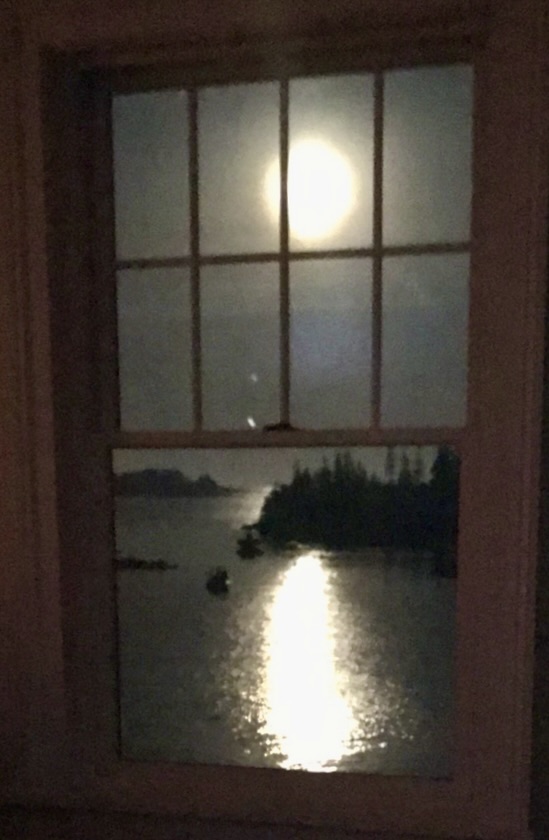
Walking by moonliight til dawn.


September 9

2 A.M. -The moon not quite full.

To Conantum via, road.

There is a low vapor in the meadows beyond the depot, dense and white, though scarcely higher than a man's head, concealing the stems of the trees. I see that the oaks, which are so dark and distinctly outlined, are illumined by the moon on the opposite side. This as I go up the back road.

A few thin, ineffectual clouds in the sky. 

I come out thus into the moonlit night, where men are not, as if into a scenery anciently deserted by men. The life of men is like a dream. It is three thousand years since night has had possession.

Go forth and hear the crickets chirp at midnight. Hear if their dynasty is not an ancient one and well founded. I feel the antiquity of the night.

She surely repossesses herself of her realms, as if her dynasty were uninterrupted, or she had underlain the day. No sounds but the steady creaking of crickets and the occasional crowing of cocks.

I go by the farmer's houses and barns, standing there in the dim light under the trees, as if they lay at an immense distance or under a veil. The farmer and his oxen now all asleep. Not even a watch-dog awake.

The human slumbers. There is less of man in the world.

The fog in the lowlands on the Corner road is never still. It now advances and envelops me as I stand to write these words, then clears away, with ever noiseless step. It covers the meadows like a web.

I hear the clock strike three.

Now at the clayey bank. The light of Orion's belt seems to show traces of the blue day through which it came to us. The sky at least is lighter on that side than in the west, even about the moon.

Even by night the sky is blue and not black, for we see through the veil of night into the distant atmosphere of day. I see to the plains of the sun, where the sunbeams are revelling.

The cricket's (?) song, on the alders of the causeway, not quite so loud at this hour as at evening. 

The moon is getting low. I hear a wagon cross one of the bridges leading into the town. I see the moonlight at this hour on a different side of objects. 

I smell the ripe apples many rods off beyond the bridge. A sultry night; a thin coat is enough.

On the first top of Conantum. I hear the farmer harnessing his horse and starting for the distant market, but no man harnesses himself, and starts for worthier enterprises. One cock-crow tells the whole story of the farmer's life.

The moon is now sinking into clouds in the horizon. I see the glow-worms deep in the grass by the little brookside in midst of Conantum. The moon shines dun and red. A solitary whip-poor-will sings.

The clock strikes four.


A few dogs bark. A few more wagons start for market, their faint rattling heard in the distance. 

I hear my owl without a name; the murmur of the slow-approaching freight-train, as far off, perchance, as Waltham; and one early bird.

The round, red moon disappearing in the west. I detect a whiteness in the east.

Some dark, massive clouds have come over from the west within the hour, as if attracted by the approaching sun, and have arranged themselves raywise about the eastern portal, as if to bar his coming. They have moved suddenly and almost unobservedly quite across the sky (which before was clear) from west to east.

No trumpet was heard which marshalled and advanced these dark masses of the west's forces thus rapidly against the coming day. Column after column the mighty west sent forth across the sky while men slept, but all in vain.

The eastern horizon is now grown dun-colored, showing where the advanced guard of the night are already skirmishing with the vanguard of the sun, a lurid light tingeing the atmosphere there, while a dark-columned cloud hangs imminent over the broad portal, untouched by the glare.

Some bird flies over, making a noise like the barking of a puppy.

It is yet so dark that I have dropped my pencil and cannot find it. It was a cuckoo.

The sound of the cars is like that of a rushing wind. They come on slowly. I thought at first a morning wind was rising.

And now (perchance at half-past four) I hear the sound of some far-off factory bell arousing the operatives to their early labors. It sounds very sweet here. It is very likely some factory which I have never seen, in some valley which I have never visited; yet now I hear this, which is its only matin bell, sweet and inspiring as if it summoned holy men and maids to worship and not factory girls and men to resume their trivial toil, as if it were the summons of some religious or even poetic community. 

My first impression is that it is the matin bell of some holy community who in a distant valley dwell, a band of spiritual knights, - thus sounding far and wide, sweet and sonorous, in harmony with their own morning thoughts. What else could I suppose fitting this earth and hour? Some man of high resolve, devoted soul, has touched the rope; and by its peals how many men and maids are waked from peaceful slumbers to fragrant morning thoughts! Why should I fear to tell that it is Knight's factory bell at Assabet? 

A few melodious peals and all is still again.

The whip-poor-wills now begin to sing in earnest about half an hour before sunrise, as if making haste to improve the short time that is left them. As far as my observation goes, they sing for several hours in the early part of the night, are silent commonly at midnight, - though you may meet [them] then sitting on a rock or flitting silently about, - then sing again just before sunrise.

It grows more and more red in the east – a fine-grained red under the overhanging cloud – and lighter too, and the threatening clouds are falling off to southward of the sun's passage, shrunken and defeated, leaving his path comparatively clear. The increased light shows more distinctly the river and the fog.

5 o'clock. - The light now reveals a thin film of vapor like a gossamer veil cast over the lower hills beneath the Cliffs and stretching to the river, thicker in the ravines, thinnest on the even slopes. The distant meadows towards the north beyond Conant's Grove, full of fog, appear like a vast lake out of which rise Annursnack and Ponkawtasset like rounded islands. Nawshawtuct is a low and wooded isle, scarcely seen above the waves. The heavens are now clear again. 

The vapor, which was confined to the river and meadows, now rises and creeps up the sides of the hills. I see it in transparent columns advancing clown the valley of the river, ghost-like, from hair Haven, and investing some wooded or rocky promontory, before free. are said to advance.

Annursnack is exactly like some round, steep, distant hill on the opposite shore of a large lake (and Tabor on the other side), with here and there some low Brush Island in middle of the waves (the tops of some oaks or elms).

Oh, what a sail I could take, if I had the right kind of bark, over to Annursnack! for there she lies four miles from land as sailors say. And all the farms and houses of Concord are at bottom of that sea. So I forget them, and my thought sails triumphantly over them.

As I looked down where the village of Concord lay buried in fog, I thought of nothing but the surface of a lake, a summer sea over which to sail; no more than a voyager on the Dead Sea who had not read the Testament would think of Sodom and Gomorrah, once cities of the plain.

I only wished to get off to one of the low isles I saw in midst of the [sea] (it may have been the top of Holbrook's elm), and spend the whole summer day there.

Meanwhile the redness in the east had diminished and was less deep. (The fog over some meadows looked green.) 

I went down to Tupelo Cliff to bathe. A great bittern, which I had scared, flew heavily across the stream. 

The redness had risen at length above the dark cloud, the sun approaching. And next the redness became a sort of yellowish or fawn-colored light, and the sun now set fire to the edges of the broken cloud which had hung over the horizon, and they glowed like burning turf.

H. D. Thoreau, Journal, September 9, 1851

 Even by night the sky is blue and not black, for we see through the veil of night into the distant atmosphere of day. See January 21, 1853 ("The blueness of the sky at night — the color it wears by day — is an everlasting surprise to me, suggesting the constant presence and prevalence of light in the firmament, that we see through the veil of night to the constant blue, as by day."); February 12, 1860 ("There is an annual light in the darkness of the winter night. The shadows are blue, as the sky is forever blue."); May 11, 1853 ("Blue is the color of the day, and the sky is blue by night as well as by day, because it knows no night.") See also  Night and Moonlight (first published in the Atlantic Monthly, November 1863) ("Nevertheless, even by night the sky is blue and not black, for we see through the shadow of the earth into the distant atmosphere of day, where the sunbeams are reveling.")

Walking by moonlight til dawn. See Basho:


Harvest moon –

circling the pond 

all night long.


We see through the veil
of night into the distant
atmosphere of day.

A Book of the Seasons,  by Henry Thoreau, Walking by moonlight til dawn. 

A Book of the Seasons
,  by Henry Thoreau
 "A book, each page written in its own season,
out-of-doors, in its own locality."
 ~edited, assembled and rewritten by zphx ©  2009-2026

Sunday, October 9, 2022

A Book of the Seasons: October nights and moonlight.


Many men walk by day --
few walk by night.
It is a very different season.
Henry Thoreau, July, 1850

The sun setting red
in haze at the same time as
the full moon rises.
October 8, 1851


October 1. Candle-light. To Conantum. The moon not quite half full. The twilight is much shorter now than a month ago, probably as the atmosphere is clearer and there is less to reflect the light. The air is cool, and the ground also feels cold under my feet, as if the grass were wet with dew, which is not yet the case. I go through Wheeler's corn-field in the twilight, where the stalks are bleached almost white, and his tops are still stacked along the edge of the field. The moon is not far up above the southwestern horizon. Looking west at this hour, the earth is an unvaried, undistinguishable black in contrast with the twilight sky. It is as if you were walking in night up to your chin. There is no wind stirring. An oak tree in Hubbard's pasture stands absolutely motionless and dark against the sky. The crickets sound farther off or fainter at this season, as if they had gone deeper into the sod to avoid the cold. There are no crickets heard on the alders on the causeway. The moon looks colder in the water, though the water-bugs are still active. There is a great change between this and my last moonlight walk. I experience a comfortable warmth when I approach the south side of a dry wood, which keeps off the cooler air and also retains some of the warmth of day. The voices of travellers in the road are heard afar over the fields, even to Conantum house. The stars are brighter than before. The moon is too far west to be seen reflected in the river at Tupelo Cliff, but the stars are reflected. The river is a dark mirror with bright points feebly fluctuating.
I smell the bruised horsemint, which I cannot see, while I sit on the brown rocks by the shore. I see the glow-worm under the damp cliff. No whip poor-wills are heard to-night, and scarcely a note of any other bird. At 8 o'clock the fogs have begun, which, with the low half-moon shining on them, look like cob webs or thin white veils spread over the earth. They are the dreams or visions of the meadow. October 1, 1851

October 1. I do not remember such cold at this season. This is about the full of the moon (it fulled at 9 P.M. the 29th) in clear bright moonlight nights. We have fine and bright but cold days after. October 1, 1860

October 2. A dark and windy night the last. It is a new value when darkness amounts to something positive. October 2, 1858  [new Oct. 7]

October 5. Moon three-quarters full. The nights now are very still, for there is hardly any noise of birds or of insects. The whip-poor-will is not heard, nor the mosquito.There is a down-like mist over the river and pond, and there are no bright reflections of the moon, all the light being absorbed by the low fog.The moon gives not a creamy but white, cold light. Standing on the Cliffs, no sound comes up from the woods. The earth has gradually turned more northward; the birds have fled south after the sun, and this impresses me as a deserted country. October 5, 1851

October 5. The nights now are very still, for there is hardly any noise of birds or of insects . . . The howling of the wind about the house just before a storm to-night sounds like a loon on the pond. October 5, 1853

October 5. The comet makes a great show these nights. Its tail is at least as long as the whole of the Great Dipper, to whose handle, till within a night or two, it reached, in a great curve, and we plainly see stars through it. October 5, 1858 [new Oct 7]

October 6.  7.30 P. M. – To Fair Haven Pond by boat, the moon four-fifths full, not a cloud in the sky; paddling all the way. The water perfectly still, and the air almost, the former gleaming like oil in the moonlight, with the moon's disk reflected in it . . . The river appears indefinitely wide; there is a mist rising from the water, which increases the indefiniteness. A high bank or moonlit hill rises at a distance over the meadow on the bank, with its sandy gullies and clamshells exposed where the Indians feasted. The shore line, though close, is removed by the eye to the side of the hill. It is at high-water mark. It is continued till it meets the hill. Now the fisherman's fire, left behind, acquires some thick rays in the distance and becomes a star. . . . Such is the effect of the atmosphere. The bright sheen of the moon is constantly travelling with us, and is seen at the same angle in front on the surface of the pads; and the reflection of its disk in the rippled water by our boat-side appears like bright gold pieces falling on the river's counter. This coin is incessantly poured forth as from some unseen horn of plenty at our side . . . I do not know but the weirdness of the gleaming oily surface is enhanced by the thin fog. A few water-bugs are seen glancing in our course . . . As we rowed to Fair Haven's eastern shore, a moonlit hill covered with shrub oaks, we could form no opinion of our progress toward it, — not seeing the water line where it met the hill, – until we saw the weeds and sandy shore and the tall bulrushes rising above the shallow water ( like ) the masts of large vessels in a haven. The moon was so high that the angle of excidence did not permit of our seeing her reflection in the pond. As we paddled down the stream with our backs to the moon, we saw the reflection of every wood and hill on both sides distinctly. These answering reflections-shadow to substance-impress the voyager with a sense of harmony and symmetry, as when you fold a blotted paper and produce a regular figure, - a dualism which nature loves. What you commonly see is but half. Where the shore is very low the actual and reflected trees appear to stand foot to foot, and it is but a line that separates them, and the water and the sky almost flow into one another, and the shore seems to float. As we paddle up or down, we see the cabins of muskrats faintly rising from amid the weeds, and the strong odor of musk is borne to us from particular parts of the shore. Also the odor of a skunk is wafted from over the meadows or fields. The fog appears in some places gathered into a little pyramid or squad by itself, on the surface of the water. Home at ten. October 6, 1851

October 8. The sun set red in haze, visible fifteen minutes before setting, and the moon rose in like manner at the same time . . . There is more fog than usual. The moon is full. The tops of the woods in the horizon seen above the fog look exactly like long, low black clouds, the fog being the color of the sky. October 8, 1851

[Thoreau gave his lecture "Moonlight" to a small audience of friends, among them Bronson Alcott. James Spooner, Marston Watson and his wife Mary Russell Watson. On Sunday, October 8, 1854   See Thoreau's Lectures after Walden 259-255]

October 10. The elms in the village have lost many of their leaves , and their shadows by moonlight are not so heavy as last month. October 10, 1851 [full]

October 14. Balloonists speak of hearing dogs bark at night and wagons rumbling over bridges. October 14, 1859 [full Oct. 11]


October 16. The new moon, seen by day, reminds me of a poet's cheese. October 16, 1851

October 16. Hunter's Moon. Walk to White Pond. October 16, 1853 [full Oct. 17]

October 17. Very high wind in the night, shaking the house. . . . Some rain also, and these two bring down the leaves. October 17, 1857

October 22. The haze is still very thick, though it is comparatively cool weather, and if there were no moon to-night, I think it would be very dark. Do not the darkest nights occur about this time, when there is a haze produced by the Indian-summer days, succeeded by a moonless night? October 22, 1858 [full]

October 28. 8 p.m.— To Cliffs.After whatever revolutions in my moods and experiences, when I come forth at evening, as if from years of confinement to the house, I see the few stars which make the constellation of the Lesser Bear in the same relative position, - the everlasting geometry of the stars. The moon beginning to wane. It is a quite warm but moist night. The dew in the withered grass reflects the moonlight like glow-worms. That star which accompanies the moon will not be her companion tomorrow . . . From the Cliffs the river and pond are exactly the color of the sky . . . Even the distant fields across the river are seen to be russet by moonlight as by day and the young pines near by are green. October 28, 1852 [ full 27th]

October 30. There’s a very large and complete circle round the moon this evening, which part way round is a faint rainbow. It is a clear circular space, sharply and mathematically cut out of a thin mackerel sky. You see no mist within it, large as it is, nor even a star. October 30, 1857 [full Nov. 2]

October 26, 2026
(full moon sets in dawn clouds)

On Sunday, October 8, 1854 Thoreau gave his lecture "Moonlight" to a small audience of friends, among them Bronson Alcott. James Spooner, and Marston Watson and his wife Mary Russell Watson. See Thoreau's Lectures after Walden 259-255. See also Night and Moonlight (first published in the Atlantic Monthly, November 1863)


A Book of the Seasons,  by Henry Thoreau
 "A book, each page written in its own season,
out-of-doors, in its own locality."
 ~edited, assembled and rewritten by zphx ©  2009-2022

Monday, September 5, 2022

By moonlight in forests like this we listen to hear wolves howl to Cynthia.


By moonlight at Potter's Field toward Bear Garden Hill, 8 P. M. 

The whip-poor-wills sing . . . Moonlight on Fair Haven Pond seen from the Cliffs. A sheeny lake in the midst of a boundless forest, the windy surf sounding freshly and wildly in the single pine behind you; the silence of hushed wolves in the wilderness, and, as you fancy, moose looking off from the shore of the lake. 

September 5, 2019

The stars of poetry and history and unexplored nature looking down on the scene.  This is my world now, with a dull whitish mark curving north ward through the forest marking the outlet to the lake. 

Fair Haven by moonlight lies there like a lake in the Maine wilderness in the midst of a primitive forest untrodden by man. This light and this hour take the civilization all out of the landscape. 

Even in villages dogs bay the moon; in forests like this we listen to hear wolves howl to Cynthia.

Even at this hour in the evening the crickets chirp, the small birds peep, the wind roars in the wood, as if it were just before dawn. 
The moonlight seems to linger as if it were giving way to the light of coming day. 

The landscape seen from the slightest elevation by moonlight is seen remotely, and flattened, as it were, into mere light and shade, open field and forest, like the surface of the earth seen from the top of a mountain.


How much excited we are, how much recruited, by a great many particular fragrances! A field of ripening corn, now at night, that has been topped, with the stalks stacked up to dry, – an inexpressibly dry, rich, sweet ripening scent. I feel as if I were an ear of ripening corn myself. Is not the whole air then a compound of such odors undistinguishable? Drying corn-stalks in a field; what an herb-garden!


H. D. Thoreau, Journal, September 5, 1851

Moonlight on Fair Haven Pond seen from the Cliffs. A sheeny lake in the midst of a boundless forest. See June 14, 1851 ("The moon was now seen rising over Fair Haven and at the same time reflected in the river, pale and white like a silvery cloud,");September 4, 1854 ("To Fair Haven Pond by boat. Full moon; bats flying about; skaters and water bugs like sparks of fire on the surface between us and the moon.") See also A Book of the Seasons, by Henry Thoreau, September Moonlight

I feel as if I were an ear of ripening corn myself.
See July 12, 1851 ("The earliest corn is beginning to show its tassels now, and I scent it as I walk, — its peculiar dry scent."); September 2, 1851 ("A writer, a man writing, is the scribe of all nature; he is the corn and the grass and the atmosphere writing."); September 4, 1859 ("Topping the corn, which has been going on some days, now reveals the yellow and yellowing pumpkins. This is a genuine New England scene. The earth blazes not only with sun-flowers but with sun-fruits.") September 14, 1851 ("The corn-stalks standing in stacks, in long rows along the edges of the corn-fields."); October 6, 1858 ("The corn stands bleached and faded — quite white in the twilight")

Monday, July 12, 2021

The moon is full, and I walk alone.


July 12.

July 12, 2012

8 P. M. Now at least the moon is full, and I walk alone, which is best by night, if not by day always.

Your companion must sympathize with the present mood. The conversation must be located where the walkers are, and vary exactly with the scene and events and the contour of the ground. 

Farewell to those who will talk of nature unnaturally, whose presence is an interruption. I know but one with whom I can walk. I might as well be sitting in a bar-room with them as walk and talk with most. We are never side by side in our thoughts, and we cannot hear each other's silence. Indeed, we cannot be silent. We are forever breaking silence, that is all, and mending nothing.

How can they keep together who are going different ways! 

I start a sparrow from her three eggs in the grass, where she had settled for the night.

The earliest corn is beginning to show its tassels now, and I scent it as I walk, — its peculiar dry scent.

(This afternoon I gathered ripe blackberries, and felt as if the autumn had commenced. )

Now perchance many sounds and sights only remind me that they once said something to me, and are so by association interesting. I go forth to be reminded of a previous state of existence, if perchance any memento of it is to be met with hereabouts.

I have no doubt that Nature preserves her integrity. Nature is in as rude health as when Homer sang. We may at last by our sympathies be well.

I see a skunk on Bear Garden Hill stealing noiselessly away from me, while the moon shines over the pitch pines, which send long shadows down the hill.  Now, looking back, I see it shining on the south side of farmhouses and barns with a weird light, for I pass here half an hour later than last night.

I smell the huckleberry bushes.

I hear a human voice, 
— some laborer singing after his day's toil, which I do not often hear.  Loud it must be, for it is far away. Methinks I should know it for a white man's voice.

Some strains have the melody of an instrument.

Now I hear the sound of a bugle in the Corner,  reminding me of poetic wars; a few flourishes and the bugler has gone to rest.

At the foot of the Cliff hill I hear the sound of the clock striking nine, as distinctly as within a quarter of a mile usually, though there is no wind.

The moonlight is more perfect than last night; hardly a cloud in the sky, — only a few fleecy ones. There is more serenity and more light.

I hear that sort of throttled or chuckling note as of a bird flying high, now from this side, then from that.

Methinks when I turn my head I see Wachusett from the side of the hill.

I smell the butter-and-eggs as I walk.

I am startled by the rapid transit of some wild animal across my path, a rabbit or a fox, 
— or you hardly know, if it be not a bird.

Looking down from the cliffs, the leaves of the tree-tops shine more than ever by day.

Here and there a lightning-bug shows his greenish light over the tops of the trees.

As I return through the orchard, a foolish robin bursts away from his perch unnaturally, with the habits of man.

The air is remarkably still and unobjectionable on the hilltop, and the whole world below is covered as with a gossamer blanket of moonlight. 
It is just about as yellow as a blanket. It is a great dimly burnished shield with darker blotches on its surface. You have lost some light, it is true, but you have got this simple and magnificent stillness, brooding like genius.

H. D. Thoreau, Journal, July 12, 1851


The moon is full, and I walk alone.
See July 16, 1850 ("Many men walk by day; few walk by night. It is a very different season. Instead of the sun, there are the moon and stars; instead of the wood thrush, there is the whip-poor-will; instead of butterflies, fireflies, winged sparks of fire!"); August  31?, 1850 ("My friends wonder that I love to walk alone in solitary fields and woods by night . ")

I pass here half an hour later than last night. See July 11, 1851 ("We go toward Bear Garden Hill. The sun is setting. . . . The moon is silvery still, not yet inaugurated.")

(This afternoon I gathered ripe blackberries, and felt as if the autumn had commenced.) See August 18, 1856 ("As I go along the hillsides in sprout-lands, amid the Solidago stricta, looking for the blackberries left after the rain, the sun warm as ever, but the air cool nevertheless, I hear the steady (not intermittent) shrilling of apparently the alder cricket, clear, loud, and autumnal, a season sound. Hear it, but see it not. It reminds me of past autumns and the lapse of time, suggests a pleasing, thoughtful melancholy, like the sound of the flail. Such preparation, such an outfit has our life, and so little brought to pass.")

I smell the huckleberry bushes. See August 12, 1851 ("How wholesome the taste of huckleberries, when now by moonlight I feel for them amid the bushes!")

I hear a human voice, — some laborer singing after his day's toil. See August 15, 1851 ("I hear now from Bear Garden Hill — I rarely walk by moonlight without hearing — the sound of a flute, or a horn, or a human voice.")

Here and there a lightning-bug shows his greenish light over the tops of the trees. See August 5, 1851 ("I see a solitary firefly over the woods".)

July 12. See A Book of the Seasons,  by Henry Thoreau, July 12

Now at least the moon 
is full, and I walk alone, 
which is best by night.

A Book of the Seasons,  by Henry Thoreau
"A book, each page written in its own season,
out-of-doors, in its own locality.”
~edited, assembled and rewritten by zphx © 2009-2021

Thursday, September 3, 2020

The tide in my thoughts,


September 3. 

daybreak, September 3, 2018

1 A. M., moon waning, to Conantum. 

A warm night. A thin coat sufficient. 

I hear an apple fall, as I go along the road. 

Meet a man going to market thus early. 

There are no mists to diversify the night. Its features are very simple. 

I hear no whip-poor-will or other bird. 

See no fireflies. 

Saw a whip- poor-will (?) flutter across the road.

Hear the dumping sound of frogs on the river meadow, and occasionally a kind of croak as from a bittern there. 

It is very dewy, and I bring home much mud on my shoes. This is a peculiarity of night, — its dews, water resuming its reign. 

Return before dawn. 

Morning and evening are more attractive than midnight. 

I will endeavor to separate the tide in my thoughts, or what is due to the influence of the moon, from the current distractions and fluctuations. The winds which the sun has aroused go down at evening, and the lunar influence may then perchance be detected. 

Of late I have not heard the wood thrush.

H. D. Thoreau, Journal, September 3, 1852

To separate the tide in my thoughts . . . from the current distractions and fluctuations. See  September 21, 1851 ("But the moon is not to be judged alone by the quantity of light she sends us, but also by her influence on the earth. No thinker can afford to overlook the influence of the moon any more than the astronomer can. “The moon gravitates towards the earth, and the earth reciprocally towards the moon.” This statement of the astronomer would be bald and meaningless, if it were not in fact a symbolical expression of the value of all lunar influence on man . Even the astronomer admits that “the notion of the moon's influence on terrestrial things was confirmed by her manifest effect upon the ocean,” but is not the poet who walks by night conscious of a tide in his thought which is to be referred to lunar influence, in which the ocean within him overflows its shores and bathes the dry land? 'Has he not his spring-tides and his neap-tides, the former sometimes combining with the winds of heaven to produce those memorable high tides of the calendar which leave their marks for ages?");July 26, 1853 ("I mark again the sound of crickets or locusts about alders, etc. about this time when the first asters open, which makes you fruitfully meditative, helps condense your thoughts, like the mel dews in the afternoon. . . .Such little objects check the diffuse tide of our thoughts and bring it to a head, which thrills us. They are such fruits as music, poetry, love, which humanity bears") See also January 22, 1852 ("My thoughts are my company."); March 1, 1860 ("I have thoughts, as I walk, on some subject that is running in my head, but all their pertinence seems gone before I can get home to set them down"); June 6, 1857 (“A year is made up of a certain series and number of sensations and thoughts which have their language in nature. ”); August 7, 1854 ("Do you not feel the fruit of your spring and summer beginning to ripen, to harden its seed within you? Do not your thoughts begin to acquire consistency as well as flavor and ripeness?"); September 14, 1859 (""Like the fruits, when cooler weather and frosts arrive, we too are braced and ripened. . . . our green and leafy and pulpy thoughts acquire color and flavor, and perchance a sweet nuttiness at last.)

Of late I have not heard the wood thrush. See August 12, 1854 ("Have not heard a wood thrush since last week of July."); August 14, 1853 ("I hear no wood thrushes for a week.") See also A Book of the Seasons,  by Henry Thoreau, The Wood Thrush

See no fireflies. See A Book of the Seasons, by Henry Thoreau, Fireflies

Warm night, moon waning –
hear an apple fall as I 
go along the road.

Sunday, January 15, 2017

What is there in music that it should so stir our deeps? / The deer mouse will be printing on the snow of Well Meadow.

January 15. 
January 15, 2017

P. M. — To Fair Haven Pond and across to railroad. 

As I passed the south shed at the depot, observed what I thought a tree sparrow on the wood in the shed, a mere roof open at the side, under which several men were at that time employed sawing wood with a horse power. Looking closer, I saw, to my surprise, that it must be a song sparrow, it having the usual marks on its breast and no bright-chestnut crown. The snow is nine or ten inches deep, and it appeared to have taken refuge in this shed, where was much bare ground exposed by removing the wood. When I advanced, instead of flying away, it concealed itself in the wood, just as it often dodges behind a wall.

What is there in music that it should so stir our deeps? We are all ordinarily in a state of desperation; such is our life; ofttimes it drives us to suicide. To how many, perhaps to most, life is barely tolerable, and if it were not for the fear of death or of dying, what a multitude would immediately commit suicide! But let us hear a strain of music, we are at once advertised of a life which no man had told us of, which no preacher preaches. 

Suppose I try to describe faithfully the prospect which a strain of music exhibits to me. 

The field of my life becomes a boundless plain, glorious to tread, with no death nor disappointment at the end of it. All meanness and trivialness disappear. I become adequate to any deed. No particulars survive this expansion; persons do not survive it. In the light of this strain there is no thou nor I. We are actually lifted above ourselves.

The tracks of the mice near the head of Well Meadow were particularly interesting. There was a level surface of pure snow there, unbroken by bushes or grass, about four rods across, and here were nine tracks of mice running across it from the bushes on this side to those on the other, the tracks quite near together but repeatedly crossing each other at very acute angles, but each particular course was generally quite direct. The snow was so light that only one distinct track was made by all four of the feet, five or six inches apart, but the tail left a very distinct mark. 

A single track, thus stretching away almost straight, sometimes half a dozen rods, over unspotted snow, is very handsome, like a chain of a new pattern; and then they suggest an airy lightness in the body that impressed them. Though there may have been but one or two here, the tracks suggesting quite a little company that had gone gadding over to their neighbors under the opposite bush. 

Such is the delicacy of the impression on the surface of the lightest snow, where other creatures sink, and night, too, being the season when these tracks are made, they remind me of a fairy revel. It is almost as good as if the actors were here. I can easily imagine all the rest. Hopping is expressed by the tracks themselves. 

Yet I should like much to see by broad daylight a company of these revellers hopping over the snow. There is a still life in America that is little observed or dreamed of. Here were possible auditors and critics which the lecturer at the Lyceum last night did not think of. How snug they are somewhere under the snow now, not to be thought of, if it were not for these pretty tracks! 

And for a week, or fortnight even, of pretty still weather the tracks will remain, to tell of the nocturnal adventures of a tiny mouse who was not beneath the notice of the Lord. 

So it was so many thousands of years before Gutenberg invented printing with his types, and so it will be so many thousands of years after his types are forgotten, perchance.  The deer mouse will be printing on the snow of Well Meadow to be read by a new race of men. 

Cold as the weather is and has been, almost all the brook is open in the meadow there, an artery of black water in the midst of the snow, and there are many sink-holes, where the water is exposed at the bottom of a dimple in the snow. Indeed, in some places these little black spots are distributed very thickly, the snow in swells covering the intervening tussocks.

H. D. Thoreau, Journal, January 15, 1857


Looking closer, I saw, to my surprise, that it must be a song sparrow, taken refuge in this shed.
January 22, 1857 ("Minott tells me that Sam Barrett told him once when he went to mill that a song sparrow took up its quarters in his grist-mill and stayed there all winter."); January 28, 1857 (“Am again surprised to see a song sparrow sitting for hours on our wood-pile in the yard, in the midst of snow in the yard.”)

What is there in music that it should so stir our deeps? See  January 13, 1857 ("one thrumming a guitar . . . reminds me of moments that I have lived. . . .”); May 19, 1856 ("I am always thus affected when I hear in the fields any singing or instrumental music at the end of the day. “);April19, 1856 ("Was awakened in the night to a strain of music dying away, — passing travellers singing. My being was so expanded and infinitely and divinely related for a brief season that I saw how unexhausted, how almost wholly unimproved, was man’s capacity for a divine life. “); May 23, 1854("There was a time when the beauty and the music were all within, and I sat and listened to my thoughts, and there was a song in them. I sat for hours on rocks and wrestled with the melody which possessed me. I sat and listened by the hour to a positive though faint and distant music . . .. When I walked with a joy which knew not its own origin.”); December 31, 1853 ("I hear very distinctly from the railroad causeway the whistle of the locomotive on the Lowell road. I hear it, and I realize and see clearly what at other times I only dimly remember. . . . It, as it were, takes me out of my body and gives me the freedom of all bodies and all nature. . . . The contact of sound with a human ear whose hearing is pure and unimpaired is coincident with an ecstasy.”); August 3, 1852 (" At the east window. — A temperate noon. I hear a cricket creak in the shade; also the sound of a distant piano. . . . At length the melody steals into my being. I know not when it began to occupy me. By some fortunate coincidence of thought or circumstance I am attuned to the universe, I am fitted to hear, my being moves in a sphere of melody, my fancy and imagination are excited to an inconceivable degree.”); June 22, 1851 ("The world is a musical instrument. The very touch affords an exquisite pleasure. I awake to its music with the calmness of a lake when there is not a breath of wind. . . .And without effort our depths are revealed to ourselves.”);  July 16, 1851("This earth was the most glorious musical instrument, and I was audience to its strains. To have such sweet impressions made on us, such ecstasies begotten of the breezes ! I can remember how I was astonished. I said to myself, — I said to others, — " There comes into my mind such an indescribable, infinite, all-absorbing, divine, heavenly pleasure, a sense of elevation and expansion, and [I] have had nought to do with it. I perceive that I am dealt with by superior powers.1 This is a pleasure, a joy, an existence which I have not procured myself.”)

The tracks suggesting quite a little company that had gone gadding over to their neighbors under the opposite bush. See January 31, 1856 (“The tracks of the mice suggest extensive hopping in the night and going a-gadding.”); December 27, 1857 ("Mice have been abroad in the night. We are almost ready to believe that they have been shut up in the earth all the rest of the year because we have not seen their tracks.”)

Thursday, September 4, 2014

The artist changes the direction of Nature and makes her grow according to his idea.


Aster multiflorus.

Observed the under sides of a shrub willow by the river, lit by the rays of the rising sun, shining like silver or dewdrops.
September 4, 2018

Yet, when I stood nearer and looked down on them at a different angle, they were quite dull.


I have provided my little snapping turtle with a tub of water and mud, and it is surprising how fast he learns to use his limbs and this world. He actually runs, with the yolk still trailing from him, as if he had got new vigor from contact with the mud.

The insensibility and toughness of his infancy make our life, with its disease and low spirits, ridiculous.

He impresses me as the rudiment of a man worthy to inhabit the earth. He is born with a shell. That is symbolical of his toughness.

His shell being so rounded and sharp on the back at this age, he can turn over without trouble.

P. M. – To climbing fern.  Polygonum articulatum, apparently three or four days.

In the wood-paths I find a great many of the Castile-soap galls, more or less fresh. Some are saddled on the twigs. They are now dropping from the shrub oaks.


September 4, 2018

Is not Art itself a gall? Nature is stung by God and the seed of man planted in her.

The artist changes the direction of Nature and makes her grow according to his idea.  If the gall was anticipated when the oak was made, so was the canoe when the birch was made.

Genius stings Nature, and she grows according to its idea.


7.30.– To Fair Haven Pond by boat.

Full moon; bats flying about; skaters and water bugs (?) like sparks of fire on the surface between us and the moon.

The high shore above the railroad bridge was very simple and grand, — first the bluish sky with the moon and a few brighter stars, then the near high level bank like a distant mountain ridge or a dark cloud in the eastern horizon, then its reflection in the water, making it double, and finally the glassy water and the sheen in one spot on the white lily pads.

Some willows for relief in the distance on the right.

It was Ossianic.

I noticed this afternoon that bubbles would not readily form on the water, and soon burst, probably on account of the late rains, which have changed its quality.

There is probably less stagnation and scum. It is less adhesive.

A fine transparent mist.

Lily Bay seemed as wide as a lake.

You referred the shore back to the Clamshell Hills. The mere edge which a flat shore presents makes no distinct impression on the eye and, if seen at all, appears as the base of the distant hills.

Commonly a slight mist yet more conceals it.

The dim low shore, but a few rods distant, is seen as the base of the distant hills whose distance you know. The low shore, if not entirely concealed by the low mist, is seen against the distant hills and passes for their immediate base. For the same reason hills near the water appear much more steep than they are.

We hear a faint metallic chip from a sparrow on the button-bushes or willows now and then.

Rowse was struck by the simplicity of nature now, — the sky the greater part, then a little dab of earth, and after some water near you.

Looking up the reach beyond Clamshell, the moon on our east quarter, its sheen was reflected for half a mile from the pads and the rippled water next them on that side, while the willows lined the shore in indistinct black masses like trees made with India ink (without distinct branches), and it looked like a sort of Broadway with the sun reflected from its pavements.

Such willows might be made with soot or smoke merely, lumpish with fine edges.

Meanwhile Fair Haven Hill, seen blue through the transparent mist, was as large and imposing as Wachusett, and we seemed to be approaching the Highlands of the river, a mountain pass, where the river had burst through mountains. A high mountain would be no more imposing.

Now I began to hear owls, screech (?) owls, at a distance up-stream; but we hardly got nearer to them, as if they retreated before us. At length, when off Wheeler's grape and cranberry meadow, we heard one near at hand.

The rhythm of it was pe-pe-ou; this once or twice repeated, but more of a squeal and somewhat human. Or do not all strange sounds thrill us as human, till we have learned to refer them to their proper source? 

They appeared to answer one another half a mile apart; could be heard from far woods a mile off.

The wind has risen and the echo is poor; it does not reverberate up and down the river.

No sound of a bullfrog, but steadily the cricket-like Rana palustris alongshore.

Rowse heard a whip-poor-will at Sleepy Hollow to night.

No scent of muskrats.


H. D. Thoreau, Journal, September 4, 1854


Nature is stung by God and the seed of man planted in her. See July 30, 1853 (“It suggests that Nature is a kind of gall, that the Creator stung her and man is the grub she is destined to house and feed.”). See also
A Book of the Seasons, by Henry Thoreau, Nature is genial to man (the anthropic principle)

The gall was anticipated when the oak was made.  See January 3, 1852 ("Oak-apples are a winter fruit . . . Do they not suggest that all vegetable fruit is but the albumen about young animal life?") 

The artist changes the direction of Nature and makes her grow according to his idea.
See Walden ("There was an artist in the city of Kouroo who was disposed to strive after perfection."); Walden ("To effect the quality of the day, that is the highest of arts"); December 11, 1855 ("The winter . . .is as it was designed and made to be, for the artist has had leisure to add beauty.") 

The artist cannot 
be hurried – time stands still while 
art is created

September 4. See A Book of the Seasons, by Henry Thoreau, September 4

As God stung Nature
and planted the seed of man

the artist changes
the direction of Nature –
Art itself a gall.


A Book of the Seasons, by Henry Thoreau
"A book, each page written in its own season,
out-of-doors, in its own locality."
~edited, assembled and rewritten by zphx © 2009-2024

https://tinyurl.com/hdt-540904


Wednesday, January 8, 2014

The pensive shores of evening skirt the great western continent of the night.


January 8

Gilpin, in his essay on the "Art of Sketching Landscape," says: "When you have finished your sketch therefore with Indian ink, as far as you propose, tinge the whole over with some light horizon hue. It may be the rosy tint of morning; or the more ruddy one of evening; or it may incline more to a yellowish, or a greyish cast . . . By washing this tint over your whole drawing, you lay a foundation for harmony." 

I have often been attracted by this harmonious tint in his and other drawings, and sometimes, especially, have observed it in nature when at sunset I inverted my head. 

We love not so well the landscape represented as in broad noon, but in a morning or evening twilight, those seasons when the imagination is most active, the more hopeful or pensive seasons of the day. Our mood may then possess the whole landscape, or be in harmony with it, as the hue of twilight prevails over the whole scene. 

Are we more than crepuscular in our intellectual and spiritual life? Have we awakened to broad noon? The morning hope is soon lost in what becomes the routine of the day, and we do not recover ourselves again until we land on the pensive shores of evening, shores which skirt the great western continent of the night. 

P. M. — To the Spruce Swamp in front of J. Farmer's. 

Can go across both rivers now. New routes are more practicable. 

Stood within a rod of a downy woodpecker on an apple tree. How curious and exciting the blood-red spot on its hindhead! I ask why it is there, but no answer is rendered by these snow-clad fields. 

It is so close to the bark I do not see its feet. It looks behind as if it had on a black cassock open behind and showing a white undergarment between the shoulders and down the back. 

It is briskly and incessantly tapping all round the dead limbs, but rarely twice in a place, as if to sound the tree and so see if it has any worm in it, or perchance to start them. 

How much he deals with the bark of trees, all his life long tapping and inspecting it! He it is that scatters those fragments of bark and lichens about on the snow at the base of trees. What a lichenist he must be! Or rather, perhaps it is fungi makes his favorite study, for he deals most with dead limbs. 

How briskly he glides up or drops himself down a limb, creeping round and round, and hopping from limb to limb, and now flitting with a rippling sound of his wings to another tree! 

The lower two-thirds of the white spruce has its branches retraced or turned downward, and then curving upward at the extremities, as much as the white pine commonly slants upwards. Above it is so thick that you cannot see through it. All the black spruce that I know hereabouts stand on higher land than this. 

Saw two squirrel-nests in the thick top of a spruce. It was a foot in diameter, of coarse grass and bark fibres, with very thick bottom and sides and a scarcely distinguishable entrance, lined with fine fibres of bark, probably inner bark of maple, very warm. Probably a red squirrel's, for I heard one winding up his clock. Many white pine cones had been eaten in the neighborhood.

H. D. Thoreau, Journal, January 8, 1854

Gilpin. William Gilpin, English writer, printmaker, clergyman and schoolmaster, best known as one of the originators of the idea of the picturesque.

I have often been attracted by this harmonious tint in his and other drawings, and sometimes, especially, have observed it in nature when at sunset I inverted my head. See January 6, 1854 ("There was a low, narrow, clear segment of sky in the west at sunset, or just after (all the rest overcast), of the coppery yellow, perhaps, of some of Gilpin's pictures, all spotted coarsely with clouds like a leopard's skin."); September 18, 1858 ("Some long amber clouds in the horizon, all on fire with gold, were more glittering than any jewelry. . . .And when you looked with head inverted the effect was increased tenfold, till it seemed a world of enchantment.")

The morning hope is soon lost in what becomes the routine of the day, and we do not recover ourselves again until we land on the pensive shores of evening, shores which skirt the great western continent of the night. See July 3, 1840 ("We will have a dawn, and noon, and serene sunset in ourselves"), and Zphx, Against the night.; See also The hour before sunset, and Seasons of the day  and


This Morning


Oh, this life,

the now,

this morning,


which I

can turn

into forever


by simply

loving

what is here,


is gone

by noon.


~ David Budbill (Happy Life)

Probably a red squirrel's [nest] , for I heard one winding up his clock. See March 18, 1857 ("A red squirrel runs nimbly before me along the wall, his tail in the air at a right angle with his body; leaps into a walnut and winds up his clock.");  March 30, 1859 ("He makes so many queer sounds, and so different from one another, that you would think they came from half a dozen creatures."); September 24, 1857 ("A red squirrel chiding you from his concealment in some pine-top. . . . is the sound most native to the locality.");  November 7, 1855 ("A red one runs along the trees to scold at me, boldly or carelessly, with a chuckling, bird like note and that other peculiar sound at intervals, between a purr and a grunt."); January 17, 1860 ("In the fall they construct a nest of grass and bark-fibres, moss, etc., in one of the [white pine] trees for winter use, and so apparently have two resources") See also A Book of the Seasons, by Henry Thoreau, The Red Squirrel

Popular Posts Last 30 Days.

The week ahead in Henry’s journal

The week ahead in Henry’s journal
A journal, a book that shall contain a record of all your joy.
"A stone fruit. Each one yields me a thought." ~ H. D. Thoreau, March 28, 1859


I sit on this rock
wrestling with the melody
that possesses me.