Showing posts with label Goodwin. Show all posts

Tuesday, October 22, 2019

It warms us twice, and the first warmth is the most wholesome and memorable

October 22

A week or more of fairest Indian summer ended last night, for to-day it rains. It was so warm day before yesterday, I worked in my shirt-sleeves in the woods. 

I cannot easily dismiss the subject of the fallen leaves. 

How densely they cover and conceal the water for several feet in width, under and amid the alders and button-bushes and maples along the shore of the river, — still light, tight, and dry boats, dense cities of boats, their fibres not relaxed by the waters, undulating and rustling with every wave, of such various pure and delicate, though fading, tints, — of hues that might make the fame of teas, — dried on great Nature's coppers. 

And then see this great fleet of scattered leaf boats, still tight and dry, each one curled up on every side by the sun's skill, like boats of hide, scarcely moving in the sluggish current, — like the great fleets with which you mingle on entering some great mart, some New York which we are all approaching together. 

Or else they are slowly moving round in some great eddy which the river makes, where the water is deep and the current is wearing into the bank. How gently each has been deposited on the water! No violence has been used toward them yet. But next the shore, as thick as foam they float, and when you turn your prow that way, list! what a rustling of the crisped waves! 

Wet grounds about the edges of swamps look dry with them, and many a wet foot you get in consequence.

 Consider what a vast crop is thus annually shed upon the earth. This, more than any mere grain or seed, is the great harvest of the year. This annual decay and death, this dying by inches, before the whole tree at last lies down and turns to soil. As trees shed their leaves, so deer their horns, and men their hair or nails. The year's great crop. 

I am more interested in it than in the English grass alone or in the corn. It prepares the virgin mould for future corn fields on which the earth fattens. They teach us how to die. How many flutterings before they rest quietly in their graves! A myriad wrappers for germinating seeds. By what subtle chemistry they will mount up again, climbing by the sap in the trees. 

The ground is all parti-colored with them. For beautiful variety can any crop be compared with them? The dogwood (poison sumach) blazing its sins as scarlet, the early-blushing maple, the rich chrome (?) yellow of the poplar, the mulberry ash, the brilliant red huckleberry with which the hills' backs are painted like sheep's, — not merely the plain flavidness of corn, but all the colors of the rainbow. 

The salmon-colored oaks, etc., etc. The frost touches them, and, with the slightest breath of day or jarring of earth's axle, see in what showers they come floating down, at the first earnest touch of autumn's wand. 

They stoop to rise, to mount higher in coming years by subtiler chemistry, and the sapling's first fruits, thus shed, transmuted at last, may adorn its crown, when, in after years, it has become the monarch of the forest.

Yesterday, toward night, gave Sophia and mother a sail as far as the Battle-Ground. One-eyed John Goodwin, the fisherman, was loading into a hand-cart and conveying home the piles of driftwood which of late he had collected with his boat. It was a beautiful evening, and a clear amber sunset lit up all the eastern shores; and that man's employment, so simple and direct, — though he is regarded by most as a vicious character, — whose whole motive was so easy to fathom, — thus to obtain his winter's wood, — charmed me unspeakably. 

So much do we love actions that are simple. They are all poetic. We, too, would fain be so employed. 

So unlike the pursuits of most men, so artificial or complicated. Consider how the broker collects his winter's wood, what sport he makes of it, what is his boat and hand-cart! Postponing instant life, he makes haste to Boston in the cars, and there deals in stocks, not quite relishing his employment, — and so earns the money with which he buys his fuel. And when, by chance, I meet him about this indirect and complicated business, I am not struck with the beauty of his employment. It does not harmonize with the sunset. How much more the former consults his genius, some genius at any rate! 

Now I should love to get my fuel so, — I have got some so, — but though I may be glad to have it, I do not love to get it in any other way less simple and direct. 

For if I buy one necessary of life, I cheat myself to some extent, I deprive myself of the pleasure, the inexpressible joy, which is the unfailing reward of satisfying any want of our nature simply and truly. 

No trade is simple, but artificial and complex. It postpones life and substitutes death. It goes against the grain. If the first generation does not die of it, the third or fourth does. In face of all statistics, I will never believe that it is the descendants of tradesmen who keep the state alive, but of simple yeomen or laborers. 

This, indeed, statistics say of the city reinforced by the country. The oldest, wisest politician grows not more human so, but is merely a gray wharf rat at last. He makes a habit of disregarding the moral right and wrong for the legal or political, commits a slow suicide, and thinks to recover by retiring on to a farm at last. This simplicity it is, and the vigor it imparts, that enables the simple vagabond, though he does get drunk and is sent to the house of correction so often, to hold up his head among men. 

"If I go to Boston every day and sell tape from morning till night," says the merchant (which we will admit is not a beautiful action), "some time or other I shall be able to buy the best of fuel without stint." Yes, but not the pleasure of picking it up by the riverside, which, I may say, is of more value than the warmth it yields, for it but keeps the vital heat in us that we may repeat such pleasing exercises. 

It warms us twice, and the first warmth is the most wholesome and memorable, compared with which the other is mere coke. It is to give no account of my employment to say that I cut wood to keep me from freezing, or cultivate beans to keep me from starving. Oh, no, the greatest value of these labors is received before the wood is teamed home, or the beans are harvested (or winnowed from it). 

Goodwin stands on the solid earth. 

The earth looks solider under him, and for such as he no political economies, with their profit and loss, supply and demand, need ever be written, for they will need to use no policy. As for the complex ways of living, I love them not, however much I practice them. In as many places as possible, I will get my feet down to the earth. There is no secret in his trade, more than in the sun's. It is no mystery how he gets his living; no, not even when he steals it. But there is less double-dealing in his living than in your trade. 

Goodwin is a most constant fisherman. He must well know the taste of pickerel by this time. He will fish, I would not venture to say how many days in succession. When I can remember to have seen him fishing almost daily for some time, if it rains, I am surprised on looking out to see him slowly wending his way to the river in his oilcloth coat, with his basket and pole. 

I saw him the other day fishing in the middle of the stream, the day after I had seen him fishing on the shore, while by a kind of magic I sailed by him; and he said he was catching minnow for bait in the winter. When I was twenty rods off, he held up a pickerel that weighed two and a half pounds, which he had forgot to show me before, and the next morning, as he afterward told me, he caught one that weighed three pounds. 

If it is ever necessary to appoint a committee on fish-ponds and pickerel, let him be one of them. Surely he is tenacious of life, hard to scale.

H. D. Thoreau, Journal, October 22, 1853

One-eyed John Goodwin, the fisherman, was loading into a hand-cart . . ., — though he is regarded by most as a vicious character, — whose whole motive was so easy to fathom, — thus to obtain his winter's wood, — charmed me unspeakably. . . .Goodwin stands on the solid earth . . . Goodwin is a most constant fisherman. See November 4, 1858 ("I took out my glass, and beheld Goodwin, the one-eyed Ajax, in his short blue frock, short and square-bodied, as broad as for his height he can afford to be, getting his winter's wood; for this is one of the phenomena of the season. ");   November 28, 1858 ("Goodwin cannot be a very bad man, he is so cheery. "); November 28, 1859 ("Goodwin is cutting out a few cords of dead wood in the midst of E. Hubbard's old lot."); March 18, 1857 ("While Emerson sits writing [in] his study this still, overcast, moist day, Goodwin is paddling up the still, dark river. Emerson burns twenty-five cords of wood and fourteen tons of coal; Goodwin perhaps a cord and a half, much of which he picks out of the river.")

They teach us how to die. How many flutterings before they rest quietly in their graves! A myriad wrappers for germinating seeds. By what subtle chemistry they will mount up again, climbing by the sap in the trees. See October 20. 1853 ("Merrily they go scampering over the earth, selecting their graves, whispering all through the woods about it. They that waved so loftily, how contentedly they return to dust again and are laid low, resigned to lie and decay at the foot of the tree and afford nourishment to new generations of their kind")

Now I should love to get my fuel so, — I have got some so. See October 20, 1855 ("I like best the bread which I have baked, the garment which I have made, the shelter which I have constructed, the fuel which I have gathered.");  October 21, 1857 ("I become a connoisseur in wood at last, take only the best.")  

For if I buy one necessary of life, I cheat myself to some extent, I deprive myself of the pleasure, the inexpressible joy, which is the unfailing reward of satisfying any want of our nature simply and truly. See October 21, 1857 ("It is pitiful to see a man of sixty, a philosopher, per chance, inquiring for a bearing apple orchard for sale. If he must have one, why did he not set it out when he was thirty?")

It warms us twice, and the first warmth is the most wholesome and. . . the greatest value of these labors is received before the wood is teamed home. See September 24, 1855 (" I derive a separate and peculiar pleasure from every stick that I find. Each has its history, of which I am reminded when I come to burn it, and under what circumstances I found it. "); October 20, 1855 ("Thus one half the value of my wood is enjoyed before it is housed, and the other half is equal to the whole value of an equal quantity of the wood which I buy.")

Saturday, August 3, 2019

The grassy sea.

August 3

6 A. M. — River fallen one inch since 2.30 P. M. yesterday; i.e., it is now a quarter of an inch above summer level. 

AUGUST 3, 2019

Juncus Greenei grows in river meadow opposite Dodd’s; long done. I saw (the 31st ult.) that the river was narrowed to a third its width by a large mass of button-bushes sunk in the middle of it_above the Sudbury causeway. 

The low water reveals a mass of meadow sunk under the railroad bridge. Both this and Lee’s Bridge are thus obstructed this year.  

I should say the origin of these holes was that the river, being shallow and therefore crowded, runs swiftly and digs into the bank and so makes a deep hole and a bend. The three large lakes may perhaps be considered as three deep holes made by a larger river or ocean current in former ages. The almost constant occurrence of a bay, or stagnant expansion, on the convex side at the bends is remarkable. It seems to be a place where the river has formerly flowed, but which, by wearing into the opposite bank, it has left. 

There are about twenty-one weedy places (i. e., where the weeds extend quite across), all together about two miles in length. These weedy places, you may say (not withstanding the frequent winding of the river), generally occur at bends (the Island shoal, perhaps, and Barrett’s Bar, and above Middlesex Turnpike Bridge are exceptions).  The most remarkable bend between Framingham and the Dam is the Ox-Bow in Framingham. 

Since our river is so easily affected by wind, the fact that its general course is northeast and that the prevailing winds in summer are southwest is very favorable to its rapid drainage at that season. If by fall you mean a swifter place occasioned by the bottom below for a considerable distance being lower than the bottom above for a considerable distance, I do not know of any such between Pelham Pond and the Falls. 

These swifter places are produced by a contraction of the stream,— chiefly by the elevation of the bottom at that point, — also by the narrowing of the stream. 

The depths are very slight compared with the lengths. The average depth of this twenty-five miles is about one seventeen thousandth the length; so that if this portion of the river were laid down on a map four feet long the  depth would be about equal to the thickness of ordinary letter paper, of which it takes three hundred and fifty to an inch. Double the thickness of the letter paper, and it will contain the deep holes which are so unfathomed and mysterious, not to say bottomless, to the swimmers and fishermen. 

Methinks the button-bushes about Fair Haven indicate a muddy but not deep pond.

The deepest reach of this twenty-five miles is from E. Davis Hill to Skelton Bend. 

Methinks I saw some of the fresh-water sponge in the river in Framingham. 

Undoubtedly, in the most stagnant parts of the river, when the wind blows hard up-stream, a chip will be drifted faster up-stream than ever it floats downward there in a calm. 

P. M. — I see two or three birds which I take to be rose-breasted grosbeaks of this year. They are speckled brown and white (with considerable white) birds, and no rose on breast that I see. I hear them singing a little in a grosbeak-like strain, but a more partial warble. Heard one July 28th on an oak high up Assabet, and to-day on an apple tree near Brister’s. 

Warren Miles tells me that in mowing lately he cut in two a checkered “adder,” — by his account it was the chicken snake, — and there was in its stomach a green snake, dead and partly digested, and he was surprised to find that they ate them. 

Water-bugs are collected in dense swarms about my boat, at its stagnant harbor. They gyrate in a very leisurely manner under my face, occasionally touching one another by their edges a moment. When I move or disturb the water, they at once begin to gyrate rapidly. After the evening has set in, I perceive that these water bugs, which all day were collected in dense swarms in the stagnant water amid the weeds at the sides, are dispersed over the river (quite across it here) and gyrating rapidly in the twilight.

The haymakers are quite busy on the Great Meadows, it being drier than usual. It being remote from public view, some of them work in their shirts or half naked. 

As I wade through the middle of the meadows in sedge up to my middle and look afar over the waving and rustling bent tops of the sedge (all are bent northeast by the southwest wind) toward the distant mainland, I feel a little as if caught by a rising tide on flats far from the shore. I am, as it were, cast away in the midst of the sea. It is a level sea of waving and rustling sedge about me. The grassy sea. 

You feel somewhat as you would if you were standing in water at an equal distance from the shore. To-day I can walk dry over the greater part of the meadows, but not over the lower parts, where pipes, etc., grow; yet many think it has not been so dry for ten years!

Goodwin is there after snipes. I scare up one in the wettest part. High blackberries begin to be ripe.

A novel phenomenon of dry weather and a low stage of water is the sight of dense green beds of Eleocharis acicularis, still in bloom, which grows at the bottom of muddy pools, but now, they being dry, looks like a dense fine bed of green moss, denser than grass. I recline on such a bed, perfectly dry and clean, amid the flags and pontederia, where lately was water and mud. It covers the mud with a short dense green mat of culms fine as a hair, quite agreeable to rest on and a rather novel sight.

H. D. Thoreau, Journal, August 3, 1859

It is a level sea of waving and rustling sedge about me. The grassy sea. See July 4, 1860 ("We are wading and navigating at present in a sort of sea of grass, which yields and undulates under the wind like water")

High blackberries begin to be ripe.
See August 3, 1856 ("High blackberries beginning; a few ripe."); August 4, 1856 ("Here and there the high blackberry, just beginning, towers over all."). See also A Book of the Seasons,  by Henry Thoreau, Blackberries

Tuesday, December 25, 2018

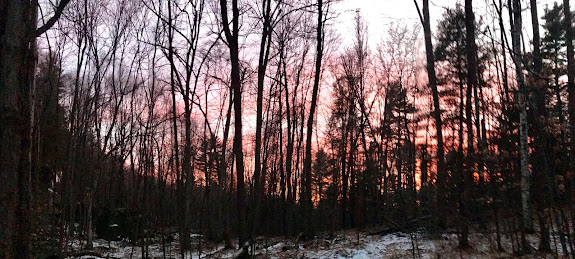
Now after sunset the light of the western sky – the outlines of pines.


December 25

December 25, 2018

P. M. —Up river on ice to Fair Haven Pond and across to Walden. 

The ground is still for the most part bare. Such a December is at least as hard a month to get through as November. You come near eating your heart now.

There is a good deal of brown or straw-color in the landscape now, especially in the meadows, where the ranker grasses, many of them uncut, still stand. They are bleached a shade or two lighter. Looking from the sun, there is a good deal of warm sunlight in them. 

I see where one farmer has been getting this withered sedge on the ice within a day or two for litter, in a meadow which had not been cut. Of course he could not cut very close. 

The ice on the river is about half covered with light snow, it being drifted thus, as usual, by the wind. (On Walden, however, which is more sheltered, the ice is uniformly covered and white.) I go running and sliding from one such snow-patch to another. It is easiest walking on the snow, which gives a hold to my feet, but I walk feebly on the ice. It is so rough that it is but poor sliding withal. 

I see, in the thin snow along by the button-bushes and willows just this side of the Hubbard bridge, a new track to me, looking even somewhat as if made by a row of large rain-drops, but it is the track of some small animal. The separate tracks are at most five eighths of an inch in diameter, nearly round, and one and three quarters to two inches apart, varying perhaps half an inch from a straight line. Sometimes they are three or four inches apart. The size is but little larger than that of a mouse, but it is never like a mouse. Goodwin, to whom I described it, did not know what it could be. 

The sun getting low now, say at 3.30, I see the ice green, southeast. 

Goodwin says that he once had a partridge strike a twig or limb in the woods as she flew, so that she fell and he secured her. 

Going across to Walden, I see that the fuzzy purple wool-grass is now bleached to a dark straw-color with out any purple. 

I notice that a fox has taken pretty much my own course along the Andromeda Ponds. 

The sedge which grows in tufts eighteen or twenty inches high there is generally recurving. 

I see that the shiners which Goodwin is using for bait to-day have no longitudinal dark bar or line on their sides, such as those minnows of the 11th and 18th had. Yet I thought that by the position of their fins, etc., the latter could not be the banded minnow. 

Walden at length skimmed over last night, i. e. the two holes that remained open. One was very near the middle and deepest part, the other between that and the railroad. 

Now that the sun is setting, all its light seems to glance over the snow-clad pond and strike the rocky shore under the pitch pines at the northeast end. Though the bare rocky shore there is only a foot or a foot and a half high as I look, it reflects so much light that the rocks are singularly distinct, as if the pond showed its teeth. 

I stayed later to hear the pond crack, but it did not much. 

December 25, 2019
How full of soft, pure light the western sky now, after sunset! I love to see the outlines of the pines against it. Unless you watch it, you do not know when the sun goes down. It is like a candle extinguished without smoke. A moment ago you saw that glittering orb amid the dry oak leaves in the horizon, and now you can detect no trace of it. In a pensive mood I enjoy the complexion of the winter sky at this hour.

Those small sphagnous mountains in the Andromeda Ponds are grotesque things. Being frozen, they bear me up like moss-clad rocks and make it easy getting through the water-brush. 

But for all voice in that serene hour I hear an owl hoot. How glad I am to hear him rather than the most eloquent man of the age! 

I saw a few days ago the ground under a swamp white oak in the river meadow quite strewn with brown dry galls about as big as a pea and quite round, like a small fruit which had fallen from it.

H. D. Thoreau, Journal, December 25, 1858

As hard a month to get through as November. You come near eating your heart now.
See November 27, 1853 ("Now a man will eat his heart, if ever, now while the earth is bare, barren and cheerless, and we have the coldness of winter without the variety of ice and snow"); November 25, 1857 (“November Eatheart, — is that the name of it? “)

Looking from the sun, there is a good deal of warm sunlight in them. See January 4, 1858 (“It is surprising how much sunny light a little straw that survives the winter will reflect . . .
That bright and warm reflection of sunlight from the insignificant edging of stubble”)

I notice that a fox has taken pretty much my own course along the Andromeda Ponds. See December 13, 1859 ("I see that the fox too has already taken the same walk before me, just along the edge of the button-bushes, where not even he can go in the summer.”)

The shiners which Goodwin is using for bait to-day have no longitudinal dark bar or line on their sides. See March 29, 1854 ("poised over the sand on invisible fins, the outlines of a shiner. . . distinct longitudinal light-colored line midway along their sides and a darker line below it”); July 16, 1856 ("I see many young shiners (?) (they have the longitudinal bar)"): July 17, 1856 (“They have . . . a broad, distinct black band along sides (which methinks marks the shiner)"); December 11, 1858 (“a minnow — apparently a young shiner, but it has a dark longitudinal line along side ”); December 18, 1858 (“They are little shiners with the dark longitudinal stripe”)

The sun getting low now, say at 3.30, I see the ice green, southeast. See January 7, 1856 (“Returning just before sunset, the few little patches of ice look green as I go from the sun . . .It is probably a constant phenomenon in cold weather when the ground is covered with snow and the sun is low, morning or evening, and you are looking from it.”); February 12, 1860 ("Returning just before sunset, I see the ice beginning to be green.”)

Walden at length skimmed over last night, i. e. the two holes that remained open. See note to December 20, 1858 (“Walden is frozen over, except two small spots, less than half an acre in all, in middle.”); 
December 22, 1858 (“The pond is no more frozen than on the 20th.”); December 24, 1858 ("Those two places in middle of Walden not frozen over yet, though it was quite cold last night! "); December 28, 1858 (“The ice is about six inches thick.”) See also December 25, 1859 ("The last our coldest night, as yet. No doubt Walden froze over last night entirely.") and A Book of the Seasons, by Henry Thoreau, Annual ice-in at Walden

Now that the sun is setting, all its light seems to glance over the snow-clad pond and strike the rocky shore under the pitch pines at the northeast end.
See December 25, 1858 ("That rocky shore under the pitch pines which so reflects the light, is only three feet wide by one foot high")

Unless you watch it, you do not know when the sun goes down.  See December 25, 1851 (“I go forth to see the sun set. Who knows how it will set, even half an hour beforehand ?”); See also July 20, 1852 (“We see the first star in the southwest, and know not how much earlier we might have seen it had we looked.”)

How full of soft, pure light the western sky now, after sunset! I love to see the outlines of the pines against it.
Full of soft pure light
western sky after sunset –
the outlines of pines.


See December 3, 1856   ("The pine forest's edge seen against the winter horizon"); December 12, 1859 ("The night comes on early these days, and I soon see the pine tree tops distinctly outlined against the dun (or amber) but cold western sky."); December 20, 1851 (In the west the sun goes down apace behind glowing pines, and golden clouds like mountains skirt the horizon."); January 5, 1853 ("A fine rosy sky in the west after sunset; and later an amber-colored horizon, in which a single tree-top showed finely."); January 9, 1859 ("It is worth the while to stand here at this hour and look into the soft western sky, over the pines whose outlines are so rich and distinct against the clear sky."); January 19, 1859 ("It occurs to me that I know of no more agreeable object to bound our view . . . than the pyramidal tops of a white pine forest in the horizon.");  See also October 20, 1858 ("There is one advantage in walking eastward these afternoons, at least, that in returning you may have the western sky before you.");   December 8, 1854 (“There is a glorious clear sunset sky, soft and delicate and warm”); December 9, 1859 (“I observe at mid-afternoon that peculiarly softened western sky . . . giving it a slight greenish tinge.”); December 11, 1854 ("I see the sun setting far through the woods, and there is that peculiar clear vitreous greenish sky in the west, as it were a molten gem.The day is short; it seems to be composed of two twilights merely"); December 18, 1853 (“The western hills, these bordering it, seen through the clear, cold air, have a hard, distinct edge against the sunset sky.”); January 17, 1852 (“In proportion as I have celestial thoughts, is the necessity for me to be out and behold the western sky sunset these winter days")

Clear yellow light of
the western sky reflected
from the smooth water.

Night comes on early.  
Pine tree tops outlined against
the cold western sky,

To look over pines
so rich and distinct into
the soft western sky.
January 9, 1859

The unclouded mind,
serene, pure, ineffable
like the western sky.

See also A Book of the Seasons,  by Henry Thoreau, the Western Sky

I hear an owl hoot. How glad I am to hear him. See November 18, 1851 ("I rejoice that there are owls. . . . This sound faintly suggests the infinite roominess of nature”); January 7, 1854 (“It is a sound which the wood or horizon makes”) See also A Book of Seasons, by Henry Thoreau, The Voice of the Barred Owl

December 25.  See A Book of the Seasons,  by Henry Thoreau, December 25


Now after sunset
the light of the western sky –
the outlines of pines.

I hear an owl hoot.
How glad I am to hear him
in this serene hour.


A Book of the Seasons
,  by Henry Thoreau, 
"A book, each page written in its own season,
out-of-doors, in its own locality.”
~edited, assembled and rewritten by zphx © 2009-2024

https://tinyurl.com/hdt-581225

Wednesday, November 28, 2018

Do we know of any other so silent and sudden a change?

November 28 

A gray, overcast, still day, and more small birds —tree sparrows and chickadees — than usual about the house. 

November 28, 2023

There have been a very few fine snowflakes falling for many hours, and now, by 2 P. M., a regular snow-storm has commenced, fine flakes falling steadily, and rapidly whitening all the landscape.


In half an hour the russet earth is painted white even to the horizon. Do we know of any other so silent and sudden a change? 

I cannot now walk without leaving a track behind me; that is one peculiarity of winter walking. Anybody may follow my trail. I have walked, perhaps, a particular wild path along some swamp-side all summer, and thought to myself, I am the only villager that ever comes here. 

here is the track of 
a sportsman and his dog in 
my secluded path

But I go out shortly after the first snow has fallen, and lo, here is the track of a sportsman and his dog in my secluded path, and probably he preceded me in the summer as well. Yet my hour is not his, and I may never meet him! 

I asked Coombs the other night if he had been a-hunting lately. He said he had not been out but once this fall. He went out the other day with a companion, and they came near getting a fox. They broke his leg. He has evidently been looking forward to some such success all summer. Having done thus much, he can afford to sit awhile by the stove at the post-office. He is plotting now how to break his head. 

Goodwin cannot be a very bad man, he is so cheery. 

And all the years that I have known Walden these striped breams have skulked in it without my knowledge! How many new thoughts, then, may I have?

H. D. Thoreau, Journal, November 28, 1858


A regular snow-storm has commenced, fine flakes falling steadily, and rapidly whitening all the landscape. See December 14, 1859 ("Snow-storms might be classified. This is a fine, dry snow"}

Do we know of any other so silent and sudden a change? See November 13, 1858 (“Thus it comes stealthily in the night and changes the whole aspect of the earth.”); November 29, 1858 ("The snow has taken all the November out of the sky."); January 26, 1855 ("This morning it snows again,—a fine dry snow with no wind to speak of, giving a wintry aspect to the landscape . . . What changes in the aspect of the earth! ")

I cannot now walk without leaving a track behind me.  See  November 15, 1858 ("You are now reminded occasionally in your walks that you have contemporaries, and 
perchance predecessors. I see the track of a fox . . . and, in the wood-path, of a man and a dog."); December 12, 1859 ("[In the winter] you see the tracks of those who had preceded you, and so are more reminded of them than in summer."); compare January 19, 1852 ("It is pleasant to make the first tracks in this road through the woods . . . the fine, dry snow blowing and drifting still.")

Here is the track of a sportsman and his dog in my secluded path See November 15, 1858 ("I see by the cakes or balls of snow that have dropped from his shoes that a man has passed. This would be known for a man and a dog’s track in any part of the world. Five toes in a bundle, somewhat diamond-shape, forming a sort of rosette, are the print of the dog.")

Goodwin cannot be a very bad man, he is so cheery. See November 28, 1859 ("Goodwin is cutting out a few cords of dead wood in the midst of E. Hubbard's old lot."); See also October 22, 1853 ("One-eyed John Goodwin, the fisherman, was loading into a hand-cart . . . — though he is regarded by most as a vicious character, — whose whole motive was so easy to fathom, — thus to obtain his winter's wood, — charmed me unspeakably . . . Goodwin stands on the solid earth"); See November 4, 1858 ("I took out my glass, and beheld Goodwin, the one-eyed Ajax, in his short blue frock, short and square-bodied, as broad as for his height he can afford to be, getting his winter's wood; for this is one of the phenomena of the season.")

These striped breams have skulked in it without my knowledge! See November 26, 1858
("Looking more attentively, I detected also a great many minnows . . .shaped like bream, but had the transverse bars of perch . . . They have about seven transverse dusky bars like a perch! Yet, from their form and single dorsal fin, I think they are breams. Are they not a new species? "); November 27, 1858 ("I got seventeen more of those little bream of yesterday. “); November 30, 1858 ("How wild it makes the pond and the township to find a new fish in it! For more than two centuries men have fished here and have not distinguished this permanent settler of the township. When my eyes first rested on Walden the striped bream was poised in it, though I did not see it. But there it dwells and has dwelt permanently, who can tell how long?")

November 28. A Book of the Seasons,  by Henry Thoreau, November 28

So sudden a change –
the russet earth painted white
to the horizon. 
I cannot now walk
without leaving tracks behind.
A Book of the Seasons,  by Henry Thoreau
"A book, each page written in its own season,
out-of-doors, in its own locality.”
~edited, assembled and rewritten by zphx © 2009-2025

https://tinyurl.com/hdt-581128

Sunday, November 11, 2018

Waters waiting for ice.

November 11

Goodwin brings me this forenoon a this year’s loon, which he just killed on the river, — great northern diver, but a smaller specimen than Wilson describes and somewhat differently marked. It is twenty-seven inches long to end of feet by forty-four, and bill three and three-quarters to angle of mouth; above blackish-gray with small white spots (two at end of each feather). Beneath, pure white, throat and all, except a dusky bar across the vent. Bill chiefly pale bluish and dusky. You are struck by its broad, flat, sharp-edged legs, made to cut through the water rather than to walk with, set far back and naturally stretched out backward, its long and powerful bill, conspicuous white throat and breast. 

Dislodged by winter in the north, it is slowly travelling toward a warmer clime, diving in the cool river this morning, which is now full of light, the trees and bushes on the brink having long since lost their leaves, and the neighboring fields are white with frost. Yet this hardy bird is comfortable and contented there if the sportsman would let it alone.

 P. M. — To Island and J. P. Brown’s cold pond. 

A cold day. Now seek sunny and sheltered places as in early spring, the south side the island, for example. Certain localities are thus distinguished. And they retain this peculiarity permanently, unless it depends on a wood which may be cut. Thousands of years hence this may still be the warmest and sunniest spot in the spring and fall. 

I hear here a faint creaking of two or three crickets or locustae, but it is a steady sound, — not the common cricket’s,— long-continued, and when one pauses, generally another continues the strain, so that it seems absolutely continuous. They are either in the grass or on the bushes by the edge of the water, under this sunny wood-side. I afterward hear a few of the common cricket on the side of Clamshell. Thus they are confined now to the sun on the south sides of hills and woods. They are quite silent long before sunset. 

Snow-fleas are skipping on the surface of the water at the edge, and spiders running about. These become prominent now. 

The waters look cold and empty of fish and most other inhabitants now. Here, in the sun in the shelter of the wood, the smooth shallow water, with the stubble standing in it, is waiting for ice. Indeed, ice that formed last night must have recently melted in it. The sight of such water now reminds me of ice as much as of winter quarters. 

The flowering dogwood, though still leafy, is uninteresting and partly withered. 

Gossamer reflecting the light is another November phenomenon (as well as October). I see here, looking toward the sun, a very distinct silvery sheen from the cranberry vines, as from a thousand other November surfaces, though, looking down on them, they are dark purple. 

Speaking of twiggy mazes, the very stubble and fine pasture grasses unshorn are others reflecting the light, too, like twigs; but these are of a peculiar bleached brownish color, a principal ingredient in the russet of the earth’s surface. 

Going by the willow-row above railroad, scare up a small duck, —perhaps teal, —and, in the withered grass at Nut Meadow Brook, two black ducks, which rise black between me and the sun, but, when they have circled round to the east, show some silvery sheen on the under side of their wings. 

Am surprised to see a little ice in this brook in the shade, as I push far up it through a dense field of withered blue-joint,—a spot white with frost, a few inches over. Saw a small pool in the woods also skimmed over, and many ice-crystals heaved up in low ground. 

Scare up a bird which at first ran in the grass, then flew, —a snipe. 

See only a very few small water-bugs in the brook, but no large ones nor skaters.

As a general rule, the leaves hold on longest on our indigenous trees and shrubs which were the first to leaf out, e. g. aspen, white birch, meadow-sweet, gooseberry, roses, sallows. 

In the shade of the wood, on the hillside just west of the cold pond, am surprised to see the frost about the cistus not in the least melted. This, at least, is an evidence that cold weather is come. Looking closely at it, it reminds me by its form and position of the decodon bark half cracked open. It consists of four or five thin curled shavings of frost, so to speak horizontally grained, placed vertically; and based on the stem, one within another, and curling toward the same side, forming a sort of fool’s cap of different thicknesses, or cockles, or sugar-plums. It seems it is so cool that the frost about the cistus does not melt all day, in the shade. 

Coming home I have cold fingers, and must row to get warm. 

In the meadows the pitcher-plants are bright-red. 

This is the month of nuts and nutty thoughts, — that November whose name sounds so bleak and cheerless. Perhaps its harvest of thought is worth more than all the other crops of the year. Men are more serious now. 

I find, in the wood-path this side that pond, thirteen kernels of corn close together, and five of them have the germ uncovered, the thin husk that was over them torn off. This might have been done accidentally by the squirrel (?) in separating it from the ear or in transporting it. And this may be the origin of some accounts of their eating out the germ to prevent its sprouting. If they do eat it, perhaps it is because it is the softest (as it is) and perhaps the most savory part. These were at least a third of a mile from a corn-field.

The tail-coverts of the young hen-hawk, i. e. this year’s bird, at present are white, very handsomely barred or watered with dark brown in an irregular manner, somewhat as above, the bars on opposite sides of the midrib alternating in an agreeable manner. Such natural objects have suggested the “watered” figures or colors in the arts. Few mortals ever look down on the tail-coverts of a young hen-hawk, yet these are not only beautiful, but of a peculiar beauty, being differently marked and colored (to judge from Wilson’s account of the old) from those of the old bird. Thus she finishes her works above men’s sight.


The scarlet oak leaf! What a graceful and pleasing outline! a combination of graceful curves and angles.     These deep bays in the leaf are agreeable to us as the thought of deep and smooth and secure havens to the mariner. But both your love of repose and your spirit of adventure are addressed, for both bays and head lands are represented, — sharp-pointed rocky capes and rounded bays with smooth strands. To the sailor’s eye it is a much indented shore, and in his casual glance he thinks that if he doubles its sharp capes he will find a haven in its deep rounded bays. 

If I were a drawing master, I would set my pupils to copying these leaves, that they might learn to draw firmly and gracefully. It is a shore to the aerial ocean, on which the windy surf beats. 

How different from the white oak leaf with its rounded headlands, on which no lighthouse need be placed! Some white oak leaves retain a smothered inward crimson fire long after they have fallen very pure and complete, more interesting to me than their fresher glow, because more indestructible, — an evening glow. 

H. D. Thoreau, Journal, November 11, 1858

Now seek sunny and sheltered places as in early spring. See note to November 18, 1857 (“Now, as in the spring, we rejoice in sheltered and sunny places. ”)

Thousands of years hence this may still be the warmest and sunniest spot in the spring and fall. Compare August 19, 1852 (“Here is a recess apparently never frequented. Thus this rill flowed here a thousand years ago, and with exactly these environments. ”)

The month of nuts and nutty thoughts, — that November whose name sounds so bleak and cheerless. Perhaps its harvest of thought is worth more than all the other crops of the year. See January 30, 1854 ("The winter was made to concentrate and harden and mature the kernel of man's brain, to give tone and firmness and consistency to his thought. This harvest of thought the great harvest of the year. The human brain is the kernel which the winter itself matures. Now we burn with a purer flame like the stars.")

See only a very few small water-bugs in the brook, but no large ones nor skaters. See November 11, 1852 ("Did Harris call the water-bug Gyrinus to-day? ")

In the meadows the pitcher-plants are bright-red.
 See September 28, 1851 ("This swamp [the spruce swamp in Conant's Grove] contains beautiful specimens of the sidesaddle-flower (Sarracenia purpurea), better called pitcher-plant. . . . These leaves are of various colors from plain green to a rich striped yellow or deep red.") See also A Book of the Seasons, by Henry Thoreau, The Purple Pitcher Plant

 A pleasing outline
of graceful curves and angles –
the scarlet oak leaf!

Tuesday, November 6, 2018

Rainy day.

November 6. 

Yesterday was a still and cloudy day. This is another rainy day. 

On the whole, we have had a good deal of fair weather the last three months. Mr. Buttrick, the marketman, says he has been to Boston twenty-seven times since the first of August, and has not got wet till to-day, though he rides in an open wagon. 

I guessed at Goodwin’s age on the 1st. He is hale and stout and looks younger than he is, and I took care to set him high enough. I guessed he was fifty-five, and he said that if he lived two or three months longer he would be fifty-six.

He then guessed at my age, thought I was forty. 

He thought that Emerson was a very young-looking man for his age, “But,” said he, “he has not been out o’ nights as much as you have.” 

Some horse-chestnuts are still thickly leaved and yellow, not withered.

H. D. Thoreau, Journal, November 6, 1858

I guessed at Goodwin’s age on the 1st. See November 4, 1858 ("On the 1st, when I stood on Poplar Hill, I saw a man. . .took out my glass, and beheld Goodwin, the one-eyed Ajax, in his short blue frock, short and square-bodied, as broad as for his height he can afford to be.")

Sunday, November 4, 2018

The scarlet oak must, in a sense, be in your eye when you go forth.

November 4
November 4, 2018
A rainy day. 

Called to C. from the outside of his house the other afternoon in the rain. At length he put his head out the attic window, and I inquired if he didn’t want to take a walk, but he excused himself, saying that he had a cold. “But,” added he, “you can take so much the longer walk. Double it.” 

On the 1st, when I stood on Poplar Hill, I saw a man, far off by the edge of the river, splitting billets off a stump. Suspecting who it was, I took out my glass, and beheld Goodwin, the one-eyed Ajax, in his short blue frock, short and square-bodied, as broad as for his height he can afford to be, getting his winter's wood; for this is one of the phenomena of the season. As surely as the ants which he disturbs go into winter quarters in the stump when the weather becomes cool, so does G. revisit the stumpy shores with his axe. As usual, his powder-flask peeped out from a pocket on his breast, his gun was slanted-over a stump near by, and his boat lay a little further along. He had been at work laying wall still further off, and now, near the end of the day, betook himself to those pursuits which he loved better still. It would be no amusement to me to see a gentleman buy his winter wood. It is to see G. get his. I helped him tip over a stump or two. He said that the owner of the land had given him leave to get them out, but it seemed to me a condescension for him to ask any man’s leave to grub up these stumps. The stumps to those who can use them, I say, — to those who will split them. He might as well ask leave of the farmer to shoot the musquash and the meadow-hen, or I might as well ask leave to look at the landscape. Near by were large hollows in the ground, now grassed over, where he had got out white oak stumps in previous years. But, strange to say, the town does not like to have him get his fuel in this way. They would rather the stumps would rot in the ground, or be floated down-stream to the sea. They have almost without dissent agreed on a different mode of living, with their division of labor. They would have him stick to laying wall, and buy corded wood for his fuel, as they do. He has drawn up an old bridge sleeper and cut his name in it for security, and now he gets into his boat and pushes off in the twilight, saying he will go and see what Mr. Musquash is about. 

When the Haverhill fishermen told me that they could distinguish the Concord River stuff (i. e. driftwood) I see they were right, for much of it is chestnut rails, and of these they have but few, and those in the southern part of New Hampshire. 

If, about the last of October, you ascend any hill in the outskirts of the town and look over the forest, you will see, amid the brown of other oaks, which are now withered, and the green of the pines, the bright-red tops or crescents of the scarlet oaks, very equally and thickly distributed on all sides, even to the horizon. Complete trees standing exposed on the edges of the forest, where you have never suspected them, or their tops only in the recesses of the forest surface, or perhaps towering above the surrounding trees, or reflecting a warm rose red from the very edge of the horizon in favorable lights. All this you will see, and much more, if you are prepared to see it, — if you look for it. 

Otherwise, regular and universal as this phenomenon is, you will think for threescore years and ten that all the wood is at this season sere and brown. Objects are concealed from our view not so much because they are out of the course of our visual ray (continued) as because there is no intention of the mind and eye toward them. We do not realize how far and widely, or how near and narrowly, we are to look. The greater part of the phenomena of nature are for this reason concealed to us all our lives. Here, too, as in political economy, the supply answers to the demand. Nature does not cast pearls before swine. There is just as much beauty visible to us in the landscape as we are prepared to appreciate, —not a grain more. 

The actual objects which one person will see from a particular hilltop are just as different from those which another will see as the persons are different. The scarlet oak must, in a sense, be in your eye when you go forth. We cannot see any thing until we are possessed with the idea of it, and then we can hardly see anything else. 

In my botanical rambles I find that first the idea, or image, of a plant occupies my thoughts, though it may at first seem very foreign to this locality, and for some weeks or months I go thinking of it and expecting it unconsciously, and at length I surely see it, and it is henceforth an actual neighbor of mine. This is the history of my finding a score or more of rare plants which I could name. 

Take one of our selectmen and put him on the highest hill in the township, and tell him to look! What, probably, would he see? What would he select to look at? Sharpening his sight to the utmost, and putting on the glasses that suited him best, aye, using a spy-glass if he liked, straining his optic nerve to its utmost, and making a full report. Of course, he would see a Brocken spectre of himself. 

Now take Julius Caesar, or Emanuel Swedenborg, or a Fiji-Islander, and set him up there! Let them compare notes afterward. Would it appear that they had enjoyed the same prospect? For aught we know, as strange a man as any of these is always at our elbows. It does not appear that anybody saw Shakespeare when he was about in England looking off, but only some of his raiment. 

Why, it takes a sharpshooter to bring down even such trivial game as snipes and woodcocks; he must take very particular aim, and know what he is aiming at. He would stand a very small chance if he fired at random into the sky, being told that snipes were flying there. And so it is with him that shoots at beauty. Not till the sky falls will he catch larks, unless he is a trained sportsman. He will not bag any if he does not already know its seasons and haunts and the color of its wing, —if he has not dreamed of it, so that he can anticipate it; then, indeed, he flushes it at every step, shoots double and on the wing, with both barrels, even in cornfields. 

The sportsman trains himself, dresses, and watches unweariedly, and loads and primes for his particular game awake and asleep, with gun and paddle and boat, he goes out after meadow-hens, — which most of his townsmen never saw nor dreamed of, — paddles for miles against a head wind, and therefore he gets them. He had them half-way into his bag when he started, and has only to shove them down. 

The fisherman, too, dreams of fish, till he can almost catch them in his sink-spout. The hen scratches, and finds her food right under where she stands; but such is not the way with the hawk. The true sportsman can shoot you almost any of his game from his windows. It comes and perches at last on the barrel of his gun; but the rest of the world never see it, with the feathers on. He will keep himself supplied by firing up his chimney. The geese fly exactly under his zenith, and honk when they get there. Twenty musquash have the refusal of each one of his traps before it is empty.

H.D Thoreau, Journal, November 4, 1858

Goodwin, the one-eyed Ajax . . .one of the phenomena of the season.  See October 29,1857 ("Melvin asked if I had seen “Pink-eye,” meaning Goodwin.");  November 28, 1859 ("Goodwin is cutting out a few cords of dead wood in the midst of E. Hubbard's old lot. . . . while Abel Brooks is hastening home from the woods with his basket half full of chips ")

The scarlet oak must, in a sense, be in your eye when you go forth. See Autumnal Tints. and February 22, 1859 ("Go to Worcester to lecture in a parlor") Also October 31, 1858 ("After walking for a couple of hours the other day through the woods, I came to the base of a tall aspen, which I do not remember to have seen before")

You will see, if you are prepared to see it, — if you look for it. See  July 2 1857 (“Many an object is not seen, though it falls within the range of our visual ray, because it does not come within the range of our intellectual ray, i. e., we are not looking for it. So, in the largest sense, we find only the world we look for.”) . Also November 6, 1853 (“It is remarkable how little we attend to what is passing before us constantly, unless our genius directs our attention that way.”); April 8, 1856 ("Most countrymen might paddle five miles along the river now and not see one muskrat, while a sportsman a quarter of a mile before or behind would be shooting one or more every five minutes.”);  September 2, 1856; ("It commonly chances that I make my most interesting botanical discoveries when I am in a thrilled and expectant mood,. . .”); September 9, 1858 (“A man sees only what concerns him.”);  Autumnal tints.("Objects are concealed from our view, not so much because they are out of the course of our visual ray as because we do not bring our minds and eyes to bear on them”); February 25, 1859 ("I am more than ever convinced . . . that there are very few persons who do see much of nature.");January 5, 1860("A man receives only what he is ready to receive. . . . He does not observe the phenomenon that cannot be linked with the rest which he has observed, however novel and remarkable it may be. A man tracks himself through life, apprehending only what he already half knows.”);  Compare March 23, 1853 ("Man cannot afford to be a naturalist, to look at Nature directly, but only with the side of his eye. He must look through and beyond her. “); March 29, 1853 (“It is not till we are completely lost, or turned around, --for a man needs only to be turned round once with his eyes shut in this world to be lost, --do we appreciate the vastness and strangeness of Nature.”); June 14, 1853 (". . . you are in that favorable frame of mind described by De Quincey, open to great impressions, and you see those rare sights with the unconscious side of the eye, which you could not see by a direct gaze before.”) ; December 11, 1855; ("I saw this familiar fact at a different angle. It is only necessary to behold thus the least fact or phenomenon, however familiar, from a point a hair’s breadth aside from our habitual path or routine, to be overcome, enchanted by its beauty and significance. To perceive freshly, with fresh senses, is to be inspired.”)

Before I see it,
the idea of a thing
occupies my thoughts.
 

Popular Posts Last 30 Days.

The week ahead in Henry’s journal

The week ahead in Henry’s journal
A journal, a book that shall contain a record of all your joy.
"A stone fruit. Each one yields me a thought." ~ H. D. Thoreau, March 28, 1859


I sit on this rock
wrestling with the melody
that possesses me.