Showing posts with label december 17. Show all posts

Friday, December 17, 2021

A time to see the character of the tree.


December 17

December 17, 2017


A piercing cold afternoon, wading in the snow.

R. Rice was going to Sudbury to put his bees into the cellar for fear they would freeze. He had a small hive; not enough to keep each other warm.

The pitch pine woods on the right of the Corner road.

The pitch pines hold the snow well. It lies now in balls on their plumes and in streaks on their branches, their low branches rising at a small angle and meeting each other.

A certain dim religious light comes through this roof of pine leaves and snow. It is a sombre twilight, yet in some places the sun streams in, producing the strongest contrasts of light and shade.

The winter morning is the time to see the woods and shrubs in their perfection, wearing their snowy and frosty dress. Even he who visits them half an hour after sunrise will have lost some of their most delicate and fleeting beauties. The trees wear their snowy burden but coarsely after midday, and it no longer expresses the character of the tree.

I observed that early in the morning every pine-needle was covered with a frosty sheath, but soon after sunrise it was all gone.

You walk in the pitch pine wood as under a penthouse. The stems and branches of the trees look black by contrast. You wander zigzag through the aisles of the wood, where stillness and twilight reign.

Improve every opportunity to express yourself in writing, as if it were your last.

I do not know but a pine wood is as substantial and as memorable a fact as a friend. I am more sure to come away from it cheered, than from those who come nearest to being my friends.

It is unfortunate for the chopper and the walker when the cold wind comes from the same side with the sun, for then he cannot find a warm recess in which to sit.

It is pleasant to walk now through open and stately white pine woods. Their plumes do not hold so much snow commonly, unless where their limbs rest or are weighed down on to a neighboring tree.

It is cold but still in their midst, where the snow is untracked by man, and ever and anon you see the snow-dust, shone on by the sun, falling from their tops and, as it strikes the lower limbs, producing innumerable new showers. For, as after a rain there is a second rain in the woods, so after a light snow there is a second snow in the woods, when the wind rises.

The branches of the white pine are more horizontal than those of the pitch, and the white streaks of snow on them look accordingly.

I perceive that the young black oaks and the red oaks, too, methinks, still keep their leaves as well as the white.

This piercing wind is so nearly from the west this afternoon that, to stand at once in a sheltered and a sunny place, you must seek the south-southeast side of the woods.

What slight but important distinctions between one creature and another! What little, but essential, advantages one enjoys over another! I noticed this afternoon a squirrel's nest high in the fork of a white pine. Thither he easily ascends, but many creatures strive in vain to get at him.

The lower branches of the hemlock point down, and even trail on the ground, the whole tree making a perfect canopy.

When they who have aspired to be friends cease to sympathize, it is the part of religion to keep asunder.

One of the best men I know often offends me by uttering made words — the very best words, of course, or dinner speeches, most smooth and gracious and fluent repartees, a sort of talking to Buncombe, a dash of polite conversation, a graceful bending, as if I were Master Slingsby of promising parts, from the University. O would you but be simple and downright! Would you but cease your palaver! It is the misfortune of being a gentleman and famous. The conversation of gentlemen after dinner! One of the best of men and wisest, to whom this diabolical formality will adhere. Repeating himself, shampooing himself! Passing the time of day, as if he were just introduced! No words are so tedious. Never a natural or simple word or yawn. It produces an appearance of phlegm and stupidity in me the auditor. I am suddenly the closest and most phlegmatic of mortals, and the conversation comes to naught. Such speeches as an ex-Member of Congress might make to an ex-Member of Parliament.

To explain to a friend is to suppose that you are not  intelligent of one another. If you are not, to what purpose will you explain?

My acquaintances will sometimes wonder why I will impoverish myself by living aloof from this or that company, but greater would be the impoverishment if I should associate with them.

H. D. Thoreau, Journal, December 17, 1851

A squirrel's nest high in the fork of a white pine. Thither he easily ascends. See December 17, 1855 ("A remarkably fine, springlike morning . . . Methinks every squirrel will be out now. "); December 17, 1859 ("I see many tracks of squirrels . . . I see no nests in the trees, but numerous holes through the snow into the earth, whence they have emerged . . . they will dig down through the snow and come right upon a pine cone or a hickory-nut or an acorn, which you and I cannot do")

The pitch pines hold the snow well. It lies now in balls on their plumes and in streaks on their branches. See  January 30, 1841("The snow collects upon the plumes of the pitch pine in the form of a pineapple."); January 31, 1852 ("The value of the pitch pine in winter is that it holds the snow so finely. . . .It makes the most cheerful winter scenery beheld from the window, you know so well the nature of the coverts and the sombre light it makes"); January 19, 1855 ("The snow lay in great continuous masses  . . . On some pitch pines it lay in fruit-like balls as big as one’s head, like cocoanuts.. . . Under one pitch pine, which shut down to the ground on every side, you could not see the sky at all, but sat in a gloomy light as in a tent"); February 16, 1860 ("Snow, lodging on trees, — leaf, bough, and trunk. The pines are well laden with it. How handsome, though wintry, the side of a high pine wood, well grayed with the snow that has lodged on it, and the smaller pitch pines converted into marble or alabaster with their lowered plumes like rams' heads! The character of the wood-paths is wholly changed by the new-fallen snow..") See also December 19, 1851 (" Why should it be so pleasing to look into a thick pine wood where the sunlight streams in and gilds it?")

Improve every opportunity to express yourself in writing, as if it were your last. See July 7, 1851 ("The writer expressing his thought must be . . .well poised upon the facts, the experience, that secures his whole attention! All the faculties in repose but the one you are using, the whole energy concentrated in that. . . . I express adequately only the thought which I love to express."); August 19, 1851 ("How vain it is to sit down to write when you have not stood up to live!"); September 2, 1851 ("We cannot write well or truly but what we write with gusto. . . . Expression is the act of the whole man. . . A writer, a man writing, is the scribe of all nature; he is the corn and the grass and the atmosphere writing. It is always essential that we love to do what we are doing, do it with a heart.”); September 4-7, 1851 (“I feel that the juices of the fruits which I have eaten, the melons and apples, have ascended to my brain and are stimulating it. They give me a heady force. Now I can write.”); November 9, 1851 ("Facts to tell who I am, and where I have been or what I have thought. . . Facts which the mind perceived, thoughts which the body thought -- with these I deal."); November 12, 1851 ("Write often, write upon a thousand themes . . .");  February, 5, 1852 ("Time never passes so rapidly and unaccountably as when I am engaged in recording my thoughts"); February 10, 1852 ("Write while the heat is in you.")

After a light snow 
a second snow in the woods
when the wind rises.

Ever and anon 
 snow-dust, shone on by the sun, 
falling from pine tops 


Thursday, December 17, 2020

Short winter days lengthened by light reflected from the snow.


December 17

Flint's Pond apparently froze completely over last night. It is about two inches thick.  Walden is only slightly skimmed over a rod from the shore.

I noticed where it had been frozen for some time near the shore of Flint's Pond and the ice was thicker and whiter, there were handsome spider-shaped dark places, where the under ice had melted, and the water had worn it running through, a handsome figure on the icy carpet.

December 17, 2020

I noticed when the snow first came that the days were very sensibly lengthened by the light being reflected from the snow. Any work which required light could be pursued about half an hour longer. So that we may well pray that the ground may not be laid bare by a thaw in these short winter days.

H. D. Thoreau, Journal, December 17, 1850

Flint's Pond apparently froze completely over last night. It is about two inches thick. Walden is only slightly skimmed over a rod from the shore. See  December 17, 1859 ("Two or three acres of Walden, off the bar, not yet frozen. Saw in [it] a good-sized black duck"); See also December 9, 1856 ("There is scarcely a particle of ice in Walden. . .[Yet] yesterday I met Goodwin bringing a fine lot of pickerel from Flint's, which was frozen at least four inches thick. This is, no doubt, owing solely to the greater depth of Walden."); December 11, 1858 ("Walden is about one-third skimmed over."); December 24, 1853 ("Walden almost entirely open again. Skated across Flint's Pond. "); December 27, 1852 (" Not a particle of ice in Walden to-day. Paddled across it. . . .. A black and white duck on it, Flint's and Fair Haven being frozen up."). See also A Book of the Seasons, by Henry Thoreau, Annual ice-in at Walden

Handsome spider-shaped dark places, where the under ice had melted, and the water had worn it running through. See December 7, 1856 ("There are many of those singular spider-shaped dark places amid the white ice, where the surface water has run through some days ago.")

The days were very sensibly lengthened by the light being reflected from the snow. See December 28, 1856 ("Since the snow of the 23d, the days seem considerably lengthened, owing to the increased light after sundown."); see also December 9, 1856 ("The worker who would accomplish much these short days must shear a dusky slice off both ends of the night”); December 11, 1854 (“The day is short; it seems to be composed of two twilights merely.”); December 15, 1856 (The short boreal twilight.")

These short winter days
sensibly lengthened by light
reflected from snow.

A Book of the Seasons
,  by Henry Thoreau, 
"A book, each page written in its own season,
out-of-doors, in its own locality.”
~edited, assembled and rewritten by zphx © 2009-2024

https://tinyurl.com/hdt-501217

Tuesday, December 17, 2019

What a change there will be in a few years, this little forest of goldenrod giving place to a forest of pines!

December 17.

P. M. — To Walden.

The snow being some three or four inches deep, I see rising above it, generally, at my old bean-field, only my little white pines set last spring in the midst of an immense field of Solidago nemoralis, with a little sweet-fern (i.e. a large patch of it on the north side).

What a change there will be in a few years, this little forest of goldenrod giving place to a forest of pines!

By the side of the Pout's Nest, I see on the pure white snow what looks like dust for half a dozen inches under a twig. Looking closely, I find that the twig is hardhack and the dust its slender, light-brown, chaffy looking seed, which falls still in copious showers, dusting the snow, when I jar it; and here are the tracks of a sparrow which has jarred the twig and picked the minute seeds a long time, making quite a hole in the snow. The seeds are so fine that it must have got more snow than seed at each peck. But they probably look large to its microscopic eyes.

I see, when I jar it, that a meadow-sweet close by has quite similar, but larger, seeds.

This the reason, then, that these plants rise so high above the snow and retain their seed, dispersing it on the least jar over each successive layer of snow beneath them; or it is carried to a distance by the wind.

What abundance and what variety in the diet of these small granivorous birds, while I find only a few nuts still!

These stiff weeds which no snow can break down hold their provender. What the cereals are to men, these are to the sparrows. The only threshing they require is that the birds fly against their spikes or stalks.

A little further I see the seed-box (?) (Ludwigia) full of still smaller, yellowish seeds.

And on the ridge north is the track of a partridge amid the shrubs. It has hopped up to the low clusters of smooth sumach berries, sprinkled the snow with them, and eaten all but a few. Also, here only, or where it has evidently jarred them down — whether intentionally or not, I am not sure — are the large oval seeds of the stiff-stalked lespedeza, which I suspect it ate, with the sumach berries. There is much solid food in them. When the snow is deep the birds could easily pick the latter out of the heads as they stand on the snow.

I observe, then, eaten by birds to-day, the seed of hardhack and meadow-sweet, sumach, and probably lespedeza, and even seed-box.

Under the hill, on the southeast side of R. W. E.'s lot, where the hemlock stands, I see many tracks of squirrels. The dark, thick green of the hemlock (amid the pines) seems to attract them as a covert. The snow under the hemlock is strewn with the scales of its cones, which they (and perhaps birds?) have stripped off, and some of its little winged seeds. It is pleasant to see the tracks of these squirrels (I am not sure whether they are red or gray or both, for I see none) leading straight from the base of one tree to that of another, thus leaving untrodden triangles, squares, and polygons of every form, bounded by much trodden highways.

One, two, three, and the track is lost on the upright bole of a pine, — as if they had played at base-running from goal to goal, while pine cones were thrown at them on the way. The tracks of two or three suggest a multitude. You come thus on the tracks of these frisky and volatile (semivolitant) creatures in the midst of perfect stillness and solitude, as you might stand in a hall half an hour after the dancers had departed.

I see no nests in the trees, but numerous holes through the snow into the earth, whence they have emerged. They have loitered but little on the snow, spending their time chiefly on the trees, their castles, when abroad.

The snow is strewn not only with hemlock scales, but, under other trees, with the large white pine scales for rods together where there is no track, the wind having scattered them as they fell, and also the shells of hickory-nuts. It reminds me of the platform before a grocery where nuts are sold.

You see many places where they have probed the snow for these white pine cones, evidently those which they cut off green and which accordingly have not opened so as to drop the seeds. This was perhaps the design in cut ting them off so early, — thus to preserve them under the snow (not dispersed). Do they find them by the scent?

At any rate they will dig down through the snow and come right upon a pine cone or a hickory-nut or an acorn, which you and I cannot do.

Two or three acres of Walden, off the bar, not yet frozen.

Saw in [it] a good-sized black duck, which did not dive while I looked. I suspect it must have been a Fuligula, though I saw no white.

H. D. Thoreau, Journal, December 17, 1859

What abundance and what variety in the diet of these small granivorous birds. These stiff weeds which no snow can break down hold their provender.  See January 16, 1860 ("Though you may have never noticed this shrub, the tree sparrow comes from the north in the winter straight to it, and confidently shakes its panicle, and then feasts on the fine shower of seed that falls from it. The bird understands how to get its dinner perfectly.")

Two or three acres of Walden, off the bar, not yet frozen. Saw in it a good-sized black duck. See December 27, 1852 ("Not a particle of ice in Walden to-day. . . . A black and white duck on it, Flint's and Fair Haven being frozen up.")

Saturday, December 17, 2016

They never did any man harm that I know.

December 17

P. M. — Cold, with a piercing northwest wind and bare ground still. 

The river, which was raised by the rain of the 14th and ran partly over the meadows, is frozen over again, and I go along the edge of the meadow under Clamshell and back by Hubbard's Bridge. 

At Clamshell, to my surprise, scare up either a woodcock or a snipe. I think the former, for I plainly saw considerable red on the breast, also a light stripe along the neck. It was feeding alone, close to the edge of the hill, where it is springy and still soft, almost the only place of this character in the neighborhood, and though I started it three times, it each time flew but little way, round to the hillside again, perhaps the same spot it had left a moment before, as if unwilling to leave this unfrozen and comparatively warm locality. It was a great surprise this bitter cold day, when so many springs were frozen up, to see this hardy bird loitering still. Once alighted, you could not see it till it arose again. 

In Saw Mill Brook, as I crossed it, I saw the tail disappearing of some muskrat or other animal, flapping in the cold water, where all was ice around.

A flock of a dozen or more tree sparrows flitting through the edge of the birches, etc., by the meadow front of Puffer's. They make excursions into the open meadow and, as I approach, take refuge in the brush. I hear their faint cheep, a very feeble evidence of their existence, and also a pretty little suppressed warbling from them. 

To-day, though so cold, there is much of the frozen overflow, a broad border of it, along the meadow, a discolored yellowish and soft ice (it probably ran out yesterday or last night), the river still rising a little. 

The wind is so cold and strong that the Indians that are encamped in three wigwams of cloth in the railroad wood-yard have all moved into two and closed them up tight. 

That feeble cheep of the tree sparrow, like the tinkling of an icicle, or the chafing of two hard shrub oak twigs, is probably a call to their mates, by which they keep together. These birds, when perched, look larger than usual this cold and windy day; they are puffed up for warmth, have added a porch to their doors. 

It is pretty poor picking out of doors to-day. There 's but little comfort to be found. You go stumping over bare frozen ground, sometimes clothed with curly yellowish withered grass like the back of half-starved cattle late in the fall, now beating this ear, now that, to keep them warm. 

It is comparatively summer-like under the south side of woods and hills. 

When I returned from the South the other day, I was greeted by withered shrub oak leaves which I had not seen there. It was the most homely and agreeable object that met me. I found that I had no such friend as the shrub oak hereabouts. A farmer once asked me what shrub oaks were made for, not knowing any use they served. But I can tell him that they do me good. They are my parish ministers, regularly settled. They never did any man harm that I know.

Yesterday afternoon I was running a line through the woods. How many days have I spent thus, sighting my way in direct lines through dense woods, through cat-briar and viburnum in New Jersey, through shrub oak in New England, requiring my axeman to shear off twigs and bushes and dead limbs and masses of withered leaves that obstruct the view, and then set up a freshly barked stake exactly on the line; looking at these barked stakes from far and near as if I loved them; not knowing where I shall come out; my duty then and there perhaps merely to locate a straight line between two points. 

Now you have the foliage of summer painted in brown. Go through the shrub oaks. All growth has ceased; no greenness meets the eye, except what there may be in the bark of this shrub. The green leaves are all turned to brown, quite dry and sapless. The little buds are sleeping at the base of the slender shrunken petioles. Who observed when they passed from green to brown? I do not remember the transition; it was very gradual. 

But these leaves still have a kind of life in them. They are exceedingly beautiful in their withered state. If they hang on, it is like the perseverance of the saints. Their colors are as wholesome, their forms as perfect, as ever. Now that the crowd and bustle of summer is passed, I have leisure to admire them. 

Their figures never weary my eye. Look at the few broad scallops in their sides. When was that pattern first cut? With what a free stroke the curve was struck! With how little, yet just enough, variety in their forms! Look at the fine bristles which arm each pointed lobe, as perfect now as when the wild bee hummed about them, or the chewink scratched beneath them. What pleasing and harmonious colors within and without, above and below! 

The smooth, delicately brown-tanned upper surface, acorn- color, the very pale (some silvery or ashy) ribbed under side. How poetically, how like saints or innocent and beneficent beings, they give up the ghost! How spiritual! Though they have lost their sap, they have not given up the ghost. Rarely touched by worm or insect, they are as fair as ever. These are the forms of some: — When was it ordained that this leaf should turn brown in the fall ?

H. D. Thoreau, Journal, December 17, 1856

The Indians that are encamped in three wigwams of cloth in the railroad wood-yard have all moved into two and closed them up tight. . . .See December 5, 1856 (“[T]hey do not appear to mind the cold, though one side the tent is partly open, and all are flapping in the wind, and there is a sick child in one.”)

That feeble cheep of the tree sparrow, like the tinkling of an icicle. . . is probably a call to their mates, by which they keep together. See December 4, 1856 ("Saw and heard cheep faintly one little tree sparrow, the neat chestnut crowned and winged and white- barred bird, perched on a large and solitary white birch. So clean and tough, made to withstand the winter. This color reminds me of the upper side of the shrub oak leaf.”); December 28, 1853 ("By their sharp silvery chip, perchance, they inform each other of their whereabouts and keep together.")

When I returned from the South ... See November 25, 1856 (“Am glad to get back to New England, the dry, sandy, wholesome land, land of scrub oaks and birches and white pines . . .”); December 1, 1856 ("I love and could embrace the shrub oak . . .”)

Merely to locate
a straight line between two points,
where shall I come out?

Thursday, December 17, 2015

A fine, springlike morning.

December 17.

9.30 A. M. — To Hill. 

A remarkably fine, springlike morning. 

The earth all bare; the sun so bright and warm; the steam curling up from every fence and roof, and carried off at an angle by the slight northwesterly air.

After those rainy days the air is apparently uncommonly clear, and hence (?) the sound of cock-crowing is so sweet, and I hear the sound of the sawmill even at the door, also the cawing of crows.

There is a little ice, which makes it as yet good walking, in the roads. 

The peculiar brightness and sunniness may be partly owing to the sun being reflected through the cleansed air from the more than russet, the bleached, surface of the earth. 

Methinks every squirrel will be out now. 

This is the morning. Ere long the wind will rise and this season will be over. There will probably be some wrack in the afternoon sky. 

H. D. Thoreau, Journal, December 17, 1855

After those rainy days the air is apparently uncommonly clear, and I hear the sound of the sawmill even at the door, also the cawing of crows. See March 15, 1854 ("The sound of Barrett's sawmill in the still morning comes over the water very loud.");April 15, 1856 ("I hear very distinctly Barrett’s sawmill at my landing."); May 8, 1857 ("I hear the sound of Barrett's sawmill with singular distinctness."); February 16, 1855 (" Sounds sweet and musical through this air, as crows, cocks, and striking on the rails at a distance.”) January 12, 1855 ("Perhaps what most moves us in winter is some reminiscence of far-off summer. . . .It is in the cawing of the crow, the crowing of the cock, the warmth of the sun on our backs. I hear faintly the cawing of a crow far, far away, echoing from some unseen wood-side. What a delicious sound! It is not merely crow calling to crow, for it speaks to me too. I am part of one great creature with him; if he has voice, I have ears. I can hear when he calls.”); See also December 31, 1853 (“I hear very distinctly from the railroad causeway the whistle of the locomotive on the Lowell road. . . . He that hath ears, let him hear. Sugar is not so sweet to the palate, as sound to the healthy ear.”)

Methinks every squirrel will be out now. See  December 17, 1859  ("I see many tracks of squirrels . . . It is pleasant to see the tracks of these squirrels (I am not sure whether they are red or gray or both, for I see none) leading straight from the base of one tree to that of another, thus leaving untrodden triangles, squares, and polygons of every form, bounded by much trodden highways.One, two, three, and the track is lost on the upright bole of a pine . . . The tracks of two or three suggest a multitude. You come thus on the tracks of these frisky and volatile (semivolitant) creatures in the midst of perfect stillness and solitude, as you might stand in a hall half an hour after the dancers had departed.")

A Book of the Seasons: December 17.

December 17.
December 17, 2017
(avesong)

These short winter days
sensibly lengthened by light
reflected from snow.
December 17, 1850


After a light snow 
a second snow in the woods
when the wind rises. 

ever and anon 
 snow-dust, shone on by the sun, 
falling from pine tops 

A dozen or more
tree sparrows flitting though the 

edge of the birches.

That feeble cheep, like
tinkling of an icicle, --
a call to their mates.

These birds look larger
when perched this cold windy day  --
all puffed up for warmth.
December 17, 1856

When was it ordained
that this summer leaf should
turn brown in the fall?
December 17, 1856

Merely to locate
a straight line between two points,
where shall I come out?

I noticed when the snow first came that the days were very sensibly lengthened by the light being reflected from the snow. Any work which required light could be pursued about half an hour longer. So that we may well pray that the ground may not be laid bare by a thaw in these short winter days. December 17, 1850

A piercing cold afternoon, wading in the snow. December 17, 1851

The earth all bare; the sun so bright and warm; the steam curling up from every fence and roof, and carried off at an angle by the slight northwesterly air. December 17, 1855

Cold, with a piercing northwest wind and bare ground still.  There 's but little comfort to be found. You go stumping over bare frozen ground, sometimes clothed with curly yellowish withered grass like the back of half-starved cattle late in the fall, now beating this ear, now that, to keep them warm.  December 17, 1856

A Book of the Seasons, by Henry Thoreau
"A book, each page written in its own season,
out-of-doors, in its own locality.”
~edited, assembled and rewritten by zphx © 2009-2020

Tuesday, December 17, 2013

While surveying for Daniel Weston in Lincoln

December 17

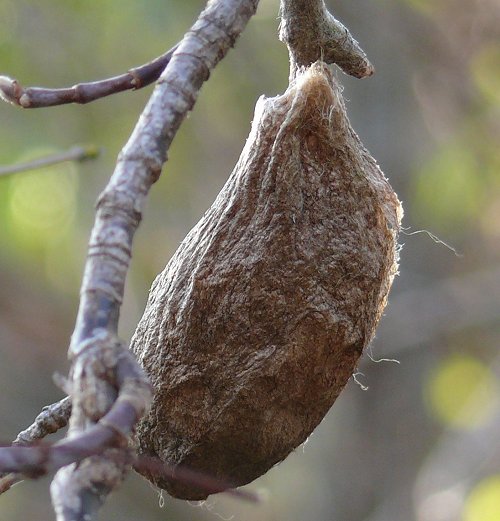
While surveying for Daniel Weston in Lincoln to-day, see a great many — maybe a hundred — silvery-brown cocoons, wrinkled and flattish, on young alders in a meadow, three or four inches long, fastened to the main stem and branches at same time, with dry alder and fragments of fern leaves attached to and partially concealing them; of some great moth.

H. D. Thoreau, Journal, December 17, 1853

Cocoons of some great moth. See December 24, 1853 ("The largest are four inches long by two and a half, bag-shaped and wrinkled and partly concealed by dry leaves, — alder, ferns, etc., — attached as if sprinkled over them. This evidence of cunning in so humble a creature is affecting, for I am not ready to refer it to an intelligence which the creature does not share, as much as we do the prerogatives of reason. This radiation of the brain. The bare silvery cocoons would otherwise be too obvious. The worm has evidently said to itself: "Man or some other creature may come by and see my casket. I will disguise it, will hang a screen before it." Brake and sweet-fern and alder leaves are not only loosely sprinkled over it and dangling from it, but often, as it were, pasted close upon and almost incorporated into it.”); January 19, 1854 ("Dr. Harris says that my cocoons found in Lincoln in December are of the Attacus cecropia, the largest of our emperor moths."); February 19, 1854 ("Each and all such disguises and other resources remind us that not some poor worm's instinct merely, as we call it, but the mind of the universe rather, which we share, has been intended upon each particular object. All the wit in the world was brought to bear on each case to secure its end.”); June 2, 1855 ("From that cocoon of the Attacus cecropia which I found — I think it was on the 24th of May . . .came out this forenoon a splendid moth . . ..It was surprising to see the creature unfold and expand before our eyes, the wings gradually elongating, . . .at dusk, when apparently it was waving its wings preparatory to its evening flight, I gave it ether and so saved it in a perfect state.");June 18, 1857 ("They brought me an Attacus Cecropia . . . Its body was large like the one I have preserved"); June 22, 1857 ("It seems that Sophia found an Attacus Cecropia out in my chamber last Monday, or the 15th. It soon went to laying eggs on the window-sill, "); May 6, 1858 ("A boy brings me to-day an Attacus Cecropia moth . . ., the male, a dark brown above, and considerably larger than mine. It must be about seven inches in alar extent."); July 8, 1858 ("I see an emperor moth (Attacus Cecropia), which came out the 6th"):

Popular Posts Last 30 Days.

The week ahead in Henry’s journal

The week ahead in Henry’s journal
A journal, a book that shall contain a record of all your joy.
"A stone fruit. Each one yields me a thought." ~ H. D. Thoreau, March 28, 1859


I sit on this rock
wrestling with the melody
that possesses me.