Showing posts with label rhus. Show all posts

Monday, July 26, 2021

At Cohasset.


July 26.

At Cohasset.

Called on Captain Snow, who remembered hearing fishermen say that they “fitted out at Thoreau's” remembered him. He had commanded a packet between Boston or New York and England.

Spoke of the wave which he sometimes met on the Atlantic coming against the wind, and which indicated that the wind was blowing from an opposite quarter at a distance, the undulation travelling faster than the wind.

They see Cape Cod loom here. Thought the Bay between here and Cape Ann thirty fathoms deep; between here and Cape Cod, sixty or seventy fathoms.

The “Annual of Scientific Discovery” for 1851 says, quoting a Mr. A. G. Findley, “Waves travel very great distances, and are often raised by distant hurricanes, having been felt simultaneously at St. Helena and Ascension, though 600 miles apart, and it is probable that ground swells often originate at the Cape of Good Hope, 3000 miles distant.”

Sailors tell of tide-rips. Some are thought to be occasioned by earthquakes.

The ocean at Cohasset did not look as if any were ever shipwrecked in it. Not a vestige of a wreck left. It was not grand and sublime now, but beautiful.

The water held in the little hollows of the rocks, on the receding of the tide, is so crystal-pure that you cannot believe it salt, but wish to drink it.

The architect of a Minot Rock lighthouse might profitably spend day studying the worn rocks of Cohasset shore, and learn the power of the waves, see what kind of sand the sea is using to grind them down.

A fine delicate seaweed, which some properly enough call sea-green.

Saw here the staghorn, or velvet, sumach (Rhus typhina), so called from form of young branches, a size larger than the Rhus glabra common with us.

The Plantago maritima, or sea plantain, properly named. I guessed its name before I knew what it was called by botanists.

The American sea-rocket (Bunias edentula) I suppose it was that I saw, the succulent plant with much cut leaves and small pinkish (?) flowers.

H. D. Thoreau, Journal, July 26, 1851

Saw here the staghorn, or velvet, sumach (Rhus typhina). See August 25, 1851 ("I now know all of the Rhus genus in Bigelow. We have all but the staghorn in Concord.")

See July 27, 1851 ("Walk from Cohasset to Duxbury and sail thence to Clark's Island.")

July 26. See A Book of the Seasons, by Henry Thoreau, July 26

A Book of the Seasons, by Henry Thoreau
"A book, each page written in its own season,
out-of-doors, in its own locality."
~edited, assembled and rewritten by zphx © 2009-2021

Friday, October 18, 2019

The sour scent of decaying ferns

October 18

Rains till 3 p. m., but is warmer. 

October 18, 2019


P. M. — To Assabet, front of Tarbell's. 

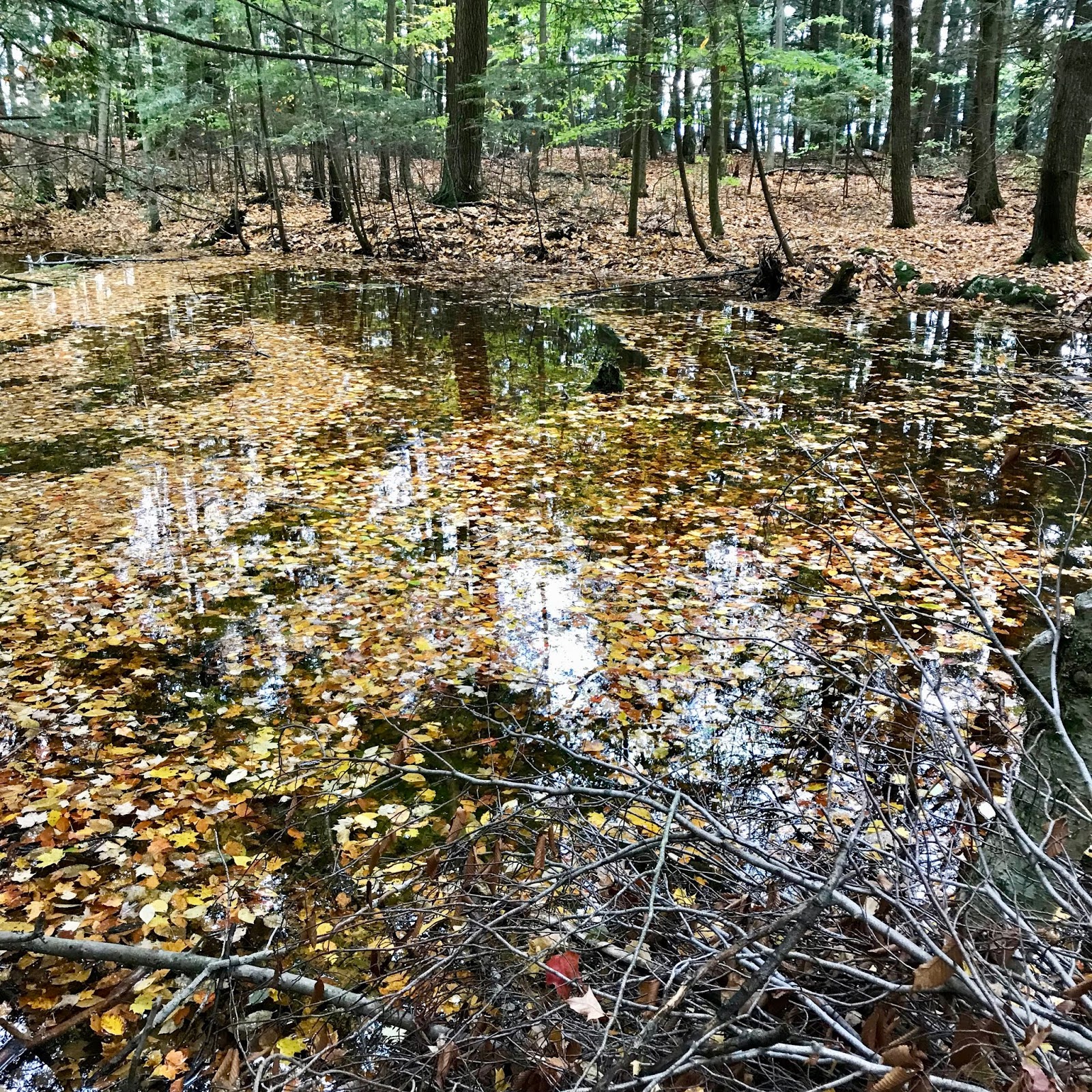
Going by Dennis Swamp on railroad, the sour scent of decaying ferns is now very strong there. 

Rhus venenata is bare, and maples and some other shrubs, and more are very thin-leaved, as alder and birches, so that the swamp, with so many fallen leaves and migrating sparrows, etc., flitting through it, has a very late look. For falling, put the canoe birch with the small white. The beach plum is almost quite bare. The leaves of a chinquapin oak have not fallen. 

The long, curved, yellowish buds of the Salix discolor begin to show, the leaves falling; even the down has peeped out from under some. 

In the ditch along the west side of Dennis Swamp I see half a dozen yellow-spot turtles moving about. Probably they are preparing to go into winter quarters. 

I see one of the smaller thrushes to-day. 

Saw a tree-toad on the ground in a sandy wood-path. It did not offer to hop away, may have been chilled by the rain (?). It is marked on the back with black, some what in the form of the hylodes. 

Why can we not oftener refresh one another with original thoughts ? If the fragrance of the dicksonia fern is so grateful and suggestive to us, how much more refreshing and encouraging — re-creating — would be fresh and fragrant thoughts communicated to us fresh from a man's experience and life! I want none of his pity, nor sympathy, in the common sense, but that he should emit and communicate to me his essential fragrance, that he should not be forever repenting and going to church (when not otherwise sinning), but, as it were, going a-huckleberrying in the fields of thought, and enrich all the world with his visions and his joys. 

Why do you flee so soon, sir, to the theatres, lecture-rooms, and museums of the city? If you will stay here awhile I will promise you strange sights. You shall walk on water; all these brooks and rivers and ponds shall be your highway. You shall see the whole earth covered a foot or more deep with purest white crystals, in which you slump or over which you glide, and all the trees and stubble glittering in icy armor.

H. D. Thoreau, Journal, October 18, 1859


Maples and some other shrubs, and more are very thin-leaved so that the swamp, with so many fallen leaves and migrating sparrows, etc., flitting through it, has a very late look.
See October 18, 1853 ("The red maples have been bare a good while. In the sun and this clear air, their bare ashy branches even sparkle like silver."); October 18, 1855 ("The maple swamps, bare of leaves, here and there about the meadow, look like smoke blown along the edge of the woods."); October 18, 1858 ("I am struck by the magical change which has taken place in the red maple swamps, . . . — all their splendor gone, wafted away, as it were, by a puff of wind, and they are the mere ghosts of trees, unnoticed by any, or, if noticed at all, like the smoke that is seen where a blaze is extinguished, ")

The sour scent of decaying ferns is now very strong. See  October 1, 1858 ("The cinnamon ferns are crisp and sour in open grounds"); October 2, 1857 ("In the more open swamp beyond, these ferns, recently killed by the frost and exposed to the sun, fill the air with a very strong sour scent"); October 2, 1859 ("I perceive in various places, in low ground, this afternoon, the sour scent of cinnamon ferns decaying. It is an agreeable phenomenon, reminding me of the season and of past years.")

The long, curved, yellowish buds of the Salix discolor begin to show. See October 24, 1860 ("I see those narrow pointed yellow buds now laid bare so thickly along the slender twigs of the Salix discolor, which is almost bare of leaves."); October 25, 1858 ("Now that the leaves are fallen (for a few days), the long yellow buds (often red-pointed) which sleep along the twigs of the S. discolor are very conspicuous and quite interesting, already even carrying our thoughts for ward to spring.")

Tuesday, October 15, 2019

Each town should have a park, or rather a primitive forest, a common possession forever, for instruction and recreation

October 15

P. M. — To Botrychium Swamp. 

A cold northwest wind. 

I see some black oak acorns on the trees still and in some places at least half the shrub oak acorns. The last are handsomer now that they have turned so much darker. 

I go along the east edge of Poplar Hill. This very cold and windy day, now that so many leaves have fallen, I begin to notice the silveriness of willows blown up in the wind, — a November sight. 

The hickories at Poplar Hill (and elsewhere, as far as I perceive) are all past prime now and most half-withered or bare, very different from last year. In warmer autumns, if I remember rightly, they last several weeks later than this in some localities, one succeeding an other with its splendid glow, an evidence of the genial-ness of the season. In cool and moist places, in a genial year, some are preserved green after others have changed, and by their later change and glow they prolong the season of autumnal tints very agreeably. 

This is a cold fall. 

The larches in A. Heywood's swamp, though a yellower green than the white pines, are not yet sharply distinguished from them by their form, as they will be. 

The oaks generally are very fair now at a distance. 

Standing on this hilltop this cold and blustering day, when dark and slate-colored clouds are flitting over the sky, the beauty of the scenery is enhanced by the contrast in the short intervals of sunshine. The whole surface of the country, both young woodlands and full- grown forests, whether they clothe sides of hills or their lit tops are seen over a ridge, — the birch phalanxes and huckleberry flocks [?], etc., — even to the horizon, is like a rug of many brilliant colors, with the towns in the more open and tawny spaces. 

The beauty or effect of the scene is enhanced, if, standing here, you see far in the horizon the red regiments of oaks alternately lit up by the sun and dimmed by the passing shadow of a cloud. As the shadows of these cold clouds flit across the landscape, the red banners of distant forests are lit up or disappear like the colors of a thousand regiments. 

Pratt says that he planted a ground-nut in his garden in good soil, but they grew no bigger than a bean. He did not know but it would take more than one year, even if he planted the tuber. 

The yellow birches are generally bare. 

Juniperus repens leaves have fallen, perhaps with red cedar.

The ash trees I see to-day are quite bare, apparently several or some days. 

The little leaves of the mitchella, with a whitish midrib and veins, lying generally flat on the mossy ground, perhaps about the base of a tree, with their bright-scarlet twin berries sprinkled over them, may properly be said to checker the ground. Now, particularly, they are noticed amid the fallen leaves. 

The bayberry leaves have fallen, and all the berries are gone. I suppose the birds have eaten them. 

Mountain laurel leaves are fallen. 

The yellow birches are bare, revealing the fruit (the short, thick brown catkins) now ripe and ready to scale off. How full the trees are! About as thick as the leaves were. 

The fever-bush is for the most part bare, and I see no berries. 

Rhus radicans too is bare. 

The maidenhair is for the most part withered. It is not evergreen, then. 

The mountain sumach which I see is bare, and some smooth ditto. 

That appears to be Aspidium cristatum which I find evergreen in swamps, but no fertile fronds now. It is broader and denser than the plate of the English one. It cannot be a described variety of spinulosum, for it is only once pinnate. 

I think I see myrtle-birds on white birches, and that they are the birds I saw on them a week or two ago, — apparently, or probably, after the birch lice. 

See a Fringilla hyemalis

The chickadees sing as if at home. They are not travelling singers hired by any Barnum. Theirs is an honest, homely, heartfelt melody. Shall not the voice of man express as much content as the note of a bird?  

Botrychium Lunaria has shed pollen, how long? 

The little larches in midst of Gowing's Swamp already changed, before others elsewhere. 

Each town should have a park, or rather a primitive forest, of five hundred or a thousand acres, where a stick should never be cut for fuel, a common possession forever, for instruction and recreation. We hear of cow-commons and ministerial lots, but we want men-commons and lay lots, inalienable forever. Let us keep the New World new, preserve all the advantages of living in the country.
There is meadow and pasture and wood-lot for the town's poor. Why not a forest and huckleberry-field for the town's rich? All Walden Wood might have been preserved for our park forever, with Walden in its midst, and the Easterbrooks Country, an unoccupied area of some four square miles, might have been our huckleberry-field. 

If any owners of these tracts are about to leave the world without natural heirs who need or deserve to be specially remembered, they will do wisely to abandon their possession to all, and not will them to some individual who perhaps has enough already. As some give to Harvard College or another institution, why might not another give a forest or huckleberry-field to Concord? A town is an institution which deserves to be remembered. 

We boast of our system of education, but why stop at schoolmasters and schoolhouses? We are all schoolmasters, and our school-house is the universe. To attend chiefly to the desk or schoolhouse while we neglect the scenery in which it is placed is absurd. If we do not look out we shall find our fine schoolhouse standing in a cow-yard at last. 

The Kalmia glauca, now falling, is quite a brilliant scarlet. In this case you have the fresh liquid-green leaves of this year above the brilliant scarlet ones of last year. Most other evergreens exhibit only a contrast of green with yellow or yellowish. 

The balm-of-Gileads by Mrs. Ripley's bare. Those beyond Barrett's Bridge green and full of leaves. 

The spruce leaves have fallen, — how long? — and its seeds are falling. Larch seeds falling. 

Celtis berries ripe, how long? 

Solanum Dulcamara berries linger over water but mostly are shrivelled. 

Canoe birch is now at least half fallen or more, apparently with the small white; looks in color like an aspen.

H. D. Thoreau, Journal, October 15, 1859

The hickories at Poplar Hill (and elsewhere, as far as I perceive) are all past prime now and most half-withered or bare, very different from last year. See October 15, 1858 ("Small hickories are the clearest and most delicate yellow in the shade of the woods.") See also October 8, 1856 ("The hickory leaves are among the handsomest now, varying from green through yellow, more or less broadly green-striped on the principal veins, to pure yellow, at first almost lemon-yellow, at last browner and crisped. This mingling of yellow and green on the same leaf, the green next the veins where the life is most persistent, is very pleasing."); October 22, 1857 ("The hickory leaves, now after they have fallen, are often if not oftenest a dark rich yellow, very conspicuous upon the brown leaves of the forest floor, seeming to have more life in them than those leaves which are brown."); October 4, 1858 ("The hickories on the northwest side of this hill are in the prime of their color, of a rich orange; some intimately mixed with green, handsomer than those that are wholly changed.")

The oaks generally are very fair now at a distance. See October 15, 1858 ("The colors of the oaks are far more distinct now than they were before.")

The chickadees sing as if at home. Theirs is an honest, homely, heartfelt melody. See note to October 15, 1856 ("The chickadees are hopping near on the hemlock above. They resume their winter ways before the winter comes.")

The balm-of-Gileads by Mrs. Ripley's bare. Those beyond Barrett's Bridge green and full of leaves. See October 15,1858 ("The balm-of-Gileads are half bare. ")

October 15.  See A Book of the Seasons,  by Henry Thoreau October 15

In the horizon 
the red regiments of oaks  
lit up by the sun.
A Book of the Seasons, by Henry Thoreau
"A book, each page written in its own season,
out-of-doors, in its own locality.”
~edited, assembled and rewritten by zphx © 2009-2025

https://tinyurl.com/hdt591015
I

Monday, October 14, 2019

We sit on the rock on Pine Hill overlooking Walden.


October 14. 

9 a. m. — To and around Flint's Pond with Blake. 

A fine Indian-summer day. 

The 6th and 10th were quite cool, and any particularly warm days since may be called Indian summer (?), I think. 

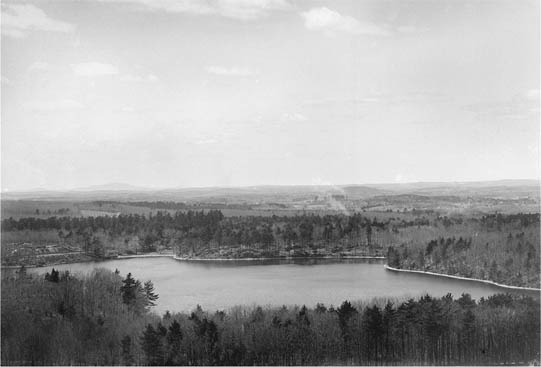
We sit on the rock on Pine Hill overlooking Walden.


Overlooking Walden Pond from Pine Hill
April 28, 1906
There is a thick haze almost entirely concealing the mountains. There is wind enough to raise waves on the pond and make it bluer. What strikes me in the scenery here now is the contrast of the unusually blue water with the brilliant-tinted woods around it. 

The tints generally may be about at their height. The earth appears like a great inverted shield painted yellow and red, or with imbricated scales of that color, and a blue navel in the middle where the pond lies, and a distant circumference of whitish haze. 

The nearer woods, where chestnuts grow, are a mass of warm, glowing [yellow] (though the larger chestnuts have lost the greater part of their leaves and generally you wade through rustling chestnut leaves in the woods), but on other sides the red and yellow are intermixed. The red, probably of scarlet oaks on the south of Fair Haven Hill, is very fair. The beech tree at Baker's fence is past prime and many leaves fallen. 

The shrub oak acorns are now all fallen, — only one or two left on, — and their cups, which are still left on, are apparently somewhat incurved at the edge as they have dried, so that probably they would not hold the acorn now. 

The ground is strewn also with red oak acorns now, and, as far as I can discover, acorns of all kinds have fallen. 

At Baker's wall two of the walnut trees are bare but full of green nuts (in their green cases), which make a very pretty sight as they wave in the wind. So distinct you could count every one against the sky, for there is not a leaf on these trees, but other walnuts near by are yet full of leaves. You have the green nut contrasted with the clean gray trunks and limbs. These are pig nut-shaped. 

The chestnuts generally have not yet fallen, though many have. I find under one tree a great many burs, apparently not cast down by squirrels — for I see no marks of their teeth — and not yet so opened that any of the nuts fall out. They do not all wait till frosts open the burs before they fall, then. 

I see a black snake, and also a striped snake, out this warm day.

***
Some Rhus radicans was leafless on the 13th, and some tupelos bare maybe a week or more, and button-bushes nearly bare. 

My little white pines by Walden are now conspicuous in their rows, the grass, etc., having withered to tawny and the blackberry turned to scarlet. They have been almost inobvious through the summer. 

The dark evergreen leaves of the checkerberry also attract us now amid the shrub oaks, as on the southwest of Pine Hill.

I hear a man laughed at because he went to Europe twice in search of an imaginary wife who, he thought, was there, though he had never seen nor heard of her. But the majority have gone further while they stayed in America, have actually allied themselves to one whom they thought their wife and found out their mistake too late to mend it. It would be cruel to laugh at these. 

Wise, the balloonist, says that he lost a balloon "in a juniper bog in the State of Maine," which he mistook for a "prairie." Does he mean a larch swamp? 

Balloonists speak of hearing dogs bark at night and wagons rumbling over bridges.

Arbor-vitae falling (seeds), how long?

H. D. Thoreau, Journal, October 14, 1859

A fine Indian-summer day. See October 14, 1853 ("Fine, clear Indian-summer weather.")

We sit on the rock on Pine Hill overlooking Walden. See October 1, 1859 ("Looking down from Pine Hill, I see a fish hawk over Walden."); October 22, 1852 ("Looking over the forest on Pine Hill, I can hardly tell which trees are lit up by the sunshine and which are the yellow chestnut-tops."); October 20, 1852 (“Picking chestnuts on Pine Hill. . . . I see the mountains in sunshine, all the more attractive from the cold I feel here, with a tinge of purple on them”); October 25, 1858 ("Returning in an old wood-path from top of Pine Hill to Goose Pond, I see many goldenrods turned purple"); November 4, 1857 ("I climb Pine Hill just as the sun is setting, this cool evening. Sitting with my back to a thick oak sprout whose leaves still glow with life, Walden lies an oblong square endwise to, beneath me. Its surface is slightly rippled, and dusky prolonged reflections of trees extend wholly across its length, or half a mile, — I sit high."); November 5, 1857 ("I shiver about awhile on Pine Hill, waiting for the sun to set."); November 30, 1852 ("From Pine Hill, Wachusett is seen over Walden. The country seems to slope up from the west end of Walden to the mountain"); February 29, 1852 ("The ice on Walden is of a dull white as I look directly down on it, but not half a dozen rods distant on every side it is a light-blue color.From Pine Hill, looking westward, I see the snowcrust shine in the sun as far as the eye can reach. . ."); April 27, 1859 ("Through the cemetery, and over Pine Hill, where I heard a strange warbler, methought, a dark-colored, perhaps reddish-headed bird"); May 15, 1856 (“Checker-berries very abundant on south side of Pine Hill, by pitch pine wood. Now is probably best time to gather them.”); June 12, 1853 ("Going up Pine Hill, disturbed a partridge and her brood. She ran indeshabille directly to me, within four feet, while her young, not larger than a chicken just hatched, dispersed. "); July 29, 1858 ("To Pine Hill, looking for the Vaccinium Pennsylvanicum berries. I find plenty of bushes, but these bear very sparingly. They appear to bear but one or two years before they are overgrown."); August 27, 1854 ("I am surprised to see the top of Pine Hill wearing its October aspect, — yellow with changed maples and here and there faintly blushing with changed red maples. . . .. As I go up Pine Hill, gather the shrivelled Vaccinium vacillans berries, many as hard as if dried on a pan. They are very sweet and good."); September 12, 1851 ("Found a violet, apparently Viola cucullata, or hood-leaved violet, in bloom in Baker's Meadow beyond Pine Hill.")

The earth appears like a great inverted shield painted yellow and red. . .and a blue navel in the middle where the pond lies, and a distant circumference of whitish haze. See October 13, 1852 (" The water or lake from however distant a point seen is always the centre of the landscape. The pond is now most beautifully framed with the autumn-tinted woods and hills.");  November 4, 1857 ("I climb Pine Hill just as the sun is setting. . . Walden lies an oblong square endwise to, beneath me. Its surface is slightly rippled, and dusky prolonged reflections of trees extend wholly across its length");See also June 3, 1850 ("The landscape is a vast amphitheatre rising to its rim in the horizon."): June 25, 1852 ("The earth appears like a vast saucer sloping upward to its sharp mountain rim.")

The ground is strewn also with red oak acorns now, and, as far as I can discover, acorns of all kinds have fallen. See September 12, 1854 ("White oak acorns have many of them fallen. . . .. Some black scrub oak acorns have fallen, and a few black oak acorns also have fallen. The red oak began to fall first."); September 30, 1854 ("Acorns are generally now turned brown and fallen or falling; the ground is strewn with them and in paths they are crushed by feet and wheels."); October 1, 1859 ("The shrub oaks on this hill are now at their height, both with respect to their tints and their fruit. . . .Now is the time for shrub oak acorns if not for others."); October 11, 1860 ("There is a remarkably abundant crop of white oak acorns this fall, also a fair crop of red oak acorns; but not of scarlet and black, very few of them. The acorns are now in the very midst of their fall."); October 12, 1858 ("Acorns, red and white (especially the first), appear to be fallen or falling. They are so fair and plump and glossy that I love to handle them, and am loath to throw away what I have in my hand."); October 13, 1859 ("I see no acorns on the trees. They appear to have all fallen before this."); October 13, 1860 ("This is a white oak year, . . . I should think that there might be a bushel or two of acorns on and under some single trees.")

Some tupelos bare maybe a week or more. Compare October 14, 1857 ("Near by is a tupelo which is all a distinct yellow with a little green. ")

Tuesday, September 24, 2019

Nature's Moods

September 24

P. M. — To Melvin's Preserve.

Was that a flock of grackles on the meadow? I have not seen half a dozen blackbirds, methinks, for a month. 

I have many affairs to attend to, and feel hurried these days. Great works of art have endless leisure for a background, as the universe has space. Time stands still while they are created. The artist cannot be in [a] hurry. The earth moves round the sun with inconceivable rapidity, and yet the surface of the lake is not ruffled by it. 

September 24, 2013

It is not by a compromise, it is not by a timid and feeble repentance, that a man will save his soul and live, at last. He has got to conquer a clear field, letting Repentance & Co. go. That 's a well-meaning but weak firm that has assumed the debts of an old and worthless one. You are to fight in a field where no allowances will be made, no courteous bowing to one-handed knights. You are expected to do your duty, not in spite of every thing but one, but in spite of everything. 

See a green snake. 

Stedman Buttrick's handsome maple and pine swamp is full of cinnamon ferns. I stand on the elevated road, looking down into it. The trees are very tall and slender, without branches for a long distance. All the ground, which is perfectly level, is covered and concealed, as are the bases of the trees, with the tufts of cinnamon fern, now a pale brown. It is a very pretty sight, these northern trees springing out of a ground work of ferns. It is like pictures of the tropics, except that here the palms are the undergrowth. You could not have arranged a nosegay more tastefully. It is a rich groundwork, out of which the maples and pines spring. 

But outside the wood and by the roadside, where they are exposed, these ferns are withered, shrivelled, and brown, for they are tenderer than the dicksonia. The fern, especially if large, is so foreign and tropical that these remind me of artificial groundworks set in sand, to set off other plants. These ferns (like brakes) begin to decay, i. e. to turn yellow or brown and ripen, as here, before they are necessarily frost-bitten. Theirs is another change and decay, like that of the brake and sarsaparilla in the woods and swamps, only later, while the exposed ones are killed before they have passed through all their changes. The exposed ones attained to a brighter yellow early and were then killed; the shaded ones pass through various stages of rich, commonly pale brown, as here, and last much longer. The brown ones are the most interesting. 

Going along this old Carlisle road, — road for walkers, for berry-pickers, and no more worldly travellers; road for Melvin and Clark, not for the sheriff nor butcher nor the baker's jingling cart; road where all wild things and fruits abound, where there are countless rocks to jar those who venture there in wagons; which no jockey, no wheelwright in his right mind, drives over, no little spidery gigs and Flying Childers; road which leads to and through a great but not famous garden, zoological and botanical garden, at whose gate you never arrive, — as I was going along there, I perceived the grateful scent of the dicksonia fern, now partly decayed, and it reminds me of all up-country with its springy mountainsides and unexhausted vigor. Is there any essence of dicksonia fern, I wonder? Surely that giant who, my neighbor expects, is to bound up the Alleghanies will have his handkerchief scented with that. In the lowest part of the road the dicksonia by the wall-sides is more than half frost-bitten and withered, — a sober Quaker-color, brown crape! — though not so tender or early [?] as the cinnamon fern; but soon I rise to where they are more yellow and green, and so my route is varied. On the higher places there are very handsome tufts of it, all yellowish out side and green within. The sweet fragrance of decay! 

When I wade through by narrow cow-paths, it is as if I had strayed into an ancient and decayed herb-garden. Proper for old ladies to scent their handkerchiefs with. Nature perfumes her garments with this essence now especially. She gives it to those who go a-barberrying and on dank autumnal walks. The essence of this as well as of new-mown hay, surely! The very scent of it, if you have a decayed frond in your chamber, will take you far up country in a twinkling. You would think you had gone after the cows there, or were lost on the mountains. It will make you as cool and well as a frog, — a wood frog, Rana sylvatica. It is the scent the earth yielded in the saurian period, before man was created and fell, before milk and water were invented, and the mints. Far wilder than they.

Rana sylvatica passed judgment on it, or rather that peculiar-scented Rana palustris. It was in his reign it was introduced. That is the scent of the Silurian Period precisely, and a modern beau may scent his handkerchief with it. Before man had come and the plants that chiefly serve him. There were no Rosacea nor mints then. So the earth smelled in the Silurian (?) Period, before man was created and any soil had been debauched with manure. The saurians had their handkerchiefs scented with it. For all the ages are represented still and you can smell them out. 

A man must attend to Nature closely for many years to know when, as well as where, to look for his objects, since he must always anticipate her a little. Young men have not learned the phases of Nature; they do not know what constitutes a year, or that one year is like another. I would know when in the year to expect certain thoughts and moods, as the sports man knows when to look for plover. 

Though you may have sauntered near to heaven's gate, when at length you return toward the village you give up the enterprise a little, and you begin to fall into the old ruts of thought, like a regular roadster. Your thoughts very properly fail to report themselves to headquarters. Your thoughts turn toward night and the evening mail and become begrimed with dust, as if you were just going to put up at (with ?) the tavern, or even come to make an exchange with a brother clergyman here on the morrow. 

Some eyes cannot see, even through a spy-glass. I showed my spy-glass to a man whom I met this afternoon, who said that he wanted to see if he could look through it. I tried it carefully on him, but he failed. He said that he tried a lot lately on the muster-field but he never could see through them, somehow or other everything was all a blur. I asked him if he considered his eyes good. He answered that they were good to see far. They looked like two old-fashioned china saucers. He kept steadily chewing his quid all the while he talked and looked. This is the case with a great many, I suspect. Everything is in a blur to them. He enjoys the distinction of being the only man in the town who raises his own tobacco. Seeing is not in them. No focus will suit them. You wonder how the world looks to them, — if those are eyes which they have got, or bits of old china, familiar with soap suds. 

As I stood looking over a wall this afternoon at some splendid red sumach bushes, now in their prime, I saw Melvin the other side of the wall and hailed him.
 "What are you after there?" asked he. 
"After the same thing that you are, perhaps," answered I.
But I mistook, this time, for he said that he was looking amid the huckleberry bushes for some spectacles which a woman lost there in the summer. It was his mother, no doubt. 

Road — that old Carlisle one — that leaves towns behind; where you put off worldly thoughts; where you do not carry a watch, nor remember the proprietor; where the proprietor is the only trespasser, — looking after his apples ! — the only one who mistakes his calling there, whose title is not good; where fifty may be a-barberrying and you do not see one. It is an endless succession of glades where the barberries grow thickest, successive yards amid the barberry bushes where you do not see out. 

There I see Melvin and the robins, and many a nut-brown maid sashe-ing to the barberry bushes in hoops and crinoline, and none of them see me. The world-surrounding hoop! faery rings! Oh, the jolly cooper's trade it is the best of any! Carried to the furthest isles where civilized man penetrates. This the girdle they've put round the world! Saturn or Satan set the example. Large and small hogsheads, barrels, kegs, worn by the misses that go to that lone schoolhouse in the Pinkham notch. 

The lonely horse in its pasture is glad to see company, comes forward to be noticed and takes an apple from your hand. 

Others are called great roads, but this is greater than they all. The road is only laid out, offered to walkers, not accepted by the town and the travelling world. To be represented by a dotted line on charts, or drawn in lime-juice, undiscoverable to the uninitiated, to be held to a warm imagination. No guide-boards indicate it. No odometer would indicate the miles a wagon had run there. Rocks which the druids might have raised — if they could. 

There I go searching for malic acid of the right quality, with my tests. The process is simple. Place the fruit between your jaws and then endeavor to make your teeth meet. The very earth contains it. The Easterbrooks Country contains malic acid. 

To my senses the dicksonia fern has the most wild and primitive fragrance, quite unalloyed and untamable, such as no human institutions give out, — the early morning fragrance of the world, antediluvian, strength and hope imparting. They who scent it can never faint. It is ever a new and untried field where it grows, and only when we think original thoughts can we perceive it. If we keep that on [sic] our boudoir we shall be healthy and evergreen as hemlocks. Older than, but related to, strawberries. Before strawberries were, it was, and it will outlast them. Good for the trilobite and saurian in us; death to dandies. It yields its scent most morning and evening. Growing without manure; older than man; refreshing him; preserving his original strength and innocence. 

When the New Hampshire farmer, far from travelled roads, has cleared a space for his mountain home and conducted the springs of the mountain to his yard, already it grows about the sources of that spring, before any mint is planted in his garden. There his sheep and oxen and he too scent it, and he realizes that the world is new to him. There the pastures are rich, the cattle do not die of disease, and the men are strong and free. The wild original of strawberries and the rest. Nature, the earth herself, is the only panacea. They bury poisoned sheep up to the necks in earth to take the poison out of them. 

After four days cloud and rain we have fair weather. A great many have improved this first fair day to come a-barberrying to the Easterbrooks fields. These bushy fields are all alive with them, though I scarcely see one. 

I meet Melvin loaded down with barberries, in bags and baskets, so that he has to travel by stages and is glad to stop and talk with me. It is better to take thus what Nature offers, in her season, than to buy an extra dinner at Parker's. 

The sumach berries are probably past their beauty. 

Fever-bush berries are scarlet now, and also green.  They have a more spicy taste than any of our berries, carrying us in thought to the spice islands. Taste like lemon-peel. 

The panicled andromeda berries (?) begin to brown. 

The bayberry berries are apparently ripe, though not so gray as they will be, — more lead-colored. They bear sparingly here. Leaves not fallen nor changed, and I the more easily find the bushes amid the changed huckleberries, brakes, etc., by their greenness. 

The poke on Eb. Hubbard's hillside has been considerably frost-bitten before the berries are one-third ripe. It is in flower still. Great drooping cylindrical racemes of blackish-purple berries, six inches or more in length, tapering a little toward the end; great flat blackish and ripe berries at base, with green ones and flowers at the other end; all on brilliant purple or crimson-purple peduncle and pedicels. 

Those thorns by Shattuck's barn, now nearly leafless, have hard green fruit as usual. 

The shrub oak is apparently the most fertile of our oaks. I count two hundred and sixty-six acorns on a branch just two feet long. Many of the cups are freshly empty now, showing a pretty circular pink scar at the bottom, where the acorn adhered. They are of various forms and sizes on different shrubs; are now turning dark-brown and showing their converging meridional light-brown lines. 

Never fear for striped squirrels in our shrub oak land.

Am surprised to find, by Botrychium Swamp, a Rhus radicans which is quite a tree by itself. It is about nine feet high by nine in width, growing in the midst of a clump of barberry bushes, which it overhangs. It is now at the height of its change, very handsome, scarlet and yellow, and I did not at first know what it was. I found it to consist of three or four branches, each nearly two inches thick and covered with those shaggy fibres, and these are twined round some long-since rotted barberry stems, and around one another, and now make a sizable-looking trunk, which rises to the height of four feet before it branches, and then spreads widely every way like an oak. It was, no doubt, indebted to the barberry for support at first, but now its very branches are much larger than that, and it far overtops and over spreads all the barberry stems.

H. D Thoreau, Journal, September 24, 1859


Great works of art have endless leisure for a background . . . Time stands still while they are created. The artist cannot be in [a] hurry. The earth moves round the sun with inconceivable rapidity, and yet the surface of the lake is not ruffled by it. See September 17, 1839 ("If the setting sun seems to hurry him to improve the day while it lasts, the chant of the crickets fails not to reassure him, even-measured as of old, teaching him to take his own time henceforth forever. The wise man is restful, never restless or impatient. He each moment abides there where he is, as some walkers actually rest the whole body at each step. As the wise is not anxious that time wait for him, neither does he wait for it.") July 19, 1851 ("This rapid revolution of nature, even of nature in me, why should it hurry me?"); January 11, 1852 ("We cannot live too leisurely. Let me not live as if time 
was short"); May 9, 1852 ("Our moods vary from week to week, with the winds and the temperature and the revolution of the seasons. It is impossible to remember a week ago."); December 28, 1852 ("A broad margin of leisure is as beautiful in a man's life as in a book. Haste makes waste, no less in life than in housekeeping. Keep the time, observe the hours of the universe, not of the cars. What are threescore years and ten hurriedly and coarsely lived to moments of divine leisure in which your life is coincident with the life of the universe?"); Walden, An artist in the city of Kouroo ("In an imperfect work time is an ingredient, but into a perfect work time does not enter. ")


The tufts of cinnamon fern, now a pale brown. See September 6, 1854 ("The cinnamon ferns along the edge of woods next the meadow are many yellow or cinnamon, or quite brown and withered."); September 12, 1858 ("The cinnamon fern has begun to yellow and wither."); September 25, 1859 ("The cinnamon ferns are all a decaying brown. . . in harmony with the twilight of the swamp"); September 27, 1857 ("The large common ferns (either cinnamon or interrupted) are yellowish, and also many as rich a deep brown now as ever."); October 1, 1858 ("The cinnamon ferns are crisp and sour in open grounds"); October 2, 1857 ("They are now generally imbrowned or crisp. In the more open swamp beyond, these ferns, recently killed by the frost and exposed to the sun, fill the air with a very strong sour scent"); October 2, 1859 ("I perceive in various places, in low ground, this afternoon, the sour scent of cinnamon ferns decaying. It is an agreeable phenomenon, reminding me of the season and of past years.");  October 6, 1858 ("Cinnamon ferns are generally crisped, but in the swamp I saw some handsomely spotted green and yellowish, and one clump, the handsomest I ever saw, ");October 17, 1857 ("The cinnamon ferns . . .have acquired their November aspect")  See also A Book of the Seasons, by Henry Thoreau, The Cinnamon Fern

He enjoys the distinction of being the only man in the town who raises his own tobacco. See September 22, 1859 ("Temple, . . .thinks he is the only one who has cultivated any in C[oncord]. of late years.")

There I see Melvin and the robins, and many a nut-brown maid sashe-ing to the barberry bushes. See October 20, 1857 ("What a wild and rich domain that Easterbrooks Country! . . . the miles of huckleberries, and of barberries, and of wild apples, so fair, both in flower and fruit, resorted to by men and beasts; Clark, Brown, Melvin, and the robins, these, at least, were attracted thither this afternoon")

I meet Melvin loaded down with barberries, in bags and baskets. See September 18, 1856 ("I get a full peck from about three bushes.”); September 25, 1855 (We get about three pecks of barberries from four or five bushes”). October 1, 1853 (" Got three pecks of barberries.")

tinyurl.com/HDThaste

Wednesday, September 11, 2019

September is the month when various small, and commonly inedible, berries in cymes and clusters hang over the roadsides and along the walls and fences, or spot the forest floor

September 11. 

P.M. — To Conantum-end. 

The prinos berries are now seen, red (or scarlet), clustered along the stems, amid the as yet green leaves. A cool red.

By the pool in Hubbard's Grove, I see tall tupelos, all dotted with the now ripe (apparently in prime) small oval purple berries, two or three together on the end of slender peduncles, amid the reddening leaves. This fruit is very acid and has a large stone, but I see several robins on the trees, which appear to have been attracted by it. Neither tree nor fruit is generally known, and many liken the former when small to a pear. The trees are quite full of fruit. 

The wax-like fruit of Cornus paniculata still holds on abundantly. 

This being a cloudy and somewhat rainy day, the autumnal dandelion is open in the afternoon.

The Rhus Toxicodendron berries are now ripe and greenish-yellow, and some already shrivelled, over bare rocks. 

September is the month when various small, and commonly inedible, berries in cymes and clusters hang over the roadsides and along the walls and fences, or spot the forest floor. 

The clusters of the Viburnum Lentago berries, now in their prime, are exceedingly and peculiarly handsome, and edible withal. These are drooping, like the Cornus sericea cymes. Each berry in the cyme is now a fine, clear red on the exposed side and a distinct and clear green on the opposite side. Many are already purple, and they turn in your hat, but they are handsomest when thus red and green. 

The large clusters of the Smilacina racemosa berries, four or five inches long, of whitish berries a little smaller than a pea, finely marked and dotted with vermilion or bright red, are very conspicuous. I do not chance to see any ripe. 

No fruit is handsomer than the acorn. I see but few fallen yet, and they are all wormy. Very pretty, especially, are the white oak acorns, three raying from one centre. 

I see dill and saffron still, commonly out at R. W. E.'s.

H. D. Thoreau, Journal, September 11, 1859


September is the month when various small, and commonly inedible, berries in cymes and clusters hang over the roadsides and along the walls and fences, or spot the forest floor.
See September 3, 1853 ("Now is the season for those comparatively rare but beautiful wild berries which are not food for man.. . .Berries which are as beautiful as flowers, but far less known, the fruit of the flower.") See also August 27, 1856 ("There are many wild-looking berries about now.");  September 1, 1854 ("The Cornus sericea berries are now in prime, of different shades of blue, lighter or darker, and bluish white."); September 1, 1856 ("Cohush berries appear now to be in their prime, and arum berries, and red choke-berries, which last further up in this swamp, with their peculiar glossy red and squarish form, are really very handsome. A few medeola berries ripe."); September 2, 1853 ("The dense oval bunches of arum berries now startle the walker in swamps. They are a brilliant vermilion on a rich ground . . . The medeola berries are now dull glossy and almost blue-black; about three, on slender threads one inch long, arising in the midst of the cup formed by the purple bases of the whorl of three upper leaves."); ); September 3, 1856 (A singular and pleasing contrast, also, do the different kinds of viburnum and cornel berries present when compared with each other. "); September 4, 1859 (See a very large mass of spikenard berries fairly ripening, eighteen inches long").

The clusters of the Viburnum Lentago berries, now in their prime, are exceedingly and peculiarly handsome, and edible withal.
 See August 21, 1853 ("The Viburnum Lentago berries are but just beginning to redden on one cheek.”); August 23, 1853 (".How handsome now the cymes of Viburnum Lentago berries, flattish with red cheeks!”); August 25, 1852 ("The fruit of the Viburnum Lentago is now very handsome, with its sessile cymes of large elliptical berries, green on one side and red with a purple bloom on the other or exposed side, not yet purple, blushing on one cheek.”);    August 27, 1854 (Some Viburnum Lentago berries, turned blue before fairly reddening."); . August 27, 1856 ("The Viburnum Lentago begin to show their handsome red cheeks, rather elliptic-shaped and mucronated, one cheek clear red with a purplish bloom, the other pale green, now. Among the handsomest of berries, one half inch long by three eighths by two eighths, being somewhat flattish"); August 30, 1853 ("Viburnum Lentago berries are now common and handsome");September 1, 1854 ("The Viburnum Lentago are just fairly begun to have purple cheeks."); September 13, 1856 ("The Viburnum Lentago, which I left not half turned red when I went up-country a week ago, are now quite black-purple and shrivelled like raisins on my table, and sweet to taste, though chiefly seed."); Also see A Book of the Seasons,by Henry Thoreau, The Viburnum lentago (Nannyberry)


September  – the month 
when various berries  hang
in cymes and clusters.

Monday, July 22, 2019

A strong west wind, saving us from intolerable heat, accompanied by a blue haze, making the mountains invisible.


July 22. 


This morning, though perfectly fair except a haziness in the east, which prevented any splendor, the birds do not sing as yesterday. They appear to make distinctions which we cannot appreciate, and perhaps sing with most animation on the finest mornings. 

1 p. m. — Lee's Bridge, via Conantum; return by Clematis Brook. 

There men in the fields are at work thus indefatigably, more or less honestly getting bread for men. The writer should be employed with at least equal industry to an analogous though higher end.

Flocks of yellow-breasted, russet-backed female bobolinks are seen flitting stragglingly across the meadows. The bobolink loses his song as he loses his colors. 

Tansy is now conspicuous by the roadsides, covered with small red butterflies. It is not an uninteresting plant. I probably put it down a little too early. 

Is that a slender bellflower with entire leaves by the Corner road? 

The green berries of the arum are seen, and the now reddish fruit of the trillium, and the round green-pea-sized green berries of the axil-flowering Solomon's-seal. 

Farmers have commenced their meadow-haying. 

The Aster macrophyllus, large-leafed, in Miles's Swamp. 

Is not that the Lysimachia ciliata, or hairy-stalked loosestrife, by the Corner road, not the lanceolata? Eupatorium sessilifolium now whitish. 

A strong west wind, saving us from intolerable heat, accompanied by a blue haze, making the mountains invisible. We have more of the furnace-like heat to-day, after all. 

The Rhus glabra flowers are covered with bees, large yellowish wasps, and butterflies; they are all alive with them. How much account insects make of some flowers! There are other botanists than I. 

The Asclepias syriaca is going to seed. Here is a kingfisher frequenting the Corner Brook Pond. They find out such places. 

Huckleberrying and blackberrying have commenced. 

The round-leafed sundew. Monotropa uniflora, Indian- pipe. 

Solidago Canadensis (?) almost out.

Either a smooth Polygonum hydropiperoides or a white P. amphibium var. terrestre. 

The spear thistle. [Cirsium lanceolatum.]

Galium circcezans, wild liquorice, in Baker Farm Swamp. 

What is that minute whitish flower with an upright thread-like stem and thread-like linear leaves, with a kind of interrupted spike or raceme of small, whitish, erect, bell-like flowers, the corolla divided by a stout partition, from which projects the style, with three distinct segments in the edge of the bell each side of the partition? [Canada snapdragon.] 

Also found a very small narrow-leaved whitish aster (?).[Erigeron Canadensis.]

H. D. Thoreau, Journal, July 22, 1852

Flocks of yellow-breasted, russet-backed female bobolinks are seen flitting stragglingly across the meadows See August 15, 1852 (" I see a dense, compact flock of bobolinks going off in the air over a field. They cover the rails and alders, and go rustling off with a brassy, tinkling note as I approach, revealing their yellow breasts and bellies. This is an autumnal sight, that small flock of grown birds in the afternoon sky. ") See also A Book of the Seasons,  by Henry Thoreau, The Bobolink

The green berries of the arum are seen. See September 28, 1856 ("The arum berries are still fresh and abundant, perhaps in their prime. A large cluster is two and a half inches long by two wide ")

The now reddish fruit of the trillium. See August 19, 1852 ("The trillium berries, six-sided, one inch in diameter, like varnished and stained cherry wood, glossy red, crystalline and ingrained, concealed under its green leaves in shady swamps. ")

The Aster macrophyllus, large-leafed, in Miles's Swamp. See August 9, 1856 ("The flowers of A. macrophyllus are white with a very slight bluish tinge, in a coarse flat-topped corymb. Flowers nine to ten eighths of an inch in diameter."); August 26, 1856 ("Aster macrophyllus, now in its prime. It grows large and rank, two feet high. On one I count seventeen central flowers withered, one hundred and thirty in bloom, and half as many buds.")

July 22. See A Book of the Seasons, by Henry Thoreau, July 22

A Book of the Seasons, by Henry Thoreau
"A book, each page written in its own season,
out-of-doors, in its own locality."
~edited, assembled and rewritten by zphx © 2009-2024

Saturday, October 6, 2018

Bleached and faded corn stands quite white in the twilight.

October 6. 

October 6, 2018

P. M. — To Saw Mill Brook and Flint’s Pond. 

Now, methinks, the autumnal tints are brightest in our streets and in the woods generally. 

In the streets, the young sugar maples make the most show. The street is never more splendid. As I look up the street from the Mill-Dam, they look like painted screens standing before the houses to celebrate a gala-day. One half of each tree glows with a delicate scarlet. 

But only one of the large maples on the Common is yet on fire. The butternuts on the street are with, or a little later than, the walnuts. The three-thorned acacias have turned (one half) a peculiarly clear bright and delicate yellow, peculiar also for the smallness of the leaf. 

Asparagus-beds are a soft mass of yellow and green. Buttonwoods have no bright colors, but are a brownish and yellowish green, some what curled and crisp and looking the worse for the wear. 

Stand where half a dozen large elms droop over a house. It is as if you stood within a ripe pumpkin rind, and you feel as mellow as if you were the pulp.

In Saw Mill Brook Path, and in most wood-paths, the Aster undulatus is now very fair and interesting. Generally a tall and slender plant with a very long panicle of middle-sized lilac or paler purple flowers, bent over to one side the path. 

The Rhus Toxicodendron leaves are completely changed and of very various colors, pale yellow to deep scarlet and delicate. The leaf-stalks are commonly drooping, being bent short downward near the base in a peculiar manner. 

Several species of ferns are faded quite white in the swamp, — dicksonia and another, and some brakes, — for in moist woods and swamps they are preserved longer than in dry places. 

Solidago latifolia in bloom still, but always sparingly. 

Cinnamon ferns are generally crisped, but in the swamp I saw some handsomely spotted green and yellowish, and one clump, the handsomest I ever saw, perfect in outline, falling over each way from the centre, of a very neat drab color, quaker-like, fit to adorn an Oriental drawing-room. 

The evergreens seem positively greener, owing to the browning of other leaves. 

I should not suspect that the white birches had changed so much and lost so many leaves, if I did not see them against the unchanged pitch pines on the hillside. 

I notice Hieracium paniculatum and scabrum in dark, low wood-paths, turned a hoary white. 

The medeola leaves are a pale straw-color with a crimson centre; perhaps getting stale now. 

The tupelo at Wharf Rock is completely scarlet, with blue berries amid its leaves. 

Leaves now have fairly begun to rustle under foot in wood-paths, especially in chestnut woods, scaring the ducks as you approach the ponds. And what is that common scent there so much like fragrant everlasting? 

The smooth sumachs, which are in their prime, or perhaps a little past, are, methinks, the most uniform and intense scarlet of any shrub or tree. They stand perfectly distinct amid the pines, with slender spreading arms, their leafets drooping and somewhat curled though fresh. Yet, high-colored as they are, from their attitude and drooping, like scarfs, on rather bare and dark stems, they have a funereal effect, as if you were walking in the cemetery of a people who mourned in scarlet. 

Most S. nemoralis, and most other goldenrods, now look hoary, killed by frost. 

The corn stands bleached and faded — quite white in the twilight — in the fields. No greenness there has the frost and sun left. Seen against the dark earth. 

My phosphorescent wood still glows a little, though it has lain on my stove all day, and, being wet, it is much improved still.

H. D. Thoreau, Journal, October 6, 1858


Autumnal tints are brightest in our streets and in the woods generally. See October 6, 1857 (“We are not prepared to believe that the earth is now so parti-colored, and would present to a bird's eye such distinct masses of bright color. A great painter is at work.”); October 23, 1857 ("I can find no bright leaves now in the woods.")

The Aster undulatus is now very fair and interesting. See September 20, 1852 ("Aster undulatus, or variable aster, with a large head of middle-sized blue flowers."); October 2, 1859 ("The A. undulatus looks fairer than ever, now that flowers are more scarce."); October 4, 1853 ("Bumblebees are on the Aster undulatus"); October 25, 1858 ("The Aster undulatus is now a dark purple (its leaves), with brighter purple or crimson under sides."); November 3, 1858 ("Aster undulatus is still freshly in bloom");November 7, 1858 ("Aster undulatus and several goldenrods, at least, may be found yet.") 
 
Most S. nemoralis, and most other goldenrods, now look hoary, killed by frost. See October 3, 1857 ("Asters, and still more goldenrods, look quite rare now.") Compare  October 3, 1852 ("The Aster undulates is common and fresh, also the Solidago nemoralis of Gray.”)

Cinnamon ferns are generally crisped, but in the swamp I saw some handsomely spotted green and yellowish. See  October 2, 1859 ("I perceive in various places, in low ground, this afternoon, the sour scent of cinnamon ferns decaying. It is an agreeable phenomenon, reminding me of the season and of past years.") See also A Book of the Seasons, by Henry Thoreau, The Cinnamon Fern

Where half a dozen large elms droop over a houseit is as if you stood within a ripe pumpkin rind. See October 9, 1857 ("As I look down our street, which is lined with them, now clothed in their very rich brownish-yellow dress, they remind me of yellowing sheaves of grain, as if the harvest had come to the village itself”)

The medeola leaves are a pale straw-color with a crimson centre; perhaps getting stale now.. See May 25, 1852 ("Medeola or cucumber-root in bud, with its two-storied whorl of leaves. "); July 24, 1853 ("The medeola is still in flower, though with large green berries"); August 27, 1851 ("The Medeola Virginica, cucumber-root, the whorl-leaved plant, is now in green fruit"); September 2, 1853 ("The medeola berries are now dull glossy and almost blue-black; about three, on slender threads one inch long, arising in the midst of the cup formed by the purple bases of the whorl of three upper leaves.");October 14, 1859 (" Medeola probably fallen several weeks.")See also A Book of the Seasons, by Henry Thoreau, Cucumber Root (medeola)

The tupelo at Wharf Rock is completely scarlet, with blue berries amid its leaves.
See August 31, 1857 ("At Flint's Pond I wade along the edge eight or ten rods to the wharf rock, carrying my shoes and stockings"); September 11, 1859 ("I see tall tupelos, all dotted with the now ripe (apparently in prime) small oval purple berries, two or three together on the end of slender peduncles, amid the reddening leaves. This fruit is very acid and has a large stone, but I see several robins on the trees, which appear to have been attracted by it."); September 30, 1854 ("I find a fine tupelo near Sam Barrett’s now all turned scarlet. I find that it has borne much fruit — small oval bluish berries,"); October 19, 1859 ("The tupelo berries have all fallen") [Nyssa sylvatica, commonly known as the Black Tupelo, is a medium-sized deciduous tree native to eastern North America, from New England and southern Ontario south to central Florida and eastern Texas. ~ iNaturalist]
Leaves now have fairly begun to rustle under foot in wood-paths, scaring the ducks as you approach the ponds. See October 10, 1851 ("You make a great noise now walking in the woods.”); October 22, 1857 (“As I go through the woods now, so many oak and other leaves have fallen the rustling noise somewhat disturbs my musing. However, Nature in this may have intended some kindness to the ducks, which are now loitering hereabouts on their migration south ward, mostly young and inexperienced birds, for, as they are feeding [in] Goose Pond, for instance, the rustling of the leaves betrays the approach of the sports man and his dog, or other foe; so perhaps the leaves on the ground protect them more than when on the trees. ”); and note to October 22, 1854 ("Now they rustle as you walk through them in the woods.”)

I notice Hieracium paniculatum and scabrum in dark, low wood-paths, turned a hoary white. See August 6, 1856 ("Hieracium scabrous.”) See July 21, 1851 ("The rough hawkweed, too, resembling in its flower the autumnal dandelion.”); August21, 1851 ("Hieracium paniculatum, a very delicate and slender hawkweed. I have now found all the hawkweeds. Singular these genera of plants, plants manifestly related yet distinct. They suggest a history to nature, a natural history in a new sense.”)

The corn stands bleached and faded — quite white in the twilight . . . seen against the dark earth. See October 1, 1851 ("I go through Wheeler's corn-field in the twilight, where the stalks are bleached almost white, and his tops are still stacked along the edge of the field. The moon is not far up above the southwestern horizon. Looking west at this hour, the earth is an unvaried, undistinguishable black in contrast with the twilight sky. It is as if you were walking in night up to your chin.") See also September 17, 1852 ("The corn-stalks are stacked like muskets along the fields."); October 8, 1858 ("Fine pasture grass seen in the sun, begins to.look faded and bleached like the corn."); October 10, 1857 ("See the heaps of apples in the fields and at the cider mill, of pumpkins in the fields, and the stacks of cornstalks and the standing corn."); October 12, 1858 ("The coarse grass of the riverside . . . is bleached as white as corn."); October 28, 1853 ("Just saw in the garden, in the drizzling rain, little sparrow-sized birds flitting about amid the dry corn stalks and the weeds.")

My phosphorescent wood.  See October 4, 1858 ("I saw on the sidewalk something bright like fire.");
October 5, 1858 ("My phosphorescent wood of last night still glows somewhat, but I improve it much by putting it in water. The little chips which remain in the water or sink to the bottom are like so many stars in the sky.")

October 6. See  A Book of the Seasons by Henry Thoreau, October 6

Medeola leaves 
 are a pale straw-color with 
a crimson centre;

Bleached and faded corn
stands quite white in the twilight
against the dark earth.
 A Book of the Seasons by Henry Thoreau, 

A Book of the Seasons, by Henry Thoreau
"A book, each page written in its own season,
out-of-doors, in its own locality.”
~edited, assembled and rewritten by zphx © 2009-2024

https://tinyurl.com/hdt-581006 

Popular Posts Last 30 Days.

The week ahead in Henry’s journal

The week ahead in Henry’s journal
A journal, a book that shall contain a record of all your joy.
"A stone fruit. Each one yields me a thought." ~ H. D. Thoreau, March 28, 1859


I sit on this rock
wrestling with the melody
that possesses me.