Showing posts with label half moon. Show all posts

Saturday, October 1, 2022

These days when the trees have put on their autumnal tints are the gala days of the year.

October 1.  

October 1, 2016

 5 P. M. –– Just put a fugitive slave who has taken the name of Henry Williams, into the cars for Canada.

He escaped from Stafford County Virginia, to Boston last October; has been in Shadrach's place at the Cornhill Coffee-House; had been corresponding through an agent with his master, who is his father, about buying himself, his master asking $600, but he having been able to raise only $500.

Heard that there were writs out for two Williamses, fugitives, and was informed by his fellow-servants and employer that Augerhole Burns and others of the police had called for him when he was out.

Accordingly fled to Concord last night on foot, bringing a letter to our family from Mr. Lovejoy of Cambridge and another which Garrison had formerly given him on another occasion. 

He lodged with us, and waited in the house till funds were collected with which to forward him. Intended to dispatch him at noon through to Burlington, but when I went to buy his ticket, saw one at the depot who looked and behaved so much like a Boston policeman that I did not venture that time.

An intelligent and very well-behaved man, a mulatto.

The slave said he could guide himself by many other stars than the north star, whose rising and setting he knew. They steered for the north star even when it had got round and appeared to them to be in the south. They frequently followed the telegraph when there was no railroad.

The slaves bring many superstitions from Africa. The fugitives sometimes superstitiously carry a turf in their hats, thinking that their success depends on it. 


There is art to be used, not only in selecting wood for a withe, but in using it. Birch withes are twisted, I suppose in order that the fibres may be less abruptly bent; or is it only by accident that they are twisted?

These days when the trees have put on their autumnal tints are the gala days of the year, when the very foliage of trees is colored like a blossom. It is a proper time for a yearly festival, an agricultural show.


Candle-light. To Conantum. The moon not quite half full.

The twilight is much shorter now than a month ago, probably as the atmosphere is clearer and there is less to reflect the light.

The air is cool, and the ground also feels cold under my feet, as if the grass were wet with dew, which is not yet the case.

I go through Wheeler's corn-field in the twilight, where the stalks are bleached almost white, and his tops are still stacked along the edge of the field.

The moon is not far up above the southwestern horizon.

Looking west at this hour, the earth is an unvaried, undistinguishable black in contrast with the twilight sky. It is as if you were walking in night up to your chin.

There is no wind stirring. An oak tree in Hubbard's pasture stands absolutely motionless and dark against the sky.

The crickets sound farther off or fainter at this season, as if they had gone deeper into the sod to avoid the cold. There are no crickets heard on the alders on the causeway.

The moon looks colder in the water, though the water-bugs are still active.

There is a great change between this and my last moonlight walk. I experience a comfortable warmth when I approach the south side of a dry wood, which keeps off the cooler air and also retains some of the warmth of day.

The voices of travellers in the road are heard afar over the fields, even to Conantum house.

The stars are brighter than before.

The moon is too far west to be seen reflected in the river at Tupelo Cliff, but the stars are reflected. The river is a dark mirror with bright points feebly fluctuating.

I smell the bruised horsemint, which I cannot see, while I sit on the brown rocks by the shore.

I see the glow-worm under the damp cliff.

No whip poor-wills are heard to-night, and scarcely a note of any other bird.

At 8 o'clock the fogs have begun, which, with the low half-moon shining on them, look like cob webs or thin white veils spread over the earth. They are the dreams or visions of the meadow.

The second growth of the white pine is probably softer and more beautiful than the primitive forest ever afforded.

The primitive forest is more grand with its bare mossy stems and ragged branches, but exhibits no such masses of green needles trembling in the light.

The elms are generally of a dirty or brownish yellow now.


H. D. Thoreau, Journal, October 1, 1851

The moon not quite half full.  See October 1, 1860 ("This is about the full of the moon (it fulled at 9 P.M the 29th) in clear, bright moonlight nights. We have fine and bright but cold days after it. ") See also A Book of the Seasons, by Henry Thoreau, October Moonlight

Birch withes are twisted, I suppose in order that the fibres may be less abruptly bent; or is it only by accident that they are twisted? See October 23, 1851 ("I observed to-day the Irishman who helped me survey twisting the branch of a birch for a withe, and before he cut it off.")

https://tinyurl.com/HDT511001

Friday, July 23, 2021

To observe the sun set.


July 23

July 23, 2015 
As the light in the west fades, the sky there,
 seen between the clouds, has a singular clarity and serenity. 

P. M. – To Annursnack.

Herbage is drying up; even weeds are wilted, and the corn rolls.

Agriculture is a good school in which to drill a man. Successful farming admits of no idling.

Now is the haying season.

How active must these men be, all the country over, that they may get through their work in season! A few spoiled windrows, all black and musty, have taught them that they must make hay while the sun shines, and get it in before it rains.

Much that I had taken to be the lanceolate loosestrife is the heart-leaved, especially by the Corner road.

Pycnanthemum muticum
, mountain mint. Have I not mistaken this for the other species heretofore? 

The dwarf choke-cherry is ripe now, long before the rum cherry.
Also the Pyrus arbutifolia.

Cnicus pumilus, pasture thistle. [Cirsium pumilum.]

Chenopodium hybridum, maple-leaved goose-foot.

What is that white hairy plant with lanceolate leaves and racemes now, with flat burs, one to three, and a long spine in the midst, and five ovate calyx-leaves left (these turned to one side of the peduncle), burs very adhesive, close to road in meadow just beyond stone bridge on right; long out of bloom? 

Every man says his dog will not touch you. Look out, nevertheless.


Twenty minutes after seven, I sit at my window to observe the sun set.

The lower clouds in the north and southwest grow gradually darker as the sun goes down, since we now see the side opposite to the sun, but those high overhead, whose under sides we see reflecting the day, are light.

The small clouds low in the western sky were at first dark also, but, as the sun descends, they are lit up and aglow all but their cores.

Those in the east, though we see their sunward sides, are a dark blue, presaging night, only the highest faintly glowing.

A roseate redness, clear as amber, suffuses the low western sky about the sun, in which the small clouds are mostly melted, only their golden edges still revealed.

The atmosphere there is like some kinds of wine, perchance, or molten cinnabar, if that is red, in which also all kinds of pearls and precious stones are melted.

Clouds generally near the horizon, except near the sun, are now a dark blue.

(The sun sets.) It is half past seven.

The roseate glow deepens to purple.

The low western sky is now, and has been for some minutes, a splendid map, where the fancy can trace islands, continents, and cities beyond compare.

The glow forsakes the high eastern clouds; the uppermost clouds in the west now darken, the glow having forsaken them too; they become a dark blue, and anon their undersides reflect a deep red, like heavy damask curtains, after they had already been dark.

The general redness gradually fades into a pale reddish tinge in the horizon, with a clear white light above it, in which the clouds grow more conspicuous and darker and darker blue, appearing to follow in the wake of the sun, and it is now a quarter to eight, or fifteen minutes after sunset, twenty-five minutes from the first.

A quarter of an hour later, or half an hour after sunset, the white light grows cream colored above the increasing horizon redness, passing through white into blue above.

The western clouds, high and low, are now dark fuscous, not dark blue, but the eastern clouds are not so dark as the western.

Now, about twenty minutes after the first glow left the clouds above the sun's place, there is a second faint fuscous or warm brown glow on the edges of the dark clouds there, sudden and distinct, and it fades again, and it is early starlight, but the tops of the eastern clouds still are white, reflecting the day.

The cream color grows more yellowish or amber.

About three quarters of an hour after sunset the evening red is deepest, i. e. a general atmospheric redness close to the west horizon.

There is more of it, after all, than I expected, for the day has been clear and rather cool, and the evening red is what was the blue haze by day.

The moon, now in her first quarter, now begins to preside, 
 her light to prevail, — though for the most part eclipsed by clouds.

As the light in the west fades, the sky there, seen between the clouds, has a singular clarity and serenity.

H. D. Thoreau, Journal, July 23, 1852

Now is the haying season. See August 5, 1854 ("We are now in the midst of the meadow-haying season.") See also A Book of the Seasons,  by Henry Thoreau, Haymaking

Much that I had taken to be the lanceolate loosestrife is the heart-leaved, especially by the Corner road.
See July 22, 1852 ("Is not that the Lysimachia ciliata, or hairy-stalked loosestrife, by the Corner road, not the lanceolata?"); July 24, 1853 ("Lysimachia ciliata and, by the causeway near, the ovate-leaved, quite distinct from the lanceolate")

Cnicus pumilus, pasture thistle. See July 23, 1856 ("Pasture thistle, not long.") See also  August 6, 1852 ("I find a bumblebee asleep in a thistle blossom (a pasture thistle)") August 15, 1851 ("Cnicus pumilus, pasture thistle. How many insects a single one attracts ! While you sit by it, bee after bee will visit it, and busy himself probing for honey and loading himself with pollen, regardless of your over shadowing presence. He sees its purple flower from afar, and that use there is in its color."); October 11, 1856 ("A pasture thistle with many fresh flowers and bees on it.")

The dwarf choke-cherry is ripe now. See July 13, 1852 ("The northern wild red cherry of the woods is ripe, handsome, bright red, but scarcely edible; also, sooner than I expected, ") July 18, 1853 ("The Cerasus Virginiana, or choke-cherry, is turning, nearly ripe.") and note to July 25, 1853 ("Cerasus Virginiana, — choke-cherry, — just ripe."); also  August 15, 1852 ("The red choke-berry is small and green still. I plainly distinguish it, also, by its woolly under side.); August 21, 1854 ("Red choke-berries are dried black; ripe some time ago."); August 25, 1854 (Choke-berries are very abundant there, but mostly dried black."); See also July 19, 1852 ("The Cerasus pumila ripe.");July 28, 1856 ("Sand cherry ripe. The fruit droops in umble-like clusters, two to four peduncles together, on each side the axil of a branchlet or a leaf.") August 10, 1860 ("Sand cherry is well ripe — some of it — and tolerable, better than the red cherry or choke-cherry."); August 11, 1852 ("The rum cherry is ripe."); August 15, 1852 (' In E. Hubbard's swamp I gather some large and juicy and agreeable rum cherries. They are much finer than the small ones on large trees; quite a good fruit. The birds make much account of them.")

Also the Pyrus arbutifolia. [Black choke-berry]  See July 19, 1854 ("Black choke-berry, several days."); July 24, 1853 ("The black choke-berry, probably some days."); August 12, 1858 ("I am also interested in the rich-looking glossy black choke-berries which nobody eats, but which bend down the bushes on every side,—sweetish berries with a dry, and so choking, taste. Some of the bushes are more than a dozen feet high."); September 6, 1857 (" I see in the swamp black choke berries twelve feet high at least and in fruit.")

I sit at my window to observe the sun set. See December 23, 1851 ("I see that there is to be a fine, clear sunset, and make myself a seat in the snow on the Cliff to witness it."); December 25, 1851 (“I go forth to see the sun set. Who knows how it will set, even half an hour beforehand ?”); January 20, 1852 ("To see the sun rise or go down every day would preserve us sane forever,”); June 5, 1854 ("I have come to this hill to see the sun go down, to recover sanity and put myself again in relation with Nature."); August 14, 1854 ("I have come forth to this hill at sunset to see the forms of the mountains in the horizon, — to behold and commune with something grander than man.”); November 4, 1857 ("I climb Pine Hill just as the sun is setting,"); November 13, 1857 ("See the sun rise or set if possible each day."); December 23, 1859 ("I ascended Ball's Hill to see the sun set.")

About three quarters of an hour after sunset the evening red is deepest. See July 20, 1852 ("And now the evening redness deepens till all the west or northwest horizon is red; as if the sky were rubbed there with some rich Indian pigment, a permanent dye; as if the Artist of the world had mixed his red paints on the edge of the inverted saucer of the sky. An exhilarating, cheering redness, most wholesome."); July 21, 1852 ("Do we perceive such a deep Indian red after the first starlight at any other season as now in July?"); July 26, 1852 ("The grandest picture in the world is the sunset sky")

As the light in the west fades, the sky there, seen between the clouds, has a singular clarity and serenity. See December 14, 1852 ("Ah, who can tell the serenity and clarity of a New England winter sunset? "); January 17, 1852 ("Those western vistas through clouds to the sky show the clearest heavens, clearer and more elysian than if the whole sky is comparatively free from clouds. As the skies appear to a man, so is his mind. Some see only clouds there; some behold there serenity, purity, beauty ineffable.") See also A Book of the Seasons, by Henry Thoreau, the Western Sky

July 23. See A Book of the Seasons, by Henry Thoreau, July 23

A Book of the Seasons, by Henry Thoreau
"A book, each page written in its own season,
out-of-doors, in its own locality.” 
~edited, assembled and rewritten by zphx © 2009-2021

Monday, December 5, 2016

Born into the most estimable place in all the world, and in the very nick of time.

December 5

Clear, cold winter weather. What a contrast between this week and last, when I talked of setting out apple trees! 

December 5,  2020

P. M. — Walked over the Hill. 

The Indians have at length got a regular load of wood. It is odd to see a pile of good oak wood beside their thin cotton tents in the snow, the wood-pile which is to be burnt within is so much more substantial than the house. Yet they do not appear to mind the cold, though one side the tent is partly open, and all are flapping in the wind, and there is a sick child in one. The children play in the snow in front, as before more substantial houses. 

The river is well skimmed over in most places, though it will not bear, — wherever there is least current, as in broad places, or where there is least wind, as by the bridges. The ice trap was sprung last night. 

As I walk along the side of the Hill, a pair of nuthatches flit by toward a walnut, flying low in mid- course and then ascending to the tree. I hear one's faint tut tut or gnah gnah — no doubt heard a good way by its mate now flown into the next tree — as it is ascending the trunk or branch of a walnut in a zigzag manner, hitching along, prying into the crevices of the bark; and now it has found a savory morsel, which it pauses to devour, then flits to a new bough. It is a chubby bird, white, slate-color, and black. 

It is a perfectly cloudless and simple winter sky. A white moon, half full, in the pale or dull blue heaven and a whiteness like the reflection of the snow, extending up from the horizon all around a quarter the way up to the zenith. I can imagine that I see it shooting up like an aurora. This at 4 p. m. About the sun it is only whiter than elsewhere, or there is only the faintest possible tinge of yellow there. 

There are a great many walnuts on the trees, seen black against the sky, and the wind has scattered many over the snow-crust. It would be easier gathering them now than ever. 

The johnswort and the larger pinweed are conspicuous above the snow. Some fine straw-colored grasses, as delicate as the down on a young man's cheek, still rise above this crusted snow, and even a recess is melted around them, so gently has it been deposited. 

The sun goes down and leaves not a blush in the sky. 

This morning I saw Riordan's cock thrust out the window on to the snow to seek his sustenance, and now, as I go by at night, he is waiting on the front door-step to be let in. 

My themes shall not be far-fetched. I will tell of homely every-day phenomena and adventures. Friends ! Society! It seems to me that I have an abundance of it, there is so much that I rejoice and sympathize with, and men, too, that I never speak to but only know and think of. 

What you call bareness and poverty is to me simplicity. God could not be unkind to me if he should try. 

I love the winter, with its imprisonment and its cold, for it compels the prisoner to try new fields and resources. 

I love to have the river closed up for a season and a pause put to my boating, to be obliged to get my boat in. I shall launch it again in the spring with so much more pleasure. This is an advantage in point of abstinence and moderation compared with the seaside boating, where the boat ever lies on the shore.  I love best to have each thing in its season only, and enjoy doing without it at all other times. 

It is the greatest of all advantages to enjoy no advantage at all. I find it invariably true, the poorer I am, the richer I am. What you consider my disadvantage, I consider my advantage. While you are pleased to get knowledge and culture in many ways, I am delighted to think that I am getting rid of them. 


I have never got over my surprise that I should have been born into the most estimable place in all the world, and in the very nick of time, too. 


H. D. Thoreau, Journal, December 5, 1856


The ice trap was sprung last night. See December 4, 1856 ("Smooth white reaches of ice, as long as the river, on each side are threatening to bridge over its dark-blue artery any night. ") and A Book of the Seasons,  by Henry Thoreau, First Ice.

I love to have the river closed up for a season and a pause put to my boating. See December 2, 1856 ("Got in my boat."); December 5, 1853 ("Got my boat in. The river frozen over thinly in most places and whitened with snow.") See also A Book of the Seasons,  by Henry Thoreau, Boat in Boat out.

I love best to have each thing in its season only. See August 23, 1853 ("Live in each season as it passes."); November 3, 1853 ("There are very few phenomena which can be described indifferently as occurring at different seasons of the year, for they will occur with some essential difference.");  August 22, 1854 ("There is, no doubt, a particular season of the year when each place may be visited with most profit and pleasure, and it may be worth the while to consider what that season is in each case."); April 24, 1859 ("There is a season for everything, and we do not notice a given phenomenon except at that season, if, indeed, it can be called the same phenomenon at any other season").

A pair of nuthatches flit by toward a walnut. See November 26, 1860 ("I detect it on the trunk of an oak much nearer than I suspected, and its mate or companion not far off."); 
  December 1, 1857  ("I  thus always begin to hear this bird on the approach of winter, as if it did not breed here, but wintered here.") See also A Book of the Seasons, by Henry Thoreau, The Nuthatch

It is a perfectly cloudless and simple winter sky. A white moon, half full,  See January 1, 1852 ("Moon little more than half full. Not a cloud in the sky.") April 30, 1852 ("Then when I turned, I saw in the east, just over the woods, the modest, pale, cloud-like moon, two thirds full, looking spirit-like on these daylight scenes. Such a sight excites me. The earth is worthy to inhabit.") See also A Book of the Seasons,  by Henry Thoreau, December  Moonlight

I will tell of homely every-day phenomena and adventures. Compare October 18, 1856 ("Give me simple, cheap, and homely themes.")

I love the winter, with its imprisonment and its cold. See December 8, 1850 ("The ground is now covered, - our first snow, two inches deep. . . . I am struck by this sudden solitude and remoteness that these places have acquired. The dear privacy and retirement and solitude which winter makes possible!”);  April 13, 1852 ("The imprisoning storm condenses our thoughts.”)


I have never got over my surprise that I should have been born into the most estimable place in all the world, and in the very nick of time, too. See Henry Thoreau, A Week (Wednesday) ("I have found all things thus far, persons and inanimate matter, elements and seasons, strangely adapted to my resources."); August 3, 1852 ("By some fortunate coincidence of thought or circumstance I am attuned to the universe."); August 6, 1852 ("We live, as it were, within the calyx of a flower."); August 23, 1853 ("Nature is doing her best each moment to make us well. She exists for no other end"); February 19, 1854 ("Who placed us with eyes between a microscopic and a telescopic world?”) Walden ("Nature is as well adapted to our weakness as to our strength."); September 9, 1854 ("The earth is the mother of all creatures."); December 11, 1855 ("The-winter, with its snow and ice, is not an evil to be corrected. It is as it was designed and made to be.");  See also A Book of the Seasons, by Henry Thoreau, Nature is genial to man (the anthropic principle)

December 5. See A Book of the Seasons, by Henry Thoreau, December 5

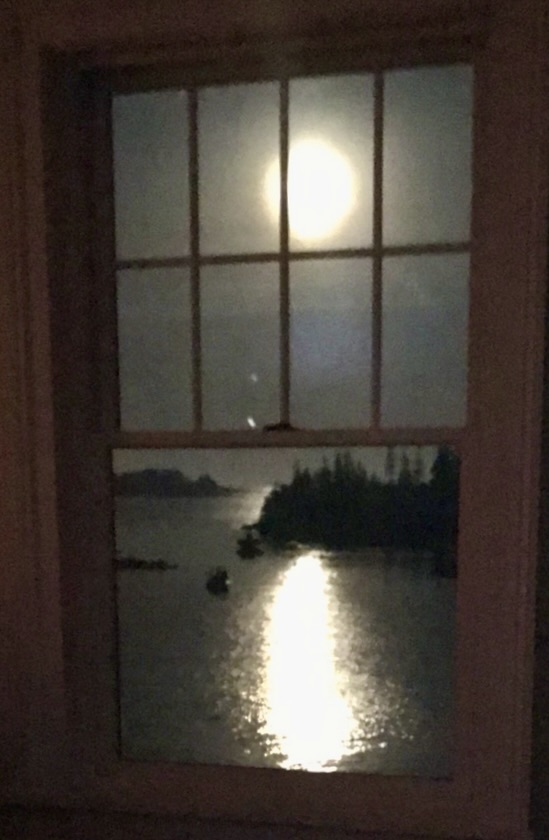
A half full white moon
in a cloudless and simple 
pale blue winter sky.

To be born into
the most estimable place
in the nick of time.

A Book of the Seasons,  by Henry Thoreau, 

A Book of the Seasons
,  by Henry Thoreau
 "A book, each page written in its own season, 
out-of-doors, in its own locality."
 ~edited, assembled and rewritten by zphx ©  2009-2024


https://tinyurl.com/HDT561205

Friday, July 27, 2012

Sunset from Fair Haven Hill.


July 27.

It has been a clear, cool, breezy day for the season. There is only one white bar of cloud in the north.  The river is silvery, as it were plated and polished smooth, with the slightest possible tinge of gold, to-night. The sun is now set.  All glow on the clouds is gone, except from one higher, small, rosy pink isle.  The solemnity of the evening sky!  Just before the earliest star I turn round, and there shines the moon, silvering the small clouds.

H. D. Thoreau, Journal, July 27, 1852


Tuesday. 4 p. m. — To Assabet behind Lee place. 

It is pleasing to behold at this season contrasted shade and sunshine on the side of neighboring hills. They are not so attractive to the eye when all in the shadow of a cloud or wholly open to the sunshine. Each must enhance the other. 

That the luxury of walking in the river may be perfect it must be very warm, such as are few days even in July, so that the breeze on those parts of the body that have just been immersed may not produce the least chilliness. It cannot be too warm, so that, with a shirt to fend the sun from your back, you may walk with perfect indifference, or rather with equal pleasure, alternately in deep and in shallow water. Both water and air must be unusually warm; otherwise we shall feel no impulse to cast ourselves into and remain in the stream. To-day it is uncomfortably cool for such a walk. 

It is very pleasant to walk up and down the stream, however, studying the further bank, which is six or seven feet high and completely covered with verdure of various kinds. 

I observe grape-vines with green clusters almost fully grown hanging over the water, and hazelnut husks are fully formed and are richly, autumnally, significant. Viburnum dentatum, elder, and red-stemmed cornel, all with an abundance of green berries, help clothe the bank, and the Asclepias incarnata and meadow-rue fill the crevices. Above all there is the cardinal-flower just opened, close to the water's edge, remarkable for its intense scarlet color, contrasting with the surrounding green. 

I see young breams in small schools, only one inch long, light-colored and semitransparent as yet, long in proportion to their depth. Some two inches long are ludicrously deep already, like little halibuts, making the impression, by their form, of vast size like halibuts or whales. They appear to be attended and guarded still by their parents. What innumerable enemies they have to encounter! 

The sun on the bottom is indispensable, and you must have your back to it. 

Woodcocks have been common by the streams and springs in woods for some weeks. 

Aster dumosus ( ?) by wood-paths. 

A quarter before seven p. m. — To Cliffs. 

It has been a clear, cool, breezy day for the season.

There is only one white bar of cloud in the north. I now perceive the peculiar scent of the corn-fields. The corn is just high enough, and this hour is favorable. I should think the ears had hardly set yet. Half an hour before sundown, you perceive the cool, damp air in valleys surrounded by woods, where dew is already formed. 

I am sure that if I call for a companion in my walk I have relinquished in my design some closeness of communion with Nature. The walk will surely be more commonplace. The inclination for society indicates a distance from Nature. I do not design so wild and mysterious a walk. 

The bigoted and sectarian forget that without religion or devotion of some kind nothing great was ever accomplished. 

On Fair Haven Hill. The slight distraction of picking berries is favorable to a mild, abstracted, poetic mood, to sequestered or transcendental thinking. I return ever more fresh to my mood from such slight interruptions. 

All the clouds in the sky are now close to the west horizon, so that the sun is nearly down before they are reached and lighted or gilded. Wachusett, free of clouds, has a fine purplish tinge, as if the juice of grapes had been squeezed over it, darkening into blue. I hear the scratching sound of a worm at work in this hardwood-pile on which I sit. 

We are most disturbed by the sun's dazzle when it is lowest. Now the upper edge of that low blue bank is gilt where the sun has disappeared, leaving a glory in the horizon through which a few cloudy peaks send raylike shadows. Now a slight rosy blush is spreading north and south over the horizon sky and tingeing a few small scattered clouds in the east. A blue tinge south ward makes the very edge of the earth there a mountain. That low bank of cloud in the west is now exactly the color of the mountains, a dark blue. 

We should think sacredly, with devotion. That is one thing, at least, we may do magnanimously. May not every man have some private affair which he can conduct greatly, unhurriedly? 

The river is silvery, as it were plated and polished smooth, with the slightest possible tinge of gold, tonight. How beautiful the meanders of a river, thus revealed! How beautiful hills and vales, the whole surface of the earth a succession of these great cups, falling away from dry or rocky edges to gelid green meadows and water in the midst, where night already is setting in! 

The thrush, now the sun is apparently set, fails not to sing. Have I heard the veery lately ? 

All glow on the clouds is gone, except from one higher, small, rosy pink or flesh-colored isle. The sun is now probably set. There are no clouds on high to reflect a golden light into the river. 

How cool and assuaging the thrush's note after the fever of the day! I doubt if they have anything so richly wild in Europe. So long a civilization must have banished it. It will only be heard in America, perchance, while our star is in the ascendant. I should be very much surprised if I were to hear in the strain of the nightingale such unexplored wildness and fertility, reaching to sundown, inciting to emigration. Such a bird must itself have emigrated long ago. 

Why, then, was I born in America ? I might ask. I should like to ask the assessors what is the value of that blue mountain range in the northwest horizon to Concord, and see if they would laugh or seriously set about calculating it. How poor, comparatively, should we be without it ! It would be descending to the scale of the merchant to say it is worth its weight in gold. The privilege of beholding it, as an ornament, a suggestion, a provocation, a heaven on earth. 

If I were one of the fathers of the town I would not sell this right which we now enjoy for all the merely material wealth and prosperity conceivable. If need were, we would rather all go down together. 

The huckleberry-bird as usual, and the nighthawk squeaks and booms, and the bullfrog trumps, just before the earliest star. The evening red is much more remarkable than the morning red. 

The solemnity of the evening sky! I turn round, and there shines the moon, silvering the small clouds which have gathered; she makes nothing red. 

New creaking or shrilling from crickets (?) for a long time past, more fine and piercing than the other.

 Aster dumosus (?) by wood-paths.

That the luxury of walking in the river may be perfect it must be very warm, such as are few days even in July .. See July 10, 1852 (" I make quite an excursion up and down the river in the water, a fluvial, a water walk. . . .Walking up and down a river in torrid weather with only a hat to shade the head.”); July 17, 1860 ("The soft sand on the bottom of Walden, as deep as I can wade, feels very warm to my feet, while the water feels cold.");July 22, 1851("I bathe, and in a few hours I bathe again, not remembering that I was wetted before. When I come to the river, I take off my clothes and carry them over, then bathe and wash off the mud and continue my walk. I would fain take rivers in my walks endwise.”).

If I call for a companion in my walk I have relinquished in my design some closeness of communion with Nature. The inclination for society indicates a distance from Nature. See July 26, 1852 ("By my intimacy with nature I find myself withdrawn from man. . . .The mind that perceives clearly any natural beauty is in that instant withdrawn from human society.")

 The solemnity of the evening sky! See July 26, 1852 ("The grandest picture in the world is the sunset sky."); December 27, 1851 ("Sunset from Fair Haven Hill.")

New creaking or shrilling from crickets . . . more fine and piercing than the other. See July 28, 1854 ("Last evening it was much cooler, and I heard a decided fall sound of crickets"); See also A Book of the Seasons, by Henry Thoreau, The Cricket in July

Before the first star
turn round and there shines the moon 
silvering small clouds.

Sunday, January 1, 2012

The stars are dazzlingly bright.


January 1


Moon little more than half full. Not a cloud in the sky.

It is a remarkably warm night for the season, the ground almost entirely bare. The stars are dazzlingly bright. 

The fault may be in my own barrenness, but methinks there is a certain poverty about the winter night's sky. 

The stars of higher magnitude are more bright and dazzling, and therefore appear more near and numerable, while those that appear indistinct and infinitely remote in the summer, imparting the impression of unfathomability to the sky, are scarcely seen at all. The front halls of heaven are so brilliantly lighted that they quite eclipse the more remote. 

The sky has fallen many degrees. The river has risen and flooded the meadows again. 

The white pines, now seen against the moon, with their single foliage, look thin. 

These are some of the differences between this and the autumn or summer nights: 
  • the stiffened glebe under my feet, 
  • the dazzle and seeming nearness of the stars, 
  • the duller gleam from ice on rivers and ponds,
  •  the white spots in the fields and streaks by the wall-sides where are the remains of drifts, yet unmelted. 

Perhaps the only thing that spoke to me on this walk was the bare, lichen-covered gray rock at the Cliff, in the moonlight, naked and almost warm as in summer.


H. D. Thoreau, Journal, January 1, 1852

Moon little more than half full. Not a cloud in the sky.
See October 1, 1851("The moon not quite half full. The twilight is much shorter now than a month ago, probably as the atmosphere is clearer and there is less to reflect the light."); December 5, 1856 ("It is a perfectly cloudless and simple winter sky. A white moon, half full, in the pale or dull blue heaven and a whiteness like the reflection of the snow, extending up from the horizon. ") See also A Book of the Seasons, by Henry Thoreau, January Moonlight

The stars dazzlingly bright.
See December 31, 1851 (“I have not enough valued and attended to the pure clarity and brilliancy of the winter skies . . . in which the stars shine and twinkle so brightly in this latitude.”); January 29, 1854 ("Tonight I feel it stinging cold . . . it bites my ears and face, but the stars shine all the brighter.”)

The fault may be in my own barrenness, but methinks there is a certain poverty about the winter night's sky. See December 27, 1851 ("The sky is always ready to answer to our moods."); January 17, 1852 ("As the skies appear to a man, so is his mind."); See also July 23, 1851 ("The mind is subject to moods, as the shadows of clouds pass over the earth.")

The differences between this and the autumn or summer nights . . .the dazzle and seeming nearness of the stars, See December 31, 1851 (I have not enough valued and attended to the pure clarity and brilliancy of the winter skies. Consider in what respects the winter sunsets differ from the summer ones. Shall I ever in summer evenings see so celestial a reach of blue sky contrasting with amber as I have seen a few days since. The day sky in winter corresponds for clarity to the night sky, in which the stars shine and twinkle so brightly in this latitude. "); February 3, 1852 ("The heavens appear less thickly starred than in summer, - rather a few bright stars, brought nearer by this splendid twinkling in the cold sky."); Compare December 27, 1851 ("There is no winter necessarily in the sky. . .The heavens present, perhaps, pretty much the same aspect summer and winter.")

The bare lichen-covered gray rock in the moonlight, naked and almost warm as in summer.
See May 16, 1851 ("A splendid full moon to-night. Walked from 6. 30 to 10 P M. Lay on a rock near a meadow, which had absorbed and retained much heat, so that I could warm my back on it"); August 2, 1854 (“I sit on rock on the hilltop, warm with the heat of the departed sun, in my thin summer clothes.”) 

I see a lichen
on a rock in a meadow –
a perfect circle.


January 1. See A Book of the Seasonsby Henry Thoreau, January 1

Lichen-covered rock
almost warm as in summer –
naked in moonlight.

A Book of the Seasons,  by Henry Thoreau
"A book, each page written in its own season,
out-of-doors, in its own locality.”
~edited, assembled and rewritten by zphx © 2009-2025

https://tinyurl.com/hdt-520101

Friday, August 5, 2011

Moon half full.

August 5. 

7:30 - I sit beside Hubbard's Grove. A few level red bars above the horizon; a dark, irregular bank beneath them, with a streak of red lay below, on the horizon's edge.

When the moon is on the increase and half full, it is already in mid-heavens at sunset, so that there is no marked twilight intervening.

It is 8 o'clock. The air is still. I hear the voices of loud-talking boys in the early twilight, it must be a mile off. The swallows go over with a watery twittering. I hear the whip-poor-will at a distance.

It is almost dark. I distinguish the modest moonlight on my paper.  

Moonlight is like a cup of cold water to a thirsty man. As the twilight deepens and the moonlight is more and more bright, I begin to distinguish myself, who I am and where. I become more collected and composed, and sensible of my own existence, as when a lamp is brought into a dark apartment and I see who the company are.

With the coolness and the mild silvery light, I recover some sanity, my thoughts are more distinct, moderated, and tempered. Reflection is more possible.  I am sobered by the moonlight. I bethink myself.

The question is not what you look at, but what you see.

H. D. Thoreau, Journal, August 5, 1851

The question is not what you look at, but what you see. See September 13, 1852 ("Be not preoccupied with looking. Go not to the object; let it come to you. . . .”); Compare July 2 1857 (“Many an object is not seen, though it falls within the range of our visual ray, because . . . we are not looking for it. So, in the largest sense, we find only the world we look for.”)

I begin to distinguish myself, who I am and where . . . See August 8, 1852 ("I. . . am sensible of a certain doubleness by which I can stand as remote from myself as from another.")

Sobered by moonlight
sensing my own existence
who I am and where. 

*****


As the twilight deepens and the moonlight is more and more bright, I begin to distinguish myself, who I am and where; as my walls contract, I become more collected and composed, and sensible of my own existence, as when a lamp is brought into a dark apartment and I see who the company are. With the coolness and the mild silvery light, I recover some sanity, my thoughts are more distinct, moderated, and tempered. Reflection is more possible while the day goes by. The intense light of the sun unfits me for meditation, makes me wander in my thought; my life is too diffuse and dissipated; routine succeeds and prevails over us; the trivial has greater power then, and most at noonday, the most trivial hour of the twenty-four. I am sobered by the moonlight. I bethink myself. It is like a cup of cold water to a thirsty man. The moonlight is more favorable to meditation than sunlight. The sun lights this world from without, shines in at a window, but the moon is like a lamp within an apartment. It shines for us. The stars themselves make a more visible, and hence a nearer and more domestic, roof at night. Nature broods us, and has not left our germs of thought to be hatched by the sun. We feel her heat and see her body darkening over us. Our thoughts are not dissipated, but come back to us like an echo. The different kinds of moonlight are infinite. This is not a night for contrasts of light and shade, but a faint diffused light in which there is light enough to travel, and that is all.

Ah, what a poor, dry compilation is the "Annual of Scientific Discovery !" I trust that observations are made during the year which are not chronicled there, — that some mortal may have caught a glimpse of Nature in some corner of the earth during the year 1851. One sentence of perennial poetry would make me forget, would atone for, volumes of mere science. The astronomer is as blind to the significant phenomena, or the significance of phenomena, as the wood-sawyer who wears glasses to defend his eyes from sawdust. The question is not what you look at, but what you see.

I hear now from Bear Garden Hill — I rarely walk by moonlight without hearing — the sound of a flute, or a horn, or a human voice. It is a performer I never see by day; should not recognize him if pointed out; but you may hear his performance in every horizon. He plays but one strain and goes to bed early, but I know by the character of that single strain that he is deeply dissatisfied with the manner in which he spends his day. He is a slave who is purchasing his freedom. He is Apollo watching the flocks of Admetus on every hill, and this strain he plays every evening to remind him of his heavenly descent. It is all that saves him, — his one redeeming trait. It is a reminiscence ; he loves to remember his youth. He is sprung of a noble family. He is highly related, I have no doubt; was tenderly nurtured in his infancy, poor hind as he is. That noble strain he utters, instead of any jewel on his finger, or precious locket fastened to his breast, or purple garments that came with him. The elements recognize him, and echo his strain. All the dogs know him their master, though lords and ladies, rich men and learned, know him not. He is the son of a rich man, of a famous man who served his country well. He has heard his sire's stories. I thought of the time when he would discover his parent age, obtain his inheritance and sing a strain suited to the morning hour. He cherishes hopes. I never see the man by day who plays that clarionet.

The distant lamps in the farmhouse look like fires. The trees and clouds are seen at a distance reflected in the river as by day. I see Fair Haven Pond from the Cliffs, as it were through a slight mist. It is the wildest scenery imaginable, — a Lake of the Woods. I just remembered the wildness of St. Anne's. That's the Ultima Thule of wildness to me.

 What an entertainment for the traveller, this incessant motion apparently of the moon traversing the clouds! Whether you sit or stand, it is always preparing new developments for you. It is event enough for simple minds. You all alone, the moon all alone, overcoming with incessant victory whole squadrons of clouds above the forests and the lakes and rivers and the mountains. You cannot always calculate which one the moon will undertake next.

 I see a solitary firefly over the woods.

The moon wading through clouds; though she is eclipsed by this one, I see her shining on a more distant but lower one. The entrance into Hubbard's Wood above the spring, coming from the hill, is like the entrance to a cave; but when you are within, there are some streaks of light on the edge of the path.

All these leaves so still, none whispering, no birds in motion, — how can I be else than still and thoughtful?

Tuesday, August 24, 2010

Coming to the window, August 23, 1852

August 23.

The perception of surfaces will always have the effect of miracle.

Now I sit on the Cliffs and look abroad over the river and Conantum hills.

I live so much in my habitual routine of thoughts, that I forget there is any outside to the globe and am surprised when I behold it as now, - yonder hills and river in the moonlight, the monsters. 

What are these rivers and hills, these hieroglyphics which my eyes behold?

There is something invigorating in this air, which I am peculiarly sensible is a real wind blowing from over the surface of a planet. 

I look out at my eyes, I come to my window, and I feel and breathe the fresh air. It is a fact equally glorious with the most inward experience.

I can see Nobscot faintly.

H. D. Thoreau, Journal, August 23, 1852

What are these rivers and hills, these hieroglyphics which my eyes behold? See November 21, 1850 ("What are these things?")


How adapted these forms and colors to my eye! A meadow and an island! I am made to love the pond and the meadow, as the wind is made to ripple the water.")

I am peculiarly sensible is a real wind blowing from over the surface of a planet. I look out at my eyes, I come to my window, and I feel and breathe the fresh air. See The Maine Woods ("daily to be shown matter, to come in contact with it-rocks, trees, wind on our cheeks! the solid earth! the actual world! the common sense! Contact! Contact! Who are we? where are we?”); Walden ("And we are enabled to apprehend at all what is sublime and noble only by the perpetual instilling and drenching of the reality that surrounds us")


About 8 p.m.- To Cliffs, moon half full. 

As I go up the back road, I hear the loud ringing creak of crickets, louder singers on each apple tree by the roadside, with an intermittent pulsing creak. Not the sound of a bird all the way to the woods.

How dark the shadows of the pines and oaks fall across the woodland path! There is a new tree, another forest in the shadow. It is pleasant walking in these forest paths, with heavy darkness on one side and a silvery moonlight on the oak leaves on the other, and again, when the trees meet overhead, to tread the checkered floor of finely divided light and shade. 

I hear a faint metallic titter from a bird, so faint that if uttered at noonday it would not be heard, — not so loud as a cricket. I cannot remember the last moon. Now that birds and flowers fall off, fruits take their places, and young birds in flocks. 

What a list of bright-colored, sometimes venomous-looking berries spot the swamps and copses amid changing leaves! For colors they will surpass the flowers, methinks. There is some thing rare, precious, and gem-like about them. Now is their time, and I must attend to them. Some, like grapes, we gather and eat, but the fairest are not edible. 

Now I sit on the Cliffs and look abroad over the river and Conantum hills. I live so much in my habitual thoughts, a routine of thought, that I forget there is any outside to the globe, and am surprised when I behold it as now, — yonder hills and river in the moon light, the monsters. Yet it is salutary to deal with the surface of things. What are these rivers and hills, these hieroglyphics which my eyes behold ? There is some thing invigorating in this air, which I am peculiarly sensible is a real wind, blowing from over the surface of a planet. I look out at my eyes, I come to my window, and I feel and breathe the fresh air. It is a fact equally glorious with the most inward experience. Why have we ever slandered the outward? The perception of surfaces will always have the effect of miracle to a sane sense. I can see Nobscot faintly. 

Descend the rocks and return through woods to railroad. How picturesque the moonlight on rocks in the woods! To-night there are no fireflies, no nighthawks nor whip-poor-wills.

Popular Posts Last 30 Days.

The week ahead in Henry’s journal

The week ahead in Henry’s journal
A journal, a book that shall contain a record of all your joy.
"A stone fruit. Each one yields me a thought." ~ H. D. Thoreau, March 28, 1859


I sit on this rock
wrestling with the melody
that possesses me.