November 24.
Setting stakes in the swamp (Ministerial). Saw seven black ducks fly out of the peat-hole.
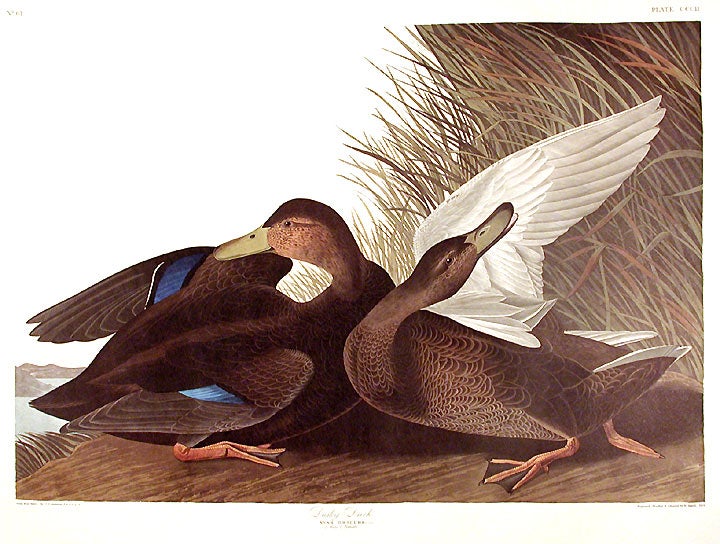
J.J. Audubon (The flight of this Duck, which, in as far as I know, is peculiar to America, is powerful, rapid, and as sustained as that of the Mallard. While travelling by day they may be distinguished from that species by the whiteness of their lower wing-coverts, which form a strong contrast to the deep tints of the rest of their plumage )
Saw there also a tortoise still stirring, the painted tortoise, I believe.
Found on the south side of the swamp the Lygodium palmatum, which Bigelow calls the only climbing fern in our latitude, an evergreen, called (with others) snake tongue, as I find in Loudon.
The Irishman who helped me says, when I ask why his countrymen do not learn trades, — do something but the plainest and hardest work, — they are too old to learn trades when they come here.
Setting stakes in the swamp (Ministerial). See November 14, 1851 ("Surveying the Ministerial Lot in the southwestern part of the town."); November 18,1851 ("Surveying these days the Ministerial Lot . . .I hear the hooting of an owl . . . Here hawks also circle by day, and chickadees are heard, and rabbits and partridges abound."); December 21, 1851 (“As I stand by the edge of the swamp (Ministerial), a heavy-winged hawk flies home to it at sundown, just over my head, in silence.”); December 13, 1857 ("I go this afternoon thinking I may find the stakes set for auction lots on the Ministerial Lot in December, '51") See also July 7, 1854 ("See a pretty large hawk. . . circling over the Ministerial Swamp.")
Saw seven black ducks fly out of the peat-hole. See September 24, 1855 ("See coming from the south in loose array some twenty apparently black ducks, . . .At first they were in form like a flock of blackbirds, then for a moment assumed the outline of a fluctuating harrow. ); September 29, 1851 ("Scared up three black ducks, which rose with a great noise of their wings, striking the water. "); September 30, 1853 ("Saw a large flock of black ducks flying northwest in the form of a harrow."); November 3, 1852 ("At Andromeda Pond, started nine black (?) ducks just at sunset, as usual they circling far round to look at me."); November 11, 1851 ("In the withered grass at Nut Meadow Brook, two black ducks, . . .rise black between me and the sun, but, when they have circled round to the east, show some silvery sheen on the under side of their wings. "); March 12, 1859 ("See two ducks flying over Ministerial Swamp.") See also A Book of the Seasons, by Henry Thoreau, the American Black Duck)
Found on the south side of the swamp the Lygodium palmatum See November 30, 1851 ("The Lygodium palmatum is quite abundant on that side of the swamp, twining round the goldenrods, etc., etc"); October 2, 1859 (“The climbing fern is perfectly fresh, — and apparently therefore an evergreen, — the more easily found amid the withered cinnamon and flowering ferns.”); May 1, 1859 ("The climbing fern is persistent, i.e. retains its greenness still, though now partly brown and withered.") See also November 24, 1852 ("At this time last year the andromeda in the Ministerial Swamp was red . Now it has not turned from brown."): November 20, 1857 ("I enter the Ministerial Swamp at the road below Tarbell’s. The water andromeda leaves are brown now, except where protected by trees. In some places where many of the bright-crimson shoots of high blueberry are seen together, they have a very pretty effect"); April 29, 1857 ("Sweet-fern at entrance of Ministerial Swamp."); May 19, 1860 (“At the Ministerial Swamp I see a white lady's-slipper almost out, fully grown, with red ones.”); August 28, 1860 ("The Lycopodium inundatum common by Harrington's mud-hole, Ministerial Swamp.")
Found on the south side of the swamp the Lygodium palmatum, which Bigelow calls the only climbing fern in our latitude, an evergreen, called (with others) snake tongue, as I find in Loudon.
The Irishman who helped me says, when I ask why his countrymen do not learn trades, — do something but the plainest and hardest work, — they are too old to learn trades when they come here.
H. D. Thoreau, Journal, November 24, 1851
Setting stakes in the swamp (Ministerial). See November 14, 1851 ("Surveying the Ministerial Lot in the southwestern part of the town."); November 18,1851 ("Surveying these days the Ministerial Lot . . .I hear the hooting of an owl . . . Here hawks also circle by day, and chickadees are heard, and rabbits and partridges abound."); December 21, 1851 (“As I stand by the edge of the swamp (Ministerial), a heavy-winged hawk flies home to it at sundown, just over my head, in silence.”); December 13, 1857 ("I go this afternoon thinking I may find the stakes set for auction lots on the Ministerial Lot in December, '51") See also July 7, 1854 ("See a pretty large hawk. . . circling over the Ministerial Swamp.")
Saw seven black ducks fly out of the peat-hole. See September 24, 1855 ("See coming from the south in loose array some twenty apparently black ducks, . . .At first they were in form like a flock of blackbirds, then for a moment assumed the outline of a fluctuating harrow. ); September 29, 1851 ("Scared up three black ducks, which rose with a great noise of their wings, striking the water. "); September 30, 1853 ("Saw a large flock of black ducks flying northwest in the form of a harrow."); November 3, 1852 ("At Andromeda Pond, started nine black (?) ducks just at sunset, as usual they circling far round to look at me."); November 11, 1851 ("In the withered grass at Nut Meadow Brook, two black ducks, . . .rise black between me and the sun, but, when they have circled round to the east, show some silvery sheen on the under side of their wings. "); March 12, 1859 ("See two ducks flying over Ministerial Swamp.") See also A Book of the Seasons, by Henry Thoreau, the American Black Duck)
Saw a tortoise still stirring, the painted tortoise, I believe. See November 14, 1855 ("A painted tortoise swimming under water and a wood tortoise out on the bank."); November 27, 1856 ("Take a turn down the river. A painted tortoise sinking to the bottom, and apparently tree sparrows along the shore"); December 2, 1857 ("Measuring Little Goose Pond, I observed two painted tortoises moving about under the thin transparent ice"); December 3, 1852 (" In a ditch near by, under ice half an inch thick, I saw a painted tortoise moving about.") See also A Book of the Seasons, by Henry Thoreau, the Painted Turtle (Emys picta)
Found on the south side of the swamp the Lygodium palmatum See November 30, 1851 ("The Lygodium palmatum is quite abundant on that side of the swamp, twining round the goldenrods, etc., etc"); October 2, 1859 (“The climbing fern is perfectly fresh, — and apparently therefore an evergreen, — the more easily found amid the withered cinnamon and flowering ferns.”); May 1, 1859 ("The climbing fern is persistent, i.e. retains its greenness still, though now partly brown and withered.") See also November 24, 1852 ("At this time last year the andromeda in the Ministerial Swamp was red . Now it has not turned from brown."): November 20, 1857 ("I enter the Ministerial Swamp at the road below Tarbell’s. The water andromeda leaves are brown now, except where protected by trees. In some places where many of the bright-crimson shoots of high blueberry are seen together, they have a very pretty effect"); April 29, 1857 ("Sweet-fern at entrance of Ministerial Swamp."); May 19, 1860 (“At the Ministerial Swamp I see a white lady's-slipper almost out, fully grown, with red ones.”); August 28, 1860 ("The Lycopodium inundatum common by Harrington's mud-hole, Ministerial Swamp.")


