Showing posts with label frog spawn. Show all posts

Saturday, September 1, 2018

Surprised to see frog spawn

September 1

P. M. — To Botrychium Swamp. 

Aster miser not long, but the leaves turned red. 

At the pool by the oaks behind Pratt’s, I see the Myriophyllum ambiguum still, and going to seed, greening the surface of the water. 

The Leersia oryzoides, false rice, or rice cut-grass, is abundant and in prime on the shore there. Also find it on the shore of Merrick’s pasture. It has very rough sheaths. 

Am surprised to see frog(?) spawn just laid, neither in spherical masses nor in a string, but flatted out thin on the surface, some eight or nine inches wide, — a small black spawn, white one side, as usual. 
I saw one or two R. fontinalis on the shore. Was it toad-spawn? 
Ranunculus repens
Ranunculus repens in bloom — as if begun again ? — at the violet wood-sorrel spring. 

Chelone glabra well out, how long? In the same meadow, Aster longifolius well out, not long. That meadow is white with the Eriophorum polystachyon, apparently var. augustifolium (?). Vide it pressed. 

On dry land, common, but apparently getting stale, Panicum clandestinum

Dangle-berries now ready for picking. 

At Botrychium Swamp, Nabalus altissimus. Of twenty plants (all in shade) only one out, apparently two or three days. Elsewhere,in open land, N. Fraseri, apparently several days, say five; but not a very rough one. 

Ledum Telephium, how long? 

In the evening, by the roadside, near R. W. E.’s gate, find a glow-worm of the common kind. Of two men, Dr. Bartlett and Charles Bowen, neither had ever seen it!

H. D. Thoreau, Journal, September 1, 1858


Rice cut-grass. Thoreau’s notes it also  on August 28, 1854 and August 1, 1856 at Great Meadows, on August 24, 1859 at the roadside of Corner road by the brook, on August 26, 1859 in prime at Potter’s holes, and on August 26, 1860 in the old pad ditch by the path beyond Hubbard’s Grove. - vascular plants of concord

Ranunculus repens in bloom — as if begun again ? — at the violet wood-sorrel spring. See August 10, 1853 (“The Ranunculus repens numerously out about Britton's Spring.”)

Aster longifolius well out. See September 1, 1856 ("A. longifolius, hardly one seen yet.”)

At Botrychium Swamp, Nabalus altissimus. Of twenty plants (all in shade) only one out.  See September 8, 1856 ("Along this path observed the Nabalus altissimus, flowers in a long panicle of axillary and terminal branches, small-flowered, now in prime.”)

Find a glow-worm of the common kind. Of two men, Dr. Bartlett and Charles Bowen, neither had ever seen it! See January 15, 1858 ("Dr. Durkee . . .has not seen the common glow-worm . . . Showed to Agassiz, Gould, and Jackson, and it was new to them.”)

Saturday, May 12, 2018

They use this wood for coffins.

May 12
May 12, 2018

Chimney swallows. 

P. M. – Up Assabet. - 

On the 8th I noticed a little pickerel recently dead in the river with a slit in its upper lip three quarters of an inch long, apparently where a hook had pulled out. There was a white fuzzy swelling at the end of the snout accordingly, and this apparently had killed it. 

It rained last night, and now I see the elm seed or samarae generally fallen or falling. It not only strews the street but the surface of the river, floating off in green patches to plant other shores. The rain evidently hastened its fall. 

This must be the earliest of trees and shrubs to go to seed or drop its seed. The white maple keys have not fallen. The elm seed floats off down the stream and over the meadows, and thus these trees are found bordering on the stream. 

By the way, I notice that birches near meadows, where there is an exceedingly gentle inclination, grow in more or less parallel lines a foot or two apart, parallel with the shore, apparently the seed having been dropped there either by a freshet or else lodged in the parallel waving hollows of the snow. 

It clears off in the forenoon and promises to be warm in the afternoon, though it at last becomes cool. 

I see now, as I go forth on the river, the first summer shower coming up in the northwest, a dark and well defined cloud with rain falling sheaf-like from it, but fortunately moving off northeast along the horizon, or down the river. The peculiarity seems to be that the sky is not generally overcast, but elsewhere, south and northeast, is a fair-weather sky with only innocent cumuli, etc., in it. 

The thunder-cloud is like the ovary of a perfect flower. Other showers are merely staminiferous or barren. There are twenty barren to one fertile. It is not commonly till thus late in the season that the fertile are seen. In the thunder-cloud, so distinct and condensed, there is a positive energy, and I notice the first as the bursting of the pollen-cells in the flower of the sky. 

Waded through the west-of-rock, or Wheeler, meadow," but I find no frog-spawn there!! I do not even notice tadpoles. Beside that those places are now half full of grass, some pools where was spawn are about dried up (!), as that in Stow's land by railroad. Where are the tadpoles? 

There is much less water there than a month ago. Where, then, do the Rana palustris lay their spawn? I think in the river, because it is there I hear them, but I cannot see any. Perhaps they choose pretty deep water, now it is so warm. 

Now and for a week I have noticed a few pads with wrinkled edges blown up by the wind. 

Already the coarse grass along the meadow shore, or where it is wettest, is a luxuriant green, answering in its deep, dark color to the thunder-cloud, – both summer phenomena, – as if it too had some lightning in its bosom. 

Some early brakes at the Island woods are a foot high and already spread three or four inches. 

The Polygonatum pubescens is strongly budded. 

The Salix lucida above Assabet Spring will not open for several days. 

The early form of the cinquefoil is now apparently in prime and very pretty, spotting the banks with its clear bright yellow. 

See apparently young toad tadpoles now, -- judging from their blackness, -- now quite free from the eggs or spawn. If I remember rightly, the toad is colored and spotted more like a frog at this season when it is found in the water. 

Observed an Emys insculpta, as often before, with the rear edge on one side of its shell broken off for a couple of inches, as if nibbled by some animal. Do not foxes or musquash do this? In this case the under jaw was quite nervy. 

Found a large water adder by the edge of Farmer’s large mud-hole, which abounds with tadpoles and frogs, on which probably it was feeding. It was sunning on the bank and would face me and dart its head toward me when I tried to drive it from the water. It is barred above, but indistinctly when out of water, so that it then appears almost uniformly dark-brown, but in the water broad reddish-brown bars are seen, very distinctly alternating with very dark brown ones. 

The head was very flat and suddenly broader than the neck behind. Beneath it was whitish and red dish flesh-color.  It was about two inches in diameter at the thickest part. They are the biggest and most formidable-looking snakes that we have. The inside of its mouth and throat was pink. It was awful to see it wind along the bottom of the ditch at last, raising wreaths of mud, amid the tadpoles, to which it must be a very sea-serpent. 

I afterward saw another running under Sam Barrett’s grist-mill the same after noon. He said that he saw a water snake, which he distinguished from a black snake, in an apple tree near by, last year, with a young robin in its mouth, having taken it from the nest. There was a cleft or fork in the tree which enabled it to ascend. 

Find the Viola Muhlenbergii abundantly out (how long?), in the meadow southwest of Farmer's Spring. 

The cinnamon and interrupted ferns are both about two feet high in some places. The first is more uniformly woolly down the stem, the other, though very woolly at top, being partly bare on the stem. The wool of the last is coarser. 

George, the carpenter, says that he used to see a great many stone-heaps in the Saco in Bartlett, near the White Mountains, like those in the Assabet, and that there were no lampreys there and they called them “snake-heaps.” 

Saw some unusually broad chestnut planks, just sawed, at the mill. Barrett said that they came from Lincoln; whereupon I said that I guessed I knew where they came from, judging by their size alone, and it turned out that I was right. I had often gathered the nuts of those very trees and had observed within a year that they were cut down. 

So it appears that we have come to this, that if I see any peculiarly large chestnuts at the sawmill, I can guess where they came from, even know them in the log. These planks were quite shaky, and the heart had fallen out of one. Barrett said that it was apt to be the case with large chestnut. 

They use this wood for coffins, instead of black walnut.

H. D. Thoreau, Journal, May 12, 1858

George, the carpenter, says that he used to see a great many stone-heaps in the Saco and that there were no lampreys there and they called them “snake-heaps.” See May 8, 1858 ("Mr. Wright , an old fisherman, thinks the stone-heaps are not made by lamprey. May 4, 1858 ("I asked [a fisherman] if he knew what fish made the stone-heaps in the river. He said the lamprey eel.”)

Find the Viola Muhlenbergii abundantly out (how long?), in the meadow southwest of Farmer's Spring. See May 22, 1856 ("Viola Muhlenbergii is abundantly out; how long?"); May 16, 1857 ("Viola Muhlenbergii abundantly out, how long?”)


Wednesday, May 9, 2018

This makes the fifth kind of frog or toad spawn that I have detected this year..

May 9. 

P. M. – To Holden and to Ledum Swamp. 

See two Rana halecina. They have the green halo, but are plain brown between the spots on the back and not vivid light-green like the one of May 4th

See in Ludwigia palustris ditch on Hubbard’s land evidently toad-spawn already hatched, or flatted out. I distinguish the long strings, now straighter than usual and floating thin on the surface. It is less obvious than frog-spawn, and might easily be overlooked on a slimy surface. I can distinguish the little pollywog while yet in the ova by their being quite small and very black. 

This makes the fifth kind of frog or toad spawn that I have detected this year.

See, in the Holden Swamp wood, the bird of May 3dIt has sly and inquisitive ways, holding down its head and looking at me at some distance off. It has a distinct white line along the bill and about the eyes, and no yellow there, as is said of the white-eyed vireo, and I am now inclined to think it the solitary vireo (?), whose song is not described, and which is considered rare. I should say it had a blue-slate head, and, I note, a distinct yellowish vent, which none of the vireos are allowed to have!! The sides of the body are distinctly yellow, but there is none at all on the throat or breast. 

Vaccinium Pennsylvanicum, – how long? — by owl nest tree. 


Sylvia Americana
The parti-colored warbler is very common and musical there, — my tweezer-bird, – making the screep screep screep note. It is an almost incessant singer and a very handsomely marked bird. It frequents the spruce trees, at regular intervals pausing as it flits, hops, and creeps about from limb to limb or up the main stem, and holding up its head, utters its humble notes, like ah twze twze twze, or ah twze twze twze twze.

I notice very large clams, apparently the Unio complanatus (vide two specimens in drawer), or common, in West Meadow Brook near the road, one more than four and a half inches long. I have before seen them very large in brooks. 


A dandelion perfectly gone to seed, a complete globe, a system in itself. 

My Rana palustris spawn, laid in house May 5th, in the sun this afternoon swells and rises to the surface in the jar, so that the uppermost ova project slightly above it.

H. D. Thoreau, Journal, May 9, 1858

The fifth kind of frog or toad spawn. See note to May 6, 1858 (Frogs of Massachusetts)

The parti-colored warbler — my tweezer-bird. See May 18, 1856 ("A Sylvia Americana, — parti-colored warbler, — in the Holden Wood, sings a, tshrea tshrea tshrea, tshre’ tshritty tshrit’." and note to May 13, 1856 ("The tweezer-bird or Sylvia Americana. . . . the parti-colored warbler, and was that switter switter switter switter swit also by it?.”) See also A Book of Seasons,  by Henry Thoreau, The Parti-Colored (Parula) Warbler (Sylvia Americana)

The bird of May 3d. . . . I am now inclined to think it the solitary vireo. See May 3, 1858.("See and hear a new bird to me. At first it was silent, and I took it for the common pewee, but, bringing my glass to bear on it, found it to be pure white throat and beneath, yellow on sides of body or wings, greenish-yellow back and shoulders, a white or whitish ring about eyes, and a light mark along side of head,
two white bars on wings, apparently black bill and dark or perhaps slate-colored (?) wings and above tail. It surprised me by singing in a novel and powerful and rich strain.")

Sunday, May 6, 2018

Thermometers, hygrometers, and barometers. Frogs of Massachusetts

May 6 

I heard from time to time a new note from my Rana palustris in the firkin in my chamber. It was that strong vibratory purr or prr-r-r-a-a-a, as if it began with a p, lasting two or three seconds and sometimes longer. In the firkin near my bed, it sounded just like a vibrating sliver which struck hard and rapidly against the rail [it] belonged to, – dry, like a fine and steady watchman's rattle sounding but little while. I recognized it as a sound I hear along the riverside. It was like the tut tut tut more sharply and very rapidly or closely sounded perchance; perhaps even like the tapping of a woodpecker. Yes, quite like it thus close by. 

This morning that spawn laid night before last has expanded to three and a half inches in diameter. 

P. M. — To Trillium Wood. 

It is a muggy and louring afternoon, and I go looking for toad spawn and for frogs. 

In all cases in which I have noticed frogs coupled this year, — the sylvatica, halecina, and palustris, - the female has been considerably the largest. 

The most common frog that I get sight of along the brooks and ditches this afternoon, and indeed for some weeks in similar localities and even in some parts of the river shore, is what I have called the young R. pipiens, with commonly a dull-green head and sides of head, sometimes bright green, and back dusky-spotted. Can this be the bull frog? Is it not the fontinalis with less bright green and a white throat? Sometimes it is yellow-throated. 

I saw lately in the river a full-grown bullfrog, with, I think, a white throat. I see a Rana sylvatica by a ditch in Stow’s meadow, fifteen rods from the (Trillium) Wood. 

The Salix rostrata staminate flowers are of very peculiar yellow, — a bright, what you might call yellow yellow. 

A boy brings me to-day an Attacus Cecropia moth which has come out of a cocoon in his trunk. It is, I think, the male, a dark brown above, and considerably larger than mine. It must be about seven inches in alar extent. 

Minott remembers the Rana palustris, or yellow legged one, as “ the one that stinks so,” as if that scent were peculiar to it. I suppose it is. He says that the white-legged one (the halecina) was preferred for invalids, i. e. their legs, as being sweeter. He says that there used to be a great many more bullfrogs than there are now, and what has got them he does not know. 

About 9 P. M. I went to the edge of the river to hear the frogs. It was a warm and moist, rather foggy evening, and the air full of the ring of the toad, the peep of the hylodes, and the low growling croak or stertoration of the Rana palustris. Just there, however, I did not hear much of the toad, but rather from the road, but I heard the steady peeping of innumerable hylodes for a background to the palustris snoring, further over the meadow. 

There was a universal snoring of the R. palustris all up and down the river on each side, the very sounds that mine made in my chamber last night, and probably it began in earnest last evening on the river. It is a hard, dry, unmusical, fine watchman’s-rattle-like stertoration, swelling to a speedy conclusion, lasting say some four or five seconds usually. The rhythm of it is like that of the toads’ ring, but not the sound. This is considerably like that of the tree-toad, when you think of it critically, after all, but is not so musical or sonorous as that even. There is an occasional more articulate, querulous, or rather quivering, alarm note such as I have described (May 2d). 

Each shore of the river now for its whole length is all alive with this stertorous purring. It is such a sound as I make in my throat when I imitate the growling of wild animals. I have heard a little of it at intervals for a week, in the warmest days, but now at night it [is] universal all along the river. If the note of the R. halecina, April 3d, was the first awakening of the river meadows, this is the second, —considering the hylodes and toads less (?) peculiarly of the river meadows. Yet how few distinguished this sound at all, and I know not one who can tell what frog makes it, though it is almost as universal as the breeze itself. 

The sounds of those three reptiles now fill the air, especially at night. The toads are most regardless of the light, and regard less a cold day than the R. palustris does. In the mornings now, I hear no R. palustris and no hylodes, but a few toads still, but now, at night, all ring together, the toads ringing through the day, the hylodes beginning in earnest toward night and the palustris at evening. I think that the different epochs in the revolution of the seasons may perhaps be best marked by the notes of reptiles. They express, as it were, the very feelings of the earth or nature. They are perfect thermometers, hygrometers, and barometers. 

One of our cherries opens. 

I heard a myrtle-bird's tull-lull yesterday, and that somebody else heard it four or five days ago. 

Many are catching pouts this louring afternoon, in the little meadow by Walden. 

May 6, 2017


The thinker, he who is serene and self-possessed, is the brave, not the desperate soldier. He who can deal with his thoughts as a material, building them into poems in which future generations will delight, he is the man of the greatest and rarest vigor, not sturdy diggers and lusty polygamists. He is the man of energy, in whom subtle and poetic thoughts are bred. Common men can enjoy partially; they can go a-fishing rainy days; they can read poems perchance, but they have not the vigor to beget poems. They can enjoy feebly, but they cannot create. Men talk of freedom! How many are free to think? free from fear, from perturbation, from prejudice? Nine hundred and ninety-nine in a thousand are perfect slaves. How many can exercise the highest human faculties? He is the man truly — courageous, wise, ingenious - who can use his thoughts and ecstasies as the material of fair and durable creations. One man shall derive from the fisherman’s story more than the fisher has got who tells it. The mass of men do not know how to cultivate the fields they traverse. The mass glean only a scanty pittance where the thinker reaps an abundant harvest. What is all your building, if you do not build with thoughts? No exercise implies more real manhood and vigor than joining thought to thought. How few men can tell what they have thought! I hardly know half a dozen who are not too lazy for this. They cannot get over some difficulty, and therefore they are on the long way round. You conquer fate by thought. If you think the fatal thought of men and institutions, you need never pull the trigger. The consequences of thinking inevitably follow. There is no more Herculean task than to think a thought about this life and then get it expressed. - Horticulturalists think that they make flower-gardens, though in their thoughts they are barren and flowerless, but to the poet the earth is a flower-garden wherever he goes, or thinks. Most men can keep a horse or keep up a certain fashionable style of living, but few indeed can keep up great expectations. They justly think very meanly of themselves.

H. D. Thoreau, Journal, May 6, 1858

The Salix rostrata staminate flowers are of very peculiar yellow, — a bright, what you might call yellow yellow. See May 5, 1857 ("Staminate Salix rostrata, possibly yesterday.”); June 6, 1856 ("That willow, male and female, opposite to Trillium Woods on the railroad, I find to be the Salix rostrata, or long-beaked willow, one of the ochre-flowered . . . willows”); May 2, 1859 (“I see on the Salix rostrata by railroad many honey bees laden with large and peculiarly orange-colored pellets of its pollen.”)

A boy brings me to-day an Attacus Cecropia moth . . . considerably larger than mine. See June 2, 1855 (“I gave it ether and so saved it in a perfect state. As it lies, not spread to the utmost, it is five and nine tenths inches by two and a quarter.”)

I heard a myrtle-bird's tull-lull yesterday, and that somebody else heard it four or five days ago. See May 5, 1857 (“Hear the tull-lull of a myrtle-bird (very commonly heard for three or four days after).”); May 6, 1855 (“Myrtle-birds very numerous just beyond Second Division. They sing like an instrument, teee teee te, t t t, t t t, on very various keys . . . Many white-throated sparrows there.”

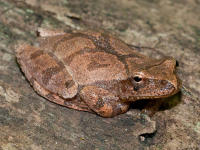
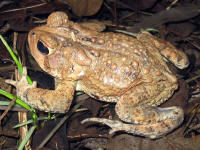
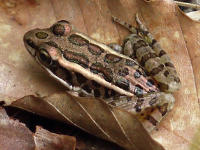
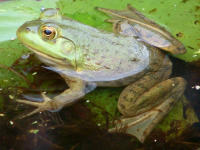
In all cases in which I have noticed frogs coupled this year, — the sylvatica, halecina, and palustris, - the female has been considerably the largest. . .The young R. pipiens, with commonly a dull-green head and sides of head, sometimes bright green, and back dusky-spotted. Can this be the bull frog? Is it not the fontinalis with less bright green and a white throat? Sometimes it is yellow-throated. I saw lately in the river a full-grown bullfrog, with, I think, a white throat. . . .the air full of the ring of the toad, the peep of the hylodes, and the low growling croak or stertoration of the Rana palustris. . . .The rhythm of it is like that of the toads’ ring, but not the sound. This is considerably like that of the tree-toad.  See The 10 frog species in Massachusetts. (Mass Audubon) (HDT’s halecina is the northern leopard frog, his fontinalis is the green frog, his hylodes the peeper):

Spring peeper (Pseudacris crucifer)[hylodes]


Wood frog (Lithobates sylvaticus)[Rana 
sylvatica]


American toad (Anaxyrus americanus)


Green frog (Lithobates clamitans)[
Rana pipiens]


Northern leopard frog (Lithobates pipiens)[Rana halecina]


Pickerel frog (Lithobates palustris)[Rana palustris]


American bullfrog (Lithobates catesbeianus)


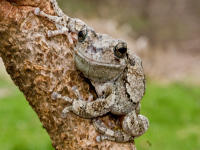
Gray treefrog (Hyla versicolor)[tree-toad ]


Eastern spadefoot (Scaphiopus holbrookii)


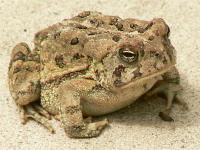
Fowler's toad (Anaxyrus fowleri)

Saturday, May 5, 2018

Saw and heard the small pewee yesterday.


May 5


May 5, 2018

The two Rana palustris which I caught May 1st have been coupled ever since in a firkin in my chamber. They were not coupled when I caught them. Last night I heard them hopping about, for the first time, as if trying to get out. Perhaps the female was trying to find a good place to deposit her spawn. 

As soon as I get up I find that she has dropped her spawn, a globular mass, wrong or white side up, about two inches in diameter, which still adheres to her posterior, and the male still lies on her back. A few moments later they are separate. 

The female moves about restlessly from time to time, the spawn still attached, but soon it is detached from her posterior, still adhering to her right leg, as if merely sticking to it. In the course of the forenoon it becomes quite detached. 

At night they are coupled again. The spawn was not dropped at 10 P.M. the evening before, but apparently in the night. The female now looked long and lank. 

This is the first spawn I have known to be dropped by the R. palustris. I should not know it by its appearance from that of the sylvatica and halecina.

The only frogs hereabouts whose spawn I do not know are the bullfrogs, R. fontinalis, and hylodes. The first have not begun to trump, and I conclude are not yet breeding; the last, I think, must be nearly done breeding, and probably do not put their spawn in the river proper; possibly, therefore, the oat spawn of yesterday may be that of the R. fontinalis.

Saw and heard the small pewee yesterday. 

The aspen leaves at Island to-day appear as big as a nine pence suddenly.

H. D. Thoreau, Journal, May 5, 1858

Saw and heard the small pewee yesterday. See May 3, 1854 ("What I have called the small pewee on the willow by my boat, — quite small, uttering a short tchevet from time to time.”); May 7, 1852 ("The first small pewee sings now che-vet, or rather chirrups chevet, tche-vet — a rather delicate bird with a large head and two white bars on wings.) Also note to May 3, 1855("Small pewee; tchevet, with a jerk of the head.”)   ~ The “Small Pewee” is listed as Muscicapa acadia in Report on the Fishes, Reptiles and Birds of Massachusetts 295 (1839), also in Thompson, Natural History of Vermont, part I, 76 (1842). Probably what Thoreau calls the "small pewee” is what we now know as the Least Flycatcher (Empidonax minimus). It arrives in Massachusetts the last week in April and in Vermont the first week of May. See A Book of the Seasons, the "Small Pewee”

The aspen leaves at Island to-day appear as big as a nine pence suddenly. See May 2, 1855 (" The young aspens are the first of indigenous trees conspicuously leafed.”); May 2, 1859 (" I am surprised by the tender yellowish green of the aspen leaf just expanded suddenly, even like a fire, seen in the sun, against the dark-brown twigs of the wood, though these leafets are yet but thinly dispersed. It is very enlivening.”); May 4, 1856 ("The aspen there ( the Island) just begun to leaf.”)

Friday, May 4, 2018

By boat to Holden Swamp.

May 4. 

Camel’s Hump
May 4, 2015

The Salix pedicellaris by railroad, apparently not for two or three days. 

The Missouri currant, probably to-day. 

P. M. — By boat to Holden Swamp. 

To go among the willows now and hear the bees hum is equal to going some hundreds of miles southward toward summer. 

I see along the sides of the river, i. e., where the bottom is permanently covered, what I have heretofore called the oat spawn, attached to old pontederia stems, etc., now some foot or eighteen inches under the surface. It is not black and white, like that of the Rana halecina, sylvaltica, and palustris, which I cannot distinguish from one another, but a pale brown or fawn-color. Some is pretty fresh or recently laid, others already flatted out. Hence, from comparison with my earlier sylvatica and halecina spawn, I judge that it may have been laid ten days. [Is it not that of the R. fontinalis?]

At Clamshell Shore, I see a clam lying up with open valves. 

Salix pedicellaris at Holden's Swamp, staminate, out apparently two days. - 

It is still warmer than May 1st, yet I hear the stertorous tut tut tut of hardly so many frogs (R. palustris chiefly, I suppose) as then. As with the halecina, it is the first sudden heats that excite them most, me thinks. 

I find hopping in the meadow a Rana halecina, much brighter than any I have seen this year. There is not only a vivid green halo about each spot, but the back is vivid light-green between the spots. I think this was not the case with any of the hundreds I saw a month ago!! Why?? The brassy lines along the sides of the back are narrower (only about one sixteenth of an inch) and more prominent than the more fawn-colored lines of the R. palustris. In this one, which I carry home and compare with the palustris, there is a large spot on each orbit, but none on the top of the head in front. It is all white beneath, except a tinge of greenish yellow on the abdomen. 

Witherell speaks of the R. palustris as the yellow legged frog, very properly. 

See several bullfrogs along the river, but silent. 

I go into Holden Swamp to hear warblers. See a little blue butterfly (or moth) — saw one yesterday — fluttering about over the dry brown leaves in a warm place by the swamp-side, making a pleasant contrast. From time to time have seen the large Vanessa Antiopa resting on the black willows, like a leaf still adhering.

As I sit there by the swamp-side this warm summery afternoon, I hear the crows cawing hoarsely, and from time to time see one flying toward the  top of a tall white pine. At length I distinguish a hen-hawk perched on the top. The crow repeatedly stoops toward him, now from this side, now from that, passing near his head each time, but he pays not the least attention to it. 

I hear the weese wese wese of the creeper continually from the swamp. It is the prevailing note there. And methought I heard a redstart's note (?), but oftener than the last I heard the tweezer note, or screeper note, of the particolored warbler, bluish above, yellow or orange throat and breast, white vent, and white on wings, neck above yellowish, going restlessly over the trees — maples, etc. — by the swamp, in creeper fashion, and as you may hear at the same time the true creeper's note without seeing it, you might think it uttered the creeper's note also. 

The red-wings, though here and there in flocks, are apparently beginning to build. I judge by their shyness and alarm in the bushes along the river and their richer, solitary warbling. 

Coming back, I talk with Witherell at William Wheeler's landing. He comes pushing Wheeler's square ended boat down-stream with a fish-spear. Says he caught a snapping turtle in the river May 1st. He sits on the side of my boat by the shore a little while, talking with me. There is a hole in the knee of his pants as big as your hand, and he keeps passing his hand over this slowly, to hide his bare skin, which is sun burnt and the color of his face, though the latter is reddened by rum, of which his breath smells. But how intimate he is with mud and its inhabitants. 

He says he caught a large pickerel the other night with spawn in it yet; that Henry Bigelow put many little trout into that round pond (Green Pond he calls it) on the Marlborough road, which Elbridge Haynes caught a few years after, weighing two or three pounds apiece. A man told him that he saw a trout weighing about a pound and a half darting at a pickerel, and every time he darted he took a bit off a fin, and at last the man walked in and caught the pickerel, and it weighed five pounds. This was in Spectacle Pond in Littleton. 

A fisherman told him once that the common eel “gendered” into the river clam, and the young fed on the clam till they were big enough to get other food, and hence you found so many dead clams in the river. 

I asked him if he knew what fish made the stone-heaps in the river. He said the lamprey eel. He saw one making one last spring about this time, as he was going across the fields by the river near Tarbell's to get seed corn. It was a single lamprey piling up the stones. He used to see thousands of them where he lived a boy, where the lead pipe factory was. 

Agassiz says in his Introduction (page 175), “I have known it [the Chelonara serpentina] snapping in the same fierce manner [which somebody else had described at a later period when it was very young] as it does when full grown, at a time it was still a pale almost colorless embryo, wrapped up in its foetal envelopes, with a yolk larger than itself hanging from its sternum, three months before hatching.”

H. D. Thoreau, Journal, May 4, 1858

The crow repeatedly stoops toward him, now from this side, now from that, passing near his head each time, but he pays not the least attention to it. See May 13, 1860 ("See two crows pursuing and diving at a hen-hawk very high in the air over the river. [H]e merely winks, as it were, bends or jerks his wings slightly as if a little startled. but never ceases soaring. nor once turns to pursue or shake them off.") See also A Book of the Seasons, by Henry Thoreau, the American Crow

I heard the tweezer note, or screeper note, of the particolored warbler. See  May 13, 1860 ("At Holden Swamp, hear plenty of parti-colored warblers (tweezer-birds) and redstarts."); May 18, 1856 ("A Sylvia Americana, — parti-colored warbler, — in the Holden Wood, sings a, tshrea tshrea tshrea, tshre’ tshritty tshrit’.”)  See note to May 13, 1856 (“At the swamp, hear the yorrick of Wilson’s thrush; the tweezer-bird or Sylvia Americana. Also the oven-bird sings.”) See also A Book of Seasons,  by Henry Thoreau, the parti-colored warbler (Sylvia Americana)

See a little blue butterfly (or moth) — saw one yesterday — fluttering about over the dry brown leaves in a warm place. See April 30, 1859 ("That interesting small blue butterfly (size of small red) is apparently just out, fluttering over the warm dry oak leaves within the wood in the sun.");See also A Book of the Seasons,  by Henry Thoreau, The  Blue Butterfly in Spring

Friday, April 27, 2018

Snows hard in afternoon and evening. Quite wintry.

April 27 


April 27, 2018

It has been so cold since the 23d that I have not been able to catch a single frog, have hardly seen where one jumped, as I walked through the meadows looking for them, though in some warmer places I heard a low stertorous R. halecina-like note from a few. 

The tortoises are stirring much more. 

Frogs appear to love warm and moist weather, rainy or cloudy. They will sit thickly along the shore, apparently small bullfrogs, etc., R. palustris

My young fishes had the pectoral fins and tail very early developing, but not yet can I detect any other fins with my glass. They had mouths, which I saw them open as soon as hatched, and more and more a perch-like head. I think that with Hoar's microscope I detected two dorsal fins such as the perch have. When I put them suddenly in the sun they sink and rest on the bottom a moment. 

In the French work for schools of Edwards and Comte, it is said that the perch spawns not till the age of three years, and in the spring. “The ova are joined together by some glutinous matter in long strings (codons) intertwined with the reeds.” (Page 36.) 

I noticed yesterday that again the newly laid spawn at the cold pool on Hubbard's land was all gone, and that in the larger pool south of it was much diminished. What creature devours it? 

Snows hard in afternoon and evening. Quite wintry. About an inch on ground the next morning.

H. D. Thoreau, Journal, April 27, 1858

It has been so cold since the 23d that I have not been able to catch a single frog. See April 24, 1858 (“This shows how sensitive they are to changes of temperature. Hardly one puts its head out of the water, if ever he creeps out the grassy or muddy bottom this cold day. ”)

The newly laid spawn at the cold pool on Hubbard's land was all gone. See April 22, 1858 (“The spawn of April 18th is gone! It was fresh there and apparently some creature has eaten it.”)

Snows hard in afternoon and evening. Quite wintry. See note to April 2, 1861 ("A drifting snow-storm, perhaps a foot deep on an average.”)

Tuesday, April 24, 2018

I go at 8 A.M. to catch frogs to compare with the R. palustris.

April 24.

A cold northwest wind.

April 24, 2018

I go at 8 A.M. to catch frogs to compare with the R. palustris and bull frog which I have, but I find it too cold for them. Though I walk more than a mile along the river, I do not get sight of one, and only of one or two turtles. Neither do I find any more frogs (though many Emys picta) at 4 P. M., it being still cold. 

Yet the frogs were quite numerous yesterday. This shows how sensitive they are to changes of temperature. Hardly one puts its head out of the water, if ever he creeps out the grassy or muddy bottom this cold day. 

That proserpinaca deserves to be named after the frog, — ranunculus, or what-not, — it is so common and pretty at the bottom the shallow grassy pools where I go looking for spawn. 

It is remarkable that I see many E. picta dead along the shore, dead within a few weeks apparently, also a sternothaerus. One of the last, alive, emitted no odor to-day. 

I find washed up by the riverside part of a pale-greenish egg-shell bigger than a hen’s egg, which was probably the egg of a duck laid on the meadow last year or lately. 

There is an abundance of the R. halecina spawn near the elm at the hill shore north of Dodd's. It is now semiopaque, greenish, and flatted down and run together, mostly hatched; and a good deal has been killed, apparently by the cold. The water thereabouts is swarming with the young pollywogs for a rod about, but where have all the frogs hidden themselves? 

E. Hoar saw the myrtle-bird to-day. 

The pollywogs must be a long time growing, for I see those of last year not more than two inches long, also some much larger. 

The hatched frog-spawn is quite soft and apparently dissolving at last in the water. Yet possibly that mass of jelly once brought me on a stake was this jelly consolidated. 

I find that my fish ova were not all killed some weeks ago in the firkin, as I supposed, for many that were accidentally left in it have hatched, and they bore the cold of last night better than those hatched earlier and kept in the larger vessel (tub), which froze but thinly, while the firkin froze a quarter of an inch thick last night.

H. D. Thoreau, Journal,  April 24, 1858

Many Emys picta. See April 24, 1856 ("A young Emys Picta one and five eighths inches long and one and a half wide. . . . already covered with some kind of green moss."); See also March 28, 1857 ("The Emys picta, now pretty numerous . . .He who painted the tortoise thus, what were his designs?");  April 22, 1858 ("The Emys picta are evidently breeding also.") and  A Book of the Seasons, by Henry Thoreau, the Painted Turtle (Emys picta)

A sternothaerus emitted no odor to-day. See April 1, 1858 ("I see six Sternothaarus odoratus . . . and smelt of five of these, and they emitted none of their peculiar scent! It would seem, then, that this may be connected with their breeding, or at least with their period of greatest activity.");   June 16, 1858 ("Two sternothaerus which I smell of have no scent to-day.  ")  See also A Book of the Seasons, by Henry Thoreau, the Musk Turtle (Sternothaerus odoratus )

That proserpinaca [palustris] deserves to be named after the frog:  Rana palustris, the pickerel frog; Proserpinaca is a genus of flowering plants found in aquatic or terrestrial wetland habitat  Palustris is a Latin word meaning swampy or marshy often used for species names to refer to the typical habitat of the species. ~ Wikipedia

There is an abundance of the R. halecina spawn near the elm at the hill shore north of Dodd's. The water thereabouts is swarming with the young pollywo
gs for a rod about. See April 14, 1858 (“My Rana halecina spawn in tumbler is now flatted out and begins to betray the pollywog form.”); 

I find that my fish ova were not all killed some weeks ago in the firkin, as I supposed. See note to April 16, 1858 ("I think that the spawn could not have been laid long when I found it April 3d, . . .My fish ova in a tumbler has gradually expanded ... (Some are still in the egg on the 18th.)")

Popular Posts Last 30 Days.

The week ahead in Henry’s journal

The week ahead in Henry’s journal
A journal, a book that shall contain a record of all your joy.
"A stone fruit. Each one yields me a thought." ~ H. D. Thoreau, March 28, 1859


I sit on this rock
wrestling with the melody
that possesses me.