Showing posts with label euphorbia. Show all posts

Saturday, June 27, 2020

Fishing for the Pond.


Very cool day.

Had for dinner a pudding made of service-berries.

It was very much like a rather dry cherry pudding without the stones.

A slight hail-storm in the afternoon. [see after the rain]

Euphorbia maculata.

Our warmest night thus far this year was June 21st.

It began to be cooler the 24th.
  
5.30 P. M. – To Cliffs.

Carrot by railroad.

Mine apparently the Erigeron strigosus, yet sometimes tinged with purple.

The tephrosia is an agreeable mixture of white, straw color, and rose pink; unpretending.

What is the result of that one leaf (or more), much and irregularly, or variously, divided and cut, with milk in it, in woods, either a lactuca or prenanthes, probably, one foot or more high? 


Such is oftenest the young man’s introduction to the forest and wild.

He goes thither at first as a hunter and fisher, until at last the naturalist or poet distinguishes that which attracted him and leaves the gun and fishing-rod behind.

The mass of men are still and always young in this respect.

I have been surprised to observe that the only obvious employment which ever to my knowledge detained at Walden Pond for a whole half-day, unless it was in the way of business, any of my “fellow-citizens,” whether fathers or children of the town, with just one exception, was fishing.

They might go there a thousand times, perchance, before the sediment of fishing would sink to the bottom and leave their purpose pure, — before they began to angle for the pond itself.

Thus, even in civilized society, the embryo man (speaking intellectually) passes through the hunter stage of development.

They did not think they were lucky or well paid for their time unless they got a long string of fish, though they had the opportunity of seeing the pond all the while.

They measured their success by the length of a string of fish.

The Governor faintly remembers the pond, for he went a-fishing there when he was a boy, but now he is too old and dignified to go a-fishing, and so he knows it no longer.

If the Legislature regards it, it is chiefly to regulate the number of hooks to be used in fishing there, but they know nothing about the hook of hooks.

   
H. D. Thoreau, Journal, June 26, 1853

They might go there a thousand times, perchance, before the sediment of fishing would sink to the bottom and leave their purpose pure, — before they began to angle for the pond itself. See January 26, 1853 ("Now I go a-fishing and a-hunting every day, but omit the fish and the game  which are the least important part. ");  December 2, 1856 ("There they sit, ever and anon scanning their reels to see if any have fallen, and, if not catching many fish, still getting what they went for, though they may not be aware of it, i. e. a wilder experience than the town affords.") ; October 4, 1858 ("There he stands at length, per chance better employed than ever, holding communion with nature and himself and coming to understand his real position and relation to men in this world. ")

At length the fisher
leaves rod behind and angles
for the pond itself.


Saturday, September 22, 2018

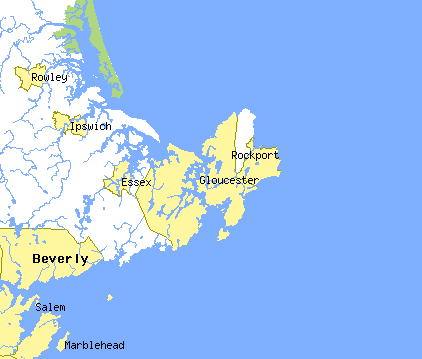
From Salem to Cape Ann on foot.


A clear cold day, wind northwest. 


Cape Ann
Leave Salem for the Cape on foot. Near Beverly Bridge, crossed over that low and flat part of Salem where the first settlement was made and Arabella Stewart is supposed to have been buried. 

Soon struck off to the shore in Beverly. See the discolor thistle on a sandy beach, and Phaseolus diversifolius (three-lobed bean vine), with pretty terete long pods, some ripe, but a few flowers still. Aster linifolius, perhaps still in prime, — though it has a flexuous stem, — in a marsh, and lyme-grass, apparently like ours, along edge of marsh. 

Dined on the edge of a high rocky clifl', quite perpendicular, on the west side of entrance of Manchester Harbor. 

One mile southeast of the village of Manchester, struck the beach of “musical sand,” just this side of a large, high, rocky point called Eagle Head. This is a curving sandy beach, maybe a third of a mile long by some twelVe rods wide. (We also found it on a similar but shorter beach on the east side of Eagle Head.) 

We first perceived the sound when we scratched with our umbrella or finger swiftly and forcibly through the sand; also still louder when we struck forcibly with our heels “scuffing” along. The wet or damp sand yielded no peculiar sound, nor did that which lay loose and deep next the bank, but only the more compact and dry. 

The sound was not at all musical, nor was it loud. Fishermen might walk over it all their lives, as indeed they have done, without noticing it. R., who had not heard it, was about right when he said it was like that made by rubbing on wet glass with your fingers. I thought it as much like the sound made in waxing a table as anything. It was a squeaking sound, as of one particle rubbing on another. I should say it was merely the result of the friction of peculiarly formed and constituted particles. 

The surf was high and made a great noise, yet I could hear the sound made by my companion’s heels two or three rods distant, and if it had been still, probably could have heard it five or six rods. 

We kept thence along the rocky shore to Kettle Cove, where, however, I did not find any rocks like Lewis’s.

Somewhere thereabouts Scirpus maritimus, with its great spikes now withered. In the marsh at Kettle Cove, Gerardia maritima, apparently in prime, four or five inches high; Euphorbia polygonifolia, six inches in diameter. Spartina glabra in the salt water of the cove.

The shore, thus far, from Beverly Bridge had been a succession of bold rocky points half a mile apart, with sometimes curving sandy beaches between, or else rocks. 

We now kept the road to Gloucester, leaving the shore a mile or more to the right, wishing to see the magnolia swamp. This was perhaps about a mile and a half beyond Kettle Cove. After passing over a sort of height of land in the woods, we took a path to the left, which within a few rods became a corduroy road in the swamp. Within three or four rods on the west side of this, and perhaps ten or fifteen from the highroad, was the magnolia. 

It was two to seven or eight feet high, but distinguished by its large and still fresh green leaves, which had not begun to fall. I saw last year's shoots which had died down several feet, and probably this will be the fate of most which has grown this year. 

The swamp was an ordinary one, not so wet but we got about very well. The bushes of this swamp were not generally more than six feet high. There was another locality the other side of the road. 

Cooked our supper in a salt marsh some two miles this side of Gloucester, in view of the town. We had cooked our tea for dinner with dead bayberry bushes; now we used the chips and bark which the tide had deposited in little parcels on the marsh, having carried water in our dippers from a brook, a quarter of a mile. 

There was a large patch of samphire turned a bright crimson, very conspicuous, near by on the flat marsh, the more conspicuous because large and in the midst of the liquid green of the marsh. 

We sat on some stones which we obtained flat in the marsh till starlight. 

I had seen in this day’s walk an abundance of Aster cordifolius (but no A. undulatus); also saw A. corymbosus, which is a handsome white wood aster; and, very common, what I called A. longifolius, with shorter thick, clasping leaves and growing in drier ground than ours, methinks; also, all along the road, the up-country hard, small, mulberry-shaped high blackberry, and many still holding on. This may be due to the cool air of the Cape. They were quite sweet and good. Vide a specimen. 

The foliage had but just fairly begun to change. Put up in Gloucester.

H. D. Thoreau, Journal, September 22, 1858

September 22, 2018

Thursday, September 13, 2018

Many yellow butterflies in road and fields all the country over.

September 13

P. M._—To Annursnack.


September 13, 2018
 Solidago puberula, apparently in prime and handsome, roadside, Colburn’s Hill. 

I noticed the black willows quite imbrowned on the 10th, and the button-bushes beginning to look yellowish. 

A. Hosmer is pleased because from the cupola of his new barn he can see a new round-topped mountain in the northwest. Is curious to know what one it is. Says that if he lived as near Annursnack as Heywood does, he should go up it once a week, but he supposes that Heywood does not go up it more than once a year. 

What is that grass still in bloom a foot or more in height in Heywood’s potato-field, some fifty rods west of house leek? It is somewhat like what I have wrongly called Danthonia spicata, but with a longer and a round spike, etc., etc. Vide press. 

There is a man there mowing the Panicum Crus-galli, which is exceedingly rank and dense, completely concealing the potatoes, which have never been hoed, it was so wet. He saves this grass and says the cattle like it well. 

I notice that the large ant-hills, though they prevent bushes and ferns from growing where they are built, keeping open a space four to seven feet wide in their midst, do not keep out grass, but they are commonly little grassy mounds with bare tops. 

Looking from the top of Annursnack, the aspect of the earth generally is still a fresh green, especially the woods, but many dry fields, where apparently the June-grass has withered uncut, are a very pale tawny or lighter still. It is fit that some animals should be nearly of this color. The cougar would hardly be observed stealing across these plains. In one place I still detect the ruddiness of sorrel. 

Euphorbia hypericifolia still, and gone to seed, on the top of Annursnack. 

From many a barn these days I hear the sound of the flail. For how many generations this sound will continue to be heard here! At least until they discover a new way of separating the chaff from the wheat.

Saw one raking cranberries on the 10th; rather early.

A small dense flock of wild pigeons dashes by over the side of the hill, from west to east, — perhaps from Wetherbee’s to Brooks’s, for I see the latter’s pigeon place. They make a dark slate-gray impression. 

Fringed gentian out well, on easternmost edge of the Painted-Cup Meadows, by wall.[Caroline Pratt tells me the 20th that her father found it out full a fortnight before that date!]

Saw a striped snake run into the wall, and just before it disappeared heard a loud sound like a hiss! I think it could hardly have been made by its tail among leaves. 

The squirrels know better than to open unsound hazelnuts. At most they only peep into them. I see some on the walls with a little hole gnawed in them, enough to show that they are empty. 

Muskmelons and squashes are turning yellow in the ‘  gardens, and ferns in the swamps. 

Hear many warbling vireos these mornings.

Many yellow butterflies in road and fields all the country over.

H. D. Thoreau, Journal, September 13, 1858

Fringed gentian out well, on easternmost edge of the Painted-Cup Meadows, by wall. See October 12, 1857 ("To Annursnack. . . .The fringed gentian by the brook opposite is in its prime, and also along the north edge of the Painted-Cup Meadows")

Many yellow butterflies in road and fields all the country over. See September 4, 1856 ("Butterflies in road a day or two. "); September 3, 1854 (“I see some fleets of yellow butterflies in the damp road after the rain, as earlier.”); September 11, 1852 ("I see some yellow butterflies and others occasionally and singly only."); September 17, 1852 ("Still the oxalis blows, and yellow butterflies are on the flowers"); September 19, 1859 (" See many yellow butterflies in the road this very pleasant day after the rain of yesterday. One flutters across between the horse and the wagon safely enough, though it looks as if it would be run down.")

Sunday, August 28, 2016

Be not in haste

August 28 

First watermelon. 

P. M. — To tortoise eggs, Marlborough road. 

Potentilla Norvegica again. 

I go over linnaea sprout lands. 

The panicled cornel berries are whitening, but already mostly fallen. As usual the leaves of this shrub, though it is so wet, are rolled like corn, showing the paler under sides. At this season it would seem that rain, frost, and drought all produce similar effects. 

Now the black cherries in sprout-lands are in their  prime, and the black choke-berries just after huckleberries and blueberries. They are both very abundant this year. The branches droop with cherries. Those on some trees are very superior to others. 

The bushes are weighed down with choke-berries, which no creature appears to gather. This crop is as abundant as the huckleberries have been. They have a sweet and pleasant taste enough, but leave a mass of dry pulp in the mouth. But it is worth the while to see their profusion, if only to know what nature can do. 

Huckleberries are about given up, low blueberries more or less shrivelled, low blackberries done, high blackberries still to be had. Viburnum nudum berries are beginning; I already see a few shrivelled purple ones amid the light green. Poke berries also begun. 

A goldfinch twitters away from every thistle now, and soon returns to it when I am past. I see the ground strewn with the thistle-down they have scattered on every side. 

At Tarbell's andromeda swamp. A probable Bidens connata or small chrysanthemoides. 

I open the painted tortoise nest of June 10th, and find a young turtle partly out of his shell. He is roundish and the sternum clear uniform pink. The marks on the sides are pink. The upper shell is fifteen sixteenths of an inch plus by thirteen sixteenths. He is already wonderfully strong and precocious. Though those eyes never saw the light before, he watches me very warily, even at a distance. With what vigor he crawls out of the hole I have made, over opposing weeds! He struggles in my fingers with great strength; has none of the tenderness of infancy. His whole snout is convex, and curved like a beak. Having attained the surface, he pauses and warily watches me. In the meanwhile another has put his head out of his shell, but I bury the latter up and leave them.

Meanwhile a striped squirrel sits on the wall across the road under a pine, eying me, with his cheek-pouches stuffed with nuts and puffed out ludicrously, as if he had the mumps, while the wall is strewn with the dry brown husks of hazelnuts he has stripped. A bird, perhaps a thrasher, in the pine close above him is hopping restlessly and scolding at him. 

June, July, and August, the tortoise eggs are hatching a few inches beneath the surface in sandy fields. You tell of active labors, of works of art, and wars the past summer; meanwhile the tortoise eggs underlie this turmoil. What events have transpired on the lit and airy surface three inches above them! Sumner knocked down; Kansas living an age of suspense. Think what is a summer to them! How many worthy men have died and had their funeral sermons preached since I saw the mother turtle bury her eggs here! They contained an undeveloped liquid then, they are now turtles. 

June, July, and August, — the livelong summer, — what are they with their heats and fevers but sufficient to hatch a tortoise in. Be not in haste; mind your private affairs. Consider the turtle. A whole summer — June, July, and August — is not too good nor too much to hatch a turtle in. 

Perchance you have worried yourself, despaired of the world, meditated the end of life, and all things seemed rushing to destruction; but nature has steadily and serenely advanced with a turtle's pace. 

The young turtle spends its infancy within its shell. It gets experience and learns the ways of the world through that wall. While it rests warily on the edge of its hole, rash schemes are undertaken by men and fail. Has not the tortoise also learned the true value of time? You go to India and back, and the turtle eggs in your field are still unhatched. French empires rise or fall, but the turtle is developed only so fast. 

What's a summer? Time for a turtle's eggs to hatch. So is the turtle developed, fitted to endure, for he outlives twenty French dynasties. One turtle knows several Napoleons. 

They have seen no berries, had no cares, yet has not the great world existed for them as much as for you?

Euphorbia hypericifolia, how long? It has pretty little white and also rose-colored petals, or, as they are now called, involucre. Stands six inches high, regularly curving, with large leaves prettily arranged at an angle with both a horizontal and perpendicular line. 

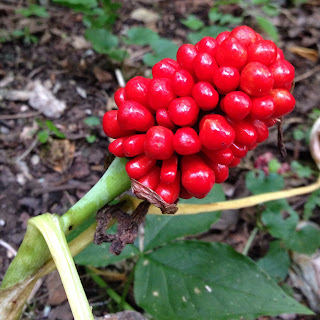
See the great oval masses of scarlet berries of the arum now in the meadows. Trillium fruit, long time.
August 28, 2014

The river being thus high, for ten days or more I have seen little parcels of shells left by the muskrats. So they eat them thus early. 

Peppermint, how long? May be earlier than I have thought, for the mowers clip it. 

The bright china-colored blue berries of the Cornus sericea begin to show themselves along the river, amid their red-brown leaves, — the kinnikinnic of the Indians. 

H. D. Thoreau, Journal, August 28, 1856

The panicled cornel berries are whitening. See August 15, 1854 ("Panicled cornel berries on College Road. “); August 22, 1852 ("The panicled cornel berries now white. “)

I open the painted tortoise nest of June 10th. See June 10, 1856 ("A painted tortoise laying her eggs ten feet from the wheel-track on the Marlborough road.”). See also August 26, 1854 ("Open one of my snapping turtle's eggs.”)

Be not in haste. September 17, 1839 ("Nature never makes haste; her systems revolve at an even pace."); July 19, 1851 ("This rapid revolution of nature, even of nature in me, why should it hurry me?"); August 19, 1851 ("The seasons do not cease a moment to revolve, and therefore Nature rests no longer at her culminating point than at any other."); September 24, 1859 ("Great works of art have endless leisure for a background, as the universe has space. Time stands still while they are created. The artist cannot be in [a] hurry. The earth moves round the sun with inconceivable rapidity, and yet the surface of the lake is not ruffled by it.")

Has not the great world existed for them as much as for you?
See September 9, 1854 ("Thus the earth is the mother of all creatures.”); August 26, 1854 ("I am convinced that there must be an irresistible necessity for mud turtles.”)

The bright china-colored blue berries of the Cornus sericea [red-osier dogwood]] begin to show themselves along the river. .See  August 28, 1852 ("Now the red osier berries are very handsome along the river, overhanging the water, for the most part pale blue mixed with whitish, -- part of the pendant jewelry of the season.”);   See also August 31, 1856 (“The Cornus sericea, with its berries just turning, is generally a dull purple now."); September 1, 1854 (The Cornus sericea berries are now in prime, of different shades of blue, lighter or darker, and bluish white. . . .a great ornament to our causeways and riverside.”)

What is a summer? 
Time for turtle eggs to hatch
June, July, August.

Nature steadily 
and serenely advances 
with a turtle's pace.

A Book of the Seasons, by Henry Thoreau
"A book, each page written in its own season,
out-of-doors, in its own locality.”
~edited, assembled and rewritten by zphx © 2009-2026

https://tinyurl.com/hdt-560828


Friday, August 5, 2016

Botanizing the Assabet near House-leek Rock

August 5

August 5, 2016

A. M. — On river. 

Mikania a day or two. Polygonum amphibium in water, slightly hairy, well out. Polygonum orientate, how long? 

P. M. — To house-leek via Assabet Bath. 

Trichostema, maybe several days in some places. Nightshade berries, how long? 

When I crossed the new stone bridge a great water adder lay on it, full five feet long and nearly as big round as my arm. It turned and ran along, with a coarse grating rustle, to the end of the railing, and then dropped deliberately head foremost from the last abutment, full nine feet, to the gravelly ground, amid the osiers, making a loud sound when he struck; at once took to the water, and showed his head amid the pads. I also saw another similar one at House-leek Rock. 

Centaurea well out, how long? 

Aster dumosus, apparently a day or two, with its large conspicuous flower-buds at the end of the branchlets and linear-spatulate involucral scales. 

At haunted house site, as at Bittern Cliff grain-field, I see much apparent Euphorbia maculata semi-erect in the grass. Eupatorium pubescens, by Pear Path. 

I now find an abundance of the clustered rubus ripe. It is not large and has a clammy, subacid taste, but some are very sweet. Clusters generally drooping.

Hypericum mutilum, dwart john’s-wort,
August 2, 2019
Now, at 4 p. m. this dog-day, cloudy weather, the Hypericum mutilum is abundantly open in the Solidago lanceolata path, sometimes fifteen inches high, while the Canadense and angulatum are shut.

S. lanceolata, some days. S. nemoralis, two or three days. 

Choke-cherries near House-leek Rock begin to be ripe, though still red. They are scarcely edible, but their beauty atones for it. See those handsome racemes of ten or twelve cherries each, dark glossy red, semi- transparent. You love them not the less because they are not quite palatable. Along fences or hedgerows. 


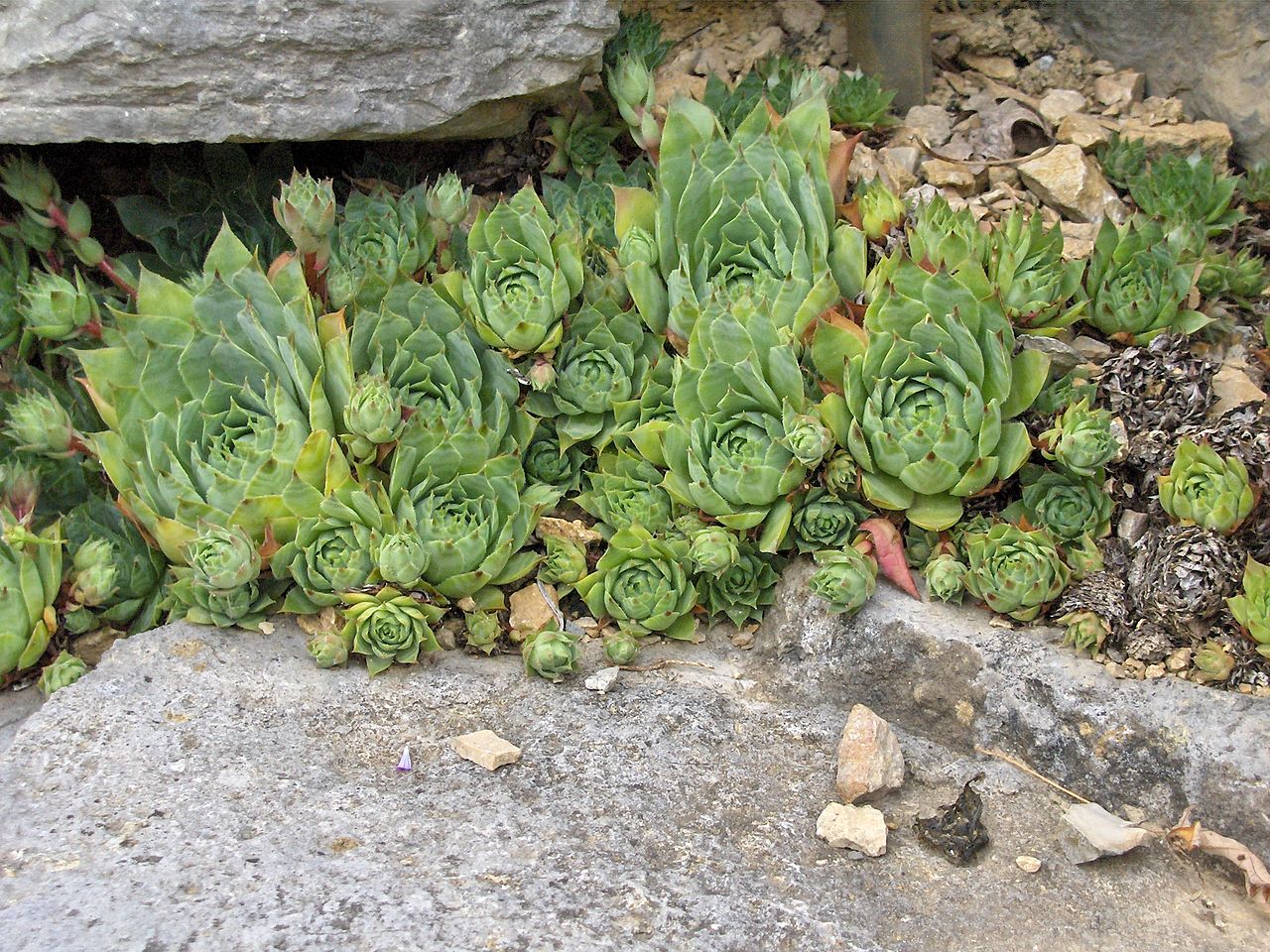
Sempervivium
(houseleek ~ hen & chickens)
To my surprise one house-leek (apparently Sempervivum tectorum of Dewey) has shot up twenty-two inches high and is apparently nearly out, though the petals are erect, not spread. The stem is clothed with the same thick leaves, only smaller and lessening up ward and forming a column about one and a half inches in diameter (with the leaves). The top is a broad raceme (?), about eight inches wide and two thirds as long, of eleven long, spreading, and recurved branches, lined with flowers on the upper side only. These consist of twelve to thirteen lanceolate calyx-segments and as many still longer dull-purple petals and about twenty pistils within and short stamens around them. It is a strange but rather stately cactus-like plant. 

The children call the pretty clusters of radical leaves hen and chickens. In this case the radical leaves are withered, and a fusiform root sustains the flower. This one is not on the bare rock, but lower amid the huckleberry bushes. 

At the Assabet stone bridge, apparently freshly in flower, — though it may have been out nearly as long as the androscemifolium, — apparently the Apocynum cannabinum var. hypericifolium (?). The tallest is four feet high. The flowers very small (hardly more than an eighth of an inch in diameter), the segments of the corolla not revolute but nearly erect. There are twenty to thirty flowers at end of a branch. The divisions of the calyx are longer than in the common, long ovate. Yet it differs from Gray's hypericifolium in having flowers rose-streaked within like the common, the cymes not shorter than the leaves, and the tube of the corolla rather longer than the divisions of the calyx. The leaves are hardly more downy or heart-shaped below than the common. Hypericifolium is a separate species in Pursh and some others. And the branches are less ascending than the common, making an angle of about 62° with the stem (the four lower), while three of the lower of a common one make an angle of 44°.

H. D. Thoreau, Journal, August 5, 1856

Trichostema, maybe several days in some places. See July 31, 1856  ("Trichostema has now for some time been springing up in the fields, giving out its aromatic scent when bruised, and I see one ready to open.");  August 17, 1851 ("The Trichostema dichotomum, — not only its bright blue flower above the sand, but its strong wormwood scent which belongs to the season, –– feed my spirit, endear the earth to me, make me value myself and rejoice.") See also  A Book of the Seasons, by Henry Thoreau, Blue-Curls

Now, at 4 p. m . .  .The Hypericum mutilum is abundantly open . . . sometimes fifteen inches high, while the Canadense and angulatum are shut
.  See August 12, 1856 ("11 a. m. . . .  The Hypericum mutilum is well out at this hour.");  August 17, 1856 ("Hypericum Canadense well out at 2 p. m"); .August 19, 1856 ("I see Hypericum Canadense and mutilum abundantly open at 3 p. m");  August 27, 1856  ("Hypericum Canadense and mutilum now pretty generally open at 4 P.M., thus late in the season, it being more moist and cooler."). See also  A Book of the Seasons by Henry Thoreau, St. Johns-wort (Hypericum)

A great water adder . . . full five feet long and nearly as big round as my arm. See July 23, 1856 ("water adder killed on the 15th and left hanging on a twig"); July 15, 1856 ("It was about three feet long, but large round in proportion, with about one hundred and forty abdominal plates and a long, slender tail.)

Aster dumosus, apparently a day or two, with its large conspicuous flower-buds. See August 10, 1856  ("Aster dumosus and pennyroyal out; how long? ");   August 24, 1853 ("The dumosus is the prevailing white one, very abundant.") See also   A Book of the Seasons by Henry Thoreau, Asters in August

Choke-cherries. . . scarcely edible, but their beauty atones for it. See August 5, 1858 ("Choke-berries, fair to the eye but scarcely palatable, hang far above your head, weighing down the bushes."); See 
also September 3, 1853 ("Now is the season for those comparatively rare but beautiful wild berries which are not food for man . . . it is strange that we do not devote an hour in the year to gathering those which are beautiful to the eye. It behooves me to go a-berrying in this sense once a year at least.”)

Apparently the Apocynum cannabinum var. hypericifolium (?). The tallest is four feet high. See August 7, 1856 ("Hemp, perhaps a week.");  August 13, 1856 ("I stripped off a shred of Indian hemp bark and could not break it. It is as strong as anything of the kind I know. ") August 16, 1856 (" I find the dog's-bane (Apocynum androsoemifolium) bark not the nearly so strong as that of the A. cannabinum.");  September 2, 1856 ("Some years ago I sought for Indian hemp (Apocynum cannabinum) hereabouts in vain, and concluded that it did not grow here. A month or two ago . . . my eyes fell on it, aye, in three different places, and different varieties of it.") See also A Book of the Seasons, by Henry Thoreau, Dogsbane and Indian hemp

August 5. See A Book of the Seasonsby Henry Thoreau, August 5

Now at 4 p. m.
this dog-day cloudy weather
dwarf johnswort open.

A Book of the Seasonsby Henry Thoreau. Near House-leek Rock

A Book of the Seasonsby Henry Thoreau. 

"A book, each page written in its own season,
out-of-doors, in its own locality."
~edited, assembled and rewritten by zphx © 2009-2026

https://tinyurl.com/hdt-560805

Thursday, July 21, 2016

With each fresh varnish of the air we frequent our oldest haunts with new love and reverence.

July 21

P. M. — To A. Wheeler's grape meadow. 

Mimulus, not long. Hypericum corymbosum, a day or two. Rusty cotton-grass, how long ? The small hypericums are open only in the forenoon. Pursley, also, in our garden opens now not till 8 a. m., and shuts up before 12 m. 

The flat euphorbia is now in prime on the sandy path beyond Potter's Desert, five-finger fungus path.

Plucked a handful of huckleberries from one bush! The Vaccinium vacillans thick enough to go picking, and probably for a day or two in some places. 

Low blackberries thick enough to pick in some places, three or four days. 

Thimble-berries about the 12th, and V. Pennsylvanicum much longer. 

These hot afternoons I go panting through the close sprout-lands and copses, as now from Cliff Brook to Wheeler meadow, and occasionally come to sandy places a few feet in diameter where the partridges have dusted themselves. 

[Gerard, the lion-killer of Algiers, speaks of seeing similar spots when tracking or patiently waiting the lion there, and his truth in this particular is a confirmation of the rest of his story. But his pursuit dwarfs this fact and makes it seem trivial.

Shall not my pursuit also contrast with the trivialness of the partridges' dusting? It is interesting to find that the same phenomena, however simple, occur in different parts of the globe. 

I have found an arrowhead or two in such places even. 

Far in warm, sandy woods in hot weather, when not a breath of air is stirring, I come upon these still sandier and warmer spots where the partridges have dusted themselves, now all still and deserted, and am not relieved, yet pleased to find that I have been preceded, by any creature. 

Grapes ready to stew. 

Mr. Russell writes me to-day that he visited the locality of the Magnolia glauca the 18th, on Cape Ann, and saw lingering still a few flowers and flower-buds. It is quite open and rising above the bushes. 

The brook cress might be called river cress, for it is very abundant rising above the surface in all the shallower parts of the river. 

Verbena hastata, apparently several days. 

Sonchus, some time. 

July 21, 2020

This has been a peculiarly fine afternoon. When I look about casually, am surprised at the fairness of the landscape. Though warm, it is clear and fresh, and the air imparts to all surfaces a peculiar fine glaucous color, full of light, without mistiness, like the under side of the Salix lucida (?) leaves at present.  Not only the under sides of the leaves, but the very afternoon landscape, has become glaucous. 

Now, when the fashionable world goes to Saratoga, Nahant, and Newport, we frequent our oldest haunts with new love and reverence and sail into new ports with each fresh varnish of the air.

H. D. Thoreau, Journal, July 21
, 1856

When I look about casually, am surprised at the fairness of the landscape. See note to May 22, 1854 ("How many times I have been surprised thus, on turning about on this very spot, at the fairness of the earth!")

We frequent our oldest haunts with new love and reverence and sail into new ports with each fresh varnish of the air. See October 18, 1855 (“Pursue some path, however narrow and crooked, in which you can walk with love and reverence.”); August 30, 1856 (“[T]here are square rods in Middlesex County as purely primitive and wild as they were a thousand years ago. . .  I believe almost in the personality of such planetary matter, feel something akin to reverence for it, can even worship it as terrene, titanic matter extant in my day. We are so different we admire each other, we healthily attract one another. I love it as a maiden”) 

July 21. See A Book of the Seasons, by Henry Thoreau, July 21

Sandy places where
partridges dusted themselves
this hot afternoon.

Surprised – the fairmess
of the afternooon landscape,
clear fresh full of light.

With each fresh varnish
we frequent our oldest haunts
with new reverence.


A Book of the Seasons, by Henry Thoreau
"A book, each page written in its own season,
out-of-doors, in its own locality."
~edited, assembled and rewritten by zphx ©  2009-2026

https://tinyurl.com/hdt-560721

Popular Posts Last 30 Days.

The week ahead in Henry’s journal

The week ahead in Henry’s journal
A journal, a book that shall contain a record of all your joy.
"A stone fruit. Each one yields me a thought." ~ H. D. Thoreau, March 28, 1859


I sit on this rock
wrestling with the melody
that possesses me.