Showing posts with label trichostema. Show all posts

Saturday, July 11, 2020

At entrance to pokelogan near Assabet Bathing-Place.


July 11.

Rain last night.

The aromatic trichostema now springing up. 

Trichostema dichotomum
 
(blue-curl)

Gnaphalium uliginosum now. 
Gnaphalium uliginosum
 (Marsh Cudweed)

Hydrocotyle, some days.

Agrimony, also, some days.

Button-bush.

Centaurea nigra, some time, Union Turnpike, against E.Wood's, low ground, and Ludwigia alternifolia, apparently just begun, at entrance to pokelogan near Assabet Bathing-Place.

The small crypta already in fruit.

I find in the river, especially near the Assabet Bathing Place, a ranunculus some of whose leaves are capillary, others merely wedge-cut or divided.

Is it not the R. aquatilis? But I see no flowers. [I think it is the R. Purshii.]


H. D. Thoreau, Journal, July 11, 1853


The aromatic trichostema[blue-curls]now springing up. See July 31, 1856 ("Trichostema has now for some time been springing up in the fields, giving out its aromatic scent when bruised, and I see one ready to open.");August 9, 1851 ("The Trichostema dichotomum is quite beautiful now in the cool of the morning."); August 11, 1853 ("Evening draws on while I am gathering bundles of pennyroyal on the further Conantum height. I find it amid the stubble mixed with blue-curls and, as fast as I get my hand full, tie it into a fragrant bundle.”); August 13, 1856 (“Is there not now a prevalence of aromatic herbs in prime? — The polygala roots, blue-curls, wormwood, pennyroyal, . . . etc., etc. Does not the season require this tonic?“);  August 17, 1851 ("The Trichostema dichotomum, — not only its bright blue flower above the sand, but its strong wormwood scent which belongs to the season, -- feed my spirit.");

Gnaphalium uliginosum now. See June 24, 1853 ("The Gnaphalium uliginosum seems to be almost in blossom."); July 17, 1852 ("Gnaphalium uliginosum by the roadside,"); July 24, 1856 ("Some Gnaphalium uliginosum going to seed; how long?")

I think it is the R. Purshii. See June 6, 1857 ('The Ranunculus Purshii is in some places abundantly out now and quite showy. It must be our largest ranunculus (flower).”); July 2, 1853 ("The Ranunculus Purshiï is very rarely seen now.”)


July 11. See A Book of the Seasons, by Henry Thoreau, July 11

A Book of the Seasons, by Henry Thoreau
"A book, each page written in its own season,
out-of-doors, in its own locality.”
~edited, assembled and rewritten by zphx © 2009-2021

Saturday, August 17, 2019

My life flows with a deeper current.

August 17

haymakers

For a day or two it has been quite cool, a coolness that was felt even when sitting by an open window in a thin coat on the west side of the house in the morning, and you naturally sought the sun at that hour. The coolness concentrated your thought, however. As I could not command a sunny window, I went abroad on the morning of the 15th and lay in the sun in the fields in my thin coat, though it was rather cool even there. I feel as if this coolness would do me good. 

If it only makes my life more pensive! 


Why should pensiveness be akin to sadness? There is a certain fertile sadness which I would not avoid, but rather earnestly seek. It is positively joyful to me. It saves my life from being trivial. 

My life flows with a deeper current, no longer as a shallow and brawling stream, parched and shrunken by the summer heats. This coolness comes to condense the dews and clear the atmosphere. The stillness seems more deep and significant. Each sound seems to come from out a greater thoughtfulness in nature, as if nature had acquired some character and mind. The cricket, the gurgling stream, the rushing wind amid the trees, all speak to me soberly yet encouragingly of the steady onward progress of the universe. 

My heart leaps into my mouth at the sound of the wind in the woods. I, whose life was but yesterday so desultory and shallow, suddenly recover my spirits, my spirituality, through my hearing. 

I see a goldfinch go twittering through the still, louring day, and am reminded of the peeping flocks which will soon herald the thoughtful season. Ah! if I could so live that there should be no desultory moment in all my life! that in the trivial season, when small fruits are ripe, my fruits might be ripe also! that I could match nature always with my moods ! that in each season when some part of nature especially flourishes, then a corresponding part of me may not fail to flourish! 

Ah, I would walk, I would sit and sleep, with natural piety ! What if I could pray aloud or to myself as I went along by the brooksides a cheerful prayer like the birds ! For joy I could embrace the earth; I shall delight to be buried in it. 

And then to think of those I love among men, who will know that I love them though I tell them not! I some times feel as if I were rewarded merely for expecting better hours. I did not despair of worthier moods, and now I have occasion to be grateful for the flood of life that is flowing over me. 

I am not so poor: I can smell the ripening apples; the very rills are deep; the autumnal flowers, the Trichostema dichotomum, — not only its bright blue flower above the sand, but its strong wormwood scent which belongs to the season, — feed my spirit, endear the earth to me, make me value myself and rejoice; the quivering of pigeons' wings reminds me of the tough fibre of the air which they rend. 

I thank you, God. I do not deserve anything, I am unworthy of the least regard; and yet I am made to rejoice. I am impure and worthless, and yet the world is gilded for my delight and holidays are prepared for me, and my path is strewn with flowers. 

But I cannot thank the Giver; I cannot even whisper my thanks to those human friends I have. It seems to me that I am more rewarded for my expectations than for anything I do or can do. Ah, I would not tread on a cricket in whose song is such a revelation, so soothing and cheering to my ear! 

Oh, keep my senses pure! And why should I speak to my friends? for how rarely is it that I am I; and are they, then, they? We will meet, then, far away. The seeds of the summer are getting dry and falling from a thousand nodding heads. If I did not know you through thick and thin, how should I know you at all? 

Ah, the very brooks seem fuller of reflections than they were! Ah, such provoking sibylline sentences they are! The shallowest is all at once unfathomable. How can that depth be fathomed where a man may see himself reflected? 

The rill I stopped to drink at I drink in more than I expected. I satisfy and still provoke the thirst of thirsts. 

Nut Meadow Brook where it crosses the road beyond Jenny Dugan's that was. I do not drink in vain. I mark that brook as if I had swallowed a water snake that would live in my stomach. I have swallowed something worth the while. The day is not what it was before I stooped to drink. Ah, I shall hear from that draught! It is not in vain that I have drunk. 

I have drunk an arrowhead. It flows from where all fountains rise. How many ova have I swallowed? Who knows what will be hatched within me? There were some seeds of thought, methinks, floating in that water, which are expanding in me. 

The man must not drink of the running streams, the living waters, who is not prepared to have all nature reborn in him, — to suckle monsters. 

The snake in my stomach lifts his head to my mouth at the sound of running water. When was it that I swallowed a snake? I have got rid of the snake in my stomach. I drank of stagnant waters once. That accounts for it. I caught him by the throat and drew him out, and had a well day after all. Is there not such a thing as getting rid of the snake which you have swallowed when young, when thoughtless you stooped and drank at stagnant waters, which has worried you in your waking hours and in your sleep ever since, and appropriated the life that was yours? Will he not ascend into your mouth at the sound of running water? Then catch him boldly by the head and draw him out, though you may think his tail be curled about your vitals. 

The farmers are just finishing their meadow-haying. (To-day is Sunday.) Those who have early potatoes may be digging them, or doing any other job which the haying has obliged them to postpone. For six weeks or more this has been the farmer's work, to shave the surface of the fields and meadows clean. This is done all over the country. The razor is passed over these parts of nature's face the country over. A thirteenth labor which methinks would have broken the back of Hercules, would have given him a memorable sweat, accomplished with what sweating of scythes and early and late! I chance know one young man who has lost his life in this season's campaign, by overdoing. In haying time some men take double wages, and they are engaged long before in the spring. To shave all the fields and meadows of New England clean ! If men did this but once, and not every year, we should never hear the last of that labor; it would be more famous in each farmer's case than Buonaparte's road over the Simplon. It has no other bulletin but the truthful "Farmer's Almanac." Ask them where scythe-snaths are made and sold, and rifles too, if it is not a real labor. In its very weapons and its passes it has the semblance of war. Mexico was won with less exertion and less true valor than are required to do one season's haying in New England. The former work was done by those who played truant and ran away from the latter. Those Mexicans were mown down more easily than the summer's crop of grass in many a farmer's fields. Is there not some work in New England men ? This haying is no work for marines, nor for deserters; nor for United States troops, so called, nor for West Point cadets. It would wilt them, and they would desert. Have they not deserted? and run off to West Point?

 Every field is a battle-field to the mower, — a pitched battle too, — and whole winrows of dead have covered it in the course of the season. Early and late the farmer has gone forth with his formidable scythe, weapon of time, Time's weapon, and fought the ground inch by inch. It is the summer's enterprise. And if we were a more poetic people, horns would be blown to celebrate its completion. There might be a Hay makers' Day. New England's peaceful battles. At Bunker Hill there were some who stood at the rail- fence and behind the winrows of new-mown hay.1 They have not yet quitted the field. They stand there still; they alone have not retreated. 


The Polygala sanguinea, caducous polygala, in damp ground, with red or purple heads. 

The dandelion still blossoms, and the lupine still, belated. 

I have been to Tarbell's Swamp by the Second Division this afternoon, and to the Marlborough road. It has promised rain all day; cloudy and still and rather cool; from time to time a few drops gently spit ting, but no shower. The landscape wears a sober autumnal look. I hear a drop or two on my hat. I wear a thick coat. The birds seem to know that it will not rain just yet. The swallows skim low over the pastures, twittering as they fly near me with forked tail, dashing near me as if I scared up insects for them. I see where a squirrel has been eating hazelnuts on a stump. 

Tarbell's Swamp is mainly composed of low and even but dense beds of Andromeda calyculata, or dwarf andromeda, which bears the early flower in the spring. Here and there, mingled with it, is the water (?) andromeda; also pitch pines, birches, hardhack, and the common alder (Alnus serrulata), and, in separate and lower beds, the cranberry; and probably the Rhodora Canadensis might be found. The lead-colored berries of the Viburnum dentatum now. Cow -wheat and indigo-weed still in bloom by the dry wood-path-side, and Norway cinquefoil. 

I detected a wild apple on the Marlborough road by its fragrance, in the thick woods; small stems, four inches in diameter, falling over or leaning like rays on every side; a clean white fruit, the ripest yellowish, a pleasant acid. The fruit covered the ground. It is unusual to meet with an early apple thus wild in the thickest woods. It seemed admirable to me. One of the noblest of fruits. With green specks under the skin. 

Prenanthes alba, white-flowering prenanthes, with its strange halbert and variously shaped leaves; neottia; and hypericum. 

I hear the rain (11 p. m.) distilling upon the ground, wetting the grass and leaves. The melons needed it. Their leaves were curled and their fruit stinted. 

I am less somnolent for the cool season. I wake to a perennial day. 

The hayer's work is done, but I hear no boasting, no firing of guns nor ringing of bells. He celebrates it by going about the work he had postponed "till after haying"! If all this steadiness and valor were spent upon some still worthier enterprise!! 

All men's employments, all trades and professions, in some of their aspects are attractive. Hence the boy I resolved to be a minister and make cider, not thinking, boy as he was, how little fun there was in being a minister, willing to purchase that pleasure at any price. 

When I saw the carpenters the other day repairing Hubbard's Bridge, their bench on the new planking they had laid over the water in the sun and air, with no railing yet to obstruct the view, I was almost ready to resolve that I would be a carpenter and work on bridges, to secure a pleasant place to work. One of the men had a fish-line cast round a sleeper, which he looked at from time to time. 

John Potter told me that those root fences on the Corner road were at least sixty or seventy years old.

 I see a solitary goldfinch now and then. 

Hieracium Marianum or scabrum; H. Kalmii or Canadense; Marlborough road. Leontodon autumriale passim.

H. D.. Thoreau , Journal, August 17, 1851

I can smell the ripening apples. August 9, 1851 ("Now the earliest apples begin to be ripe, but none are so good to eat as some to smell.")

The Trichostema dichotomum [blue-curls], — not only its bright blue flower above the sand, but its strong wormwood scent which belongs to the season, -- feed my spirit. See  July 31, 1856 ("Trichostema has now for some time been springing up in the fields, giving out its aromatic scent when bruised, and I see one ready to open.");:August 9, 1851 ("The Trichostema dichotomum is quite beautiful now in the cool of the morning."); August 11, 1853 ("Evening draws on while I am gathering bundles of pennyroyal on the further Conantum height. I find it amid the stubble mixed with blue-curls and, as fast as I get my hand full, tie it into a fragrant bundle.”); August 13, 1856 (“Is there not now a prevalence of aromatic herbs in prime? — The polygala roots, blue-curls, wormwood, pennyroyal, . . . etc., etc. Does not the season require this tonic?“)

I thank you, God. . . .I am unworthy of the least regard; and yet I am made to rejoice. . . .the world is gilded for my delight and holidays are prepared for me, and my path is strewn with flowers. See June 22, 1851 ("We live and rejoice. I awoke into a music which no one about me heard. Whom shall I thank for it ? . . .I feel my Maker blessing me.")

When I saw the carpenters the other day repairing Hubbard's Bridge. See August 8, 1851 ("The planks and railing of Hubbard's Bridge are removed."); August 12, 1851 ("Sitting on the sleepers of Hubbard’s Bridge, which is being repaired, now, 3 o’clock A. M")

August 17. See   A Book of the Seasons,by Henry Thoreau, August 17


Now to be grateful 
for the flood of life that is 
flowing over me. 

A Book of the Seasons, by Henry Thoreau
"A book, each page written in its own season,
out-of-doors, in its own locality.”
~edited, assembled and rewritten by zphx © 2009-2022

***

Aug. 17. For a day or two it has been quite cool, a coolness that was felt even when sitting by an open window in a thin coat on the west side of the house in the morning, and you naturally sought the sun at that hour.

 The coolness concentrated ,your thought, however.

 As 1 could not command a sunny window, I went abroad on the morning of the 15th and lay in the sun in the fields in my thin coat, though it was rather cool even there.

 I feel as if this coolness would do me good.

 If it only makes my life more pensive! 


Why should pensiveness be akin to sadness ? 

There is a certain fertile sadness which I would not avoid, but rather earnestly seek.

 It is positively joyful to me.

 It saves my life from being trivial.

 My life flows with a deeper current, no longer as a shallow and brawling stream, parched and shrunken by the summer heats.

 This coolness comes to condense the dews and clear the atmosphere.

 The stillness seems more deep and significant.

 Each sound seems to come from out a greater thoughtfulness in nature, as if nature: had acquired some character and mind.

 The cricket, the gurgling stream, the rushing wind amid the trees, all speak to me soberly yet encouragingly of the steady onward progress of the universe.

 My heart leaps into my mouth at the sound of the wind in the woods.

 I, whose life was but yesterday so desultory and shallow, suddenly recover my spirits, my spirituality, through my hearing.

 I see a goldfinch go twittering through the still, louring day, and am reminded of the peeping flocks which will soon herald the thoughtful season.

 Ah! if I could so live that there should be no desultory moment in all my life! that in the trivial season, when small fruits are ripe, my fruits might he ripe also! that I could match nature always with my moods! that in each season when some part of nature especially flourishes, then a corresponding part of me may not fail to flourish!

 Ah, I would walk, I would sit and sleep, with natural piety! 

What if I could pray aloud or to myself as I went along by the brooksides a cheerful prayer like the birds!

For joy I could embrace the earth; I shall delight to be buried in it.

 And then to think of those I love among men, who will know that I love them though I tell them not!

I sometimes feel as if I were rewarded merely for expecting better hours.

 I did not despair of worthier moods, and now I have occasion to be grateful for the flood of life that is flowing over me.

 I am not so poor : I can smell the ripening apples; the very rills are deep; the autumnal flowers, the Trichostetna dichotomum, -not only its bright blue flower above the sand, but its strong wormwood scent which belongs to the season, - feed my spirit, endear the earth to me, make me value myself and rejoice; the quivering of pigeons' wings reminds me of the tough fibre of the air which they rend.

 I thank you, God.

 I do not deserve anything, I am unworthy of the least regard; and yet I am made to rejoice.

 I am impure and worthless, and yet the world is gilded for my delight and holidays are prepared for me, and my path is strewn with flowers.

 But I cannot thank the Giver; I cannot even whisper my thanks to those human friends I have.

 It seems to me that I am more rewarded for my expectations than for anything I do or can do.

 Ah, I would not tread on a cricket in whose song is such a revelation, so soothing and cheering to my car!

 Oh, keep my senses pure!

And why should I speak to my friends ? for how rarely is it that I am I; and are they, then, they? 

We will meet, then, far away.

 The seeds of the summer are getting dry and falling from a thousand nodding heads.

 If I did not know you through thick and thin, how should I know you at all ?

 Ah, the very brooks seem fuller of reflections than they were! 

Ah, such provoking sibylline sentences they are! 

The shallowest is all at once unfathomable.

 How can that depth be fathomed where a man may see himself reflected ? 

The rill I stopped to drink at I drink in more than I expected.

 I satisfy and still provoke the thirst  of thirsts.

 Nut Meadow Brook where it crosses the road beyond Jenny Dugan's that was.

 I do not drink in vain.

 I mark that brook as if I had swallowed a water snake that would live in my stomach.

 I have swallowed something worth the while.

 The day is not what it was before I stooped to drink.

 Ah, I shall hear from that draught!

 It is not in vain that I have drunk.

 I have drunk an arrowhead.

 It flows from where all fountains rise.

 How many ova have I swallowed? 

Who knows what will be hatched within me? 

There were some seeds of thought, methinks, floating in that water, which are expanding in me.

 The man must not drink of the running streams, the living waters, who is not prepared to have all nature reborn in him, - to suckle monsters.

 The snake in my stomach lifts his head to my mouth at the sound of running water.

 When was it that I swallowed a snake? 

I have got rid of the snake in my stomach.

 I drank of stagnant waters once.

 That accounts for it.

 I caught him by the throat and drew him out, and had a well day after all.

 Is there not such a thing as getting rid of the snake which you have swallowed when young, when thoughtless you stooped and drank at stagnant waters, which has worried you in your waking hours and in your sleep ever since, and appropriated the life that was yours ? 

Will he not ascend into your mouth at the sound of running water- 

Then catch him boldly by the head and draw him out, though you may think his tail be curled about your vitals.

 The farmers are just finishing their meadow-haying.

 (To-day is Sunday.) 

Those who have early potatoes may be digging them, or doing any other job which the haying has obliged them to postpone.

 For six weeks or more this has been the farmer's work, to shave the surface of the fields and meadows clean.

 This is done all over the country.

 The razor is passed over these parts of nature's face the country over.

 A thirteenth labor which methinks would have broken the back of Hercules, would have given him a memorable sweat, accomplished with what sweating of scythes and early and late! I chance [to] know one young man who has lost his life in this season's campaign, by overdoing.

 In haying time some men take double wages, and they are engaged long before in the spring.

 To shave all the fields and meadows of New England clean! If men did this but once, and not every year, we should never hear the last of that labor ; it would be more famous in each farmer's case than Buonaparte's road over the Simplon.

 It has no other bulletin but the truthful "Farmer's Almanac.

" Ask them where scythe-snaths are made and sold, and rifles too, if it is not a real labor.

 In its very weapons and its passes it has the semblance of war.

 Mexico was won with less exertion and less true valor than are required to do one season's baying in New England.

 The former work was done by those who played truant and ran awav from the latter.

 Those Mexicans were mown dowT1 more easily than the summer's crop of grass in many a, Farmer's fields.

 Is there not some work in New England men` 

Haying is no work for marines, nor for deserters ; nor for United States troops, so called, nor for West Point cadets.

 It would wilt them, and they would desert.

 [lave they not deserted ? and run off to West Point?

Every field is a battle-field to the mower, - a pitched battle too, - and whole winrows of dead have covered it in the course of the season.

 Earlv and late the farmer has gone forth with his formidable scythe, weapon of time, Time's weapon, and fought the ground inch by inch.

 It is the summer's enterprise.

 And if we were a more poetic people, horns would be blown to celebrate its completion.

 There might be a Haymakers' Day.

 New England's peaceful battles.

 At Bunker Hill there were some who stood at the railfence and behind the winrows of new-mown hay.

' They have not yet quitted the field.

 They stand there still ; they alone have not retreated.

 The Polygala sanguinea, caducous polygala, in damp ground, with red or purple heads.

 The dandelion still blossoms, and the lupine still, belated.

 I have been to Tarbell's Swamp by the Second Division this afternoon, and to the Marlborough road.

 It has promised rain all day ; cloudy and still and rather cool ; from time to time a few drops gently spitting, but no shower.

 The landscape wears a sober autumnal look.

 I hear a drop or two on my hat.

 I wear a thick coat.

 The birds seem to know that it will not rain just yet.

 The swallows skim low over the pastures, twittering as they fly near me with forked tail, dashing near me as if I scared up insects for them.

 I see where a squirrel has been eating hazelnuts on a stump.

 Tarbell's Swamp is mainly composed of low and even but dense beds of Andromeda calyculata, or dwarf a dromeda, which bears the *early flower in the spring.

 ' Stark and his companions met the enemy in the hay-field.

 Here and there, mingled with it, is the water (?) andromeda ; also pitch pines, birches, hardback, and the common alder (Alms serrulata), and, in separate and lower beds, the cranberry ; and probably the Rhodora Canadensis might be found.

 The lead-colored berries of the Viburnum dentatum now.

 Cow-wheat and indigo-weed still in bloom by the dry wood-path-side, and Norway cinquefoil.

 I detected a wild apple on the Marlborough road by its fragrance, in the thick woods ; small stems, four inches in diameter, falling over or leaning like rays on every side; a clean white fruit, the ripest yellowish, a pleasant acid.

 The fruit covered the ground.

 It is unusual to meet with an early apple thus wild in the thickest woods.

 It seemed admirable to me.

 One of the noblest of fruits.

 With green specks under the skin.

 Prenanthes alba, white-flowering prenanthes, with its strange halbert and variously shaped leaves ; neottia ; and hypericum.

 I hear the rain (11 P.M.) distilling upon the ground, wetting the grass and leaves.

 The melons needed it.

 Their leaves were curled and their fruit stinted.

 I am less somnolent for the cool season.

 I wake to a perennial day.

 The hayer's work is done, but I hear no boasting, no firing of guns nor ringing of bells.

 He celebrates it by going about the work he had postponed "till after haying"! 

If all this steadiness and valor were spent upon some still worthier enterprise!! 

All men's employments, mens trades and professions, in some of their aspects are attractive.

 Hence the boy I knew, having sucked cider at a minister's cider-mill, resolved to be a minister and make cider, not 'thinking, boy as he was, how little fun there was in being a minister, willing to purchase that pleasure at any price.

 When I saw the carpenters the other day repairing Hubbard's Bridge, their bench on the new planking they had laid over the water in the sun and air, with no railing yet to obstruct the view, I was almost ready to resolve that 1 would be a carpenter and work on bridges, to secure a pleasant place to work.

 One of the men had a fish-line cast round a sleeper, which he looked at from time to time.

 John Potter told me that those root fences on the Corner road were at least sixty or seventy years old.

 I see a solitary goldfinch now and then.

 Hieracium Marianum or scabrum ; H. Kalmii or Canadense ; Marlborough road. Leontodon autumnale passim.


***

 Coolness See September 2, 1851 ("The first coolness is welcome, so serious and fertile of thought.")


Why should pensiveness be akin to sadness? There is a certain fertile sadness which I would not avoid, but rather earnestly seek. It is positively joyful to me. See July 31, 1856 ("I hear the distant sound of a flail, and thoughts of autumn occupy my mind, and the memory of past years."); August 9, 1853 ("This is the season of small fruits. I trust, too, that I am maturing some small fruit as palatable in these months, which will communicate my flavor to my kind.");  August 18, 1853 (“What means this sense of lateness that so comes over one now? — now is the season of fruits; but where is our fruit?); August 18, 1856 ("As I go along the hillsides in sprout-lands, amid the Solidago stricta, looking for the blackberries left after the rain, the sun warm as ever, but the air cool nevertheless, I hear the steady (not intermittent) shrilling of apparently the alder cricket, clear, loud, and autumnal, a season sound. Hear it, but see it not. It reminds me of past autumns and the lapse of time, suggests a pleasing, thoughtful melancholy, like the sound of the flail. Such preparation, such an outfit has our life, and so little brought to pass.");August 19, 1851. "The poet must be continually watching the moods of his mind,"); August 20, 1858 ("This weather is a preface to autumn. There is more shadow in the landscape than a week ago, methinks, and the creak of the cricket sounds cool and steady. The grass and foliage and landscape generally are of a more thought-inspiring color, suggest what some perchance would call a pleasing melancholy. ");August 28, 1851 ("The poet is a man who lives at last by watching his moods."); March 12, 1852 ("The whistling of the wind, which makes one melancholy, inspires another.")

Friday, August 5, 2016

Botanizing the Assabet near House-leek Rock

August 5

August 5, 2016

A. M. — On river. 

Mikania a day or two. Polygonum amphibium in water, slightly hairy, well out. Polygonum orientate, how long? 

P. M. — To house-leek via Assabet Bath. 

Trichostema, maybe several days in some places. Nightshade berries, how long? 

When I crossed the new stone bridge a great water adder lay on it, full five feet long and nearly as big round as my arm. It turned and ran along, with a coarse grating rustle, to the end of the railing, and then dropped deliberately head foremost from the last abutment, full nine feet, to the gravelly ground, amid the osiers, making a loud sound when he struck; at once took to the water, and showed his head amid the pads. I also saw another similar one at House-leek Rock. 

Centaurea well out, how long? 

Aster dumosus, apparently a day or two, with its large conspicuous flower-buds at the end of the branchlets and linear-spatulate involucral scales. 

At haunted house site, as at Bittern Cliff grain-field, I see much apparent Euphorbia maculata semi-erect in the grass. Eupatorium pubescens, by Pear Path. 

I now find an abundance of the clustered rubus ripe. It is not large and has a clammy, subacid taste, but some are very sweet. Clusters generally drooping.

Hypericum mutilum, dwart john’s-wort,
August 2, 2019
Now, at 4 p. m. this dog-day, cloudy weather, the Hypericum mutilum is abundantly open in the Solidago lanceolata path, sometimes fifteen inches high, while the Canadense and angulatum are shut.

S. lanceolata, some days. S. nemoralis, two or three days. 

Choke-cherries near House-leek Rock begin to be ripe, though still red. They are scarcely edible, but their beauty atones for it. See those handsome racemes of ten or twelve cherries each, dark glossy red, semi- transparent. You love them not the less because they are not quite palatable. Along fences or hedgerows. 


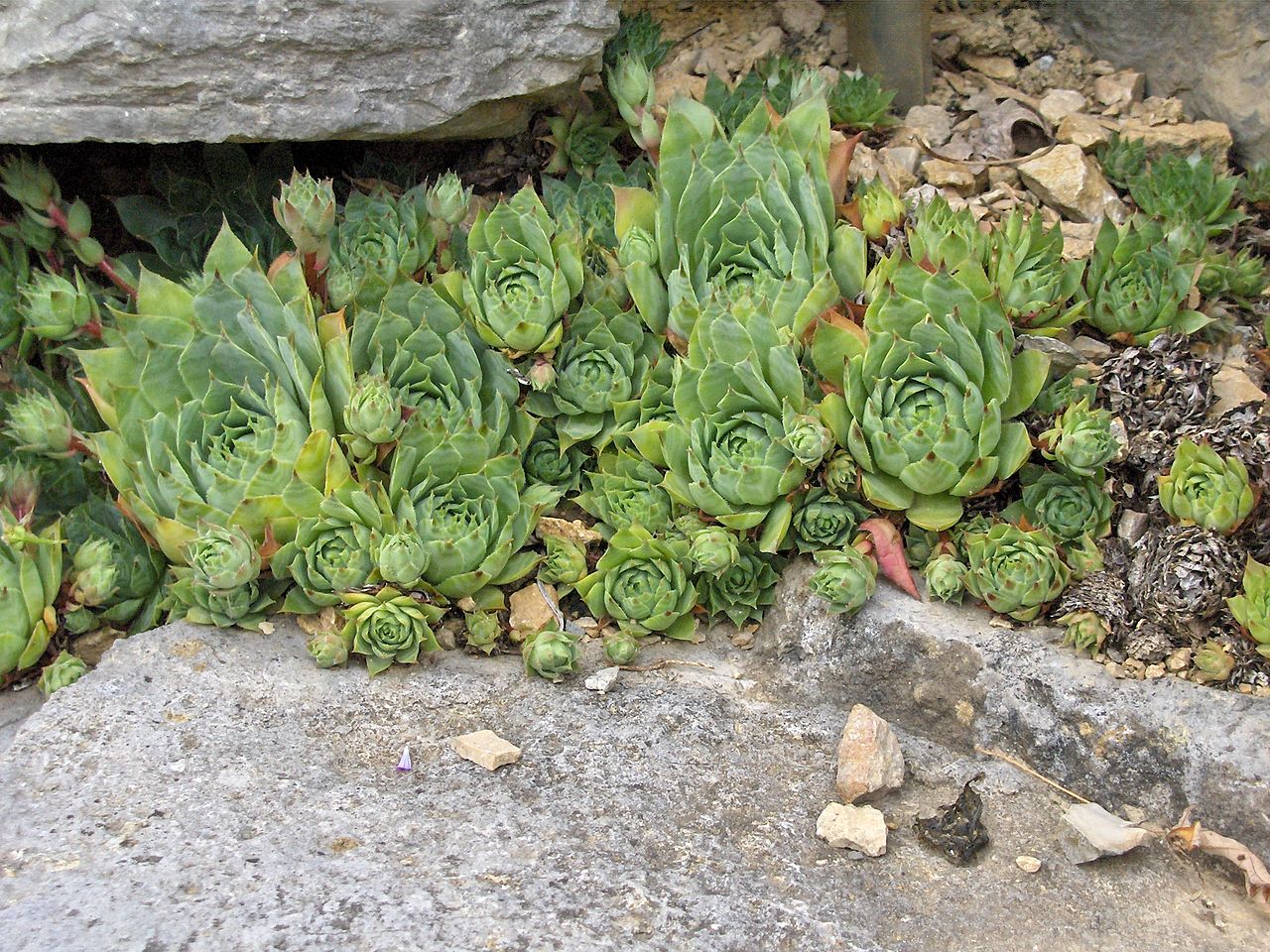
Sempervivium
(houseleek ~ hen & chickens)
To my surprise one house-leek (apparently Sempervivum tectorum of Dewey) has shot up twenty-two inches high and is apparently nearly out, though the petals are erect, not spread. The stem is clothed with the same thick leaves, only smaller and lessening up ward and forming a column about one and a half inches in diameter (with the leaves). The top is a broad raceme (?), about eight inches wide and two thirds as long, of eleven long, spreading, and recurved branches, lined with flowers on the upper side only. These consist of twelve to thirteen lanceolate calyx-segments and as many still longer dull-purple petals and about twenty pistils within and short stamens around them. It is a strange but rather stately cactus-like plant. 

The children call the pretty clusters of radical leaves hen and chickens. In this case the radical leaves are withered, and a fusiform root sustains the flower. This one is not on the bare rock, but lower amid the huckleberry bushes. 

At the Assabet stone bridge, apparently freshly in flower, — though it may have been out nearly as long as the androscemifolium, — apparently the Apocynum cannabinum var. hypericifolium (?). The tallest is four feet high. The flowers very small (hardly more than an eighth of an inch in diameter), the segments of the corolla not revolute but nearly erect. There are twenty to thirty flowers at end of a branch. The divisions of the calyx are longer than in the common, long ovate. Yet it differs from Gray's hypericifolium in having flowers rose-streaked within like the common, the cymes not shorter than the leaves, and the tube of the corolla rather longer than the divisions of the calyx. The leaves are hardly more downy or heart-shaped below than the common. Hypericifolium is a separate species in Pursh and some others. And the branches are less ascending than the common, making an angle of about 62° with the stem (the four lower), while three of the lower of a common one make an angle of 44°.

H. D. Thoreau, Journal, August 5, 1856

Trichostema, maybe several days in some places. See July 31, 1856  ("Trichostema has now for some time been springing up in the fields, giving out its aromatic scent when bruised, and I see one ready to open.");  August 17, 1851 ("The Trichostema dichotomum, — not only its bright blue flower above the sand, but its strong wormwood scent which belongs to the season, –– feed my spirit, endear the earth to me, make me value myself and rejoice.") See also  A Book of the Seasons, by Henry Thoreau, Blue-Curls

Now, at 4 p. m . .  .The Hypericum mutilum is abundantly open . . . sometimes fifteen inches high, while the Canadense and angulatum are shut
.  See August 12, 1856 ("11 a. m. . . .  The Hypericum mutilum is well out at this hour.");  August 17, 1856 ("Hypericum Canadense well out at 2 p. m"); .August 19, 1856 ("I see Hypericum Canadense and mutilum abundantly open at 3 p. m");  August 27, 1856  ("Hypericum Canadense and mutilum now pretty generally open at 4 P.M., thus late in the season, it being more moist and cooler."). See also  A Book of the Seasons by Henry Thoreau, St. Johns-wort (Hypericum)

A great water adder . . . full five feet long and nearly as big round as my arm. See July 23, 1856 ("water adder killed on the 15th and left hanging on a twig"); July 15, 1856 ("It was about three feet long, but large round in proportion, with about one hundred and forty abdominal plates and a long, slender tail.)

Aster dumosus, apparently a day or two, with its large conspicuous flower-buds. See August 10, 1856  ("Aster dumosus and pennyroyal out; how long? ");   August 24, 1853 ("The dumosus is the prevailing white one, very abundant.") See also   A Book of the Seasons by Henry Thoreau, Asters in August

Choke-cherries. . . scarcely edible, but their beauty atones for it. See August 5, 1858 ("Choke-berries, fair to the eye but scarcely palatable, hang far above your head, weighing down the bushes."); See 
also September 3, 1853 ("Now is the season for those comparatively rare but beautiful wild berries which are not food for man . . . it is strange that we do not devote an hour in the year to gathering those which are beautiful to the eye. It behooves me to go a-berrying in this sense once a year at least.”)

Apparently the Apocynum cannabinum var. hypericifolium (?). The tallest is four feet high. See August 7, 1856 ("Hemp, perhaps a week.");  August 13, 1856 ("I stripped off a shred of Indian hemp bark and could not break it. It is as strong as anything of the kind I know. ") August 16, 1856 (" I find the dog's-bane (Apocynum androsoemifolium) bark not the nearly so strong as that of the A. cannabinum.");  September 2, 1856 ("Some years ago I sought for Indian hemp (Apocynum cannabinum) hereabouts in vain, and concluded that it did not grow here. A month or two ago . . . my eyes fell on it, aye, in three different places, and different varieties of it.") See also A Book of the Seasons, by Henry Thoreau, Dogsbane and Indian hemp

August 5. See A Book of the Seasonsby Henry Thoreau, August 5

Now at 4 p. m.
this dog-day cloudy weather
dwarf johnswort open.

A Book of the Seasonsby Henry Thoreau. Near House-leek Rock

A Book of the Seasonsby Henry Thoreau. 

"A book, each page written in its own season,
out-of-doors, in its own locality."
~edited, assembled and rewritten by zphx © 2009-2026

https://tinyurl.com/hdt-560805

Sunday, July 31, 2016

Thoughts of autumn occupy my mind, and the memory of past years.

July 31. 

Thursday. P. M. — To Decodon Pond. 

Erigeron Canadensis, some time. Alisma mostly gone to seed. Thoroughwort, several days. Penthorum, a good while. 

Trichostema has now for some time been springing up in the fields, giving out its aromatic scent when bruised, and I see one ready to open. 

For a morning or two I have noticed dense crowds of little tender whitish parasol toadstools, one inch or more in diameter, and two inches high or more, with simple plaited wheels, about the pump platform; first fruit of this dog-day weather. 

Measured a Rudbeckia hirta flower; more than three inches and three eighths in diameter. 

As I am going across to Bear Garden Hill, I see much white Polygala sanguinea with the red in A. Wheeler's meadow (next to Potter's). 

Also much of the Bartonia tenella, which has been out some days at least, five rods from ditch, and three from Potter's fence. 

Went through Potter's Aster Radula swamp this dog-day afternoon. As I make my way amid rank weeds still wet with the dew, the air filled with a decaying musty scent and the z-ing of small locusts, I hear the distant sound of a flail, and thoughts of autumn occupy my mind, and the memory of past years.

Some late rue leaves on a broken twig have turned all a uniform clear purple. 

How thick the berries — low blackberries, Vaccinium vacillans, and huckleberries — on the side of Fair Haven Hill ! The berries are large, for no drought has shrunk them. They are very abundant this year to compensate for the want of them the last. The children should grow rich if they can get eight cents a quart for blackberries, as they do. 

Again I am attracted by the hoary, as it were misty morning light on the base of the upper leaves of the velvety Pycnanthemum incanum. It is the most interesting of this genus here. 

The smooth sumach is pretty generally crimson-berried on the Knoll, and its lower leaves are scarlet-tipped (though there are some blossoms yet), but the Rhus copallina there is not yet out. 

See dense fields of the great epilobium now in its prime, like soldiers in the meadow, resounding with the hum of bees. The butterflies are seen on the pearly everlasting, etc., etc. 

Hieracium paniculatum by Gerardia quercifolia path in woods under Cliffs, two or three days

Elodea two and a half feet high, how long? The flowers at 3 p. m. nearly shut, cloudy as it is. Yet the next day, later, I saw some open, I think. 

Another short-tailed shrew dead in the wood-path.

Near Well Meadow, hear the distant scream of a hawk, apparently anxious about her young, and soon a large apparent hen-hawk (?) comes and alights on the very top of the highest pine there, within gunshot, and utters its angry scream. This a sound of the season when they probably are taking their first (?) flights. 

See yellow Bethlehem-star still. 

As I look out through the woods westward there, I see, sleeping and gleaming through the stagnant, misty, glaucous dog-day air, i. e. blue mist, the smooth silvery surface of Fair Haven Pond. There is a singular charm about it in this setting. The surface has a dull, gleaming polish on it, though draped in this glaucous mist. 

The Solidago gigantea (?), three-ribbed, out a long time at Walden shore by railroad, more perfectly out than any solidago I have seen. I will call this S. gigantea, yet it has a yellowish-green stem, slightly pubescent above, and leaves slightly rough to touch above, rays small, about fifteen.

Mine must be the Aster Radula (if any) of Gray, yet the scales of the involucre are not appressed, but rather sub-squamose, nor is it rare. Pursh describes it, or the Radula, as white-flowered, and mentions several closely allied species. 

Wade through the northernmost Andromeda Pond. Decodon not nearly out there. Do I not see some kind of sparrow about the shore, with yellow beneath? Mountain cranberries apparently full grown, many at least.

H. D. Thoreau, Journal, July 31, 1856

Trichostema has now for some time been springing up in the fields, giving out its aromatic scent.
 See Jujy 31, 1854 ("Blue-curls."); July 11, 1853 ("The aromatic trichostema now springing up"). See also A Book of the Seasons, by Henry Thoreau, Blue-Curls

This dog-day afternoon . . .  the air filled with a decaying musty scent and the z-ing of small locusts. See July 31, 1855 ("Our dog-days seem to be turned to a rainy season.") July 31, 1859 ("It is emphatically one of the dog-days. A dense fog, not clearing off till we are far on our way, and the clouds (which did not let in any sun all day) were the dog-day fog and mist, which threatened no rain. A muggy but comfortable day."); July 31, 1860 ("Decidedly dog-days, and a strong musty scent, not to be wondered at after the copious rains and the heat of yesterday.") See also A Book of the Seasons, by Henry Thoreau, Locust, Dogdayish Days and August 2, 1859 ("That fine z-ing of locusts in the grass which I have heard for three or four days is an August sound.")

Thoughts of autumn occupy my mind, and the memory of past years. See August 7, 1854 ("I am not so much reminded of former years, as of existence prior to years.”) See also Farewell, my friend

Another short-tailed shrew dead in the wood-path. See July 12, 1856 (“I have found them thus three or four times before.”)


July 31.
  See A Book of the Seasons, by Henry Thoreau July 31

Thoughts of autumn and
the memory of past years
occupy my mind.

A Book of the Seasons, by Henry Thoreau, Thoughts of autumn
A Book of the Seasons, by Henry Thoreau
"A book, each page written in its own season,
out-of-doors, in its own locality."
 ~edited, assembled and rewritten by zphx ©  2009-2024

Wednesday, August 10, 2011

The dispersion of seeds

August 9


The OEnothera biennis along the railroad now. Do the cars disperse seeds?

The Trichostema dichotomum is quite beautiful now in the cool of the morning. 

The epilobium in the woods still. 

Now the earliest apples begin to be ripe, but none are so good to eat as some to smell. Some knurly apple which I pick up in the road reminds me by its fragrance of all the wealth of Pomona.

H. D. Thoreau, Journal, August 9, 1851

August 9. See A Book of the Seasons, by Henry Thoreau,  August 9


A Book of the Seasons, by Henry Thoreau
"A book, each page written in its own season,
out-of-doors, in its own locality.”
~edited, assembled and rewritten by zphx © 2009-2021
.

Popular Posts Last 30 Days.

The week ahead in Henry’s journal

The week ahead in Henry’s journal
A journal, a book that shall contain a record of all your joy.
"A stone fruit. Each one yields me a thought." ~ H. D. Thoreau, March 28, 1859


I sit on this rock
wrestling with the melody
that possesses me.