Showing posts with label eleocharis. Show all posts

Wednesday, May 27, 2020

The black-polls are very numerous all over the town this spring.


May 27.

Fire in house again. 


The Sylvia striata are the commonest bird in the street, as I go to the post-office, for several days past. I see six (four males, two females) on one of our little fir trees; are apparently as many more on another close by. The white bars on the wings of both sexes are almost horizontal. 


I see them thus early and late on the trees about our houses and other houses the 27th and 28th and 29th also, - peach trees, etc., but especially on the firs.

They are quite tame. I stand within seven or eight feet while they are busily pecking at the freshly bursting or extending glaucous fir twigs, deliberately examining them on all sides, and from time to time one utters a very fine and sharp, but faint tse tse, tse tse, tse tse, with more or less of these notes. I hear the same in the woods.

Examining the freshly starting fir twigs, I find that there are a great many lice or aphides amid the still appressed leafets or leaves of the buds, and no doubt they are after these. Occasionally a summer yellowbird is in company with them, about the same business.

They, the black-polls, are very numerous all over the town this spring. The female has not a black, but rather, methinks, a slate - colored crown, and is a very different bird, — more of a yellowish brown.

Eleocharis acicularis, not long, on the low exposed bank of the river; if it is that that greens the very low muddy banks.

J. Farmer found a marsh hawk's nest on the 16th, — near the Cooper ' s hawk nest, — with three fresh eggs.

H. D. Thoreau, Journal, May 27, 1860

Fire in house again. See May 21, 1860 (“Cold, at 11 A.M. 50°; and sit by a fire”); and note to May 22, 1860 ("Another cold and wet day, requiring fire")

They, the black-polls, are very numerous all over the town this spring. See May 20, 1856 ("The Sylvia striata, or black-poll warbler, busily picking about the locust buds and twigs. Black head and above, with olive (green) wings and two white bars; white all beneath, with a very distinct black line from throat to shoulders; flesh-colored legs; bill, dark above, light beneath."); and note to June 4, 1860 ("The black-poll warblers (Sylvia striata) appear to have left, and some other warblers, if not generally, with this first clear and bright and warm, peculiarly June weather, immediately after the May rain.") See also A Book of the Seasons,  by Henry Thoreau, The Black-poll Warbler


J. Farmer found a marsh hawk's nest on the 16th with three fresh eggs. See May 29, 1860 ("We next proceeded to the marsh hawk’s nest from which the eggs were taken a fortnight ago and the female shot")

Friday, May 8, 2020

The simple peep peep of the peetweet.


May 8


A cloudy day. 

The small pewee, how long. 

The night-warbler's note. 

River four and seven eighths inches below summer level. 

Stone-heaps, how long? 

I see a woodchuck in the middle of the field at Assabet Bath. He is a  heavy fellow with a black tip to his tail, poking about almost on his belly, — where there is but little greenness yet, — with a great heavy head. He is very wary, every minute pausing and raising his head, and sometimes sitting erect and looking around. He is evidently nibbling some green thing, maybe clover. He runs at last, with an undulating motion, jerking his lumbering body along, and then stops when near a hole. But on the whole he runs and stops and looks round very much like a cat in the fields. 

The cinquefoil is closed in a cloudy day, and when the sun shines it is turned toward it. 

The simple peep peep of the peetweet, as it flies away from the shore before me, sounds hollow and rather mournful, reminding me of the seashore and its wrecks, and when I smell the fresh odor of our marshes the resemblance is increased. 

How the marsh hawk circles or skims low, round and round over a particular place in a meadow, where, perhaps, it has seen a frog, screaming once or twice, and then alights on a fence-post! How it crosses the causeway between the willows, at a gap in them with which it is familiar, as a hen knows a hole in a fence! I lately saw one flying over the road near our house. 

I see a gray squirrel ascend the dead aspen at the rock, and enter a hole some eighteen feet up it. Just below this, a crack is stuffed with leaves which project. Probably it has a nest within and has filled up this crack. 

Now that the river is so low, the bared bank, often within the button-bushes, is seen to be covered with that fine, short, always green Eleocharis acicularis (?).

C. has seen a brown thrasher and a republican swallow to-day.

H. D. Thoreau, Journal, May 8, 1860


The small pewee, how long. See May 7, 1852 (" The first small pewee sings now che-vet, or rather chirrups chevet, tche-vet — a rather delicate bird with a large head and two white bars on wings."). See also A Book of the Seasons,  by Henry Thoreau,the “Small Pewee"

The night-warbler's note. See May 8, 1852 ("The night-warbler while it is yet pretty light.");  May 28, 1854 ("The night-warbler, after his strain, drops down almost perpendicularly into a tree-top and is lost.”);  According to Emerson the night warbler is "a bird he had never identified, had been in search of twelve years, which always, when he saw it, was in the act of diving down into a tree or bush.” Probably the flight song of the oven-bird. See A Book of the Seasons, by Henry Thoreau, The Oven-bird.

Stone-heaps, how long? See May 4, 1858 ("I asked [a fisherman] if he knew what fish made the stone-heaps in the river. He said the lamprey eel.”) May 8, 1858 ("Mr. Wright . . ., an old fisherman, remembers the lamprey eels well, which he used to see in the Assabet there, but thinks that there have been none in the river for a dozen years and that the stone-heaps are not made by them. "); May 12, 1858 ("George, the carpenter, says that he used to see a great many stone-heaps in the Saco in Bartlett, near the White Mountains, like those in the Assabet, and that there were no lampreys there and they called them “snake-heaps.”); July 31, 1859 ("A man fishing at the Ox-Bow said without hesitation that the stone-heaps were made by the sucker, at any rate that he had seen them made by the sucker in Charles River,")

The cinquefoil is closed in a cloudy day, and when the sun shines it is turned toward it. See May 2, 1860 ("The early potentillas are now quite abundant."); May 17, 1853 ("The early cinquefoil is now in its prime and spots the banks and hillsides and dry meadows with its dazzling yellow. How lively! It is one of the most interesting yellow flowers. ")

The simple peep peep of the peetweet, as it flies away from the shore before me, sounds hollow and rather mournful. See 
 April 30, 1856 (“As I go along the Assabet, a peetweet skims away from the shore.”);  May 2, 1859 ("The river seems really inhabited when the peetweet is back . . . This bird does not return to our stream until the weather is decidedly pleasant and warm . . .Its note peoples the river, like the prattle of children once more in the yard of a house that has stood empty."); May 4, 1856 (“As soon as the rocks begin to be bare the peetweet comes and is seen teetering on them and skimming away from me.”) [Thoreau's Peetweet  is the Spotted Sandpiper  (Actitis macularia)]

How the marsh hawk circles or skims low, round and round over a particular place in a meadow. See May 2, 1855 ("Was that a harrier seen at first skimming low then seating and circling, with a broad whiteness on the wings beneath"); May 2, 1858 (" How patiently they skim the meadows, occasionally alighting, and fluttering "); May 14, 1855 (" See a male hen-harrier skimming low along the side of the river, often within a foot of the muddy shore . . . Occasionally he alights and walks or hops flutteringly a foot or two over the ground")

 C. has seen a brown thrasher and a republican swallow to-day. See  May 7, 1852 ("Beginning, I may say, with robins, song sparrows, chip-birds, bluebirds, etc., I walk through larks, pewees, pigeon woodpeckers, chickadees, towhees, huckleberry-birds, wood thrushes, brown thrasher, jay, catbird, ");May 8, 1857  ("The ring of toads, the note of the yellowbird, the rich warble of the red-wing, the thrasher on the hillside, the robin's evening song, the woodpecker tapping some dead tree across the water")

*****
 I had a minor discovery in the wildflower garden while trimming branches off the ten-year old white pines i had cut there. Deep into the work I suddenly saw that the branches come in whorls of five, just as the white pine needles are in bundles of five. According to my friend Henry your true discoveries are made when you’re doing something else.  Amid the tedium and torment of cutting the little branches into four-foot lengths  I saw they were growing in  whorls of five . . . 5.   5!   5 !   Five whorls. Five needles. May 8, 2020

Saturday, August 3, 2019

The grassy sea.

August 3

6 A. M. — River fallen one inch since 2.30 P. M. yesterday; i.e., it is now a quarter of an inch above summer level. 

AUGUST 3, 2019

Juncus Greenei grows in river meadow opposite Dodd’s; long done. I saw (the 31st ult.) that the river was narrowed to a third its width by a large mass of button-bushes sunk in the middle of it_above the Sudbury causeway. 

The low water reveals a mass of meadow sunk under the railroad bridge. Both this and Lee’s Bridge are thus obstructed this year.  

I should say the origin of these holes was that the river, being shallow and therefore crowded, runs swiftly and digs into the bank and so makes a deep hole and a bend. The three large lakes may perhaps be considered as three deep holes made by a larger river or ocean current in former ages. The almost constant occurrence of a bay, or stagnant expansion, on the convex side at the bends is remarkable. It seems to be a place where the river has formerly flowed, but which, by wearing into the opposite bank, it has left. 

There are about twenty-one weedy places (i. e., where the weeds extend quite across), all together about two miles in length. These weedy places, you may say (not withstanding the frequent winding of the river), generally occur at bends (the Island shoal, perhaps, and Barrett’s Bar, and above Middlesex Turnpike Bridge are exceptions).  The most remarkable bend between Framingham and the Dam is the Ox-Bow in Framingham. 

Since our river is so easily affected by wind, the fact that its general course is northeast and that the prevailing winds in summer are southwest is very favorable to its rapid drainage at that season. If by fall you mean a swifter place occasioned by the bottom below for a considerable distance being lower than the bottom above for a considerable distance, I do not know of any such between Pelham Pond and the Falls. 

These swifter places are produced by a contraction of the stream,— chiefly by the elevation of the bottom at that point, — also by the narrowing of the stream. 

The depths are very slight compared with the lengths. The average depth of this twenty-five miles is about one seventeen thousandth the length; so that if this portion of the river were laid down on a map four feet long the  depth would be about equal to the thickness of ordinary letter paper, of which it takes three hundred and fifty to an inch. Double the thickness of the letter paper, and it will contain the deep holes which are so unfathomed and mysterious, not to say bottomless, to the swimmers and fishermen. 

Methinks the button-bushes about Fair Haven indicate a muddy but not deep pond.

The deepest reach of this twenty-five miles is from E. Davis Hill to Skelton Bend. 

Methinks I saw some of the fresh-water sponge in the river in Framingham. 

Undoubtedly, in the most stagnant parts of the river, when the wind blows hard up-stream, a chip will be drifted faster up-stream than ever it floats downward there in a calm. 

P. M. — I see two or three birds which I take to be rose-breasted grosbeaks of this year. They are speckled brown and white (with considerable white) birds, and no rose on breast that I see. I hear them singing a little in a grosbeak-like strain, but a more partial warble. Heard one July 28th on an oak high up Assabet, and to-day on an apple tree near Brister’s. 

Warren Miles tells me that in mowing lately he cut in two a checkered “adder,” — by his account it was the chicken snake, — and there was in its stomach a green snake, dead and partly digested, and he was surprised to find that they ate them. 

Water-bugs are collected in dense swarms about my boat, at its stagnant harbor. They gyrate in a very leisurely manner under my face, occasionally touching one another by their edges a moment. When I move or disturb the water, they at once begin to gyrate rapidly. After the evening has set in, I perceive that these water bugs, which all day were collected in dense swarms in the stagnant water amid the weeds at the sides, are dispersed over the river (quite across it here) and gyrating rapidly in the twilight.

The haymakers are quite busy on the Great Meadows, it being drier than usual. It being remote from public view, some of them work in their shirts or half naked. 

As I wade through the middle of the meadows in sedge up to my middle and look afar over the waving and rustling bent tops of the sedge (all are bent northeast by the southwest wind) toward the distant mainland, I feel a little as if caught by a rising tide on flats far from the shore. I am, as it were, cast away in the midst of the sea. It is a level sea of waving and rustling sedge about me. The grassy sea. 

You feel somewhat as you would if you were standing in water at an equal distance from the shore. To-day I can walk dry over the greater part of the meadows, but not over the lower parts, where pipes, etc., grow; yet many think it has not been so dry for ten years!

Goodwin is there after snipes. I scare up one in the wettest part. High blackberries begin to be ripe.

A novel phenomenon of dry weather and a low stage of water is the sight of dense green beds of Eleocharis acicularis, still in bloom, which grows at the bottom of muddy pools, but now, they being dry, looks like a dense fine bed of green moss, denser than grass. I recline on such a bed, perfectly dry and clean, amid the flags and pontederia, where lately was water and mud. It covers the mud with a short dense green mat of culms fine as a hair, quite agreeable to rest on and a rather novel sight.

H. D. Thoreau, Journal, August 3, 1859

It is a level sea of waving and rustling sedge about me. The grassy sea. See July 4, 1860 ("We are wading and navigating at present in a sort of sea of grass, which yields and undulates under the wind like water")

High blackberries begin to be ripe.
See August 3, 1856 ("High blackberries beginning; a few ripe."); August 4, 1856 ("Here and there the high blackberry, just beginning, towers over all."). See also A Book of the Seasons,  by Henry Thoreau, Blackberries

Friday, July 26, 2019

Apple trees, square and round, in the northwest landscape.

July 26. 

P. M. — To Great Meadows.

July 26, 2019

I see in Clark's (?) land, behind Garfield's, a thick growth of white birches, apparently three years old, blown from the wood on the west and southwest.

Looking from Peter's, the meadows are somewhat glaucous, with a reddish border, or bank, by the river, where the red-top and Agrostis scabra grow, and a greener stream where the pipes are, in the lowest part, by the Holt, and in some places yellowish-green ferns and now brown-topped wool-grass. 

There is much of what I call Juncus scirpoides now in its prime in the wetter parts, as also the Eleocharis palustris, long done, and Rhyncospora alba lately begun. Also buck-bean by itself in very wet places which have lost their crust. 

Elodea, how long? 

Now observe the darker shades, and especially the apple trees, square and round, in the northwest landscape. 

Dogdayish. 

Methinks the hardhack leaves always stand up, for now they do, and have as soon as they blossomed at least.

July 26, 2019

H. D. Thoreau, Journal, July 26, 1859

I see in Clark's land, behind Garfield's, a thick growth of white birches, apparently three years old, blown from the wood on the west and southwest. See January 7, 1854 ("The bird-shaped scales of the white birch are blown more than twenty rods from the trees"); January 7, 1856 ("I see birch scales (bird-like) on the snow on the river more than twenty rods south of the nearest and only birch, and trace them north to it”);  March 25, 1858 ("Going across A. Clark's field behind Garfield’s, I see many fox-colored sparrows flitting past in a straggling manner into the birch and pitch pine woods on the left"); November 8, 1860 ("Also a wet and brushy meadow some forty rods in front of Garfield's is being rapidly filled with white pines whose seeds must have been blown  [fifty rods].").

July 26. See A Book of the Seasons, by Henry Thoreau, July 26

A Book of the Seasons, by Henry Thoreau
"A book, each page written in its own season,
out-of-doors, in its own locality."
~edited, assembled and rewritten by zphx © 2009-2021

Sunday, July 7, 2019

Bathing at Barrett's Bay, I find it to be composed in good part of sawdust

July 7

P. M. — To Great Meadows. 

July 7,  2019
P. Hutchinson says he once found a wood duck's nest in a hollow maple by Heywood's meadow (now by railroad), and tried to get the young as soon as hatched, but they were gone too soon for him. 

On the first, or westerly, part of the Great Meadows, i. e. the firmer parts and the bank, I find, mixed with sedges of different kinds, much red-top (coloring the surface extensively), fowl-meadow (just begun to bloom and of a purplish lead-color, taller than the red-top), the slender purple-spiked panic, Agrostis (perennans? or scabra??). 

In the wet, or main, part, beside various other sedges, — as [Carex] stellulata, lanuginosa, stricta, etc., etc., — wool-grass, now in flower, a sedge (apparently C. ampullacea var. utriculata toward Holbrook's) thicker-culmed than wool-grass, but softer and not round, with fertile spikes often three inches long, and slender. A great part of the meadow is covered with, I think, either this or wood grass (not in flower). I am not certain which prevails, but I think wool-grass, which does not flower. 

Also, mixed with these and lower, dulichium, Eleocharis palustris, etc., etc. 

First notice pontederia out; also tephrosia, how long? 

The note of the bobolink has begun to sound rare? 

Do not young nighthawks run pretty soon after being hatched? I hear of their being gone very soon. 

Bathing at Barrett's Bay, I find it to be composed in good part of sawdust, mixed with sand. There is a narrow channel on each side, deepest on the south. 

The potamogeton is eight feet long there in eighteen inches of water. 

I learn from measuring on Baldwin's second map that the river (i. e. speaking of that part below Framingham) is much the straightest in the lower part of its course, or from Ball's Hill to the Dam. It winds most in the broad meadows. The greatest meander is in the Sudbury meadows. 

From upper end of Sudbury Canal to Sherman's Bridge direct is 558 rods (1 mile 238 rods); by thread of river, 1000 rods (3 miles 40 rods), or nearly twice as far. But, though meandering, it is straighter in its general course than would be believed. These nearly twenty-three miles in length (or 16 + direct) are contained within a breadth of two miles twenty-six rods; i. e., so much it takes to meander in. It can be plotted by the scale of one thousand feet to an inch on a sheet of paper seven feet one and one quarter inches long by eleven inches wide. 

The deep and lake-like are the straightest reaches. The straightest reach within these limits above Ball's Hill is from Fair Haven Pond to Clamshell Hill.

I observed in Maine that the dam at the outlet of Chesuncook Lake, some twenty miles off, had raised the water so as to kill the larches on the Umbazookskus extensively. They were at least four or five miles up the Umbazookskus.

H. D. Thoreau, Journal, July 7, 1859

The slender purple-spiked panic, Agrostis (perennans? or scabra??).See September 5, 1858 ("Agrostis perennans, thin grass, or hair grass, on moist ground or near water. The branches of the panicle are but slightly purplish."); July 3, 1859 (" A large patch of Agrostis scabra a very interesting purple with its fine waving top, mixed with blue-eyed grass.");July 11, 1860 (" I am interested now by patches of Agrostis scabra. Drooping and waving in the wind a rod or two over amid the red-top and herd's-grass of A.Wheeler's meadow, this grass gives a pale purple sheen to those parts, the most purple impression of any grass.")

The note of the bobolink has begun to sound rare? See June 9, 1855 ("I think I have hardly heard a bobolink for a week or ten days.");June 15, 1852 ("The note of the bobolink begins to sound somewhat rare."); June 19, 1853 ("The strain of the bobolink now begins to sound a little rare. It never again fills the air as the first week after its arrival.") Compare June 30, 1852 ("(I heard a bobolink this afternoon.)");July 2, 1855 ("Young bobolinks are now fluttering over the meadow."); July 10, 1859 ("See many young birds now. . . Even hear one link from a bobolink."); July 11, 1856 ('Hear now the link of bobolinks, and see quite a flock of red-wing blackbirds and young. "); July 12, 1857 ("I hear the occasional link note from the earliest bobolinks of the season"); July 15, 1854 ("I hear the link link of the bobolink,. . . . Many birds begin to fly in small flocks like grown-up broods."); July 15, 1856 ("Bobolinks are heard — their link, link — above and amid the tall rue which now whitens the meadows”); July 19, 1855 ("Young bobolinks; one of the first autumnalish notes."); August 6, 1852 (“With the goldenrod comes the goldfinch. About the time his cool twitter is heard, does not the bobolink, thrasher, catbird, oven-bird, veery, etc., cease?”);  August 10, 1853 ("Of late, and for long time, only the link, link of bobolink."); August 10, 1854 ("The tinkling notes of goldfinches and bobolinks which we hear nowadays are of one character and peculiar to the season."); August 16, 1858 ("[Hear]the link of many bobolinks (and see large flocks on the fences and weeds; they are largish-looking birds with yellow throats)"); August 22, 1853 ("Surprised to hear a very faint bobolink in the air; the link, link, once or twice later"); August 25, 1852 (" I hear no birds sing these days, only . . . the mew of a catbird, the link link of a bobolink, or the twitter of a goldfinch, all faint and rare"); September 15, 1858 ("I have not seen not heard a bobolink for some days at least, numerous as they were three weeks ago, and even fifteen days. They depart early.") See also A Book of the Seasons,  by Henry Thoreau, the Bobolink


Do not young nighthawks run pretty soon after being hatched? See June 17, 1853 (" One of the nighthawk's eggs is hatched. The young is unlike any that I have seen, exactly like a pinch of rabbit's fur or down of that color dropped on the ground, not two inches long, with a dimpling or geometrical or somewhat regular arrangement of minute feathers in the middle, destined to become the wings and tail. Yet even it half opened its eye, and peeped if I mistake not. . . It seemed a singular place for a bird to begin its life, — to come out of its egg, — this little pinch of down, — . . ., with nothing but the whole heavens, the broad universe above, to brood it when its mother was away.") See also A Book of Seasons,  by Henry Thoreau,, the Nighthawk

Bathing at Barrett's Bay, I find it to be composed in good part of sawdust, mixed with sand. See April 19, 1854 ("I was surprised to find the river so full of sawdust from the pail-factory and Barrett's mill that I could not easily distinguish if the stone-heaps had been repaired. There was not a square three inches clear. And I saw the sawdust deposited by an eddy in one place on the bottom like a sand-bank a foot or more deep half a mile below the mill.") and note to July 14, 1857 ("Set fire to the carburetted hydrogen from the sawdust shoal with matches, and heard it flash.")

Wednesday, July 3, 2019

A very interesting purple with its fine waving top, mixed with blue-eyed grass.

July 3. 

P. M. — To Hubbard's Grove.

You see in rich moist mowing the yet slender, recurving unexpanded panicles or heads of the red-top (?), mixed with the upright, rigid herd's-grass. Much of it is out in dry places. 

Glyceria fluitans is very abundant in Depot Field Brook. 

Hypericum ellipticum out. 

I noticed the other day, I think the 30th, a large patch of Agrostis scabra in E. Hosmer's meadow, — the firmer ridges, — a very interesting purple with its fine waving top, mixed with blue-eyed grass.

July 3, 2019
partridge berry

The Mitchella repens, so abundant now in the north west part of Hubbard's Grove, emits a strong astringent cherry-like scent as I walk over it, now that it is so abundantly in bloom, which is agreeable to me, — spotting the ground with its downy-looking white flowers. 

Eleocharis obtusa and acicularis are now apparently in prime at water's edge by Hubbard's Grove bridge path. 

Also Juncus bufonius is very abundant in path there, fresh quite, though some shows seed. Juncus tenuis, though quite fresh, is also as much gone to seed.

H. D. Thoreau, Journal, July 3, 1859

The yet slender, recurving unexpanded panicles or heads of the red-top. See July 6, 1851 ("The red-topped grass is in its prime, tingeing the fields with red.");  July 13, 1860 ("First we had the June grass reddish-brown, and the sorrel red, of June; now the red-top red of July.)

Hypericum ellipticum out. See July 26, 1856 ("Arranged the hypericums in bottles this morning and watched their opening. . . . The pod of the ellipticum, when cut, smells like a bee.") See also A Book of the Seasons,  by Henry ThoreauSt. Johns-wort (Hypericum)

A large patch of Agrostis scabra a very interesting purple with its fine waving top, mixed with blue-eyed grass. See July 11, 1860 (" I am interested now by patches of Agrostis scabra. Drooping and waving in the wind a rod or two over amid the red-top and herd's-grass of A.Wheeler's meadow, this grass gives a pale purple sheen to those parts, the most purple impression of any grass.")

Mixed with blue-eyed grass. See June 15, 1851 ("The blue-eyed grass, well named, looks up to heaven."); July 6, 1851("Blue-eyed grass is now rarely seen. ") See also A Book of the Seasons,  by Henry Thoreau, blue-eyed grass

The Mitchella repens, so abundant now in the north west part of Hubbard's Grove, emits a strong astringent cherry-like scent. See  July 2, 1859 ("Mitchella repens is abundantly out").  See also  A Book of the Seasons, by Henry Thoreau, Partridge-berry (Mitchella Repens)

Wth its white flowers
so abundantly in bloom
Mitchella repens
A Book of the Seasons, by Henry Thoreau, 
interesting purplemixed with blue-eyed grass

A Book of the Seasons, by Henry Thoreau 

"A book, each page written in its own season,
out-of-doors, in its own locality.”
~edited, assembled and rewritten by zphx © 2009-2025


Thursday, May 30, 2019

He may have thought that no one but he came to Gowing's Swamp these afternoons

May 30.

 P. M. — To Gowing's Swamp. 
Gowing's Swamp
August 23, 1854
amid the sphagnum, lambkill, Kalmia glauca, andromeda, cranberry, etc

Sorrel begins to redden fields. 


The peculiarly tender foliage (yellowish) which began to invest the dark evergreens on the 22d lasts a week or more, growing darker.


May 30, 2019
No American mountain-ash out. 

When I entered the interior meadow of Gowing's Swamp I heard a slight snort, and found that I had suddenly come upon a woodchuck amid the sphagnum, lambkill, Kalmia glauca, andromeda, cranberry, etc., there. It was only seven feet off, and, being surprised, would not run. It would only stand erect from time to time, — perfectly erect with its blackish paws held like hands near together in front, — just so as to bring its head, or eyes, above the level of the lambkill, kalmia, etc., and look round, turning now this ear toward me, then that; and every now and then it would make a short rush at me, half a foot or so, with a snort, and then draw back, and also grit its teeth — which it showed — very audibly, with a rattling sound, evidently to intimidate me. I could not drive it, but it would steadily face me and rush toward me thus. Also it made a short motion occasionally as if to bury itself by burrowing there. It impressed me as a singularly wild and grizzly [sic] native, survivor of the red man. 

He may have thought that no one but he came to Gowing's Swamp these afternoons. 

Its colors were gray, reddish brown, and blackish, the gray-tipped wind hairs giving it a grizzly look above, and when it stood up its distinct rust-color beneath was seen, while the top of its head was dark-brown, becoming black at snout, as also its paws and its little rounded ears. Its head from snout to ears, when it stood up erect, made a nearly horizontal line. It did much looking round. When thus erect, its expression and posture were very bear-like, with the clumsiness of the bear. Though I drew off three or four rods, it would not retreat into the thicket (which was only a rod off) while I was there so near. 

The scheuchzeria is at height or past. 

E. Emerson's Calla palustris out the 27th. 

Eleocharis palustris, R. W. E.'s meadow, not long. 

Hear of linnaea out, the 28th.

H. D. Thoreau, Journal, May 30, 1859

Sorrel begins to redden fields. See May 19, 1860 ("Sorrel just begins to redden some fields"); May 22, 1854 ("The grass so short and fresh, the tender yellowish-green and silvery foliage of the deciduous trees lighting up the landscape, the birds now most musical, the sorrel beginning to redden the fields with ruddy health, — all these things make earth now a paradise.");  May 26, 1852 ("Walking home from surveying, the fields are just beginning to be reddened with sorrel. "); June 12, 1859 ("I am struck with the beauty of the sorrel now. . . What a wholesome red! . . . There is hardly a more agreeable sight at this season.")


The peculiarly tender foliage (yellowish) which began to invest the dark evergreens on the 22d lasts a week or more, growing darker. See note to May 22, 1859 ("The foliage is never more conspicuously a tender yellow than now. This lasts a week from this date, and then begins to be confounded with the older green. "). See also May 27, 1855("How important the dark evergreens now seen through the haze in the distance and contrasting with the gauze-like, as yet thin-clad deciduous trees"); May 26, 1857 ("The silvery leafets of the deciduous trees invest the woods like a permanent mist. At the same season with this haze of buds comes also the kindred haziness of the air.")


The interior meadow of Gowing's Swamp. See note to January 30, 1858  ("The pool, where there is nothing but water and sphagnum to be seen and where you cannot go in the summer, is about two rods long and one and a half wide.")

Its colors were gray, reddish brown, and blackish, the gray-tipped wind hairs giving it a grizzly look above, and when it stood up its distinct rust-color beneath was seen, while the top of its head was dark-brown, becoming black at snout, as also its paws and its little rounded ears. See note to April 29, 1855 ("See his shining black eyes and black snout and his little erect ears. He is of a light brown forward at this distance (hoary above, yellowish or sorrel beneath), gradually darkening backward to the end of the tail, which is dark-brown. The general aspect is grizzly.")

May 30 See A Book of the Seasons, by Henry Thoreau, May 30


A Book of the Seasons,  by Henry Thoreau
"A book, each page written in its own season,
out-of-doors, in its own locality.”


~edited, assembled and rewritten by zphx © 2009-2021

Sunday, May 26, 2019

The rhodora at Ledum Swamp is now in its perfection, brilliant islands of color..

May 26. 
RWE 1847


Thursday. P. M. — To Ledum Swamp and Lee's Cliff.

Eleocharis tenuis in bloom, apparently the earliest eleocharis. 

The rhodora at Ledum Swamp is now in its perfection, brilliant islands of color. 

Eriophorum vaginatum, how long? 

Ledum out apparently two or three days. 

Andromeda Polifolia out, how long? 

Tall swamp huckleberry just budded to bloom. 

Do I not hear the nuthatch note in the swamp? 

Do not detect the scheuchzeria there yet.

The air is full of terebinthine odors to-day, — the scent of the sweet-fern, etc. 


May 26, 2019
Moss Ledge
The reddish leaves (and calyx) of the Vaccinium vacillans, just leafed, are interesting and peculiar now, perhaps more or less crimson. 

See a flock of cowbirds, the first I have seen. 

Cows in water, so warm has it got to be. 

Geranium (how long?), behind Bittern Cliff, and wild pink. 

Pitch pine pollen at Lee's. 

Cherry-birds. 

Ascendant potentilla abundant, how long? 

Juniperus repens pollen, how long ? 

Interrupted fern pollen [sic]. 

The dicksonia fern is one foot high, but not fairly unfolded. 

The tender white-downy stems of the meadow saxifrage, seen toward the westering sun, are very conspicuous and thick in the meadows now. 

A purple finch's nest in one of our firs.

H. D. Thoreau, Journal, May 26, 1859

The rhodora at Ledum Swamp is now in its perfection, brilliant islands of color.   See May 17, 1853 (“The rhodora is peculiar for being, like the peach, a profusion of pink blossoms on a leafless stem. This shrub is, then, a late one to leaf out.”);  May 17, 1858 ("Rhodora at Clamshell well out.”); May 18, 1853 ("The rhodora is one of the very latest leafing shrubs, for its leaf-buds are but just expanding, making scarcely any show yet, but quite leafless amid the blossoms."); May 18, 1855 ("Rhodora; probably some yesterday."); May 18, 1856 ("The rhodora there [Kalmia Swamp] maybe to-morrow. Elsewhere I find it (on Hubbard’s meadow) to-day. "); May 18, 1857 ("Pratt says he saw the first rhodora . . . out yesterday");  May 19, 1854 ("The rhodora is late, and is naked flowering."); May 27, 2016 (“Kalmia in prime, and rhodora.”); May 31, 1857 (“Rhodora now in its prime.”).

See a flock of cowbirds, the first I have seen. See September 6, 1858  (“To Ledum Swamp. Going over Clamshell Plain, I see a very large flock of a hundred or more cowbirds about some cows.”); August 25, 1855 (“They keep close to the cow’s head and feet, and she does not mind them; but when all go off . . .at my approach, the cow (about whom they were all gathered) looks off after them for some time, as if she felt deserted.”).

Cows in water, so warm has it got to be. See July 12, 1857 (“It is exceedingly sultry this afternoon, and few men are abroad. The cows stand up to their bellies in the river, lashing their sides with their tails from time to time.”).

May 26. See  A Book of the Seasons, by Henry Thoreau, May 26

Friday, August 31, 2018

The smooth sumach’s lower leaves are bright-scarlet on dry hills.

August 31

P. M. — To Flint’s Pond. 

A hot afternoon. We have had but few warmer. 
wood aster
August 31, 2018
I hear and see but few bobolinks or blackbirds for several days past. The former, at least, must be withdrawing. I have not heard a seringo of late, but I see to-day one golden robin. 

The birches have lately lost a great many of their lower leaves, which now cover and yellow the ground. Also some chestnut leaves have fallen. Many brakes inthe woods are perfectly withered. 

At the Pout’s Nest, Walden, I find the Scirpus debilis, apparently in prime, generally aslant; also the Cyperus dentatus, with some spikes changed into leafy tufts; also here less advanced what I have called Juncus acuminatus

Ludwigia alternifolia still. Sericocarpus about done. 

High blackberries are abundant in Britton’s field. At a little distance you would not suspect that there were any, — even vines, — for the racemes are bent down out of sight, amid the dense sweet-ferns and sumachs, etc. The berries still not more than half black or ripe, keeping fresh in the shade. Those in the sun are a little wilted and insipid. 

The smooth sumach’s lower leaves are bright-scarlet on dry hills. 

Lobelia Dortmanna is not quite done. 

Some ground-nuts are washed out. 

The Flint’s Pond rush appears to be Cladium mariscoides, twig rush, or, in Bigelow, water bog rush, a good while out of bloom; style three-cleft. It is about three feet high. This, with Eleocharis palustris, which is nearest the shore, forms the dense rushy border of the pond. It extends along the whole of this end, at least about four rods wide, and almost every one of the now dry and brown flower-heads has a cobweb on it. I perceive that the slender semicircular branchlets so fit to the grooved or flattened culm as still, when pressed against it, to make it cylindrical! —very neatly. 

The monotropa is still pushing up. Red choke-berry, apparently not long. 

At Goose Pond I scare up a small green bittern. It plods along low, a few feet over the surface, with limping flight, and alights on a slender water-killed stump, and voids its excrement just as it starts again, as if to lighten itself. 

Edward Bartlett brings me a nest found three feet from the ground in an arbor-vitae, in the New Burying Ground, with one long-since addled egg in it. It is a very thick, substantial nest, five or six inches in diameter and rather deep; outwardly of much coarse stubble with its fine root-fibres attached, loose and dropping off, around a thin casing of withered leaves; then finer stubble within, and a lining of fine grass stems and horse hair. 

The nest is most like that found on Cardinal Shore with an addled pale-bluish egg, which I thought a wood thrush’s at first, except that that has no casing of leaves. It is somewhat like a very large purple finch’s nest, or perchance some red-wing’s with a hair lining. 

The egg is three quarters of an inch long, rather broad at one end (or for length), greenish-white with brown dashes or spots, becoming a large conspicuous purple-brown blotch at the large end; almost exactly like — but a little greener (or bluer) and a little smaller — the egg found on the ground in R. W. E.’s garden. 

Do the nest and egg belong together? Was not the egg dropped by a bird of passage in another’s nest? Can it be an indigo-bird’s nest? I take it to be too large.

H. D. Thoreau, Journal, August 31, 1858


The birches have lately lost a great many of their lower leaves, which now cover and yellow the ground.  See August 13, 1854 (“At Thrush Alley, I am surprised to behold how many birch leaves have turned yellow, — every other one, — while clear, fresh, leather-colored ones strew the ground with a pretty thick bed under each tree.”); August 31, 1856 (“The birches on Wheeler's meadow have begun to yellow, apparently owing to the [high] water.”)

High blackberries are abundant in Britton’s field. At a little distance you would not suspect that there were any. See note to August 31, 1857 (“An abundance of fine high blackberries behind Britton's old camp on the Lincoln road, now in their prime there, which have been overlooked.”)

Some ground-nuts are washed out. See August 31, 1857  (“Am surprised to see on the bottom and washing up on to the shore many little farinaceous roots or tubers like very small potatoes, in strings. . . . I never saw so many ground-nuts before.”)

A small green bittern plods along low, a few feet over the surface, with limping flight.
 See  May 16, 1855  ("A green bittern with its dark-green coat and crest, sitting watchful, goes off with a limping peetweet flight.”); August 2, 1856 ("A green bittern comes, noiselessly flapping, with stealthy and inquisitive looking to this side the stream and then that, thirty feet above the water.") and note to July 30, 1856 ("A green bittern. . .with heavy flapping flight, its legs dangling")

Thursday, August 30, 2018

This is the sound which Farmer hears.

August  30

P. M. — To bayonet rush by river. Find at Dodd’s shore: Eleocharis obtusa, some time out of bloom (fresh still at Pratt’s Pool); also Juncus acumiuatus (?), just done (also apparently later and yet in bloom at Pout’s Nest);  also what I called Juncus scirpoides, but which  appears to be Juncus paradoxus, with seeds tailed at both ends, (it is fresher than what I have seen before, and smaller), not done. Some of it with few flowers! A terete leaf rises above the flower. It looks like a small bayonet rush.

The Juncus militaris has been long out of bloom. The leaf is three feet long; the whole plant, four or five. It grows on edge of Grindstone Meadow and above. It would look more like a bayonet if the leaf were shorter than the flowering stem, which last is the bayonet part. This is my rainbow rush. 

All over Ammannia Shore and on bare spots in meadows generally, Fimbristylis autumnalis, apparently in prime; minute, two to five inches high, with aspect of F. capillaris. 

As I am now returning over Lily Bay, I hear behind me a singular loud stertorous sound which I thought might have been made by a cow out of order, twice sounded. Looking round, I saw a blue heron flying low, about forty rods distant, and have no doubt the sound was made by him. Probably this is the sound which Farmer hears.

H. D. Thoreau, Journal, August 30, 1858


The sound which Farmer hears
. See August 29, 1858 ("He hears — heard a week ago — the sound of a bird flying over, like cra-a-ack, cr-r-r-a-k, only in the night, and thinks it may be a blue heron") See also A Book of the Seasons, by Henry Thoreau, the Blue Heron

Saturday, June 13, 2009

Early Strawberries


June 14

P. M. — To Flint's Pond. 

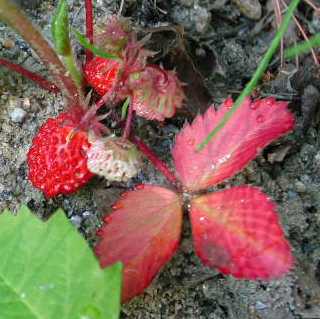
Early strawberries begin to be common. The lower leaves of the plant are red, concealing the fruit. 

Violets, especially of dry land, are scarce now. 

Eleocharis palustris abundant in Stow's meadow, by railroad. 

See a rose-bug. 

A pout's nest (at Pout's Nest) with a straight entrance some twenty inches long and a simple round nest at end. The young just hatched, all head, light-colored, under a mass of weedy hummock which is all under water. 

The common utricularia out. 

Hear the phebe note of a chickadee.

Cow-wheat, how long ? 

A rose-breasted grosbeak betrays itself by that peculiar squeak, on the Britton path. It is evident that many breed in the low woods by Flint's Pond. 

Catbird's nest with four eggs in a swamp-pink, three and a half feet up. 

The rose-breasted grosbeak is common now in the Flint's Pond woods. It is not at all shy, and our richest singer, perhaps, after the wood thrush. The rhythm is very like that of the tanager, but the strain is perfectly clear and sweet. 

One sits on the bare dead twig of a chestnut, high over the road, at Gourgas Wood, and over my head, and sings clear and loud at regular intervals, — the strain about ten or fifteen seconds long, rising and swelling to the end, with various modulations.

Another, singing in emulation, regularly answers it, alternating with it, from a distance, at least a quarter of a mile off. It sings thus long at a time, and I leave it singing there, regardless of me.

H.D. Thoreau, Journal, June 14, 1859

Early strawberries begin to be common
The lower leaves of the plant are red, concealing the fruit. See June 2, 1859 ("Strawberries reddening on some hills"}; June 10, 1856 ("Ripe strawberries . . . hard at first to detect amid the red radical leaves.”)

A rose-breasted grosbeak. It is evident that many breed in the low woods by Flint's Pond
See June 2, 1859 ("Found within three rods of Flint's Pond a rose-breasted grosbeak's nest.") See also A Book of Seasons,  by Henry Thoreau, , the Rose-breasted Grosbeak

A pout's nest (at Pout's Nest).The young just hatched. See April 25, 1859 ("Young Stewart tells me that he saw last year a pout's nest at Walden in the pond-hole by the big pond. The spawn lay on the mud quite open and uncovered, and the old fish was tending it. A few days after, he saw that it was hatched and little pouts were swimming about.") "Pout’s Nest": HDT's name for Wyman's Meadow near Walden. See note to July 26, 1860 (I see a bream swimming about in that smaller pool by Walden in Hubbard's Wood. . . So they may be well off in the Wyman meadow or Pout's Nest."); see also June 7, 1858 ("Pouts, then, make their nests in shallow mud-holes or bays, in masses of weedy mud, or probably in the muddy bank; and the old pout hovers over the spawn or keeps guard at the entrance.Where do the Walden pouts breed when they have not access to this meadow?")

Popular Posts Last 30 Days.

The week ahead in Henry’s journal

The week ahead in Henry’s journal
A journal, a book that shall contain a record of all your joy.
"A stone fruit. Each one yields me a thought." ~ H. D. Thoreau, March 28, 1859


I sit on this rock
wrestling with the melody
that possesses me.