Showing posts with label false solomon’s seal. Show all posts

Sunday, June 19, 2016

Looked at rare plants at the Natural History Rooms

June 19 

[Worcester] Looked at a collection of the rarer plants made by Higginson and placed at the Natural History Rooms. 

Among which noticed:

  • Ranunculus Purshii varieties a and b with no difference apparent, unless in upper leaves being more or less divided.
  • Ribes lacustre, or swamp gooseberry, with a loose raceme such as I have not seen, from White Mountains. 
  • A circaea, or enchanter’s-nightshade, with a very large raceme and with longer branchlets than I have seen, methinks. 
  • Calla palustris, very different from the Peliandra Virginia. 
  • Cerastium arvense, with linear leaves, quite new to me. 
  • Smilacina stellata, from Dr. Harris, very different from the racemosa, being simple. 
  • Ledum latifolium, from White Mountains, rather broader-leafed than mine from Maine. 
  • Barbarea sativa, from Cambridge, apparently like my B. vulgaris. 
Is the Smilacina racemosa with such long lower branchlets peculiar, there in Worcester?  I saw several in woods. 

On way to Concord see mountain laurel out in Lancaster. Had seen none out in Worcester.

H. D. Thoreau, Journal, June 19, 1856


June 19.
Thomas Wentworth Higginson (1823- 1911) was educated at Harvard where he developed interests in botany and entomology. From 1840-1841, Higginson was corresponding secretary and entomological curator of the Harvard Natural History Society; he was a member of the Boston Society of Natural History and of the Cambridge Entomological Club. He shared HDT’s antislavery views and in 1856 had just moved to Worcester, where he joined gatherings at Blake's house to read the letters that HDT wrote to Blake throughout the 1850’s. Mapping Thoreau Country.

Looked at a collection of the rarer plants. See September 21, 1856 (" I have within a week found in Concord two of the new plants I found up-country. Such is the advantage of going abroad, — to enable [you] to detect your own plants. I detected them first abroad, because there I was looking for the strange.");  June 9, 1857( "I have observed that where one rare plant grows there will commonly be others.")

Ribes lacustre, or swamp gooseberry. Thoreau recognized  2 kinds of gooseberry,  swamp gooseberry and prickly gooseberry. See April 30, 1852 ("At Saw Mill Run the swamp gooseberry is partly leaved out. This . . . methinks is the earliest shrub or tree that shows leaves."; May 5, 1855 ("Gooseberry, both kinds "). SSeptember 8, 1856 (" Prickly gooseberry, with its bur-like fruit") 

Calla palustris. See June 7, 1857 (“Pratt has got the Calla palustris, in prime . . . from the bog near Bateman's Pond”); June 9, 1857( “The calla is generally past prime and going to seed."); June 24, 1857 ("The Calla palustris, out of bloom,."); July 2, 1857 ("Calla palustris . . . at the south end of Gowing's Swamp. Having found this in one place, I now find it in another.")

Ledum latifolium:  Rhododendron groenlandicum (Bog Labrador-tea) a diminutive shrub of cool, wet swamps, spruce forests, and muskeg recognized by its clusters of tiny white flowers and its folded-under leaves with brown hairs on the undersides. GoBotany. See 
July 25, 1857 (“Here [at Kimeo], . . .Labrador tea (Ledum latifolium), out of bloom."); February 4, 1858 ("To C. Miles Swamp. Discover the Ledum latifolium, quite abundant over a space about six rods in diameter just east of the small pond-hole . . . I had a presentiment that I should find the ledum in Concord. It is a remarkable fact that, in the case of the most interesting plants which I have discovered in this vicinity, I have anticipated finding them perhaps a year before the discovery.")

Smilacina racemosa with such long lower branchlets. 
See July 7, 1855 
(Cape Cod) ("What that smilacina-like plant very common in the shrubbery,?"); June 19, 1857  (Cape Cod) ("The Smilacina racemosa was just out of bloom on the bank. They call it the "wood lily" there. Uncle Sam called it "snake-corn," and said it looked like corn when it first came up"). See also A Book of the Seasons,  by Henry Thoreau, False Solomon's Sea

On way to Concord see mountain laurel out in Lancaster. Had seen none out in Worcester. See June 3, 1851 ("In Worcester near the hill; an abundance of mountain laurel on the hills, now budded to blossom") See also June 10, 1853 ("The mountain laurel will begin to bloom to-morrow."); June 12, 1854 ("Mountain laurel at [Walden]pond."); June 28, 1858 ("Mountain laurel on east side of the rocky Boulder Field wood is apparently in prime ");  July 3, 1853 ("Mountain laurel lingers in the woods still.") 

Mountain laurel seen
on way back to Concord  – none 
seen out in Worcester.


Tuesday, July 7, 2015

Botanizing Cape Cod: sandwort, saltwort, starwort.

July 7

Smilax glauca in blossom, running over the shrubbery. Honkenya peploides, sea sandwort, just out of bloom on beach. The thick-leaved and dense tufted, upright plant Salsola Kali, saltwort, prickly and glaucous, in bloom. Beach pea (Lathyrus maritimus) going out of bloom.

The piping plover running and standing on the beach, and a few mackerel gulls skimming over the sea and fishing. 

Josh(?) pears (“ juicy,” suggests Small) just begun; few here compared with Provincetown; do not cook them. 

Seaside goldenrod (Solidago sempervirens) not nearly yet. Xanthium echinatum, sea cocklebur or sea-burdock, not yet.

What that smilacina-like plant very common in the shrubbery, a foot high, with now green fruit big as peas at end of spike, with reddish streaks? Uncle Sam calls it snake-corn. It is Smilacina racemosa. Brought home some fruit.

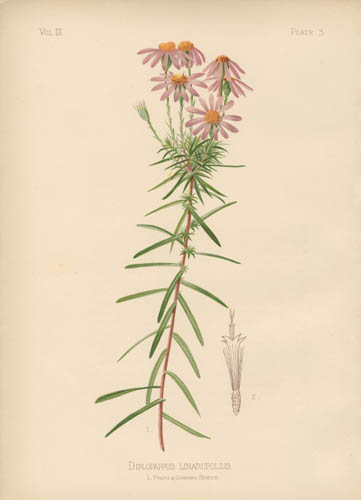
Just south of the lighthouse near the bank on a steep hillside, the savory-leaved aster (Diplopappus linariifolius) and mouse-ear (Gnaphalium plantaginifolium) form a dense sward, being short and thick; the aster not yet out.

Scarlet pimpernel, or poor-man’s weather glass (Anagallis arvensis), in bloom some time, very common on sandy fields and sands, and very pretty, with a peculiar scarlet.

H. D. Thoreau, Journal, July 7, 1855


Just south of the lighthouse near the bank on a steep hillside, the savory-leaved aster (Diplopappus linariifolius) . . . not yet out. See 
July 28, 1853 ("Aster linariifolius."); July 29, 1852 ("That common rigid narrow-leaved faint-purplish aster in dry woods by shrub oak path , Aster linariifolius of Bigelow, but it is not savory leaved. I do not find it in Gray."); August 3, 1858 ("Savory-leaved aster.");  August 4, 1851 ("a bluish 'savory-leaved aster.'"); August 16, 1856 (" Diplopappus linariifolius, apparently several days."); September 10, 1854 ("Diplopappus linariifolius and Aster undulatus apparently now in prime."); August 22, 1859 ("The savory-leaved aster (Diplopappus linariifolius) out; how long?"); September 18, 1856 ("Diplopappus linariifolius in prime.");  September 29,1853 ("Diplopappus linariifolius, Aster undulatus, and a few small ones"); September 30, 1852 ("We then took the path to Clematis Brook on the north of Mt. Misery, where we found a few of the Diplopappus linariifolius ( savory-leaved aster ) and one or two small white (bushy ?) asters, also A. undulatus"); October 10, 1858 ("Pulling up some Diplopappus linariifolius, now done, I find many bright-purple shoots, a half to three quarters of an inch long, freshly put forth underground and ready to turn upward and form new plants in the spring."); October 12, 1858 ("With man all is uncertainty. He does not confidently look forward to another spring. But examine the root of the  savory-leaved aster, and you will find the new shoots, fair purple shoots, which are to curve upward and bear the next year’s flowers, already grown half an inch or more in earth. Nature is confident.");  October 16, 1859 ("Many Diplopappus linariifolius are gone to seed, and yellowish globes."); November 7, 1858 ("The Diplopappus linariifolius, which was yellow in the shade, in open and sunny places is purple."); December 26, 1855 (“Weeds in the fields and the wood-paths are the most interesting. Here are asters, savory-leaved, whose flat imbricated calyxes, three quarters of an inch over, are surmounted and inclosed in a perfectly transparent icebutton, like a glass knob, through which you see the reflections of the brown calyx.”)


Sandpaper Star-Wort, or Diplopappus Linariifolius


Ionactis linariifolia
—Flax-leaved stiff-aster  -- Stiff-leafed Aster, Sandpaper Aster or Sandpaper Starwort (previously classified as Aster linariifolius and 
Diplopappus linariifolius) 

South of the lighthouse 
the savory-leaved aster
on a steep hillside.

 A Book of the Seasons, by Henry Thoreau
"A book, each page written in its own season,
out-of-doors, in its own locality."
~edited, assembled and rewritten by zphx ©  2009-2025

https://tinyurl.com/hdt-18550707

Popular Posts Last 30 Days.

The week ahead in Henry’s journal

The week ahead in Henry’s journal
A journal, a book that shall contain a record of all your joy.
"A stone fruit. Each one yields me a thought." ~ H. D. Thoreau, March 28, 1859


I sit on this rock
wrestling with the melody
that possesses me.