Showing posts with label sugar maples. Show all posts

Friday, September 24, 2021

One milkweed with faith in its seeds.


September 24

Returning over the causeway from Flint's Pond the other evening (22d ), just at sunset, I observed that while the west was of a bright golden color under a bank of clouds, — the sun just setting, — and not a tinge of red was yet visible there, there was a distinct purple tinge in the nearer atmosphere, so that Annursnack Hill, seen through it, had an exceedingly rich empurpled look.

It is rare that we perceive this purple tint in the air, telling of the juice of the wild grape and poke-berries. The empurpled hills! Methinks I have only noticed this in cooler weather.

Last night was exceedingly dark. I could not see the sidewalk in the street, but only felt it with my feet. I was obliged to whistle to warn travellers of my nearness, and then I would suddenly find myself abreast of them without having seen anything or heard their footsteps.

It was cloudy and rainy weather combined with the absence of the moon. So dark a night that, if a farmer who had come in a-shopping had spent but an hour after sunset in some shop, he might find himself a prisoner in the village for the night.

Thick darkness.

8 A. M. — To Lee's Bridge via Conantum.

It is a cool and windy morning, and I have donned a thick coat for a walk.

The wind is from the north, so that the telegraph harp does not sound where I cross.

This windy autumnal weather is very exciting and bracing, clear and cold, after the rain of yesterday, it having cleared off in the night.

I see a small hawk, a pigeon (?) hawk, over the Depot Field, which can hardly fly against the wind.

At Hubbard's Grove the wind roars loudly in the woods.

Grapes are ripe and already shrivelled by frost; barberries also.

It is cattle show day at Lowell.

Yesterday's wind and rain has strewn the ground with leaves, especially under the apple trees. Rain coming after frost seems to loosen the hold of the leaves, making them rot off.

Saw a woodchuck disappearing in his hole.

The river washes up-stream before the wind, with white streaks of foam on its dark surface, diagonally to its course, showing the direction of the wind. Its surface, reflecting the sun, is dazzlingly bright.

The outlines of the hills are remarkably distinct and firm, and their surfaces bare and hard, not clothed with a thick air.

I notice one red tree, a red maple, against the green woodside in Conant's meadow. It is a far brighter red than the blossoms of any tree in summer and more conspicuous.

The huckleberry bushes on Conantum are all turned red.


September 24, 2021

What can be handsomer for a picture than our river scenery now? Take this view from the first Conantum Cliff:
  • First this smoothly shorn meadow on the west side of the stream, with all the swaths distinct, sprinkled with apple trees casting heavy shadows black as ink, such as can be seen only in this clear air, this strong light, one cow wandering restlessly about in it and lowing; 
  • then the blue river, scarcely darker than and not to be distinguished from the sky, its waves driven southward, or up-stream, by the wind, making it appear to flow that way, bordered by willows and button-bushes; 
  • then the narrow meadow beyond, with varied lights and shades from its waving grass, which for some reason has not been cut this year, though so dry, now at length each grass-blade bending south before the wintry blast, as if bending for aid in that direction; 
  • then the hill rising sixty feet to a terrace-like plain covered with shrub oaks, maples, etc., now variously tinted, clad all in a livery of gay colors, every bush a feather in its cap; and
  •  further in the rear the wood crowned Cliff some two hundred feet high, where gray rocks here and there project from amidst the bushes, with its orchard on the slope; 
  • and to the right of the Cliff the distant Lincoln hills in the horizon.
The landscape so handsomely colored, the air so clear and wholesome; and the surface of the earth is so pleasingly varied, that it seems rarely fitted for the abode of man.


In Cohush Swamp the sumach leaves have turned a very deep red, but have not lost their fragrance. I notice wild apples growing luxuriantly in the midst of the swamp, rising red over the colored, painted leaves of the sumach, and reminding me that they were ripened and colored by the same influences, some green, some yellow, some red, like the leaves.

Fell in with a man whose breath smelled of spirit which he had drunk. How could I but feel that it was his own spirit that I smelt? 

Behind Miles's, Darius Miles's, that was, I asked an Irishman how many potatoes he could dig in a day, wishing to know how well they yielded. “Well, I don't keep any account,” he answered; “I scratch away, and let the day's work praise itself.” Aye, there's the difference between the Irish man and the Yankee; the Yankee keeps an account. The simple honesty of the Irish pleases me.

A sparrow hawk, hardly so big as a nighthawk, flew over high above my head, –
 a pretty little graceful fellow, too small and delicate to be rapacious.

Found a grove of young sugar maples (Acer saccharinum ) behind what was Miles's. How silently and yet startlingly the existence of these sugar maples was revealed to me, which I had not thought grew in my immediate neighborhood, — when first I perceived the entire edges of its leaves and their obtuse sinuses.

Such near hills as Nobscot and Nashoba have lost all their azure in this clear air and plainly belong to earth. Give me clearness nevertheless, though my heavens be moved further off to pay for it.

I perceive from the hill behind Lee's that much of the river meadows is not cut, though they have been very dry. The sun-sparkle on the river is dazzlingly bright in this atmosphere, as it has not been, perchance, for many a month.

It is so cold I am glad to sit behind the wall.

Still the great bidens blooms by the causeway side beyond the bridge.


At Clematis Brook I perceive that the pods or follicles of the Asclepias Syriaca now point upward. Did they before all point down? Have they turned up? They are already bursting.

I release some seeds with the long, fine silk attached. The fine threads fly apart at once, open with a spring, and then ray themselves out into a hemispherical form, each thread freeing itself from its neighbor and all reflecting prismatic or rainbow tints. The seeds, besides, are furnished with wings, which plainly keep them steady and prevent their whirling round. I let one go, and it rises slowly and uncertainly at first, now driven this way, then that, by currents which I cannot perceive, and I fear it will make shipwreck against the neighboring wood; but no, as it approaches it, it surely rises above it, and then, feeling the strong north wind, it is borne off rapidly in the opposite direction, ever rising higher and higher and tossing and heaved about with every fluctuation of the air, till, at a hundred feet above the earth and fifty rods off, steering south, I lose sight of it.

How many myriads go sailing away at this season, high over hill and meadow and river, on various tacks until the wind lulls, to plant their race in new localities, who can tell how many miles distant! And for this end these silken streamers have been perfecting all summer, snugly packed in this light chest,
— a perfect adaptation to this end, a prophecy not only of the fall but of future springs.

Who could believe in prophecies of Daniel or of Miller that the world would end this summer, while one milkweed with faith matured its seeds?


On Mt. Misery some very rich yellow leaves — clear yellow — of the Populus grandidentata, which still love to wag, and tremble in my hands. Also canoe birches there.

The river and pond from the side of the sun look comparatively dark.

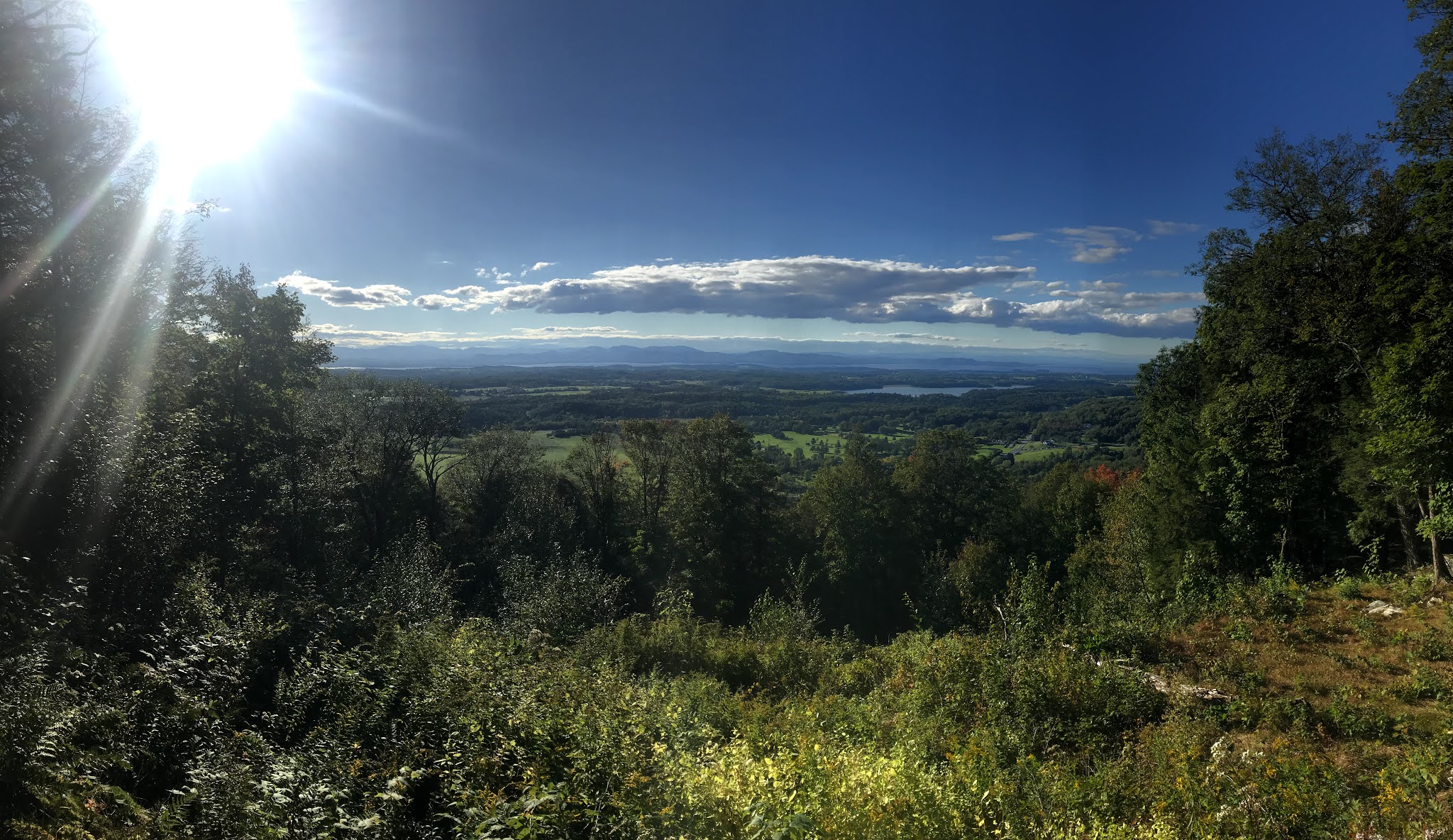
As I look over the country westward and northwestward, the prospect looks already bleak and wintry. The surface of the earth between the forests is no longer green, but russet and hoary. You see distinctly eight or ten miles the russet earth and even houses, and then its outline is distinctly traced against the further blue mountains, thirty or thirty-five miles distant. You see distinctly perhaps to the height of land between the Nashua and Concord, and then the convexity of the earth conceals the further hills, though high, and your vision leaps a broad valley at once to the mountains.

Get home at noon.

At sundown the wind has all gone down.

H. D. Thoreau, Journal, September 24, 1851


 I observed that while the west was of a bright golden color under a bank of clouds, — the sun just setting, — and not a tinge of red was yet visible there, there was a distinct purple tinge in the nearer atmosphere, so that Annursnack Hill, seen through it, had an exceedingly rich empurpled look. See October 19, 1858 ("The sun just ready to set, I notice that its light on my note-book is quite rosy or purple")

Last night was exceedingly dark. I could not see the sidewalk in the street, but only felt it with my feet. I was obliged to whistle to warn travellers of my nearness. See September 12, 1860 ("A dark and stormy night . . . Where the fence is not painted white I can see nothing, and go whistling for fear I run against some one. . . .You walk with your hands out to feel the fences and trees"); September 18, 1857 ("It was exceedingly dark. I met two persons within a mile, and they were obliged to call out from a rod distant lest we should run against each other. ")

I notice one red tree, a red maple, against the green woodside in Conant's meadow. See September 24, 1855 ("the maples are but just beginning to blush") See also September 25, 1857 ("The whole tree, thus ripening in advance of its fellows, attains a singular preéminence"); September 25, 1857 ("The red maple has fairly begun to blush in some places by the river. I see one, by the canal behind Barrett’s mill, all aglow against the sun."); September 25, 1857 ("A single tree becomes the crowning beauty of some meadowy vale and attracts the attention of the traveller from afar."); September 26, 1854 ("Some single red maples are very splendid now, the whole tree bright-scarlet against the cold green pines; now, when very few trees are changed, a most remarkable object in the landscape; seen a mile off."); September 27, 1855 ("Some single red maples now fairly make a show along the meadow. I see a blaze of red reflected from the troubled water."

At Clematis Brook I perceive that the pods or follicles of the Asclepias Syriaca now point upward. Did they before all point down? Have they turned up? See August 24, 1851 ("The pods of the Asclepias pulchra stand up pointedly like slender vases on a salver, an open salver truly! Those of the Asclepias Syriaca hang down.")

The fine threads fly apart at once, open with a spring, and then ray themselves out into a hemispherical form, each thread freeing itself from its neighbor. . . .a prophecy not only of the fall but of future springs. See September 10, 1860 ("If you sit at an open attic window almost anywhere, about the 20th of September, you will see many a milkweed down go sailing by on a level with you, though commonly it has lost its freight, — notwithstanding that you may not know of any of these plants growing in your neighborhood."); October 23, 1852 ("The milkweed (Syriaca) now rapidly discounting. The lanceolate pods having opened, the seeds spring out on the least jar, or when dried by the sun, and form a little fluctuating white silky mass or tuft, each held by the extremities of the fine threads, until a stronger puff of wind sets them free. It is a pleasant sight to see it dispersing its seeds")

The further blue mountains, thirty or thirty-five miles distant. See June 3, 1850 ("The landscape is a vast amphitheatre rising to its rim in the horizon."); September 12, 1851 ("It is worth the while to see the mountains in the horizon once a day"); August 2, 1852 ("In many moods it is cheering to look across hence to that blue rim of the earth,"); March 31, 1853 ("It is affecting to see a distant mountain-top,. . . still as blue and ethereal to your eyes as is your memory of it.'); September 27, 1853 ("From our native hills we look out easily to the far blue mountains, which seem to preside over them.");October 22, 1857 ("But what a perfect crescent of mountains we have in our northwest horizon! Do we ever give thanks for it? "); November 22, 1860 ("Simply to see to a distant horizon through a clear air, - the fine outline of a distant hill or a blue mountaintop through some new vista, - this is wealth enough for one afternoon.")

Saturday, May 16, 2020

This the first really warm day and thunder-shower.


E. Hoar saw the henbit (Lamium amplexi caule) a week ago from Mr. Pritchard’s garden. 

Celandine is out a day or more, and rhodora, trillium, and yellow violets yesterday at least. 

Horse-chestnut to-day. 

What handsome long yellow, threadlike peduncles to the staminate flowers of the sugar maple! three inches long, tassel-like, appearing with the leaves. 

A man is about town with a wagon-load of the Rhododendron maximum this evening from Gardiner, Maine. It is well budded; buds nearly an inch long; long, narrow, thick leaves, six inches long or more. He says it means the “rose of Dendrum" and will grow from a mere slip cut off and stuck in any soil, — only water it three times a day!!! No doubt of it. 

It has been oppressively warm to-day, the first really warm, sultry-like weather, so that we were prepared for a thunder-storm at evening. 

At 5 P. M., dark, heavy, wet-looking clouds are seen in the northern horizon, perhaps over the Merrimack Valley, and we say it is going down the river and we shall not get a drop. The main body goes by, there is a shower in the north, and the western sky is suffused with yellow where its thin skirts are withdrawing. 

People stand at their doors in the warm evening, listening to the muttering of distant thunder and watching the forked lightning, now descending to the earth, now ascending to the clouds. This the first really warm day and thunder-shower. 

Had thunder-shower while I was in Haverhill in April.

Nature’appears to have passed a crisis. All slimy reptile life is wide awake. The sprayey dream of the toad has a new sound; from the meadow the hylodes are heard more distinctly; and the tree-toad chirrups often from the elms (?). The sultry warmth and moister air has called him into life. 

We smell the fresher and cooler air from where the storm has passed. 

And now that it has grown dark, the skirts of the cloud seem to promise us a shower. It lightens incessantly right in the west; the right wing of the rear guard of the storm is steadily advancing and firing, and every flash shows the outlines of the cloud. 

We look out into the dark, and ever and anon comes a sudden illumination blinding our eyes, like a vast glow-worm, succeeded ere long by the roll of thunder. 

The first pattering of drops is heard; all west windows are hastily shut. The weak-eyed sit with their backs to windows and close the blinds. 

But we are disappointed, after all, and each flash reveals a narrow strip of evening red through the thin drops below the advancing cloud.

H. D. Thoreau, Journal, May 16, 1853

A man is about town with a wagon-load of the Rhododendron maximum. See June 4, 1853 ("I noticed next day one or more in every front yard on each side of the street, and the inhabitants out watering them. Said to be the most splendid native flower in Massachusetts . . . I hear to-day that one in town has blossomed.")

Yellow violets yesterday at least.  See May 11, 1860 ("Yellow violet, almost; say to-morrow."); May 18, 1856 ("E. Emerson finds half a dozen yellow violets."); May 25, 1852 ("The large yellow woods violet (V. pubescens) by this brook now out"); 

It is going down the river and we shall not get a drop. See June 15, 1860 (“A thunder-shower in the north goes down the Merrimack.”)

This the first really warm day and thunder-shower.   See  April 13, 1858 ("See through the dark rain the first flash of lightning, in the west horizon, doubting if it was not a flash of my eye at first, but after a very long interval I hear the low rumbling of the first thunder, and now the summer is baptized and inaugurated in due form."); May 9, 1859 ("The first thunder this afternoon."); May 10, 1857 ("Before night a sudden shower with some thunder and lightning; the first.”); May 11, 1854 (“ I feel the air cooled and hear the muttering of distant thunder in the northwest and see a dark cloud in that direction indistinctly through the wood. That distant thunder-shower very much cools our atmosphere. I make haste through the woods homeward ...It is surprising what an electrifying effect this shower appears to have had. It is like the christening of the summer.”); May 12, 1858 (“I see now, as I go forth on the river, the first summer shower coming up in the northwest, a dark and well defined cloud with rain falling sheaf-like from it, . . .The thunder-cloud is like the ovary of a perfect flower. . . .. It is not commonly till thus late in the season that the fertile are seen. In the thunder-cloud, so distinct and condensed, there is a positive energy, and I notice the first as the bursting of the pollen-cells in the flower of the sky.”); May 20, 1856 ("Was awaked and put into sounder sleep than ever early this morning by the distant crashing of thunder, and now ... I hear it in mid-afternoon, muttering, crashing in the muggy air in mid-heaven,... like the tumbling down of piles of boards, and get a few sprinkles in the sun. Nature has found her hoarse summer voice again.."); May 29, 1857 ("a first regular summer thunder-shower, preceded by a rush of wind,")

Friday, May 1, 2020

The sugar maple keys (or buds?) hang down one inch.


May 1. 

May 1, 2020

Plant potatoes; the very midst of early potato planting.

I now, as usual, turn up numerous yellow dor-bugs, which are as yet a very pale yellow, not having been exposed to the light. Also those great white potato worms. 

The sugar maple keys (or buds?) hang down one inch, quite. 

Ed. Emerson's snails (the simplest kind) spawned March 28. I see young now as big as the head of a pin. The stones in his aquarium are covered with very minute green polypuses, some of them budded. We The incipient ones are like a fine forest. You can only see them against a strong light. 

H. D Thoreau, Journal, May 1, 1860


I now, as usual, turn up numerous yellow dor-bugs. See April 6, 1857 ("Areoda lanigera is apparently the common yellow dor-bug.")

Also those great white potato worms. See May 5, 1857 ("Have dug up in the garden this season half a dozen of those great leather-colored pupae (with the tongue-case bent round to breast like a long urn-handle) of the sphinx moth. First potato-worm.")

The sugar maple keys (or buds?) hang down one inch, quite. See May 6, 1860 ("Maple keys an inch and a half long."); May 10, 1852 ("Are those the young keys of sugar maples that I see?"); June 2, 1856 ("White maple keys conspicuous.”)

Wednesday, October 23, 2019

I cannot excuse myself for using the stone.

October 23

P. M. — To Saw Mill Brook. 

The streets are strewn with buttonwood leaves, which rustle under your feet, and the children are busy raking them into heaps, some for bonfires. 

The large elms are bare; not yet the buttonwoods. 

The sugar maples on the Common stand dense masses of rich yellow leaves with a deep scarlet blush,—far more than blush. They are remarkably brilliant this year on the exposed surfaces. The last are as handsome as any trees in the street. 

I am struck with the handsome form and clear, though very pale, say lemon, yellow of the black birch leaves on sprouts in the woods, finely serrate and distinctly plaited from the midrib. 

I plucked three leaves from the end of a red maple shoot, an underwood, each successively smaller than the last, the brightest and clearest scarlet that I ever saw. These and the birch attracted universal admiration when laid on a sheet of white paper and passed round the supper table, and several inquired particularly where I found them. I never saw such colors painted. They were without spot; ripe leaves.

The small willows two or three feet high by the road side in woods have some rich, deep chrome-yellow leaves with a gloss. The sprouts are later to ripen and richer-colored. 

The pale whitish leaves (I horehound in damp grassy paths, with its spicy fruit in the axils, are tinged with purple or lake more or less. - 

Going through what was E. Hosmer’s muck-hole pond, now almost entirely dry, the surface towards the shore is covered with a dry crust more or less cracked, which crackles under my feet. I strip it up like bark in long pieces, three quarters of an inch thick and a foot wide and two long. It appears to be composed of fine mosses and perhaps utricularia and the like, such as grow in water. A little sphagnum is quite conspicuous, erect but dry, in it. 

Now is the time for chestnuts. A stone cast against the trees shakes them down in showers upon one’s head and shoulders. 

But I cannot excuse myself for using the stone. It is not innocent, it is not just, so to maltreat the tree that feeds us. I am not disturbed by considering that if I thus shorten its life I shall not enjoy its fruit so long, but am prompted to a more innocent course by motives purely of humanity. I sympathize with the tree, yet I heaved a big stone against the trunks like a robber,—not too good to commit murder. I trust that I shall never do it again.

These gifts should be accepted, not merely with gentleness, but with a certain humble gratitude. The tree whose fruit we would obtain should not be too rudely shaken even. It is not a time of distress, when a little haste and violence even might be pardoned. It is worse than boorish, it is criminal to inflict an unnecessary injury on the tree that feeds or shadows us. 

Old trees are our parents, and our parents’ parents, perchance. If you would learn the secrets of Nature, you must practice more humanity than others. The thought that I was robbing myself by injuring the tree did not occur to me, but I was affected as if I had cast a rock at a sentient being, — with a duller sense than my own, it is true, but yet a distant relation. 

Behold a man cutting down a tree to come at the fruit! What is the moral of such an act? 

Faded white ferns now at Saw Mill Brook. They press yellow or straw-color.

Ah! we begin old men in crime. Would that we might grow innocent at last as the children of light! 

A downy woodpecker on an apple tree utters a sharp, shrill, rapid tea te t, t, t, t t t t t.

Is that tall weed in Mrs. Brooks’s yard Cacalia suaveolens?? Yet stem more angled than grooved; four or five feet high. Some time ago. 

Cousin Charles writes that his horse drew 5286 pounds up the hill from Hale’s factory, at Cattle-Show in Haverhill the other day.

H. D. Thorerau, Journal,  October 23, 1855

Now is the time for chestnuts. A stone cast against the trees shakes them down in showers upon one’s head and shoulders. See  October 11, 1852 ("The jays scream, and the red squirrels scold, while you are clubbing and shaking the trees."); October 22, 1857 ("Chestnut trees are almost bare. Now is just the time for chestnuts.");   October 24, 1857 ("I hear the dull thump of heavy stones against the trees from far through the rustling wood, where boys are ranging for nuts.")

A downy woodpecker on an apple tree utters a sharp, shrill, rapid tea te t, t, t, t t t t t. See October 23, 1853 ("I see a downy woodpecker tapping an apple tree, and hear, when I have passed, his sharp, metallic note."); December 5, 1853 ("See and hear a downy woodpecker on an apple tree. Have not many winter birds, like this and the chickadee, a sharp note like tinkling glass or icicles?") See also A Book of the Seasons, by Henry Thoreau, The Downy Woodpecker

Friday, May 10, 2019

For some reason I now remember the autumn

May 10

This Monday the streets are full of cattle being driven up-country, — cows and calves and colts. 

The rain is making the grass grow apace. It appears to stand upright, — its blades, — and you can almost see it grow.

For some reason I now remember the autumn, — the succory and the goldenrod. We remember autumn to best advantage in the spring; the finest aroma of it reaches us then. 

Are those the young keys of sugar maples that I see? 

The Canada (?) (N. Brooks's) plum in bloom, and a cherry tree. 

How closely the flower follows upon, if it does not precede, the leaf! The leaves are but calyx and escort to the flower. 

Some beds of clover wave. 

Some look out only for the main chance, and do not regard appearances nor manners; others — others regard these mainly. It is an immense difference. I feel it frequently. It is a theme I must dwell upon. 

There is an aurora borealis to-night, and I hear a snoring, praying sound from frogs in the river, baser and less ringing and sonorous than the dreamers.

H. D. Thoreau, Journal, May 10, 1852

The streets are full of cattle being driven up-country, See April 30, 1860 ("Cattle begin to go up-country."); May 4, 1853 ("Cattle are going up country."); May 6, 1855 ("Road full of cattle going up country.”); May 7, 1856 ("For a week the road has been full of cattle going up country. "); May 8, 1854 ("I hear the voices of farmers driving their cows past to their up-country pastures now.");

We remember autumn to best advantage in the spring; the finest aroma of it reaches us then. See May 7, 1852 ("How full of reminiscence is any fragrance!"). Compare July 1, 1856 ("The air filled with a decaying musty scent and the z-ing of small locusts, I hear the distant sound of a flail, and thoughts of autumn occupy my mind, and the memory of past years.") July 19, 1851 ("Yesterday it was spring, and to-morrow it will be autumn. Where is the summer then?"); October 26, 1853 ("It is surprising how any reminiscence of a different season of the year affects us."); 

Are those the young keys of sugar maples that I see? See May 1, 1860 ("The sugar maple keys (or buds?) hang down one inch, quite."); May 29, 1854 (“The white maple keys have begun to fall and float down the stream like the wings of great insects.”)

The Canada (?) (N. Brooks's) plum in bloom, and a cherry tree. See May 10, 1855 ("Canada plum opens petals to-day and leafs. Domestic plum only leafs.”) and note to May 10, 1856 ("Mr. Prichard’s Canada plum will open as soon as it is fair weather. "); May 10, 1857 ("Cultivated cherry out. "); May 10, 1858 ("The northern wild red cherry by Everett's, apparently to-morrow.")

How closely the flower follows upon, if it does not precede, the leaf! See April 28, 1852 ("The spring flowers wait not to perfect their leaves before they expand their blossoms. The blossom in so many cases precedes the leaf; so with poetry? They flash out.") 

I hear a snoring, praying sound from frogs in the river, baser and less ringing and sonorous than the dreamers. See May 25, 1851 (“Now, at 8.30 o'clock P.M., I hear the dreaming of the frogs.”); June 13, 1851 ("The different frogs mark the seasons pretty well,- the peeping hyla, the dreaming frog, and the bullfrog." Also April 3, 1858 (“Sometimes the meadow will be almost still; then they will begin in earnest, and plainly excite one an other into a general snoring or eructation over a quarter of a mile of meadow.”); April 11, 1854 (“Hear a slight snoring of frogs on the bared meadows. Is it not the R. palustris? ”); April 15, 1855 ("That general tut tut tut tut, or snoring, of frogs on the shallow meadow heard first slightly the 5th.."); May 8, 1857 ("It is an evening for the soft-snoring, purring frogs (which I suspect to be Rana palustris)."); May 6, 1858 ("About 9 P. M. I went to the edge of the river to hear the frogs. It was a warm and moist, rather foggy evening, and the air full of the ring of the toad, the peep of the hylodes, and the low growling croak or stertoration of the Rana palustris. . . . There was a universal snoring of the R. palustris all up and down the river on each side, . . . It is a hard, dry, unmusical, fine watchman’s-rattle-like stertoration, swelling to a speedy conclusion.”)

May 10.  See A Book of the Seasons, by Henry Thoreau, May 10

A Book of the Seasons,  by Henry Thoreau
"A book, each page written in its own season,
out-of-doors, in its own locality."
 ~edited, assembled and rewritten by zphx ©  2009-2021

Friday, October 26, 2018

The scarlet oak generally is not in prime till now, or even later.

October 26. 

The sugar maples are about bare, except a few small ones. 


October 26, 2018
Minott remembers how he used to chop beech wood. He says that when frozen it is hard and brittle just like glass, and you must look out for the chips, for, if they strike you in the face, they will cut like a knife.

He says that some call the stake-driver “'belcher squelcher,” and some, “wollerkertoot. ” I used to call them “pump-er-gor’. ” Some say “slug-toot. ” 

The largest scarlet oak that I remember hereabouts stands by the penthorum pool in the Sleepy Hollow cemetery, and is now in its prime. I found the sap was flowing fast in it. White birches, elms, chestnuts, Salix alba (small willows), and white maple are a long time falling. The scarlet oak generally is not in prime till now, or even later. 

I wear a thicker coat, my single thick fall coat, at last, and begin to feel my fingers cool early and late. One shopkeeper has hung out woollen gloves and even thick buckskin mittens by his door, foreseeing what his customers will want as soon as it is finger-cold, and determined to get the start of his fellows.

H. D. Thoreau, Journal, October 26, 1858

The sugar maples are about bare, except a few small ones. See October 24, 1853 ("Red maples and elms alone very conspicuously bare in our landscape"); October 25, 1853 ("The white maples are completely bare. ");October 25, 1855 ("The willows along the river now begin to look faded and somewhat bare and wintry.") October 25, 1858 ("I see some alders about bare. Aspens (tremuliformis) generally bare. . . .At the pond the black birches are bare"); October 26, 1854 ("Apple trees are generally bare, as well as bass, ash, elm, maple.")

I used to call them “pump-er-gor’.See April 24, 1854 (" I hear the loud and distinct pump-a-gor of a stake-driver. Thus he announces himself."); and note to April, 25 1858 ("Goodwin says he heard a stake-driver several days ago.")

The scarlet oak generally is not in prime till now, or even later."); October 21, 1855 ("Up Assabet. . . . [T]he scarlet oak is very bright and conspicuous. How finely its leaves are out against the sky with sharp points, especially near the top of the tree! "); October 24, 1858 ("The scarlet oak. . . is now completely scarlet and apparently has been so a few days. This alone of our indigenous deciduous trees . . .is now in its glory. "); October 30, 1855 ("Going to the new cemetery, I see that the scarlet oak leaves have still some brightness; perhaps the latest of the oaks."); November 1, 1858 ("If you wish to count the scarlet oaks. do it now. Stand on a hilltop in the woods, when the sun is an hour high and the sky is clear, and every one within range of your vision will be revealed. ")

The largest scarlet oak that I remember hereabouts stands in the Sleepy Hollow cemetery, and is now in its prime. See December 11, 1858 ("The large scarlet oak in the cemetery has leaves on the lower limbs near the trunk just like the large white oaks now."); January 19, 1859 {"Our largest scarlet oak (by the Hollow), some three feet diameter at three feet from ground, has more leaves than the large white oak close by."); March 22, 1859 ("The great scarlet oak has now lost almost every leaf, while the white oak near it still retains them.")

I wear a thicker coat, my single thick fall coat, at last, and begin to feel my fingers cool early and late.
See October 25, 1858 ("This is the coolest day thus far, reminding me that I have only a half-thick coat on. ")

One shopkeeper has hung out woollen gloves and even thick buckskin mittens See October 14, 1856 (“[F]inger-cold to-day. Your hands instinctively find their way to your pockets”); October 20, 1859 (“It is finger-cold as I come home, and my hands find their way to my pocket.”); November 11, 1851 (”A bright, but cold day, finger-cold. One must next wear gloves, put his hands in winter quarters.”); November 11, 1853 ("I wear mittens now.")


October 26.
 See A Book of the Seasons, by Henry Thoreau, October 26 and A Book of the Seasons, by Henry Thoreau, The seasons and all their changes are in me.

Sunday, October 21, 2018

The large sugar maples on the Common are in the midst of their fall to-day.

October 21. 

Cooler to-day, yet pleasant. 

October 21, 2018
6 A. M. — Up Assabet. 

Most leaves now on the water. They fell yesterday, — white and red maple, swamp white oak, white birch, black and red oak, hemlock (which has begun to fall), hop-hornbeam, etc., etc. They cover the water thickly, concealing all along the south side for half a rod to a rod in width, and at the rocks, where they are met and stopped by the easterly breeze, form a broad and dense crescent quite across the river. 

On the hilltop, the sun having just risen, I see on my note-book that same rosy or purple light, when contrasted with the shade of another leaf, which I saw on the evening of the 19th, though perhaps I can detect a little purple in the eastern horizon. 

The Populus grandidentata is quite yellow and leafy yet,— the most showy tree thereabouts. 

P. M. — Up Assabet, for a new mast, the old being broken in passing under a bridge. 

Talked with the lame Haynes, the fisherman. He feels sure that they were not “suckers” which I saw rise to the shad-flies, but chivin, and that suckers do not rise to a fly nor leap out. 

He has seen a great many little lamprey eels come down the rivers, about as long as his finger, attached to shad. But never knew the old to come down. Thinks they die attached to roots. Has seen them half dead thus. Says the spawn is quite at the bottom of the heap. Like Witherell, he wonders how the eels increase, since he could never find any spawn in them. 

The large sugar maples on the Common are in the midst of their fall to-day. 

H. D.. Thoreau, Journal, October 21, 1858

Up Assabet. Most leaves now on the water. They cover the water thickly See October 12, 1855 ("The leaves fallen last night now lie thick on the water next the shore, concealing it, “); October 15, 1856 ("Large fleets of maple and other leaves are floating on its surface as I go up the Assabet. . ."); October 17, 1856 ("Countless leafy skiffs are floating on pools and lakes and rivers and in the swamps and meadows, often concealing the water quite from foot and eye."); October 17, 1857("The swamp floor is covered with red maple leaves, many yellow with bright-scarlet spots or streaks. Small brooks are almost concealed by them”) ; October 17, 1858 (" Up Assabet. There are many crisped but colored leaves resting on the smooth surface of the Assabet,”); October 19, 1853 ("The leaves have fallen so plentifully that they quite conceal the water along the shore, and rustle pleasantly when the wave which the boat creates strikes them.”)


The Populus grandidentata is quite yellow and leafy yet. See October 16, 1857 (“The large poplar (P. grandidentata) is now at the height of its change, – clear yellow, but many leaves have fallen.”); Also October 18, 1853 (“clear, rich yellow.”); October 25, 1858 (“The leaves of the Populus grandidentata, though half fallen and turned a pure and handsome yellow, are still wagging as fast as ever. .. . I do not think of any tree whose leaves are so fresh and fair when they fall.”); October 28, 1858 (“Its leaves are large and conspicuous on the ground, and from their freshness make a great show there”); November 22, 1853 ("I was just thinking it would be fine to get a specimen leaf from each changing tree and shrub and plant in autumn, in September and October, when it had got its brightest characteristic color . . . I remember especially the beautiful yellow of the Populus grandidentata...”)


The large sugar maples on the Common are in the midst of their fall to-day. See. October 6, 1858 ("only one of the large maples on the Common is yet on fire. "); October 18, 1856 ("The sugar maples are now in their glory, all aglow with yellow, red, and green.”);  October 18, 1858 ("The large sugar maples on the Common are now at the height of their beauty. “);  October 24, 1855 (“The rich yellow and scarlet leaves of the sugar maple on the Common now thickly cover the grass in great circles about the trees, and, half having fallen, look like the reflection of the trees ")

Thursday, October 18, 2018

The large sugar maples on the Common are now at the height of their beauty

October 18. 

October 18, 2018


P. M. — To Smith’s chestnut grove and Saw Mill Brook. 

The large sugar maples on the Common are now at the height of their beauty. One, the earliest to change, is partly bare. This turned so early and so deep a scarlet that some thought that it was surely going to die. 

Also that one at the head of the Turnpike reveals its character now as far as you can see it. Yet about ten days ago all but one of these was quite green, and I thought they would not acquire any bright tints. A delicate but warmer than golden yellow is the prevailing color, with scarlet cheeks. They are great regular oval masses of yellow and scarlet. All the sunny warmth of the season seems to be absorbed in their leaves. 

There is an auction on the Common, but its red flag is hard to be discerned amid this blaze of color. The lowest and inmost leaves next the bole are of the most delicate yellow and green, as usual, like the complexion of young men brought up in the house.

Little did the fathers of the town anticipate this brilliant success when they caused to be imported from further in the country some straight poles with the tops cut off, which they called sugar maple trees, — and a neighboring merchant’s clerk, as I remember, by way of jest planted beans about them. Yet these which were then jestingly called bean-poles are these days far the most beautiful objects noticeable in our streets. They are worth all and more than they have cost, — though one of the selectmen did take the cold which occasioned his death in setting them out, — if only because they have filled the open eyes of children with their rich color so unstintedly so many autumns. 

We will not ask them to yield us sugar in the spring, while they yield us so fair a prospect in the autumn. Wealth may be the inheritance of few in the houses, but it is equally distributed on the Common. All children alike can revel in this golden harvest. These trees, throughout the street, are at least equal to an annual festival and holiday, or a week of such, — not requiring any special police to keep the peace, — and poor indeed must be that New England village’s October which has not the maple in its streets. 

This October festival costs no powder nor ringing of bells, but every tree is a liberty-pole on which a thousand bright flags are run up. Hundreds of children’s eyes are steadily drinking in this color, and by these teachers even the truants are caught and educated the moment they step abroad. It is as if some cheap and innocent gala-day were celebrated in our town every autumn, — a week or two of such days. 

What meant the fathers by establishing this living institution before the church, —this institution which needs no repairing nor repainting, which is continually “enlarged and repaired” by its growth? Surely trees should be set in our streets with a view to their October splendor. 

Do you not think it will make some odds to these children that they were brought up under the maples?  Indeed, neither the truant nor the studious are at present taught colors in the schools. These are instead of the bright colors in apothecary shops and city windows. It is a pity we have not more red maples and some hickories in the streets as well. Our paint-box is very imperfectly filled. Instead of, or besides, supplying paint-boxes, I would supply these natural colors to the young.

I know of one man at least, called an excellent and peculiarly successful farmer, who has thoroughly repaired his house and built a new barn with a barn cellar, such as every farmer seems fated to have, who has not a single tree or shrub of any kind about his house or within a considerable distance of it. 

No annual training or muster of soldiery, no celebration with its scarfs and banners, could import into the town a hundredth part of the annual splendor of our October. We have only to set the trees, or let them stand, and Nature will find the colored drapery, — flags of all her nations, some of whose private signals hardly the botanist can read. Let us have a good many maples and hickories and scarlet oaks, then, I say. Blaze away! Shall that dirty roll of bunting in the gunhouse be all the colors a village can display? 

A village is not complete unless it has these trees to mark the season in it. They are as important as a town clock. Such a village will not be found to work well. It has a screw loose; an essential part is wanting. Let us have willows for spring, elms for summer, maples and walnuts and tupelos for autumn, evergreens for winter, and oaks for all seasons. 

What is a gallery in a house to a gallery in the streets! I think that there is not a picture gallery in the country which would be worth so much to us as is the western view under the elms of our main street. They are the frame to a picture, and we are not in the dilemma of the Irishman who, having bought a costly gilt picture-frame at an auction, found himself obliged to buy a picture at private sale to put into it, for our picture is already painted with each sunset behind it. 

An avenue of elms as large as our largest, and three miles long, would seem to lead to some admirable place, though only Concord were at the end of it. Such a street as I have described Would be to the traveller, especially in October, an ever-changing panorama. 

A village needs these innocent stimulants of bright and cheery prospects to keep off melancholy and superstition. 

October 18, 2018

Show me two villages, one embowered in trees and blazing with all the glories of October, the other a merely trivial and treeless waste, and I shall be sure that in the latter will be found the most desperate and hardest drinkers. What if we were to take half as much pains in protecting them as we do in setting them out,— not stupidly tie our horses to our dahlia stems? They are cheap preachers, permanently settled, which preach their half-century, and century, aye, and century and a half sermons, with continually increasing influence and unction, ministering to many generations of men, and the least we can do is to supply them with suitable colleagues as they grow infirm.  

Children are now everywhere playing with the brown and withered leaves of elms and buttonwoods, which strew the streets and are collected into heaps in the sluiceways. 

In the woods even the little pea-vine turns a delicate yellow and is more conspicuous than ever, and in the now neglected gardens the asparagus-beds, greenish without, glow yellow within, as if a fire were bursting out there. 

As I go down the Turnpike past Clintonia Swamp, I am struck by the magical change which has taken place in the red maple swamps, which just a fortnight ago were splendid masses of scarlet and yellow and crimson, rising amid the yet green trees, — pines and oaks, etc., —like immense flower-beds on one side of the town, visible for miles, attracting the eyes of all travellers; now, —though a few late ones are bright as ever in some places, — all their splendor gone, wafted away, as it were, by a puff of wind, and they are the mere ghosts of trees, unnoticed by any, or, if noticed at all, like the smoke that is seen where a blaze is extinguished, or as the red clouds at evening change suddenly to gray and black,— so suddenly their glory departs, — desolate gray twigs.

The Salix alba is a light and silvery green. 

Since the red maples generally fell, the chestnuts have been yellowing, and the oaks reddening and yellowing. The chestnuts are now in their prime, though many leaves are fallen. The forest, which showed but little ripeness ten days ago, except about its edges and here and there as you looked down on it from a height, is now seen to be generally of a mellow brownish yellow, like perfectly ripe fruit, which we know to be more perfectly ripe for being a little specked.

By the brook, witch-hazel, as an underwood, is in the height of its change, but elsewhere exposed large bushes are bare. Rhus Toxicodendron is fallen. The hornbeam is a greenish yellow, or yellow as it were dusted with green. The maple-leaved viburnum, now at its height, varies, with more or less of shade, from dark crimson through a delicate pale crimson to whitish. The sage willow, a light yellow, in prime, though hardly noticed amid the more conspicuous oaks. Larches have begun to change in water. 

As I come through Hubbard’s Woods I see the wintergreen, conspicuous now above the freshly fallen white pine needles. Their shining green is suddenly revealed above the pale-brown ground. I hail its cool unwithering green, one of the humbler allies by whose aid we are to face the winter. 

Saw, October 14th, a snake at Ball’s Hill, like a striped snake, but apparently yellow-spotted above and with a flatter head? 

Noticed a little snake, eight or nine inches long, in the rut in the road in the Lincoln woods. It was brown above with a paler-brown dorsal stripe, which was bounded on each side by a row of dark-brown or blackish dots one eighth inch apart, the opposite rows alternating; beneath, light cream-color or yellowish white. Evidently Storer’s Coluber ordinatus. It ran along in the deep sandy rut and would probably be run over there. 

See larks, with their white tail-feathers, fluttering low over the meadows these days. 

Minott was sitting outside, as usual, and inquired if I saw any game in my walks these days; since, now that he cannot go abroad himself, he likes to hear from the woods. He tried to detain me to listen to some of his hunting-stories, especially about a slut that belonged to a neighbor by the name of Billings, which was excellent for squirrels, rabbits, and partridges, and would always follow him when he went out, though Billings was “plaguy mad about it;” however, he had only to go by Billings’s to have the dog accompany him. B. afterward carried her up country and gave her away, the news of which almost broke Minott’s heart. He said he could have cried when he heard of it, for he had dreamed of her several nights. She was a plaguy good dog for squirrels, etc., but her pups were none of them equal to herself. It was not time for squirrels now, because the leaves were not off enough. 

He used sometimes to take his old king’s-arm on these excursions. It was heavy, but it was sure. His present gun has a flint lock and has often been repaired, and he said he did n’t suppose it would fetch more than a dollar if put up at auction now. But he would n’t take twenty dollars for it. He didn’t want to part with it. He liked to look at it. As leaves fall along the river and in the woods, the squirrels and musquash make haste to shelter and conceal themselves by constructing nests and cabins..

H. D. Thoreau, Journal, October 18, 1858

Neither the truant nor the studious are at present taught colors in the schools. Compare September 1, 1856 ("When colors come to be taught in the schools, as they should be, both the prism (or the rainbow) and these fungi should be used by way of illustration, and if the pupil does not learn colors, he may learn fungi, which perhaps is better.")


The large sugar maples on the Common are now at the height of their beauty. See October 6, 1858 ("only one of the large maples on the Common is yet on fire. "); October 18, 1856 ("The sugar maples are now in their glory, all aglow with yellow, red, and green.”); October 21, 1858 (“The large sugar maples on the Common are in the midst of their fall to-day.”); October 24, 1855 ("he rich yellow and scarlet leaves of the sugar maple on the Common now thickly cover the grass in great circles about the trees, and, half having fallen, look like the reflection of the trees ")

I am struck by the magical change which has taken place in the red maple swamps like the smoke that is seen where a blaze is extinguished,, — desolate gray twigs. See October 18, 1853 ("The red maples have been bare a good while. In the sun and this clear air, their bare ashy branches even sparkle like silver."); October 18, 1855 ("The maple swamps, bare of leaves, here and there about the meadow, look like smoke blown along the edge of the woods.");  October 16, 1857 ("The red maples are now fairly bare, ")

By the brook, witch-hazel, as an underwood, is in the height of its change, but elsewhere exposed large bushes are bare.  See October 16, 1857 ("Am surprised to find an abundance of witch-hazel, now at the height of its change,. . .. The tallest bushes are bare, though in bloom, but the lowest are full of leaves, many of them green, but chiefly clear and handsome yellow of various shades, from a pale lemon in the shade or within the bush to a darker and warmer yellow with out. Some are even a hue of crimson; some green, with bright yellow along the veins.")

Noticed a little snake brown above with a paler-brown dorsal stripe. See October 18, 1857 (" Snakes lie out now on sunny banks, amid the dry leaves, now as in spring. They are chiefly striped ones.")

See larks, with their white tail-feathers, fluttering low over the meadows these days. See October 18, 1855 ("I scare up a dozen larks at once. ")

I am struck by the 
magical change taken place 
in red maple swamps

Friday, October 12, 2018

Nature is confident.

October 12. 


October 12, 2018

P. M. — Up Assabet. 

Most exposed button-bushes and black willows are two thirds bare, and the leaves which remain on the former are for the most part brown and shrivelled. The balls stand out bare, ruddy or brown. The coarse grass of the riverside (Phalaris ?) is bleached as white as corn. 

The Cornus sericea begins to fall, though some of it is green; and the C. florida at Island shows some scarlet tints, but it is not much exposed. I believe that this was quite showy at Perth Amboy. 

There are many maple, birch, etc., leaves on the Assabet, in stiller places along the shore, but not yet a leaf harvest. Many swamp white oaks look crisp and brown. 

I land at Pinxter Swamp. The leaves of the azaleas are falling, mostly fallen, and revealing the large blossom-buds, so prepared are they for another year. 

With man all is uncertainty. He does not confidently look forward to another spring. But examine the root of the  savory-leaved aster, and you will find the new shoots, fair purple shoots, which are to curve upward and bear the next year’s flowers, already grown half an inch or more in earth. Nature is confident. 

The river is lower than before this year, or at least since spring, yet not remarkably low, and meadows and pools generally are drier. 

The oak leaves generally are duller than usual this year. I think it must be that they are killed by frost before they are ripe. 

Some small sugar maples are still as fair as ever. You will often see one, large or small, a brilliant and almost uniform scarlet, while another close to it will be perfectly green. 

The Osmunda regalis and some of the small or middle-sized ferns, not evergreens, in and about the swamps, are generally brown and withered, though with green ones intermixed. They are still, however, interesting, with their pale brown or cinnamon-color and decaying scent. 

Hickories are for the most part being rapidly browned and crisp. 

Of the oaks, the white is apparently the most generally red at present. I see a scarlet oak still quite green.

Brakes are fallen in the pastures. They lie flat, still attached to the ground by their stems, and in sandy places they blow about these and describe distinct and perfect circles there. The now fallen dark-brown brake lies on or across the old brake, which fell last year and is quite gray but remarkably conspicuous still. They have fallen in their ranks, as they stood, and lie as it were with a winding-sheet about them. 

Young sweet-fern, where it had been burned in the spring, is quite green. 

Exposed clethra is crisp and brown. 

Some bass trees are quite bare, others but partly. 

The hop hornbeam is in color and falling like the elm. 

Acorns, red and white (especially the first), appear to be fallen or falling. They are so fair and plump and glossy that I love to handle them, and am loath to throw away what I have in my hand. 

I land at Pinxter Swamp. The leaves of the azaleas are falling, mostly fallen, and revealing the large blossom-buds, so prepared are they for another year. 

With man all is uncertainty. He does not confidently look forward to another spring. But examine the root of the savory-leaved aster, and you will find the new shoots, fair purple shoots, which are to curve upward and bear the next year's flowers, already grown half an inch or more in earth. Nature is confident. 

I see a squirrel-nest of leaves, made now before the leaves are fallen. 

I have heard of judges, accidentally met at an evening party, discussing the efficacy of the laws and courts, and deciding that, with the aid of the jury system, “substantial justice was done.” But taking those cases in which honest men refrain from going to law, together with those in which men, honest and dishonest, do go to law, I think that the law is really a “humbug,” and a benefit principally to the lawyers.

This town has made a law recently against cattle going at large, and assigned a penalty of five dollars. I am troubled by an Irish neighbor’s cow and horse, and have threatened to have them put in the pound. But a lawyer tells me that these town laws are hard to put through, there are so many quibbles. He never knew the complainant to get his case if the defendant were a-mind to contend. However, the cattle were kept out several days, till a Sunday came, and then they were all in my grounds again, as I heard, but all my neighbors tell me that I cannot have them impounded on that day. Indeed, I observe that very many of my neighbors do for this reason regularly turn their cattle loose on Sundays. 

The judges may discuss the question of the courts and law over their nuts and raisins, and mumble forth the decision that “substantial justice is done,” but I must believe they mean that they do really get paid a “substantial” salary.

H. D. Thoreau, Journal, October 12, 1858


The large blossom-buds, so prepared are they for another year. See January 10, 1856 ("the great yellow and red forward-looking buds of the azalea")

Examine the root of the savory-leaved aster, and you will find the new shoots, fair purple shoots, which are to curve upward and bear the next year's flowers, already grown half an inch or more in earth.  See October 10, 1858 ("Pulling up some Diplopappus linariifolius, now done, I find many bright-purple shoots, a half to three quarters of an inch long, freshly put forth underground and ready to turn upward and form new plants in the spring.") See also A Book of the Seasons, by Henry Thoreau, Savory-leaved aster

Some bass trees are quite bare. See October 4, 1858 ("The bass is in the prime of its change, a mass of yellow."); October 9, 1853 ("The birch is yellow; the black willow brown; the elms sere, brown, and thin; the bass bare.");    October 13, 1855 ("The maples now stand like smoke along the meadows. The bass is bare"); October 18, 1857 ("The bass and the black ash are completely bare; how long?"); October 19, 1856 ("The bass has lost, apparently, more than half its leaves.")October 22, 1854 ("Bass trees are bare.”) See also A Book of Seasons, by Henry Thoreau, The Basswood

The Osmunda regalis . . . in and about the swamps, are generally brown and withered.  See   October 11, 1857 ("The osmunda ferns are generally withered and brown except where very much protected from frost. ")


OCTOBER 12, 2018


Popular Posts Last 30 Days.

The week ahead in Henry’s journal

The week ahead in Henry’s journal
A journal, a book that shall contain a record of all your joy.
"A stone fruit. Each one yields me a thought." ~ H. D. Thoreau, March 28, 1859


I sit on this rock
wrestling with the melody
that possesses me.